
Calcium Hypochlorite Market Size and Share
Market Overview
| Study Period | 2021 - 2031 |
|---|---|
| Market Size (2026) | USD 0.93 Billion |
| Market Size (2031) | USD 1.19 Billion |
| Growth Rate (2026 - 2031) | 5.23 % |
| Fastest Growing Market | Asia-Pacific |
| Largest Market | Asia-Pacific |
| Market Concentration | Medium |
Major Players *Disclaimer: Major Players sorted in no particular order Image © Mordor Intelligence. Reuse requires attribution under CC BY 4.0. | |
Calcium Hypochlorite Market Analysis by Mordor Intelligence
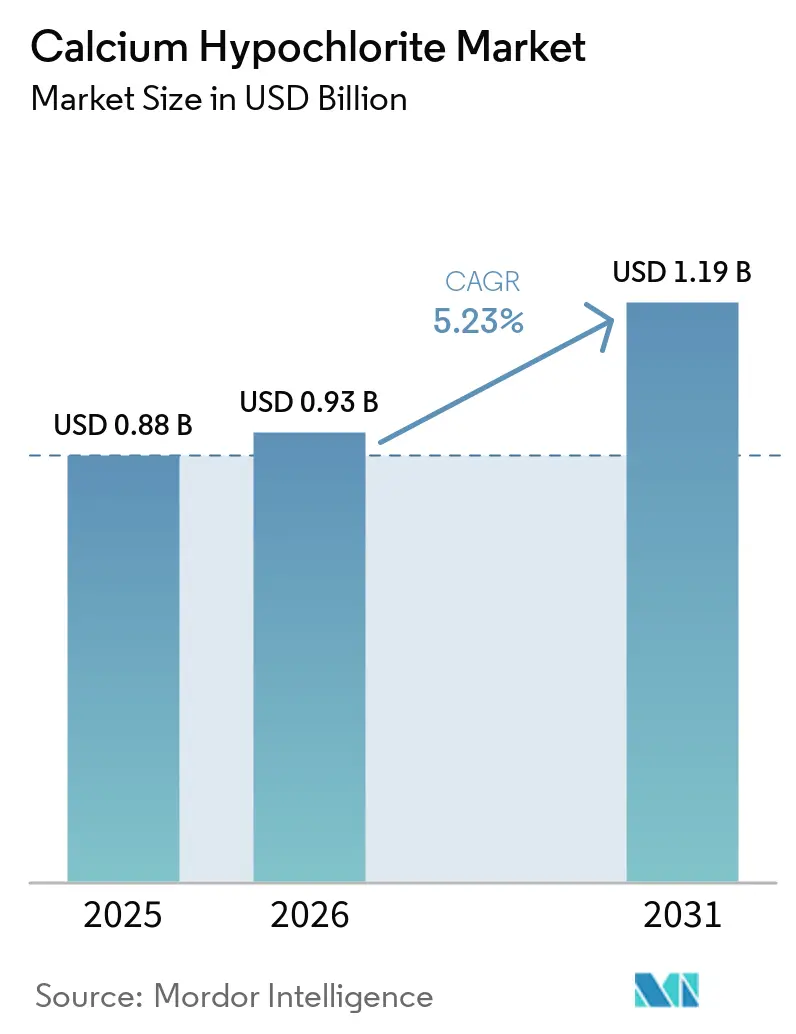
The Calcium Hypochlorite Market size was valued at USD 0.88 billion in 2025 and is estimated to grow from USD 0.93 billion in 2026 to reach USD 1.19 billion by 2031, at a CAGR of 5.23% during the forecast period (2026-2031). The calcium hypochlorite market benefits from the product’s 65% to 70% available chlorine content, which is 4 to 5 times the active chlorine concentration of typical liquid sodium hypochlorite solutions. This supports use where transport weight, dry storage, and shelf stability matter, especially in remote water systems and high-throughput facilities. Municipal water investment, hygiene requirements, and new aquatic facilities continue to support consumption across the calcium hypochlorite market. Producers are also competing through reliable supply, a wider range of product forms, certified dosing systems, and closer distribution coverage. Alternative technologies, disinfection byproduct controls, and storage risks remain important limits on adoption in premium and highly regulated applications.
Key Report Takeaways
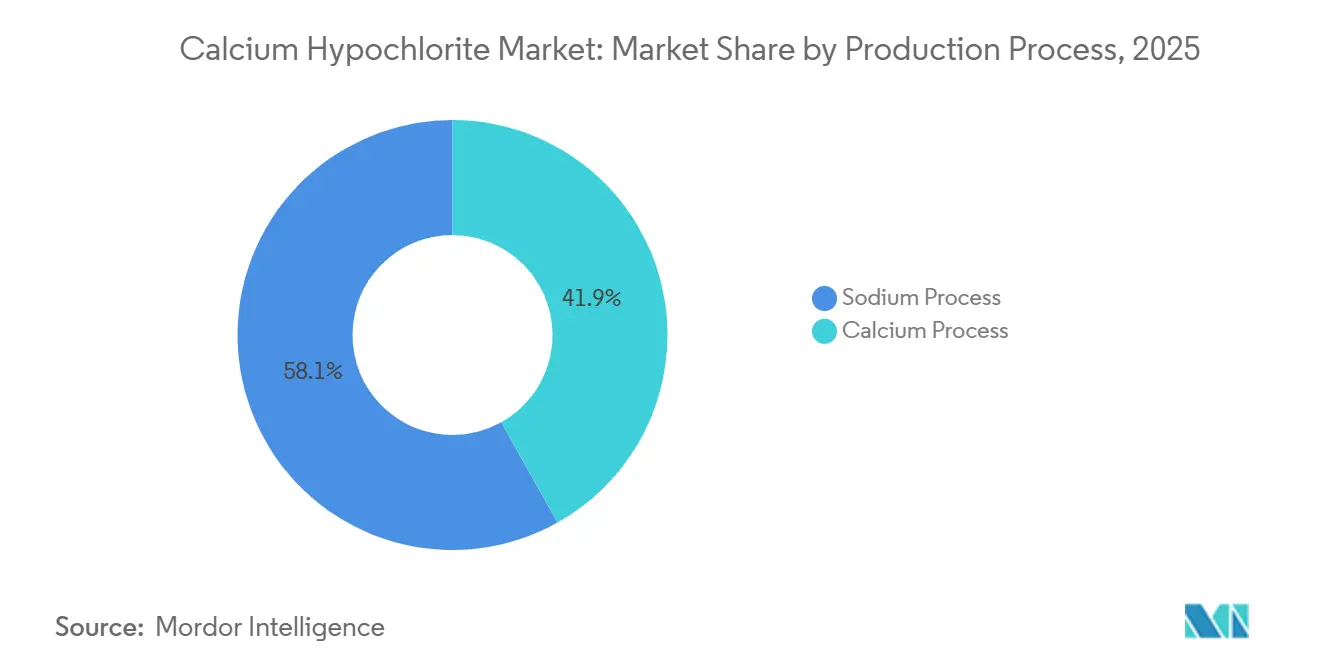
- By production process, the sodium process held 58.12% of the calcium hypochlorite market share in 2025 and is projected to advance at a 5.71% CAGR through 2031.
- By form, powder held 44.23% of the calcium hypochlorite market share in 2025, while granular is projected to advance at a 5.89% CAGR through 2031.
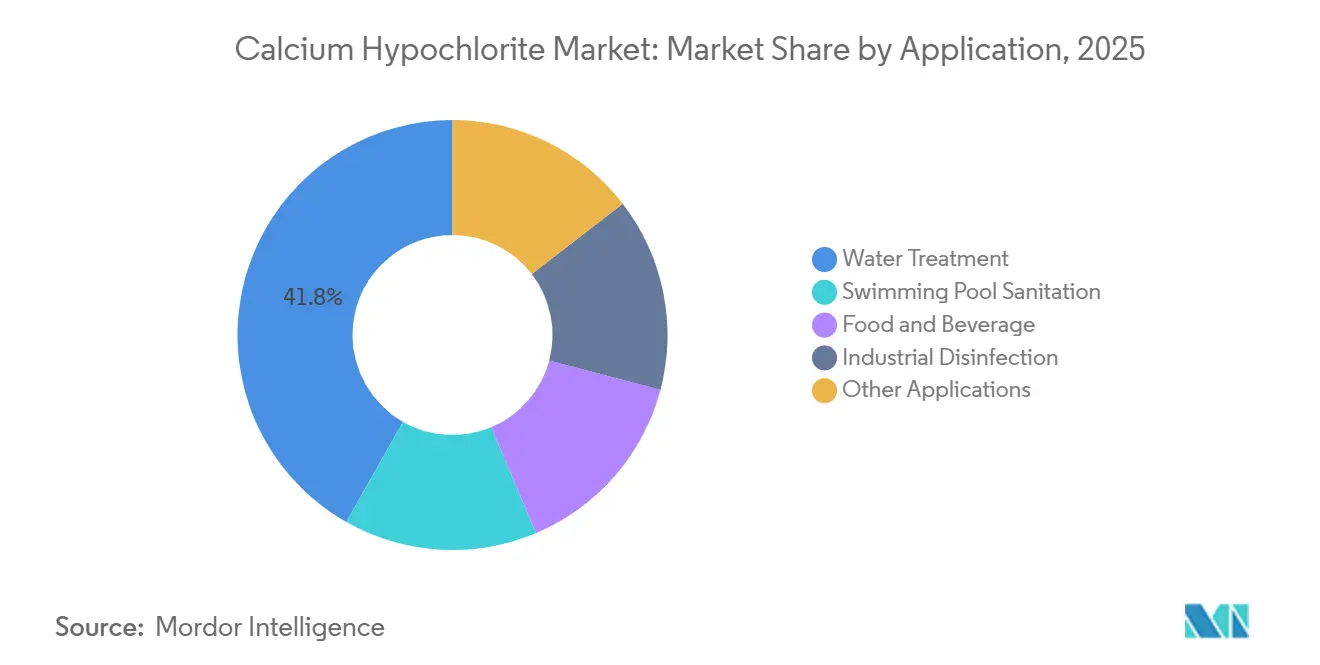
- By application, water treatment held 41.78% of the calcium hypochlorite market share in 2025, while industrial disinfection is projected to advance at a 6.13% CAGR through 2031.
- By geography, Asia-Pacific held 38.41% of the calcium hypochlorite market share in 2025 and is projected to advance at a 5.77% CAGR through 2031.
Note: Market size and forecast figures in this report are generated using Mordor Intelligence’s proprietary estimation framework, updated with the latest available data and insights as of January 2026.
Market Trends and Insights
Drivers Impact Analysis of Calcium Hypochlorite Market*
| Driver | (~) % Impact on CAGR Forecast | Geographic Relevance | Impact Timeline |
|---|---|---|---|
| Expansion of Municipal and Industrial Water Treatment | +2.1% | Global; strongest in Asia-Pacific and Middle East & Africa | Long term (≥ 4 years) |
| Swimming Pool and Aquatic-Facility Sanitation Demand | +1.3% | North America, Europe, China, Japan, Australia | Medium term (2–4 years) |
| Increasing Hygiene Requirements in Food Processing and Manufacturing | +0.8% | Global; strongest in North America and EU | Medium term (2–4 years) |
| Growth of Dry Chlorination in Remote and Small Water Systems | +0.6% | Middle East & Africa, South Asia, rural Asia-Pacific | Medium term (2–4 years) |
| Improved Compatibility with Automated Dosing and Remote Monitoring | +0.4% | North America, Europe, urban Asia-Pacific | Short term (≤ 2 years) |
| Source: Mordor Intelligence | |||
Expansion of Municipal and Industrial Water Treatment
Expansion of municipal and industrial water treatment supports demand because dry chlorination can serve locations where liquid bleach storage is difficult. India’s Jal Jeevan Mission has increased the relevance of products that can be transported and stored without a cold chain. China’s investment in wastewater treatment also supports demand from domestic chlor-alkali supply chains and municipal users. Industrial process-water systems in textiles, paper, and petrochemicals need rapid disinfection dosing, which broadens the calcium hypochlorite market beyond municipal procurement. The World Health Organization’s drinking-water guidance continues to support chlorine-based primary disinfection as a recognized treatment approach for national programs[1]. This regulatory foundation supports purchasing frameworks in developing economies where dependable residual disinfection remains essential.
Swimming Pool and Aquatic-Facility Sanitation Demand
Swimming pool and aquatic-facility sanitation demand supports the calcium hypochlorite market because a concentrated dry product reduces the chemical volume handled by pool operators. Commercial facilities use the chemistry in erosion-feeder systems that support steady dosing and simplify storage. This is relevant for hospitality operators in Asia and the Middle East that manage pools with high bather loads. The International Association of Plumbing and Mechanical Officials updated technical materials for chemical-feed equipment and disinfection standards in 2025, supporting continued attention to certified pool treatment systems. The calcium hypochlorite market, therefore, benefits when operators replace manual chemical handling with automated equipment. Demand is also supported by the need to maintain reliable sanitation in residential and commercial pools.
Increasing Hygiene Requirements in Food Processing and Manufacturing
Increasing hygiene requirements in food processing and manufacturing expand the calcium hypochlorite market through food-contact surface cleaning and process-water treatment. Calcium hypochlorite is commonly dissolved before it enters clean-in-place circuits or produce-wash systems. The Food and Drug Administration’s 2025 draft guidance for low-moisture ready-to-eat foods emphasizes documented sanitation programs and corrective actions after contamination events. The European Food Safety Authority’s WaterManage4You tool identifies disinfectant concentration as an important process-water control for fresh-cut fruit, vegetable, and herb production. These requirements favor traceable products and accurate dosing instead of higher chemical use alone. The calcium hypochlorite market also benefits from the availability of granular and tablet forms that can support controlled preparation.
Growth of Dry Chlorination in Remote and Small Water Systems
Growth of dry chlorination in remote and small water systems is a central opportunity for the calcium hypochlorite market. Small utilities often face transport, storage, and degradation problems when they rely on liquid sodium hypochlorite. A 2024 PLOS Water study in rural Ghana found that calcium hypochlorite tablets used in passive inline chlorination maintained free-chlorine residuals within the World Health Organization target range in 86% of measurements. The study also reported an 85% ease-of-use score for the passive approach during its five-month follow-up.
Restraints Impact Analysis of Calcium Hypochlorite Market*
| Restraint | (~) % Impact on CAGR Forecast | Geographic Relevance | Impact Timeline |
|---|---|---|---|
| Competition From Sodium Hypochlorite, Ozone, Hydrogen Peroxide, and UV | -1.5% | Global; strongest in North America and EU | Long term (≥ 4 years) |
| Chlorine-Related Disinfection Byproduct Management | -0.9% | North America and EU, spillover to urban Asia-Pacific | Medium term (2–4 years) |
| Moisture Sensitivity and Chlorine-Gas Release During Storage | -0.5% | Global; elevated in tropical and humid-climate markets | Short term (≤ 2 years) |
| Source: Mordor Intelligence | |||
Competition From Sodium Hypochlorite, Ozone, Hydrogen Peroxide, and UV
Competition from sodium hypochlorite, ozone, hydrogen peroxide, and UV restrains the calcium hypochlorite market in large utilities and advanced treatment facilities. Ultraviolet treatment can inactivate chlorine-resistant pathogens without creating chlorinated disinfection byproducts. Ozone provides a broad biocidal action and is becoming available in more compact systems. Some utilities also use ultraviolet and hydrogen peroxide in advanced oxidation processes to manage micropollutants alongside disinfection. The calcium hypochlorite market remains more competitive in mid-scale industrial and decentralized systems where dry logistics are valuable.
Chlorine-Related Disinfection Byproduct Management
Chlorine-related disinfection byproduct management creates a persistent constraint in regulated drinking-water systems. A 2025 study in Environmental Science & Technology called for new approaches to manage disinfection byproducts and consider toxicity-weighted limits for emerging haloacetic acid categories. Utilities treating water with high organic content may reduce chlorine doses or move disinfection later in the treatment train. This can limit the use of high-chlorine products where full-strength dosing had been common. The Safe Drinking Water Act compliance process also requires validation when utilities change disinfection chemistry, which slows substitution but can delay new product adoption. These conditions make precise dosing and upstream removal of organic matter more important for the calcium hypochlorite market.
*Our forecasts treat driver/restraint impacts as directional, not additive. The impact forecasts reflect baseline growth, mix effects, and variable interactions.
Calcium Hypochlorite Market Segment Analysis
By Production Process:
Sodium Process Leads Both Revenue and GrowthThe sodium process held 58.12% of the calcium hypochlorite market size in 2025 and is projected to expand at a 5.71% CAGR through 2031. The route benefits from lower cost and scalable output at large chlor-alkali complexes. Co-produced caustic soda can improve plant economics for producers that operate integrated facilities. China’s chlor-alkali sector has supported the widespread use of this process for domestic supply and exports. Sinopec Jianghan Salt Chemical Hubei Co., Ltd. used its integrated chemical base to support international distribution. The 2024 sanitary registrations for 65%, 70%, and 72.4% granular grades in Peru show how regulatory approvals can strengthen access to export markets. The sodium process, therefore, remains the primary route for suppliers focused on volume, cost control, and broad geographic coverage.
The calcium process serves applications that require lower residual salt content and higher purity. Food-grade disinfection and tightly specified export markets can favor this production route. Its smaller scale can increase unit costs, particularly when producers lack an integrated chlorine supply. Automation can narrow this gap by improving control over available chlorine content and reducing operator exposure. LUVA stated in 2025 that its automated reactor-control approach uses real-time monitoring and remote operation for calcium hypochlorite production. Producers using the calcium process can therefore differentiate through consistent quality and traceable manufacturing. The calcium hypochlorite industry continues to use both routes because cost leadership and product purity serve different buyer needs.
By Form:
Powder Leads While Granular Gains in Automated UsePowder held 44.23% of the calcium hypochlorite market size in 2025. Its cost profile and compatibility with solution-preparation tanks support use in municipal and industrial dosing systems. Large water treatment facilities in South and Southeast Asia often use batch dissolution methods that align with powder handling. Powder also remains a practical form where operators have established facilities and procedures. However, airborne particles during handling can raise operator safety considerations. Product packaging and site practices, therefore, influence form selection in the calcium hypochlorite market. Tablets and pellets serve a distinct niche where operators need lower-maintenance dosing and reduced liquid spill risk.
Granular is projected to advance at a 5.89% CAGR through 2031. The form dissolves consistently in flow-through systems and can reduce airborne particles compared with powder. ProMinent markets its ProCal SV granular feeder with metered delivery and automatic acid injection to limit calcium scaling in commercial pool systems. Austria’s ÖNORM M 5879-5:2024 sets requirements for calcium hypochlorite dosing facilities used in drinking, bathing, and process water. These equipment requirements support more formal operating practices for granular systems. The calcium hypochlorite industry uses granular products where automation, accurate dosing, and safer handling are key purchasing considerations.
By Application:
Water Treatment Leads Demand, While Industrial Disinfection AcceleratesWater treatment held 41.78% of the calcium hypochlorite market size in 2025. Municipal utilities in developing economies use the product for routine disinfection and emergency water-treatment reserves. Dry products can be stored for longer periods than liquid alternatives, which helps emergency and remote-use programs. Product certification also matters because drinking-water applications require reliable quality and documented suitability. The World Health Organization recognizes disinfection as a core element of drinking-water safety management. Swimming pool sanitation forms another stable application because both commercial and residential facilities require routine water treatment. The calcium hypochlorite market relies on this combination of municipal, emergency, and recreational demand for its largest application base.
Industrial disinfection is projected to advance at a 6.13% CAGR through 2031. Pharmaceutical facilities, food processors, and specialty manufacturers are increasing sanitation frequencies and documentation. Food-contact applications must meet defined conditions for sanitizing solutions under United States regulations. This supports demand for products that can be dosed reliably and verified through site procedures. Food and beverage applications also include produce washing, where disinfectant concentration and process-water management require careful control. Aquaculture, textile bleaching, and pulp and paper provide additional use cases that stabilize the calcium hypochlorite market as application demand changes.

Geography Analysis
APAC Calcium Hypochlorite Market
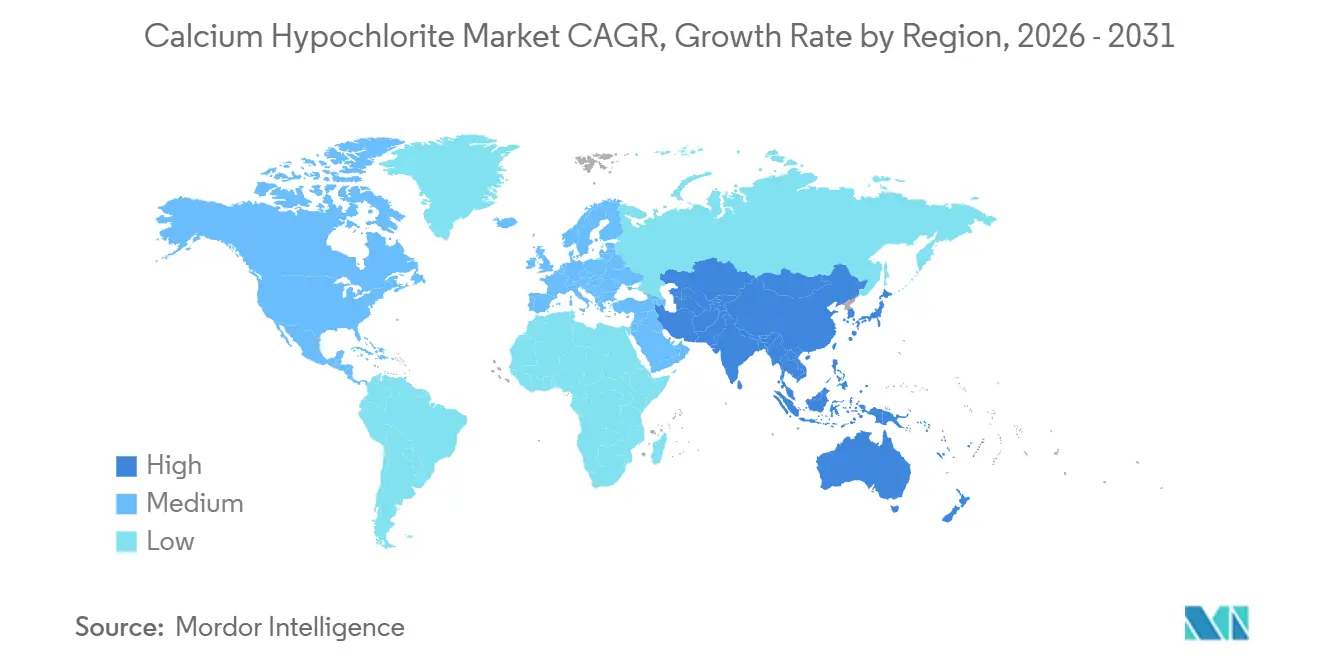
Asia-Pacific held 38.41% of the calcium hypochlorite market share in 2025 and is projected to advance at a 5.77% CAGR through 2031. The region combines strong water infrastructure spending, industrial output, and aquatic recreation demand. China is a major production and consumption center because integrated chlor-alkali facilities support cost-competitive domestic supply and exports. India’s Jal Jeevan Mission and National Clean Ganga Mission support dry chlorination demand in decentralized water systems. Granular and tablet products are useful in these systems because they avoid the storage limitations associated with liquid bleach.
North America Calcium Hypochlorite Market
Japan and South Korea represent more mature demand bases for higher-purity grades used in industrial and food applications. Japan’s water and food-safety requirements support formal specifications for chlorine-based products. North America remains a major regional user due to its large base of municipal utilities, commercial pools, and food processors. Westlake Corporation’s integrated chlor-alkali network supports supply to utilities and distributors across the region. The United States International Trade Commission initiated second five-year reviews of antidumping and countervailing duty orders on calcium hypochlorite from China in June 2025, keeping trade policy relevant to competitive conditions[2]. The calcium hypochlorite market in North America also faces more scrutiny of long-term chlorine dosing practices.
EMEA and South America Calcium Hypochlorite Market
Europe maintains demand through drinking-water compliance and industrial sanitation, although larger utilities are assessing ultraviolet, ozone, and advanced oxidation systems. Southern and Eastern Europe offer room for tablet and granular adoption, where infrastructure modernization continues, and liquid bleach logistics are more difficult. South America supports demand through urban water treatment and food and beverage production. Sinopec Jianghan Salt Chemical Hubei Co., Ltd.’s 2024 registrations in Peru show the role of regulatory access in regional expansion. The Middle East and Africa are emerging opportunities for the calcium hypochlorite market because small water systems need dry and transportable disinfectants. Angola’s planned local chemical production investment also illustrates a move toward regional supply development.
Competitive Landscape
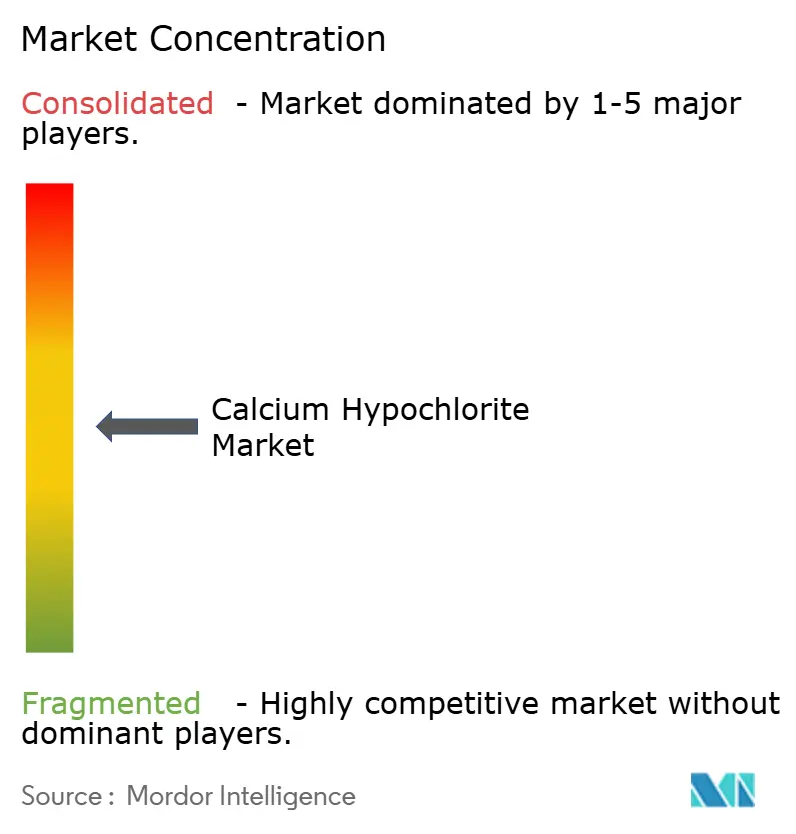
The calcium hypochlorite market is moderately concentrated, with the top five players including Westlake Corporation, Sigura, Tosoh Corporation, Henan Weilite Chemical Co., Ltd., and Nankai Chemical Co., Ltd. Westlake Corporation uses its chlor-alkali operations and certified product portfolio to serve North American customers. Japanese suppliers such as Tosoh Corporation and Nankai Chemical Co., Ltd. compete through product purity and process precision. This positions them in food-grade and export applications where specification requirements are strict. The United States trade review of Chinese imports remains a factor that can affect the calcium hypochlorite market and supplier access.
Automation is becoming a clearer point of competition. LUVA reported a 2025 patent for automated control of calcium hypochlorite factory reactors using oxidation-reduction potential analyzers, flow meters, and process-control systems. These systems can improve production consistency and reduce staffing and exposure risks. Solenis has also positioned calcium hypochlorite as part of a pool and industrial hygiene system that includes briquettes, dosing controllers, and remote monitoring. The company recognized POOLCORP in 2025 after the distributor expanded the use of calcium hypochlorite across its pool operator network. These moves show that suppliers increasingly compete on application support, not only on bulk chemical pricing.
Tosoh Corporation’s FY2026 to FY2028 plan commits JPY 220 billion to JPY 250 billion in capital investment (approximately USD 1.4 billion to USD 1.6 billion) across the stated period and includes plans to expand value-added chlorine-based derivative output. This supports its ability to pursue higher-value chemical applications. Westlake Corporation reported in August 2026 that its profitability plan remained on track and that it reduced total debt by USD 500 million during the second quarter. Regional production is another competitive consideration, especially where freight costs and product registrations shape customer access. Suppliers that establish production and regulatory coverage in Africa may gain advantages as local demand develops. The calcium hypochlorite market, therefore, remains competitive across cost, quality, automation, product form, and regional distribution.
Calcium Hypochlorite Industry Leaders
-
Westlake Corporation
-
Sigura
-
Tosoh Corporation
-
Henan Weilite Chemical Co., Ltd.
-
Nankai Chemical Co.,Ltd.
- *Disclaimer: Major Players sorted in no particular order
Calcium Hypochlorite Market Companies Covered in this Report
- Aditya Birla Chemicals
- Dodhia Chem-Tex Pvt. Ltd.
- ENO Chemical Co., Ltd.
- Henan Weilite Chemical Co., Ltd.
- Huanghua Kaifeng Chemical Co., Ltd.
- Nankai Chemical Co.,Ltd.
- ORGANIC INDUSTRIES PVT LTD
- Sigura
- Sinopec Jianghan Salt Chemical Hubei Co., Ltd.
- Solenis
- Sree Rayalaseema Hi-Strength Hypo Limited
- Tianjin Emore Chemical Co., Ltd.
- Tosoh Corporation
- Westlake Corporation
Recent Industry Developments in Calcium Hypochlorite Market
- November 2025: Nuberg EPC secured an Engineering, Procurement, and Construction (EPC) contract for a 120-tpd chlor-alkali expansion and an 80-tpd calcium chloride plant for Al Ghaith Chemical Industries in Oman. The expansion strengthens regional chlorine-based chemical production infrastructure, supporting the availability of feedstocks used in calcium hypochlorite manufacturing.
- November 2025: LUVA successfully commissioned and started production at its calcium hypochlorite project in South America, while advancing full automation of reactor control. The project adds regional calcium hypochlorite production capacity and demonstrates increasing investment in automated manufacturing systems for the chemical.
Global Calcium Hypochlorite Market Report Scope
Calcium hypochlorite is a chlorine-based chemical compound widely used as a disinfectant and oxidizing agent for controlling microorganisms in water and other treatment environments. It releases available chlorine when dissolved, enabling effective microbial control and sanitation across various applications.
The Calcium Hypochlorite Market is segmented by production process, form, application, and geography. By production process, the market is segmented into the sodium process and the calcium process. By form, the market is segmented into powder, granular, and tablets and pellets. By application, the market is segmented into water treatment, swimming pool sanitation, industrial disinfection, food and beverage, and other applications. The report also covers the market size and forecasts for calcium hypochlorite in 15 countries across major regions. For each segment, the market sizing and forecasts have been done on the basis of value (USD).
Segmentation Overview
| Sodium Process |
| Calcium Process |
| Powder |
| Granular |
| Tablets and Pellets |
| Water Treatment |
| Swimming Pool Sanitation |
| Industrial Disinfection |
| Food and Beverage |
| Other Applications |
| Asia-Pacific | China |
| India | |
| Japan | |
| South Korea | |
| ASEAN Countries | |
| Rest of Asia-Pacific | |
| North America | United States |
| Canada | |
| Mexico | |
| Europe | Germany |
| United Kingdom | |
| France | |
| Italy | |
| NORDIC Countries | |
| Rest of Europe | |
| South America | Brazil |
| Argentina | |
| Rest of South America | |
| Middle East and Africa | Saudi Arabia |
| South Africa | |
| Rest of Middle East and Africa |
| By Production Process | Sodium Process | |
| Calcium Process | ||
| By Form | Powder | |
| Granular | ||
| Tablets and Pellets | ||
| By Application | Water Treatment | |
| Swimming Pool Sanitation | ||
| Industrial Disinfection | ||
| Food and Beverage | ||
| Other Applications | ||
| By Geography | Asia-Pacific | China |
| India | ||
| Japan | ||
| South Korea | ||
| ASEAN Countries | ||
| Rest of Asia-Pacific | ||
| North America | United States | |
| Canada | ||
| Mexico | ||
| Europe | Germany | |
| United Kingdom | ||
| France | ||
| Italy | ||
| NORDIC Countries | ||
| Rest of Europe | ||
| South America | Brazil | |
| Argentina | ||
| Rest of South America | ||
| Middle East and Africa | Saudi Arabia | |
| South Africa | ||
| Rest of Middle East and Africa | ||
Key Questions Answered in the Report
What is the size of the calcium hypochlorite market?
The calcium hypochlorite market stands at USD 0.93 billion in 2026 and is projected to reach USD 1.19 billion by 2031.
What is driving demand for calcium hypochlorite?
Water treatment investment, pool sanitation, food processing hygiene, and dry chlorination for remote systems support demand.
Which production process led the market demand in 2025?
The sodium process held a 58.12% share in 2025.
Which form is expected to grow fastest through 2031?
Granular is projected to advance at a 5.89% CAGR through 2031 because it supports automated, controlled dosing.