
Calcium Acetate Market Size and Share
Market Overview
| Study Period | 2022 - 2032 |
|---|---|
| Market Size (2027) | USD 152.83 Million |
| Market Size (2032) | USD 186.57 Million |
| Growth Rate (2027 - 2032) | 4.07 % |
| Fastest Growing Market | Asia-Pacific |
| Largest Market | Asia-Pacific |
| Market Concentration | Medium |
Major Players *Disclaimer: Major Players sorted in no particular order Image © Mordor Intelligence. Reuse requires attribution under CC BY 4.0. | |
Calcium Acetate Market Analysis by Mordor Intelligence
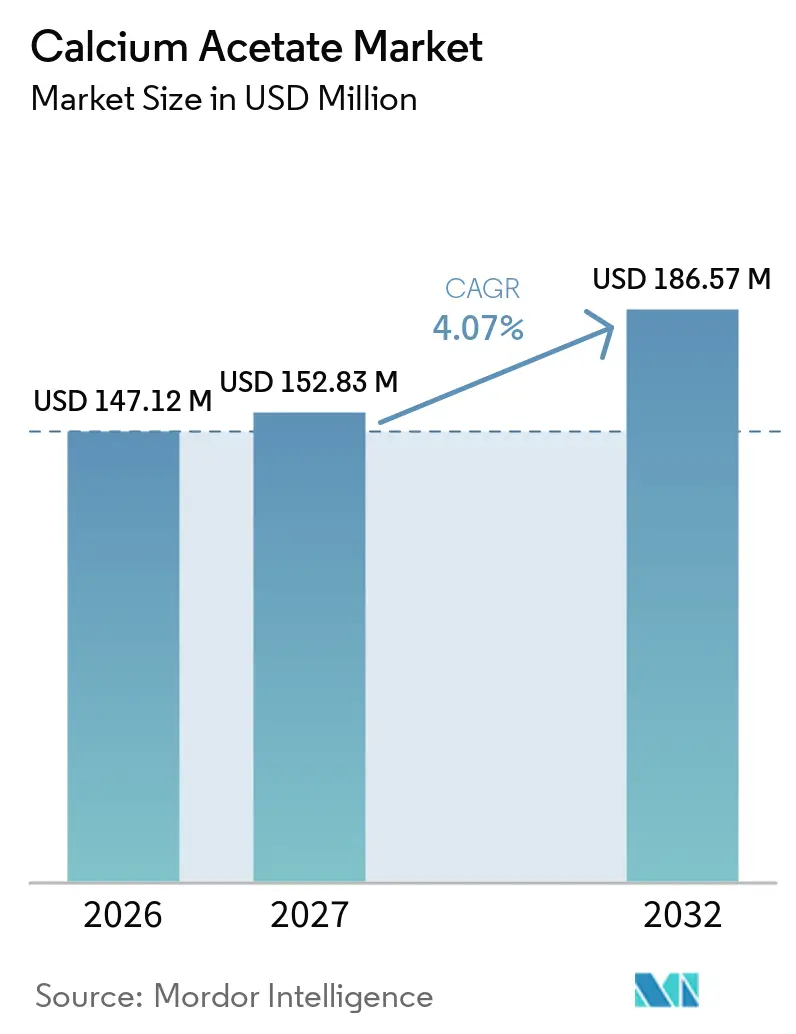
The calcium acetate market size was valued at USD 147.12 million in 2026 and is estimated to grow from USD 152.83 million in 2027 to USD 186.57 million by 2032, at a CAGR of 4.07% during the forecast period (2027-2032). Chronic kidney disease and the growing use of kidney replacement therapy support recurring demand for phosphate-binding treatments. The 2025 Medicare policy change shifted responsibility for phosphate-binder supply to dialysis facilities, supporting institutional purchasing arrangements in the United States. Food applications represent a second source of demand, as calcium acetate is permitted for several technical functions in processed foods. The calcium acetate market also benefits from the ingredient's role in pharmaceutical manufacturing, food preservation, and pH control. Documentation, production quality, and reliable supply are likely to become more important as customers purchase material for regulated uses.
Key Report Takeaways
- By function, Stabilizer held 31.67% of the calcium acetate market share in 2026, while Firming Agent is forecast to grow at a CAGR of 4.57% through 2032.
- By form, Powder held 64.74% of the calcium acetate market share in 2026, while Solution is forecast to grow at a CAGR of 4.81% through 2032.
- By application, Pharmaceutical Ingredients held 35.13% of the calcium acetate market share in 2026 and is forecast to grow at a CAGR of 5.05% through 2032.
- By geography, Asia-Pacific held 42.56% of the calcium acetate market share in 2026 and is forecast to grow at a CAGR of 4.94% through 2032.
Note: Market numbers in this report are based on Mordor Intelligence's proprietary estimation framework, which combines nine months of actuals with Q4 projections for base year 2026.
Global Calcium Acetate Market Trends and Insights
Drivers Impact Analysis*
| Drivers | (~) % Impact on CAGR Forecast | Geographic Relevance | Impact Timeline |
|---|---|---|---|
| Rising Chronic Kidney Disease and Dialysis Demand | +1.5% | Global, concentrated in Asia-Pacific, North America, and Europe | Long term (≥ 4 years) |
| Multifunctional Use in Food Preservation and pH Regulation | +0.7% | Global, strongest in Asia-Pacific and North America | Medium term (2-4 years) |
| Expansion of Pharmaceutical and Nutraceutical Manufacturing | +0.9% | Asia-Pacific, with effects in North America and Europe | Long term (≥ 4 years) |
| Growth of Processed, Fortified, and Functional Foods | +0.6% | Asia-Pacific, with gains in Europe and South America | Medium term (2-4 years) |
| Wastewater Nutrient Removal and Denitrification Demand | +0.3% | Europe and North America, with emerging use in Southeast Asia | Short term (≤ 2 years) |
| Source: Mordor Intelligence | |||
Rising Chronic Kidney Disease and Dialysis Demand
The calcium acetate market is supported by the expanding burden of chronic kidney disease. The Global Burden of Disease (GBD) 2023 study reported that nearly 800 million adults worldwide were living with chronic kidney disease in 2023, with China and India having the largest patient populations at 152 million and 138 million people, respectively. A related study reported that 4.59 million people received kidney replacement therapy globally in 2023. The Centers for Medicare & Medicaid Services (CMS) change, effective January 1, 2025, transferred responsibility for Medicare patients' phosphate-lowering agents from retail pharmacies to dialysis facilities. This arrangement makes demand more visible to suppliers that meet facility purchasing and quality requirements.
Expansion of Pharmaceutical and Nutraceutical Manufacturing
Pharmaceutical manufacturing drives demand for calcium acetate, with customers requiring consistent quality and complete product documentation. Suppliers with active Drug Master Files, written confirmations, or comparable quality records can serve customers with regulated drug-development and manufacturing needs. These records matter because buyers must assess both the chemical material and the documentation that supports their own filings. Kerry's September 2025 agreement with Brenntag for the Niacet Pharma Acetates range demonstrates how suppliers use specialized distribution to reach European pharmaceutical customers. The agreement includes calcium acetate supported by a U.S. Drug Master File, making documentation part of the commercial offer. The calcium acetate market, therefore, has a regulated supply tier that differs from high-volume food and industrial sales.
Multifunctional Use in Food Preservation and pH Regulation
Demand for calcium acetate in food applications is supported by the material's ability to serve multiple technical roles. U.S. regulations list calcium acetate as a firming agent, pH-control agent, processing aid, sequestrant, stabilizer, thickener, and texturizer[1]. These permitted roles allow processors to consider the ingredient for formulation, preservation, texture, and acidity management needs. Its use can be relevant in processed fruit and vegetables, dairy products, baked goods, gelatins, and sauces when the product formulation requires these functions. Codex also lists calcium acetate, identified as additive 263, in the General Standard for Food Additives. This regulatory basis supports use across food systems that recognize Codex requirements.
Growth of Processed, Fortified, and Functional Foods
Processed and fortified food production creates additional opportunities for food-grade calcium acetate. Food manufacturers can use the compound where calcium addition, preservation, texture control, and pH management are relevant to the finished product. Thailand's food strategy seeks to develop a USD 16 billion future-food sector by 2030, indicating continued policy attention to food processing capacity. This expansion supports demand for compliant food ingredients across regional production networks. Calcium acetate can be considered for bread, dairy, processed produce, functional beverages, and nutrition-oriented formats where its approved functions align with a formulation need. Demand depends on processors balancing functional performance, ingredient labeling, and local food requirements.
Restraints Impact Analysis*
| Restraints | (~) % Impact on CAGR Forecast | Geographic Relevance | Impact Timeline |
|---|---|---|---|
| Competition From Non-Calcium Phosphate Binders | -0.6% | North America and Europe, with moderate effects in the Asia-Pacific | Long term (≥ 4 years) |
| Hypercalcemia and Vascular Calcification Risk | -0.3% | Global, most acute in high-income markets | Medium term (2-4 years) |
| Acetic Acid and Calcium Feedstock Price Volatility | -0.4% | Global, with high exposure in Europe and the United States | Short term (≤ 2 years) |
| Source: Mordor Intelligence | |||
Competition From Non-Calcium Phosphate Binders
The calcium acetate market faces substitution pressure from non-calcium phosphate binders in renal care settings. A 2025 Cochrane review found that sevelamer may reduce all-cause mortality and hypercalcemia events compared with calcium-based binders. This clinical evidence can influence formulary decisions in countries with mature reimbursement systems and advanced renal pharmacovigilance. Calcium acetate remains relevant where providers require lower-cost phosphate management options. The Centers for Medicare & Medicaid Services (CMS) bundled-payment model also provides dialysis facilities with an incentive to evaluate treatment costs under a fixed payment structure. Price-sensitive renal care systems may therefore continue using calcium-based agents even as alternative therapies gain clinical attention.
Hypercalcemia and Vascular Calcification Risk
Safety considerations may limit the use of calcium acetate in some patients with chronic kidney disease. Clinicians and formulary committees weigh the risks of hypercalcemia and vascular calcification when selecting phosphate binders. The Cochrane evidence base identifies fewer hypercalcemia events with sevelamer than with calcium-based binders in relevant comparisons. This finding can favor non-calcium alternatives for patients with elevated cardiovascular risk or other clinical concerns. This restraint is most apparent in high-income markets with established guideline implementation and broader access to treatment options. While it does not eliminate demand for calcium acetate, it narrows its use among selected patient groups.
*Our forecasts treat driver/restraint impacts as directional, not additive. The impact forecasts reflect baseline growth, mix effects, and variable interactions.
Segment Analysis
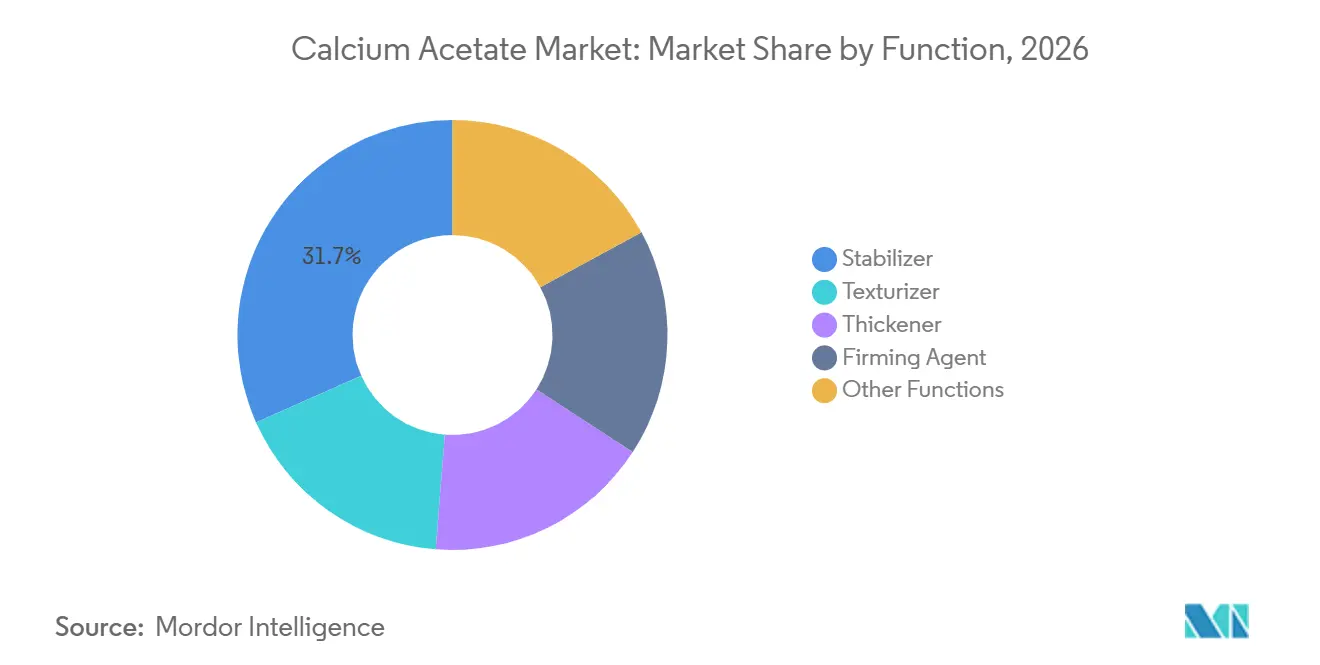
By Function: Stabilizer Leads Current Demand While Firming Agent Records Faster Growth
Stabilizer held 31.67% of the calcium acetate market share in 2026. This position reflects its use in formulations that require buffering, texture control, and preservation support. Food producers use calcium acetate, which serves a stabilizing role alongside other permitted functions under US food regulations, reducing the need to assess each ingredient separately for every formulation task. Baked goods, dairy items, and processed food formats are the primary settings for this use. The segment's scale is supported by established demand for food processing across multiple end markets.
Firming Agent is projected to expand at a CAGR of 4.57% through 2032, the fastest rate among functions in the calcium acetate market. Fresh-cut fruit and vegetable processors use firming agents to maintain texture during refrigerated distribution. This need is tied to food supply chains that require products to remain stable across processing, transport, retail handling, and consumption. Calcium acetate is considered when its food-grade status and technical properties meet a processor's specifications. Texturizer and Thickener functions provide complementary demand in gelatins, puddings, and sauces. Together, these functions make the material relevant across several food applications rather than a single product category.

By Form: Powder Retains Scale While Solution Meets Liquid-Use Requirements
Powder accounted for 64.74% of the calcium acetate market share in 2026. Its position is linked to storage stability, ease of handling, and compatibility with dry blending processes. Tablet and capsule producers prefer powder form when manufacturing phosphate-binding or fortified food products. Food producers also use powder in dry mixes where controlled addition is important. Granules provide a complementary form for applications that require managed particle size and direct-compression performance. These characteristics sustain demand for powder across pharmaceutical and food production.
Solution is forecast to grow at a CAGR of 4.81% through 2032, making it the fastest-growing form in the calcium acetate market. Liquid systems require rapid dissolution and direct use in processing operations. Dialysis-fluid compounding and liquid food processing are identified as important uses for solution-grade products. Processed vegetable canning, wet-mix sauces, and related applications require liquid-compatible ingredients. Pharmaceutical-grade solutions also require documentation aligned with relevant manufacturing standards, which favors suppliers with established quality systems and specialized technical support.
By Application: Pharmaceutical Ingredients Combine Leading Scale and Growth
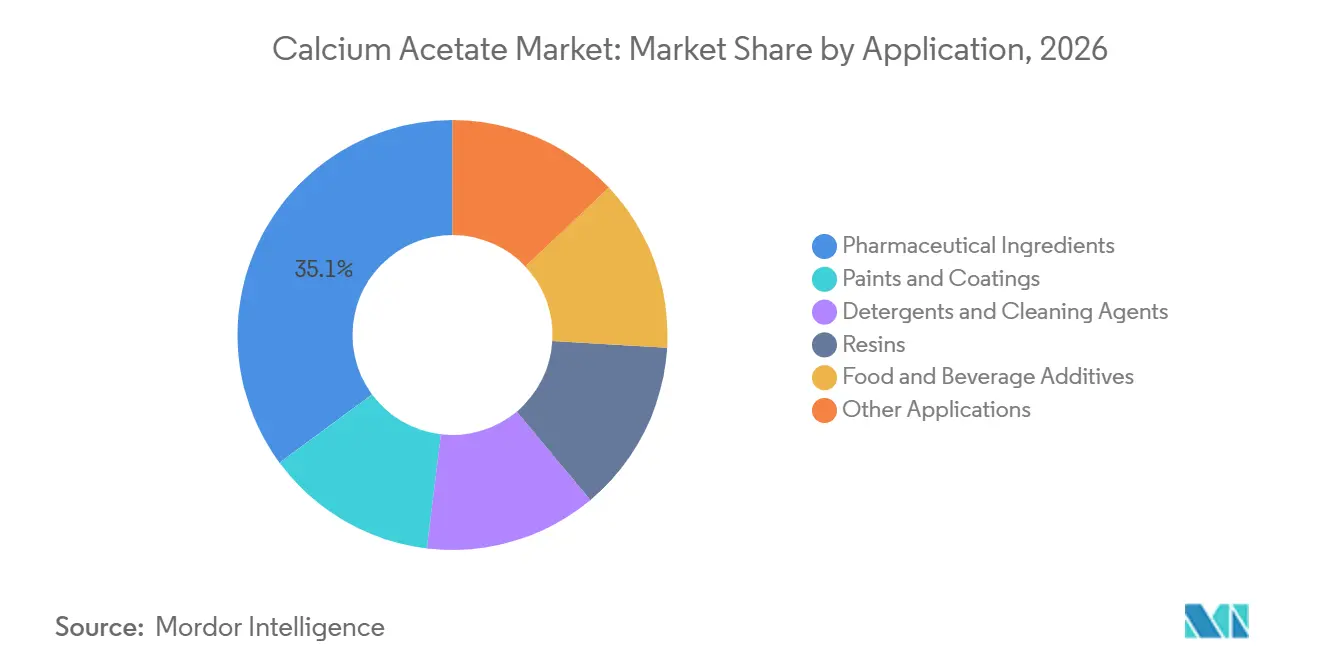
Pharmaceutical Ingredients held 35.13% of the calcium acetate market share in 2026 and also recorded the highest projected CAGR of 5.05% through 2032. Chronic kidney disease prevalence and kidney replacement therapy create a recurring need for phosphate-lowering treatments. The 2025 CMS policy shifted procurement responsibility toward dialysis facilities for Medicare patients. These conditions support institutional demand for compliant pharmaceutical-grade material. Documentation is as important as price, as drug manufacturers and dialysis-related customers must validate their supply sources.
Food and Beverage Additives form the next significant application group in the calcium acetate market. The material supports pH management, firming, stabilization, and preservation roles permitted in food applications. Codex recognition supports its use in food systems that follow international additive standards. Resins, paints and coatings, and detergents and cleaning agents represent industrial demand where customers purchase based on technical performance. Wastewater treatment is included among other applications, as acetate supports denitrification. These industrial uses provide demand diversity, although pharmaceutical and food applications remain more central to the market.
Geography Analysis
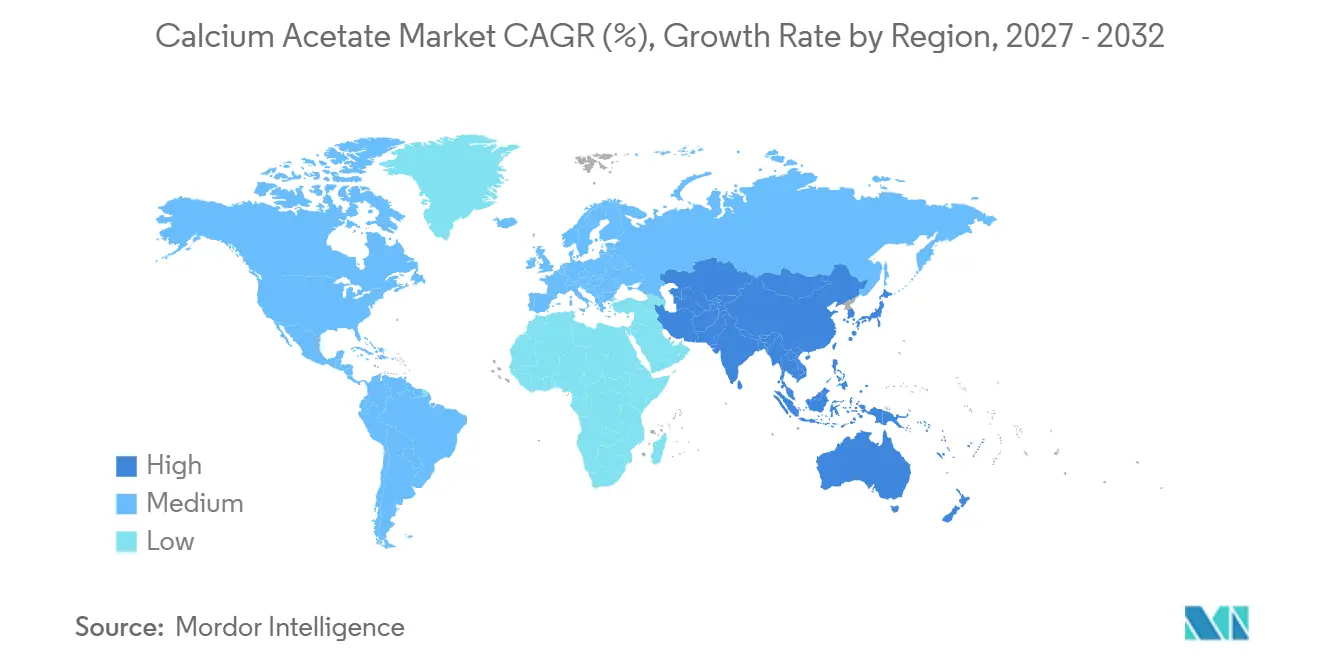
Asia-Pacific held 42.56% of the calcium acetate market share in 2026 and is projected to grow at a CAGR of 4.94% through 2032. China and India are central to regional demand, as they had the largest populations with chronic kidney disease in 2023. China is also a key part of the region's chemical production base, while India supports pharmaceutical manufacturing. Japan and South Korea contribute to demand through their healthcare systems and pharmaceutical production. Vietnam, Thailand, and Indonesia are emerging food-processing centers. Thailand's plan to develop a USD 16 billion future-food sector by 2030 supports continued investment in processed-food capacity. The region, therefore, combines pharmaceutical, food, and industrial demand channels.
North America is the second-largest regional market in this assessment. The region has established dialysis infrastructure and regulatory pathways for calcium acetate in food and pharmaceutical applications. The January 2025 Centers for Medicare & Medicaid Services (CMS) policy has concentrated Medicare phosphate-binder procurement within dialysis facilities. This favors suppliers that can meet facility requirements for quality, documentation, and continuity of supply. Canada contributes to the pharmaceutical demand for high-purity material. Global Calcium announced the successful completion of a Health Canada GMP inspection in November 2025. The calcium acetate market in North America is shaped by regulated demand rather than commodity quantity alone.
Europe remains an important market, as buyers place a high value on food and pharmaceutical compliance. The region also has demand for generic drug manufacturing and dialysis fluid formulation. Kerry and Brenntag signed a preferred distribution agreement in September 2025 for pharmaceutical-grade acetates across much of Europe. South America has longer-term potential, as chronic kidney disease represents a significant health burden, and Brazil and Argentina support pharmaceutical and food-processing activity. The Middle East and Africa also have considerable unmet renal-care needs. Future demand in these regions depends on dialysis capacity, healthcare access, food manufacturing investment, and compliant distribution networks.
Competitive Landscape
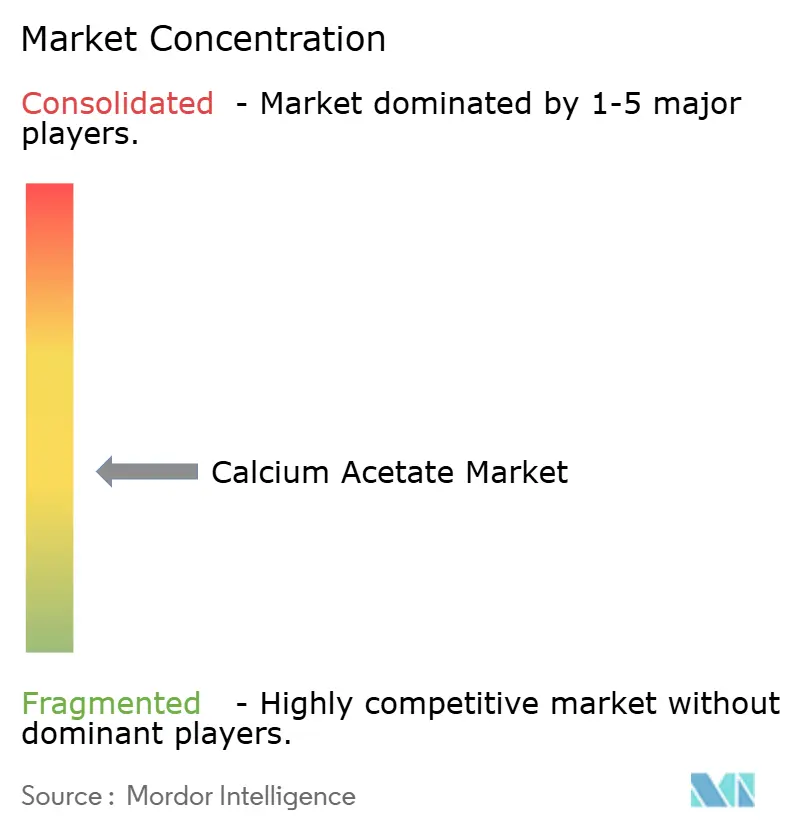
The calcium acetate market is moderately fragmented. European and Indian suppliers compete in the premium tier through quality systems, pharmacopeia documentation, and regulatory readiness. A larger group of Chinese producers competes in the food-grade and industrial-grade supply markets through cost and scale advantages. Dr. Paul Lohmann and Kerry's Niacet Pharma Acetates platform represent the documentation-led segment of the market. Customers developing regulated products require suppliers that can support their filing and quality requirements. This makes Drug Master Files, written confirmations, and related records important commercial assets, resulting in a clear distinction between pharmaceutical-grade competition and lower-specification supply.
Kerry and Brenntag's September 2025 preferred distribution agreement illustrates a strategic move in the calcium acetate market. The arrangement expanded access to a pharmaceutical-grade acetate range across Germany, France, Italy, the Nordics, Poland, and Central and Eastern Europe. It provided Brenntag with material that supports pharmaceutical customers' quality requirements. Niacet's February 2025 partnership to use bio-based acetic acid in acetate production represents another strategic response to supply and sustainability concerns. This approach is relevant to European buyers who assess both input security and emissions-related procurement requirements. These actions indicate that competition extends beyond production capacity and unit price.
Global Calcium's regulatory progress illustrates a separate route to commercial expansion. The company completed a Health Canada GMP inspection in November 2025. Compliance improvements can widen access to regulated markets and strengthen customer confidence. Jost Chemical also received ISO/IEC 17025:2017 accreditation for its St. Louis laboratory in June 2025[2]. This supports the testing competence expected by pharmaceutical and nutraceutical customers. The broader competitive landscape is therefore divided between companies that sell high-quantity technical grades and those that compete through validated quality systems.
Calcium Acetate Industry Leaders
-
Kerry Group plc
-
Dr. Paul Lohmann GmbH & Co. KGaA
-
Macco
-
Global Calcium Pvt. Ltd.
-
Formosa Laboratories, Inc.
- *Disclaimer: Major Players sorted in no particular order
Recent Industry Developments
- September 2025: Kerry Group and Brenntag Specialties signed a preferred distribution agreement for the Niacet Pharma Acetates product range, including calcium acetate backed by a US Drug Master File, across most of Europe, including Germany, France, Italy, Nordic countries, Poland, and CEE. The agreement secured compliant supply of GMP-certified calcium acetate for European dialysis-fluid formulators and generic drug manufacturers.
- June 2025: Jost Chemical Co. received ISO/IEC 17025:2017 accreditation for its St. Louis laboratory from Perry Johnson Laboratory Accreditation, Inc., confirming the technical competence of its chemical and biological testing operations for pharmaceutical and nutraceutical-grade calcium acetate.
Global Calcium Acetate Market Report Scope
Calcium acetate is a chemical compound and a calcium salt of acetic acid. It is primarily used to treat hyperphosphatemia (high blood phosphate levels) in patients with chronic kidney disease undergoing dialysis. The compound functions as a phosphate binder, reducing phosphate absorption in the gastrointestinal tract.
The calcium acetate market is segmented by function, form, application, and geography. By function, the market is segmented into stabilizer, texturizer, thickener, firming agent, and other functions. By form, the market is segmented into powder, granules, and solution. By application, the market is segmented into resins, pharmaceutical ingredients, paints and coatings, detergents and cleaning agents, food and beverage additives, and other applications. The report also covers market sizes and forecasts for calcium acetate across 15 countries in major regions. The market sizes and forecasts are provided in terms of value (USD).
| Stabilizer |
| Texturizer |
| Thickener |
| Firming Agent |
| Other Functions |
| Powder |
| Granules |
| Solution |
| Resins |
| Pharmaceutical Ingredients |
| Paints and Coatings |
| Detergents and Cleaning Agents |
| Food and Beverage Additives |
| Other Applications |
| Asia-Pacific | China |
| India | |
| Japan | |
| South Korea | |
| ASEAN Countries | |
| Rest of Asia-Pacific | |
| North America | United States |
| Canada | |
| Mexico | |
| Europe | Germany |
| United Kingdom | |
| France | |
| Italy | |
| NORDIC Countries | |
| Rest of Europe | |
| South America | Brazil |
| Argentina | |
| Rest of South America | |
| Middle East and Africa | Saudi Arabia |
| South Africa | |
| Rest of Middle East and Africa |
| By Function | Stabilizer | |
| Texturizer | ||
| Thickener | ||
| Firming Agent | ||
| Other Functions | ||
| By Form | Powder | |
| Granules | ||
| Solution | ||
| By Application | Resins | |
| Pharmaceutical Ingredients | ||
| Paints and Coatings | ||
| Detergents and Cleaning Agents | ||
| Food and Beverage Additives | ||
| Other Applications | ||
| By Geography | Asia-Pacific | China |
| India | ||
| Japan | ||
| South Korea | ||
| ASEAN Countries | ||
| Rest of Asia-Pacific | ||
| North America | United States | |
| Canada | ||
| Mexico | ||
| Europe | Germany | |
| United Kingdom | ||
| France | ||
| Italy | ||
| NORDIC Countries | ||
| Rest of Europe | ||
| South America | Brazil | |
| Argentina | ||
| Rest of South America | ||
| Middle East and Africa | Saudi Arabia | |
| South Africa | ||
| Rest of Middle East and Africa | ||
Key Questions Answered in the Report
What is current market size of Calcium Acetate Market?
The calcium acetate market size was valued at USD 147.12 million in 2026 and is estimated to grow from USD 152.83 million in 2027 to USD 186.57 million by 2032, at a CAGR of 4.07% during the forecast period (2027-2032).
Which calcium acetate application is growing fastest?
Pharmaceutical Ingredients leads applications with a projected 5.05% CAGR through 2032 and holds 35.13% share in 2026.
Which form is preferred for calcium acetate products?
Powder is the largest form with 64.74% share in 2026, while Solution is the fastest-growing form at a 4.81% CAGR.
Which region leads calcium acetate demand?
Asia-Pacific leads with 42.56% share in 2026 and has the fastest regional growth rate at a 4.94% CAGR through 2032.