
Brazil Refrigerated Trucking Market Size and Share
Market Overview
| Study Period | 2021 - 2032 |
|---|---|
| Forecast Data Period | 2027 - 2032 |
| Base Year Market Size (2026) | USD 2.5 Billion |
| Market Size (2027) | USD 2.63 Billion |
| Market Size (2032) | USD 3.36 Billion |
| Growth Rate (2027 - 2032) | 5.03 % |
| Market Concentration | Low |
Major Players *Disclaimer: Major Players sorted in no particular order Image © Mordor Intelligence. Reuse requires attribution under CC BY 4.0. | |
Brazil Refrigerated Trucking Market Analysis by Mordor Intelligence
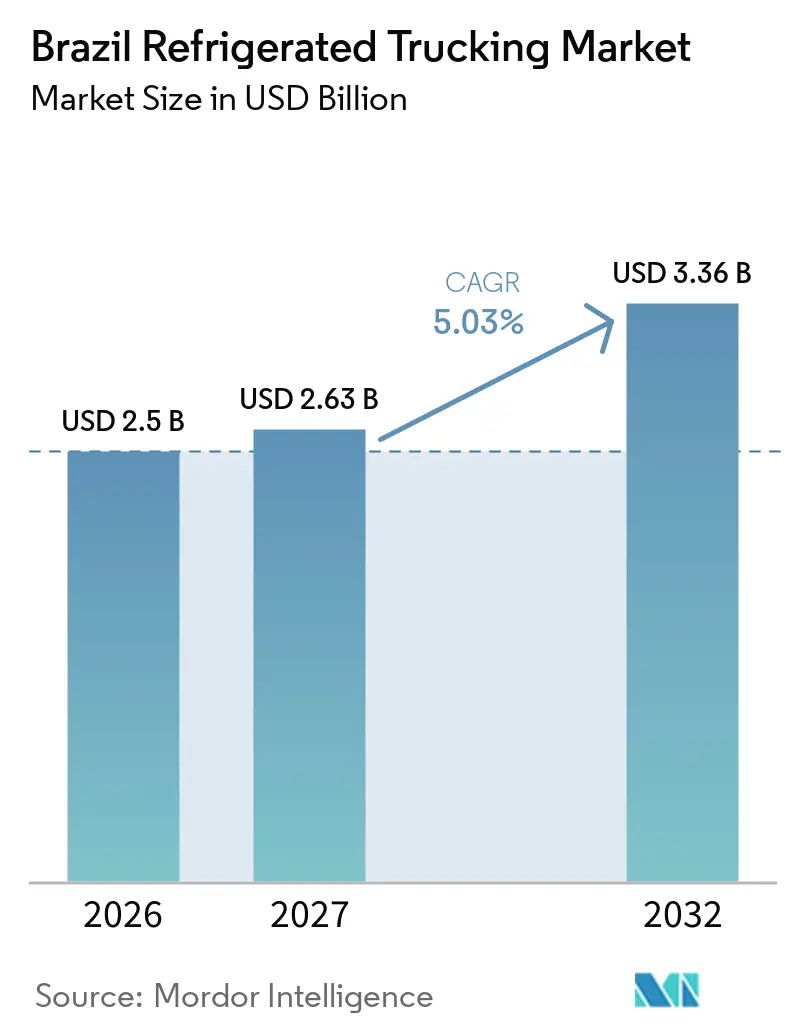
The Brazil refrigerated trucking market size is valued at USD 2.50 billion in 2026 and is estimated to grow from USD 2.63 billion in 2027 to reach USD 3.36 billion by 2032, at a CAGR of 5.03% during the forecast period from 2027 to 2032.
The Brazil refrigerated trucking market is supported by the country’s protein supply chains, which require controlled transport from processing sites to domestic distribution centers and export ports. The Brazil refrigerated trucking market also benefits from rising demand for documented temperature control in pharmaceutical distribution. Food, pharmaceutical, and export logistics operators increasingly need traceable transport rather than basic cold storage alone. This favors providers that can combine fleet capacity, route coverage, temperature records, and container handling. Cost pressure from diesel, refrigeration equipment, and difficult roads remains an important limit on the Brazil refrigerated trucking market.
Key Report Takeaways
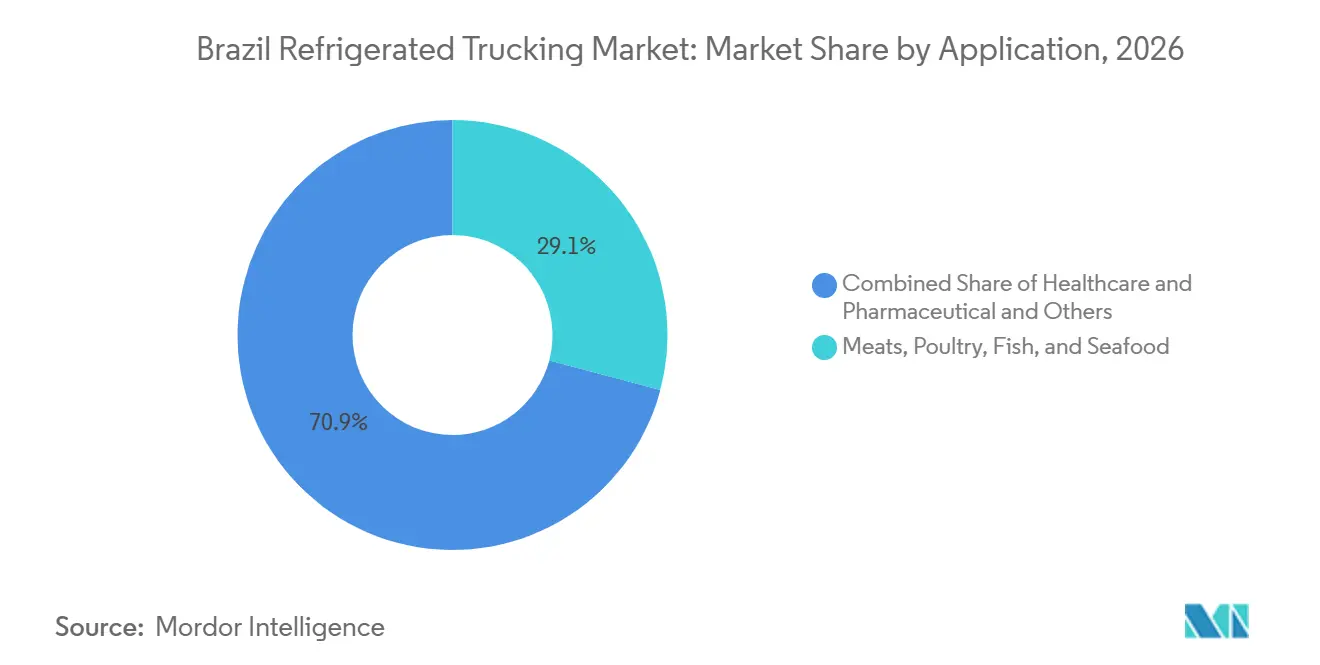
- By application, meats, poultry, fish, and seafood account for 29.12% of the Brazil refrigerated trucking market share in 2026, while healthcare and pharmaceuticals are projected to register a 6.47% CAGR through 2032.
- By truckload specification, full-truckload accounts for 65.61% of the Brazil refrigerated trucking market share in 2026, while less-than-truckload is projected to register at a 7.76% CAGR through 2032.
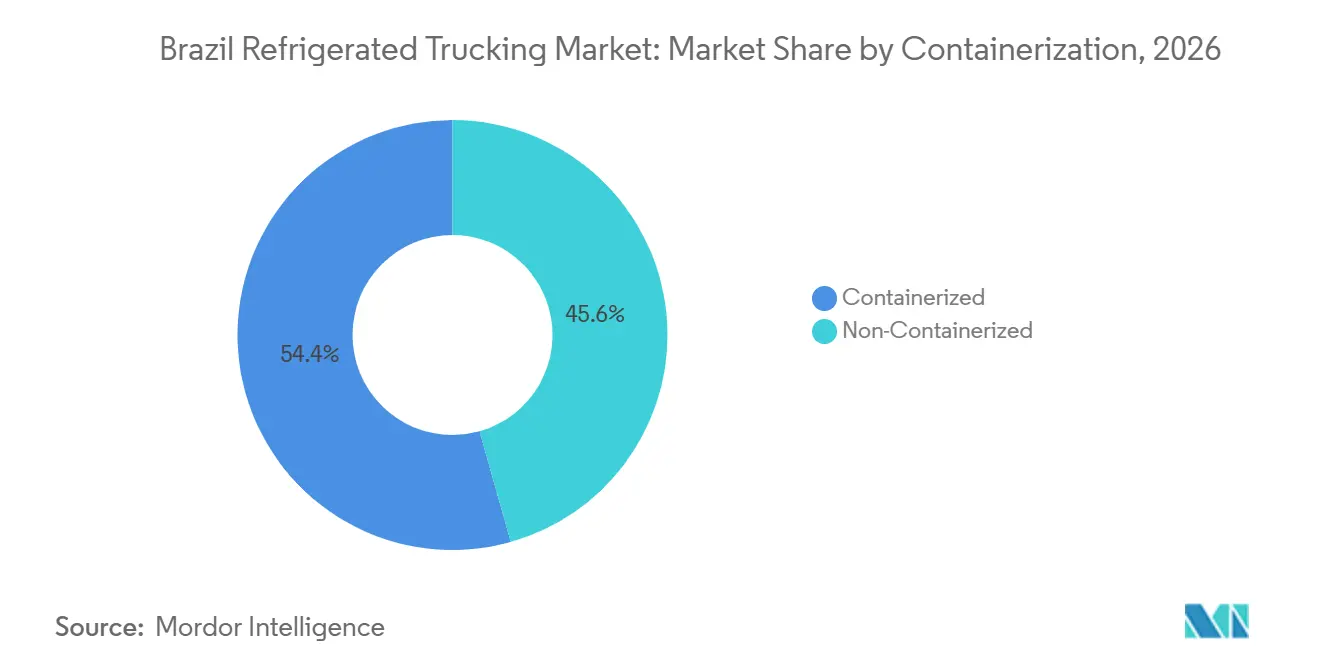
- By containerization, containerized freight accounts for 54.37% of the Brazil refrigerated trucking market share in 2026 and is projected to register at a 7.37% CAGR through 2032.
- By distance, long haul accounts for 60.41% of the Brazil refrigerated trucking market share in 2026, while short haul is projected to register at a 7.98% CAGR through 2032.
- By destination, domestic freight accounts for 90.12% of the Brazil refrigerated trucking market share in 2026, while cross-border freight is projected to register at a 6.59% CAGR through 2032.
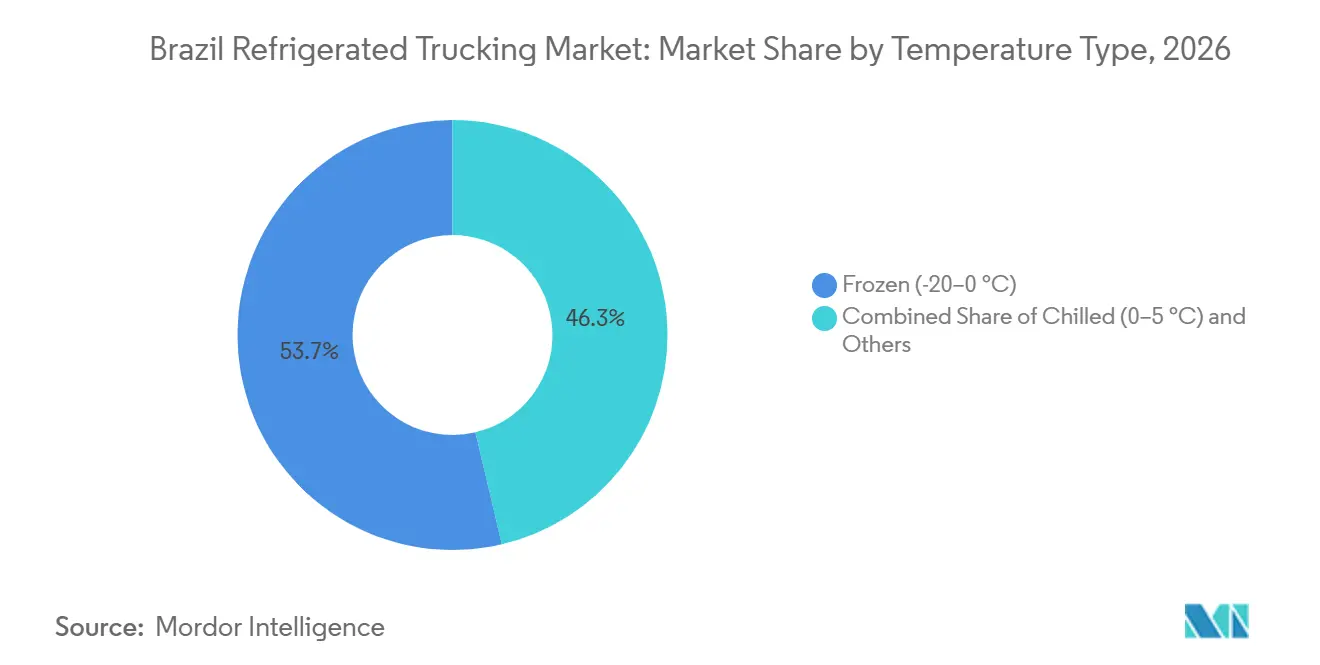
- By temperature type, frozen freight accounts for 53.68% of the Brazil refrigerated trucking market share in 2026, while chilled freight is projected to register at a 7.64% CAGR through 2032.
- By geography, the Southeast accounts for 35.27% of the Brazil refrigerated trucking market share in 2026, while the Northeast is projected to register at a 7.41% CAGR through 2032.
Note: Market numbers in this report are based on Mordor Intelligence's proprietary estimation framework, which combines nine months of actuals with Q4 projections for base year 2026.
Market Trends and Insights
Drivers Impact Analysis of Brazil Refrigerated Trucking Market*
| Driver | (~) % Impact on CAGR Forecast | Geographic Relevance | Impact Timeline |
|---|---|---|---|
| Temperature-Controlled Food Distribution Expanding Reefer Freight Demand | +1.5% | Southeast and South core, Northeast and Center-West emerging | Medium term (2-4 years) |
| Pharmaceutical Growth Increasing Specialized Cold-Chain Transport Demand | +1.0% | São Paulo and Rio de Janeiro, with spillover to Center-West and South | Short term (≤ 2 years) |
| Agricultural Corridors Strengthening Refrigerated Freight Movement Volumes | +0.8% | Center-West and South corridors, with North and Northeast development | Medium term (2-4 years) |
| Digital Temperature Monitoring Improving Compliance and Traceability | +0.5% | National, with early gains in São Paulo, Paraná, and Pernambuco | Short term (≤ 2 years) |
| Dual-Temperature Fleets Improving Utilization and Backhaul Economics | +0.4% | National, with stronger uptake in Southeast and South | Medium term (2-4 years) |
| Regional Cold-Chain Expansion Strengthening Northern Distribution Corridors | +0.3% | North and Northeast, including Manaus and Fortaleza logistics hubs | Long term (≥ 4 years) |
| Source: Mordor Intelligence | |||
Temperature-Controlled Food Distribution Expanding Reefer Freight Demand
Brazil’s protein supply chain requires refrigerated vehicles that maintain cargo conditions from processing plants to retailers and ports. The Brazil refrigerated trucking market depends on this need because ordinary road freight cannot carry chilled or frozen cargo with the required controls. Reefer container activity across the Paranaguá and Antonina port complex increased in 2025, supported by higher poultry and beef volumes. It also identifies a limited pool of qualified refrigerated operators compared with the wider logistics base. Capacity expansion is therefore not simply a storage issue, because reliable movement between plants, distribution sites, and ports is equally important. Food safety documentation and temperature records make certified equipment more valuable for contracts that require proof of handling.
Pharmaceutical Growth Increasing Specialized Cold-Chain Transport Demand
Pharmaceutical freight brings stricter temperature requirements than most food movements and supports a separate premium transport category. The Brazil refrigerated trucking market gains from demand for controlled 2–8 °C distribution of medicines, vaccines, and biological products. Demand is supported by the use of GLP-1 therapies, clinical trials, and pharmaceutical export flows. Pharmaceutical operators require documented temperature control, specialized equipment, and careful handling at transfer points. These requirements favor fleets that can meet ANVISA good distribution practice obligations. The resulting distinction between certified and non-certified operators can widen the gap in service capability across the Brazil refrigerated trucking market.
Agricultural Corridors Strengthening Refrigerated Freight Movement Volumes
Agricultural production creates demand for refrigerated movement beyond the protein trade. Higher fruit export volumes in the first half of 2026 increased the need for reliable cold-chain logistics to connect production areas with ports while preserving product quality during transit. Brazil’s fruit production base is larger than its export position would indicate, which points to gaps in collection, handling, and transport infrastructure. Center-West production in Mato Grosso and Goiás raises the need for refrigerated links to processing facilities and export gateways. Shorter intra-state routes can be important because the cold chain begins before cargo reaches a major port corridor. The Brazil refrigerated trucking market can therefore find opportunities in local connections as well as in long-distance export routes.
Digital Temperature Monitoring Improving Compliance and Traceability
Digital monitoring is changing how carriers demonstrate temperature performance to customers. Movecta deployed ReefWatch monitoring in Guarujá, Itajaí, and Suape in February 2026, replacing manual inspection at locations handling refrigerated containers[1]. These systems improve the ability to identify a deviation before it becomes a cargo loss. They also create records that can support discussions with shippers, insurers, and regulators. In the Brazil refrigerated trucking market, monitoring is becoming a basic capability for operators serving pharmaceutical and high-value food cargo.
Restraints Impact Analysis of Brazil Refrigerated Trucking Market*
| Restraint | (~) % Impact on CAGR Forecast | Geographic Relevance | Impact Timeline |
|---|---|---|---|
| Fuel and Refrigeration Costs Increasing Operating Expenses | -1.5% | National, with highest impact on North, Center-West, and Northeast long-haul routes | Short term (≤ 2 years) |
| Reefer Capacity Shortages Limiting Specialized Transport Availability | -0.8% | National, critical in Northeast, North, and seasonal peak corridors | Medium term (2-4 years) |
| Rural Road Constraints Disrupting Refrigerated Route Reliability | -0.5% | North, Northeast, interior Center-West, and Mato Grosso | Long term (≥ 4 years) |
| Temperature Excursions Increasing Cross-Docking and Power Risks | -0.3% | North and Northeast, including Suape and Manaus port transfer hubs | Short term (≤ 2 years) |
| Source: Mordor Intelligence | |||
Fuel and Refrigeration Costs Increasing Operating Expenses
Fuel inflation is a direct challenge for refrigerated carriers because diesel and cooling equipment are both material operating costs. Rising diesel prices increase operating costs for refrigerated transport, as these vehicles require fuel for both transportation and maintaining cargo temperatures during transit and while waiting at loading sites[2]. Long routes in the North, Northeast, and Center-West have greater exposure because distances and road conditions can raise fuel consumption. When freight rates do not fully recover these costs, smaller carriers face pressure on margins and fleet renewal. The Brazil refrigerated trucking market therefore depends on cost management as much as on load growth.
Reefer Capacity Shortages Limiting Specialized Transport Availability
Refrigerated vehicles represent a limited share of Brazil’s road freight fleet, making capacity harder to secure during harvests, holidays, and other seasonal peaks. Shortages of refrigeration technicians, high workforce turnover in temperature-controlled operations, and limited multimodal connectivity further constrain market expansion. Larger producers can partly manage the issue through captive fleets, while smaller manufacturers may have fewer transport options. The gap can lead to higher spot rates and delayed access to qualified vehicles. It also means that fleet availability remains a practical constraint on the Brazilian refrigerated trucking market.
*Our forecasts treat driver/restraint impacts as directional, not additive. The impact forecasts reflect baseline growth, mix effects, and variable interactions.
Brazil Refrigerated Trucking Market Segment Analysis
By Application:
Protein Demand Supports Volume While Pharmaceutical Lanes ExpandMeats, poultry, fish, and seafood account for 29.12% of the Brazil refrigerated trucking market share in 2026, making it the largest application category. The segment reflects Brazil’s protein export base and domestic distribution needs across retail, food service, and processors. Frozen and chilled protein movements require stable temperature control between plants, warehouses, ports, and stores. Large volumes can support regular routes and high vehicle utilization. These characteristics make protein logistics an anchor for the Brazil refrigerated trucking market.
Healthcare and pharmaceuticals are forecast to record the highest application CAGR of 6.47% through 2032. Pharmaceutical growth reflects demand for controlled transport of medicines, vaccines, biologics, and other sensitive products. These movements usually require more detailed temperature records than conventional food freight. Horticultural products require short dwell times and chilled conditions, while dairy, frozen desserts, and processed food can require longer-haul frozen transport. Other applications include smaller categories such as floral products and temperature-sensitive ingredients. The mix of cargo types allows operators to reduce their reliance on one product class. Carriers that add compliant pharmaceutical services and processed-food distribution can pursue higher-value contracts while maintaining food logistics volumes.

By Truckload Specification:
Full-Truckload Leads While Shared Loads Gain GroundFull-truckload accounts for 65.61% of the Brazil refrigerated trucking market size in 2026. It suits protein processors, beverage manufacturers, and pharmaceutical distributors that move consolidated cargo to regional distribution centers. A direct load limits cargo handling and reduces the chance of a temperature issue during cross-docking. This makes the model appropriate for high-volume or high-value shipments traveling long distances. FTL also fits the network design of large producers that plan regular dispatches from established facilities.
Less-than-truckload is projected to register at a 7.76% CAGR through 2032. LTL demand comes from e-grocery activity, direct-to-retail medicine delivery, and smaller food producers that need shared refrigerated capacity. The model needs dense routes, strong planning, and enough volume to keep vehicles full. Large operators need broad fleet coverage and distribution-center access to manage complex national refrigerated distribution. Multi-temperature vehicles can support fractional loads by carrying cargo with different temperature requirements. Established providers with several branches have an advantage because they can build routes across metropolitan and regional corridors. Smaller LTL operators must balance service coverage with the higher cost of equipment and coordination.
By Containerization:
Containerized Freight Integrates Port and Road OperationsContainerized freight accounts for 54.37% of the Brazil refrigerated trucking market share in 2026 and is forecast to register at a 7.37% CAGR through 2032. This format supports the movement of refrigerated export cargo between production areas and ports. It limits cargo handling, which can reduce the risk of temperature interruptions during transfer. Santos, Paranaguá, Suape, and Fortaleza are important locations for this operating model. Container use also supports traceability because equipment status can be monitored across the port and road interface. The segment therefore connects domestic trucking with international cold-chain requirements.
Movecta installed more than 500 ReefWatch sensors at Guarujá and introduced automated alerts for refrigerated container operations. Such systems help terminals and carriers manage power, temperature, and dwell time more closely. Non-containerized transport remains important for last-mile deliveries, smaller food producers, and areas where container handling infrastructure is limited. It can also offer greater flexibility for local distribution. Containerized freight will benefit where port investments improve refrigerated plug availability and terminal flow. The Brazil refrigerated trucking industry therefore includes both integrated container services and conventional road distribution.
By Distance:
Long-Haul Corridors Carry Volume While Local Routes Grow FasterLong haul accounts for 60.41% of the Brazil refrigerated trucking market size in 2026. The segment reflects the distance between Center-West and southern production zones and consumption or export hubs in the Southeast and Northeast. Some routes extend more than 700 km from processing areas in Mato Grosso to ports and major cities. Long trips generate substantial revenue per shipment, but they require reliable equipment, fuel planning, and careful driver scheduling. The segment is closely tied to protein exports and large domestic food distribution.
Short haul is projected to expand at a 7.98% CAGR through 2032. Short-haul demand is supported by urban food delivery, local pharmaceutical distribution, and smaller distribution centers. These routes often require smaller vehicles, frequent stops, and higher delivery density. They also face stronger competition from urban logistics providers adding refrigerated services. Long-haul network reach remains important for connecting production areas with border corridors and ports. Operators need different fleet and route strategies for these two distance categories. The balance between national coverage and local service density shapes the available business models.
By Destination:
Domestic Distribution Dominates While Cross-Border Services BuildDomestic freight accounts for 90.12% of the Brazil refrigerated trucking market share in 2026. The share reflects extensive internal movements from farms to plants, plants to distribution centers, and distribution centers to retailers. Brazil’s geographic scale means domestic cold-chain routes can be long and operationally demanding. São Paulo is especially important because it combines consumption, manufacturing, logistics, and pharmaceutical activity. This demand base provides steady volumes for national and regional refrigerated carriers.
Cross-Border freight is forecast to register at a 6.59% CAGR through 2032. Cross-border transport is linked to Mercosur protein flows and imports of seafood and fruit from Chile. It requires operators to manage border procedures, cold-room access, and phytosanitary documentation. These capabilities can differentiate carriers from domestic-only providers. Networks near the Paraguayan and Argentine borders can support Mercosur refrigerated movements. Cross-border services can complement domestic networks because the same provider may manage inbound cargo after it crosses the border. The Brazil refrigerated trucking market benefits when companies can connect these related flows.
By Temperature Type:
Frozen Freight Leads While Chilled Transport Grows FasterFrozen freight accounts for 53.68% of the Brazil refrigerated trucking market size in 2026. Protein exports, frozen foods, ice cream, prepared meals, and frozen vegetables support it. These cargo categories require stable sub-zero transport across both domestic and export-linked routes. The scale of frozen protein distribution gives this temperature range a broad customer base. It also supports the use of high-capacity vehicles and containerized transport.
Chilled freight is forecast to register a 7.64% CAGR through 2032. Chilled demand is linked to dairy, fresh produce, ready meals, and pharmaceutical cargo that requires a 2–8 °C range. Deep-frozen and ultra-low systems serve narrower pharmaceutical uses, including plasma, cell therapies, and some vaccine products. Dedicated pharmaceutical container services near São Paulo show the need for controlled handling before international shipment. Multi-temperature trucks can combine these requirements on selected routes. This equipment can improve flexibility when operators have enough demand to justify the investment.
Geography Analysis
The Southeast accounts for 35.27% of the Brazil refrigerated trucking market size in 2026. São Paulo supports this position through its large consumer base, pharmaceutical activity, and concentration of logistics assets. The region also includes major distribution corridors and links to export infrastructure. The South is another important area because Paraná and Santa Catarina support poultry and pork logistics. Together, these regions provide the most established setting for large refrigerated fleet networks.
The Northeast is projected to record the highest regional CAGR of 7.41% through 2032. Growth is linked to agricultural exports, seafood, port activity, and the need for wider cold-chain coverage. In September 2026, Brazil’s Ministry of Ports and Airports reported approval of the MUC04 terminal model at the Port of Fortaleza, including a minimum of 1,226 reefer plugs and an annual capacity of 360,000 TEUs[3]. This infrastructure can support export logistics and improve the handling of refrigerated containers. The Brazil refrigerated trucking market can grow as transport links between production areas, ports, and regional buyers become more reliable.
The Center-West offers growing potential because agricultural and protein production in Mato Grosso requires links to domestic and export destinations. The North records the smallest cold-storage base and faces the greatest infrastructure constraints. The USDA’s road assessment shows the scale of the challenge facing inland movement across Brazil. Cabotage and refrigerated containers can help connect Manaus and other northern locations to coastal networks. Road freight nevertheless remains essential for inland delivery. Geography will continue to shape fleet costs, service reliability, and the location of new investment.
Competitive Landscape
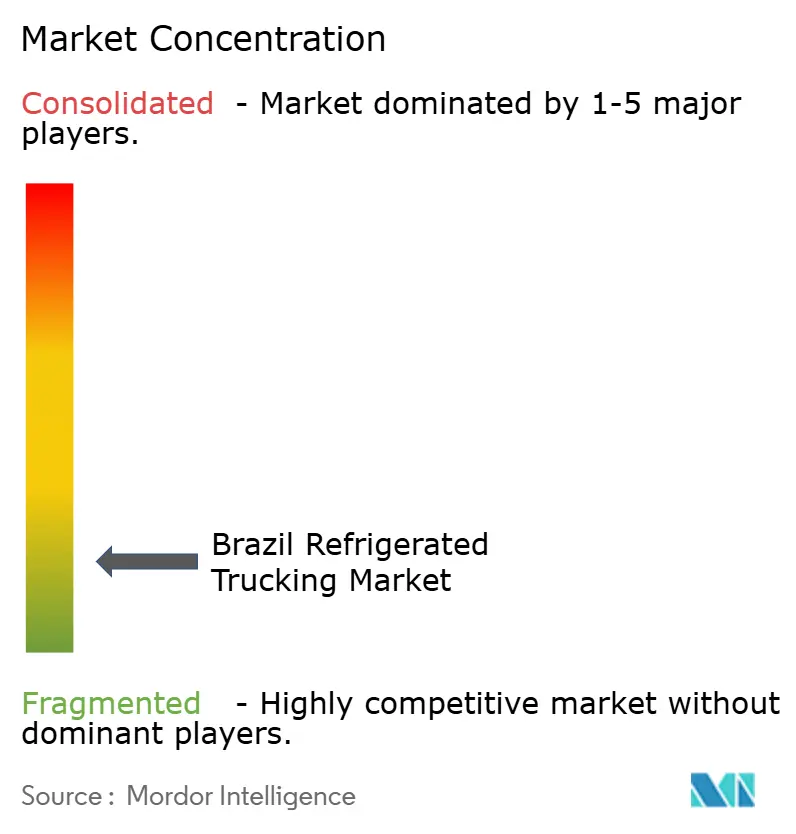
The Brazil refrigerated trucking market is fragmented. Integrated operators compete through fleet scale, national coverage, technology, and the ability to serve several customer categories. Regional specialists compete through corridor knowledge and long-standing relationships with food producers and retailers. JSL, Emergent Cold LatAm, and SuperFrio represent a larger integrated group. At the same time, BORA Transportes, DJE Transportes, Natal Transportes, Piraju Transportes, and CAP Logística Frigorificada focus more closely on selected routes or temperature needs. This structure gives large operators an advantage in complex national contracts. It also leaves room for specialists that can provide dependable service in specific regions.
Emergent Cold LatAm completed its acquisition of Comfrio in September 2025 after regulatory approval, creating a business with 37 facilities in 12 Brazilian states, 4 million m³ of capacity, and 610,000 pallet positions[4]. The transaction expanded its coverage into Minas Gerais, Ceará, Bahia, Mato Grosso, Goiás, and Amazonas. Other fleet combinations have also sought to improve access to cross-border and long-haul refrigerated routes. These moves show why geographic coverage and network depth are important competitive factors. Consolidation can help operators offer wider service while improving asset use. Regional companies still retain an important role where customers need corridor-specific capability.
Technology is becoming necessary for access to regulated pharmaceutical cargo and high-value food shipments. DHL Supply Chain confirmed a BRL 100 million (USD 17.5 million) investment in refrigerated fleet modernization for pharmaceutical transport in Brazil, including Euro 6 vehicles, AI cameras, and redundant temperature monitoring. DHL Supply Chain also formalized multi-temperature healthcare logistics operations for Bristol-Myers Squibb at Extrema, Minas Gerais, covering storage, inventory, and distribution. Monitoring, documented custody, and equipment redundancy now influence contract eligibility rather than only service quality. Urban last-mile providers are adding refrigerated capability, which can place pressure on smaller regional carriers. Cross-border competence remains a useful differentiator where border requirements and available infrastructure are more complex.
Brazil Refrigerated Trucking Industry Leaders
-
JSL SA
-
Transportes Gral
-
BORA Transportes
-
SuperFrio Armazéns Gerais SA
-
Emergent Cold LatAm (including Comfrio)
- *Disclaimer: Major Players sorted in no particular order
Brazil Refrigerated Trucking Market Companies Covered in this Report
- JSL SA
- Transportes Gral
- BORA Transportes
- SuperFrio Armazéns Gerais SA
- Emergent Cold LatAm (including Comfrio)
- Ghelere Transportes (including Brilhante Transportes)
- Friozem Armazéns Frigoríficos
- ARFRIO Armazéns Gerais Frigoríficos
- DHL Group
- Unindo Logística
- DJE Transportes
- Boeng Logística
- Kanejo Logística
- Natal Transportes
- Piraju Transportes
- MegaFrio Logística
- CAP Logística Frigorificada
- Cooperunião Transportes
- Luft Logistics
- Multilog
- Yusen Logistics
- NX Group
Recent Industry Developments in Brazil Refrigerated Trucking Market
- September 2026: DHL Supply Chain formalized pharmaceutical logistics operations for Bristol-Myers Squibb at its Extrema campus, including multi-temperature storage and distribution across Brazil.
- September 2026: Brazil’s Ministry of Ports and Airports reported approval of the MUC04 terminal model at the Port of Fortaleza, requiring BRL 429 million (USD 75.3 million) in investment over a 25-year lease and providing at least 1,226 reefer plugs.
- March 2026: DHL Supply Chain confirmed BRL 100 million (USD 17.5 million) in refrigerated fleet modernization for pharmaceutical transport in Brazil, with additional units planned during 2026.
- September 2025: Emergent Cold LatAm completed the acquisition of Comfrio after CADE regulatory approval in July 2025. The company operates 37 facilities across 12 Brazilian states, totaling 4 million m³ of capacity and 610,000 pallet positions.
Brazil Refrigerated Trucking Market Report Scope
Segmentation Overview
| Horticultural Products |
| Dairy and Frozen Dessert Products |
| Meats, Poultry, Fish, and Seafood |
| Processed Food Products |
| Healthcare and Pharmaceutical |
| Other Applications |
| Full-Truckload (FTL) |
| Less-than-Truckload (LTL) |
| Containerized |
| Non-Containerized |
| Long Haul |
| Short Haul |
| Domestic |
| Cross-border |
| Chilled (0–5 °C) |
| Frozen (-20–0 °C) |
| Ambient |
| Deep-Frozen / Ultra-Low (Less than -20 °C) |
| North |
| Northeast |
| Central-west |
| Southeast |
| South |
| By Application | Horticultural Products |
| Dairy and Frozen Dessert Products | |
| Meats, Poultry, Fish, and Seafood | |
| Processed Food Products | |
| Healthcare and Pharmaceutical | |
| Other Applications | |
| By Truckload Specification | Full-Truckload (FTL) |
| Less-than-Truckload (LTL) | |
| By Containerization | Containerized |
| Non-Containerized | |
| By Distance | Long Haul |
| Short Haul | |
| By Destination | Domestic |
| Cross-border | |
| By Temperature Type | Chilled (0–5 °C) |
| Frozen (-20–0 °C) | |
| Ambient | |
| Deep-Frozen / Ultra-Low (Less than -20 °C) | |
| By Region | North |
| Northeast | |
| Central-west | |
| Southeast | |
| South |
Key Questions Answered in the Report
What is the projected growth rate for refrigerated trucking in Brazil?
The Brazil refrigerated trucking market is forecast to register a 5.03% CAGR from 2027 to 2032, reaching USD 3.36 billion by 2032.
Which cargo category holds the largest share in Brazil’s refrigerated trucking sector?
Meats, poultry, fish, and seafood is the largest application category, with a 29.12% share in 2026.
Which refrigerated transport application is expected to grow the fastest?
Healthcare and pharmaceutical is projected to register at a 6.47% CAGR through 2032, supported by stricter handling and documentation requirements.
Why are pharmaceutical cold-chain services important in Brazil?
Pharmaceutical freight needs documented temperature control, including 2–8 °C handling for many products, which raises the value of compliant operators.
What limits the expansion of refrigerated road transport in Brazil?
Fuel costs, a limited refrigerated fleet, road conditions, and temperature risks during transfer points constrain reliable capacity.
Which Brazilian region is experiencing the strongest projected growth in refrigerated road transport?
The Northeast is projected to register at a 7.41% CAGR through 2032, supported by port activity and broader cold-chain investment.