
Brazil Palm Oil Market Size and Share
Market Overview
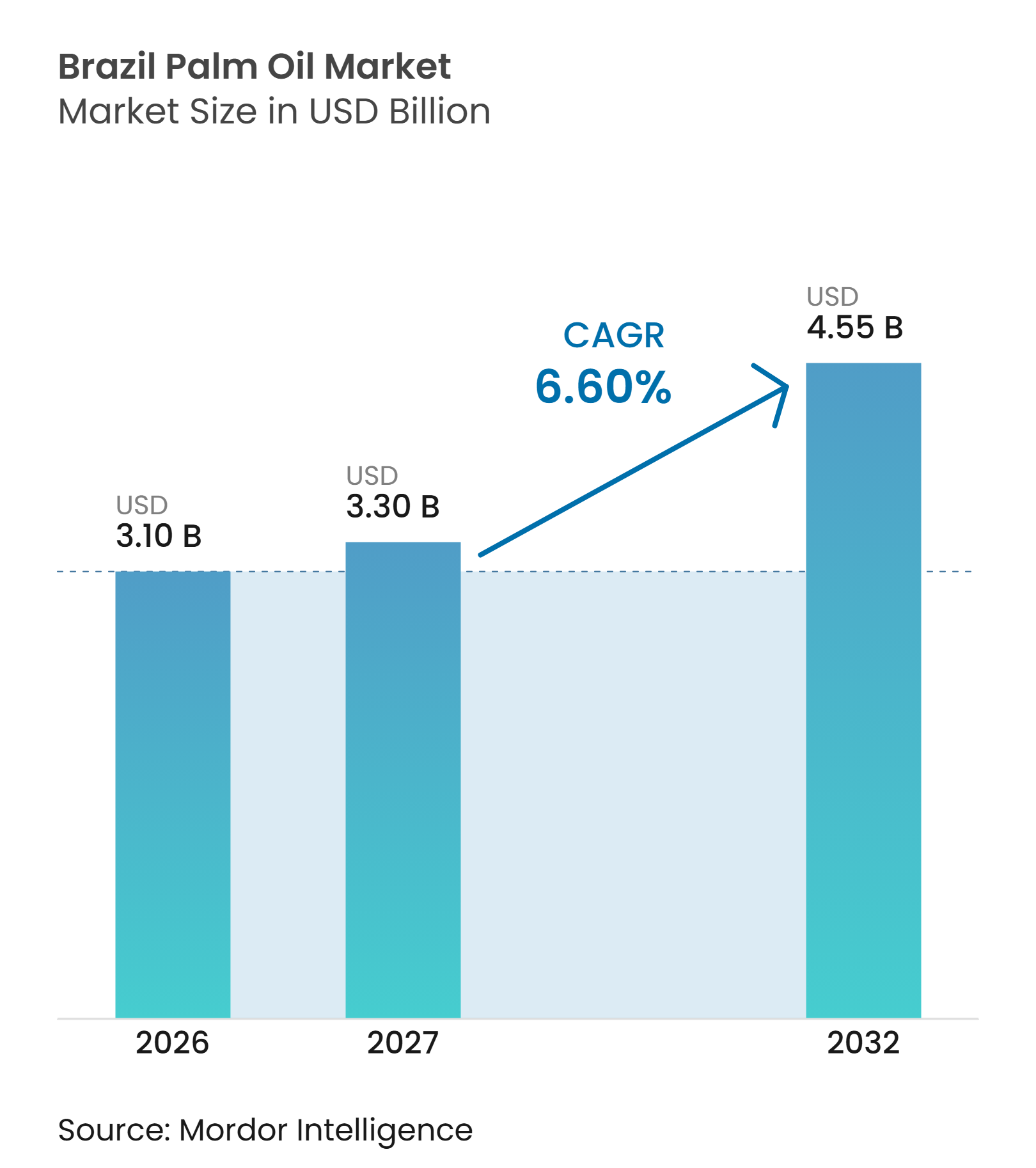
| Study Period | 2027 - 2032 |
|---|---|
| Forecast Data Period | 2027 - 2032 |
| Base Year Market Size (2026) | USD 3.10 Billion |
| Market Size (2027) | USD 3.30 Billion |
| Market Size (2032) | USD 4.55 Billion |
| Growth Rate (2027 - 2032) | 6.60 % |
| Market Concentration | Medium |
Major Players *Disclaimer: Major Players sorted in no particular order Image © Mordor Intelligence. Reuse requires attribution under CC BY 4.0. | |
Brazil Palm Oil Market Analysis by Mordor Intelligence
The Brazil palm oil market size is expected to increase from USD 3.10 billion in 2026 to USD 3.30 billion in 2027 and reach USD 4.55 billion by 2032, growing at a CAGR of 6.60% over 2027–2032. Market growth is supported by rising demand for palm oil in food processing and edible oil applications, alongside its expanding use in biodiesel production, personal care products, and oleochemicals. The availability of suitable land and investments in cultivation, processing, refining, and fractionation infrastructure further support industry development. Demand for affordable vegetable oils and the versatility of palm oil derivatives create opportunities across food and industrial applications. However, environmental concerns related to deforestation and biodiversity loss, dependence on the concentrated production base in Pará, and stringent sustainability and traceability requirements present challenges. Competition from soybean oil and other vegetable oils also influences market expansion. Growth therefore favors producers that can strengthen sustainable sourcing, improve supply-chain traceability, and expand processing capabilities while serving the food, industrial, and biofuel sectors.
Key Report Takeaways
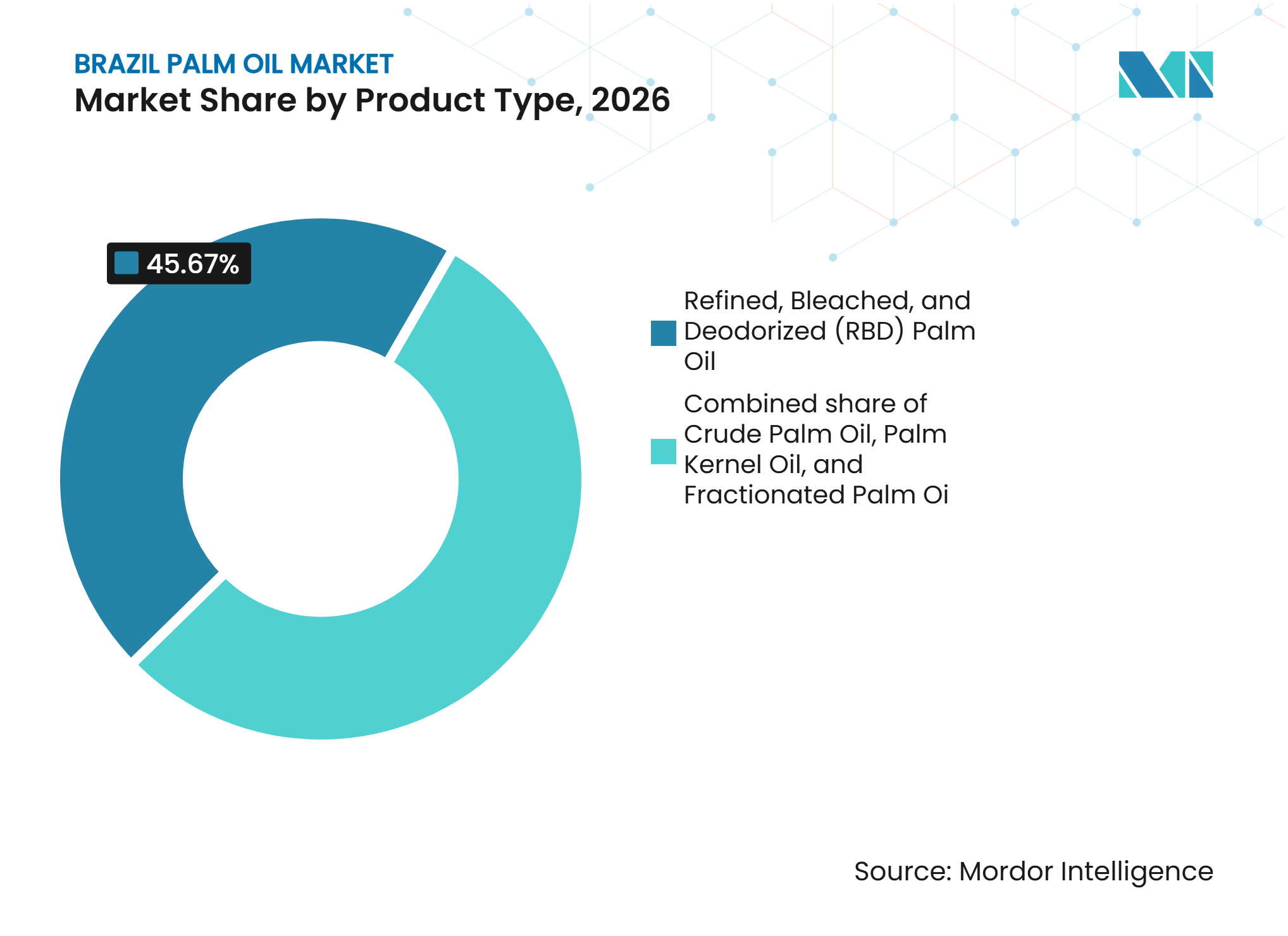
- By product type, Refined, Bleached, and Deodorized (RBD) palm oil accounted for the largest share of the Brazil palm oil market size at 45.67% in 2026, while palm kernel oil is forecast to grow fastest at a 6.20% CAGR over 2026–2031.
-
By nature, conventional palm oil dominated with a 97.45% market share in 2026, while organic palm oil is projected to record the fastest growth at a 7.00% CAGR over 2026–2031.
-
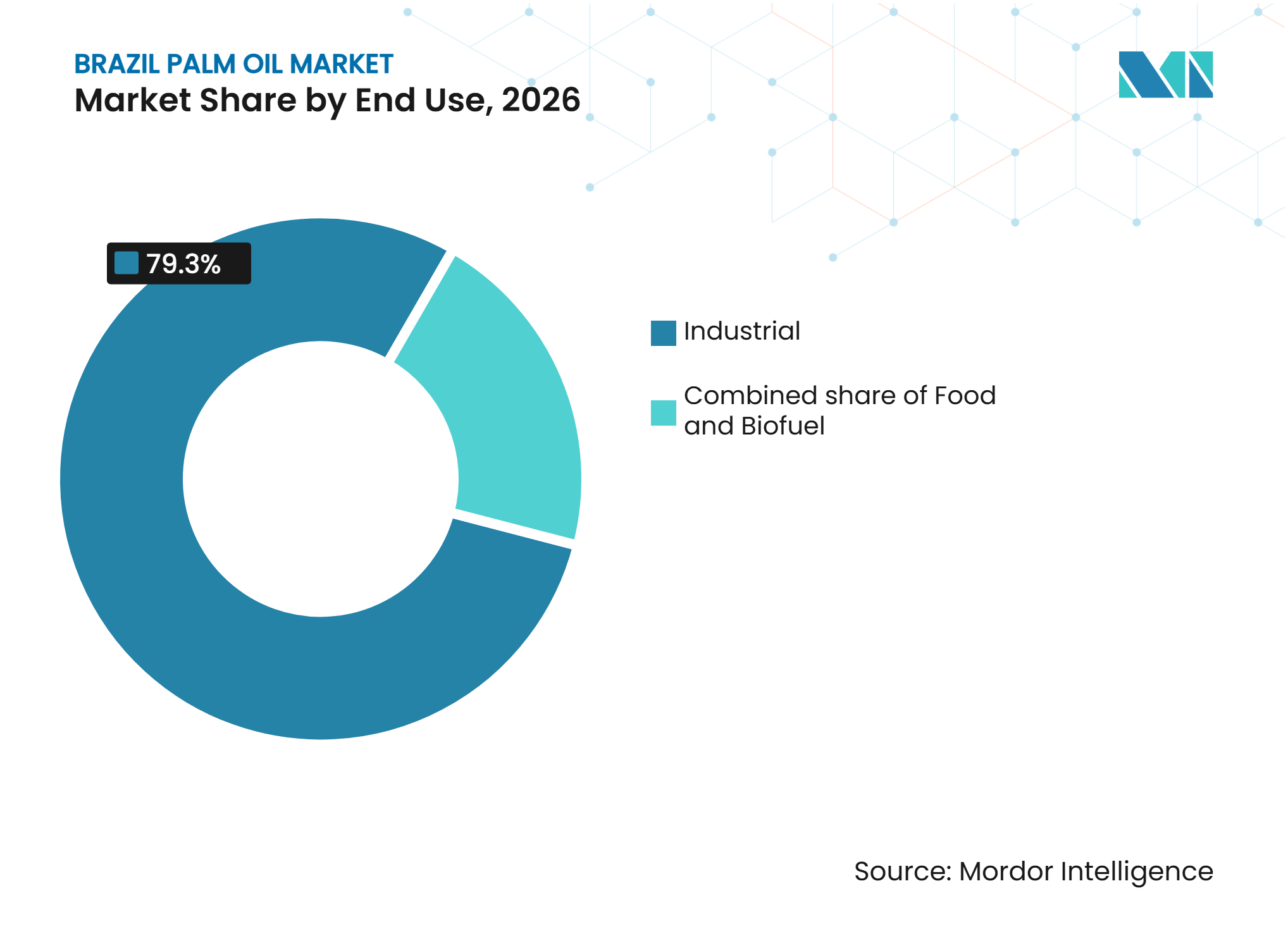
By end use, industrial applications accounted for the largest share at 79.30% in 2026, while biofuel applications are expected to grow fastest at a 7.20% CAGR over 2026–2031.
-
Among geographies, Southeast Brazil led with a 46.89% share of the Brazil palm oil market in 2026, while South Brazil is forecast to register the fastest growth at a 6.50% CAGR over 2026–2031.
Note: Market numbers in this report are based on Mordor Intelligence's proprietary estimation framework, which combines nine months of actuals with Q4 projections for base year 2026.
Market Trends and Insights
Drivers of Brazil Palm Oil Market*
| Driver | (~) % Impact on CAGR Forecast | Geographic Relevance | Impact Timeline |
|---|---|---|---|
| Growing demand for palm oil in food processing and edible oil applications | +0.9% | Brazil, particularly Southeast and South Brazil, where food-processing industries and large consumer markets support demand for edible oils | Medium term (2–4 years) |
| Expansion of biodiesel production and renewable fuel applications | +0.8% | Brazil, particularly Southeast and Central-West Brazil, supported by biofuel production and agricultural supply-chain activity | Medium term (2–4 years) |
| Rising demand for palm oil derivatives in personal care and oleochemicals | +0.7% | Brazil, particularly Southeast and South Brazil, where personal care, cosmetics, and oleochemical manufacturing activities create industrial demand | Long term (More than 4 years) |
| Availability of suitable land and expansion of oil palm cultivation | +0.6% | Primarily North Brazil, particularly Pará, where oil palm cultivation and production are concentrated | Long term (More than 4 years) |
| Growing domestic consumption of affordable vegetable oils | +0.5% | Nationwide, particularly Southeast and Northeast Brazil, supported by household consumption and food-processing demand | Short term (Less than 2 years) |
| Investments in palm oil processing, refining, and fractionation infrastructure | +0.5% | Primarily North and Southeast Brazil, reflecting the production base in Pará and major downstream industrial demand centres | Medium term (2–4 years) |
| Source: Mordor Intelligence | |||
Growing Demand for Palm Oil in Food Processing and Edible Oil Applications
Demand from Brazil’s food-processing industry supports the use of palm oil across several processed food categories, including biscuits, cakes, ice cream, chocolates, pasta, and margarine. The Brazilian Ministry of Finance identifies palm oil as an input used in the manufacture of these products and notes that imports play an important role in meeting domestic industrial requirements. The government’s decision to increase the tariff-exempt import quota for palm oil from 60,000 tonnes to 150,000 tonnes in 2025 also reflects the importance of this ingredient to the processed-food supply chain [1]. Palm oil’s functional properties, including its suitability for frying, bakery applications, and margarine production, further support its use as an edible oil ingredient. For suppliers, these applications create opportunities to serve food manufacturers through crude, refined, and fractionated palm oil products. However, competition from soybean oil and dependence on imported supplies remain relevant considerations.
Expansion of Biodiesel Production and Renewable Fuel Applications
Brazil’s established biodiesel industry provides a potential additional outlet for palm oil and its derivatives as renewable fuel feedstocks. The National Agency of Petroleum, Natural Gas and Biofuels (ANP) monitors domestic biodiesel production through regularly updated production statistics, reflecting the scale and development of the country’s biofuel sector [2]. Embrapa identifies oil palm as a high-productivity oilseed crop with potential for biodiesel production, particularly in northern Brazil, where cultivation can support regional agricultural and energy supply chains [3]. The Brazilian government’s agroecological zoning initiative for oil palm also considers the crop’s potential contribution to the country’s energy matrix and sustainable rural development. These developments create opportunities for palm oil producers to explore biofuel applications alongside established food and industrial markets. Nevertheless, palm oil currently represents a relatively limited component of Brazil’s biodiesel feedstock mix, with soybean oil remaining the dominant feedstock; therefore, further growth depends on feedstock economics, processing capacity, and competitiveness with alternative oils.
Rising Demand for Palm Oil Derivatives in Personal Care and Oleochemicals
The use of palm oil and palm kernel oil in personal care, cosmetics, hygiene, and oleochemical applications broadens the market beyond conventional edible oil consumption. Embrapa identifies palm oil as an input used in food, cosmetics, hygiene, and cleaning products, while palm kernel oil is particularly relevant to cosmetic manufacturing [4]. The different fatty-acid compositions of palm oil and palm kernel oil allow processors to supply ingredients for a range of downstream formulations, including soaps, detergents, and personal care products. These applications create opportunities for Brazilian producers and processors to expand the supply of refined oils and specialized derivatives to industrial customers. The development of value-added processing can also improve the utilization of different oil fractions and support diversification across end-use industries. However, demand depends on the formulation requirements of downstream manufacturers, product quality standards, and competition from alternative vegetable oils and synthetic oleochemical inputs.
Availability of Suitable Land and Expansion of Oil Palm Cultivation
Brazil’s agroecological conditions and the availability of previously altered or deforested land in selected areas of the Amazon provide opportunities for the expansion of oil palm cultivation. Embrapa’s agroecological zoning initiative identifies areas with cultivation potential across several states in the Legal Amazon and was developed to guide expansion in line with environmental, social, and economic sustainability considerations. The Ministry of Agriculture’s agricultural zoning for Pará also identifies municipalities and soil and climate conditions considered suitable for oil palm cultivation. More recently, a technical note published through the Ministry of Development, Industry, Trade and Services reports that Pará accounted for approximately 92% of Brazil’s oil palm planted area in 2024, highlighting the concentration of the existing cultivation base. Expansion within suitable, already altered areas can improve domestic raw-material availability and support the development of local processing capacity. However, land-use restrictions, environmental safeguards, plantation establishment costs, and the long maturation period of oil palm cultivation influence the pace of new capacity development.
Growing Domestic Consumption of Affordable Vegetable Oils
Domestic demand for vegetable oils across household consumption and food manufacturing supports the use of palm oil as part of Brazil’s edible oil supply. The OECD-FAO Agricultural Outlook identifies food preparation and food manufacturing as major uses of vegetable oils and projects Brazil’s per-capita food consumption of vegetable oils to remain significant over the coming years. In the domestic processed-food sector, the Brazilian Ministry of Finance has also identified palm oil as an important ingredient in products such as biscuits, cakes, ice cream, chocolates, pasta, and margarine. Its 2025 discussion of the increased tariff-exempt import quota linked the measure to reducing production costs for processed foods. Palm oil’s functionality in food formulations and availability in refined and fractionated forms allow manufacturers to use it across different product categories. This creates opportunities for suppliers serving price-sensitive food manufacturers and the broader edible oil market. However, the relative attractiveness of palm oil depends on international prices, import costs, exchange-rate movements, and competition from domestically available soybean oil.
Restraints of Brazil Palm Oil Market*
| Restraint | (~) % Impact on CAGR Forecast | Geographic Relevance | Impact Timeline |
|---|---|---|---|
| Environmental concerns related to deforestation and biodiversity loss | −0.8% | Primarily North Brazil, particularly Pará and the wider Amazon region, where oil palm cultivation is subject to heightened environmental scrutiny | Long term (More than 4 years) |
| Dependence on the concentrated production base in Pará | −0.7% | Primarily North Brazil, particularly Pará, with potential supply-chain implications for processing and consumption markets across Southeast, Northeast, and other regions | Medium term (2–4 years) |
| Stringent sustainability, traceability, and environmental compliance requirements | −0.6% | Nationwide, particularly North Brazil for cultivation and production, and Southeast Brazil for downstream processing and industrial buyers | Medium term (2–4 years) |
| Competition from soybean oil and other vegetable oils | −0.5% | Nationwide, particularly Southeast and South Brazil, where food manufacturers and industrial buyers have access to alternative vegetable oil supplies | Short term (Less than 2 years) |
| Source: Mordor Intelligence | |||
Environmental Concerns Related to Deforestation and Biodiversity Loss
Oil palm cultivation in Brazil faces environmental scrutiny because agricultural expansion in the Amazon region can create risks for forest ecosystems, biodiversity, and land-use sustainability. Although Brazil has designated suitable areas for oil palm cultivation on previously deforested land, ensuring that plantation development remains within permitted areas requires effective land-use monitoring and environmental oversight. Concerns regarding habitat loss, ecosystem disruption, and the environmental footprint of agricultural production can influence the willingness of industrial buyers and downstream manufacturers to source palm oil from suppliers with insufficient sustainability safeguards. These concerns also increase the importance of responsible plantation management, environmental licensing, and traceable sourcing practices. Producers must therefore balance cultivation expansion with forest protection and compliance with environmental requirements, which can increase operational complexity and constrain the development of new plantations.
Dependence on the Concentrated Production Base in Pará
Brazil's oil palm production is heavily concentrated in Pará, making the domestic supply chain dependent on a relatively limited geographic production base. This concentration exposes the market to regional disruptions arising from adverse weather conditions, agricultural diseases, labour constraints, infrastructure limitations, and logistical interruptions. Since palm oil extraction requires harvested fresh fruit bunches to be transported and processed promptly, disruptions affecting plantations or nearby processing facilities can influence production continuity and oil quality. The concentration of cultivation and processing activities also increases the importance of transportation links connecting production areas with domestic industrial buyers and other consumption regions. Limited geographic diversification can therefore create supply-chain vulnerabilities and make it more difficult for processors to maintain consistent raw-material availability across different market conditions.
*Our forecasts treat driver/restraint impacts as directional, not additive. The impact forecasts reflect baseline growth, mix effects, and variable interactions.
Brazil Palm Oil Market Segment Analysis
By Product Type:
RBD Palm Oil Leads While Palm Kernel Oil Expands FasterIn 2026, Refined, Bleached, and Deodorized (RBD) palm oil accounted for the largest share of the Brazil palm oil market, representing 45.67% of the market. Its leading position reflects demand for refined palm oil in food processing and industrial applications, where consistent quality and functional properties support its use in products such as margarine, bakery items, confectionery, and other processed foods. Meanwhile, palm kernel oil is projected to record the fastest growth, at a CAGR of 6.20% over 2026–2031. Its applications in personal care, cosmetics, soaps, and oleochemicals provide opportunities for demand expansion beyond conventional edible oil uses.
Crude palm oil serves as the primary output of oil palm processing and provides the raw material for refining and further industrial applications. Fractionated palm oil, including olein and stearin, offers differentiated functional properties for food manufacturers and other industrial users. Demand across product categories therefore depends on the requirements of downstream processors, product specifications, and the availability of suitable processing infrastructure. The ability to maintain consistent quality, improve refining capabilities, and supply application-specific palm oil products will remain important for market participants.



By Nature:
Conventional Palm Oil Dominates While Organic Palm Oil Grows FasterIn 2026, conventional palm oil accounted for 97.45% of the Brazil palm oil market, making it the dominant category by nature. Its substantial position reflects the established cultivation, processing, and distribution infrastructure supporting conventional palm oil production and its widespread use across food, industrial, and biofuel applications. Meanwhile, organic palm oil is projected to record the faster growth, at a CAGR of 7.00% over 2026–2031. Growing attention to sustainable agricultural practices, responsible sourcing, and environmental considerations creates opportunities for organically produced palm oil, particularly among buyers with specific sustainability and procurement requirements.
Conventional palm oil benefits from a broader established supply base and wider availability across domestic applications. Organic palm oil, in contrast, requires compliance with organic production and certification requirements, which can increase cultivation, segregation, documentation, and supply-chain management complexity. The ability to maintain certified sourcing, ensure traceability, and meet downstream customer specifications will influence the development of the organic segment.
By End Use:
Industrial Applications Lead While Biofuel Expands FasterIn 2026, industrial applications accounted for the largest share of the Brazil palm oil market, representing 79.30% of the market. This leading position reflects the use of palm oil and its derivatives across food manufacturing, personal care, cosmetics, soaps, detergents, and oleochemical applications. Industrial buyers use different palm oil grades and fractions according to their formulation and processing requirements. Meanwhile, the biofuel segment is projected to record the fastest growth, at a CAGR of 7.20% over 2026–2031. The development of Brazil's biodiesel industry and the potential use of palm oil as a renewable feedstock provide opportunities for this application.
The food segment represents another important application, supported by palm oil's functional properties in bakery products, confectionery, margarine, and other processed foods. Industrial demand is influenced by downstream manufacturing activity and the requirements of specialized formulations, while biofuel demand depends on feedstock economics, biodiesel production capacity, and competition from alternative oils. Market participants will need to balance established industrial demand with emerging opportunities in renewable fuel applications.

Geography Analysis
North Brazil Palm Oil Market
North Brazil represents the core production region of the Brazil Palm Oil Market, with cultivation and processing concentrated primarily in Pará, followed by Roraima and Amapá. According to the USDA Foreign Agricultural Service, Pará accounts for more than 85% of Brazil's palm oil production. The region benefits from established oil palm plantations, extraction facilities, and processing infrastructure. Continued investment in cultivation, processing capacity, and sustainable production practices is expected to support the regional supply base.
Northeast Brazil Palm Oil Market
Northeast Brazil has an established role in palm oil production and consumption, particularly through Bahia. Research on palm oil consumption in Brazil identifies Bahia as an important production and consumption centre for crude palm oil, supported by its use in regional food preparations. Demand from food applications, alongside local production, supports the region's position in the domestic market. Opportunities are linked to food processing, edible oil applications, and the development of value-added palm oil products.
Southeast Brazil Palm Oil Market
Southeast Brazil accounted for an estimated 46.89% of the Brazil Palm Oil Market in 2026, making it the largest regional market. The region's food-processing, personal care, cosmetics, and oleochemical industries support demand for refined and fractionated palm oil products and their derivatives. Its industrial and consumer markets create opportunities for suppliers to serve food manufacturers and downstream product companies. Established processing and distribution networks further support the region's role as a major demand centre.
Competitive Landscape
Market Concentration
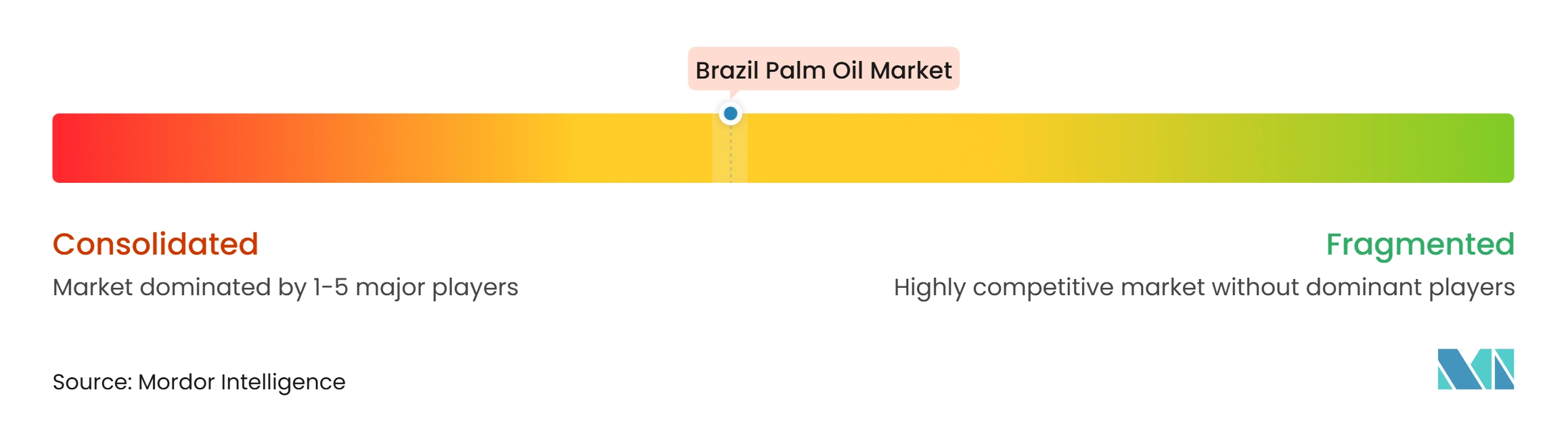
The Brazil Palm Oil Market includes domestic oil palm cultivators and processors, integrated palm oil producers, international agribusiness companies, specialty oils and fats manufacturers, oleochemical suppliers, and downstream consumer goods companies. The companies listed in the competitive landscape have varying levels of participation across cultivation, extraction, refining, fractionation, distribution, and end-use applications. Domestic producers such as Agropalma Group, Brasil BioFuels (BBF), Belém Bioenergia Brasil (Tauá Brasil Palma), Marborges Agroindústria, and Denpasa – Dendê do Pará are associated with Brazil's oil palm production and processing base. International companies such as AAK AB, Bunge Limited, Cargill, Archer Daniels Midland Company (ADM), Olenex, KLK Oleo, Oleon, and Sime Darby Oils have broader exposure to vegetable oils, specialty fats, and oleochemical value chains.
Competitive strategies in the Brazil Palm Oil Market involve strengthening production and processing capabilities, expanding refined and specialty oil portfolios, improving supply-chain integration, and serving diverse industrial applications. Domestic producers compete through access to oil palm cultivation areas, extraction capacity, refining operations, and relationships with downstream buyers. Agropalma Group, BBF, Tauá Brasil Palma, Marborges, and Denpasa are relevant to the domestic production landscape, while companies such as AAK, Bunge, Cargill, ADM, and Olenex participate in broader vegetable oil and specialty fats value chains. KLK Oleo and Oleon have exposure to oleochemical applications, where palm-based feedstocks are used in products serving personal care, cleaning, and industrial formulation markets. These different areas of participation create competition across raw-material supply, processing, product quality, and customer relationships.
Downstream demand and sourcing requirements also influence the competitive environment. Companies such as Unilever PLC and Nestlé S.A. represent important downstream consumer goods participants whose product manufacturing and procurement requirements can influence demand for vegetable oil ingredients, including palm-derived materials. Producers and processors must therefore address customer requirements relating to consistent quality, reliable supply, traceability, and responsible sourcing. Environmental scrutiny, the concentration of domestic oil palm production in Pará, and competition from soybean oil and other vegetable oils further shape competitive positioning. Companies with integrated sourcing, efficient processing infrastructure, diversified customer relationships, and credible sustainability practices are better positioned to serve Brazil's food, industrial, personal care, and biofuel value chains.
Brazil Palm Oil Industry Leaders
-
Agropalma Group
-
Brasil BioFuels (BBF)
-
Belém Bioenergia Brasil S.A. (Tauá Brasil Palma)
-
Marborges Agroindústria S.A.
-
Denpasa – Dendê do Pará S.A.
- *Disclaimer: Major Players sorted in no particular order
Brazil Palm Oil Market Companies Covered in this Report
- Agropalma Group
- Brasil BioFuels (BBF)
- Belém Bioenergia Brasil S.A. (Tauá Brasil Palma)
- Marborges Agroindústria S.A.
- Denpasa – Dendê do Pará S.A.
- Ecotauá
- Mejer Óleos e Gorduras Vegetais
- Palmaplan Agroindustrial Ltda.
- Agroindustrial Palmasa S.A.
- Vila Nova Agroindustrial Ltda.
- AAK AB
- Bunge Limited
- Cargill, Incorporated
- Archer Daniels Midland Company (ADM)
- Olenex S.A.
- KLK Oleo
- Oleon NV
- Sime Darby Oils
- Unilever PLC
- Nestlé S.A.
Recent Industry Developments in Brazil Palm Oil Market
- June 2026: Daabon Group completed the acquisition of 100% of Agropalma's operations in Pará, marking its entry into Brazil's palm oil industry. The transaction included oil palm plantations, forest reserve areas, six extraction mills in Tailândia, and a refinery in Belém. The acquired facilities retained the Agropalma brand, while Daabon indicated plans to invest in plantation productivity, smallholder farmer support, and local community partnerships. The acquisition represents a significant ownership change in Brazil's palm oil production and processing landscape.
- November 2025: Agropalma resumed biodiesel production after a 15-year absence from the segment, inaugurating a new industrial plant in Belém, Pará. The facility uses 100% enzymatic reaction technology and has an authorized annual production capacity of 36,000 cubic metres, with initial production projected at 19,000 cubic metres. The company intends to use oil-bearing residues from palm oil extraction and refining, targeting local biodiesel demand and expanding the utilization of palm processing by-products.
- September 2025: Banco do Brasil and Natura formalized a BRL 50 million financing agreement to support agroforestry systems in northern Brazil, targeting the recovery of 12,000 hectares. The initiative includes the expansion of sustainable oil palm cultivation through agroforestry systems in Tomé-Açu, Pará, where oil palm is cultivated alongside crops such as cocoa, açaí, cassava, and pepper. The partnership aims to improve land-use sustainability, diversify family-farmer income, and strengthen responsible palm oil sourcing.
- August 2025: Agropalma announced plans to invest BRL 25 million by 2026 in its clonal seedling biotechnology laboratory in Belém, Pará, with the objective of increasing annual oil palm seedling production to 2 million units by 2032. The initiative builds on the company's research partnership with the Federal University of Viçosa and focuses on improving plantation productivity through genetically selected planting material. Clonal seedlings are expected to offer benefits such as shorter harvesting cycles, improved drought tolerance, and lower fertilizer requirements, supporting production efficiency and agricultural sustainability.
Brazil Palm Oil Market Report Scope
For this study, the Brazil Palm Oil Market is defined as the sales value of palm oil and palm oil-derived products produced, processed, imported, and sold in Brazil. The market covers crude palm oil, palm kernel oil, refined, bleached, and deodorized (RBD) palm oil, and fractionated palm oil. It is segmented by nature into organic and conventional products, and by end use into industrial, food, and biofuel applications. Industrial applications include the use of palm oil and its derivatives in personal care products, cosmetics, soaps, detergents, and oleochemicals, while food applications cover their use in edible oils, margarine, bakery products, confectionery, and other processed foods. The market is analyzed across North Brazil, Northeast Brazil, Central-West Brazil, Southeast Brazil, and South Brazil, with regional coverage as specified in the report. Market sizing and forecasts are presented in value terms (USD) across the defined product types, nature, end uses, and geographies.
Segmentation Overview
| Crude Palm Oil |
| Palm Kernel Oil |
| Refined, Bleached, and Deodorized (RBD) Palm Oil |
| Fractionated Palm Oil |
| Organic |
| Conventional |
| Industrial |
| Food |
| Biofuel |
| North Brazil |
| Northeast Brazil |
| Central-West Brazil |
| Southeast Brazil |
| South Brazil |
| By Product Type | Crude Palm Oil |
| Palm Kernel Oil | |
| Refined, Bleached, and Deodorized (RBD) Palm Oil | |
| Fractionated Palm Oil | |
| By Nature | Organic |
| Conventional | |
| By End Use | Industrial |
| Food | |
| Biofuel | |
| By Geography | North Brazil |
| Northeast Brazil | |
| Central-West Brazil | |
| Southeast Brazil | |
| South Brazil |
Key Questions Answered in the Report
What is the size of the Brazil Palm Oil Market?
The Brazil Palm Oil Market is estimated at USD 3.10 billion in 2026 and is projected to reach USD 4.55 billion by 2032, growing at an estimated CAGR of 6.60% over 2027–2032.
Which product type holds the largest share of the Brazil Palm Oil Market?
Refined, Bleached, and Deodorized (RBD) Palm Oil holds the largest share of the Brazil Palm Oil Market, accounting for 45.67% in 2026.
Which segment is expected to grow the fastest in the Brazil Palm Oil Market?
The Biofuel segment is expected to record the fastest growth among end-use segments, with a projected CAGR of 7.20% over 2026–2031.
Which region dominates the Brazil Palm Oil Market?
Southeast Brazil holds the largest regional share, accounting for 46.89% of the market in 2026.