
Brazil Grapes Harvesters Market Size and Share
Market Overview
| Study Period | 2021 - 2031 |
|---|---|
| Forecast Data Period | 2026 - 2031 |
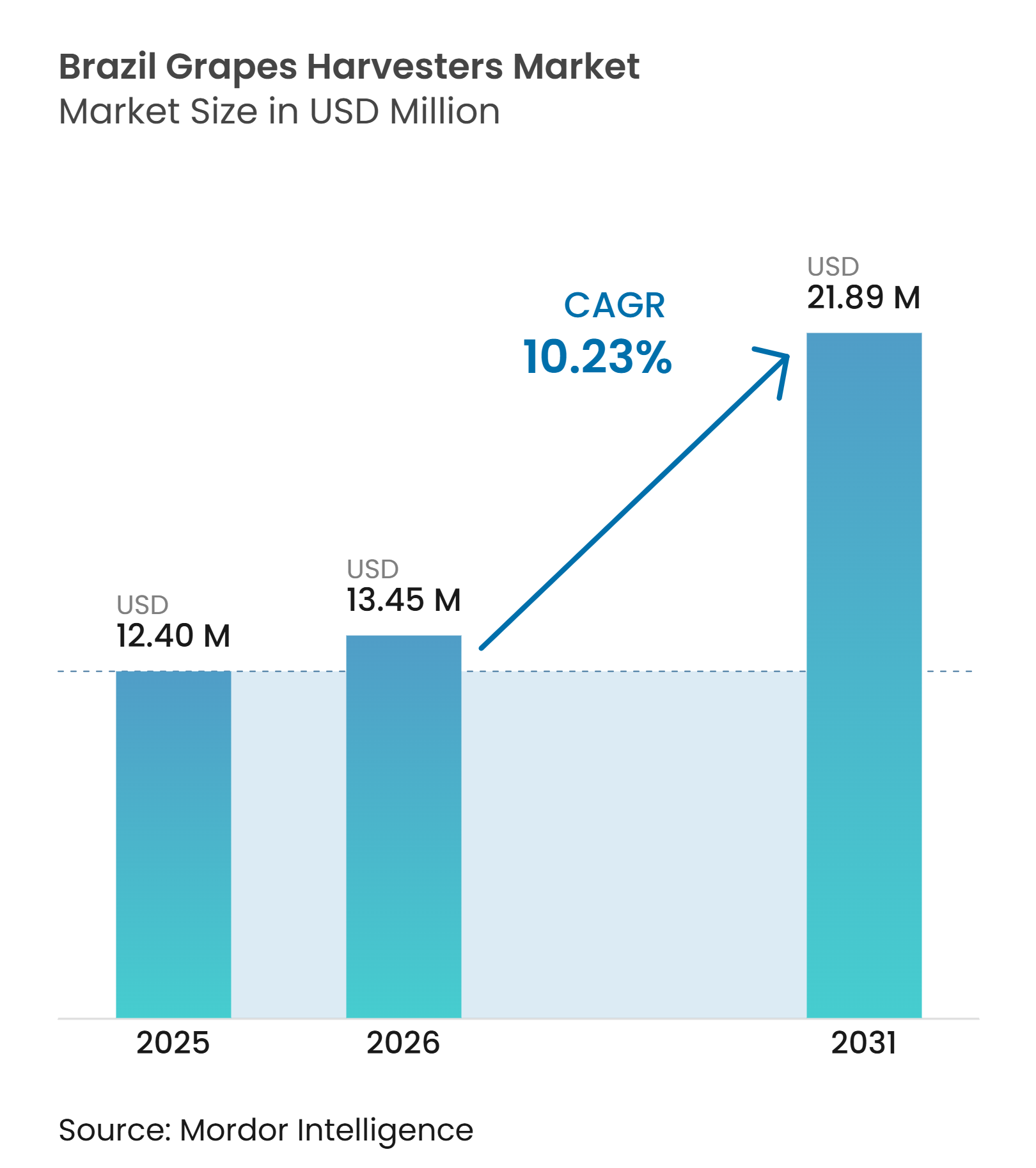
| Base Year Market Size (2025) | USD 12.40 Million |
| Market Size (2026) | USD 13.45 Million |
| Market Size (2031) | USD 21.89 Million |
| Growth Rate (2026 - 2031) | 10.23 % |
| Market Concentration | High |
Major Players *Disclaimer: Major Players sorted in no particular order Image © Mordor Intelligence. Reuse requires attribution under CC BY 4.0. | |
Brazil Grapes Harvesters Market Analysis by Mordor Intelligence
The Brazil grapes harvesters market was valued at USD 12.40 million in 2025 and is estimated to grow from USD 13.45 million in 2026 to reach USD 21.89 million by 2031, at a CAGR of 10.23% during the forecast period (2026-2031). The market remains at an early adoption stage, as manual harvesting still dominates the country's vineyards. Labor availability, vineyard layout, and access to financing will determine how quickly purchase intentions translate into equipment orders. Wineries and cooperatives can reduce adoption barriers by sharing equipment, technical support, and training with member growers. The contrasting harvest calendars of southern and northeastern vineyards also give international manufacturers an incentive to serve the Brazil grapes harvesters market outside their home harvesting season.
Key Report Takeaways
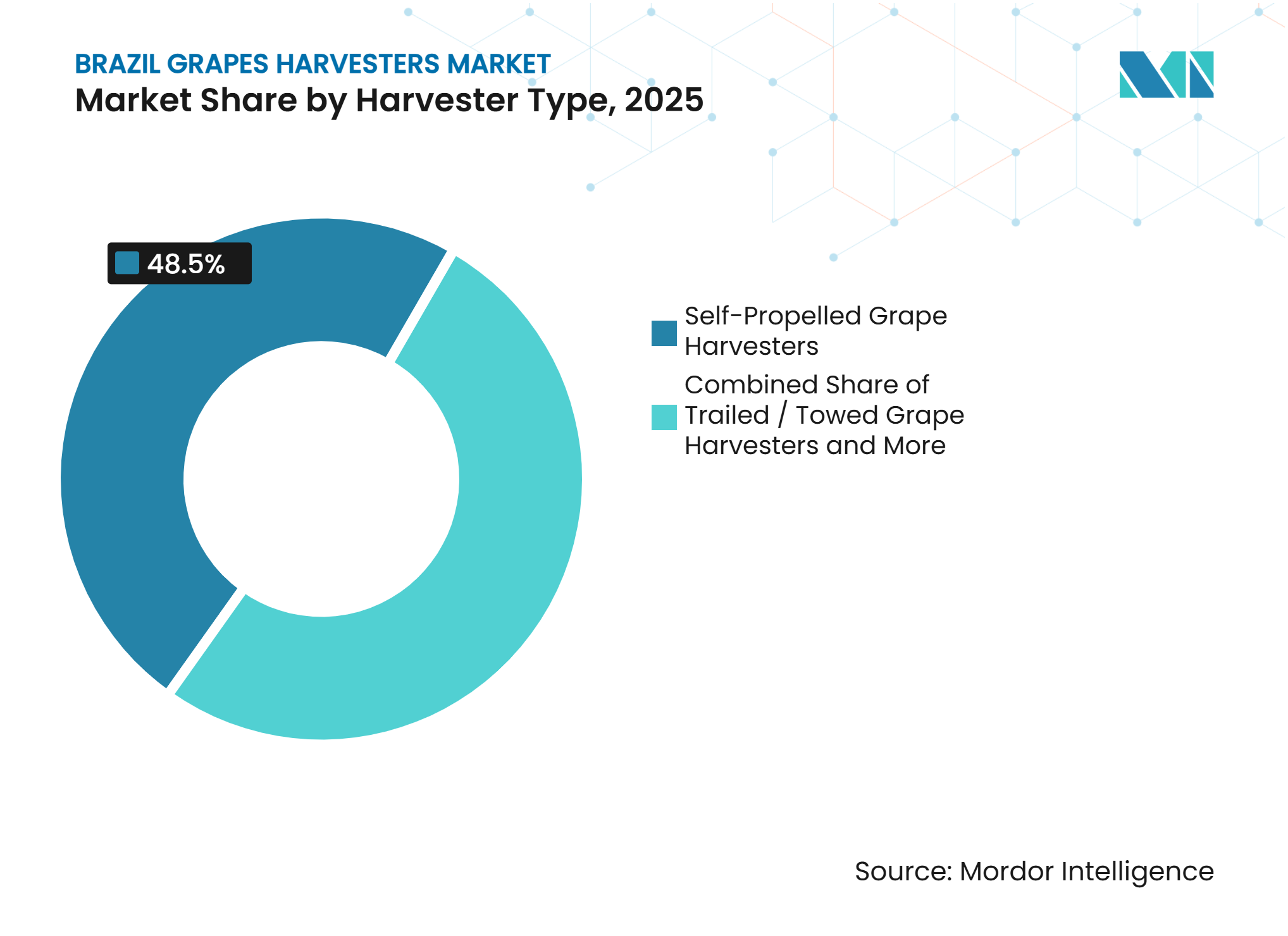
- By harvester type, self-propelled harvesters accounted for 48.5% of the Brazil grapes harvesters market share in 2025, while tractor-mounted harvesters are forecast to be the fastest-growing segment, with a CAGR of 11.8% from 2026 to 2031.
- By mode of operation, assisted and precision-guided systems accounted for 54.2% of the Brazil grapes harvesters market size in 2025, while autonomous and semi-autonomous systems are forecast to be the fastest-growing segment, with a CAGR of 13.2% from 2026 to 2031.
- By power source, diesel harvesters accounted for 66.8% of the market share in 2025, while electric harvesters are forecast to be the fastest-growing segment, with a CAGR of 14.0% from 2026 to 2031.
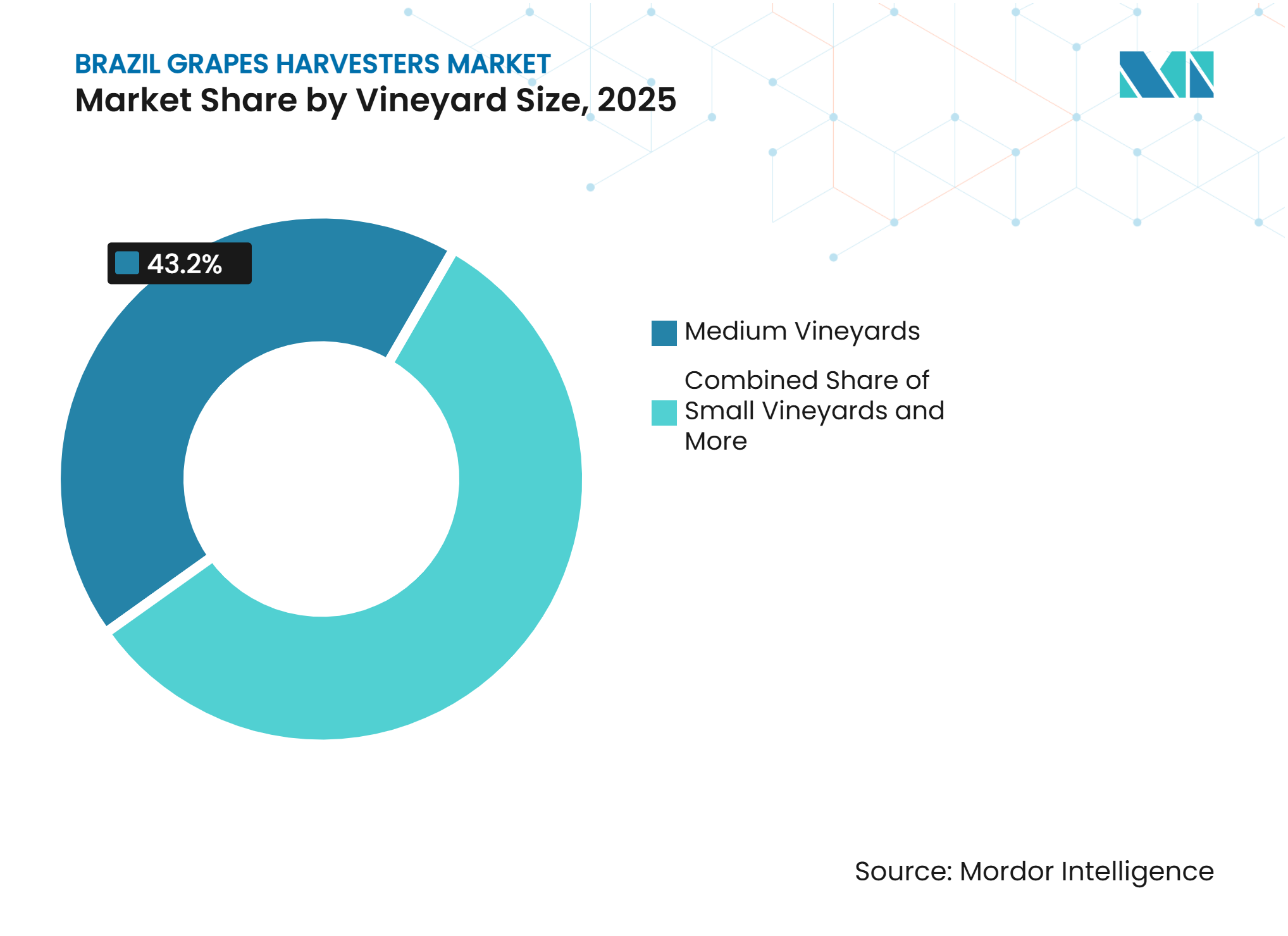
- By vineyard size, medium vineyards accounted for 43.2% of the market share in 2025, while small vineyards are forecast to be the fastest-growing segment, with a CAGR of 12.4% from 2026 to 2031.
Note: Market size and forecast figures in this report are generated using Mordor Intelligence’s proprietary estimation framework, updated with the latest available data and insights as of January 2026.
Market Trends and Insights
Drivers Impact Analysis of Brazil Grapes Harvesters Market*
| Driver | (~) % Impact on CAGR Forecast | Geographic Relevance | Impact Timeline |
|---|---|---|---|
| Vineyard labor shortages and wage pressure | +2.8% | Brazil-wide, concentrated in Serra Gaúcha and São Francisco Valley | Short term (≤ 2 years) |
| Expansion of irrigated, multi-cycle vineyards in the São Francisco Valley | +2.2% | Northeastern Brazil, particularly Pernambuco and Bahia | Medium term (2-4 years) |
| Export-oriented quality and harvest-window compliance | +1.8% | Brazil-wide, with early gains in Rio Grande do Sul and São Francisco Valley | Medium term (2-4 years) |
| Winery-led mechanization in Rio Grande do Sul | +1.5% | Rio Grande do Sul, particularly Campanha Gaúcha and Serra Gaúcha | Short term (≤ 2 years) |
| Seasonal complementarity supporting shared machinery utilization | +1.2% | Campanha Gaúcha and São Francisco Valley espalier areas | Medium term (2-4 years) |
| Early-stage vineyard redesign for machine-compatible trellising | +1.0% | Brazil-wide, especially São Francisco Valley and Campanha Gaúcha | Long term (≥ 4 years) |
| Source: Mordor Intelligence | |||
Vineyard Labor Shortages and Wage Pressure
Labor scarcity is a direct reason growers are considering mechanical harvesting in the Brazil grapes harvesters market. A 2026 survey by Confederation of Agriculture and Livestock of Brazil (CNA) found that 44.5% of agricultural producers identified labor shortages as their main concern. The same survey reported hiring difficulties for 94.8% of respondents, delayed operations for 48.7%, and accelerated mechanization or automation plans for 42.6% of respondents[1]. Smaller agricultural families in Rio Grande do Sul have reduced the pool of workers available for harvest work. This condition can shorten the equipment payback period even where imported machines remain costly. The need for dependable harvest capacity becomes more acute when fruit reaches maturity simultaneously across neighboring vineyards.
Expansion of Irrigated, Multi-Cycle Vineyards in the São Francisco Valley
The São Francisco Valley supports 2 to 2.5 grape harvests per year, as irrigation allows growers to manage vine cycles. This production pattern increases annual machine use compared with single-cycle vineyards in the south, making the region a more intensive market for harvesting equipment. In 2025, Companhia de Desenvolvimento dos Vales do São Francisco e do Parnaíba (Codevasf ) managed 39 irrigation projects covering 125,000 hectares. These projects generated a Gross Production Value of BRL 8.15 billion (USD 1.55 billion) in 2024, which was 43% higher than the prior year, reflecting the growing agricultural output of the region. Codevasf plans to expand the irrigated area to 250,000 hectares over 5 to 8 years, which is anticipated to further increase demand for mechanized harvesting solutions. The BRL 1.75 billion (USD 304 million) Iuiú irrigation concession in Bahia is scheduled for 2026, and its completion would bring additional vineyard area into production, supporting longer-term growth in machine utilization across the valley.
Export-Oriented Quality and Harvest-Window Compliance
Brazil's expanding grape exports strengthen the need for timely and consistent harvesting, particularly in the São Francisco Valley, which accounts for approximately 98% of the country's exported grapes. In 2025, Brazil exported approximately 62,000 metric tons of grapes, up 5.62% in volume from 2024, according to the Brazilian Association of Fruit Producers and Exporters and Derivatives (Abrafrutas)[2]. The concentration of export production in the São Francisco Valley creates a strong requirement for coordinated harvesting and post-harvest handling, as producers supply demanding international markets and need to maintain fruit quality through the harvest and packing process. The region's irrigated production system also enables producers to schedule production and harvest periods, increasing the importance of completing harvesting operations within planned windows. For the Brazil grapes harvesters market, these conditions support mechanization where harvesting equipment can provide additional capacity during peak periods; however, the direct suitability of mechanical harvesting depends on grape variety, vineyard architecture, and quality requirements.
Winery-Led Mechanization in Rio Grande do Sul
Large wineries and cooperatives can serve as early adopters and service partners for nearby farms. Cooperative programs help member growers adapt vine trellises for equipment compatibility. Shared or contracted equipment reduces the immediate ownership burden for growers unable to finance a machine independently. This approach also generates demand for operator support, parts, and maintenance, while making equipment performance visible to growers before they commit capital. When growers observe consistent results across multiple harvests, confidence in mechanization tends to grow, accelerating broader adoption within the cooperative network. Rio Grande do Sul's winery and cooperative network provides suppliers a practical route to demonstrate equipment in the Brazil grapes harvesters market, allowing them to build references and establish service infrastructure before pursuing wider regional expansion.
Restraints Impact Analysis of Brazil Grapes Harvesters Market*
| Restraint | (~) % Impact on CAGR Forecast | Geographic Relevance | Impact Timeline |
|---|---|---|---|
| Very low national mechanization penetration and thin local installed base | -1.8% | Brazil-wide | Medium term (2-4 years) |
| High capital cost versus smallholder vineyard cash flows | -1.5% | Brazil-wide, concentrated in Serra Gaúcha smallholder clusters | Medium term (2-4 years) |
| Rain-related trafficability and soil moisture disruption | -1.2% | Serra Gaúcha traditional vineyards and legacy latada systems | Long term (≥ 4 years) |
| Trellis, row-geometry, variety, and harvest-quality incompatibility | -0.8% | Serra Gaúcha and wet-season Northeast areas | Short term (≤ 2 years) |
| Source: Mordor Intelligence | |||
Very Low National Mechanization Penetration and Thin Local Installed Base
Brazil has historically maintained a small installed base of grape harvesters, limiting local references for machine uptime, resale values, servicing, and field performance. Challenges related to imported spare parts, maintenance, and access to specialized labor can reduce buyer confidence in capital-intensive harvesting equipment. These constraints increase the importance of local demonstrations, dealer support, technician availability, and spare-parts networks. The Brazil grapes harvesters market therefore remains dependent on the development of a stronger local service ecosystem to support broader mechanization adoption.
High Capital Cost Versus Smallholder Vineyard Cash Flows
Imported self-propelled grape harvesters require a substantial upfront investment, which can exceed the financing capacity of many family vineyards in Rio Grande do Sul. Program for the Modernization of the Agricultural Tractor and Implement Fleet (Moderfrota) allocated BRL 12.3 billion (USD 2.3 billion) under the 2024–25 Crop Plan. The interest rate for large producers under this program decreased from 12.5% to 11.5% per year in that cycle, before increasing to 13.5% in the 2025–26 cycle[3]. Higher borrowing costs can reduce the appeal of direct equipment purchases, particularly for smaller growers with limited cash flow.
*Our forecasts treat driver/restraint impacts as directional, not additive. The impact forecasts reflect baseline growth, mix effects, and variable interactions.
Brazil Grapes Harvesters Market Segment Analysis
By Harvester Type:
Self-Propelled Machines Lead, Tractor-Mounted Gains GroundSelf-propelled equipment accounted for 48.5% of the Brazil grapes harvesters market share in 2025. Larger Campanha Gaúcha estates can deploy these machines across contiguous vineyard blocks, spreading capital costs across greater annual output. Flat terrain and established row patterns support straddle-machine operation in this region. The equipment also gives wineries greater control over harvest timing and collection during concentrated harvest periods. This segment is associated with the earliest commercial adopters in Brazilian viticulture.
The Brazil grapes harvesters market for tractor-mounted machines is forecast to grow at a CAGR of 11.8% from 2026 to 2031. These machines are compatible with tractors that many growers already operate, and their lower acquisition costs make them more accessible to cooperatives and medium-scale producers. Trailed and towed machines remain relevant where terrain is relatively flat and harvesting operations can be scheduled efficiently. In contrast, Tecnofrutt has developed self-propelled grape harvesters adapted to the terrain conditions of Serra Gaúcha. In November 2025, New Holland announced the Braud 9.80N for model year 2026, featuring a redesigned narrow-row front axle for compact vineyards.



By Mode of Operation:
Precision Guidance Dominates Installed Base as Autonomy AcceleratesAssisted and precision-guided systems accounted for 54.2% of the Brazil grapes harvesters market in 2025. Imported machines already sold in the country commonly include electro-hydraulic controls and GPS row-following. They can also incorporate ISOBUS interfaces for tractor and implement communication. These functions make operation more consistent when rows are regular and equipment is properly calibrated. They also increase the importance of local technical training and after-sales support. As vineyard operations scale and row configurations become more standardized, demand for assisted systems is anticipated to remain strong.
Autonomous and semi-autonomous equipment is forecast to grow at a CAGR of 13.2% from 2026 to 2031. Sensor systems, terrain compensation, and machine data connectivity can reduce dependence on advanced operator skills, making these systems more accessible to a broader range of vineyard operators. Manual and operator-controlled equipment remains relevant for domestic units with fewer electronic functions, particularly in smaller vineyards where investment in advanced technology may not be justified. In 2025, Pellenc introduced EASY ADJUST, which allows operators to adjust shaker settings remotely and record performance data. This feature can simplify setup for users unfamiliar with mechanical adjustments and reduce the time required for equipment calibration. The Brazil grapes harvesters market can use these functions to improve equipment support as technical capability develops, particularly as local service networks expand to accommodate more complex machinery.
By Power Source:
Diesel Powers Today, Electric Harvesters Redefine Future EconomicsDiesel equipment accounted for 66.8% of the Brazil grapes harvesters market in 2025. This position reflects the country's diesel supply network and the familiarity of mechanics with conventional engines. Diesel machines also align with the equipment types historically covered by agricultural financing programs, making them the default choice for most vineyard operators. Hybrid machines provide an intermediate option for wineries seeking lower fuel consumption without moving entirely away from combustion systems. Their role remains tied to operating costs and service availability, as hybrid-specific maintenance expertise is not yet widely accessible across Brazil's wine-producing regions.
Electric harvesters are forecast to grow at a CAGR of 14.0% from 2026 to 2031. Night harvesting is useful in warmer vineyards as it can limit grape heating and oxidation before processing, helping preserve fruit quality. Electric equipment can reduce noise and eliminate exhaust near grape bunches, which is particularly relevant during harvest when grapes are exposed to the surrounding environment. In 2026, New Holland presented the Braud 9070L at Sitevinitech in Mendoza with updates intended to lower fuel consumption. Tecnofrutt has incorporated electric actuation and remote-control functions into tractor-mounted equipment, reflecting a broader shift toward greater automation and reduced operator effort. These developments indicate that powertrain choices are becoming more important in the Brazil grape harvesters market, with fuel efficiency and operational flexibility increasingly influencing purchasing decisions.
By Vineyard Size:
Medium Estates Drive Current Demand, Small Vineyards EmergeMedium vineyards of 50 to 200 hectares accounted for 43.2% of the Brazil grapes harvesters market in 2025. This segment includes commercial estates and cooperatives with sufficient output to justify regular use of dedicated equipment. These operations have greater financing capacity than smaller family farms, but manage fewer units than large estates. Buyers in this range can evaluate the cost of ownership against seasonal service contracts, making equipment investment decisions more structured compared to smaller operators. Their purchasing decisions also influence the availability of local demonstration sites and after-sales service networks, positioning this group at the center of current equipment demand.
Small vineyards below 50 hectares are anticipated to expand at a 12.4% CAGR between 2026 and 2031. Cooperative ownership models and contract harvesting services can lower the effective adoption threshold for this group by distributing capital costs across multiple operators. Meanwhile, lower-cost domestic tractor-mounted models broaden available options for producers with limited budgets. Large vineyards above 200 hectares remain a smaller but high-value customer group, concentrated in Campanha Gaúcha, where fully mechanized blocks are already in operation and multi-unit fleets are more common. Financing conditions, infrastructure availability, and local service access will determine how quickly smaller vineyards enter the Brazil grapes harvesters market.

Geography Analysis
Rio Grande do Sul held 53.6% of the Brazil grape harvesters market share in 2025. The state is the country's main commercial center for wine-related grape production and winery activity. Campanha Gaúcha has flat land that supports self-propelled equipment. Serra Gaúcha has steeper sites, legacy latada systems, and smaller holdings. Tecnofrutt and Fontana Maquinas e Equipamentos have developed locally relevant equipment for these vineyard conditions. Cooperative programs can help growers in both areas access machinery and technical support.
São Paulo, Paraná, Santa Catarina, and the rest of Brazil represent smaller geographic areas within the Brazil grapes harvesters market. São Paulo has emerging commercial wine vineyards. Paraná and Santa Catarina increased grape production in 2025. Most holdings in these states remain small, and direct purchases may be limited in the near term. Contract harvesting could offer a more practical route as regional machine availability improves. A contractor can schedule a single machine across farms with similar harvest requirements, which can also give suppliers a base for building local maintenance capability. Large vineyards above 200 hectares remain a smaller but high-value customer group. These properties are concentrated in Campanha Gaúcha, where fully mechanized blocks are already in operation. Financing conditions and local service access will shape how quickly smaller vineyards enter the Brazil grape harvesters market.
São Paulo, Paraná, Santa Catarina, and the rest of Brazil represent smaller geographic areas within the Brazil grapes harvesters market. São Paulo has emerging commercial wine vineyards. Paraná and Santa Catarina increased grape production in 2025. Most holdings in these states remain small, and direct purchases may be limited in the near term. Contract harvesting could offer a more practical route as regional machine availability improves. A contractor can schedule a single machine across farms with similar harvest requirements, which can also give suppliers a base for building local maintenance capability. Large vineyards above 200 hectares remain a smaller but high-value customer group. These properties are concentrated in Campanha Gaúcha, where fully mechanized blocks are already in operation. Financing conditions and local service access will shape how quickly smaller vineyards enter the Brazil grapes harvesters market.
Competitive Landscape
Market Concentration
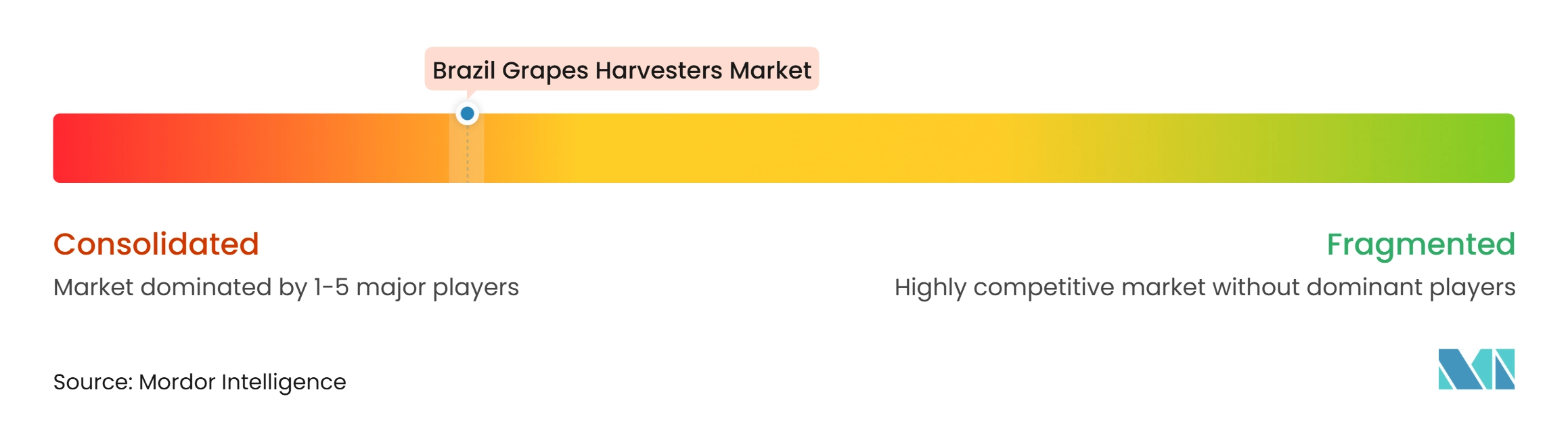
The Brazil grape harvesters market is concentrated, with the top five suppliers — Pellenc, CNH Industrial (through New Holland Agriculture and Braud), Oxbo, Tecnofrutt, and Ce&T — holding a major share in 2025. Their position reflects established product portfolios, financing relationships, and existing customer ties. Wider adoption depends on localized parts supply, trained technicians, and dealer coverage. The competitive position of each supplier is influenced by response times during short harvest windows. Equipment buyers evaluate service reliability as closely as machine specifications. This creates room for both established suppliers and domestic manufacturers to differentiate their offerings.
New Holland introduced the Braud 9.50L, 9.70L, and 9.70M at SITEVI 2025. The launch included the Vari-Control System for automatic leveling and hopper unloading adjustment. The company also provides a two-year factory warranty for units from 2025 onward. Pellenc's 2025 EASY ADJUST launch addressed harvester settings and performance recording through a smartphone interface. These product developments place operating simplicity and after-sales support at the center of competition in the Brazil grapes harvesters market. New features can reduce the time required to adjust machines between vineyard blocks and help managers review operating conditions before service issues interrupt harvest work.
Domestic manufacturers address local row widths, terrain variability, and trellis structures. Tecnofrutt's Farroupilha-built harvester operates across widths from 1.25 to 2.5 meters and has a stated capacity of 2 to 5 metric tons per hour. Fontana Maquinas offers the tractor-mounted Colheitadeira Stella with a leaf and branch separation system. Contract harvesting, compact machines, local parts availability, and operator training remain underdeveloped areas. Suppliers that address these needs can strengthen their market position as demand widens. A clear local support offering can reduce uncertainty for growers considering their first mechanical harvesting investment.
Brazil Grapes Harvesters Industry Leaders
-
Pellenc S.A.S.
-
CNH Industrial N.V. (New Holland Agriculture/Braud)
-
Oxbo International Corporation (Ploeger Oxbo Group B.V.)
-
Tecnofrutt - Maquinas e Implementos Agricolas Ltda.
-
Ce&T - Cengect Centro Tecnologico Ltda.
- *Disclaimer: Major Players sorted in no particular order
Brazil Grapes Harvesters Market Companies Covered in this Report
- Pellenc S.A.S.
- CNH Industrial N.V. (New Holland Agriculture/Braud)
- Oxbo International Corporation (Ploeger Oxbo Group B.V.)
- Tecnofrutt - Maquinas e Implementos Agricolas Ltda.
- Ce&T - Cengect Centro Tecnologico Ltda.
- Fontana Maquinas e Equipamentos Ltda.
Recent Industry Developments in Brazil Grapes Harvesters Market
- April 2025: Chile's INDAP Ñuble launched a special investment program for wine-sector associative enterprises in the Itata Valley, with CLP 125 million (USD 130,000) allocated for infrastructure, mechanization, equipment, and production inputs. While the program is broader than grape harvesters, its explicit inclusion of mechanization supports investment in vineyard equipment in one of Chile's wine-producing regions.
- January 2025: Pellenc appointed Agrocosecha as its official importer and service partner for grape-harvesting machines and viticulture equipment in Argentina, effective January 1, 2025. The partnership strengthens Pellenc's distribution and after-sales presence in Argentina and supports access to mechanized harvesting equipment for local vineyards.
- January 2025: New Holland Agriculture and Grupo Fecovita announced a collaboration to support the expansion of mechanical grape harvesting in Argentina. Fecovita represents more than 5,000 producers through 29 cooperatives in Mendoza and has established a professional team focused on technology adoption and technical assistance for its members. The partnership provides a direct channel for New Holland's Braud harvesters into a large cooperative producer network.
Brazil Grapes Harvesters Market Report Scope
A grape harvesting machine is a mechanized device used in vineyards to detach grapes from vines and collect them efficiently during harvest, reducing manual labor and increasing harvesting speed. The Brazil grapes harvesters market report is segmented by harvester type (self-propelled, trailed or towed, and tractor mounted), by mode of operation (manual steering, assisted or precision-guided, and autonomous or semi autonomous), by power source (diesel, hybrid, and electric), and by vineyard size (small vineyards (below 50 hectares), medium vineyards (51-200 hectares) and large vineyards (above 200 hectares)). The market forecasts are provided in USD (value).
Segmentation Overview
| Self-Propelled Grape Harvesters |
| Trailed and Towed Grape Harvesters |
| Tractor-Mounted Grape Harvesters |
| Manual Steering and Operation |
| Assisted and Precision-Guided Operation |
| Autonomous and Semi-Autonomous Operation |
| Diesel-Powered Harvesters |
| Hybrid Harvesters |
| Electric Harvesters |
| Small Vineyards Below 50 Hectares |
| Medium Vineyards 51 to 200 Hectares |
| Large Vineyards Above 200 Hectares |
| By Harvester Type | Self-Propelled Grape Harvesters |
| Trailed and Towed Grape Harvesters | |
| Tractor-Mounted Grape Harvesters | |
| By Mode of Operation | Manual Steering and Operation |
| Assisted and Precision-Guided Operation | |
| Autonomous and Semi-Autonomous Operation | |
| By Power Source | Diesel-Powered Harvesters |
| Hybrid Harvesters | |
| Electric Harvesters | |
| By Vineyard Size | Small Vineyards Below 50 Hectares |
| Medium Vineyards 51 to 200 Hectares | |
| Large Vineyards Above 200 Hectares |
Key Questions Answered in the Report
What is the size of the Brazil grapes harvesters market?
The Brazil grapes harvesters market is valued at USD 13.45 million in 2026 and is forecast to reach USD 21.89 million by 2031, at a CAGR of 10.23% from 2026 to 2031.
What is driving adoption of grape harvesters in Brazil?
Labor scarcity, irrigated multi-cycle vineyards, export timing requirements, and winery-supported mechanization are supporting adoption.
Which harvester type leads sales in Brazil?
Self-propelled harvesters accounted for 48.5% of the market in 2025, while tractor-mounted harvesters are forecast to be the fastest-growing segment, with a CAGR of 11.8% from 2026 to 2031.
Why do smaller vineyards use contract harvesting services?
Contract services can provide equipment access without the cost of owning an imported self-propelled harvester. This approach also gives growers access to trained operators and established service arrangements during harvest work.