
Brazil Government Super App Platforms Market Size and Share
Market Overview
| Study Period | 2020 - 2031 |
|---|---|
| Forecast Data Period | 2026 - 2031 |
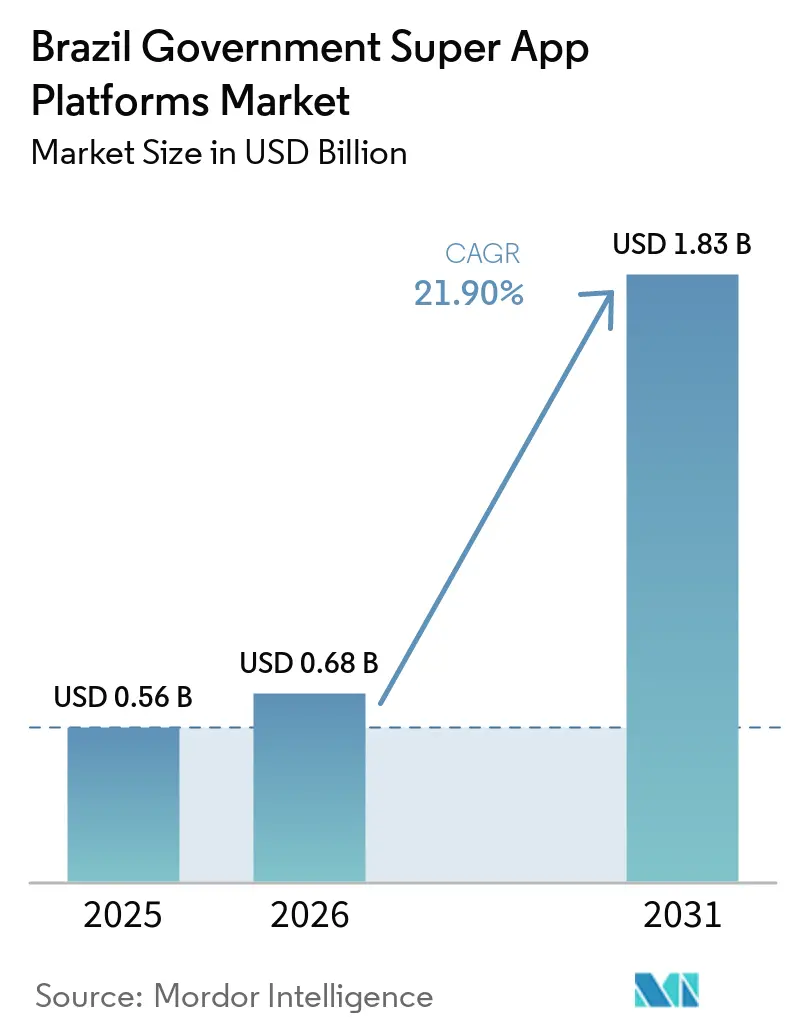
| Base Year Market Size (2025) | USD 0.56 Billion |
| Market Size (2026) | USD 0.68 Billion |
| Market Size (2031) | USD 1.83 Billion |
| Growth Rate (2026 - 2031) | 21.90 % |
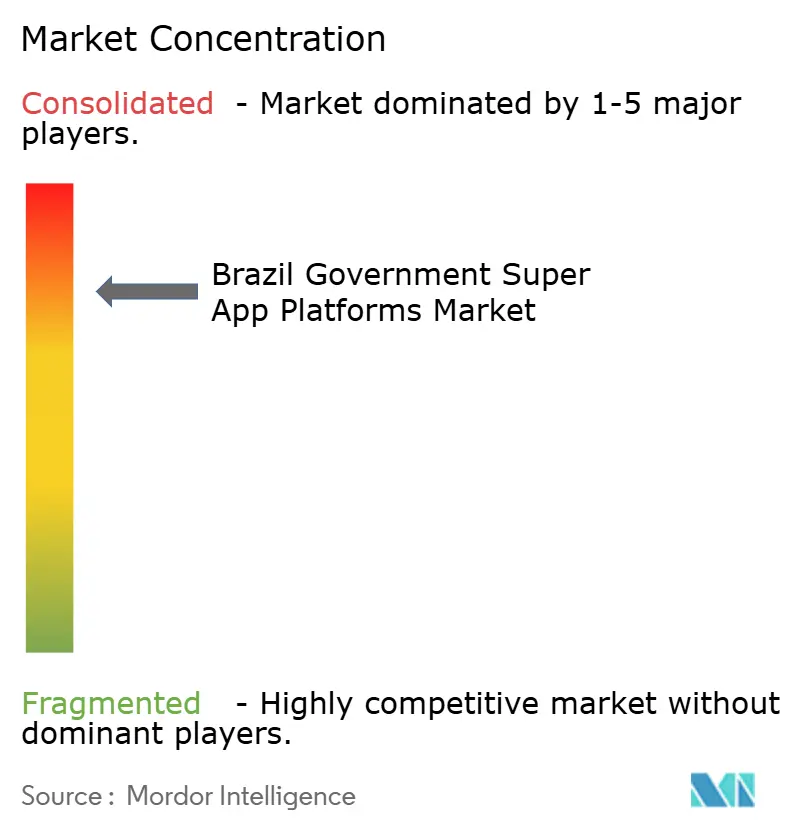
| Market Concentration | High |
Major Players *Disclaimer: Major Players sorted in no particular order Image © Mordor Intelligence. Reuse requires attribution under CC BY 4.0. | |
Brazil Government Super App Platforms Market Analysis by Mordor Intelligence
The Brazil government super app platforms market size was valued at USD 0.56 billion in 2025 and estimated to grow from USD 0.68 billion in 2026 to reach USD 1.83 billion by 2031, at a CAGR of 21.9% during the forecast period (2026-2031). Growth is tied to the federal shift from separate information portals toward integrated, transactional citizen services. GOV.BR has become the central channel for identity, signatures, benefits, and service access, which creates demand for platforms that can manage secure, high-volume interactions. Public investment in digital identity, interoperability, assisted onboarding, and AI capabilities is extending the scope of the Brazil government super app platforms market. Data sovereignty requirements are also shaping procurement, especially where government agencies combine public cloud services with state-managed infrastructure. The opportunity depends on vendors meeting privacy, residency, and integration requirements while reaching citizens with limited connectivity.
Key Report Takeaways
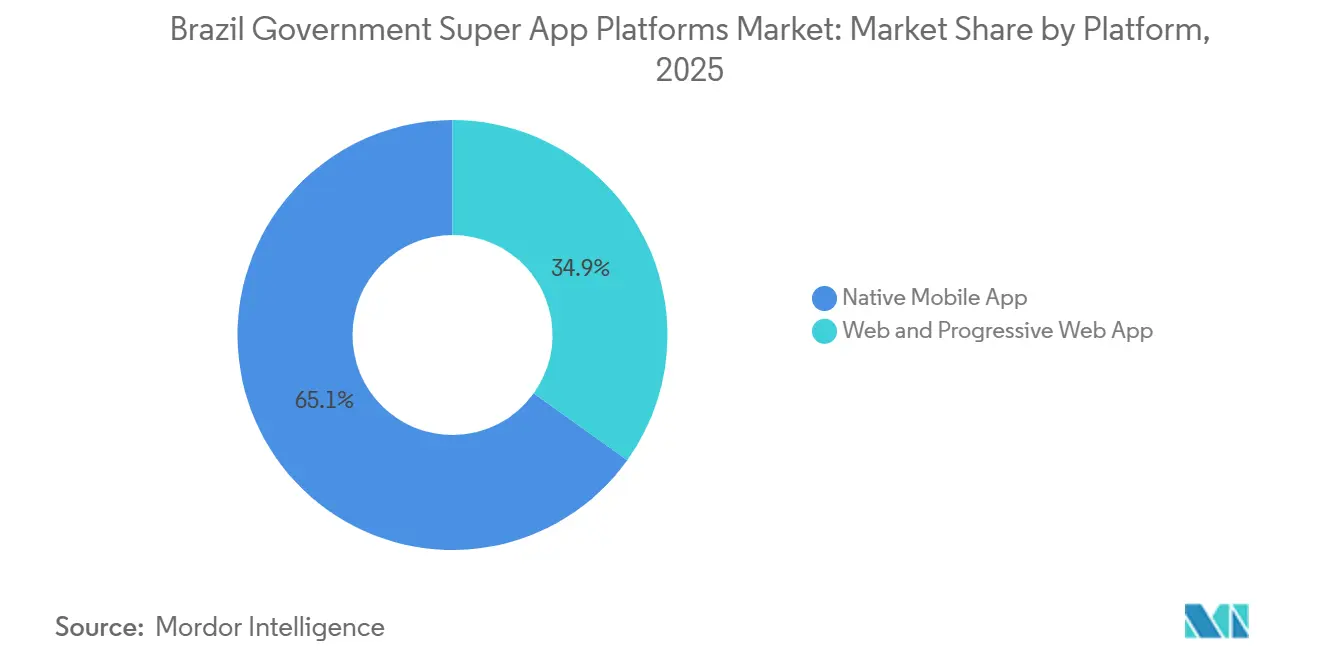
- By platform, Native Mobile Apps held 65.11% of the Brazil government super app platforms market share in 2025, while Web and Progressive Web Apps are projected to expand at a CAGR of 22.18% through 2031.
- By deployment type, Cloud held 42.33% of the Brazil government super app platforms market share in 2025, while Hybrid deployment is projected to expand at a CAGR of 23.12% through 2031.
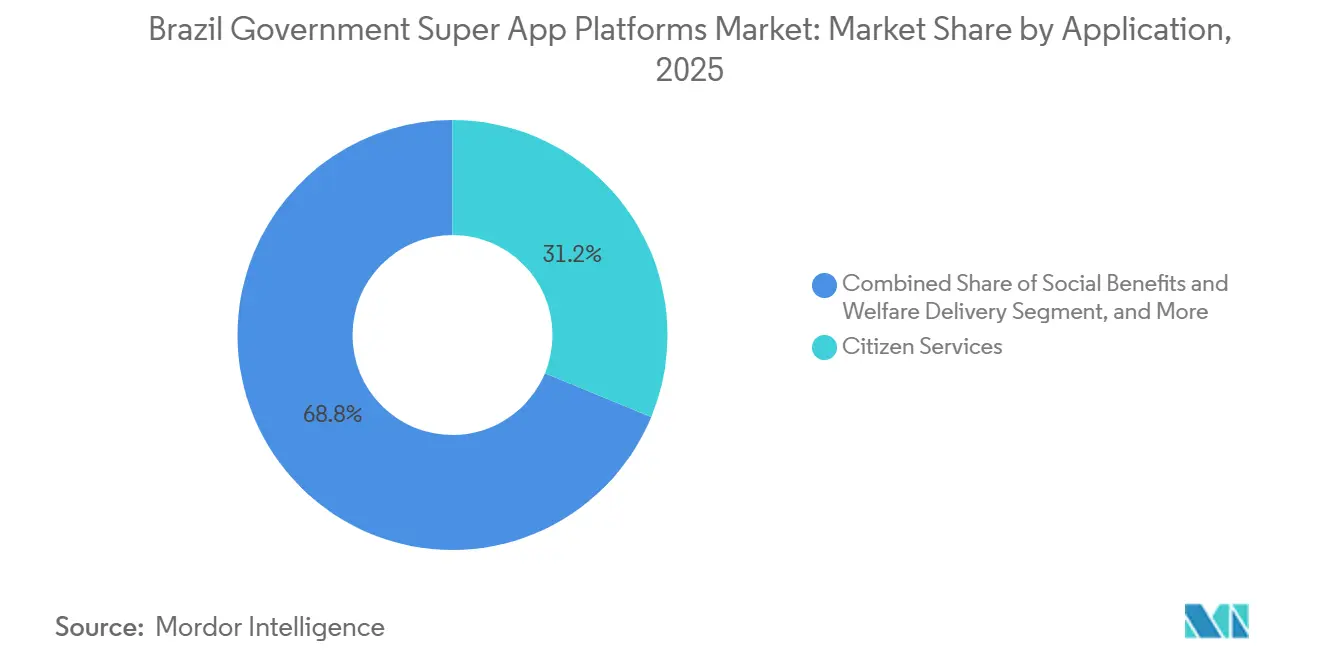
- By application, Citizen Services accounted for 31.23% of the Brazil government super app platforms market size in 2025, while Identity, Credentials, and Wallet Services are projected to expand at a CAGR of 22.87% through 2031.
- By end user, State and Provincial Governments accounted for 53.11% of the Brazil government super app platforms market size in 2025, while the Central Government is projected to expand at a CAGR of 22.65% through 2031.
Note: Market size and forecast figures in this report are generated using Mordor Intelligence’s proprietary estimation framework, updated with the latest available data and insights as of January 2026.
Brazil Government Super App Platforms Market Trends and Insights
Drivers Impact Analysis*
| DRIVER | (~) % IMPACT ON CAGR FORECAST | GEOGRAPHIC RELEVANCE | IMPACT TIMELINE |
|---|---|---|---|
| Rising Demand for One-Stop Citizen Service Delivery | +4.2% | National, with the strongest acceleration in São Paulo, Rio de Janeiro, and Minas Gerais | Short term (≤ 2 years) |
| Digital Identity, Payments, and Data Sharing as Foundational Layers | +3.6% | Nationwide, the highest intensity is in the Southeast and South | Short term (≤ 2 years) |
| Interoperability Pressure Across Fragmented Agency Systems | +2.8% | National, with cross-state momentum in Paraná, Ceará, and Rio Grande do Sul | Medium term (2-4 years) |
| AI-Enabled Proactive Services and Case Routing | +2.5% | Federal agencies primarily, with spillover to state capitals | Medium term (2-4 years) |
| Cross-Agency Cost Compression Through Shared Platforms | +1.8% | National, strongest in fiscally constrained mid-sized states | Medium term (2-4 years) |
| National Digital Sovereignty and Public-Control Requirements | +1.5% | National, concentrated in federal agency procurement decisions | Long term (≥ 4 years) |
| Source: Mordor Intelligence | |||
Rising Demand for One-Stop Citizen Service Delivery
GOV.BR’s move from an information portal to a broader service platform is expanding the Brazilian government super-app market. The platform reached 175 million registered users and recorded 80 million monthly unique accesses in March 2026.[1] Its service base includes identity verification, electronic signatures, benefit consultations, and tax-related interactions. The World Bank reported BRL 12.98 billion, USD 2.24 billion, in cumulative public-sector savings from secure digital identity and service digitization.[2] Portaria 473 expanded planned federal digital government actions from 93 to 100 and increased the Balcão GOV.BR target from 50 to 250 desks by the end of 2026. Assisted access matters because the Brazilian government's super app platforms market depends on both digital reach and in-person support for citizens who need help enrolling or completing services.
Digital Identity, Payments, and Data Sharing as Foundational Layers
Digital identity is a core layer of the Brazilian government super-app platforms market because it enables secure access to public transactions. Brazil had issued 44 million National Civil Identity Cards by February 2026, linking biometric identity enrollment with higher-assurance GOV.BR access. The identity layer supports access to 12,000 public services through GOV.BR Gold accounts. Nubank connected 3.2 million customers to GOV.BR Silver accounts within 3 months of launching its onboarding partnership in 2024. That outcome showed that financial institutions can help distribute government identity services at scale. As stronger identity verification supports more payments and benefit transactions, providers that can manage consent and data exchange become more relevant to the Brazil government super app platforms market.
Interoperability Pressure Across Fragmented Agency Systems
The Brazil government super-app platforms market needs interoperability because agencies have historically used separate systems and data environments. The federal strategy seeks integration across the national, state, and municipal levels of government. Conecta GOV.BR provides a common route for agencies to exchange data and reduce repeated document requests from citizens. The strategy aimed to integrate 60% of Brazil’s 5,570 municipalities into Rede GOV.BR by 2026. Yet municipal participation requires technical contacts, privacy controls, and separate interoperability agreements. This creates demand for implementation services, API integration, and governance support across the Brazilian government super-app platforms market.
AI-Enabled Proactive Services and Case Routing
AI is expanding the range of services being considered in the Brazilian government super app platforms market. A July 2026 government survey found that 59% of federal and state agencies used AI, and 70% of federal agencies did so. Citizen-service chatbots were the most requested near-term capability among 144 federal organizations.[3] In September 2025, MGI and CPQD launched INSPIRE with BRL 390 million (USD 76.76 million) over 4 years to develop AI platforms that connect Cadúnico, health, and education data. These programs support notifications, routing, and personalized service delivery. Providers that deliver compliant modules before public platforms mature may secure positions in the Brazil government super app platforms market.
Restraints Impact Analysis*
| RESTRAINT | (~) % IMPACT ON CAGR FORECAST | GEOGRAPHIC RELEVANCE | IMPACT TIMELINE |
|---|---|---|---|
| Legacy System Lock-In and Slow Core Modernization | -1.8% | National, most acute in the North, Northeast, and mid-sized state governments | Long term (≥ 4 years) |
| Procurement Complexity and Multi-Agency Governance | -1.2% | National, more severe in multi-ministry federal procurements | Medium term (2-4 years) |
| Privacy, Consent, and Data Residency Constraints | -0.7% | National, with specific intensity in federal data-sharing projects | Medium term (2-4 years) |
| Digital Exclusion Risk in Low-Literacy and Low-Connectivity Populations | -0.5% | North and Northeast regions, rural municipalities nationwide | Short term (≤ 2 years) |
| Source: Mordor Intelligence | |||
Legacy System Lock-In and Slow Core Modernization
Legacy systems can slow the growth of Brazil's government super app platforms market because older ministry environments require tailored integrations with new service layers. Long-standing enterprise software contracts can also limit the adoption of modular applications. Law 14.133/2021 introduced procedural requirements that add steps to the public technology procurement process. State-operated providers have a dual role as infrastructure and solution providers, which can complicate agencies' architecture choices. The federal government is also building public AI capabilities, including INSPIRE, which means core modernization can follow public-sector schedules. These factors can delay deployments even where agencies recognize the need for integrated service delivery.
Procurement Complexity and Multi-Agency Governance
Cross-ministry initiatives in the Brazil government super-app platforms market require approval from agencies with separate budgets, legal obligations, and risk priorities. The federal strategy requires interoperability across government levels, but participating institutions retain independent authority over implementation. Each state or municipality using Conecta GOV.BR must meet privacy obligations and enter its own interoperability agreement. The CIGA consortium agreement with MGI covered 354 municipalities in March 2026, illustrating the role of consortium arrangements in simplifying local participation.[4] Smaller governments may still lack the technical and legal capacity to complete the required processes quickly. These requirements extend delivery schedules for data-intensive and AI-enabled modules.
*Our forecasts treat driver/restraint impacts as directional, not additive. The impact forecasts reflect baseline growth, mix effects, and variable interactions.
Segment Analysis
By Platform: Mobile-First Architecture Meets Progressive Web App Expansion
Native mobile apps are expected to capture 65.11% of the Brazil government super app platforms market by platform type in 2025. Mobile access remains central because biometric smartphone authentication supports high-assurance GOV.BR accounts and secure transactions. GOV.BR is expected to have 80 million Gold-account users by February 2026, with 55% of them enabled for two-factor authentication. This account tier enables document signing and access to public services through verified digital identity. The mobile-first model keeps native applications critical for transactions that require strong authentication.
Web and Progressive Web Apps are projected to expand at a CAGR of 22.18% through 2031. These formats support professional users on desktop devices and citizens who rely on lower-cost smartphones. Progressive Web Apps can also offer offline functions, which are useful in areas with unstable connectivity. In 2025, 14% of Brazilian households are expected to lack stable internet access, with the challenge concentrated in the North and Northeast. The combination of mobile and browser access allows the Brazil government super app platforms market to address different service needs without making a single format the only delivery channel.
By Deployment Type: Hybrid Becomes the Architecture of Sovereignty
Cloud deployment is expected to hold 42.33% of the Brazil government super app platforms market by deployment type in 2025. MGI, Serpro, and Dataprev are expected to launch the Government Cloud service catalog in June 2025 for more than 250 federal executive branch agencies. The initial investment is expected to exceed BRL 1 billion (USD 172.4 million), and the catalog is set to include services from AWS, Google, Huawei, and Oracle. Standardized procurement terms will give agencies a route to acquire cloud capabilities within public-sector controls. This approach supports common infrastructure while allowing agencies to add applications that meet their operational requirements.
Hybrid deployment is projected to expand at a CAGR of 23.12% through 2031. Its growth reflects a model in which sensitive data remains within Serpro or Dataprev environments, while less sensitive layers use approved cloud services. Brazil’s digital government framework emphasizes platforms, interoperability, and secure data use across public services. The OECD is expected to assign Brazil a score of 0.81 for Government as a Platform in 2025, above the OECD average of 0.71. This policy context favors architectures that combine shared cloud capacity with national control of sensitive information.
By Application: Citizen Services Anchors Revenue While Digital Wallets Accelerate
Citizen Services are expected to account for 31.23% of the Brazil government super app platforms market by application in 2025. The category includes tax declarations, social security consultations, vehicle registration, access to healthcare, and digital driver's licenses. These transactions provide a broad base of recurring interactions for public platforms. Law 14.129/2021 requires federal public services to offer digital equivalents. This mandate supports continued service digitization across the Brazil government super app platforms industry.
Identity, Credentials, and Wallet Services are projected to expand at a CAGR of 22.87% through 2031. MGI and Caixa Econômica Federal are expected to sign an agreement in July 2025 to develop the Civil Identification Digital Public Infrastructure and a unified GOV.BR super app. The initiative links biometric identity with authentication to create an integrated service experience. Payments, fees, revenue collection, social benefits, and welfare delivery can use verified data to reduce repeated checks. Licensing, permits, and registrations can also be used with GOV.BR authentication as a federal trust anchor. Privacy requirements remain central because each application flow must include data-sharing consent.

By End User: State Governments Dominate, Federal Mandates Drive the Next Cycle
State and provincial governments are expected to account for 53.11% of the Brazil government super app platforms market by end user in 2025. States manage key public services, including health, education, public safety, and social programs, through their own delivery structures. São Paulo, Rio de Janeiro, Minas Gerais, Paraná, and Ceará have developed citizen-facing services alongside GOV.BR integrations. This structure creates a mixed procurement environment in which global providers may supply platforms, while local specialists may adapt integrations. As a result, the Brazil government super app platforms industry remains diverse across state-level technical specifications and contracting practices.
The central government is projected to expand at a CAGR of 22.65% through 2031. The federal strategy directs agencies to build interoperable digital services and extend common tools to state and municipal users. The OECD is expected to assign a score of 0.84 to Brazil’s User-Driven digital government dimension in 2025. Investments in AI, identity, and interoperability around GOV.BR also supports federal demand. However, a vendor's win in one state does not automatically translate to the other 25 states or the Federal District.
Geography Analysis
The Southeast is the largest contributor to the Brazil government super app platforms market. São Paulo, Rio de Janeiro, Minas Gerais, and Espírito Santo combine advanced state digital programs with a high concentration of federal activity. São Paulo’s Municipal Health Secretariat is expected to sign a SaaS contract with Softplan in early 2026 for international financing management systems. These conditions are expected to support earlier adoption of biometric identity, electronic signatures, and browser-based service modules.
The North and Northeast offer the clearest growth opportunity, as connectivity gaps continue to limit access to digital services. In 2025, 54% of rural residents in these regions are expected to remain in the lowest significant-connectivity tier. In August 2025, the Ministry of Communications is expected to allocate BRL 1.4 billion (USD 241.4 million) to expand broadband access to 767,000 households across 552 municipalities in 17 states. A separate BRL 4 billion (USD 689 million) rural 4G program is expected to connect 1.7 million people across 2,826 communities by January 2026. Ceará and Rio Grande do Norte show how assisted service models can help citizens transition toward more independent digital use.
The South and the Center-West show a more mature pattern of public platform adoption. The CIGA agreement gives 354 municipalities, mainly in Santa Catarina, access to GOV.BR tools and a digital maturity self-assessment framework. Brasília’s role as the federal center makes the Center-West important for government cloud and identity-related decisions. Although no regional share has been published, federal architecture choices made in the Center-West affect procurement nationwide. Brazil’s 2025 Open by Default score is expected to reach 0.74, while its Government Support for Data Re-use score is expected to reach 0.57.
Competitive Landscape
The Brazil government super app platforms market has a concentrated infrastructure layer and a more fragmented integration layer. Serpro and Dataprev control the sovereign government cloud layer and core federal identity systems. Private providers participate through approved cloud, enterprise software, implementation, and application services. Microsoft’s expanded agreement with MGI is expected to cover more than 2,007 catalog products for over 250 federal agencies in March 2026. The agreement is expected to increase the Microsoft 365 Copilot discount from 5% to 10% and deliver reported savings of BRL 15 million (USD 2.6 million) during the 2025 agreement cycle.
Enterprise vendors such as SAP, ServiceNow, Salesforce, and IBM compete by offering licensing and platform options available to federal agencies. Consulting and integration firms compete on implementation, interoperability, and privacy architecture. Brazil’s public sector is expected to contract more than BRL 5.97 billion (USD 1.03 billion) in software licenses during the preceding 2.5 years. Softplan’s expected early 2026 contract with São Paulo’s Municipal Health Secretariat highlights how a local provider can serve a specialized government function.
AI-based benefit routing, tailored notifications, and real-time eligibility assessment remain open application areas. INSPIRE is expected to build public AI capabilities, while providers can still offer compliant modules for defined agency needs. The July 2025 MGI and Caixa agreement is expected to support a unified, identity-led public service model. Vendors need to align their offerings with LGPD controls and public cloud governance. The Brazil government super app platforms market is likely to reward providers that can integrate with public systems without weakening data control.
Brazil Government Super App Platforms Industry Leaders
-
Microsoft Corporation
-
Amazon Web Services, Inc.
-
Google LLC
-
IBM Corporation
-
SAP SE
- *Disclaimer: Major Players sorted in no particular order
Recent Industry Developments
- July 2026: A Brazilian government report released in July 2026 confirmed AI adoption across 59% of federal and state agencies, with federal agencies at 70% and the Judiciary leading at 94%, while citizen-service chatbots were identified as the most-demanded near-term AI tool across 144 federal organizations, directly framing demand for AI-integrated super app modules.
- March 2026: MGI signed a Technical Cooperation Agreement with the CIGA consortium, extending GOV.BR digital tools and a digital maturity self-assessment framework to 354 municipalities concentrated in Santa Catarina, broadening the Rede GOV.BR subnational integration pipeline.
- March 2026: MGI expanded its Microsoft framework agreement to cover over 2,007 catalog products for more than 250 federal agencies, increasing the Microsoft 365 Copilot discount from 5% to 10% and yielding BRL 15 million (USD 2.95 million) in reported savings under the 2025 agreement cycle.
- August 2025: The Ministry of Communications allocated BRL 1.4 billion (0.28 billion) from the Telecommunications Universalization Fund (Fust) to expand broadband to 767,000 households across 552 municipalities in 17 states, directly addressing the connectivity infrastructure gap that limits super app reach in underserved regions.
Brazil Government Super App Platforms Market Report Scope
The Brazil Government Super App Platforms Report is Segmented by Platform (Native Mobile App, and Web and Progressive Web App), Deployment Type (Cloud, On-Premise, and Hybrid), Application (Citizen Services, Identity, Credentials, and Wallet Services, Payments, Fees, and Revenue Collection, Social Benefits and Welfare Delivery, Licensing, Permits, and Registrations, and Other Applications), and End User (Central Government, and State Or Provincial Government). The Market Forecasts are Provided in Terms of Value (USD).
| Native Mobile App |
| Web and Progressive Web App |
| Cloud |
| On-Premise |
| Hybrid |
| Citizen Services |
| Identity, Credentials, and Wallet Services |
| Payments, Fees, and Revenue Collection |
| Social Benefits and Welfare Delivery |
| Licensing, Permits, and Registrations |
| Other Applications |
| Central Government |
| State Or Provincial Government |
| By Platform | Native Mobile App |
| Web and Progressive Web App | |
| By Deployment Type | Cloud |
| On-Premise | |
| Hybrid | |
| By Application | Citizen Services |
| Identity, Credentials, and Wallet Services | |
| Payments, Fees, and Revenue Collection | |
| Social Benefits and Welfare Delivery | |
| Licensing, Permits, and Registrations | |
| Other Applications | |
| By End User | Central Government |
| State Or Provincial Government |
Key Questions Answered in the Report
What is the size of the Brazil government super app platforms market?
The Brazil government super app platforms market was valued at USD 0.56 billion in 2025 and is estimated at USD 0.68 billion in 2026. It is forecast to reach USD 1.83 billion by 2031 at a 21.9% CAGR, supported by the expansion of transactional public services.
What is driving demand for government super app platforms in Brazil?
GOV.BR's move toward integrated transactions, digital identity, data sharing, and assisted onboarding is supporting demand for new public service platforms. The platform recorded 80 million monthly unique accesses in March 2026.
Which platform format led in 2025?
Native Mobile Apps led with 65.11% share in 2025 because verified mobile access is central to high-assurance government transactions. Web and Progressive Web Apps are projected to expand at a CAGR of 22.18% through 2031.
Which deployment model is expected to grow fastest?
Hybrid deployment is projected to expand at a CAGR of 23.12% through 2031 because agencies need cloud flexibility and control over sensitive data. Cloud deployment held 42.33% share in 2025.
Which application area is growing fastest?
Identity, Credentials, and Wallet Services is projected to expand at a CAGR of 22.87% through 2031, supported by biometric identity and unified GOV.BR service plans. Citizen Services held 31.23% share in 2025.
Which end-user segment had the largest share in 2025?
State and Provincial Governments held 53.11% in 2025 because they administer major health, education, public safety, and social programs. Central Government is projected to expand at a CAGR of 22.65% through 2031.