
Bottling Line Sterilization Machinery Market Size and Share
Market Overview
| Study Period | 2021 - 2032 |
|---|---|
| Market Size (2027) | USD 28.12 Million |
| Market Size (2032) | USD 40.98 Million |
| Growth Rate (2027 - 2032) | 7.82 % |
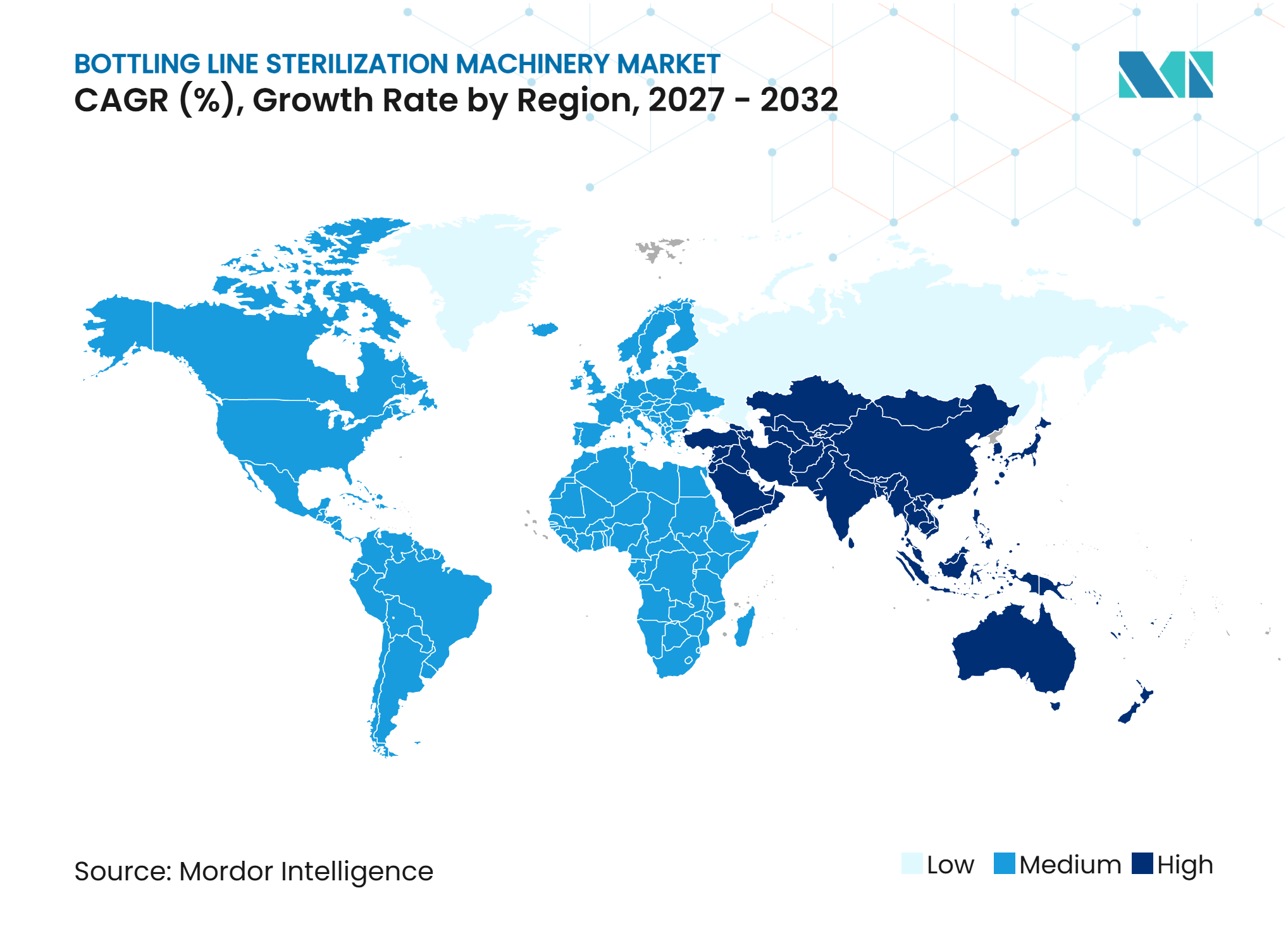
| Fastest Growing Market | Asia-Pacific |
| Largest Market | Asia-Pacific |
| Market Concentration | Medium |
Major Players *Disclaimer: Major Players sorted in no particular order Image © Mordor Intelligence. Reuse requires attribution under CC BY 4.0. | |
Bottling Line Sterilization Machinery Market Analysis by Mordor Intelligence
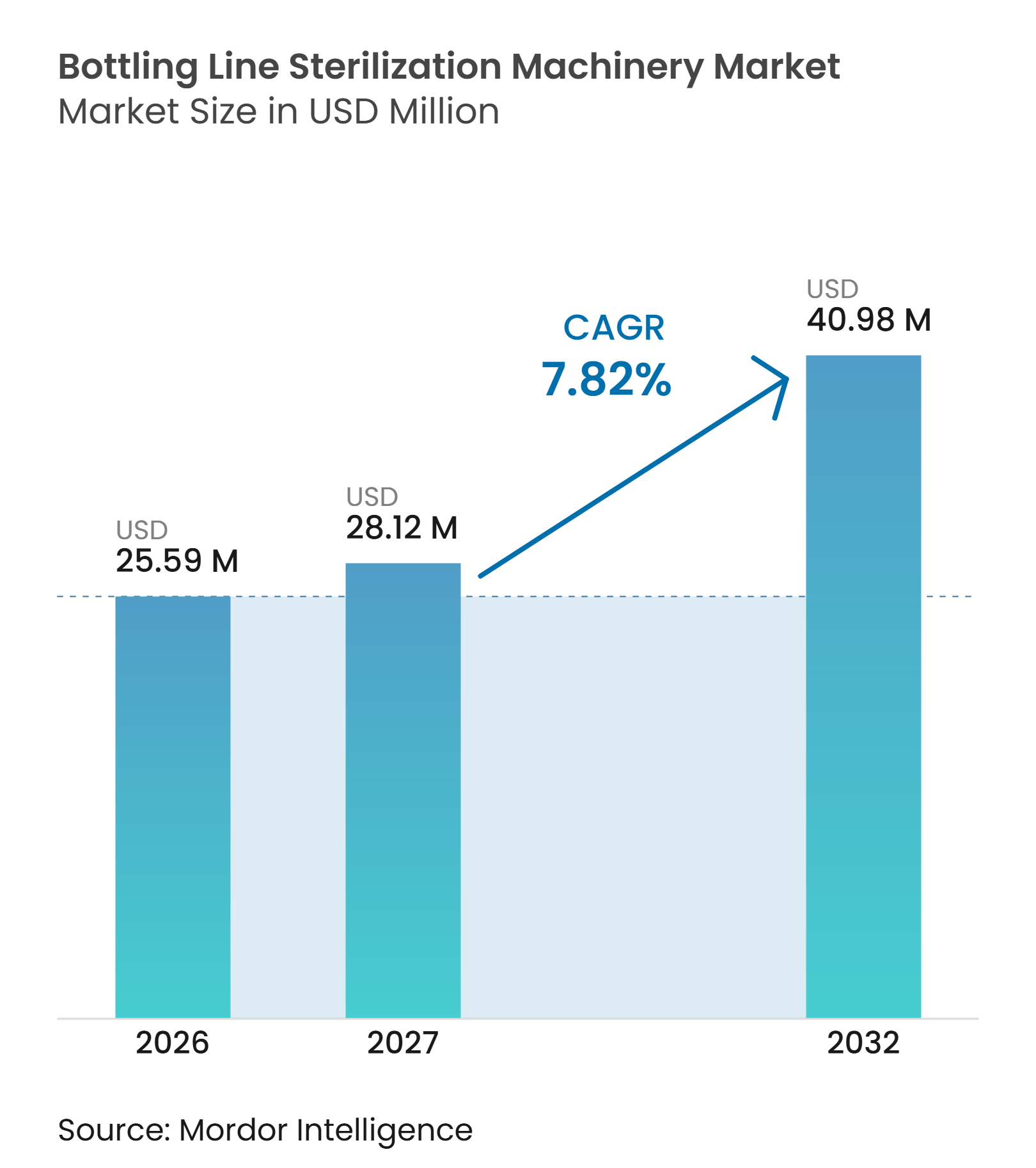
The Bottling Line Sterilization Machinery Market size is expected to grow from USD 25.59 million in 2026 to USD 28.12 million in 2027 and is forecast to reach USD 40.98 million by 2032 at 7.82% CAGR over 2027-2032.
Demand is supported by wider use of aseptic packaging for shelf-stable drinks, dairy products, and liquid pharmaceuticals. Producers are placing more emphasis on sterile handling at the preform and closure stages, which raises the value of integrated equipment. Regulatory requirements for residue control, validation records, and hygienic design are also shaping replacement decisions. Suppliers can benefit from upgrades to established lines in Europe and North America, while new capacity in Asia-Pacific creates opportunities for localized service and lower-footprint systems. High equipment costs and limited sterility-assurance skills may slow adoption among smaller producers.
Key Report Takeaways
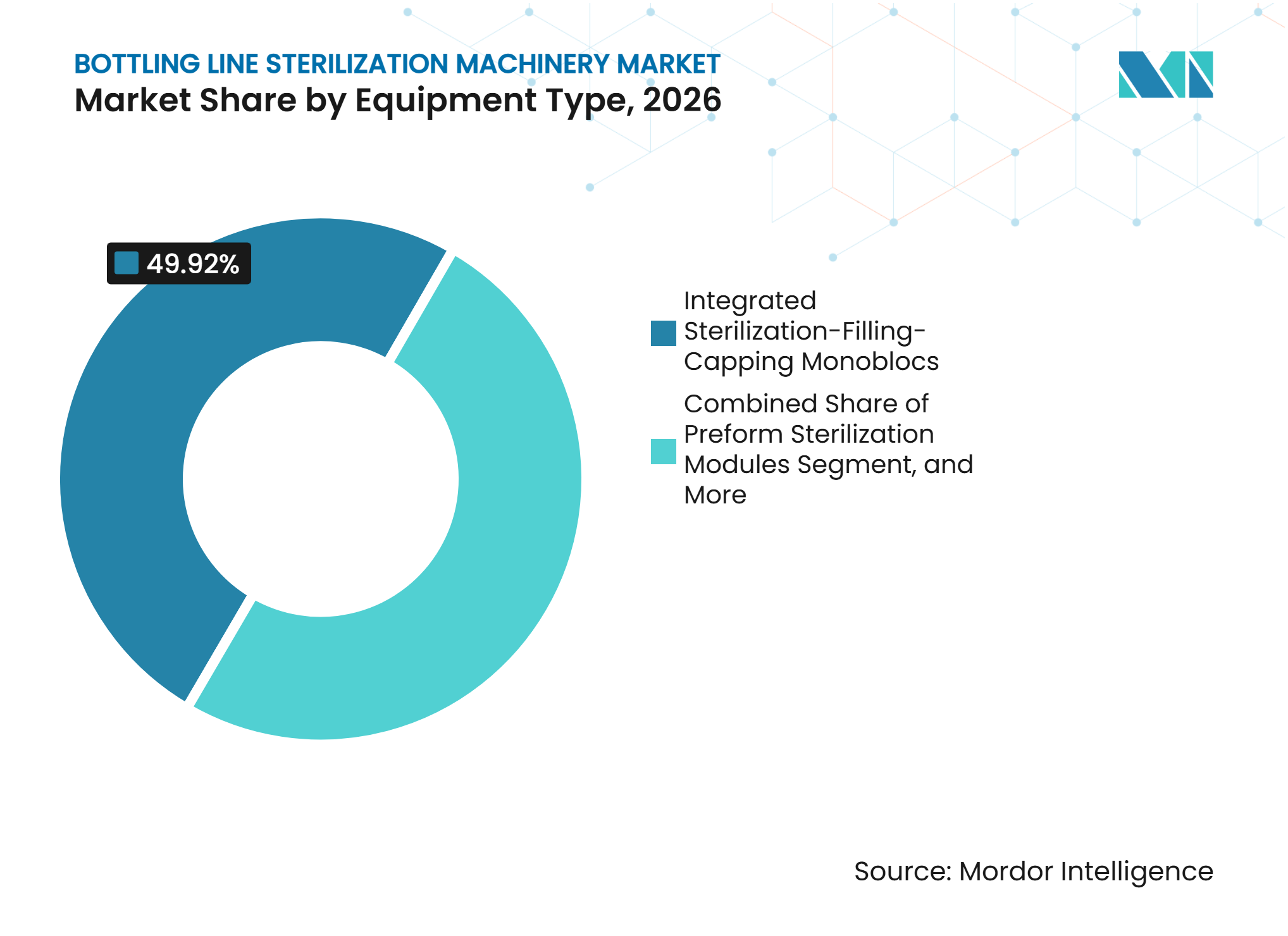
- By equipment type, integrated sterilization-filling-capping monoblocs held 49.92% of the bottling line sterilization machinery market share in 2026, while preform sterilization modules are projected to expand at an 8.62% CAGR through 2032.
- By sterilization technology, hydrogen peroxide accounted for 41.03% of the bottling line sterilization machinery market share in 2026, while electron beam and other emerging technologies are expected to advance at an 8.19% CAGR through 2032.
- By format, PET bottles held a 38.13% share in 2026 of the bottling line sterilization machinery market, while preforms are projected to expand at an 8.13% CAGR through 2032.
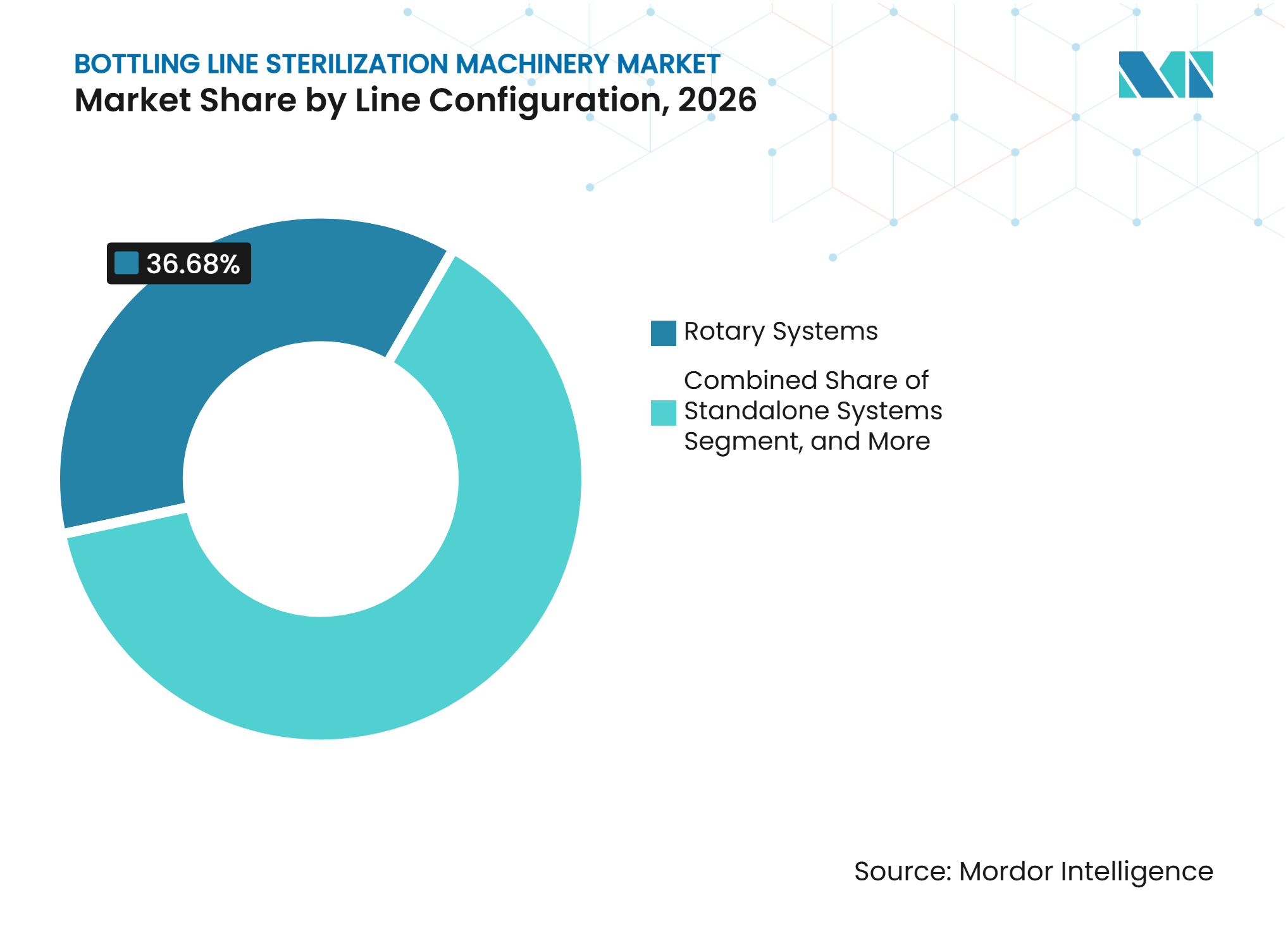
- By line configuration, rotary systems accounted for a 36.68% share in 2026, while integrated systems are expected to advance at an 8.78% CAGR through 2032.
- By end user, juice, tea, and functional beverage producers held a 26.54% share in 2026, while pharmaceutical and biopharmaceutical manufacturers are projected to expand at an 8.79% CAGR through 2032.
- By geography, Asia-Pacific accounted for a 35.81% share in 2026 and is expected to grow at an 8.71% CAGR through 2032.
Note: Market numbers in this report are based on Mordor Intelligence's proprietary estimation framework, which combines nine months of actuals with Q4 projections for base year 2026.
Market Trends and Insights
Drivers Impact Analysis of Bottling Line Sterilization Machinery Market*
| Driver | (~) % Impact on CAGR Forecast | Geographic Relevance | Impact Timeline |
|---|---|---|---|
| Expansion of Shelf-Stable Beverages and Dairy Products | +2.0% | Global, with intensity in Asia-Pacific and South America | Long term (≥ 4 years) |
| Stricter Validation of Commercial Sterility | +1.5% | Global, with regulatory intensity highest in North America and Europe | Medium term (2-4 years) |
| Growth of High-Speed Aseptic PET Bottling | +1.2% | Asia-Pacific core, with spillover to Middle East and Africa | Medium term (2-4 years) |
| Outsourcing of Sterile Beverage and Liquid-Food Production | +0.9% | North America, Asia-Pacific, and South America | Short term (≤ 2 years) |
| Shift Toward Low-Water and Low-Chemical Sterilization | +0.6% | Global, strongest in markets with high water-scarcity risk | Medium term (2-4 years) |
| Retrofit Demand from Aging Aseptic Lines | +0.4% | Europe and North America | Short term (≤ 2 years) |
| Source: Mordor Intelligence | |||
Expansion of Shelf-Stable Beverages and Dairy Products
Aseptic filling is becoming more important as producers seek products that can move through ambient distribution channels. This increases the need for reliable container and closure sterilization in the bottling line sterilization machinery market. Low-acid drinks, plant-based beverages, cold-pressed juices, and functional teas have limited tolerance for microbial contamination. These products often need treatment at both the bottle and cap stages. That requirement favors systems that keep sterilization, filling, and capping within a controlled production boundary. The resulting equipment choice can move buyers toward integrated configurations rather than separate modules.
Stricter Validation of Commercial Sterility
Commercial sterility requirements are making equipment validation a more prominent purchasing consideration. In September 2025, the U.S. Food and Drug Administration expanded permitted uses of food-grade hydrogen peroxide as an antimicrobial agent, subject to processing conditions that remove residual peroxide.[1] The rule provides a clearer compliance route for some dry preform sterilization applications. Equipment suppliers must also demonstrate that their systems support residue verification and documented operating controls. Producers using legacy equipment may therefore face a stronger case for upgrades. These requirements can shorten replacement cycles when existing systems cannot provide the required control or traceability.
Growth of High-Speed Aseptic PET Bottling
High-speed aseptic PET lines make the consistency of preform treatment central to overall line performance. At very high throughput, uneven application of sterilant can interrupt validation and require a line to stop. Krones states that its compact Contipure AsepBloc combines preform sterilization, stretch blow molding, and aseptic filling within a 100 m² footprint, with output ranging from 8,000 to 27,500 bottles per hour. The configuration can support producers that need smaller production runs without abandoning integrated aseptic handling. High line speeds also increase the value of designs that reduce the number of transfer points between production steps. This makes the sterilization module a direct determinant of uptime, rather than a secondary part of the line.
Outsourcing of Sterile Beverage and Liquid-Food Production
Contract manufacturers and aseptic co-packers offer an alternative for brands that do not want to own specialized production assets. Their operating model concentrates demand for sterilization machinery among a smaller set of high-volume buyers. These buyers benefit from systems that can run continuously and require limited manual intervention. A large aseptic production line requires substantial equipment investment and can take up to 2 years to receive regulatory validation. Those commitments make outsourced production more attractive for newer brands and private-label programs. The bottling line sterilization machinery industry can therefore gain demand from co-packers that need dependable, flexible capacity across multiple customers.
Restraints Impact Analysis of Bottling Line Sterilization Machinery Market*
| Restraint | (~) % Impact on CAGR Forecast | Geographic Relevance | Impact Timeline |
|---|---|---|---|
| High Capital and Validation Costs | -1.8% | Global, most acute in South America, Middle East, and Africa | Long term (≥ 4 years) |
| Sterility Assurance Skill Shortages | -1.0% | Global, concentrated in high-growth markets in Asia-Pacific and South America | Medium term (2-4 years) |
| Energy Intensity of Dry-Heat and Hot-Air Tunnels | -0.5% | Europe and North America | Medium term (2-4 years) |
| Residual-Chemical and Worker-Safety Constraints | -0.3% | Global, with stricter compliance in Europe and North America | Short term (≤ 2 years) |
| Source: Mordor Intelligence | |||
High Capital and Validation Costs
The capital requirements of aseptic systems can exclude many small- and mid-sized producers from making an immediate investment. A 50-million-unit aseptic line can require substantial investment in equipment. The regulatory authorization process may also take 18 to 24 months before a new line begins generating revenue. That period adds financing risk for buyers with only 1 line or a limited production portfolio. Smaller producers cannot always spread validation costs across multiple products and facilities. This limits adoption in fragmented regions, even where demand for shelf-stable beverages is rising.
Sterility Assurance Skill Shortages
Aseptic production depends on technicians who can interpret process controls and manage validation records. Developing these capabilities takes time and cannot be replaced by general engineering staffing. Shortages are more disruptive where producers are commissioning new capacity at a rapid pace. India had more than 6,244 BIS-licensed packaged-water manufacturers, while validated aseptic expertise remained concentrated among a relatively small group of larger operators. Limited specialist capacity can extend commissioning schedules and increase the risk of a failed validation attempt. The effect can delay a product launch by 6 to 12 months for a line that does not meet its required standard on the first attempt.
*Our forecasts treat driver/restraint impacts as directional, not additive. The impact forecasts reflect baseline growth, mix effects, and variable interactions.
Bottling Line Sterilization Machinery Market Segment Analysis
By Equipment Type:
Integrated Monoblocs Lead as Preform Modules AccelerateIntegrated sterilization-filling-capping monoblocs held 49.92% of the bottling line sterilization machinery market size in 2026. Their position reflects the benefit of keeping bottle treatment, filling, and capping within a single controlled system. Fewer transfers between modules can reduce potential points of contamination on an aseptic line. This becomes especially important when a producer runs millions of units each day. Krones offers the compact Contipure AsepBloc as an integrated system that combines preform sterilization, stretch blow molding, and aseptic filling in 100 m².
Preform sterilization modules are projected to advance at an 8.62% CAGR through 2032. Treating the preform before blow molding can provide a more controlled process than treating the finished bottle. Bottle sterilization and rinsing modules still serve HDPE applications and retrofit projects where preform treatment is not practical. Cap and closure modules are also receiving more attention because closure contamination can compromise the full sterility process. Pharmaceutical equipment users are placing greater emphasis on documented validation for each part of the container system. The equipment mix will therefore continue to include standalone modules alongside integrated designs.



By Sterilization Technology:
Hydrogen Peroxide Anchors the Market, Electron Beam AdvancesHydrogen peroxide systems accounted for 41.03% of the bottling line sterilization machinery market size in 2026. Their broad use is linked to established food-contact applications and the ability to support low-residue packaging processes. The FDA’s 2025 final rule expanded permitted antimicrobial uses of food-grade hydrogen peroxide when residual peroxide is removed during processing. Peracetic acid remains important for HDPE bottles and lower-acid applications. Steam and hot-water systems continue to serve glass containers and pharmaceutical uses that require validated heat-distribution profiles.
Electron beam and other emerging technologies are projected to advance at an 8.19% CAGR through 2032. These systems can treat bottles without chemical sterilants and can support high-speed PET production. A 2026 study in Radiation Physics and Chemistry found no significant difference in radical generation in PE/EVOH/PE multilayer film between e-beam and X-ray irradiation at equivalent doses. This finding supports the technical case for irradiation-based treatment where packaging compatibility is a concern. TECH-LONG reported that its dry sterilization and aseptic filling technology achieves Log 3-6 kill rates with no chemical residues. UV-C and pulsed light also continue to serve narrower closure and supplemental treatment applications.
By Format:
PET Holds the Largest Position as Preforms Change Process DesignPET bottles held 38.13% of the bottling line sterilization machinery market share in 2026. Beverage, dairy, and liquid pharmaceutical producers use PET because it enables transparent, lightweight packaging. Suppliers have developed sterilization methods that work with PET at both the bottle and preform stages. Sidel supplied CR Beverage with 3 aseptic complete lines for facilities in Yixing and Chengdu. The supplied configurations were designed for 450 ml formats at 54,000 bottles per hour and 1 L formats at 27,000 bottles per hour. HDPE remains relevant for bulk formats, while glass keeps a defined role in pharmaceutical and premium beverage applications.
Preforms are projected to expand at an 8.13% CAGR through 2032. Preform treatment can eliminate sterile-water rinsing and can reduce hydrogen peroxide use per container. Heat from blow molding can also contribute to the sterilization process. These operational factors increase interest in preform-based equipment among PET producers. Caps and closures are gaining investment priority because a poorly treated closure can negate the effects of upstream container treatment. The bottling line sterilization machinery market therefore depends on coordinated treatment of containers and closures, not on bottle treatment alone.
By Line Configuration:
Rotary Systems Hold Share While Integrated Systems Set the Upgrade PathRotary systems accounted for 36.68% of the bottling line sterilization machinery market in 2026. Continuous circular motion supports stable operation for high-volume, single-format production runs. Rotary equipment can maintain controlled conditions effectively at high throughput. Its large installed base also creates demand for replacement parts, retrofits, and full line upgrades. Linear and inline systems remain appropriate for producers that make frequent format changes. Standalone systems serve facilities that upgrade sterilization without replacing other parts of the filling line.
Integrated systems are projected to advance at an 8.78% CAGR through 2032. Their appeal comes from combining several production steps within 1 aseptic boundary. GEA introduced a modular filling system in September 2025 with an EHEDG-compliant aseptic isolator and automated format changes for bottles with the same neck finish. The isolator uses a sloped ceiling intended to prevent droplet accumulation. This type of design can reduce manual intervention and address contamination risks in the process area. Automatic and semi-automatic systems are also becoming more relevant for pharmaceutical users seeking controlled operations.

By End User:
Functional Beverage Producers Lead While Pharmaceutical Users AccelerateJuice, tea, and functional beverage producers accounted for 26.54% of the bottling line sterilization machinery market in 2026. Their demand is driven by cold aseptic PET filling for products that cannot rely on conventional hot-fill processing. A sterility failure can place a large production run at risk and create expensive recall exposure. This gives buyers a strong reason to select validated systems with redundancy in critical steps. Dairy and plant-based beverage producers are another significant source of demand for aseptic filling capacity. SIG opened its first aseptic carton plant in India in 2025 to support local dairy and non-carbonated beverage customers.
Pharmaceutical and biopharmaceutical manufacturers are projected to expand at an 8.79% CAGR through 2032. This user group is moving from open cleanroom filling toward isolator-integrated systems with documented controls. Pharmaceutical bottle sterilization requires batch-level sterility assurance and intensive monitoring. Syntegon presented its SynTiso concept in May 2025 with magnetic levitation transport, 100% in-process control, and processing rates of up to 600 vials or bottles per minute. Bottled-water producers and contract packers also provide stable demand, particularly as outsourced aseptic capacity expands.
Geography Analysis
Asia-Pacific
Asia-Pacific held 35.81% of the bottling line sterilization machinery market share in 2026 and is projected to grow at an 8.71% CAGR through 2032. China, India, and Southeast Asia are increasing investment in aseptic filling capacity for drinks, dairy products, and nutrition products. Sidel agreed in May 2025 to supply DenEast’s new facility in Ho Chi Minh City with an Aseptic Combi Predis line capable of processing nutritional dairy and plant-based beverages in formats ranging from 150 ml to 1,500 ml. India has a large packaged-water production base and is adding domestic filling infrastructure. Local suppliers are also developing faster aseptic PET systems, which increases price and delivery competition. This combination of demand, local engineering, and new production capacity supports a broad customer base across the region.
Europe
Europe is a key center for aseptic equipment design and a major market for upgrades to installed lines. Krones, Sidel, GEA, and KHS have established service networks and validated process platforms across the region. GEA’s 2025 modular filler launch demonstrates a continued focus on hygienic isolators, automated changeovers, and service access.[2] Regulatory influence comes from requirements for hygienic equipment design and connected-machine documentation. Operators are also reviewing older assets as energy use and maintenance needs become more material. The market is therefore supported by retrofits and replacements as well as new capacity.
North America, South America, and Middle East and Africa
North America has demand from pharmaceutical contract development and manufacturing organizations and food safety-focused beverage producers. U.S. requirements on sanitary equipment design support demand for systems with clean-in-place capability and controlled surfaces. South America has an established UHT dairy base in Brazil and is seeing growing investment in Colombia, Peru, and Ecuador. The Middle East centers on Saudi Arabia and the United Arab Emirates, where bottled water and functional drink facilities require aseptic lines suited to demanding operating conditions. Buyers across these geographies often evaluate equipment on its ability to combine reliable validation with efficient water and chemical use. New opportunities are likely to favor suppliers that can provide localized engineering and responsive service. These mixed regions remain important for suppliers seeking projects beyond the mature equipment bases of Europe and North America.
Competitive Landscape
Market Concentration
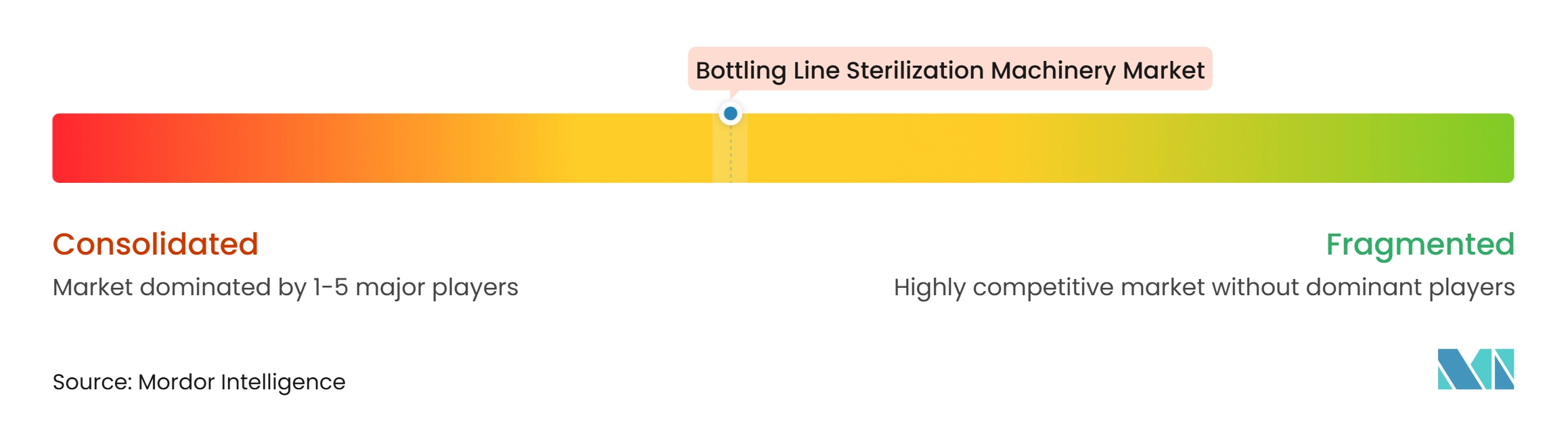
The bottling line sterilization machinery market is moderately consolidated at the premium end. Krones, Sidel, GEA, and KHS benefit from validated process knowledge, service networks, and equipment already installed in customer facilities. Buyers can incur significant revalidation costs when switching suppliers for an established aseptic line. This supports long-term customer relationships for the leading equipment providers. Krones stated in February 2026 that aseptic lines manufactured in China would serve the Chinese market during 2026.[3] This approach points to a stronger focus on local production for cost-sensitive buyers.
Competition is more open in the mid-tier line range, where buyers may not be able to justify the premium attached to imported equipment. Chinese manufacturers such as TECH-LONG and Newamstar are targeting this space with locally engineered aseptic PET lines. TECH-LONG launched dry preform sterilization and aseptic filling technology in December 2025, positioning chemical residue elimination and reduced water use as operating benefits. The competitive pressure is strongest where producers want higher output but have limited capital for European systems. Suppliers must therefore balance performance, service coverage, validation support, and acquisition cost. The bottling line sterilization machinery industry has room for both established global suppliers and regional specialists.
Pharmaceutical users create another area of product differentiation. Syntegon launched RackSter in April 2026 as a mobile steam-sterilizable containment system for aseptic parts transfer. The system is designed to reduce manual handling and support faster aseptic batch changeovers. GEA’s 2025 filler redesign similarly focused on isolator hygiene and automated format changes. These moves show that suppliers are competing not only on line speed but also on validation, operator access, and upgrade costs. The bottling line sterilization machinery market remains moderately concentrated because leading suppliers retain substantial technology and service advantages.
Bottling Line Sterilization Machinery Industry Leaders
-
Krones AG
-
GEA Group Aktiengesellschaft
-
Sidel International AG
-
Serac Group
-
Shibuya Corporation
- *Disclaimer: Major Players sorted in no particular order
Bottling Line Sterilization Machinery Market Companies Covered in this Report
- Krones AG
- GEA Group Aktiengesellschaft
- Sidel International AG
- Serac Group
- Shibuya Corporation
- KHS GmbH
- Guangzhou TECH-LONG Packaging Machinery Co., Ltd.
- SIPA S.p.A.
- DNP Group
- MCF Technology S.r.l.
- Promec S.r.l.
- Wallstein GmbH
- Klenzaids Contamination Controls Pvt. Ltd.
- M&O Perry Industries, Inc.
- Bausch + Ströbel Maschinenfabrik Ilshofen GmbH + Co. KG
- Syntegon Technology GmbH
- Rommelag Engineering
- Steriline S.r.l.
- Marchesini Group S.p.A.
- I.M.A. Industria Macchine Automatiche S.p.A.
- OPTIMA packaging group GmbH
- Tofflon Science and Technology Co., Ltd.
- Maquinaria Industrial Dara, S.L.
Recent Industry Developments in Bottling Line Sterilization Machinery Market
- November 2026: KHS GmbH presented retrofit and machinery upgrade strategies for reusable glass bottle sterilization lines at BrauBeviale 2026 in Nuremberg, demonstrating spray-pump energy reductions of up to 40% and rolling maintenance programs that reduce downtime to 10 hours per cycle, extending line asset life for European operators facing rising energy costs and capital allocation constraints.
- April 2026: Syntegon Technology GmbH launched RackSter, a patented mobile multirack steam-sterilizable containment system for aseptic parts transfer, designed to work in combination with its SynTiso filling platform and reduce batch changeover times while eliminating manual handling within the aseptic zone, directly addressing the pharmaceutical end-user segment’s demand for gloveless, fully automated operations.
- February 2026: Krones AG’s Q4 FY2025 earnings call confirmed that aseptic lines produced at the company’s China operations would begin serving the domestic Chinese market in 2026, formalizing a production-localization strategy aimed at competing with domestic Chinese machinery suppliers on delivery time and cost while retaining European engineering standards.
- January 2026: Sidel supplied 3 high-speed aseptic complete lines to China Resources Beverage at its Yixing and Chengdu plants, featuring Aseptic Combi Predis FMa and FMac configurations capable of 54,000 bottles per hour at 450 ml and 27,000 bottles per hour at 1 L, achieving a 100% first-attempt aseptic validation pass rate.
Global Bottling Line Sterilization Machinery Market Report Scope
The Bottling Line Sterilization Machinery Market comprises the global market for equipment, systems, and integrated machinery designed to sterilize bottles, preforms, caps, closures, and other packaging components used in liquid product filling and packaging operations. These systems employ various sterilization technologies, including hydrogen peroxide, peracetic acid, steam, hot water, dry heat, hot air, UV-C radiation, pulsed light, electron beam, and other emerging technologies to eliminate or reduce microbial contamination and ensure product safety, hygiene, and extended shelf life.
The Bottling Line Sterilization Machinery Market Report is Segmented by Equipment Type (Bottle Sterilization and Rinsing Modules, Preform Sterilization Modules, Cap and Closure Sterilization Modules, Integrated Sterilization-Filling-Capping Monoblocs), Sterilization Technology (Hydrogen Peroxide, Peracetic Acid, Steam and Hot Water, Dry Heat and Hot Air, UV-C and Pulsed Light, Electron Beam and Other Emerging Technologies), Format (PET Bottles, HDPE Bottles, Glass Bottles, Preforms, Caps and Closures, Other Formats), Line Configuration (Rotary Systems, Linear and Inline Systems, Standalone Systems, Integrated Systems, Automatic and Semi-Automatic Systems), End User (Dairy and Plant-Based Beverage Producers, Juice, Tea, and Functional Beverage Producers, Bottled Water Producers, Pharmaceutical and Biopharmaceutical Manufacturers, Contract Beverage and Aseptic Packaging Organizations, Cosmetics, Personal Care, and Other Liquid Product Producers), and Geography (North America, South America, Europe, Asia-Pacific, Middle East and Africa). The Market Forecasts are Provided in Terms of Value (USD).
Segmentation Overview
| Bottle Sterilization and Rinsing Modules |
| Preform Sterilization Modules |
| Cap and Closure Sterilization Modules |
| Integrated Sterilization-Filling-Capping Monoblocs |
| Hydrogen Peroxide |
| Peracetic Acid |
| Steam and Hot Water |
| Dry Heat and Hot Air |
| UV-C and Pulsed Light |
| Electron Beam and Other Emerging Technologies |
| PET Bottles |
| HDPE Bottles |
| Glass Bottles |
| Preforms |
| Caps and Closures |
| Other Formats |
| Rotary Systems |
| Linear and Inline Systems |
| Standalone Systems |
| Integrated Systems |
| Automatic and Semi-Automatic Systems |
| Dairy and Plant-Based Beverage Producers |
| Juice, Tea, and Functional Beverage Producers |
| Bottled Water Producers |
| Pharmaceutical and Biopharmaceutical Manufacturers |
| Contract Beverage and Aseptic Packaging Organizations |
| Cosmetics, Personal Care, and Other Liquid Product Producers |
| North America | United States |
| Canada | |
| Mexico | |
| South America | Brazil |
| Argentina | |
| Chile | |
| Rest of South America | |
| Europe | Germany |
| France | |
| Italy | |
| United Kingdom | |
| Rest of Europe | |
| Asia-Pacific | China |
| India | |
| Japan | |
| South Korea | |
| Rest of Asia-Pacific | |
| Middle East | Saudi Arabia |
| United Arab Emirates | |
| South Africa | |
| Rest of Middle East and Africa |
| By Equipment Type | Bottle Sterilization and Rinsing Modules | |
| Preform Sterilization Modules | ||
| Cap and Closure Sterilization Modules | ||
| Integrated Sterilization-Filling-Capping Monoblocs | ||
| By Sterilization Technology | Hydrogen Peroxide | |
| Peracetic Acid | ||
| Steam and Hot Water | ||
| Dry Heat and Hot Air | ||
| UV-C and Pulsed Light | ||
| Electron Beam and Other Emerging Technologies | ||
| By Format | PET Bottles | |
| HDPE Bottles | ||
| Glass Bottles | ||
| Preforms | ||
| Caps and Closures | ||
| Other Formats | ||
| By Line Configuration | Rotary Systems | |
| Linear and Inline Systems | ||
| Standalone Systems | ||
| Integrated Systems | ||
| Automatic and Semi-Automatic Systems | ||
| By End User | Dairy and Plant-Based Beverage Producers | |
| Juice, Tea, and Functional Beverage Producers | ||
| Bottled Water Producers | ||
| Pharmaceutical and Biopharmaceutical Manufacturers | ||
| Contract Beverage and Aseptic Packaging Organizations | ||
| Cosmetics, Personal Care, and Other Liquid Product Producers | ||
| By Geography | North America | United States |
| Canada | ||
| Mexico | ||
| South America | Brazil | |
| Argentina | ||
| Chile | ||
| Rest of South America | ||
| Europe | Germany | |
| France | ||
| Italy | ||
| United Kingdom | ||
| Rest of Europe | ||
| Asia-Pacific | China | |
| India | ||
| Japan | ||
| South Korea | ||
| Rest of Asia-Pacific | ||
| Middle East | Saudi Arabia | |
| United Arab Emirates | ||
| South Africa | ||
| Rest of Middle East and Africa | ||
Key Questions Answered in the Report
What is the size of the bottling line sterilization machinery market?
The bottling line sterilization machinery market is projected to expand from USD 25.59 million in 2026 and USD 27.59 million in 2027 to USD 40.98 million by 2032, at a 7.82% CAGR.
Which equipment type leads bottling line sterilization machinery demand?
Integrated sterilization-filling-capping monoblocs lead with 49.92% share in 2026 because they reduce transfers between sterilization, filling, and capping steps.
Which sterilization technology is most widely used for bottling lines?
Hydrogen peroxide systems held 41.03% share in 2026, supported by established food-contact applications and compliance controls for residual removal.
Why are preform sterilization modules gaining adoption?
Preform sterilization modules are projected to expand at an 8.62% CAGR through 2032 because treatment before blow molding can reduce water and sterilant use.
Which region is expanding fastest for bottling sterilization equipment?
Asia-Pacific held 35.81% share in 2026 and is projected to advance at an 8.71% CAGR through 2032, supported by beverage, dairy, and nutrition product capacity additions.
Which end users are creating the fastest demand for sterilization machinery?
Pharmaceutical and biopharmaceutical manufacturers are projected to expand at an 8.79% CAGR through 2032 as they shift towar