
Blue Cheese Market Size and Share
Market Overview
| Study Period | 2027 - 2032 |
|---|---|
| Market Size (2027) | USD 1.83 Billion |
| Market Size (2032) | USD 2.38 Billion |
| Growth Rate (2027 - 2032) | 5.40 % |
| Fastest Growing Market | Asia-Pacific |
| Largest Market | Europe |
| Market Concentration | Medium |
Major Players *Disclaimer: Major Players sorted in no particular order Image © Mordor Intelligence. Reuse requires attribution under CC BY 4.0. | |
Blue Cheese Market Analysis by Mordor Intelligence
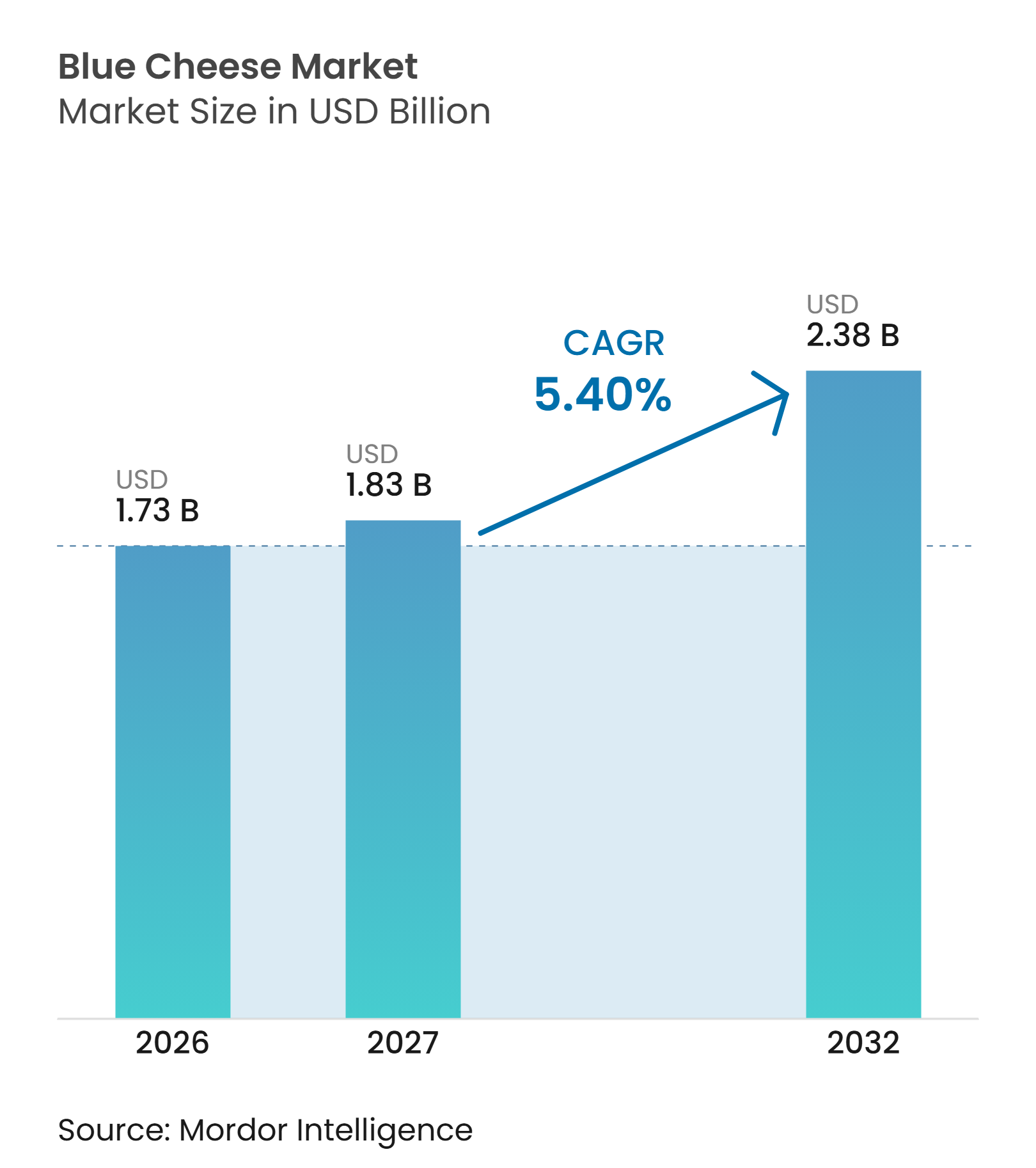
The blue cheese market size is expected to increase from USD 1.73 billion in 2026 to USD 1.83 billion in 2027 and reach USD 2.38 billion by 2032, growing at a CAGR of 5.4% over 2027–2032. Growth is supported by rising consumer interest in specialty and premium cheese varieties, expanding gourmet foodservice applications, and the growing international popularity of established European blue cheese varieties. Gorgonzola remains the leading product category, while demand for Roquefort and other distinctive varieties benefits from increasing consumer interest in artisanal cheese and differentiated flavour profiles. Product innovation across blocks, wheels, slices, crumbles, and spreads, alongside wider availability through specialty stores and online retail platforms, creates opportunities to reach diverse consumer groups. However, the strong flavour profile of blue cheese, relatively high retail prices, complex ripening requirements, and cold-chain management challenges can limit mainstream adoption and distribution efficiency. Growth therefore favours producers that can maintain consistent product quality, strengthen premium positioning, and expand distribution across retail and foodservice channels, particularly in emerging Asia-Pacific markets.
Key Report Takeaways
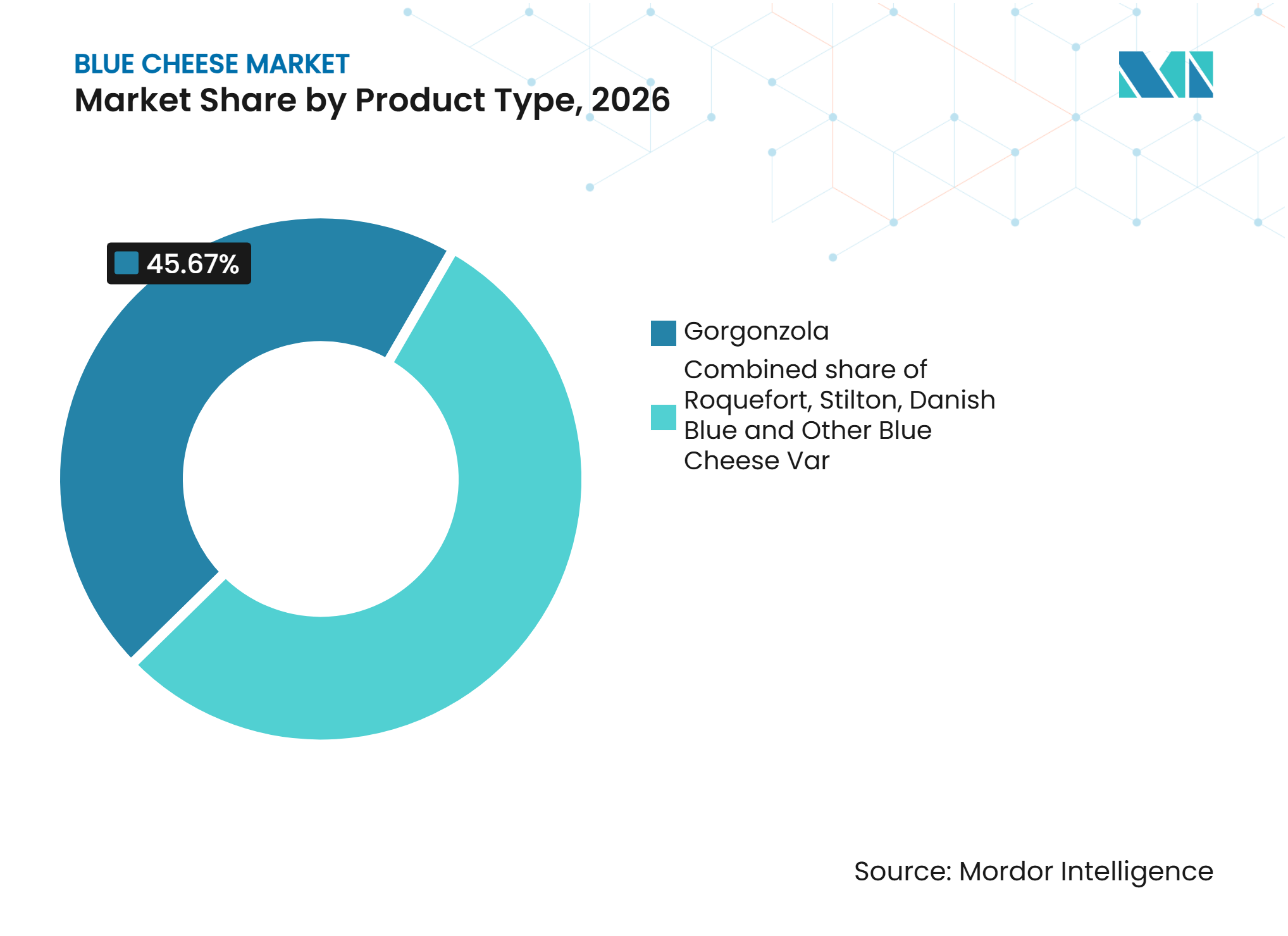
- By product type, Gorgonzola led the blue cheese market with a 45.67% share in 2026, while Roquefort is forecast to grow fastest at a 6.20% CAGR over 2027–2032.
- By milk source, cow milk accounted for the largest share at 79.30% in 2026, while goat milk is forecast to grow fastest at a 6.95% CAGR over 2027–2032.
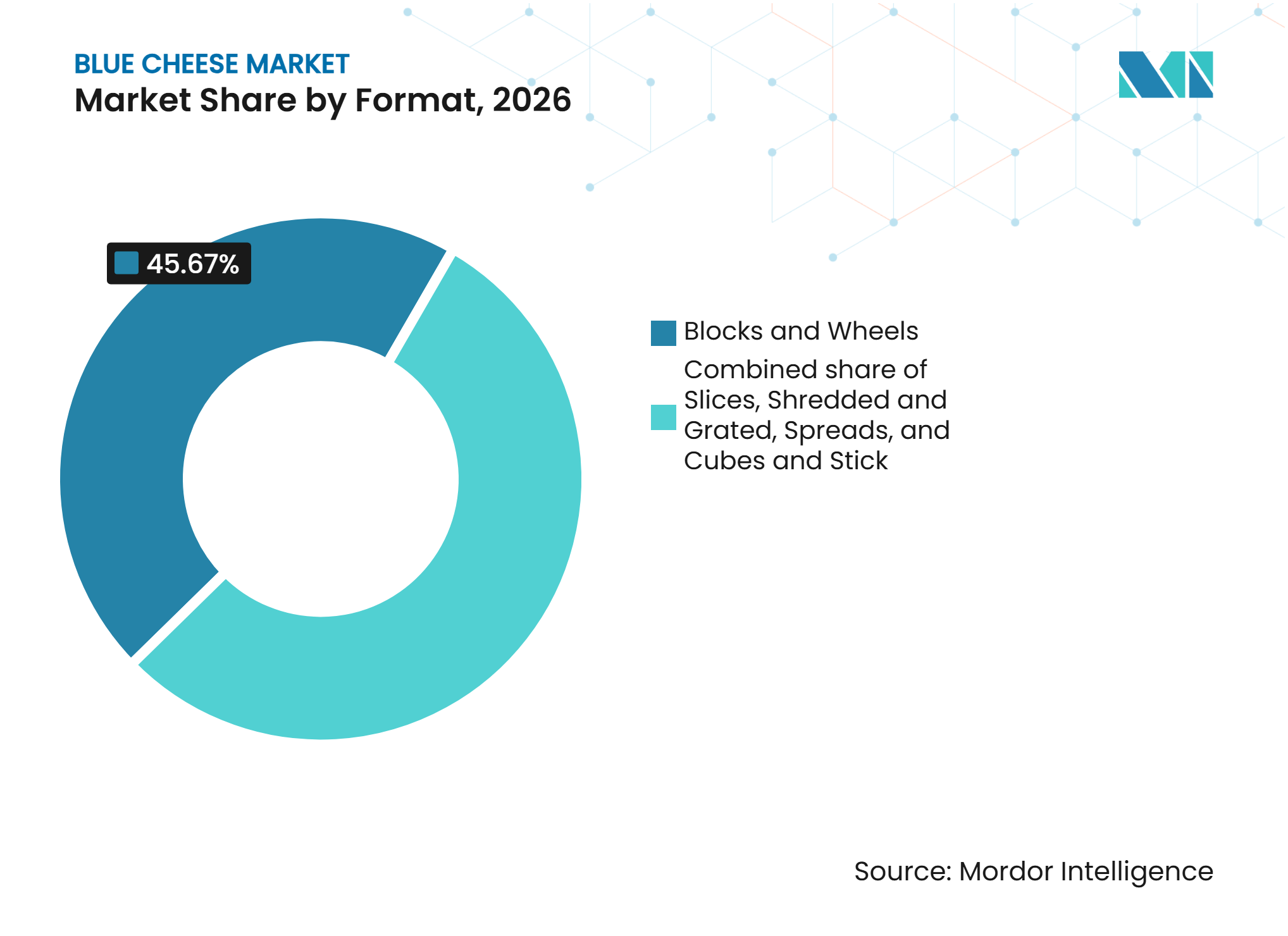
- By format, blocks and wheels dominated with a 45.67% market share in 2026, while crumbles are projected to record the fastest growth at a 6.70% CAGR over 2027–2032.
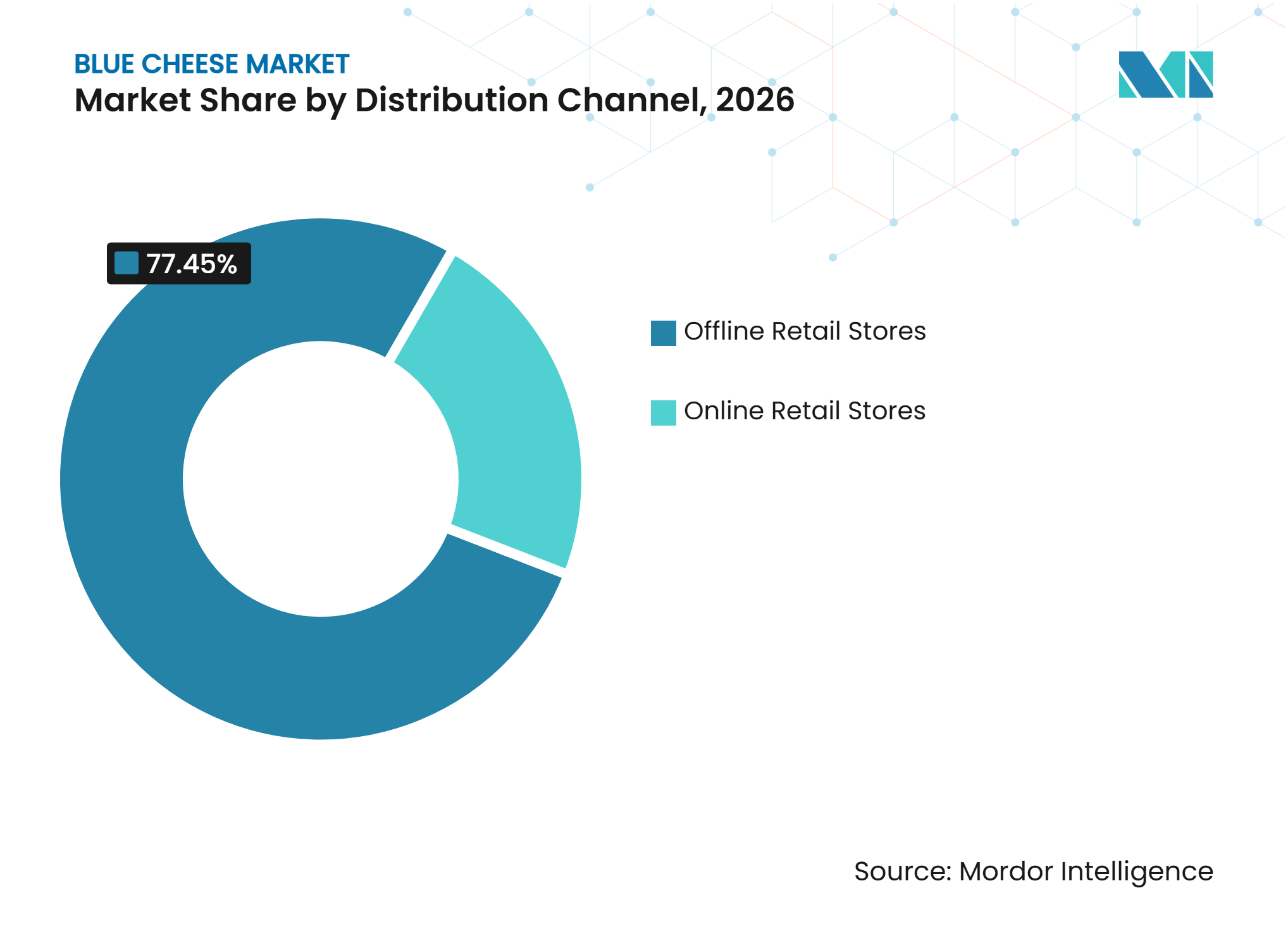
- By distribution channel, offline retail stores accounted for the largest share at 77.45% in 2026, while online retail stores are expected to grow fastest at an 8.10% CAGR over 2027–2032.
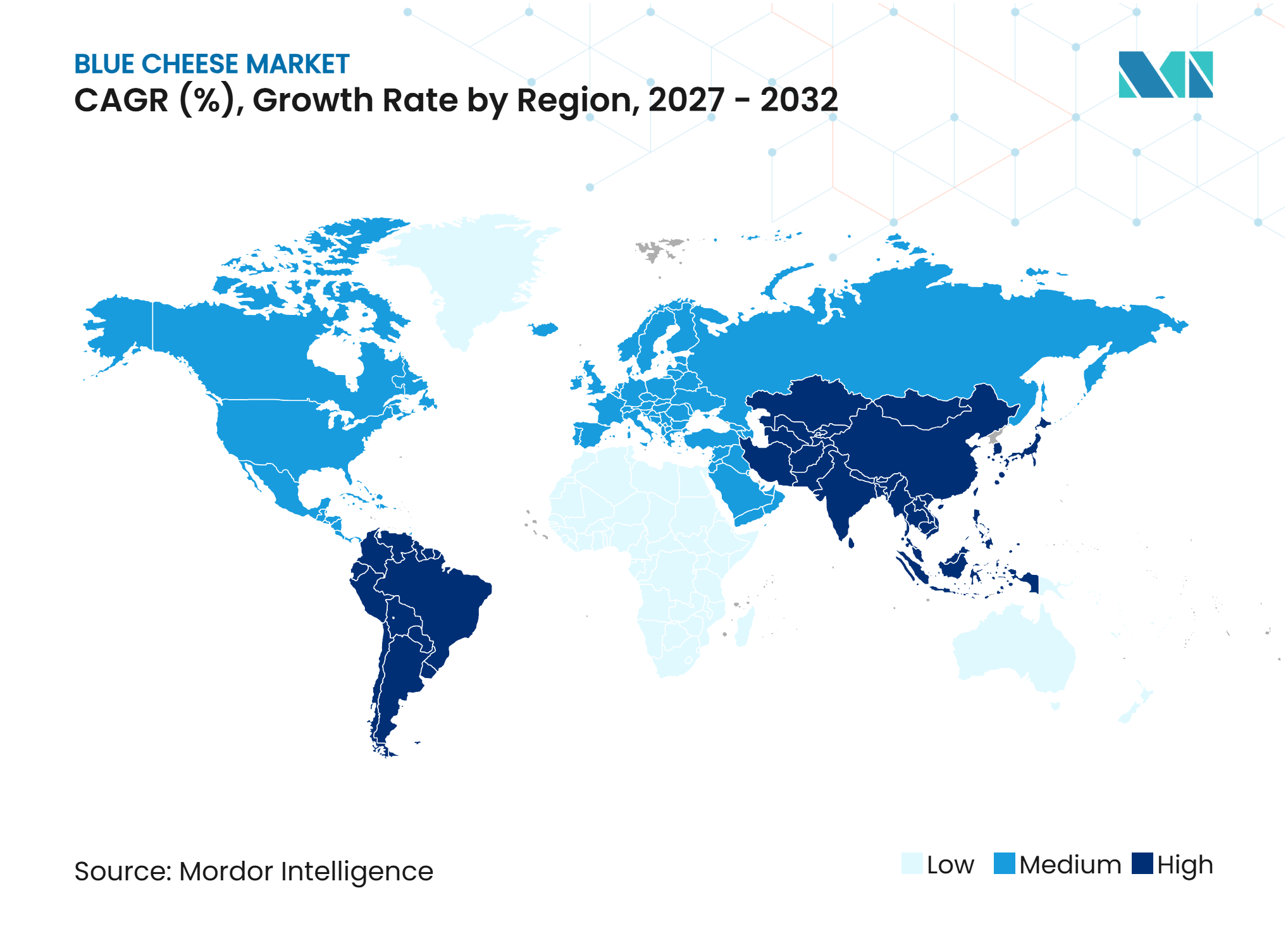
- Among geographies, Europe led with a 46.89% share of the blue cheese market in 2026, while Asia-Pacific is forecast to grow fastest at a 7.20% CAGR over 2027–2032.
Note: Market numbers in this report are based on Mordor Intelligence's proprietary estimation framework, which combines nine months of actuals with Q4 projections for base year 2026.
Market Trends and Insights
Drivers of Blue Cheese Market*
| Driver | (~) % Impact on CAGR Forecast | Geographic Relevance | Impact Timeline |
|---|---|---|---|
| Growing consumer preference for specialty and premium cheese varieties | +0.9% | Global, particularly Europe and North America, where premium and specialty cheese consumption is well established | Medium term (2–4 years) |
| Rising demand for blue cheese in foodservice and gourmet culinary applications | +0.8% | Global, particularly Europe and North America, with growing opportunities across Asia-Pacific's expanding foodservice sector | Medium term (2–4 years) |
| Increasing popularity of European blue cheese varieties across international markets | +0.7% | Global, particularly Europe and North America, with expanding consumer awareness in Asia-Pacific and the Middle East | Long term (More than 4 years) |
| Expansion of premium cheese portfolios through modern retail and specialty stores | +0.6% | Global, particularly North America and Europe, with increasing premium cheese distribution across urban Asia-Pacific markets | Medium term (2–4 years) |
| Growing consumer interest in artisanal cheese and distinctive flavour profiles | +0.5% | Global, particularly Europe and North America, supported by established artisanal cheese cultures and emerging specialty food markets | Long term (More than 4 years) |
| Source: Mordor Intelligence | |||
Growing Consumer Preference for Specialty and Premium Cheese Varieties
Increasing consumer interest in premium, specialty, and differentiated cheese products is creating opportunities for blue cheese manufacturers across retail and foodservice channels. Consumers seeking distinctive flavour profiles, traditional production methods, and higher-quality ingredients are supporting demand for varieties such as Gorgonzola, Roquefort, Stilton, and Danish Blue. According to the Agriculture and Horticulture Development Board (AHDB), premium cheese recorded 9.8% value growth and 7.1% volume growth in the 12 weeks ending October 4, 2025, indicating increasing consumer demand for higher-value cheese offerings [1]. Additionally, the AHDB identifies Stilton and other regionally protected cheeses as products benefiting from strong branding and quality recognition in international markets, particularly across Europe. For manufacturers, these preferences create opportunities to differentiate blue cheese portfolios through regional provenance, traditional maturation techniques, distinctive flavour characteristics, and premium product formats. Expanding specialty cheese selections across supermarkets, delicatessens, and gourmet retail outlets can further improve product accessibility and encourage trial among consumers seeking alternatives to conventional cheese varieties.
Rising Demand for Blue Cheese in Foodservice and Gourmet Culinary Applications
The increasing use of speciality cheeses in restaurant menus, gourmet dishes, and premium foodservice offerings is supporting demand for blue cheese. Varieties such as Gorgonzola and Roquefort are used in applications including gourmet pizzas, burgers, salads, pasta, sauces, dressings, and cheese platters because of their distinctive flavour and ability to enhance culinary formulations. The Agriculture and Horticulture Development Board (AHDB) reported in its 2026 foodservice analysis that cheese accounted for 30.1% of menu items containing dairy ingredients in the first quarter of 2026, compared with 23.7% in 2023 [2]. The U.S. Dairy Export Council also identifies blue cheese and Gorgonzola as suitable ingredients for premium beef-based menu applications, including burgers, salads, and steak preparations. These applications allow chefs and foodservice operators to differentiate menus through stronger flavours and premium ingredients. Consequently, increasing adoption across restaurants, hotels, specialist cafés, and catering establishments creates opportunities for blue cheese producers to supply bulk formats, crumbles, blocks, and foodservice-oriented formulations.
Increasing Popularity of European Blue Cheese Varieties Across International Markets
The international recognition of European blue cheese varieties is supporting product demand beyond traditional European consumption markets. Established varieties such as French Roquefort, Italian Gorgonzola, British Stilton, and Danish Blue benefit from longstanding production traditions, distinctive regional identities, and established quality reputations. A 2024 review published in the International Dairy Journal highlights that many blue-veined cheeses are closely associated with regional heritage and traditional production methods, with several prominent varieties holding Protected Designation of Origin (PDO) or Protected Geographical Indication (PGI) status . International trade data from the World Bank's World Integrated Trade Solution (WITS) indicates that European Union exports of blue-veined cheese reached approximately USD 211.3 million in 2024, with the United Kingdom, United States, Australia, Ukraine, and Canada among the leading destinations. These established export networks help introduce European blue cheese varieties to international consumers and speciality food retailers. For manufacturers, strengthening geographical branding, maintaining product authenticity, and developing export distribution partnerships can support wider international market penetration.
Expansion of Premium Cheese Portfolios Through Modern Retail and Specialty Stores
The expansion of premium cheese assortments across supermarkets, hypermarkets, delicatessens, and specialty food retailers is improving consumer access to blue cheese products. Retailers are increasingly incorporating differentiated cheese varieties into their product portfolios to cater to consumers seeking international flavours, premium ingredients, and alternatives to conventional cheese offerings. According to Euromonitor International, retail distribution for dairy products is evolving through the growing presence of e-commerce, discounters, warehouse clubs, and smaller grocery formats, although offline retail continues to dominate dairy sales [3]. Specialty retail outlets also provide opportunities to introduce consumers to different blue cheese varieties through curated assortments, product information, tasting activities, and premium positioning. For manufacturers, wider retail availability creates opportunities to expand product visibility through packaged blocks, slices, crumbles, spreads, and smaller consumer portions. Strengthening partnerships with modern retail chains and speciality cheese retailers can therefore improve market penetration and support sales across established and emerging markets.
Growing Consumer Interest in Artisanal Cheese and Distinctive Flavour Profiles
Increasing consumer interest in artisanal food products, traditional cheese-making methods, and distinctive flavour experiences is creating opportunities for specialised blue cheese producers. Blue cheeses offer differentiated sensory characteristics through their characteristic blue-green veining, sharp and tangy flavour profiles, and specialised mould-ripening processes. A 2024 review published in the International Dairy Journal highlights that more than 100 types of blue-veined cheeses exist globally, each featuring distinctive manufacturing processes and sensory properties. The review also emphasises the importance of regional heritage and complex biochemical and microbiological changes during cheese maturation. Furthermore, the European Commission's geographical indication framework protects products whose characteristics, reputation, and production methods are linked to specific geographical regions, supporting the authenticity and recognition of traditional cheese varieties [4]. These characteristics provide opportunities for artisanal producers to differentiate their offerings through traditional maturation, regional sourcing, small-batch production, and distinctive flavour profiles. As consumers explore speciality food experiences, producers that communicate product heritage and maintain consistent quality can strengthen their positioning in premium cheese markets.
Restraints of Blue Cheese Market*
| Restraint | (~) % Impact on CAGR Forecast | Geographic Relevance | Impact Timeline |
|---|---|---|---|
| Strong and pungent flavour limiting blue cheese acceptance among mainstream consumers | −0.8% | Global, particularly markets with limited consumer familiarity with blue cheese, including parts of Asia-Pacific, South America and the Middle East and Africa | Medium term (2–4 years) |
| High production costs and premium retail prices of specialty blue cheese | −0.7% | Global, particularly price-sensitive markets and regions dependent on imported specialty cheese, including Asia-Pacific and the Middle East and Africa | Medium term (2–4 years) |
| Complex ripening processes and strict quality control requirements | −0.6% | Global, particularly smaller producers and markets with limited access to specialised maturation facilities, technical expertise and quality-control infrastructure | Long term (More than 4 years) |
| Perishability and cold-chain management challenges during storage and distribution | −0.5% | Global, particularly markets with long distribution routes, warm climates and less-developed refrigerated storage and transportation infrastructure | Medium term (2–4 years) |
| Source: Mordor Intelligence | |||
High Production Costs and Premium Retail Pricing
The production of blue cheese involves higher manufacturing costs than several conventional cheese varieties due to specialised processing, controlled maturation, and stringent quality requirements. Manufacturers must invest in high-quality milk, specialised microbial cultures, temperature- and humidity-controlled ripening facilities, and skilled cheesemakers to achieve the characteristic flavour, texture, and blue veining. Extended maturation periods also increase inventory holding costs, storage requirements, and working capital commitments. Additionally, the use of premium milk sources, traditional production methods, and geographical indication requirements for varieties such as Roquefort and Gorgonzola can further increase production expenditure. These costs are often reflected in premium retail prices, potentially limiting affordability among price-sensitive consumers and restricting wider adoption in markets where conventional cheese varieties offer more economical alternatives. Manufacturers therefore need to improve production efficiency, optimise maturation processes, and strengthen distribution capabilities to manage costs while maintaining product quality.
Complex Ripening Processes and Strict Quality Control Requirements
Blue cheese production requires carefully controlled ripening conditions to develop its characteristic blue-green veining, distinctive flavour, and desired texture. Manufacturers must manage temperature, humidity, oxygen exposure, and microbial activity throughout the maturation process to ensure consistent product quality. The introduction and growth of Penicillium cultures require precise production conditions, while variations in moisture levels, ripening duration, and storage environments can affect the cheese's sensory characteristics and final quality. Additionally, manufacturers must maintain strict hygiene standards and conduct regular microbiological and quality assessments to minimise contamination risks during production and maturation. These requirements increase operational complexity, extend production timelines, and create additional quality-control costs, particularly for smaller artisanal producers with limited specialised infrastructure. Manufacturers therefore need to invest in controlled maturation facilities, standardised production practices, and continuous quality monitoring to maintain product consistency and meet food safety requirements.
*Our forecasts treat driver/restraint impacts as directional, not additive. The impact forecasts reflect baseline growth, mix effects, and variable interactions.
Blue Cheese Market Segment Analysis
By Product Type:
Gorgonzola Leads While Roquefort Expands FasterIn 2026, Gorgonzola accounted for an estimated 45.67% of the Blue Cheese Market, making it the leading product type. Its position reflects the established recognition of Gorgonzola as a versatile blue cheese used in sauces, pasta dishes, salads, dressings, and cheese boards. Its availability in different textures, including creamy and firmer varieties, also supports its use across household consumption and foodservice applications. Meanwhile, Roquefort is projected to record the fastest growth, at an estimated CAGR of 6.20% through 2032. Its distinctive flavour, traditional production heritage, and protected geographical identity support its positioning in the premium specialty cheese category.
Stilton and Danish Blue contribute to the market through their established regional identities and applications in cheese boards, sauces, and prepared foods. Other blue cheese varieties further broaden the category by offering differences in milk source, texture, flavour intensity, and maturation characteristics. Producers can strengthen demand by improving product accessibility, communicating variety-specific characteristics, and introducing formats that encourage consumer trial.



By Milk Source:
Cow Milk Dominates While Goat Milk Gains MomentumIn 2026, cow milk accounted for an estimated 79.30% of the Blue Cheese Market, making it the leading milk source. Its dominance reflects the established use of cow milk in commercial cheese manufacturing, supported by its broad availability, established processing infrastructure, and suitability for producing consistent cheese textures and flavour profiles. Meanwhile, goat milk is projected to record the fastest growth, at an estimated CAGR of 6.95% through 2032. Its distinctive flavour characteristics and association with specialty dairy products support its appeal among consumers seeking alternatives to conventional cow-milk cheese.
Sheep milk and other milk sources contribute to product differentiation by offering variations in flavour, texture, and composition. These categories also provide opportunities for producers to develop regionally distinctive and premium cheese varieties. However, manufacturers need to manage milk sourcing, processing conditions, and maturation requirements to maintain consistent product quality across different milk-based formulations.
By Format:
Blocks and Wheels Lead While Crumbles Expand FasterIn 2026, blocks and wheels accounted for an estimated 45.67% of the Blue Cheese Market, making them the leading product format. Their position reflects their suitability for traditional cheese retailing, specialty cheese counters, foodservice preparation, and further processing into smaller portions. Blocks and wheels also allow retailers and foodservice operators to cut, portion, and prepare cheese according to specific requirements. Meanwhile, crumbles are projected to record the fastest growth, at an estimated CAGR of 6.70% through 2032. Their ready-to-use format supports convenient incorporation into salads, pizzas, pasta, sauces, and other prepared dishes, reducing the need for additional preparation.
Slices, shredded and grated cheese, spreads, and cubes and sticks serve different consumption and application requirements. These formats offer convenience for household use, snacking, food preparation, and foodservice operations. Manufacturers can expand their reach by developing portion-controlled packaging and application-specific formats while maintaining the characteristic flavour, texture, and quality of blue cheese.

By Distribution Channel:
Offline Retail Stores Lead While Online Retail Expands FasterIn 2026, offline retail stores accounted for an estimated 77.45% of the Blue Cheese Market, making them the leading distribution channel. Their position reflects the importance of supermarkets, hypermarkets, specialty cheese shops, and delicatessens in the sale of premium and specialty cheese products. Physical retail outlets allow consumers to compare varieties, assess packaging and product information, and seek recommendations from store personnel. Meanwhile, online retail stores are projected to record the fastest growth, at an estimated CAGR of 8.10% through 2032. E-commerce platforms offer access to a wider selection of specialty cheese varieties, convenient ordering, and home delivery, supporting purchases among consumers who may have limited access to dedicated cheese retailers.
The expansion of online distribution also creates opportunities for producers to reach niche consumer groups and introduce premium or region-specific varieties beyond established retail markets. However, both channels require appropriate refrigerated storage, product handling, and packaging to preserve quality. Retailers and manufacturers that combine wider product availability with reliable temperature-controlled distribution are better positioned to support market expansion.
Geography Analysis
Europe Blue Cheese Market
Europe accounted for an estimated 46.89% of the Blue Cheese Market in 2026, making it the largest regional market. The region benefits from a long-established cheese-making tradition and the presence of internationally recognised blue cheese varieties, including Gorgonzola from Italy, Roquefort from France, and Stilton from the United Kingdom. Protected geographical indication and designation-of-origin systems also help preserve the identity and reputation of traditional regional cheeses. Established specialty cheese retailers, supermarkets, and foodservice channels further support product availability and consumption. These factors strengthen Europe's position as the leading market for blue cheese.
Asia-Pacific Blue Cheese Market
Asia-Pacific is projected to be the fastest-growing regional market, with an estimated CAGR of 7.20% over 2027–2032. Growing exposure to international cuisines, expanding premium food retail, and wider availability of imported specialty cheeses are creating opportunities for blue cheese producers. Demand from hotels, restaurants, and modern foodservice operators also supports the use of blue cheese in salads, pizzas, pasta, sauces, and fusion dishes. However, manufacturers need to address differences in flavour preferences, consumer familiarity, and price sensitivity across individual markets. Smaller packs, milder varieties, and ready-to-use formats can help encourage product trial and broader adoption.
North America Blue Cheese Market
North America represents an established market for blue cheese, supported by consumer familiarity with specialty cheese varieties and their use in salads, burgers, dressings, sauces, and other foodservice applications. The United States is an important market for premium and specialty cheese products, with supermarkets, specialty retailers, and foodservice operators providing routes to consumers. The region's established cheese consumption base and continued use of cheese in restaurant menus create opportunities for blue cheese producers to expand product applications. However, premium pricing and competition from more widely consumed cheese varieties can influence purchasing decisions.
Competitive Landscape
Market Concentration
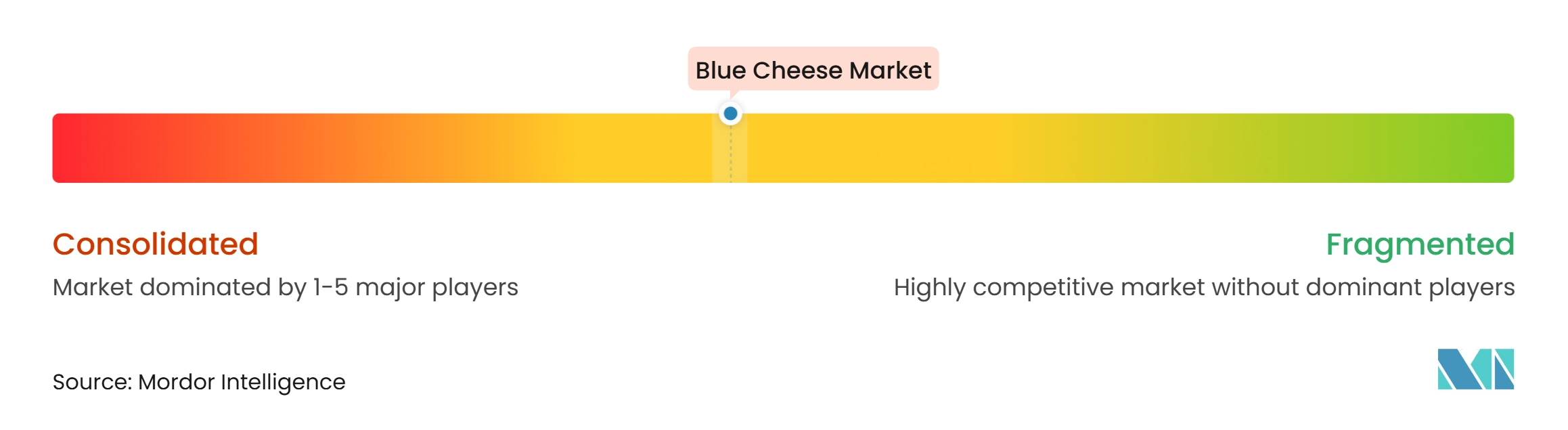
The Blue Cheese Market includes multinational dairy companies, specialist cheese manufacturers, regional dairies, and producers of protected-origin cheese varieties competing through product quality, traditional production expertise, brand positioning, and distribution reach. Companies have varying levels of participation across Gorgonzola, Roquefort, Stilton, Danish Blue, and other blue cheese varieties. Specialist producers differentiate through regional heritage, milk sourcing, and maturation techniques, while larger dairy companies leverage established manufacturing capabilities, foodservice relationships, and retail distribution networks.
Competitive strategies in the Blue Cheese Market focus on expanding product formats, developing variety-specific offerings, and strengthening premium and foodservice positioning. For example, Arla Foods markets blue cheese under its Castello brand, including Traditional Danish Blue and foodservice formats such as blue cheese wheels and crumbles. Saputo offers blue-veined cheese products through its Treasure Cave brand, including blue cheese and Gorgonzola wheels and crumbles. Lactalis also participates in the category through its Galbani brand, which offers Gorgonzola products for retail and culinary applications. These portfolios demonstrate how manufacturers serve different consumption occasions through traditional varieties, convenient formats, and products designed for professional kitchens.
Regional expertise and product authenticity remain important competitive considerations. The Gorgonzola Consortium represents producers of Gorgonzola PDO, while the Stilton Cheese Makers' Association identifies six licensed dairies authorised to produce Blue Stilton. Such regional production networks reinforce the importance of origin, traditional methods, and product specifications in differentiating specialty blue cheese varieties. Meanwhile, companies with established retail and foodservice relationships can improve market access through wider product availability and formats suited to professional kitchens. However, manufacturers must manage milk procurement, maturation conditions, quality consistency, refrigerated distribution, and premium pricing. These factors make product differentiation, production expertise, reliable sourcing, and efficient cold-chain operations important areas of competition.
Blue Cheese Industry Leaders
-
Groupe Lactalis
-
Savencia Fromage and Dairy
-
Arla Foods amba
-
Saputo Inc.
-
Rogue Creamery
- *Disclaimer: Major Players sorted in no particular order
Blue Cheese Market Companies Covered in this Report
- Arla Foods amba
- Groupe Lactalis
- Savencia Fromage and Dairy
- Emmi Group
- Saputo Inc.
- Ornua Co-operative Limited
- Colston Bassett Dairy
- Cropwell Bishop Creamery
- Long Clawson Dairy
- Hartington Creamery
- Roquefort Société
- Fromageries Papillon
- Gabriel Coulet S.A.
- Les Fromageries Occitanes
- Mammen Cheese A/S
- Point Reyes Farmstead Cheese Company
- Rogue Creamery
- Maytag Dairy Farms
- Prairie Farms Dairy
- Highland Fine Cheeses Ltd.
Recent Industry Developments in Blue Cheese Market
- October 2026: The Gorgonzola Consortium participated in B2Cheese 2026 in Bergamo, Italy, alongside other Italian PDO cheese consortia. The initiative included product tastings, educational activities, and industry discussions on cheese retailing, international buyer engagement, and commercial partnerships, supporting the visibility and market positioning of Gorgonzola PDO.
- September 2026: The Gorgonzola Consortium promoted Gorgonzola PDO through its autumn communication campaign, highlighting the cheese's nutritional attributes and culinary versatility. The initiative supported consumer awareness and reinforced the positioning of traditional Italian Gorgonzola in the specialty cheese market.
- August 2026: Treasure Cave Cheese expanded its distribution network through a retail partnership with Wegmans Food Markets, introducing its Crumbled Blue Cheese and Blue Cheese Dip & Spread across select stores in the northeastern United States. The expansion strengthened the brand's retail presence and increased consumer access to packaged blue cheese products.
- March 2026: Kingston Creamery introduced three new blue cheese products: Organic Gorgonzola, Bountiful Blue, and Smoked Bountiful Blue in the United States. The launch expanded its specialty cheese portfolio with organic cow's milk Gorgonzola and sheep's milk blue cheese varieties, supported by nationwide distribution and selected retail partnerships.
Global Blue Cheese Market Report Scope
For this study, the Blue Cheese Market is defined as the sales value of commercially produced blue-veined cheeses manufactured through the introduction of Penicillium cultures during the cheese-making and ripening process, resulting in their characteristic blue or green veins, distinctive flavour, and aroma. The market covers Gorgonzola, Roquefort, Stilton, Danish Blue, and other blue cheese varieties, segmented by milk source into cow milk, goat milk, sheep milk, and other milk sources; by format into blocks and wheels, slices, shredded and grated, spreads, and cubes and sticks; and by distribution channel into offline retail stores and online retail stores. The market is analyzed across North America, Europe, Asia-Pacific, South America, and the Middle East and Africa, with country-level coverage as specified in the report. Market sizing and forecasts are presented in value terms (USD) across the defined segments and geographies.
Segmentation Overview
| Roquefort |
| Gorgonzola |
| Stilton |
| Danish Blue |
| Other Blue Cheese Varieties |
| Cow |
| Goat |
| Sheep |
| Other Milk Sources |
| Blocks/Wheels |
| Slices |
| Shredded and Grated |
| Spreads |
| Cubes and Sticks |
| Online Retail Stores |
| Offline Retail stores |
| North America | United States |
| Canada | |
| Mexico | |
| Rest of North America | |
| Europe | United Kingdom |
| Germany | |
| France | |
| Italy | |
| Spain | |
| Sweden | |
| Belgium | |
| Poland | |
| Netherlands | |
| Europe | |
| Asia-Pacific | China |
| Japan | |
| India | |
| Thailand | |
| Singapore | |
| Indonesia | |
| South Korea | |
| Australia | |
| Rest of Asia-Pacific | |
| South America | Brazil |
| Argentina | |
| Colombia | |
| Peru | |
| Chile | |
| Rest of South America | |
| Middle East and Africa | South Africa |
| Saudi Arabia | |
| United Arab Emirates | |
| Nigeria | |
| Egypt | |
| Morocco | |
| Turkey | |
| Rest of Middle East and Africa |
| By Product Type | Roquefort | |
| Gorgonzola | ||
| Stilton | ||
| Danish Blue | ||
| Other Blue Cheese Varieties | ||
| By Milk Source | Cow | |
| Goat | ||
| Sheep | ||
| Other Milk Sources | ||
| By Format | Blocks/Wheels | |
| Slices | ||
| Shredded and Grated | ||
| Spreads | ||
| Cubes and Sticks | ||
| By Distribution Channel | Online Retail Stores | |
| Offline Retail stores | ||
| By Geography | North America | United States |
| Canada | ||
| Mexico | ||
| Rest of North America | ||
| Europe | United Kingdom | |
| Germany | ||
| France | ||
| Italy | ||
| Spain | ||
| Sweden | ||
| Belgium | ||
| Poland | ||
| Netherlands | ||
| Europe | ||
| Asia-Pacific | China | |
| Japan | ||
| India | ||
| Thailand | ||
| Singapore | ||
| Indonesia | ||
| South Korea | ||
| Australia | ||
| Rest of Asia-Pacific | ||
| South America | Brazil | |
| Argentina | ||
| Colombia | ||
| Peru | ||
| Chile | ||
| Rest of South America | ||
| Middle East and Africa | South Africa | |
| Saudi Arabia | ||
| United Arab Emirates | ||
| Nigeria | ||
| Egypt | ||
| Morocco | ||
| Turkey | ||
| Rest of Middle East and Africa | ||
Key Questions Answered in the Report
What is the size of the Blue Cheese Market?
The Blue Cheese Market is estimated at USD 1.73 billion in 2026 and is projected to reach USD 2.38 billion by 2032.
What is the CAGR of the Blue Cheese Market?
The Blue Cheese Market is expected to register a CAGR of 5.4% during the forecast period (2027–2032).
Which product type holds the largest share of the Blue Cheese Market?
Gorgonzola is the largest product type, accounting for 45.67% of the Blue Cheese Market in 2026, supported by its established presence in European cheese consumption and international specialty cheese distribution.
Which region dominates the Blue Cheese Market?
Europe holds the largest regional share of the Blue Cheese Market, accounting for 46.89% in 2026, driven by its established blue cheese production traditions, strong consumer familiarity, and presence of prominent regional varieties such as Gorgonzola, Roquefort, and Stilton.