
Blank Apparel Market Size and Share
Market Overview
| Study Period | 2022 - 2032 |
|---|---|
| Market Size (2027) | USD 16.58 Billion |
| Market Size (2032) | USD 21.31 Billion |
| Growth Rate (2027 - 2032) | 5.15 % |
| Fastest Growing Market | Asia-Pacific |
| Largest Market | Asia-Pacific |
| Market Concentration | Medium |
Major Players *Disclaimer: Major Players sorted in no particular order Image © Mordor Intelligence. Reuse requires attribution under CC BY 4.0. | |
Blank Apparel Market Analysis by Mordor Intelligence
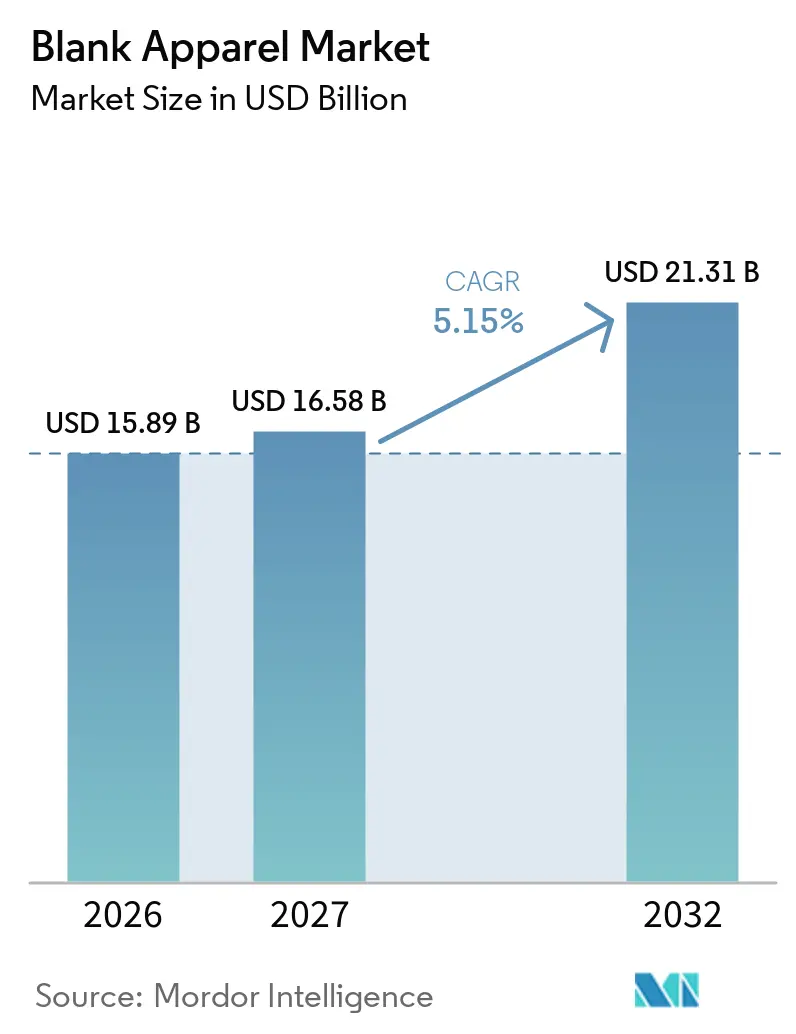
The blank apparel market size is expected to grow from USD 15.89 billion in 2026 to USD 16.58 billion in 2027 and is forecast to reach USD 21.31 billion by 2032 at 5.15% CAGR over 2027-2032. The market draws demand from decorators, promotional distributors, corporate buyers, schools, and direct-to-consumer sellers, which reduces exposure to any one buyer group. Print-on-demand services and short digital decoration runs are turning undecorated garments into production inputs rather than finished retail goods. This shift broadens the customer base beyond established wholesale buyers and supports recurring smaller orders. Competitive activity is concentrating manufacturing scale while leaving room for suppliers that offer reliable fabric quality, deeper color ranges, and flexible order fulfillment.
Key Report Takeaways
- By product type, t-shirts & tops held 47.71% of the market share in 2026, while sweatshirts & hoodies are forecast to grow at a CAGR of 6.61% through 2032.
- By age group, men held 53.08% of the market share in 2026, while women are forecast to grow at a CAGR of 6.37% through 2032.
- By price range, mass held 72.51% of the market share in 2026, while premium is forecast to grow at a CAGR of 6.68% through 2032.
- By material, cotton held 55.27% of the market share in 2026, while polyester is forecast to grow at a CAGR of 6.34% through 2032.
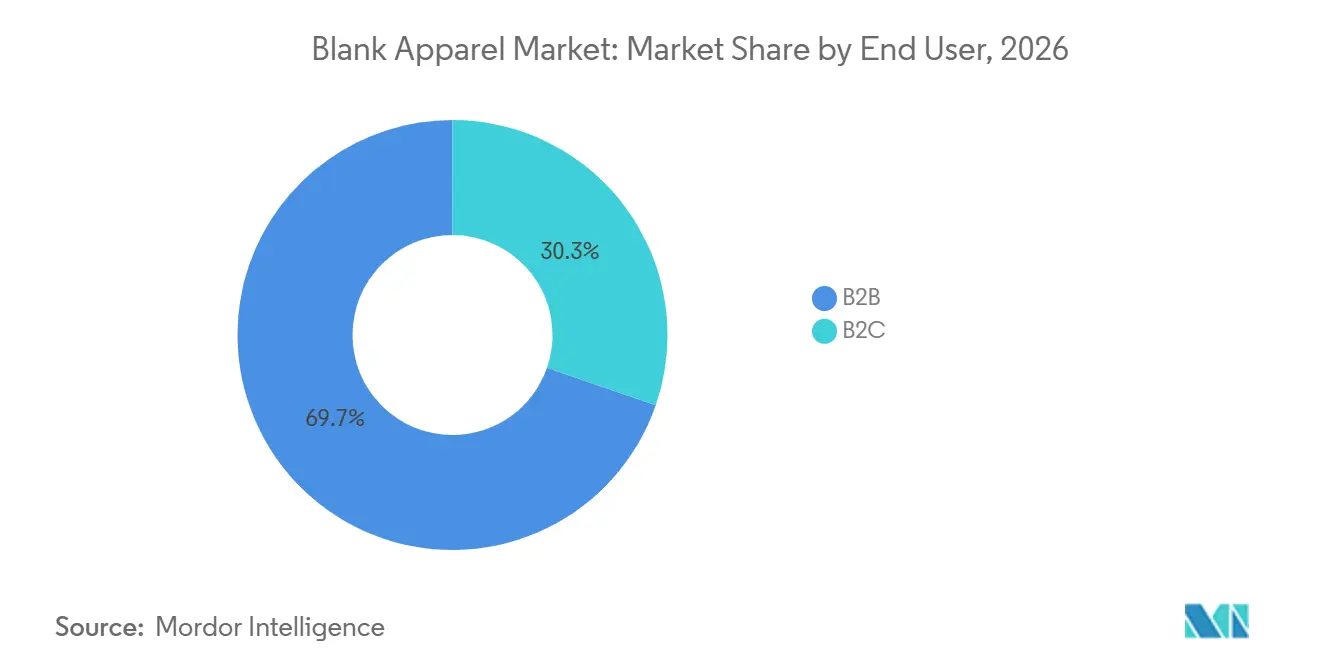
- By end user, B2B held 69.71% of the market share in 2026, while B2C is forecast to grow at a CAGR of 6.56% through 2032.
- By geography, Asia-Pacific held 43.56% market share in 2026 and is forecast to grow at a CAGR of 6.24% through 2032.
Note: Market numbers in this report are based on Mordor Intelligence's proprietary estimation framework, which combines nine months of actuals with Q4 projections for base year 2026.
Global Blank Apparel Market Trends and Insights
Drivers Impact Analysis*
| Driver | (~) % Impact on CAGR Forecast | Geographic Relevance | Impact Timeline |
|---|---|---|---|
| Growing demand for customized and personalized clothing | +1.3% | Global | Medium term (2–4 years) |
| Increasing adoption of print-on-demand business models | +1.1% | Global | Short term (≤ 2 years) |
| Rising demand for promotional apparel and corporate merchandise | +0.7% | North America and European Union | Medium term (2–4 years) |
| Increasing demand from screen printing and embroidery businesses | +0.5% | Global | Short term (≤ 2 years) |
| Growing demand for comfortable and versatile everyday clothing | +0.4% | Global | Long term (≥ 4 years) |
| Increasing adoption of blank apparel for team uniforms, schools, and institutional wear | +0.3% | Asia-Pacific core, spill-over to North America | Medium term (2–4 years) |
| Source: Mordor Intelligence | |||
Growing Demand for Customized and Personalized Clothing
The increasing preference for unique clothing and self-expression is supporting demand for blank apparel, which serves as a base for personalized T-shirts, hoodies, sweatshirts, and other garments. According to a 2025 VistaPrint survey of 2,000 US consumers, 52% reported owning personalized clothing to support a small business, while 47% were willing to pay more for personalized apparel because of its uniqueness. This trend encourages apparel brands, independent designers, and small businesses to procure undecorated garments for customization through screen printing, embroidery, and heat-transfer techniques. The expansion of e-commerce and print-on-demand platforms further enables consumers to access customized clothing without large minimum-order requirements.
Increasing Adoption of Print-on-Demand Business Models
Print-on-demand is expanding access to the blank apparel market by enabling entrepreneurs, independent clothing brands, and small businesses to operate without meeting conventional minimum order quantities. Advances in direct-to-film (DTF) and direct-to-garment (DTG) printing equipment allow small printing shops to process short production runs, customized designs, and individual customer orders more efficiently. This model generates recurring purchases of blank T-shirts, hoodies, sweatshirts, and other garments, with smaller orders collectively contributing meaningful sales volumes across a broad base of apparel decorators. PRINTING United Alliance highlighted the growing role of print-on-demand services in the garment decoration industry during 2025, reflecting the industry's shift toward flexible, demand-driven production[1]. The model also increases the importance of maintaining broad color selections, diverse fabric options, and complete size ranges to accommodate varied customer requirements.
Rising Demand for Promotional Apparel and Corporate Merchandise
Promotional apparel and corporate merchandise provide a consistent source of demand for the blank apparel market, as organizations use customized clothing to strengthen brand visibility and engage employees and customers. The promotional products industry reached USD 26.6 billion in 2025, with T-shirts remaining the leading product category in the sector. Branded garments serve both promotional and employee-engagement purposes, supporting repeat purchases for marketing campaigns, corporate events, and internal branding initiatives. Corporate uniforms and company stores also procure polos, sweatshirts, and fleece garments, which can command higher unit values than basic T-shirts depending on fabric quality and product specifications.
Increasing Demand for Blank Apparel From Screen Printing and Embroidery Businesses
Screen printing and embroidery businesses are driving demand for blank apparel by purchasing undecorated garments as base products for customized clothing and merchandise. These businesses procure T-shirts, hoodies, sweatshirts, polos, and other garments in bulk to serve apparel brands, corporate clients, educational institutions, and event organizers. The growing use of screen printing for promotional designs and embroidery for premium branding is supporting demand for garments compatible with different decoration techniques. Small-scale decorators and independent apparel businesses also purchase blank clothing to fulfill customized orders without investing in garment manufacturing.
Restraints Impact Analysis*
| Restraint | (~) % Impact on CAGR Forecast | Geographic Relevance | Impact Timeline |
|---|---|---|---|
| Volatility in cotton and other textile raw material prices | -0.8% | Global | Short term (≤ 2 years) |
| Intense price competition among blank apparel manufacturers and suppliers | -0.6% | Global | Long term (≥ 4 years) |
| Dependence on overseas manufacturing and exposure to supply chain disruptions | -0.5% | North America and European Union | Medium term (2–4 years) |
| Rising labor, energy, and garment manufacturing costs | -0.5% | Asia-Pacific core, spill-over to Middle East and Africa | Medium term (2–4 years) |
| Source: Mordor Intelligence | |||
Volatility in Cotton and Other Textile Raw Material Prices
Fluctuations in cotton, polyester, and other textile raw material prices create cost pressures for manufacturers in the blank apparel market. Changes in cotton availability, weather conditions, energy costs, and global supply-demand dynamics can increase the cost of yarn, fabric, and garment production. These variations make it difficult for manufacturers to maintain stable pricing, particularly when supplying basic T-shirts, hoodies, and other high-volume garments at competitive rates. Smaller manufacturers and wholesale suppliers may face additional pressure when rising input costs cannot be fully passed on to buyers. Frequent price adjustments can also affect purchasing decisions among screen printers, promotional merchandise providers, and apparel brands that rely on predictable procurement budgets.
Fluctuations in cotton, polyester, and other textile raw material prices create cost pressures for manufacturers in the blank apparel market. Changes in cotton availability, weather conditions, energy costs, and global supply-demand dynamics can increase the cost of yarn, fabric, and garment production. These variations make it difficult for manufacturers to maintain stable pricing, particularly when supplying basic T-shirts, hoodies, and other high-volume garments at competitive rates. Smaller manufacturers and wholesale suppliers may face additional pressure when rising input costs cannot be fully passed on to buyers. Frequent price adjustments can also affect purchasing decisions among screen printers, promotional merchandise providers, and apparel brands that rely on predictable procurement budgets.
Intense Price Competition Among Blank Apparel Manufacturers and Suppliers
Price competition limits the ability of blank apparel suppliers to recover higher material, labor, and energy costs. Larger vertically integrated producers can absorb cost swings more readily than many mid-sized specialists. PRINTING United Alliance reported that 73.9% of decorated-apparel businesses identified recession risk as their leading concern in 2025, while 55.1% cited tariffs as a critical cost concern[2]. Online wholesale systems make it easier for buyers to compare supplier price lists. This reduces pricing flexibility for suppliers even when their products offer better fabric quality. Sustainability reporting requirements, including certified-input documentation and textile-labeling rules, add further administrative work for suppliers seeking certified materials.
*Our forecasts treat driver/restraint impacts as directional, not additive. The impact forecasts reflect baseline growth, mix effects, and variable interactions.
Segment Analysis
By Product Type: T-Shirts and Tops Lead Demand While Fleece Formats Grow Faster
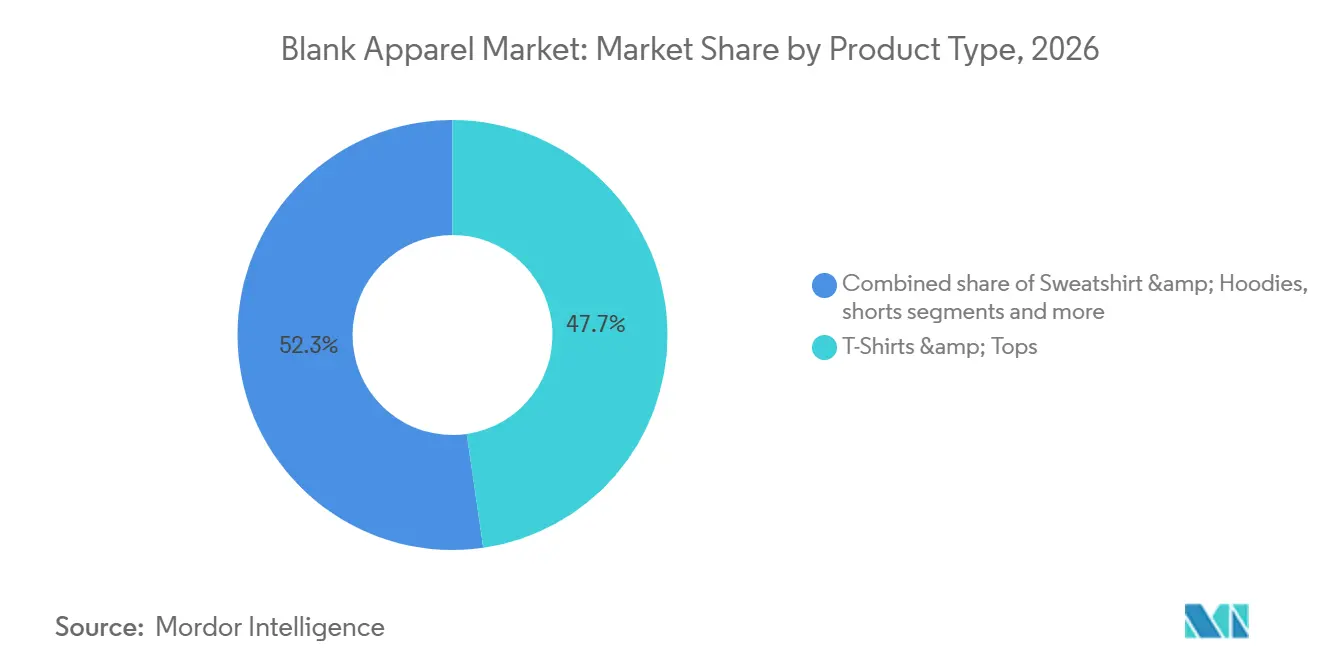
T-shirts and tops accounted for the largest share of the blank apparel market, representing 47.71% of the market in 2026. Their leading position is supported by widespread use across casualwear, corporate apparel, promotional merchandise, and customized clothing. These products are widely preferred by businesses, event organizers, educational institutions, and apparel brands for bulk purchasing and customization. Their versatility in terms of fabric, fit, color, and printing options makes them suitable for diverse consumer and commercial applications. The growing popularity of personalized clothing and branded merchandise further supports demand for blank t-shirts and tops.
Sweatshirts and hoodies are projected to register the fastest growth in the blank apparel market, expanding at a CAGR of 6.61% through 2032. Growth is supported by increasing demand for comfortable, versatile clothing suitable for casual wear, athleisure, and layering. The continued popularity of streetwear and oversized apparel is also encouraging demand for customizable sweatshirts and hoodies. Businesses and clothing brands increasingly use these products for promotional merchandise, employee apparel, college merchandise, and private-label collections. Their suitability for screen printing, embroidery, heat transfer, and other decoration methods makes them attractive to customization businesses.

By Age Group: Men's Established Base Faces Faster Growth in Women's Styles
The men's segment accounted for the largest share of the blank apparel market, representing 53.08% of the market in 2026. This dominance is supported by consistent demand for basic clothing products, including t-shirts, sweatshirts, hoodies, and trousers, across casualwear and everyday apparel categories. Blank apparel is widely used by businesses, sports organizations, educational institutions, and promotional merchandise providers to develop customized clothing for male consumers. The growing popularity of branded merchandise and personalized apparel further supports demand within this segment.
The women's segment is projected to register the fastest growth in the blank apparel market, expanding at a CAGR of 6.37% through 2032. This growth is supported by increasing demand for customizable clothing across casualwear, athleisure, and fashion-oriented apparel categories. The rising popularity of personalized t-shirts, sweatshirts, and hoodies is creating opportunities for businesses catering to women's apparel preferences. The expansion of e-commerce and print-on-demand platforms is further enabling sellers to offer customized products in a wide range of designs, colors, and sizes.
By Price Range: Mass Buying Supports Volume While Premium Garments Gain Value
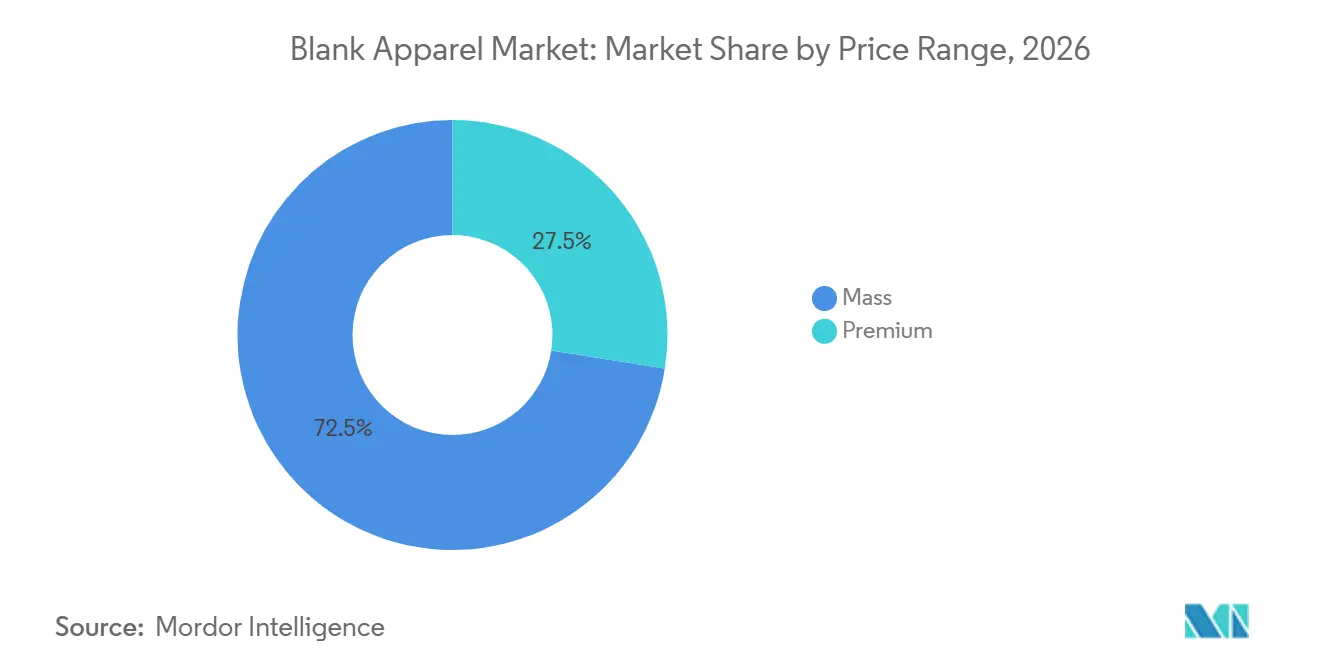
The mass segment accounted for the largest share of the blank apparel market, representing 72.51% of the market in 2026. Its leading position is supported by demand for affordable clothing among individual consumers, small businesses, apparel brands, and bulk purchasers. Mass-market blank apparel provides a cost-effective base for customization, including screen printing, embroidery, and heat-transfer applications. These products are widely used for promotional merchandise, corporate uniforms, school apparel, and event-related clothing, where affordability and bulk availability are important purchasing considerations. The availability of standardized designs, multiple color options, and a broad range of sizes further supports adoption across diverse customer groups.
The premium segment is projected to register the fastest growth in the blank apparel market, expanding at a CAGR of 6.68% through 2032. Growth is supported by increasing demand for higher-quality blank garments that offer enhanced comfort, durability, and fabric performance. Apparel brands and independent designers are increasingly using premium blanks to develop customized collections positioned in higher-value market categories. The preference for heavyweight fabrics, superior stitching, refined fits, and improved fabric finishes is also contributing to demand for premium products.
By Material: Cotton Leads Decoration Applications While Polyester Advances in Performance Wear
The cotton segment accounted for the largest share of the blank apparel market, representing 55.27% of the market in 2026. Its leading position is supported by the widespread preference for cotton garments due to their softness, breathability, and comfort for everyday wear. Cotton blank apparel is widely used across t-shirts, tops, sweatshirts, and other clothing categories intended for casual, promotional, and customized applications. Its compatibility with various printing and decoration techniques makes it a preferred material for apparel brands, promotional merchandise providers, and print-on-demand businesses.
The polyester segment is projected to register the fastest growth in the blank apparel market, expanding at a CAGR of 6.34% through 2032. This growth is supported by the material's durability, wrinkle resistance, quick-drying properties, and suitability for active lifestyles. Polyester blank apparel is widely used in sportswear, performance clothing, promotional garments, and customized apparel that requires frequent washing and extended use. Its moisture-management capabilities and compatibility with sublimation printing make it particularly suitable for sports jerseys, team uniforms, and design-intensive products.
By End User: B2B Volume Leads While B2C Changes Order Patterns
The B2B segment accounted for the largest share of the blank apparel market, representing 69.71% of the market in 2026. Its dominance is supported by bulk purchasing from apparel manufacturers, clothing brands, promotional merchandise providers, corporate buyers, and customization businesses. Blank garments serve as essential inputs for businesses that apply printing, embroidery, branding, and other decoration techniques before selling finished products. Purchasing in large volumes enables businesses to reduce per-unit costs and maintain consistent product availability across their operations.
The B2C segment is projected to register the fastest growth in the blank apparel market, expanding at a CAGR of 6.56% through 2032. Growth is supported by increasing consumer access to blank garments through online marketplaces, direct-to-consumer websites, and specialized apparel retailers. Individuals purchase blank t-shirts, sweatshirts, hoodies, and other garments for personal use, DIY projects, and small-scale customization. The growing popularity of personalized clothing is also encouraging consumers to purchase blank apparel for home-based printing, crafting, and creative applications.
Geography Analysis
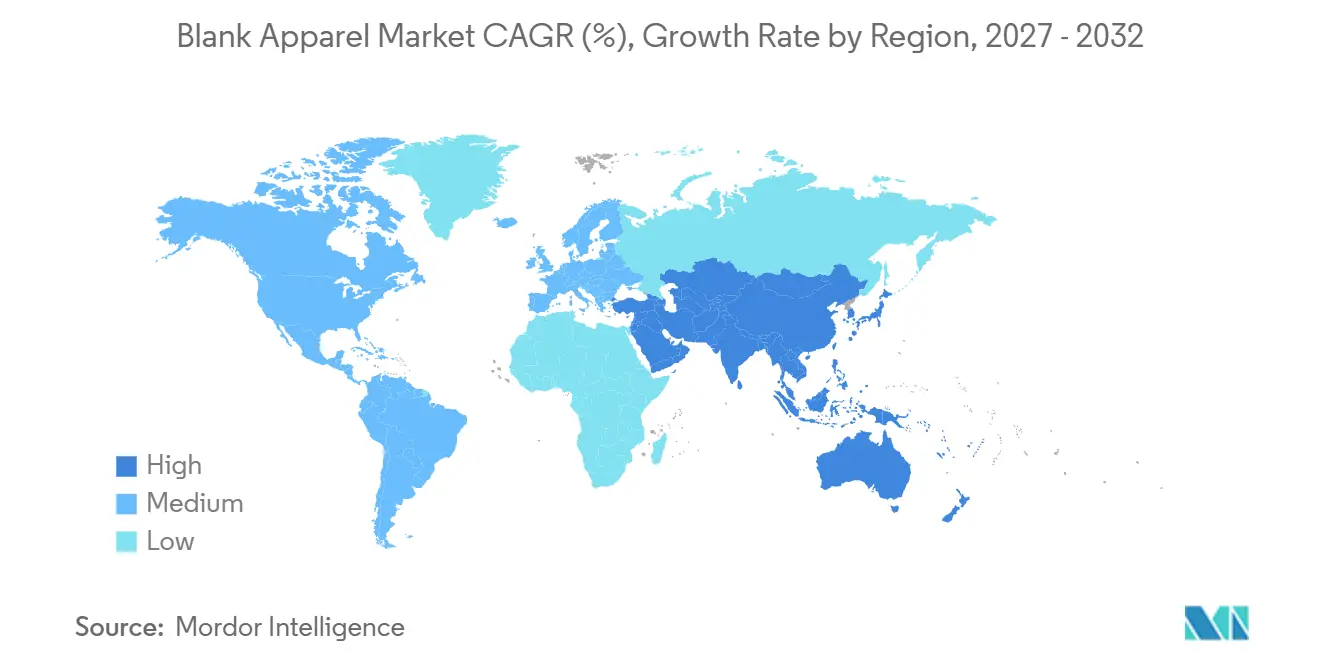
Asia-Pacific held 43.56% of the blank apparel market share in 2026 and is forecast to grow at a CAGR of 6.24% through 2032. The region combines manufacturing scale with expanding domestic demand for customized clothing. The International Labour Organization stated that Asia accounted for more than 70% of world textile and garment exports in 2025[3]. China accounted for 34% of global export volume, while Vietnam accounted for 5% and Bangladesh and India each accounted for 4.3%. India benefits from wedding merchandise, sports clubs, and startup activity. Vietnam's export base and China's e-commerce channels support both B2B supply and B2C demand. China's manufacturing scale provides a broad upstream base for fabric and garment production. India brings a growing domestic customization ecosystem that includes wedding merchandise, sports clubs, and startup-oriented selling.
North America and Europe remain major demand centers for the blank apparel market. Corporate merchandise programs support regular purchases through the year. Tariff uncertainty is encouraging North American distributors to diversify sourcing toward Mexico and Central America. European buyers place greater emphasis on certified sustainable substrates. Germany, the United Kingdom, Belgium, Poland, Italy, France, and Spain support short-run promotional and event-printing demand through different local campaigns. European demand is geographically dispersed, which requires suppliers to serve different languages, buyer preferences, and distribution routes. Certified organic cotton and fair-trade garments hold particular appeal in parts of the region where buyers request verified sourcing.
South America and the Middle East & Africa offer smaller but distinct opportunities for the blank apparel market. Brazil is a leading South American demand center. Peru's apparel exports to South America reached USD 73 million during January through May 2025, rising 6.9% year over year, while Brazil's share increased 24.1%. Colombia, Chile, Argentina, and Peru support promotional merchandise and school uniform demand. Economic volatility can limit premium adoption in the region. In the Middle East & Africa, Saudi Arabia has seasonal souvenir and branded-garment demand around Hajj, while South Africa and the United Arab Emirates have more developed corporate merchandise channels. Developing production capacity in Nigeria, Morocco, Egypt, and Turkey could reduce import dependence over time.
Competitive Landscape
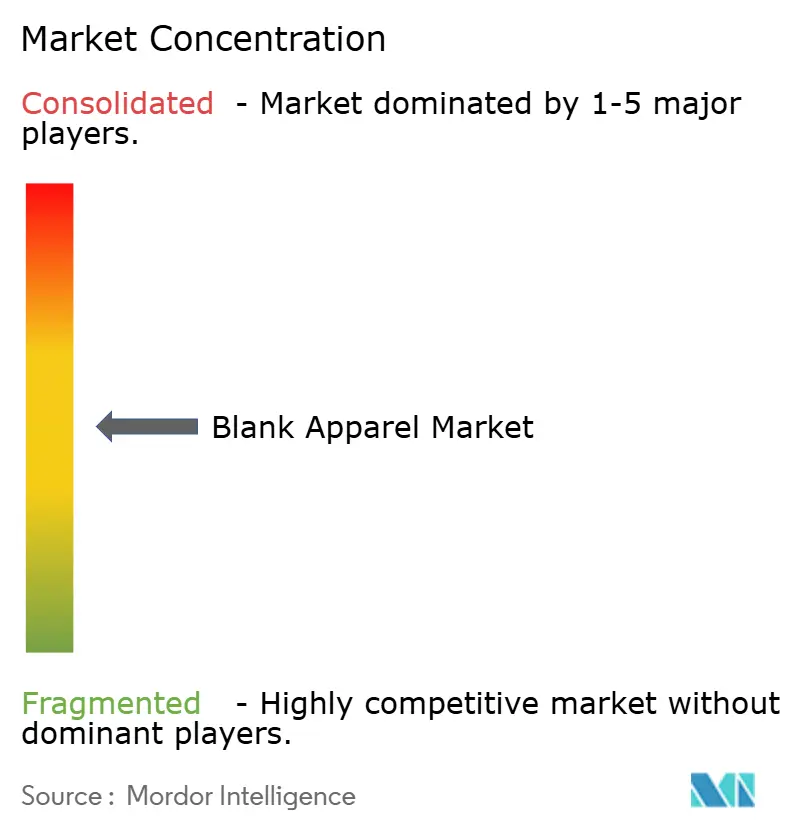
The blank apparel market is characterized by a moderate level of concentration, with established manufacturers competing alongside specialized suppliers to serve businesses, apparel brands, and individual consumers. Hanesbrands Inc., Fruit of the Loom, Inc., Next Level Apparel, and Gildan Activewear, Inc. are among the prominent players in the market. Competition is primarily driven by product quality, pricing, fabric variety, garment consistency, and distribution capabilities. Manufacturers cater to demand across t-shirts, tops, sweatshirts, hoodies, and other basic apparel products used for customization and resale.
Product differentiation and portfolio expansion are important competitive strategies in the blank apparel market. Gildan Activewear, Inc. offers a broad range of basic apparel products, while Hanesbrands Inc. and Fruit of the Loom, Inc. leverage their established apparel manufacturing and distribution capabilities to serve diverse customer segments. Next Level Apparel focuses on blank garments designed for customization, including products used by screen printers, promotional product distributors, and apparel businesses.
Distribution reach, operational efficiency, and responsiveness to changing customer preferences further shape competition in the market. Leading manufacturers seek to serve wholesale distributors, screen-printing businesses, retailers, and other commercial buyers through established supply networks and extensive product portfolios. Consistent product quality and reliable order fulfillment are particularly important for customers purchasing blank garments in large volumes for branding and resale.
Blank Apparel Industry Leaders
-
Gildan Activewear Inc.
-
Hanesbrands Inc.
-
Fruit of the Loom, Inc.
-
Next Level Apparel
-
SanMar Corp.
- *Disclaimer: Major Players sorted in no particular order
Recent Industry Developments
- July 2026: CheapTshirtUSA expanded its online wholesale catalog to more than 50,000 stock-keeping units across over 30 brands, covering T-shirts, hoodies, sweatshirts, polos, tank tops, workwear, and other products. The company also introduced a simplified multi-warehouse ordering system with warehouse-level inventory visibility and revised shipping arrangements.
- April 2026: Lane Seven Apparel expanded its European presence through a partnership with UTT Europe, making its premium blank apparel collections available to decorators, printers, and brands across more than 40 countries. The partnership broadens distribution access to its fleece and print-ready garments while leveraging UTT Europe’s wholesale network and e-commerce capabilities to serve regional customers.
- February 2026: Vantage Apparel added popular styles from Lane Seven Apparel to its product portfolio, expanding access to premium blank T-shirts and fleece garments for distributors and branded apparel customers. The collection is supported by Vantage’s decoration services, including embroidery, chenille patches, appliqué, and direct-to-film printing, strengthening its offering for customized merchandise programs.
Global Blank Apparel Market Report Scope
The blank apparel market refers to the market for undecorated clothing products, including t-shirts, tops, sweatshirts, hoodies, shorts, trousers, joggers, and other basic garments sold without pre-applied designs, logos, or branding. The blank apparel market is segmented by product type, age group, price range, material, end user and geography. Based on product type, the market is segmented into t-shirts & tops, sweatshirt & hoodies , shorts, trousers, joggers & sweatpants and others. Based on age group, the market is segmented into men, women and children. Based on price range, the market is segmented into mass and premium. Based on material, the market is segmented into cotton, polyester, blends and other fabric types. Based on end user, the market is segmented into b2b and b2c. By geography, the market is segmented into North America, Europe, Asia-Pacific, South America, and Middle-East and Africa. For each segment, the market sizing and forecasting have been done in value terms (USD billion).
| T-Shirts & Tops |
| Sweatshirt & Hoodies |
| Shorts |
| Trousers, Joggers & Sweatpants |
| Others |
| Men |
| Women |
| Children |
| Mass |
| Premium |
| Cotton |
| Polyester |
| Blends |
| Other Fabric Types |
| B2B |
| B2C |
| North America | United States |
| Canada | |
| Mexico | |
| Rest of North America | |
| Europe | Germany |
| United Kingdom | |
| Italy | |
| France | |
| Spain | |
| Belgium | |
| Poland | |
| Rest of Europe | |
| Asia-Pacific | China |
| India | |
| Japan | |
| Australia | |
| South Korea | |
| Vietnam | |
| Malaysia | |
| Rest of Asia-Pacific | |
| South America | Brazil |
| Argentina | |
| Colombia | |
| Peru | |
| Chile | |
| Rest of South America | |
| Middle East and Africa | South Africa |
| Saudi Arabia | |
| United Arab Emirates | |
| Egypt | |
| Morocco | |
| Nigeria | |
| Turkey | |
| Rest of Middle East and Africa |
| By Product Type | T-Shirts & Tops | |
| Sweatshirt & Hoodies | ||
| Shorts | ||
| Trousers, Joggers & Sweatpants | ||
| Others | ||
| By Age Group | Men | |
| Women | ||
| Children | ||
| By Price Range | Mass | |
| Premium | ||
| By Material | Cotton | |
| Polyester | ||
| Blends | ||
| Other Fabric Types | ||
| By End User | B2B | |
| B2C | ||
| By Geography | North America | United States |
| Canada | ||
| Mexico | ||
| Rest of North America | ||
| Europe | Germany | |
| United Kingdom | ||
| Italy | ||
| France | ||
| Spain | ||
| Belgium | ||
| Poland | ||
| Rest of Europe | ||
| Asia-Pacific | China | |
| India | ||
| Japan | ||
| Australia | ||
| South Korea | ||
| Vietnam | ||
| Malaysia | ||
| Rest of Asia-Pacific | ||
| South America | Brazil | |
| Argentina | ||
| Colombia | ||
| Peru | ||
| Chile | ||
| Rest of South America | ||
| Middle East and Africa | South Africa | |
| Saudi Arabia | ||
| United Arab Emirates | ||
| Egypt | ||
| Morocco | ||
| Nigeria | ||
| Turkey | ||
| Rest of Middle East and Africa | ||
Key Questions Answered in the Report
What is the projected value of the blank apparel sector by 2032?
The blank apparel market is forecast to reach USD 21.31 billion by 2032, growing from USD 16.58 billion in 2027 at a 5.15% CAGR.
Which product category has the largest share of blank apparel demand?
T-Shirts & Tops lead with 47.71% share in 2026 because they are compatible with major garment-decoration methods.
What is driving demand for print-on-demand garments?
Lower minimum order requirements and access to direct-to-film and direct-to-garment equipment are expanding purchases by small creators and print shops.
Which material is growing fastest in blank apparel?
Polyester is forecast to grow at a CAGR of 6.34% through 2032, supported by performance-wear demand and cost advantages.
Which region leads blank apparel demand and growth?
Asia-Pacific held 43.56% share in 2026 and is forecast to grow at a CAGR of 6.24% through 2032, supported by its manufacturing base and domestic customization demand.