
Bitterness Suppressor Flavor Carrier Market Size and Share
Market Overview
| Study Period | 2021 - 2031 |
|---|---|
| Market Size (2026) | USD 204.71 Million |
| Market Size (2031) | USD 238.12 Million |
| Growth Rate (2026 - 2031) | 3.07 % |
| Fastest Growing Market | Asia-Pacific |
| Largest Market | North America |
| Market Concentration | Medium |
Major Players *Disclaimer: Major Players sorted in no particular order Image © Mordor Intelligence. Reuse requires attribution under CC BY 4.0. | |
Bitterness Suppressor Flavor Carrier Market Analysis by Mordor Intelligence
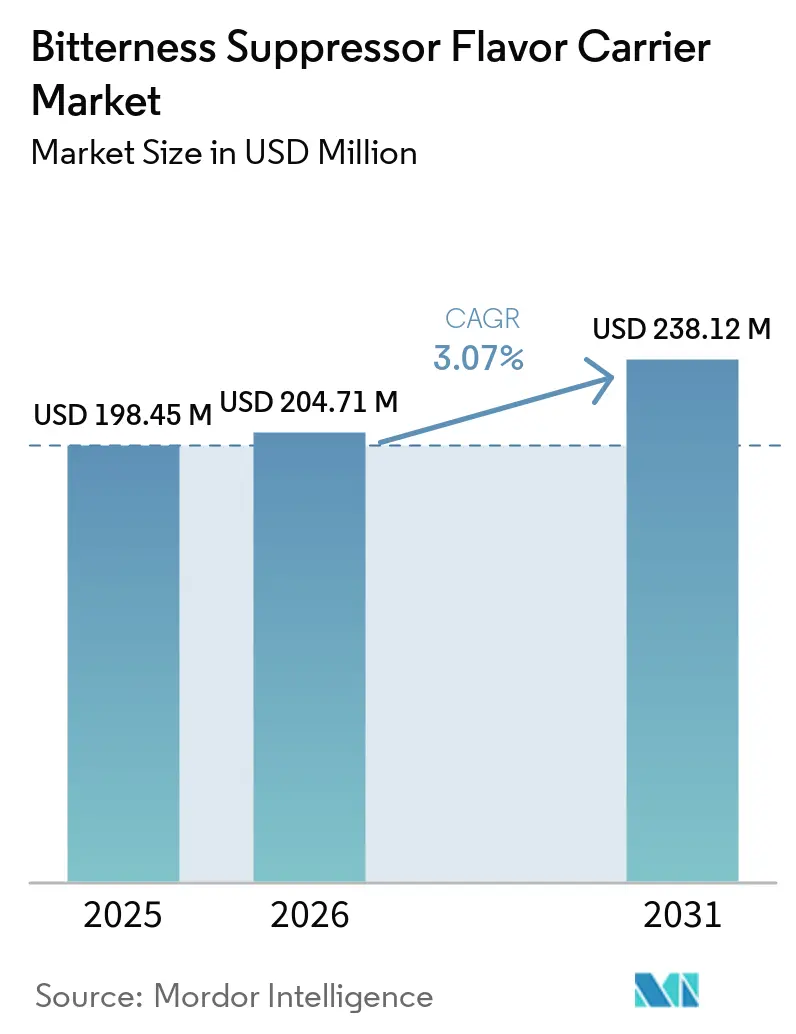
The bitterness suppressor flavor carrier market size is expected to grow from USD 198.45 million in 2025 to USD 204.71 million in 2026 and is forecast to reach USD 238.12 million by 2031 at 3.07% CAGR over 2026-2031. Growth is supported by food and beverage reformulation, wider use of plant proteins, and earlier attention to palatability in oral drug development. These applications need ingredients from the bitterness suppressor flavor carrier market that reduce bitterness or protect flavor compounds during processing and storage. The bitterness suppressor flavor carrier market remains a specialty category rather than a high-volume commodity market because many solutions need to be tailored to a specific formulation. Technical performance therefore supports premium pricing, while customization limits the speed at which suppliers can scale.
Key Report Takeaways
- By product type, flavor carriers held 58.24% of the bitterness suppressor flavor carrier market share in 2025, while bitterness suppressors are forecast to grow at a 4.09% CAGR through 2031.
- By form, liquid formulations accounted for 63.37% of global share in 2025, while powder is forecast to expand at a 4.47% CAGR through 2031.
- By application, food and beverages accounted for 42.11% of the bitterness suppressor flavor carrier market size in 2025, while pharmaceuticals are forecast to grow at a 4.29% CAGR through 2031.
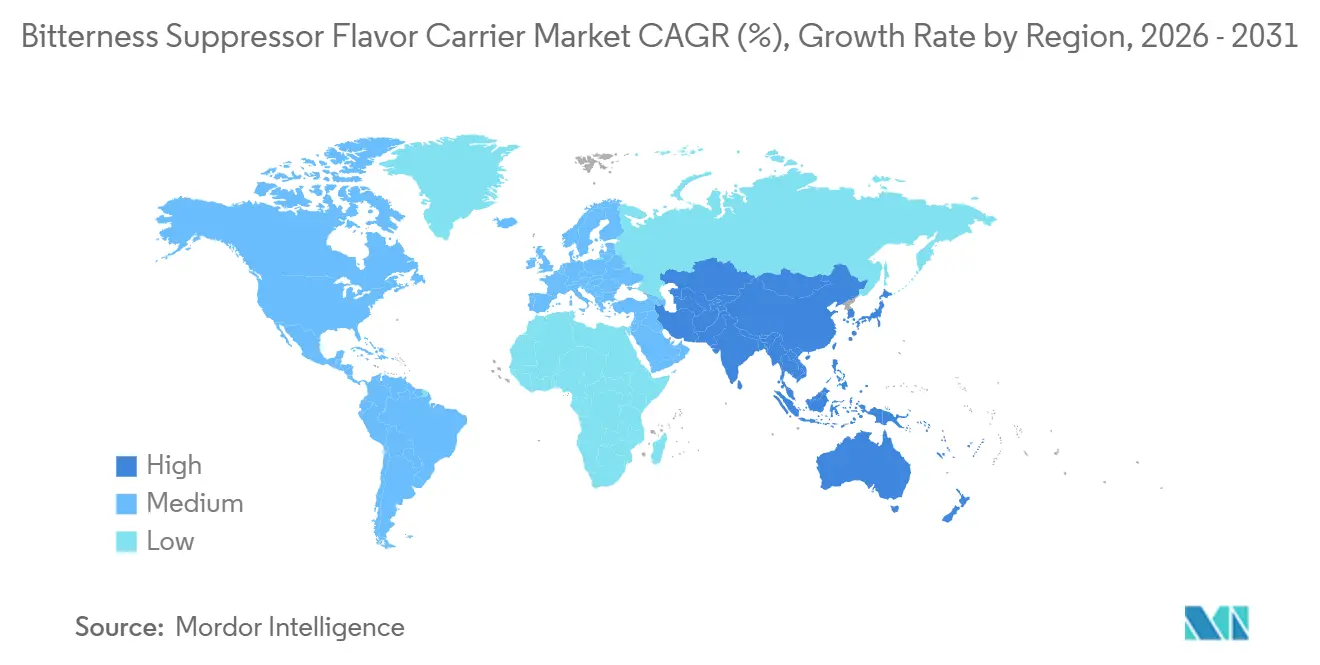
- By geography, North America accounted for 34.41% of the bitterness suppressor flavor carrier market size in 2025, while Asia-Pacific is forecast to advance at a 4.78% CAGR through 2031.
Note: Market size and forecast figures in this report are generated using Mordor Intelligence’s proprietary estimation framework, updated with the latest available data and insights as of January 2026.
Market Trends and Insights
Drivers Impact Analysis of Bitterness Suppressor Flavor Carrier Market*
| Driver | (~) % Impact on CAGR Forecast | Geographic Relevance | Impact Timeline |
|---|---|---|---|
| Rising demand for functional and fortified foods and beverages | +0.7% | Global | Short term (≤ 2 years) |
| Growing use of plant-based proteins with undesirable aftertastes | +0.6% | North America and Europe, with spillover to Asia-Pacific | Medium term (2-4 years) |
| Increasing sugar-reduction and low-calorie product reformulation | +0.5% | North America and Europe, with spillover to Asia-Pacific | Short term (≤ 2 years) |
| Expansion of nutraceuticals and dietary supplements | +0.4% | Global, with early gains in Asia-Pacific | Medium term (2-4 years) |
| Rising demand for clean-label and natural taste-masking solutions | +0.3% | North America and Europe | Long term (≥ 4 years) |
| Advancements in microencapsulation and controlled flavor-release technologies | +0.4% | Global | Long term (≥ 4 years) |
| Source: Mordor Intelligence | |||
Rising Demand for Functional and Fortified Foods and Beverages
Functional foods and fortified beverages need taste-masking and flavor-delivery systems when formulations include vitamins, minerals, adaptogens, and other bioactive ingredients that affect the sensory profile. These ingredients can produce several off-notes at once, particularly when they are combined with plant proteins or botanical extracts in a single product matrix. Flavor carriers must remain effective across different pH levels, water activity conditions, processing temperatures, and storage periods in beverages and nutrition bars. The formulation challenge becomes more difficult when a producer reduces fat and sugar at the same time to meet broader health and labeling objectives. Those ingredients can soften bitter tastes, so their removal shifts more of the sensory burden to specialty systems that preserve product acceptance. This demand for balanced products supports the bitterness suppressor flavor carrier market in functional product development and encourages suppliers to provide formulation-specific technical support.
Growing Use of Plant-based Proteins with Undesirable Aftertastes
The growing use of plant-based proteins is creating demand for bitterness suppressors and flavor carriers, as plant-derived proteins can contribute undesirable bitter, beany, grassy, and astringent aftertastes that affect consumer acceptance. The Good Food Institute reports that the U.S. plant-based food retail market reached USD 7.9 billion in 2025, while 60% of U.S. households purchased plant-based foods during the year[1]. Despite this broad adoption, taste remains one of the key barriers to greater consumption of plant-based products. As manufacturers expand the use of soy, pea, rice, and other plant proteins in beverages, nutrition products, and alternative foods, managing their inherent off-notes becomes increasingly important. Bitterness suppressors and flavor carriers help mask undesirable flavors, improve sensory balance, and enhance overall palatability.
Increasing Sugar-reduction and Low-calorie Product Reformulation
The increasing focus on sugar reduction and low-calorie product reformulation is driving demand for bitterness suppressors and flavor carriers, as reducing sugar can alter sweetness balance and make bitter or undesirable taste notes more noticeable. According to the 2025 IFIC Food & Health Survey, 75% of Americans reported trying to limit or avoid sugar, with 63% of these consumers specifically targeting added sugars[2]. Furthermore, 27% reported choosing products labeled “reduced sugar,” while 25% purchased “sugar-free” options when available. As manufacturers increasingly replace sugar with high-intensity sweeteners and other low-calorie ingredients, managing associated bitter, metallic, or lingering aftertastes becomes essential. Bitterness suppressors and flavor carriers help mask these undesirable notes and restore a more balanced sensory profile, enabling manufacturers to develop reduced-sugar products without compromising taste.
Rising Demand for Clean-label and Natural Taste-masking Solutions
The rising demand for clean-label and natural taste-masking solutions is driving the bitterness suppressor and flavor carrier market as food and beverage manufacturers increasingly seek recognizable, naturally derived ingredients that can improve taste without compromising clean-label positioning. According to research cited by the Centre for the Promotion of Imports (CBI) of the Netherlands Ministry of Foreign Affairs, clean-label products are projected to account for over 70% of European food and beverage portfolios in 2025 and 2026, up from 52% in 2021[3]. This shift is encouraging manufacturers to replace synthetic taste-modulation ingredients with natural alternatives, including botanical extracts, citrus-derived compounds, and natural flavor systems. As formulations increasingly prioritize shorter and more transparent ingredient lists, manufacturers require taste-masking solutions that effectively reduce bitterness while supporting natural and clean-label claims.
Restraints Impact Analysis of Bitterness Suppressor Flavor Carrier Market*
| Restraint | (~) % Impact on CAGR Forecast | Geographic Relevance | Impact Timeline |
|---|---|---|---|
| High development and formulation costs | -0.4% | Global, with greater pressure in smaller Asia-Pacific and Middle East and Africa markets | Medium term (2-4 years) |
| Complexity of achieving effective taste masking | -0.3% | Global | Long term (≥ 4 years) |
| Compatibility issues with active and functional ingredients | -0.3% | Global | Medium term (2-4 years) |
| High cost of advanced encapsulation technologies | -0.3% | Global | Long term (≥ 4 years) |
| Source: Mordor Intelligence | |||
High Development and Formulation Costs
Developing a formulation-specific suppressor or flavor carrier system can limit adoption by small and mid-sized food and pharmaceutical manufacturers with limited internal sensory resources. Projects can require sensory panels, receptor-binding assays, stability testing across processing conditions, and regulatory documentation for the final ingredient system. These activities can consume a large share of the research budget for regional producers and generic drug manufacturers that need external technical support. The issue is especially important in Asia-Pacific and Middle East and Africa markets where companies may need outside development partners and longer project timelines. Large companies with in-house sensory teams can build tailored systems, while smaller firms may have to accept flavor compromises or higher ingredient costs.
Complexity of Achieving Effective Taste Masking
Effective masking must manage bitterness onset, lingering aftertaste, astringency, and the release of off-note volatiles throughout a product’s use period. These characteristics can change when pH, temperature, water activity, or co-ingredients change during formulation, processing, and storage. Many pharmaceutical actives interact with more than 1 TAS2R bitter receptor subtype, which makes a single-pathway response inadequate in some products. Blocking only 1 pathway can therefore deliver incomplete palatability improvement and lead to further rounds of formulation development. Food systems create a similar challenge because lipids, proteins, and carbohydrates can alter the performance of masking compounds and flavor carriers. The bitterness suppressor flavor carrier market must address this complexity through repeated validation when a base recipe changes because of cost, supply, or product format conditions, which makes specialist services important.
*Our forecasts treat driver/restraint impacts as directional, not additive. The impact forecasts reflect baseline growth, mix effects, and variable interactions.
Bitterness Suppressor Flavor Carrier Market Segment Analysis
By Product Type:
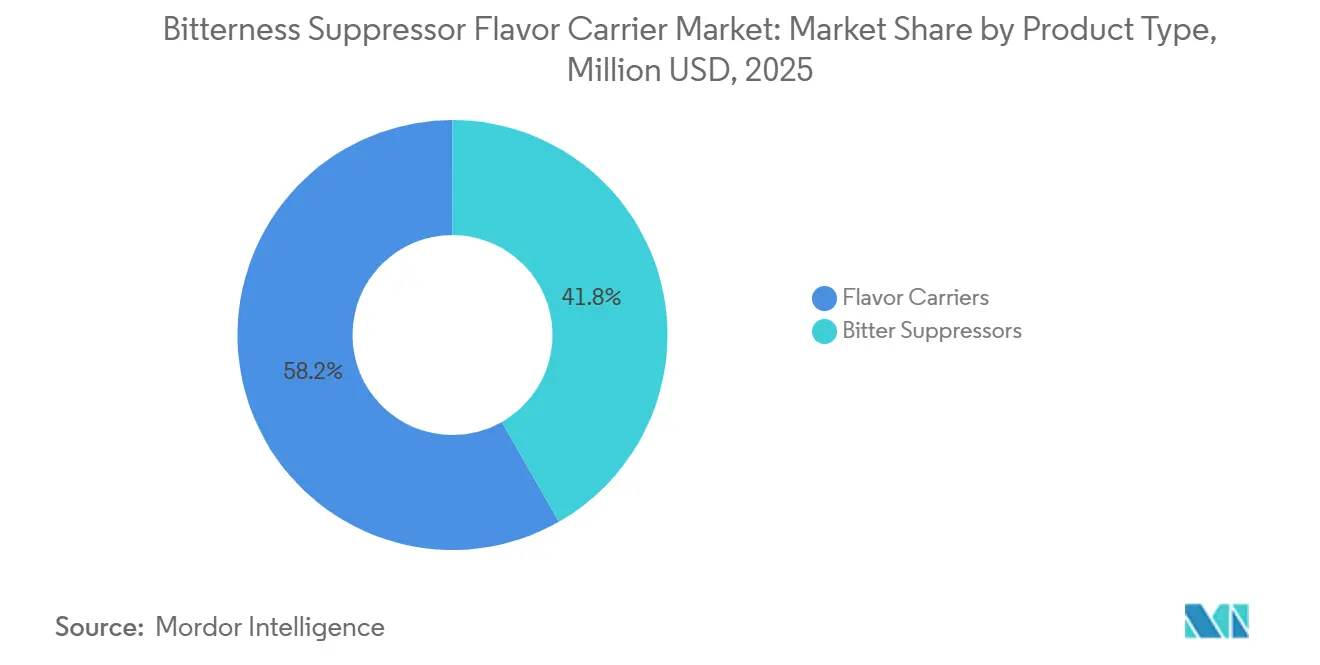
Suppressors Scale Alongside a Stable Carrier BaseFlavor carriers held 58.24% of the bitterness suppressor flavor carrier market share in 2025 because they perform a core function in processed food and beverage formulations. Modified starches, gums, lipid matrices, and cyclodextrin complexes can protect volatile flavor compounds against oxidation, heat, and moisture during manufacture. The systems help preserve aromatic quality through storage, including in powdered drink mixes, fortified cereals, and shelf-stable nutrition products. Their large position reflects their broad use because most flavored products need some method to stabilize ingredients and manage flavor release. Within the market, suppressors are more selective products, used when a pronounced off-note requires active intervention rather than standard flavor protection.
Bitterness suppressors are forecast to grow at a 4.09% CAGR through 2031, outpacing the overall market as reformulation needs become more demanding. Sugar reduction, plant protein adoption, and pharmaceutical palatability requirements are each increasing the need for targeted control of bitter notes. A 2025 review reported that more than 60% of active pharmaceutical ingredients have intrinsic bitterness, which broadens the application base for bitter receptor-blocking solutions. Development has moved beyond adding sweeteners or acid modulators toward receptor-targeted ligand design that prevents bitter compound binding. This approach can allow higher active loading and lower additive use, supporting premium pricing where technical results meet formulation requirements in the bitterness suppressor flavor carrier market.

By Form:
Liquids Lead, Encapsulated Powders Capture Emerging Nutrition FormatsLiquid formulations accounted for 63.37% of the bitterness suppressor flavor carrier market size in 2025 because they disperse effectively in beverages and liquid pharmaceutical dosage forms. They integrate easily into high-throughput production lines and can reduce flavor loss during handling and blending. Uniform distribution is important in complex beverage systems because inconsistent dosing can produce sensory variation between batches. Liquid carriers and suppressors remain common in syrups, drops, and suspensions for pediatric and geriatric use, where palatability can affect treatment adherence. Their continuing role in the bitterness suppressor flavor carrier market reflects both their processing advantages and the established demand for liquid consumer and therapeutic formats.
Powder is forecast to grow at a 4.47% CAGR through 2031, the highest rate among form segments in the bitterness suppressor flavor carrier market. Demand is expanding across dry-mix nutrition, bakery applications, and co-processed supplement systems that need shelf stability and controlled delivery. Encapsulation can isolate reactive flavor compounds from the product matrix until consumption, protecting aromatic integrity and masking performance. The others category includes gels, emulsions, and semi-solid forms for orally disintegrating tablets and chewable dosage formats.
By Application:
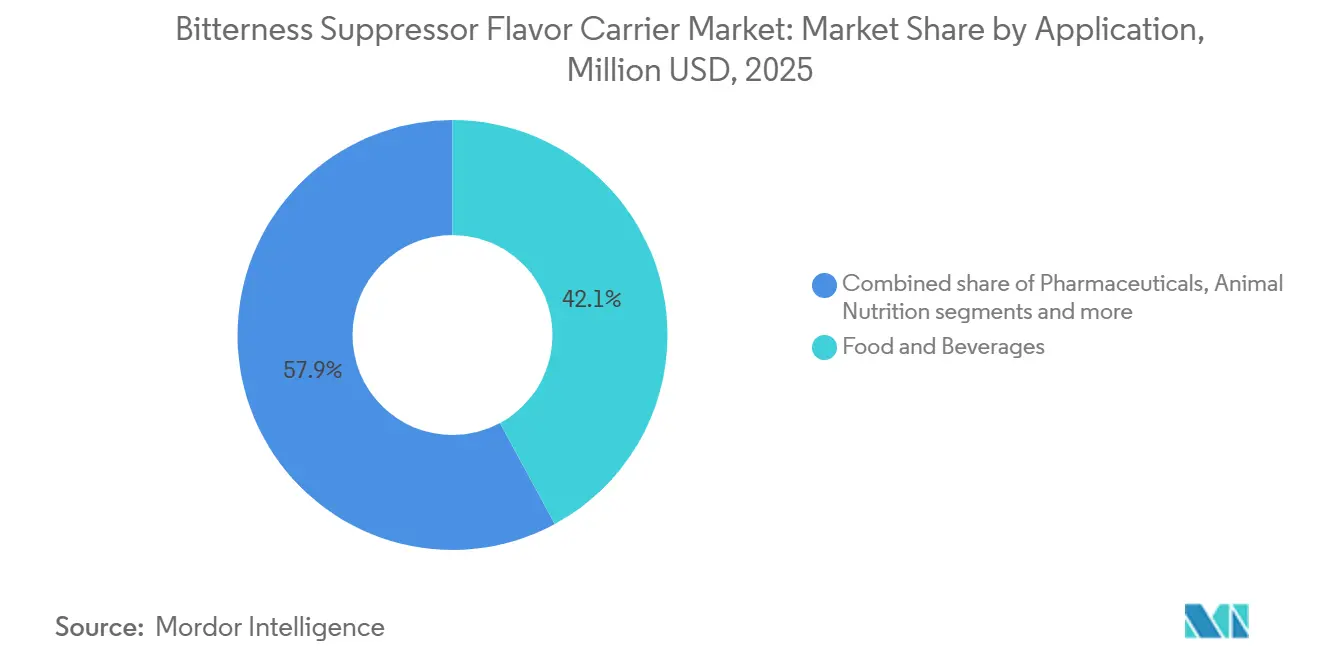
Food and Beverages Anchor Volume, Pharmaceuticals Drive Value IntensityFood and beverages accounted for 42.11% of global application share in 2025, reflecting the scale of functional beverages, dairy alternatives, bakery products, confectionery, and savory foods. These categories use taste-management systems when sugar, fat, or other ingredients are reduced without an acceptable loss of flavor. Removing sugar and fat also removes elements that can soften bitterness from plant proteins, sweeteners, and mineral fortifiers. Nutraceuticals and dietary supplements face similar issues because adaptogens, botanical extracts, collagen peptides, and branched-chain amino acids can be bitter or astringent. The category therefore gives the bitterness suppressor flavor carrier market a broad customer base across everyday packaged foods and specialized health-oriented products with different sensory needs.
Pharmaceuticals are forecast to grow at a 4.29% CAGR through 2031, the fastest rate among applications in the bitterness suppressor flavor carrier market. Growth is tied to oral drug development, evidence linking palatable dosage forms with adherence, and earlier use of masking during formulation design. In March 2026, dsm-firmenich launched ModulaSENSE® Bitter, a receptor-based system combining bitter blockers, maskers, and sweeteners for active pharmaceutical ingredient bitterness profiles. The offering includes structured sensory evaluation and technical and regulatory documentation, which positions masking as a formulation tool rather than a late-stage adjustment. Other applications include personal care, oral hygiene, and industrial products where comparable functions are used at a smaller scale.
Geography Analysis
North America Bitterness Suppressor Flavor Carrier Market
North America held 34.41% of global revenue in 2025, supported by the United States' large functional beverage, sports nutrition, and dietary supplement sectors. These categories often use alternative sweeteners, plant proteins, and botanical extracts that create bitterness and astringency challenges. Demand also reflects the pharmaceutical sector's increasing focus on patient adherence and earlier palatability work during product development. Stevia and monk fruit use in functional beverages creates recurring demand for suppressor systems in both established products and new launches. Canada’s fortified food activity and Mexico’s pharmaceutical manufacturing capacity add to the regional demand base.
Europe and APAC Bitterness Suppressor Flavor Carrier Market
Europe is mature but remains active in clean-label taste modulation and natural ingredient development. In June 2025, the European Commission added naringenin, FL No 16.132, to the European Union Food Flavoring Regulation after a positive European Food Safety Authority safety opinion in March 2024. The addition expanded options for bitterness modification in soft drinks, dairy products, and plant-based food categories across the European Union. Germany, France, and the United Kingdom are leading countries because each has substantial functional food and pharmaceutical manufacturing activity. Asia-Pacific is forecast to grow at a 4.78% CAGR through 2031, supported by urbanization, rising disposable incomes, and processed food manufacturing across China, India, Japan, and Southeast Asia, which expands the bitterness suppressor flavor carrier market.
South America and MEA Bitterness Suppressor Flavor Carrier Market
South America and the Middle East and Africa are smaller but steadily developing markets for these ingredients. Brazil and Argentina support demand through dairy alternatives and functional beverages, where sensory management is becoming more important in product development. In the Middle East and Africa, nutraceutical and pharmaceutical import flows support specialty ingredient demand, with Saudi Arabia and the United Arab Emirates operating as distribution hubs. Local production remains limited, while private-label supplement powders and fortified snacks are creating demand for accessible masking options used by regional contract manufacturers.
Competitive Landscape
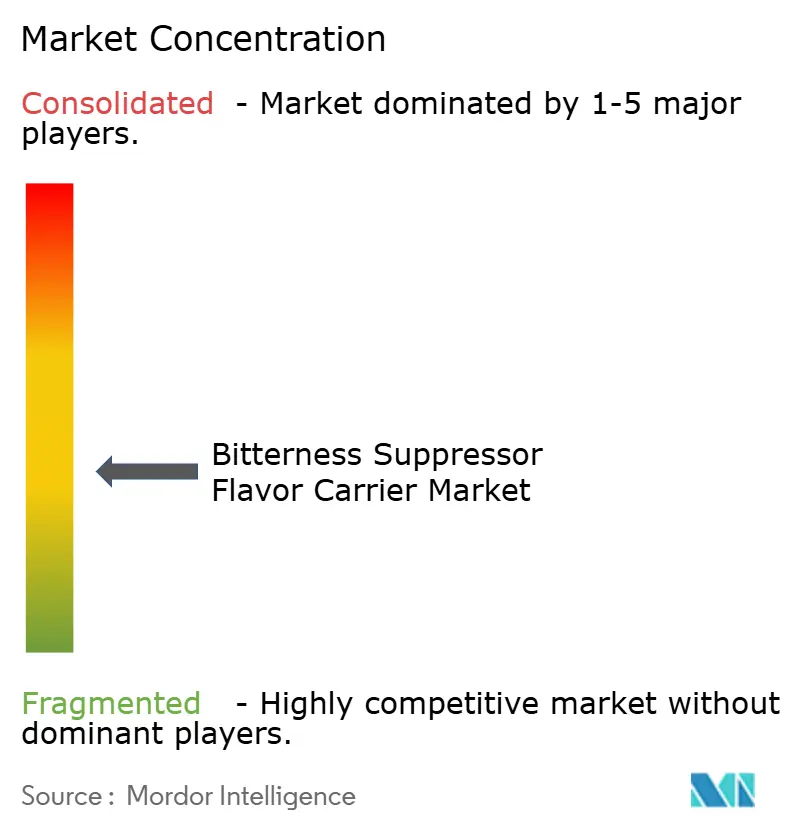
The bitterness suppressor flavor carrier market is characterized by medium level of concentration, because diversified flavor houses and specialized taste-modulation firms compete across overlapping technical areas. Givaudan, dsm-firmenich, IFF, and Kerry Group use platforms that combine sensory science, receptor biology, and formulation services. Mid-sized specialists offer proprietary bitter blocker libraries, citrus flavonoid extracts, and yeast-based masking systems with clean-label credentials. No supplier dominates every application, so formulation capability and customer service remain important sources of differentiation.
Co-development work is becoming more important as ingredient companies place technical teams closer to customer product development processes. This rewards formulation responsiveness and service depth instead of a broad ingredient catalog alone. Pharmaceutical-grade masking for biologic-derived active pharmaceutical ingredients and pediatric formulations remains an opportunity because off-the-shelf systems can lack necessary precision. Patent activity around cyclodextrin complexation, lipid-based encapsulation, and TAS2R receptor-specific ligand design is increasing. These areas can create durable intellectual property positions for suppliers that develop effective, formulation-specific solutions.
In March 2026, dsm-firmenich launched ModulaSENSE® Bitter for pharmaceutical manufacturers, combining bitter blockers, maskers, and sweeteners with structured sensory evaluation. In 2025, Kerry Group increased research and development expenditure to EUR 314 million, equivalent to USD 330 million, while advancing fermentation-derived taste modulation and enzyme-based sweetness systems. In June 2025, HealthTech Bioactives secured the addition of naringenin to the European Union Food Flavoring Regulation, supporting its OptiTaste® platform.
Bitterness Suppressor Flavor Carrier Industry Leaders
-
Givaudan SA
-
International Flavors & Fragrances Inc.
-
Symrise AG
-
dsm-firmenich AG
-
Kerry Group plc
- *Disclaimer: Major Players sorted in no particular order
Bitterness Suppressor Flavor Carrier Market Companies Covered in this Report
- Givaudan SA
- International Flavors & Fragrances Inc.
- Symrise AG
- dsm-firmenich AG
- Kerry Group plc
- Cargill, Incorporated
- Tate & Lyle PLC
- Sensient Technologies Corporation
- Takasago International Corporation
- Döhler GmbH
- Roquette Frères
- Ingredion Incorporated
- Archer-Daniels-Midland Company
- Stepan Company
- Flavorchem Corporation
- Synergy Flavors, Inc.
- Nactis Flavours
- Bell Flavors & Fragrances, Inc.
- Blue Pacific Flavors, Inc.
- Robertet SA
Recent Industry Developments in Bitterness Suppressor Flavor Carrier Market
- March 2026: dsm-firmenich launched ModulaSENSE® Bitter, a receptor-based taste-masking platform designed for pharmaceutical manufacturers. The technology combines bitter blockers, masking agents, and sweeteners with structured sensory evaluation to enhance the palatability of oral medicines across solid, liquid, and semi-solid dosage forms. It addresses the challenge that more than 60% of active pharmaceutical ingredients are inherently bitter and is supported by comprehensive technical and regulatory documentation.
- July 2025: Sensient Technologies introduced BioSymphony, a portfolio of biotransformation-derived natural flavors available in liquid and powder formats. The solutions are designed to mask undesirable taste and flavor notes associated with proteins, high-intensity sweeteners, caffeine, and bitter amino acids, while supporting regulatory requirements across the European, Asia-Pacific, and South American markets.
- July 2025: HealthTech Bioactives (HTBA) showcased its enhanced OptiTaste® Taste Modulation Solutions platform at IFT FIRST 2025 in Chicago. The platform offers sweetness optimization, flavor balancing, and bitterness and astringency masking solutions based on citrus-derived flavonoids with upcycled certification. The technology targets formulation challenges associated with sugar reduction, protein-related off-notes, and bitterness from botanical ingredients.
- June 2025: Sensient Technologies launched BioSymphony, a biotransformation-derived natural flavor portfolio available in liquid and powder formats designed to mask off-notes from proteins, high-intensity sweeteners, caffeine, and bitter amino acids, with regulatory compliance across European Union, Asia-Pacific, and Latin American flavor frameworks.
Global Bitterness Suppressor Flavor Carrier Market Report Scope
Bitterness suppressor is a flavor ingredient or additive used to reduce, mask, or block the perception of bitter tastes in food and beverage products. A flavor carrier is a substance used to dilute, stabilize, protect, or deliver flavor compounds in a food or beverage formulation. The market is segmented by product type, form, application and geography. Based on product type, the market is segmented into bitterness suppressors, flavor carriers. Based on the form, the market is segmented into liquid, powder, and others. Based on the application, the market is segmented into food and beverages, pharmaceuticals, nutraceuticals and dietary supplements, animal nutrition and others. By geography, the market is segmented into North America, Europe, Asia-Pacific, South America, and Middle East and Africa. For each segment, the market sizing and forecasting have been done in value terms (USD million).
Segmentation Overview
| Bitterness Suppressors |
| Flavor Carriers |
| Liquid |
| Powder |
| Others |
| Food and Beverages |
| Pharmaceuticals |
| Nutraceuticals and Dietary Supplements |
| Animal Nutrition |
| Others |
| North America | United States |
| Canada | |
| Mexico | |
| Rest of North America | |
| Europe | Germany |
| United Kingdom | |
| Italy | |
| France | |
| Spain | |
| Rest of Europe | |
| Asia-Pacific | China |
| India | |
| Japan | |
| Australia | |
| Rest of Asia-Pacific | |
| South America | Brazil |
| Argentina | |
| Rest of South America | |
| Middle East and Africa | South Africa |
| Saudi Arabia | |
| United Arab Emirates | |
| Rest of Middle East and Africa |
| By Product Type | Bitterness Suppressors | |
| Flavor Carriers | ||
| By Form | Liquid | |
| Powder | ||
| Others | ||
| By Application | Food and Beverages | |
| Pharmaceuticals | ||
| Nutraceuticals and Dietary Supplements | ||
| Animal Nutrition | ||
| Others | ||
| By Geography | North America | United States |
| Canada | ||
| Mexico | ||
| Rest of North America | ||
| Europe | Germany | |
| United Kingdom | ||
| Italy | ||
| France | ||
| Spain | ||
| Rest of Europe | ||
| Asia-Pacific | China | |
| India | ||
| Japan | ||
| Australia | ||
| Rest of Asia-Pacific | ||
| South America | Brazil | |
| Argentina | ||
| Rest of South America | ||
| Middle East and Africa | South Africa | |
| Saudi Arabia | ||
| United Arab Emirates | ||
| Rest of Middle East and Africa | ||
Key Questions Answered in the Report
What is the projected value of the bitterness suppressor flavor carrier sector by 2031?
The market is forecast to reach USD 238.12 million by 2031, rising from USD 204.71 million in 2026 at a 3.07% CAGR.
Which product type leads demand for bitterness suppression and flavor delivery?
Flavor carriers led with 58.24% share in 2025 because they are used broadly to protect flavor compounds during food and beverage processing.
Which application is growing fastest for taste-masking solutions?
Pharmaceuticals are forecast to grow at a 4.29% CAGR through 2031 as palatability is addressed earlier in oral drug development.
Which region is forecast to grow fastest through 2031?
Asia-Pacific is forecast to grow at a 4.78% CAGR through 2031, supported by food manufacturing expansion and functional product demand.