
Biodegradable Chelating Agents Market Size and Share
Market Overview
| Study Period | 2021 - 2031 |
|---|---|
| Market Size (2026) | USD 5.49 Billion |
| Market Size (2031) | USD 7.94 Billion |
| Growth Rate (2026 - 2031) | 7.66 % |
| Fastest Growing Market | Asia-Pacific |
| Largest Market | Europe |
| Market Concentration | Medium |
Major Players *Disclaimer: Major Players sorted in no particular order Image © Mordor Intelligence. Reuse requires attribution under CC BY 4.0. | |
Biodegradable Chelating Agents Market Analysis by Mordor Intelligence
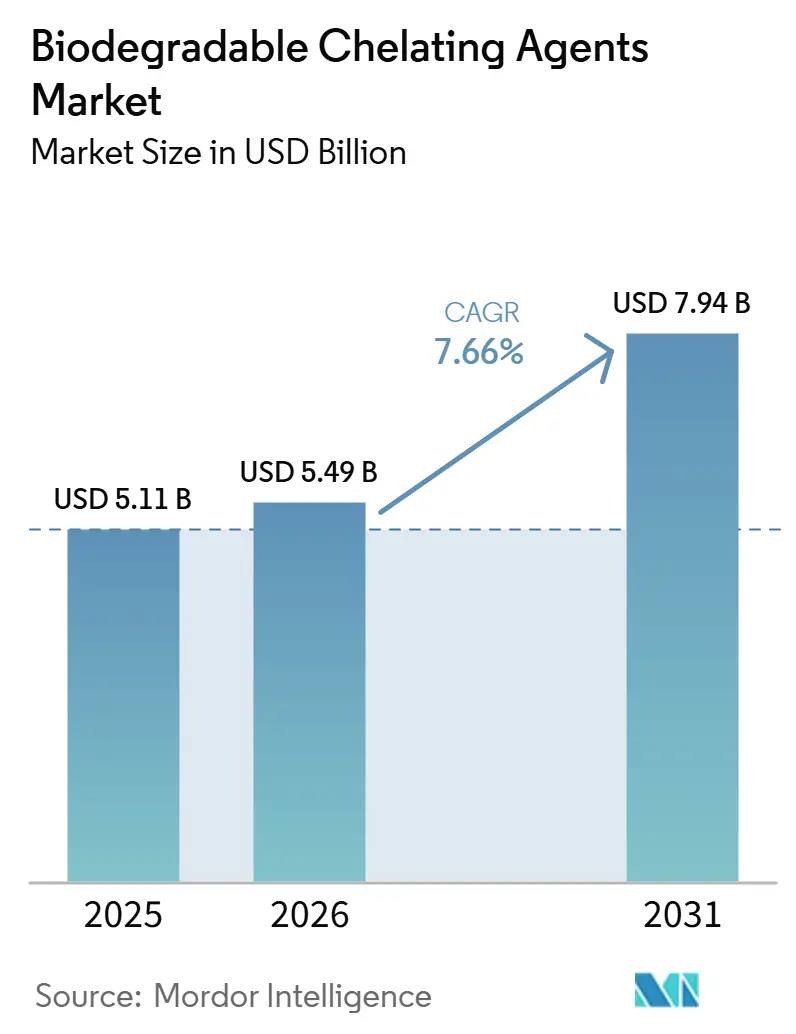
The Biodegradable Chelating Agents Market size is expected to grow from USD 5.11 billion in 2025 to USD 5.49 billion in 2026 and is forecast to reach USD 7.94 billion by 2031 at 7.66% CAGR over 2026-2031. Regulatory action on persistent synthetic chelants is influencing purchasing decisions across cleaning, industrial processing, and personal care applications. In December 2025, the European Commission proposed biodegradability requirements for organic substances used in detergent products, establishing clearer compliance expectations for formulators. Demand for ingredients that meet environmental certification requirements while performing effectively in hard-water applications, household cleaning systems, and other commercial uses supports the biodegradable chelating agents market. Key suppliers have expanded sustainable product portfolios and invested in application support ahead of regulatory deadlines. However, performance under high temperatures, concentrated brines, and extreme pH conditions remains a limiting factor for the market, as some heavy industrial users continue to require conventional chelants.
Key Report Takeaways
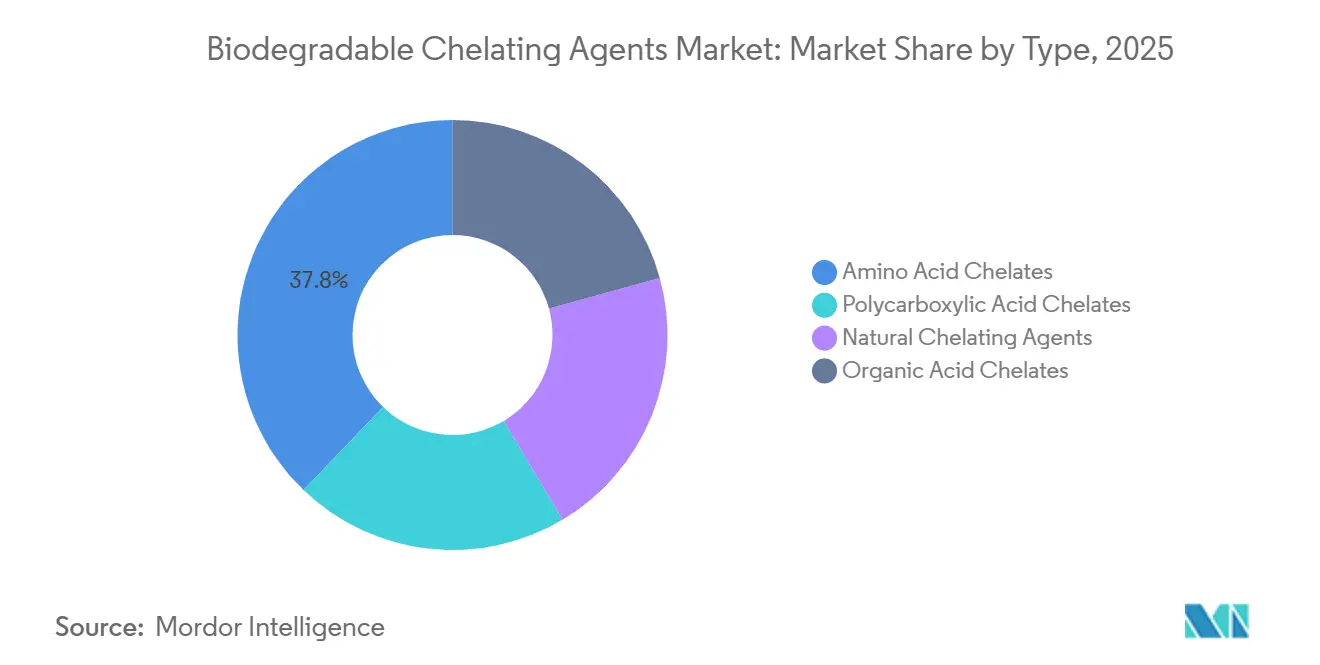
- By type, amino acid chelates held 37.82% of the biodegradable chelating agents market share in 2025, while natural chelating agents are forecast to grow at an 8.52% CAGR through 2031.
- By formulation, liquid products accounted for 54.72% of the biodegradable chelating agents market size in 2025 and are projected to expand at a 7.92% CAGR through 2031.
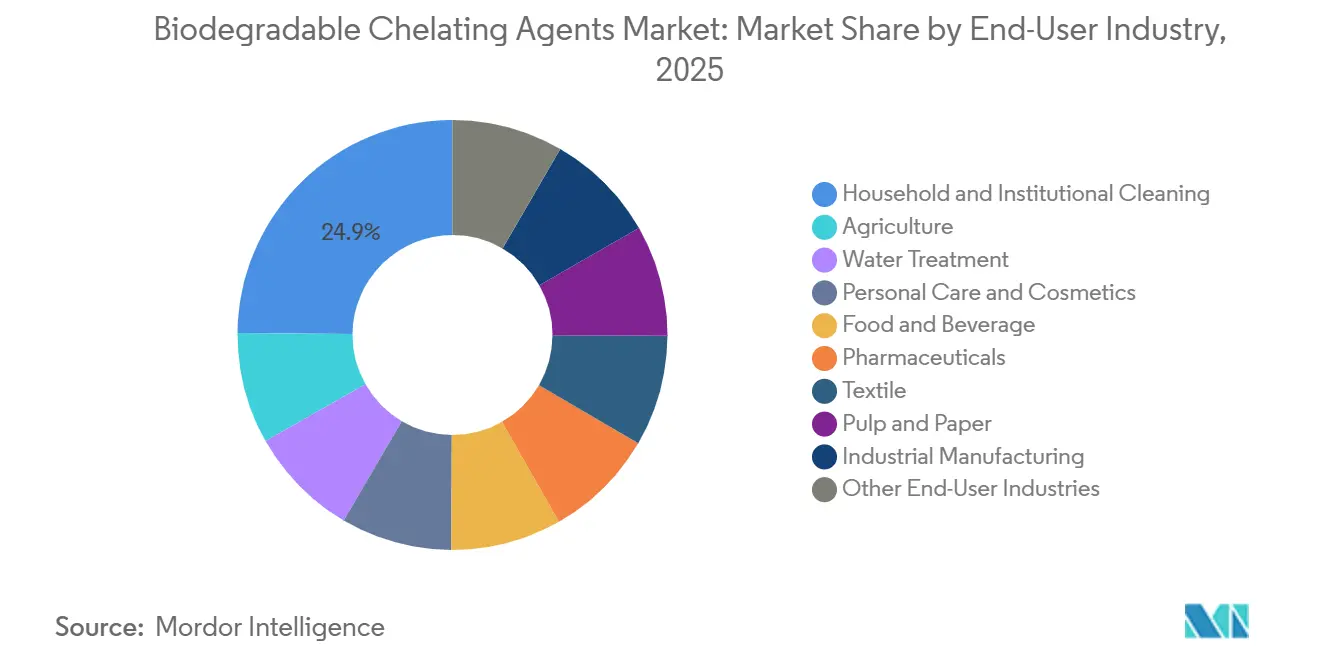
- By end-user industry, household and institutional cleaning held 24.85% of revenue in 2025, while water treatment is forecast to grow at an 8.33% CAGR through 2031.
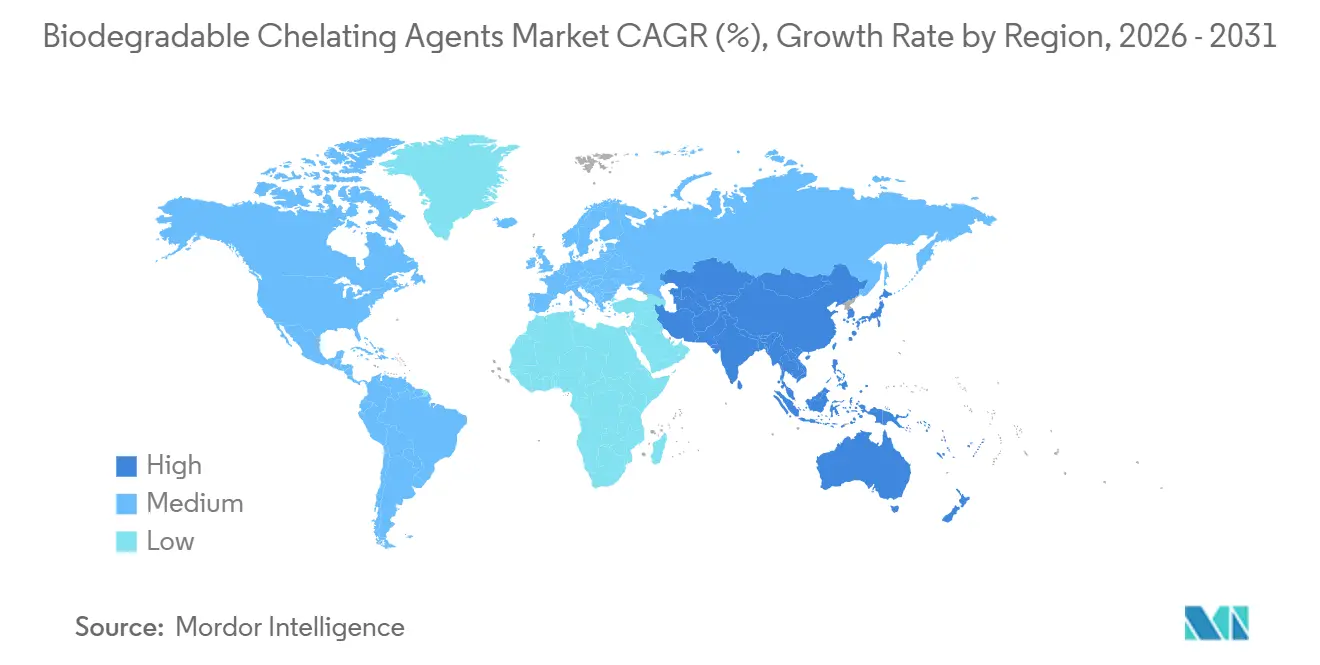
- By geography, Europe accounted for 35.44% of revenue in 2025, while Asia-Pacific is projected to grow at an 8.42% CAGR through 2031.
Note: Market size and forecast figures in this report are generated using Mordor Intelligence’s proprietary estimation framework, updated with the latest available data and insights as of January 2026.
Market Trends and Insights
Drivers Impact Analysis of Biodegradable Chelating Agents Market*
| Drivers | (~) % Impact on CAGR Forecast | Geographic Relevance | Impact Timeline |
|---|---|---|---|
| Stringent Environmental Regulations Promoting Biodegradable Chelating Agents | +2.5% | Global, the highest concentration in Europe and North America | Short term (≤ 2 years) |
| Sustainable Cleaning Demand in Household and Industrial Applications | +1.8% | Europe, North America, mature Asia-Pacific markets | Medium term (2-4 years) |
| Agricultural Use for Micronutrient Delivery and Crop Protection | +1.2% | Asia-Pacific, South America, and Sub-Saharan Africa | Medium term (2-4 years) |
| Adoption in Personal Care, Food Processing, and Pharmaceuticals | +1.0% | Europe, North America, and the Asia-Pacific | Medium term (2-4 years) |
| Consumer Preference for Eco-Friendly and Bio-Based Ingredients | +0.8% | Europe and North America | Long term (≥ 4 years) |
| Source: Mordor Intelligence | |||
Stringent Environmental Regulations Promoting the Adoption of Biodegradable Chelating Agents
Environmental regulations targeting persistent chemical substances and requiring clear evidence of biodegradation provide the strongest near-term support for the biodegradable chelating agents market. The proposed EU Detergents Regulation sets biodegradability requirements for detergent-capsule films within 6 years of enactment and for concentrated organic substances within 8 years[1]European Commission, “Proposal for a Regulation on Detergents and Surfactants,” EUR-Lex, eur-lex.europa.eu. These timelines give European formulators a clear framework for reviewing existing chelant systems, scheduling reformulation work, and assessing the status of raw materials already used in cleaning products. Glutamic acid diacetate (GLDA) can achieve more than 60% biodegradation within 28 days under OECD 301D testing, supporting its use in relevant cleaning formulations. Compliance requirements are shifting procurement discussions from initial material cost toward product eligibility, documentation, testing records, and the ability to demonstrate acceptable environmental performance to customers and regulators. This shift also benefits suppliers in the biodegradable chelating agents market by enabling them to provide technical data and certification evidence across several end uses.
Growing Demand for Sustainable Cleaning Products in Household and Industrial Applications
Cleaning applications represent a major demand base for the biodegradable chelating agents market, as formulators require strong hard-water performance, credible environmental credentials, practical dosing characteristics, and ingredients compatible with established manufacturing processes. Glutamic acid diacetic acid (GLDA) and methylglycinediacetic acid (MGDA) are used in European dishwasher and laundry products as replacements for older phosphate-based builder systems. BASF introduced Trilon G in April 2025 for home care and institutional and industrial cleaning applications, with 56% of its carbon atoms derived from renewable sources. Concentrated liquid products can reduce packaging and transport volumes per unit of active ingredient. This is relevant to retail buyers who evaluate supply chain emissions, packaging use, distribution efficiency, and product performance when reviewing cleaning product claims and supplier proposals. Consumer preference for eco-friendly and bio-based ingredients reinforces the commercial case for formulation changes in the biodegradable chelating agents market for cleaning applications.
Increasing Use in Agriculture for Micronutrient Delivery and Crop Protection Formulations
Agriculture supports the biodegradable chelating agents market through demand for soluble micronutrients in fertigation and foliar applications, particularly where soil conditions reduce the availability of zinc, iron, manganese, and other trace elements. Amino acid chelates can improve micronutrient availability in alkaline and calcareous soils, where mineral competition can limit the effectiveness of inorganic sources. A 2025 study reported wheat yield improvements of up to 46% from amino acid-chelated zinc compared with zinc sulfate applications. The same study reported a 57% increase in tomato fruit set with Fe-glutamate compared with ferrous sulfate under field conditions. BASF launched Sokalan CP 301 in April 2025 as a readily biodegradable dispersant for agrochemical formulations. This product launch indicates that the biodegradable chelating agents market is expanding into other areas of agricultural formulations, including dispersants that help maintain product stability and application properties.
Rising Adoption in Personal Care, Food Processing, and Pharmaceutical Applications
Personal care, food processing, and pharmaceutical applications extend the biodegradable chelating agents market beyond bulk cleaning demand and create requirements for products with defined composition, certification, purity, and traceability. Nouryon states that Dissolvine GL holds USDA BioPreferred certification, EPA Safer Choice recognition, and Whole Foods Market Premium Body Care approval for personal care uses. These credentials are important for brands that must meet multiple product requirements across the United States and Europe. Jungbunzlauer reports that its fermentation-derived sodium gluconate achieved 98% biodegradation within two days and is approved as food additive E576 in the European Union. Food-grade and pharmaceutical uses require extensive quality documentation and regulatory records, which favor established producers with the ability to maintain consistent product quality, documentation, traceability, and customer support across regulated applications.
Restraints Impact Analysis of Biodegradable Chelating Agents Market*
| Restraints | (~) % Impact on CAGR Forecast | Geographic Relevance | Impact Timeline |
|---|---|---|---|
| Higher Production and Formulation Costs Compared with Conventional Chelating Agents | -1.5% | Global, most acute in Asia-Pacific and South America | Short term (≤ 2 years) |
| Performance Limits Under Extreme pH, High Temperature, and High-Hardness Water | -0.8% | Global, primarily oil and gas, and heavy industry | Medium term (2-4 years) |
| Limited Awareness Among Small and Medium-Sized End Users | -0.4% | South Asia, Southeast Asia, the Middle East, and Africa | Long term (≥ 4 years) |
| Source: Mordor Intelligence | |||
Higher Production and Formulation Costs Compared with Conventional Chelating Agents
Cost remains a restraint for the biodegradable chelating agents market, particularly where environmental enforcement is less consistent and customers remain focused on the immediate price of raw materials. Biodegradable products typically carry a production cost premium of 1.5 to 3 times that of ethylenediaminetetraacetic acid (EDTA), depending on grade and purchase volume. Glutamic acid diacetic acid (GLDA) production uses fermentation-derived L-glutamic acid and additional derivatization steps, which require tighter process control than established EDTA routes. Small formulators in South and Southeast Asia may lack the resources to assess lower effective dosing rates in certain cleaning systems, conduct comparative performance trials, or revise existing product specifications. Limited technical awareness can sustain the apparent cost disadvantage even where the cost in use is more favorable. Capacity additions by major producers could narrow this gap over time, but substantial price changes are not expected before the late 2020s.
Performance Limitations Under Extreme pH, High Temperature, and High-Hardness Water Conditions
Performance limitations define the boundaries of substitution in the biodegradable chelating agents market, particularly where chelants must operate reliably under demanding water chemistry and severe process conditions. A 2025 peer-reviewed study found that MGDA and GLDA had lower CaSO₄ scale-removal effectiveness than nondegradable aminopolycarboxylic acids under concentrated brine and elevated-temperature conditions[2]Q. Ma et al., “Biodegradable Chelating Agents for Effective CaSO₄ Scale Removal,” US National Library of Medicine, pmc.ncbi.nlm.nih.gov. This difference is linked to conditional stability at high ionic strength rather than a simple formulation adjustment, meaning the limitation cannot be resolved by changing dose levels or adding routine formulation aids alone. Oil-field operations, industrial boiler treatment, and concentrated industrial cleaning may therefore continue using conventional agents. This technical constraint limits near-term demand for biodegradable chelating agents in severe operating conditions, while creating a product development opportunity for suppliers to engineer biodegradable structures with stronger performance at process extremes.
*Our forecasts treat driver/restraint impacts as directional, not additive. The impact forecasts reflect baseline growth, mix effects, and variable interactions.
Biodegradable Chelating Agents Market Segment Analysis
By Type:
Amino Acid Chelates Lead Demand While Natural Agents Grow FasterAmino acid chelates held 37.82% of revenue in 2024, supported by agricultural micronutrient delivery and premium personal care applications. Their value is particularly evident in calcareous soils, where calcium competition can limit the effectiveness of synthetic iron chelates. Research found that Zn-lysine chelates improved sorghum grain yield by 39.9% compared with untreated controls. Foliar research in soybean also found greater manganese and zinc translocation from histidine and glutamate complexes than from sulfate controls. Organic acid chelates, including citrates and gluconates, are the second-largest type. They are used in food and pharmaceutical applications, where fermentation-based materials offer lower-cost alternatives to EDTA.
Natural chelating agents, including GLDA and MGDA, are forecast to grow at an 8.52% CAGR through 2031. Their adoption is driven by institutional cleaning and automatic dishwashing applications that require performance across a broad pH range. GLDA can support reformulation without substantial process redesign in these applications. Polycarboxylic acid chelates retain demand in pulp and paper bleaching because process-efficiency gains can offset chelant costs. Natural products can also support manufacturers seeking COSMOS and EU Ecolabel certification. BASF's Trilon G and Nouryon's Dissolvine GL portfolio serve this application and certification demand.



By Formulation:
Liquid Products Retain an Operating AdvantageLiquid formulations accounted for 54.72% of the biodegradable chelating agents market in 2024 and are forecast to grow at a 7.92% CAGR through 2031. Industrial and institutional cleaning operators use liquids in automated dosing and dispensing systems. Liquid products eliminate dissolution delays that can occur with powder grades and reduce handling risks in facilities that use continuous chemical dosing. Nouryon identifies Dissolvine GL-47-S MAX as a product with 100% bio-based carbon content. Such concentrated solutions can reduce the volume required for transport and storage.
Proposed EU rules for detergent products are directly relevant to concentrated liquid cleaning formulations, creating early conversion pressure in a format already favored by industrial users. Powder products are used in agriculture because they can be dry-blended with Nitrogen, Phosphorus, and Potassium (NPK) fertilizers. Granular products are used in soil applications across Asia and South America, where liquid infrastructure is limited. Nippon Shokubai offers 3-Hydroxy-2,2'-iminodisuccinic acid (HIDS) in several physical forms for water treatment, semiconductor cleaning, and personal care applications. Product form flexibility can support biodegradable chelating agents market applications that require specialized handling or grade selection.
By End-User Industry:
Cleaning Leads Revenue While Water Treatment Grows FastestHousehold and institutional cleaning held 24.85% of the biodegradable chelating agents market share in 2024. The segment has become the main commercial testing ground for biodegradable chelant chemistry. Major consumer brands and institutional laundry operators have reduced the reformulation lead times for Glutamic acid diacetic acid (GLDA) and Methylglycinediacetic acid (MGDA) to 12-18 months. These timelines allow products to meet EU Ecolabel and retailer procurement requirements within standard development cycles. Water treatment is projected to grow at an 8.33% CAGR through 2031, as municipalities evaluate biodegradable chelants to reduce regulatory exposure from persistent agents in discharge streams.
Kemira's FennoBio range is designed for chemical, mechanical, and recycled-fiber bleaching processes, demonstrating that biodegradable chemistry is already used at a commercial scale in related process-water applications. Agriculture is the third-largest end-user category, using amino acid and Imino Disuccinic Acid (IDHA) grades in drip irrigation and foliar sprays. Personal care, cosmetics, food, and beverage applications depend on ingredient certification and traceable supply. Pharmaceutical applications require the highest-purity grades. Textile, pulp, paper, and industrial manufacturing use mid-grade chelants in fiber bleaching, water conditioning, and metal-recovery processes.
Geography Analysis
Europe Biodegradable Chelating Agents Market
Europe accounted for 35.44% of revenue in 2025 and remains the primary region for regulatory-driven reformulation. Germany, France, and the United Kingdom support demand through cleaning, personal care, agrochemical, pulp, and paper activities. Continued REACH enforcement has encouraged the shift from EDTA to GLDA in these applications. LANXESS positions its Baypure range as an environmentally compatible alternative for water treatment applications. European distributors are also providing certification support for customers working with REACH and EU Ecolabel requirements. Italy and Russia contribute additional demand through textile and pulp applications.
APAC Biodegradable Chelating Agents Market
Asia-Pacific is projected to expand at an 8.42% CAGR through 2031, making it the fastest-growing region. China and India lead global demand for chelated fertilizer inputs due to micronutrient deficiencies in key soils. Demand is concentrated in boron, manganese, zinc, and iron applications. Both countries have biofortification programs that support the use of chelated zinc and iron inputs. Japan and South Korea represent demand pools for high-purity, eco-friendly chelates in electronics, pharmaceuticals, and personal care. Domestic suppliers are building documentation capabilities to serve internationally certified supply chains. Chinese GLDA and MGDA suppliers may intensify price competition in standard-grade export products through the late 2020s.
The Americas and MEA Biodegradable Chelating Agents Market
North America is transitioning at a measured pace, supported by the EPA Safer Choice program and state-level restrictions in California and Washington. These requirements affect cleaning formulations sold in those markets. South America remains at an earlier stage, with Brazil offering potential demand for soybeans, fruits, and vegetables. Export-market quality requirements are driving interest in biodegradable chelating agent products for higher-value crops. The Middle East and Africa present demand for biodegradable scale inhibitors in water treatment circuits. Water scarcity and desalination investment make Saudi Arabia and South Africa notable markets in this region.

Competitive Landscape
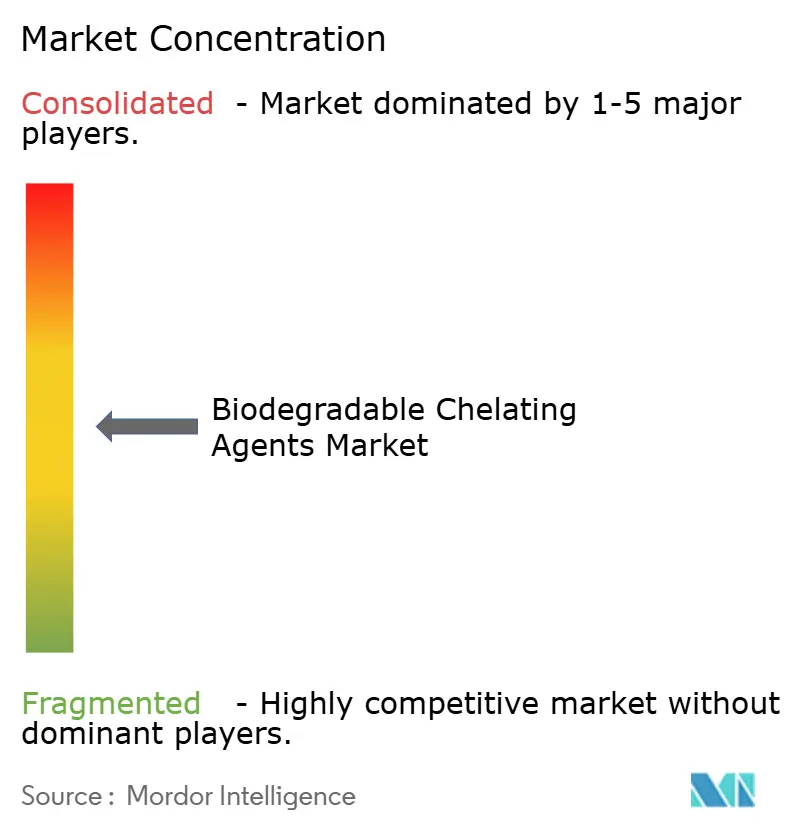
The biodegradable chelating agents market is moderately fragmented, with BASF, Nouryon, LANXESS, and Kemira holding significant capacity in GLDA and MGDA and established positions in regulated application areas. Nippon Shokubai, Mitsubishi Chemical, Jungbunzlauer, Aquapharm Chemicals, and Shandong IRO Chelating Chemical compete across specialist chemistries and regional supply. Smaller competitors are improving their certification records to enter regulated markets. The combined market share of BASF, Nouryon, LANXESS, and Kemira was not disclosed in the available material, and a precise market concentration score cannot be calculated from verified company-share data. Competition is strongest in standard glutamic acid diacetic acid (GLDA) grades, where a wider supply base increases price pressure. Biodegradable products have not matched the performance of diethylenetriaminepentaacetic acid (DTPA) or hydroxyethylethylenediaminetriacetic acid (HEDTA) in high-temperature and high-hardness applications, leaving a technical gap in extreme-condition chelants.
BASF pursued a portfolio-breadth approach through the April 2025 launches of Trilon G and Sokalan CP 301, which address market requirements for biodegradable chemistry in cleaning and agrochemical formulations. Nouryon has focused on application depth through its dedicated biodegradable chelates facility in Herkenbosch, Netherlands, and its planned customer experience and innovation center in Brazil. This approach supports closer technical collaboration with end users. Its Dissolvine GL portfolio serves personal care and cleaning applications. Suppliers with laboratory support and formulation expertise are better positioned to serve smaller customers that lack internal testing resources.
Kemira and International Flavors & Fragrances (IFF) formed a joint venture to produce biobased materials at scale for water treatment and fiber applications, with commercial production expected in 2029. This project reflects continued investment in biobased infrastructure rather than reformulation of existing products. Kemira also identifies water chemistry as a strategic growth area, which reinforces its position in process water and treatment applications adjacent to chelant use. Specialized competitors can gain share by offering high-purity grades, regional service, or application-specific product forms. Competitive outcomes in this market will depend on performance verification, regulatory documentation, and the ability to support customers through formulation changes.
Biodegradable Chelating Agents Industry Leaders
BASF
Dow
Innospec
LANXESS
Nouryon
- *Disclaimer: Major Players sorted in no particular order
Biodegradable Chelating Agents Market Companies Covered in this Report
- Aquapharm Chemical Limited
- AVA Chemicals
- BASF
- Cargill, Incorporated
- Dow
- Hebei Think-Do Chemicals Co., Ltd.
- Innospec
- Jungbunzlauer Suisse AG
- Kemira
- LANXESS
- Mitsubishi Chemical Corporation
- Nippon Shokubai Co., Ltd.
- Nouryon
- Shandong IRO Chelating Chemical Co., Ltd.
- Solvay
- Zschimmer & Schwarz Chemie GmbH

Recent Industry Developments in Biodegradable Chelating Agents Market
- November 2025: Jungbunzlauer acquired IFF's manufacturing facility in Thomson, Illinois, establishing its first US production site for naturally derived ingredients, including citric acid, mineral salts, and specialty chelating agents. Combined with a biogum expansion in Port Colborne, Canada (Phase 1 expected from Spring 2026), the moves reinforced Jungbunzlauer's North American supply capacity for biodegradable chelating inputs.
- April 2025: BASF launched Trilon G, a GLDA-based chelating agent for home care and institutional and industrial (I&I) cleaning applications. Trilon G contains 56% renewable carbon atoms, and its GLDA active ingredient achieves more than 60% biodegradation within 28 days under OECD 301D. The launch expanded BASF's sustainable chelating portfolio alongside its methylglycine diacetic acid (MGDA)-based Trilon M line.


Global Biodegradable Chelating Agents Market Report Scope
A biodegradable chelating agent is a compound that binds to metal ions (such as calcium, magnesium, or heavy metals) to keep them in solution and decomposes naturally into harmless substances. These agents replace traditional synthetic chelators that do not break down and can harm ecosystems.
The biodegradable chelating market is segmented by type, formulation, end-user industry, and geography. By type, the market is segmented into amino acid chelates, organic acid chelates, polycarboxylic acid chelates, and natural chelating agents. By formulation, the market is segmented into liquid, powder, and granular. By end-user industry, the market is segmented into agriculture, household and institutional cleaning, water treatment, personal care and cosmetics, food and beverage, pharmaceuticals, textile, pulp and paper, industrial manufacturing, and other end-user industries. The report also covers the market size and forecasts for biodegradable chelating agents in 16 countries across major regions. The market sizes and forecasts are provided in terms of value (USD).
| Amino Acid Chelates |
| Organic Acid Chelates |
| Polycarboxylic Acid Chelates |
| Natural Chelating Agents |
| Liquid |
| Powder |
| Granular |
| Agriculture |
| Household and Institutional Cleaning |
| Water Treatment |
| Personal Care and Cosmetics |
| Food and Beverage |
| Pharmaceuticals |
| Textile |
| Pulp and Paper |
| Industrial Manufacturing |
| Other End-User Industries |
| Asia-Pacific | China |
| India | |
| Japan | |
| South Korea | |
| Rest of Asia-Pacific | |
| North America | United States |
| Canada | |
| Mexico | |
| Europe | Germany |
| United Kingdom | |
| France | |
| Italy | |
| Russia | |
| Rest of Europe | |
| South America | Brazil |
| Argentina | |
| Rest of South America | |
| Middle-East and Africa | Saudi Arabia |
| South Africa | |
| Rest of Middle-East and Africa |
| By Type | Amino Acid Chelates | |
| Organic Acid Chelates | ||
| Polycarboxylic Acid Chelates | ||
| Natural Chelating Agents | ||
| By Formulation | Liquid | |
| Powder | ||
| Granular | ||
| By End-User Industry | Agriculture | |
| Household and Institutional Cleaning | ||
| Water Treatment | ||
| Personal Care and Cosmetics | ||
| Food and Beverage | ||
| Pharmaceuticals | ||
| Textile | ||
| Pulp and Paper | ||
| Industrial Manufacturing | ||
| Other End-User Industries | ||
| By Geography | Asia-Pacific | China |
| India | ||
| Japan | ||
| South Korea | ||
| Rest of Asia-Pacific | ||
| North America | United States | |
| Canada | ||
| Mexico | ||
| Europe | Germany | |
| United Kingdom | ||
| France | ||
| Italy | ||
| Russia | ||
| Rest of Europe | ||
| South America | Brazil | |
| Argentina | ||
| Rest of South America | ||
| Middle-East and Africa | Saudi Arabia | |
| South Africa | ||
| Rest of Middle-East and Africa | ||


Key Questions Answered in the Report
What is current market size of Biodegradable Chelating Agents Market?
The Biodegradable Chelating Agents Market size is expected to grow from USD 5.11 billion in 2025 to USD 5.49 billion in 2026 and is forecast to reach USD 7.94 billion by 2031 at 7.66% CAGR over 2026-2031.
Which type held the largest share in 2025?
Amino acid chelates led with 37.82% share in 2025, supported by agricultural micronutrient delivery and premium personal care uses. Their role is strongest where crop systems need soluble nutrients in alkaline or calcareous soil conditions.
Which formulation is growing fastest?
Liquid formulations are projected to grow at a 7.92% CAGR through 2031. They accounted for 54.72% of revenue in 2025 because automated dosing systems favor liquids, helping avoid dissolution delays and simplifying material handling.
Which end-user segment is growing fastest?
Water treatment is projected to grow at an 8.33% CAGR through 2031 as users address effluent and metal-sequestration requirements. Municipal users are evaluating biodegradable alternatives that may persist in discharge streams and create regulatory exposure.
Page last updated on:





