
Bicycle Accessories Market Size and Share
Market Overview
| Study Period | 2027 - 2032 |
|---|---|
| Market Size (2027) | USD 10.43 Billion |
| Market Size (2032) | USD 14.30 Billion |
| Growth Rate (2027 - 2032) | 6.50 % |
| Fastest Growing Market | Asia-Pacific |
| Largest Market | Asia-Pacific |
| Market Concentration | Medium |
Major Players *Disclaimer: Major Players sorted in no particular order Image © Mordor Intelligence. Reuse requires attribution under CC BY 4.0. | |
Bicycle Accessories Market Analysis by Mordor Intelligence
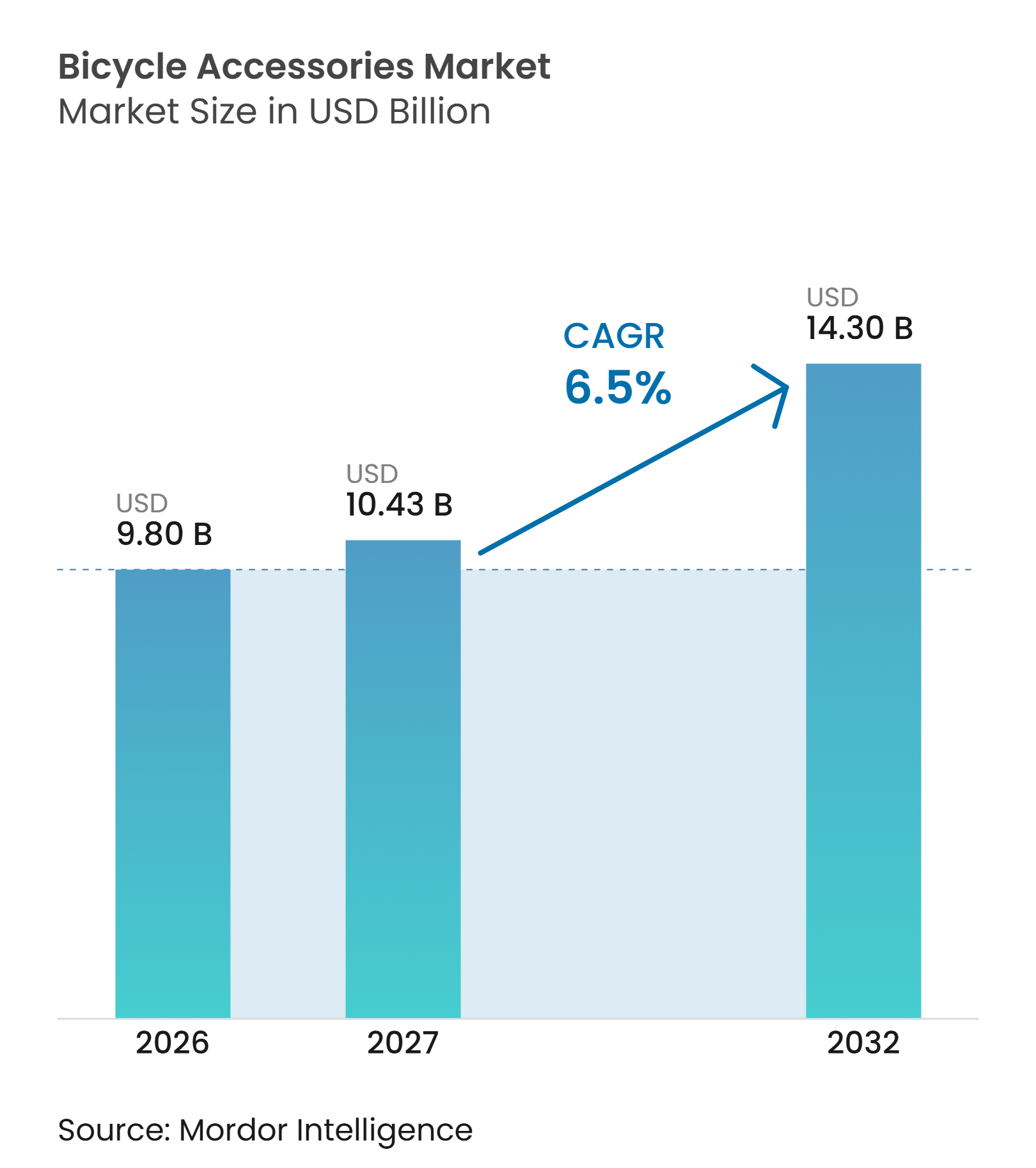
The bicycle accessories market size is expected to increase from USD 9.8 billion in 2026 to USD 10.43 billion in 2027 and reach USD 14.3 billion by 2032, growing at a CAGR of 6.50% over 2027–2032. Growth is supported by rising bicycle adoption for urban commuting, fitness, sports, and recreational activities, alongside increasing investments in cycling infrastructure and sustainable transportation. Helmets represent the largest product segment, accounting for 28.11% of the market in 2026, reflecting the growing emphasis on cyclist safety and accident prevention. Commuting and urban mobility is the leading application segment with a 42.32% share, while offline distribution accounts for 39.62% of sales. However, online distribution is expected to grow fastest at a CAGR of 8.60%, supported by expanding e-commerce platforms and brand-owned websites. Women represent the fastest-growing end-user segment at a CAGR of 7.30%, while Asia-Pacific leads geographically with a 36.81% market share and is also projected to grow at 7.40%. Market expansion is challenged by the durability and longer replacement cycles of accessories, product compatibility issues, counterfeit offerings, and fluctuations in raw material and manufacturing costs. Overall, growth opportunities favor manufacturers offering safety-oriented, technologically advanced, and performance-focused accessories through expanding online and specialized retail channels.
Key Report Takeaways
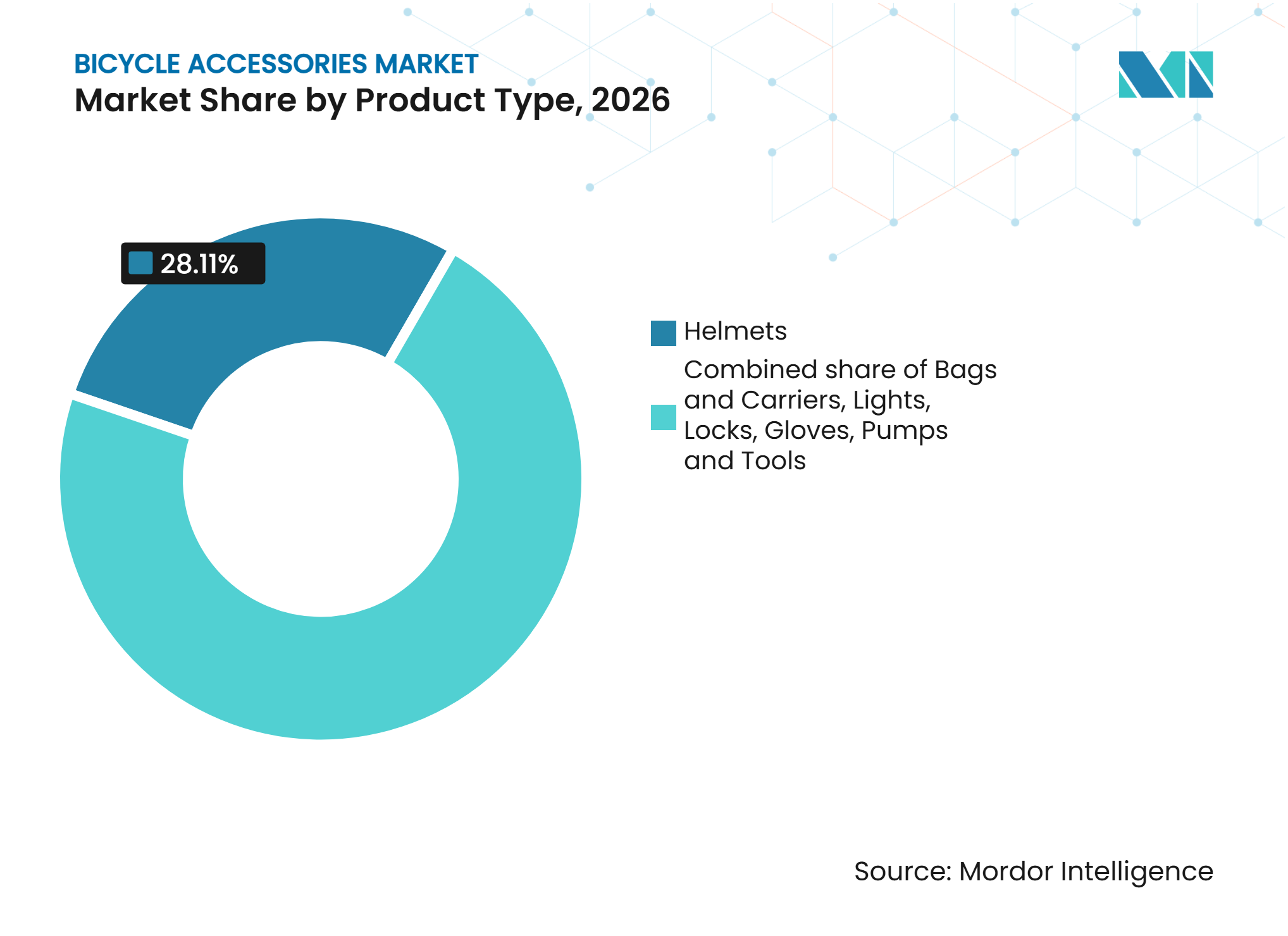
- By product type, helmets accounted for the largest share of the bicycle accessories market at 28.11% in 2026, while lights are forecast to grow fastest at a 7.90% CAGR over 2027–2032.
-
By application, commuting and urban mobility dominated with a 42.32% market share in 2026, while off-road and adventure cycling is projected to record the fastest growth at a 7.30% CAGR over 2027–2032.
-
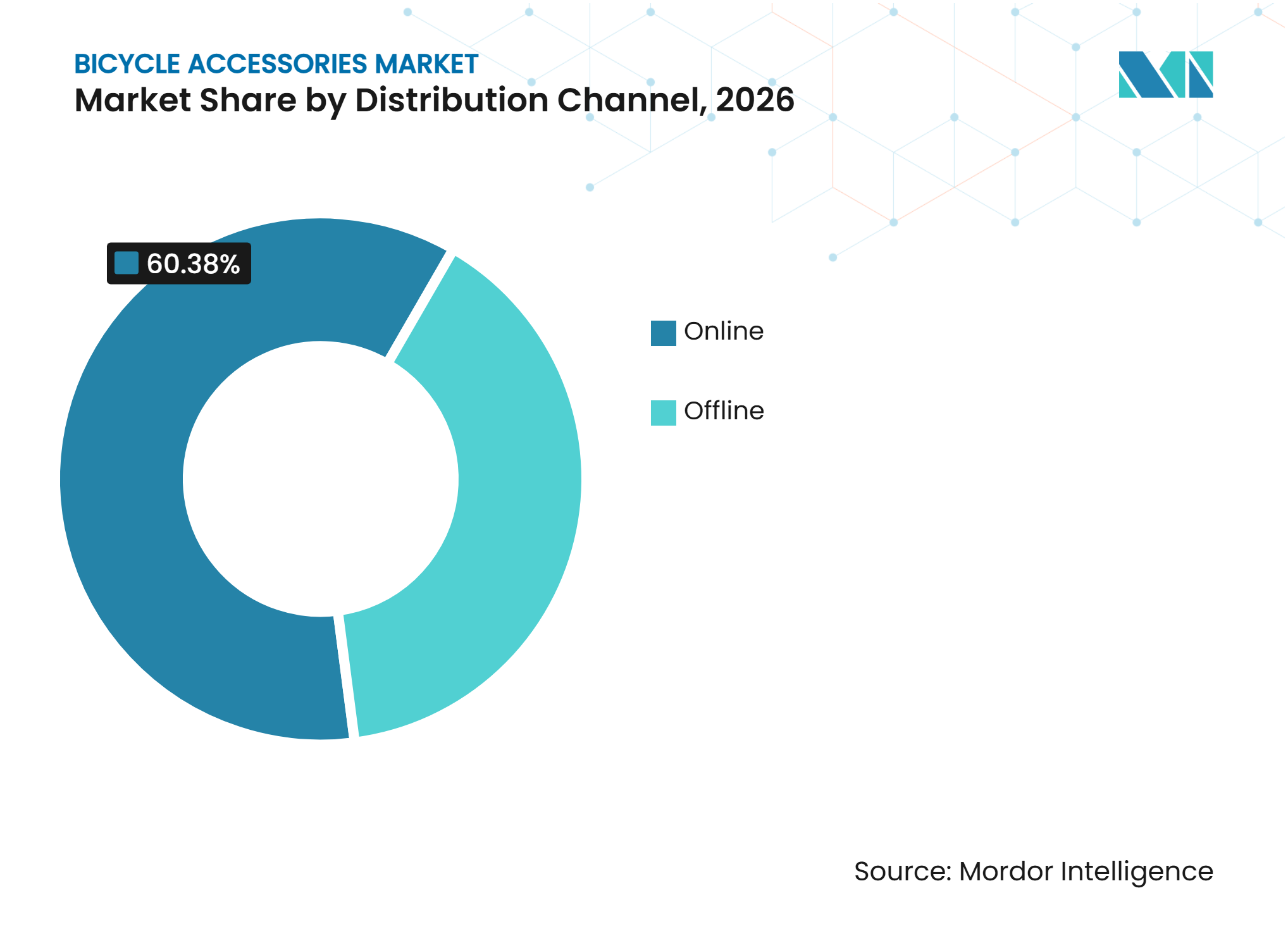
By distribution channel, offline accounted for the largest share at 39.62% in 2026, while online distribution is expected to grow fastest at an 8.60% CAGR over 2027–2032.
-
By end-user, men held the largest share of the bicycle accessories market at 55.79% in 2026, while women are forecast to register the fastest growth at a 7.30% CAGR over 2027–2032.
-
Among geographies, Asia-Pacific led with a 36.81% share of the bicycle accessories market in 2026 and is also projected to grow fastest at a 7.40% CAGR over 2027–2032.
Note: Market numbers in this report are based on Mordor Intelligence's proprietary estimation framework, which combines nine months of actuals with Q4 projections for base year 2026.
Market Trends and Insights
Drivers Impact Analysis of Bicycle Accessories Market*
| Driver | (~) % Impact on CAGR Forecast | Geographic Relevance | Impact Timeline |
|---|---|---|---|
| Rising adoption of cycling for urban mobility and sustainable transportation | +1.0% | Global, particularly Europe and Asia-Pacific, where urban cycling and sustainable mobility initiatives are gaining traction | Medium term (2–4 years) |
| Growing popularity of cycling for fitness, sports, and recreation | +0.8% | Global, particularly North America and Europe, supported by increasing participation in recreational and competitive cycling | Medium term (2–4 years) |
| Expansion of electric bicycle adoption and demand for specialized accessories | +0.7% | Global, particularly Europe and Asia-Pacific, where electric bicycle adoption is expanding | Long term (More than 4 years) |
| Increasing focus on cyclist safety and road accident prevention | +0.6% | Global, particularly Europe and North America, where cyclist safety standards and road-safety initiatives support demand for protective accessories | Medium term (2–4 years) |
| Growing investments in cycling infrastructure and government initiatives | +0.5% | Global, particularly Europe and Asia-Pacific, where governments are investing in cycling lanes and sustainable transportation infrastructure | Long term (More than 4 years) |
| Rising demand for premium, performance-oriented cycling accessories | +0.4% | Global, particularly North America and Europe, with growing opportunities across Asia-Pacific's expanding cycling markets | Short term (Less than 2 years) |
| Source: Mordor Intelligence | |||
Rising Adoption of Cycling for Urban Mobility and Sustainable Transportation
The growing integration of cycling into urban transportation systems is supporting demand for bicycle accessories used in daily commuting. Governments are increasingly promoting cycling as an affordable, low-emission mode of transport to reduce traffic congestion, transport-related emissions, and dependence on motorized mobility. The European Commission identifies cycling as an important component of sustainable urban mobility and highlights the need for dedicated cycling infrastructure, secure bicycle parking, and better integration with public transportation [1]. These initiatives create opportunities for manufacturers of helmets, lights, locks, bags, and other commuting-oriented accessories as more consumers incorporate bicycles into their daily travel routines.
Growing Popularity of Cycling for Fitness, Sports, and Recreation
Increasing participation in cycling for physical fitness, recreational activities, and organized sporting events is expanding demand for specialized bicycle accessories. Cycling provides an accessible form of physical activity that supports active lifestyles, while participation in group rides, recreational cycling, and competitive events encourages consumers to invest in equipment that improves comfort, safety, and riding performance. The European Union's Declaration on Cycling recognizes cycling as a healthy form of transport and recreation and encourages governments to promote cycling through awareness campaigns, advocacy initiatives, and participation-oriented programs [2]. This growing institutional support for cycling as a recreational and fitness activity creates opportunities for manufacturers of cycling gloves, helmets, performance accessories, pumps, and specialized equipment.
Expansion of Electric Bicycle Adoption and Demand for Specialized Accessories
The increasing adoption of electric bicycles is creating additional opportunities for manufacturers of specialized bicycle accessories designed for electric-assisted riding. E-bikes support longer commuting distances and provide an alternative for consumers seeking convenient and less physically demanding transportation, increasing the relevance of compatible helmets, integrated lighting systems, security locks, storage solutions, and other riding equipment. The European Commission identifies e-bikes as the fastest-growing segment of e-mobility in Europe and highlights their contribution to sustainable urban transportation [3]. The expansion of e-bike adoption is therefore encouraging accessory manufacturers to develop products suited to different riding requirements, including enhanced visibility, secure battery storage, and compatibility with electric bicycle designs.
Increasing Focus on Cyclist Safety and Road Accident Prevention
Growing awareness of cyclist vulnerability on roads is strengthening demand for protective and visibility-enhancing bicycle accessories. Helmets, front and rear lights, reflective equipment, and high-visibility clothing are important for reducing injury risks and improving cyclist visibility, particularly during nighttime riding and in areas with mixed traffic. The United States Centers for Disease Control and Prevention (CDC) reports that nearly 1,000 bicyclists die annually in motor-vehicle-related road crashes in the country and identifies bicycle injuries and fatalities as preventable [4]. Such safety concerns encourage consumers to prioritize protective equipment and support demand for accessories that improve visibility, protection, and riding safety.
Growing Investments in Cycling Infrastructure and Government Initiatives
Increasing public investment in dedicated cycling infrastructure and government-led mobility initiatives is improving the accessibility and practicality of bicycle transportation. Investments in segregated cycling lanes, bicycle parking facilities, connected cycling networks, and integration with public transport encourage wider bicycle usage across urban areas. The European Commission's 2025 cycling policy update reports that EUR 4.5 billion has been allocated to cycling investments during 2021–2027, including funding expected to support more than 12,000 km of new or improved cycle paths [5]. The expansion of cycling infrastructure is expected to encourage bicycle adoption and generate additional demand for helmets, locks, lights, bags, and other accessories required for regular commuting and recreational riding.
Restraints Impact Analysis of Bicycle Accessories Market*
| Restraint | (~) % Impact on CAGR Forecast | Geographic Relevance | Impact Timeline |
|---|---|---|---|
| Limited replacement frequency and durability of bicycle accessories | −0.8% | Global, particularly mature cycling markets across Europe and North America, where durable accessories and longer product lifecycles can reduce repeat purchases | Medium term (2–4 years) |
| Product standardization and bicycle compatibility challenges | −0.7% | Global, particularly markets with diverse bicycle designs and expanding adoption of electric bicycles and specialized cycling equipment | Medium term (2–4 years) |
| Availability of low-cost counterfeit and unorganized products | −0.5% | Global, particularly price-sensitive markets across Asia-Pacific, South America, and the Middle East and Africa | Long term (More than 4 years) |
| Fluctuations in raw material and manufacturing costs | −0.4% | Global, particularly manufacturing-dependent markets across Asia-Pacific and regions reliant on imported materials and components | Short term (Less than 2 years) |
| Source: Mordor Intelligence | |||
Limited Replacement Frequency and Durability of Bicycle Accessories
Bicycle accessories such as helmets, locks, pumps, bags, and other equipment are generally designed for repeated use over extended periods, which can limit replacement frequency and recurring purchases. Durable products with long functional lifespans reduce the need for frequent replacements, particularly among regular commuters and recreational cyclists who maintain their existing equipment. Although certain accessories, including helmets and lights, may require replacement due to wear, damage, or changing safety requirements, replacement cycles vary considerably across product categories. This limits repeat-purchase opportunities for manufacturers and can constrain market growth, particularly in mature cycling markets where accessory ownership is already established. Manufacturers therefore need to encourage replacement demand through product innovation, improved functionality, updated designs, and enhanced safety features.
Product Standardization and Bicycle Compatibility Challenges
Differences in bicycle designs, frame configurations, mounting systems, and component specifications can create compatibility challenges for bicycle accessories. Products such as lights, bags, carriers, locks, pumps, and electronic cycling equipment may require specific mounting arrangements or technical specifications to function effectively across different bicycle models. The growing adoption of electric bicycles and specialized road, mountain, and hybrid bicycles further increases the diversity of compatibility requirements. These variations can complicate product selection, increase inventory management requirements for retailers, and create additional product-development challenges for manufacturers seeking to serve a broad consumer base. Companies must therefore invest in adaptable designs, standardized mounting solutions, and wider product compatibility to address diverse cycling requirements.
*Our forecasts treat driver/restraint impacts as directional, not additive. The impact forecasts reflect baseline growth, mix effects, and variable interactions.
Bicycle Accessories Market Segment Analysis
By Product Type:
Helmets Lead While Lights Record Faster GrowthIn 2026, helmets accounted for an estimated 28.11% of the bicycle accessories market, making them the leading product type. Their position reflects the importance of cyclist safety and the widespread use of protective headgear across commuting, recreational, and competitive cycling activities. Growing awareness of road accidents and the need for protective equipment supports demand for helmets across different bicycle categories. Meanwhile, bicycle lights are projected to record the fastest growth, at an estimated CAGR of 7.90% through 2032. Increasing emphasis on cyclist visibility during nighttime riding, early-morning commuting, and low-light conditions is encouraging demand for front and rear lighting systems. Technological improvements in rechargeable batteries, LED lighting, and compact designs are also supporting product development.
Bags and carriers, locks, gloves, pumps and tools, and other accessories serve complementary requirements across different cycling activities. Bags and carriers support storage and transportation needs, while locks address bicycle security concerns. Gloves improve riding comfort, and pumps and tools support routine maintenance and emergency repairs. Manufacturers must therefore balance safety, durability, functionality, and affordability while developing accessories suited to different cycling applications.



By Application:
Commuting and Urban Mobility Leads While Off-Road and Adventure Cycling Expands FasterIn 2026, commuting and urban mobility accounted for an estimated 42.32% of the bicycle accessories market, making it the leading application segment. Its position reflects the increasing use of bicycles for daily transportation, particularly in urban areas where consumers seek alternatives to motorized commuting. Regular bicycle users require practical accessories such as helmets, lights, locks, bags, and carriers to support safety, convenience, and everyday functionality. Meanwhile, off-road and adventure cycling is projected to record the fastest growth, at an estimated CAGR of 7.30% through 2032. Growing interest in mountain biking, trail riding, and outdoor cycling activities is supporting demand for specialized accessories designed to withstand challenging terrain and extended riding conditions.
Sports and competitive cycling and recreational and leisure cycling also contribute to accessory demand through requirements for performance, comfort, and equipment functionality. Other specialized cycling applications further support demand for accessories designed for specific riding conditions and user requirements. Manufacturers are increasingly focusing on application-specific designs, durability, and product versatility to serve different cycling activities.
By Distribution Channel:
Offline Leads While Online Distribution Expands FasterIn 2026, offline distribution accounted for an estimated 39.62% of the bicycle accessories market, making it the largest distribution channel. Its position reflects the importance of physical retail outlets, including specialty bicycle retailers, mass merchants, and sporting goods stores, where consumers can examine products, assess compatibility, and obtain assistance before purchasing. Specialty bicycle retailers are particularly relevant for technical accessories such as helmets, lights, pumps, and bicycle-specific equipment that may require product guidance. Meanwhile, online distribution is projected to record the fastest growth, at an estimated CAGR of 8.60% through 2032. The expansion of e-commerce platforms and brand-owned websites is improving product accessibility, enabling consumers to compare specifications, prices, and product reviews across multiple manufacturers.
Online channels also provide manufacturers with opportunities to reach consumers beyond traditional retail markets and offer broader product selections. However, physical stores continue to play an important role in product demonstrations, compatibility assessments, and personalized purchasing assistance. The coexistence of online convenience and offline product evaluation is expected to shape distribution strategies across the market.

By End-User:
Men Lead While Women Record Faster GrowthIn 2026, men accounted for an estimated 55.79% of the bicycle accessories market, making them the largest end-user segment. This position reflects established participation in cycling across commuting, recreational, fitness, and competitive activities. Demand from male cyclists spans a broad range of accessories, including helmets, gloves, lights, locks, bags, and performance-oriented equipment. Meanwhile, the women segment is projected to record the fastest growth, at an estimated CAGR of 7.30% through 2032. Increasing participation in cycling for fitness, recreation, commuting, and organized sporting activities is supporting demand for accessories designed to accommodate different comfort, fit, and functional requirements.
The kids segment represents another important application area, with demand influenced by family-oriented recreational cycling and children's bicycle safety requirements. Manufacturers are increasingly addressing varied end-user needs through improvements in product sizing, ergonomic designs, comfort, safety features, and styling. Expanding participation across demographic groups is expected to support product diversification and broader accessory adoption.
Geography Analysis
Asia-Pacific Bicycle Accessories Market
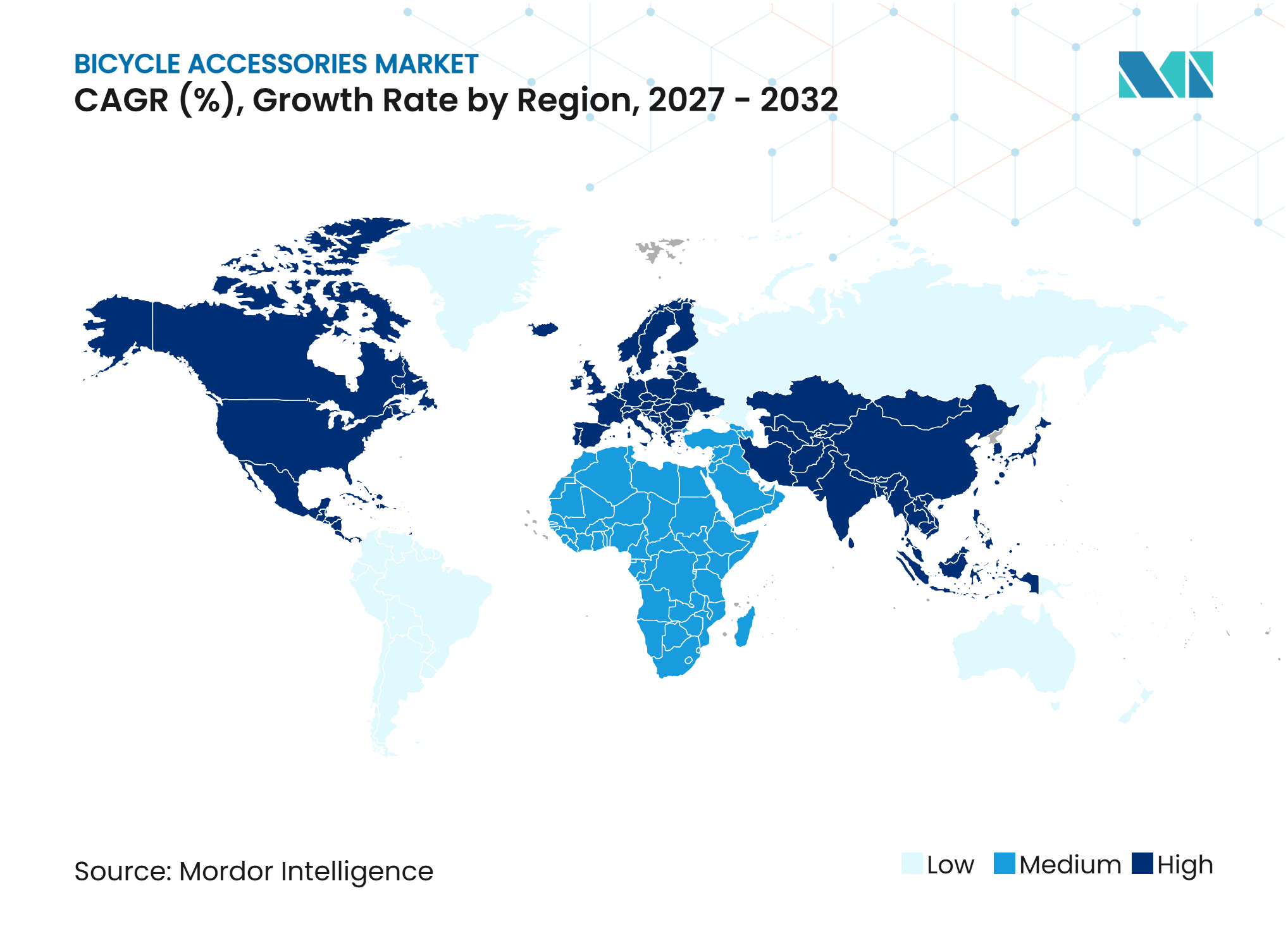
Asia-Pacific accounted for an estimated 36.81% of the bicycle accessories market in 2026, making it the largest regional market. The region's position is supported by established bicycle manufacturing industries, widespread bicycle usage for daily transportation, and growing participation in recreational and fitness cycling. China, India, Japan, and Indonesia represent important markets with varying demand patterns across commuting, urban mobility, and specialized cycling applications. The region is also projected to record the fastest growth, at an estimated CAGR of 7.40% over 2027–2032. Expanding urban transportation networks, rising interest in electric bicycles, and increasing investment in cycling infrastructure create opportunities for manufacturers of helmets, lights, locks, bags, and other specialized accessories.
North America Bicycle Accessories Market
North America represents an established market for bicycle accessories, supported by recreational cycling, fitness-oriented activities, and demand for specialized cycling equipment. The United States and Canada are important markets, where cycling participation across urban commuting, road cycling, mountain biking, and recreational activities supports demand for helmets, lights, gloves, bags, locks, and performance-oriented accessories. The US Department of Transportation promotes investments in bicycle and pedestrian infrastructure to improve safety and encourage active transportation. Canada's National Active Transportation Strategy also prioritizes investments in connected cycling networks and safe infrastructure. These initiatives create opportunities for accessory manufacturers, particularly in safety-oriented and premium product categories.
Europe Bicycle Accessories Market
Europe represents an important market for bicycle accessories, supported by established cycling cultures, government-led mobility initiatives, and investments in dedicated cycling infrastructure. Countries such as Germany, the Netherlands, France, the United Kingdom, and Denmark provide opportunities for manufacturers across commuting, recreational, and competitive cycling applications. According to the European Commission's 2025 progress report on the European Declaration on Cycling, EUR 4.5 billion has been allocated to cycling investments during 2021–2027, including funding intended to support more than 12,000 km of new or improved cycle paths. These developments support demand for helmets, bicycle lights, locks, bags, and other accessories as cycling becomes more integrated into urban transportation systems.
Competitive Landscape
Market Concentration
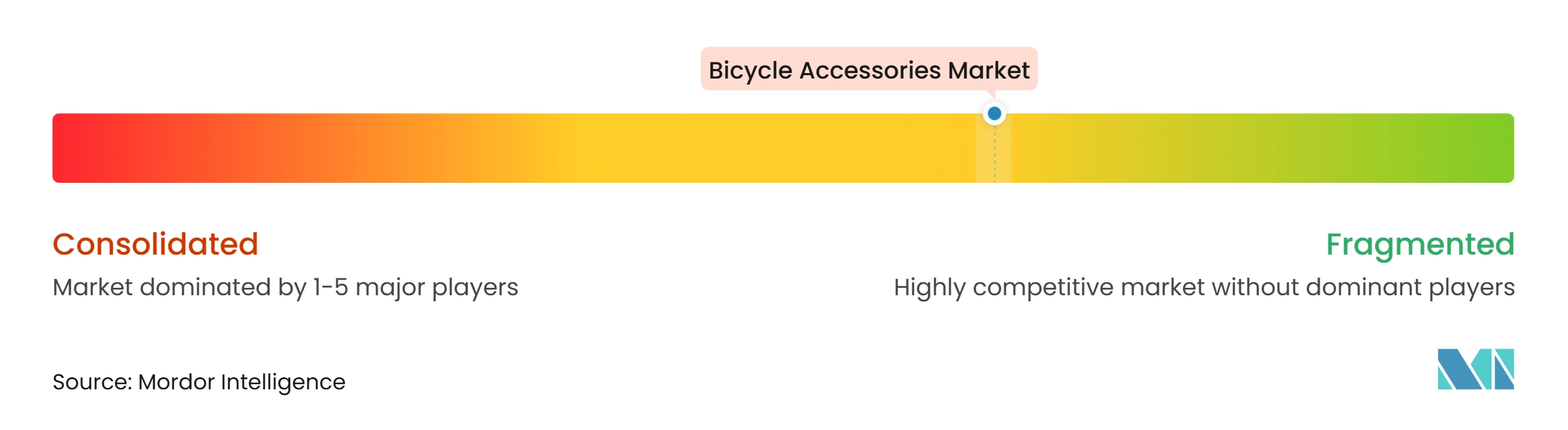
The Bicycle Accessories Market includes global bicycle component manufacturers, bicycle brands, specialist accessory companies, and regional producers competing through product innovation, product quality, brand positioning, and distribution reach. Companies have varying levels of exposure to the market through helmets, lights, bags and carriers, locks, gloves, pumps, tools, and other cycling accessories. Specialist accessory manufacturers can differentiate through focused product portfolios and technical expertise, while established bicycle brands can leverage their existing customer relationships, retail networks, and cycling-related product ecosystems.
Competitive strategies in the Bicycle Accessories Market focus on expanding product portfolios, improving rider safety and comfort, and introducing performance-oriented and technology-enabled products. For example, ABUS offers bicycle helmets and a broad range of locks, including U-locks, folding locks, chain locks, and cable locks. Lezyne provides cycling lights, pumps, tools, and tire-repair products, while Garmin offers cycling computers, bike lights, rearview radar, and related accessories. These portfolios illustrate how companies differentiate through specialized product categories, safety features, connected technology, and solutions for commuting, road cycling, and off-road applications.
Product compatibility, retail reach, and brand positioning remain important competitive considerations. Companies such as Trek offer accessories including helmets, lights, bags, racks, fenders, locks, and tools, with product options tailored to commuting, fitness, and recreational cycling. Compatibility with different bicycle types and mounting systems can influence purchasing decisions, particularly for lights, carriers, and other fitted accessories. Manufacturers therefore compete through product design, durability, ease of installation, technical features, and availability across specialty bicycle retailers, sporting goods stores, and online platforms. At the same time, fluctuations in material and component costs, counterfeit products, product-quality expectations, and the need to meet applicable safety requirements can affect operating conditions. These factors make product innovation, quality assurance, reliable distribution, and clear compatibility information important areas of competition.
Bicycle Accessories Industry Leaders
-
Shimano Inc.
-
Giant Manufacturing Co., Ltd.
-
Garmin Ltd.
-
Trek Bicycle Corporation
-
Specialized Bicycle Components, Inc.
- *Disclaimer: Major Players sorted in no particular order
Bicycle Accessories Market Companies Covered in this Report
- Shimano Inc.
- Garmin Ltd.
- Giant Manufacturing Co., Ltd.
- Trek Bicycle Corporation
- Specialized Bicycle Components, Inc.
- SRAM LLC
- Accell Group
- Merida Industry Co., Ltd.
- Campagnolo S.R.L.
- DT Swiss
- Continental AG
- Fox Factory Inc.
- Thule Group AB
- ABUS August Bremicker Söhne KG
- Lezyne USA, Inc.
- Endura Ltd.
- Topeak Inc.
- Cateye Co., Ltd.
- Avon Cycles Ltd.
- Selle Italia S.p.A.
Recent Industry Developments in Bicycle Accessories Market
- November 2026: Park Tool released its FSK-1 Fork Seal Kit, designed for the fast and safe removal and installation of suspension fork dust wipers. The product launch expands the company's bicycle maintenance tool portfolio, supporting demand for specialized repair and maintenance accessories.
- November 2026: Hollywood Racks acquired OttoLock, adding a bicycle security product line to its existing carrying and accessories portfolio. The acquisition strengthens Hollywood Racks' presence in the bicycle accessories market by expanding its offerings into bicycle locks and security solutions.
- November 2026: Apidura launched its Expedition Series Long Top Tube Pack, providing waterproof storage for easily accessible cycling essentials. The product expands the company's bikepacking accessories portfolio, targeting riders seeking practical storage solutions for commuting, touring, and off-road cycling.
- October 2026: Thule acquired New Zealand-based bikepacking brand Aeroe, which specializes in bikepacking bags, racks, and accessories. The acquisition expands Thule's bicycle storage and carrying solutions portfolio, with Aeroe products planned for integration under the Thule brand by the second quarter of 2027.
Global Bicycle Accessories Market Report Scope
For this study, the Bicycle Accessories Market is defined as the sales value of commercially produced accessories designed to enhance bicycle safety, functionality, comfort, storage, and performance. The market covers helmets, bags and carriers, lights, locks, gloves, pumps and tools, and other bicycle accessories, segmented by application into commuting and urban mobility, sports and competitive cycling, recreational and leisure cycling, off-road and adventure cycling, and other specialized cycling applications. The market is further segmented by end-user into men, women, and kids, and by distribution channel into offline and online. Offline includes specialty bicycle retailers, mass merchants and sporting goods stores, and other distribution channels, while online includes e-commerce platforms, brand-owned websites, and other online channels. The market is analyzed across North America, Europe, Asia-Pacific, South America, and the Middle East and Africa, with country-level coverage as specified in the report. Market sizing and forecasts are presented in value terms (USD) across the defined segments and geographies.
Segmentation Overview
| Helmets |
| Bags and Carriers |
| Lights |
| Locks |
| Gloves |
| Pumps and Tools |
| Others |
| Commuting and Urban Mobility |
| Sports and Competitive Cycling |
| Recreational and Leisure Cycling |
| Off-Road and Adventure Cycling |
| Other Specialized Cycling Applications |
| Men |
| Women |
| Kids |
| Offline | Specialty Bicycle Retailers |
| Mass Merchants and Sporting Goods Stores | |
| Others | |
| Online | E-Commerce Platforms |
| Brand-Owned Websites | |
| Others |
| North America | United States |
| Canada | |
| Mexico | |
| Rest of North America | |
| Europe | United Kingdom |
| Germany | |
| France | |
| Italy | |
| Spain | |
| Sweden | |
| Belgium | |
| Poland | |
| Netherlands | |
| Rest of Europe | |
| Asia-Pacific | China |
| Japan | |
| India | |
| Thailand | |
| Singapore | |
| Indonesia | |
| Korea | |
| Australia | |
| Rest of Asia-Pacific | |
| South America | Brazil |
| Argentina | |
| Colombia | |
| Peru | |
| Chile | |
| Rest of South America | |
| Middle East and Africa | South Africa |
| Saudi Arabia | |
| United Arab Emirates | |
| Nigeria | |
| Egypt | |
| Morocco | |
| Turkey | |
| Rest of Middle East and Africa |
| By Product Type | Helmets | |
| Bags and Carriers | ||
| Lights | ||
| Locks | ||
| Gloves | ||
| Pumps and Tools | ||
| Others | ||
| By Application | Commuting and Urban Mobility | |
| Sports and Competitive Cycling | ||
| Recreational and Leisure Cycling | ||
| Off-Road and Adventure Cycling | ||
| Other Specialized Cycling Applications | ||
| By End-User | Men | |
| Women | ||
| Kids | ||
| By Distribution Channel | Offline | Specialty Bicycle Retailers |
| Mass Merchants and Sporting Goods Stores | ||
| Others | ||
| Online | E-Commerce Platforms | |
| Brand-Owned Websites | ||
| Others | ||
| By Geography | North America | United States |
| Canada | ||
| Mexico | ||
| Rest of North America | ||
| Europe | United Kingdom | |
| Germany | ||
| France | ||
| Italy | ||
| Spain | ||
| Sweden | ||
| Belgium | ||
| Poland | ||
| Netherlands | ||
| Rest of Europe | ||
| Asia-Pacific | China | |
| Japan | ||
| India | ||
| Thailand | ||
| Singapore | ||
| Indonesia | ||
| Korea | ||
| Australia | ||
| Rest of Asia-Pacific | ||
| South America | Brazil | |
| Argentina | ||
| Colombia | ||
| Peru | ||
| Chile | ||
| Rest of South America | ||
| Middle East and Africa | South Africa | |
| Saudi Arabia | ||
| United Arab Emirates | ||
| Nigeria | ||
| Egypt | ||
| Morocco | ||
| Turkey | ||
| Rest of Middle East and Africa | ||
Key Questions Answered in the Report
What is the size of the Bicycle Accessories Market?
The Bicycle Accessories Market is estimated at USD 9.8 billion in 2026 and is projected to reach USD 14.3 billion by 2032.
What is the CAGR of the Bicycle Accessories Market?
The Bicycle Accessories Market is expected to register a CAGR of 6.50% during the forecast period (2026–2031).
Which product type holds the largest share of the Bicycle Accessories Market?
The helmets segment holds the largest share of the Bicycle Accessories Market, accounting for 28.11% in 2026.
Which region dominates the Bicycle Accessories Market?
Asia-Pacific dominates the Bicycle Accessories Market, accounting for 36.81% of the market share in 2026.