
Beekeeping Equipment Market Size and Share
Market Overview
| Study Period | 2022 - 2032 |
|---|---|
| Market Size (2027) | USD 1.46 Billion |
| Market Size (2032) | USD 1.96 Billion |
| Growth Rate (2027 - 2032) | 6.07 % |
| Fastest Growing Market | Asia-Pacific |
| Largest Market | Europe |
| Market Concentration | Low |
Major Players *Disclaimer: Major Players sorted in no particular order Image © Mordor Intelligence. Reuse requires attribution under CC BY 4.0. | |
Beekeeping Equipment Market Analysis by Mordor Intelligence
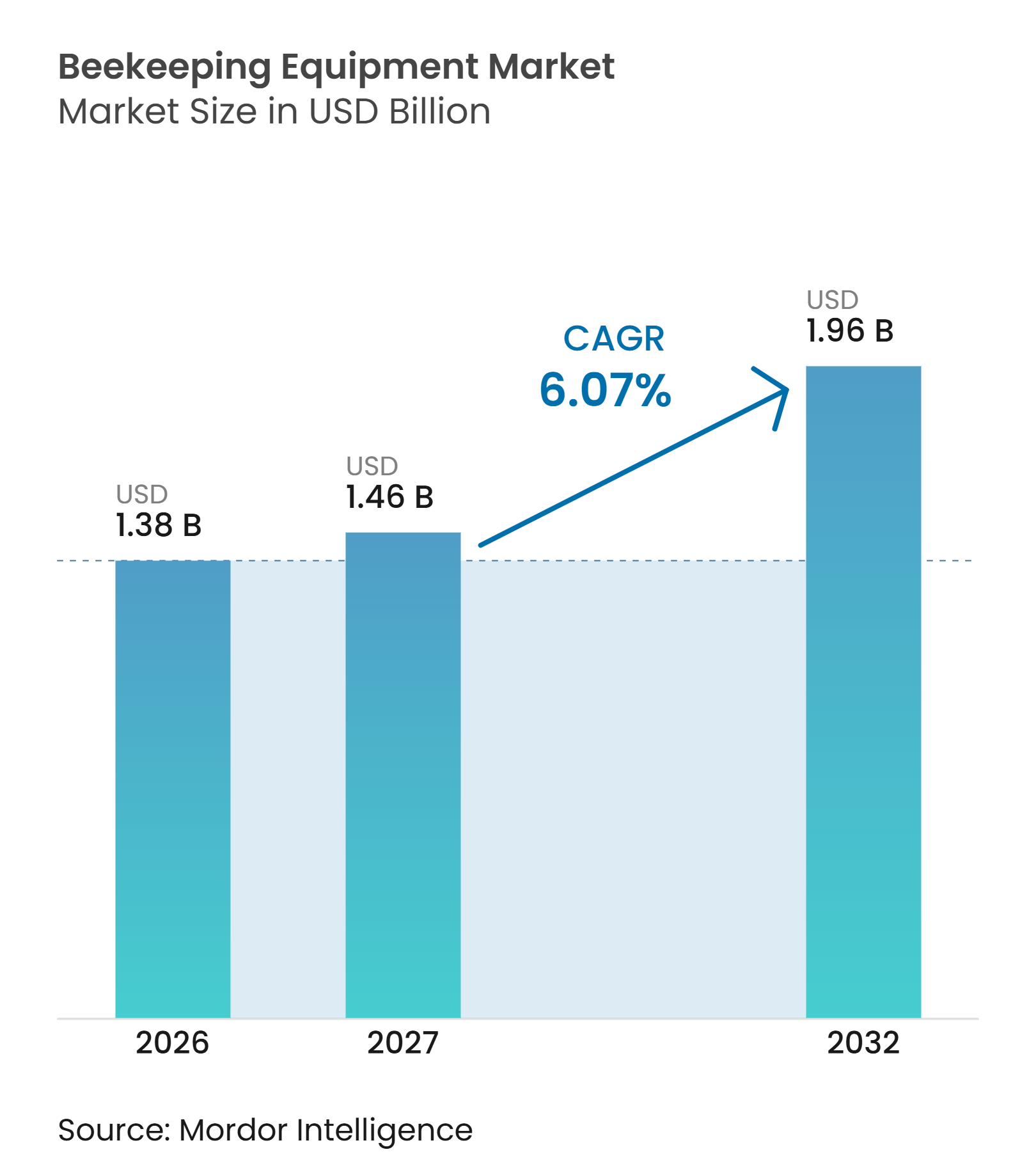
The beekeeping equipment market size was valued at USD 1.38 billion in 2026 and is forecast to grow from USD 1.46 billion in 2027 to USD 1.96 billion by 2032, at a CAGR of 6.07% from 2027 to 2032. Commercial operators are investing in extraction and handling equipment to increase throughput in areas with limited skilled labor. Food traceability requirements are also driving demand for processing systems that support batch records and food-contact compliance. Connected hive tools are improving operator visibility into colony condition, weight, and activity, supporting more planned equipment decisions. Severe colony losses can reduce the active hive base, but they also drive replacement purchases of hive components, frames, and beeswax foundation in line with biosecurity practices. The beekeeping equipment market therefore depends on a balance between the near-term pressure of colony losses and recurring purchases driven by replacement, compliance, and productivity needs.
Key Report Takeaways
- By equipment type, honey harvesting and processing equipment accounted for 45% of the beekeeping equipment market share in 2026 and is forecast to grow at a CAGR of 7.2% from 2027 to 2032.
- By application, honey production accounted for 62% of the beekeeping equipment market size in 2026, while pollination services are forecast to grow at a CAGR of 6.8% from 2027 to 2032.
- By distribution channel, indirect sales accounted for 62% of the market share in 2026 and are forecast to grow at a CAGR of 6.6% from 2027 to 2032.
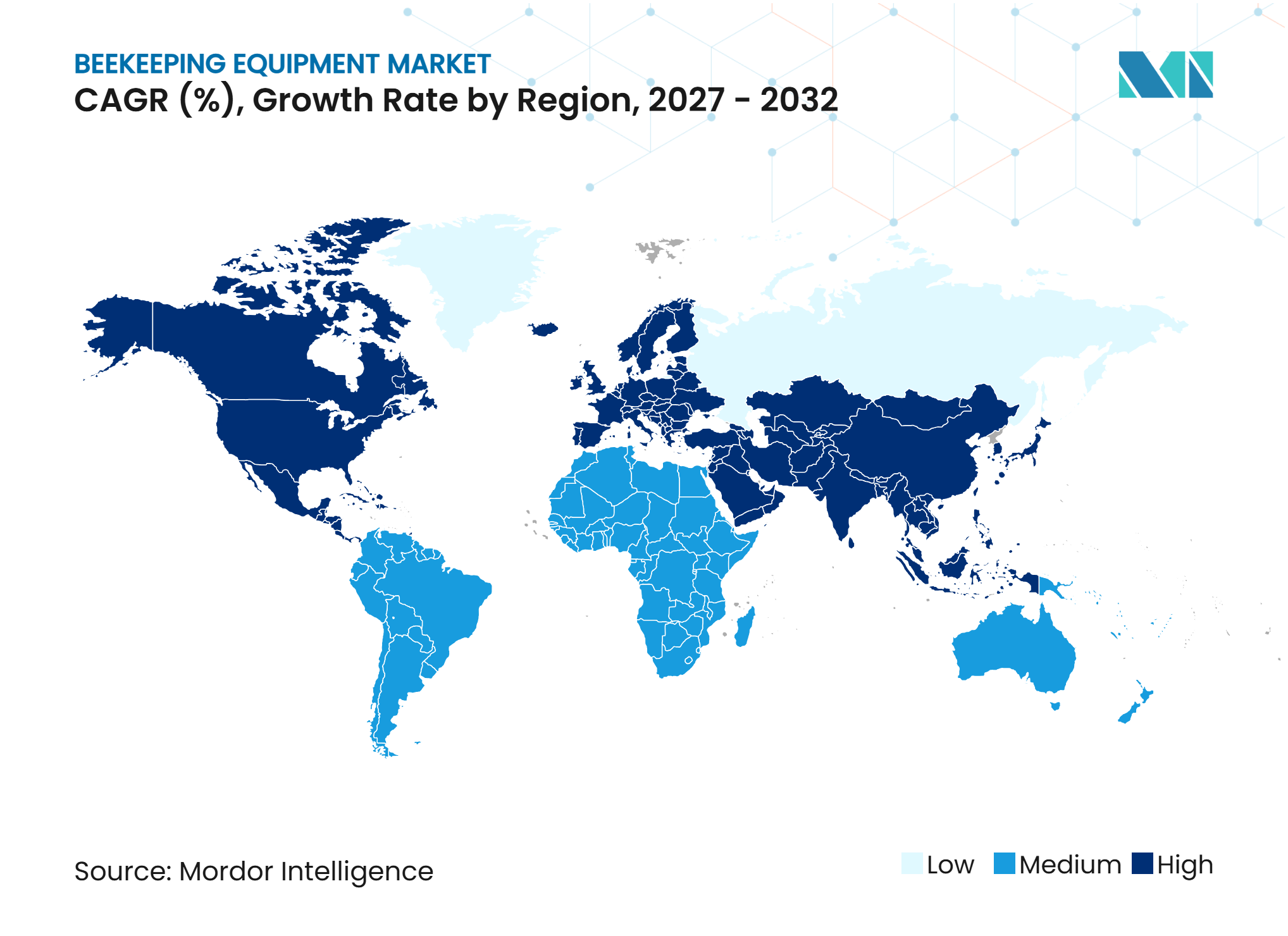
- By geography, Europe accounted for 32.1% of the market share in 2026, while Asia-Pacific is forecast to grow at a CAGR of 7.1% from 2027 to 2032.
Note: Market numbers in this report are based on Mordor Intelligence's proprietary estimation framework, which combines nine months of actuals with Q4 projections for base year 2026.
Market Trends and Insights
Drivers Impact Analysis of Beekeeping Equipment Market*
| Driver | (~) % Impact on CAGR Forecast | Geographic Relevance | Impact Timeline |
|---|---|---|---|
| Commercial Apiary Mechanization and Labor Productivity | +1.2% | Global, with highest intensity in the United States, Germany, Poland, Australia, and Brazil | Medium term (2-4 years) |
| Growth of Commercial Pollination Services | +1.0% | North America, Australia, and Brazil, with spillover to South America and Southern Europe | Medium term (2-4 years) |
| Replacement Demand from Colony Health and Biosecurity | +1.1% | North America, Europe, and Asia-Pacific, especially the United States, France, Germany, China, and India | Short term (≤ 2 years) |
| Organized Beekeeper Training and Starter-Kit Adoption | +0.8% | Asia-Pacific and Africa, with secondary gains in Europe, especially India, China, the United Kingdom, South Africa, and Brazil | Medium term (2-4 years) |
| Smart Hive Monitoring and Data-Led Management | +0.9% | North America and Asia-Pacific, expanding into Europe, especially the United States, Canada, Poland, China, and Australia | Long term (≥ 4 years) |
| Food-Grade Traceability Requirements in Honey Processing | +0.7% | Europe, followed by North America and Asia-Pacific, especially Germany, France, the United Kingdom, China, and New Zealand | Short term (≤ 2 years) |
| Source: Mordor Intelligence | |||
Commercial Apiary Mechanization and Labor Productivity
Commercial beekeeping operations face labor cost pressures that encourage investment in mechanized equipment to improve operational efficiency and productivity. Operators use automated honey extractors, uncapping machines, and motorized handling equipment to increase processing throughput and reduce manual labor requirements. In France, FranceAgriMer offers financial assistance covering up to 40% of eligible investment costs for qualifying beekeepers with at least 50 declared colonies. Eligible equipment includes cranes, electric wheelbarrows, lifting carts, trailers, and remotely accessible electronic hive scales. This support reduces the upfront investment required to modernize apiary operations and improve working conditions. Mechanization also helps commercial operators manage larger apiaries more efficiently, supporting continued investment in beekeeping equipment.
Growth of Commercial Pollination Services
The expansion of commercial pollination services is driving additional demand for beekeeping equipment for colony transportation, monitoring, and management. Commercial pollination contracts require beekeepers to supply healthy, strong colonies and deliver them to crop-growing locations during specific flowering periods. These operations rely on transport systems, hive-handling equipment, and monitoring devices to manage colony movement and assess hive condition. The United States Department of Agriculture identifies seasonal transportation of honeybee colonies as an important part of meeting pollination demand across crops with different flowering periods. Research supported by Hort Innovation has also evaluated sensing technologies, including monitoring hive temperature and weight, to assess colony health and hive strength for commercial pollination services [1]. As commercial pollination activity expands, demand for transport, handling, and monitoring equipment is forecast to increase in line with the requirements of professional beekeeping operations.
Replacement Demand from Colony Health and Biosecurity
Colony mortality can prompt equipment replacement when operators restock colonies and apply biosecurity practices. In June 2025, the United States Department of Agriculture's (USDA) Agricultural Research Service reported that commercial beekeeping operations had experienced average colony losses exceeding 60% since the previous summer. The researchers identified high levels of deformed wing virus A and B and acute bee paralysis virus in sampled bees and found a genetic marker associated with amitraz resistance in all collected Varroa destructor mites. The findings highlight the importance of managing colony health and preventing the spread of pests and pathogens. Operators restocking colonies may also need to replace or disinfect hive components, frames, and beeswax foundation to reduce the risk of pathogen transmission. The Canadian Food Inspection Agency recommends routinely replacing brood frames and contaminated comb and avoiding the introduction of healthy bees into contaminated equipment. These practices can create equipment replacement needs beyond routine wear-and-tear purchases in the beekeeping equipment market.
Organized Beekeeper Training and Starter-Kit Adoption
Training programs and starter-kit distribution bring new entrants into beekeeping and support demand for basic equipment. In India, government-backed initiatives such as the Khadi and Village Industries Commission's Honey Mission provide beekeeping training and equipment support to rural beneficiaries. Under the program, eligible beneficiaries receive 10 bee boxes with live colonies and a tool kit containing a bee veil, smoker, knife, and hive tool. The scheme also provides one stainless-steel honey extractor for every five beneficiaries. These initiatives introduce new beekeepers to essential hive management and honey harvesting equipment. As their operations develop, beneficiaries may require additional harvesting and processing tools, supporting gradual expansion of the beekeeping equipment user base.
Restraints Impact Analysis of Beekeeping Equipment Market*
| Restraint | (~) % Impact on CAGR Forecast | Geographic Relevance | Impact Timeline |
|---|---|---|---|
| Volatility in Timber, Stainless Steel, and Freight Costs | -1% | Global, most acute in the United States, Poland, China, Brazil, and South Africa | Short term (≤ 2 years) |
| Colony Losses Reducing Equipment Utilization | -1.2% | North America and Europe, with secondary effects in Asia-Pacific, especially the United States, Canada, France, and Australia | Medium term (2-4 years) |
| Fragmented Distribution and Limited After-Sales Service | -0.8% | Asia-Pacific and Africa, with secondary effects in South America, especially India, Indonesia, Kenya, Ethiopia, and Brazil | Long term (≥ 4 years) |
| Seasonal Cash Flow and High Upfront Cost for Small Apiaries | -0.7% | Global, especially India, Mexico, Brazil, South Africa, and Argentina | Medium term (2-4 years) |
| Source: Mordor Intelligence | |||
Volatility in Timber, Stainless Steel, and Freight Costs
Timber, stainless steel, and freight costs affect equipment suppliers' production expenses and beekeepers' budgets. Hive boxes and frames depend largely on timber, while honey extraction and processing systems use food-grade stainless steel, as illustrated by Dadant's stainless-steel honey extractor range. Changes in raw material prices, trade duties, and freight rates can increase equipment production and delivery costs. For example, the United States introduced a 10% additional import duty on specified softwood timber and lumber products, effective October 2025. Higher material and logistics costs can make equipment less affordable, prompting smaller operators to delay purchases. These pressures can restrain investment in extraction and handling equipment, limiting demand in the beekeeping equipment market.
Colony Losses Reducing Equipment Utilization
Severe colony losses can delay capital spending when operators must rebuild bee stock before expanding capacity. The U.S. Beekeeping Survey recorded that 55.6% of managed honey bee colonies were lost in the 2024–2025 season, followed by 39.9% in the 2025–2026 season. Ontario reported 37% overwinter mortality among commercial beekeepers in 2024–2025, compared with 43% among small-scale beekeepers [2]. Operators facing these losses may prioritize rebuilding colony strength and purchasing replacement bees over expanding equipment capacity. This can delay investment in larger automated processing systems and reduce the utilization of existing equipment.
*Our forecasts treat driver/restraint impacts as directional, not additive. The impact forecasts reflect baseline growth, mix effects, and variable interactions.
Beekeeping Equipment Market Segment Analysis
By Equipment Type:
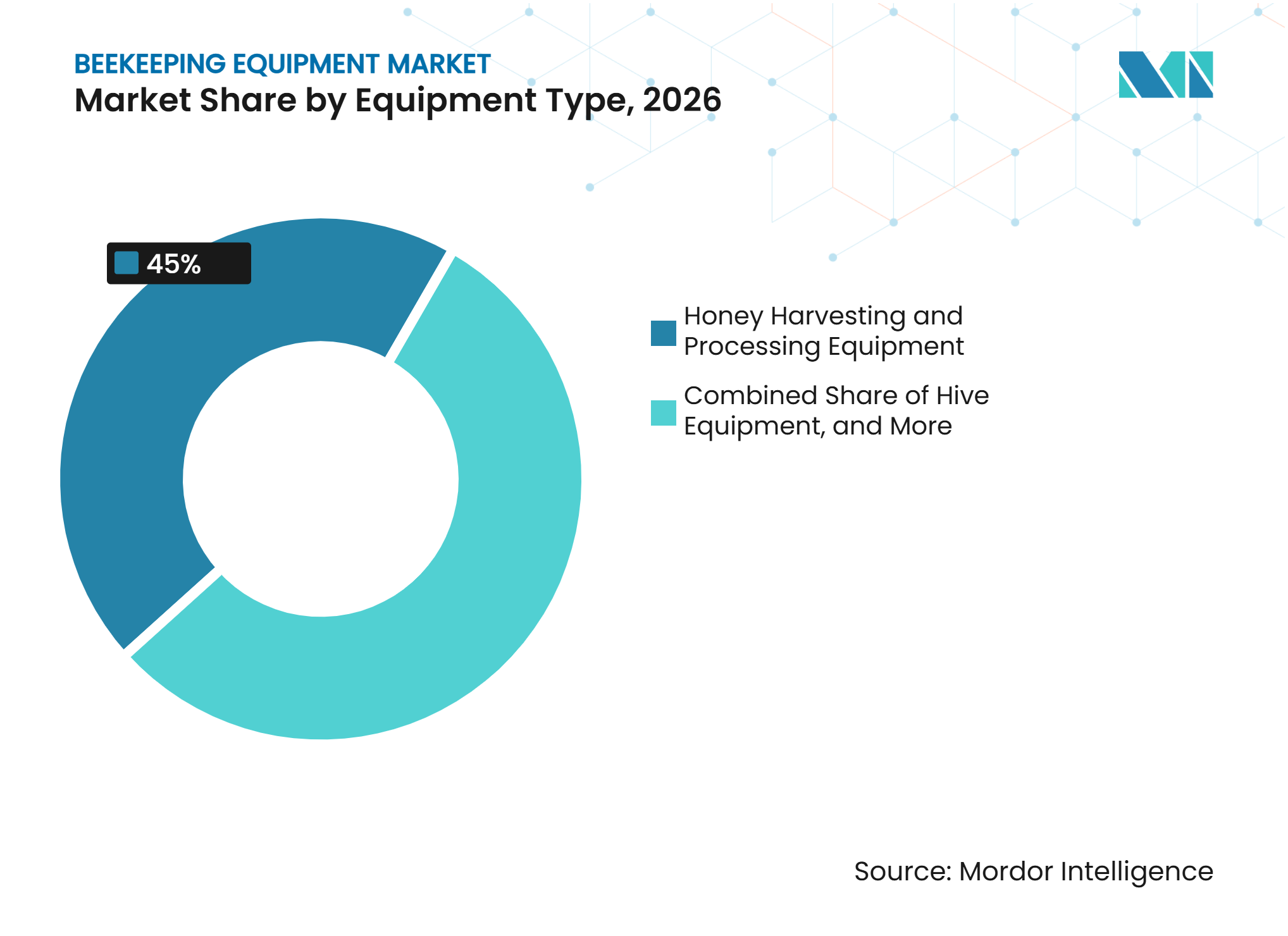
Honey Harvesting and Processing Equipment Leads and Grows FastestHoney harvesting and processing equipment accounted for 45% of the beekeeping equipment market share in 2026 and is forecast to grow at a CAGR of 7.2% from 2027 to 2032. This category includes radial and tangential extractors, automated uncappers, pumping lines, filtration systems, maturators, and warming cabinets. These products occupy the high-value end of the equipment mix due to their use in extraction and processing workflows. Directive (EU) 2024/1438 requires honey blends sold in the European Union to disclose each country of origin in descending order of weight, along with the percentage contribution of each origin, effective June 14, 2026 [3]. This requirement increases the importance of origin documentation and traceability across honey blending and processing operations, supporting demand for equipment and systems that facilitate product segregation and batch-level recordkeeping.
Smart and connected hive equipment is gaining traction among professional operators through the adoption of sensors, hive scales, acoustic monitors, and analytical platforms. A systematic review published in the journal Sensors in 2025 identified health assessment, including disease detection, and colony-behavior monitoring as the two most common research objectives for smart beehive technologies, accounting for 36 and 35 studies, respectively. Hive equipment such as bodies, frames, and foundation remains widely used by commercial and hobbyist beekeepers. Protective gear, apiary tools, smokers, feeding equipment, pest-management tools, wax-processing accessories, and queen-rearing systems maintain recurring demand across the broader equipment portfolio.



By Application:
Honey Production Leads, Pollination Services Grows FastestHoney production accounted for 62% of market share in 2026, as it remains the primary activity for many professional beekeepers and the main use case for extractors, filtration systems, and other processing equipment. China remains a major contributor to global honey production. Quality and traceability requirements are encouraging purchases of stainless-steel systems that support food-contact documentation, retaining honey production as the core demand base for the beekeeping equipment market.
Pollination services are forecast to grow at a CAGR of 6.8% from 2027 to 2032. This activity has become a major revenue source for professional beekeepers and requires colony transport platforms, hive-strength verification tools, and in-field monitoring equipment. Procurement needs differ from those for honey processing, as operators must maintain colony conditions across crop locations. Beeswax production requires melting tanks and filtration units with contamination controls, while queen rearing requires mating nuclei, grafting tools, and cell-incubation systems.
By Distribution Channel:
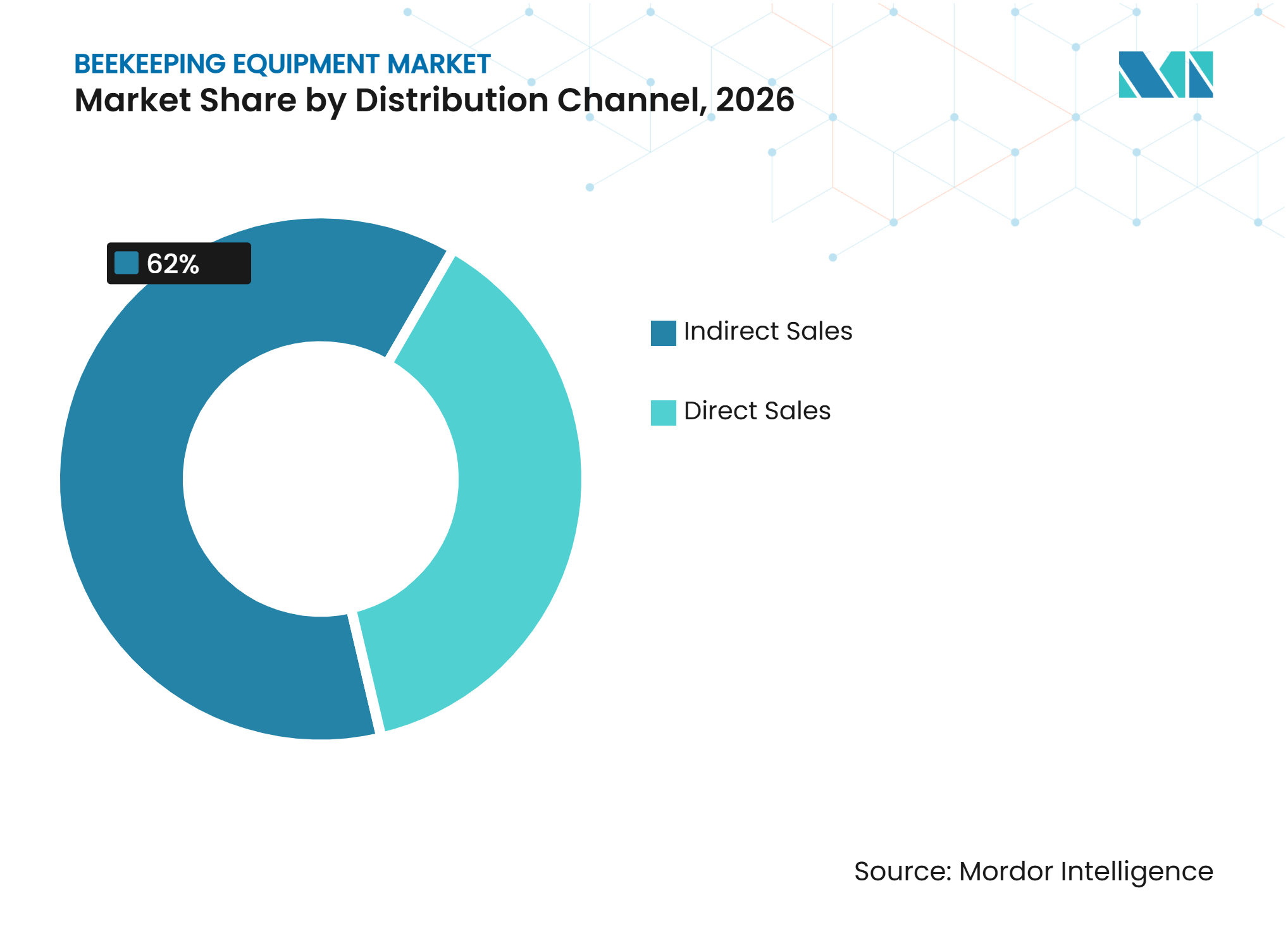
Indirect Sales Leads and Grows FastestIndirect sales accounted for 62% of the beekeeping equipment market share in 2026 and are forecast to grow at the fastest CAGR of 6.6% from 2027 to 2032. Specialist retailers, distributors, cooperative buying groups, and online stores improve access to equipment across commercial and hobbyist customer segments. These channels offer entry-level hive kits, protective gear, apiary tools, and honey-processing equipment. Regional beekeeper associations can also organize bulk purchases to negotiate favorable prices for members. Digital platforms help buyers access a wider range of products, particularly in areas with limited access to specialist stores, supporting demand by making beekeeping equipment more accessible to new and established operators.
Direct sales remain important for large commercial apiaries and buyers requiring specialized equipment configurations. Purchasing directly from manufacturers allows customers to discuss technical specifications, customize extraction and processing systems, and access installation guidance and after-sales support. These relationships are particularly relevant for high-capacity equipment purchases, where factors such as colony count, honey variety, processing throughput, and equipment compatibility influence buying decisions. Manufacturers can also provide product documentation, maintenance guidance, and technical assistance to support direct sales to professional beekeeping operations.

Geography Analysis
Europe: Regulation and Commercial Apiary Density Support Demand
Europe accounted for 32.1% of the beekeeping equipment market share in 2026. Germany, France, Poland, Italy, and Spain have large commercial apiary populations and established distribution networks. EU honey-labeling regulations are also strengthening requirements for product traceability and origin disclosure, supporting investment in equipment that enables batch identification and product separation. Government support programs across the region also facilitate the adoption of modern beekeeping equipment by reducing investment barriers for eligible beekeepers. Demand is further supported by the replacement of existing equipment and the adoption of mechanized honey extraction and processing systems.
Asia-Pacific: Production Scale and Digitization Needs Create Opportunity
Asia-Pacific is forecast to grow at a CAGR of 7.1% from 2027 to 2032. China is a major contributor to global honey production, creating demand for equipment that improves extraction efficiency and processing capacity. The region includes large commercial producers and rural smallholders with varying equipment requirements. In India, beekeeper training programs support the adoption of starter kits and protective gear. Honey processors in states such as Maharashtra and Uttar Pradesh are also upgrading stainless-steel extraction equipment to meet export quality requirements. Smart monitoring systems offer additional opportunities, although the affordability of equipment and rural connectivity remain important considerations for adoption.
North America, South America, the Middle East, and Africa: Different Sources of Demand
North America benefits from commercial pollination activity, which supports demand for transport pallets, colony-strength verification tools, and field-monitoring equipment. In South America, Brazil and Argentina support demand through export-oriented honey production and investments in mechanized extraction capacity. In the Middle East, investments in honey-processing infrastructure in Turkey and Gulf Cooperation Council countries create opportunities for stainless-steel extraction lines and related equipment. Across Africa, expanding beekeeping activity in countries such as Ethiopia, Kenya, and South Africa supports demand for hives, protective gear, and honey-processing equipment. However, financing constraints and limited formal distribution networks continue to affect access to equipment in parts of the continent.
Competitive Landscape
Market Concentration
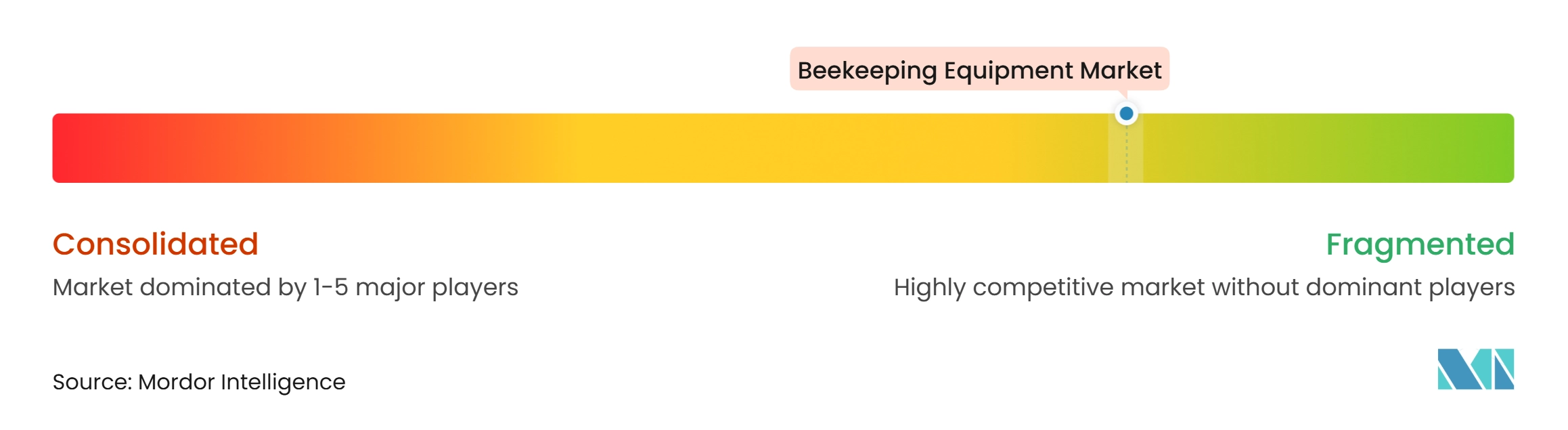
The beekeeping equipment market was fragmented in 2026, with competition distributed among established equipment manufacturers, specialized regional suppliers, and technology-focused companies. The leading companies include Mann Lake Ltd., Dadant & Sons, Inc., PP Łysoń Sp. z o.o., E.H. Thorne (Beehives) Ltd., and Swienty A/S. Mann Lake Ltd. and Dadant & Sons, Inc. offer broad portfolios covering hive components, protective gear, smokers, and honey extraction equipment. PP Łysoń Sp. z o.o. exports beekeeping equipment to more than 70 countries and received the Teraz Polska emblem in 2024 for its honey extractors. Industrie Lega supplies extractors, maturators, and honey-processing machinery to commercial operators across multiple markets. The presence of manufacturers with different product specializations and geographic reach contributes to the fragmented competitive structure.
Suppliers compete through product range, processing capabilities, service support, and distribution networks. Beewise, Inc. raised USD 50 million in a Series D financing round in June 2025 to support technological innovation, market expansion, and research and development. Mann Lake Ltd. expanded warehouse capacity and invested in warehouse technology at its Clarkson, Kentucky, facility while closing its Wilkes-Barre, Pennsylvania, and Marshall, Texas, locations in response to growth in online orders. These developments highlight investments by companies serving the beekeeping equipment market in automated hive technologies, digital sales channels, and distribution infrastructure.
Opportunities remain for modular starter systems targeting small apiaries and retrofit sensor kits for traditional wooden hives. Locally serviceable extraction equipment can also address the needs of beekeepers in areas with limited infrastructure, including parts of Africa and South America. Traditional equipment manufacturers and sensor-focused companies are expanding their offerings across physical equipment, monitoring systems, and data services. Companies that provide repair-ready products and reliable regional after-sales support can address purchasing requirements across diverse beekeeping operations.
Beekeeping Equipment Industry Leaders
-
Mann Lake Ltd.
-
Dadant & Sons, Inc.
-
PP Łysoń Sp. z o.o.
-
E.H. Thorne (Beehives) Ltd.
-
Swienty A/S
- *Disclaimer: Major Players sorted in no particular order
Beekeeping Equipment Market Companies Covered in this Report
- Mann Lake Ltd.
- Dadant & Sons, Inc.
- PP Łysoń Sp. z o.o.
- E.H. Thorne (Beehives) Ltd.
- Carl Fritz GmbH
- Multi-Sweet Group
- Maxant Industries, Inc.
- Cowen Manufacturing, Inc.
- Cook & Beals, Inc.
- Paradise Honey Ltd.
- Swienty A/S
- Apimaye
- Industrie Lega 1937 S.r.l.
- Biozentrum GmbH & Co. KG (Werner Seip)
- Apikunst
Recent Industry Developments in Beekeeping Equipment Market
- June 2025: Beewise, Inc. raised USD 50 million in a Series D financing round, bringing its total funding to nearly USD 170 million. The company used the funding to support technological innovation, market expansion, and research related to its AI-powered BeeHome robotic hive system, which uses machine learning and precision robotics to monitor hive health and enable automated colony treatments.
- May 2025: BeeHero Inc. launched HeroLink, a solar-powered gateway designed to collect and transmit data from the company’s in-field and in-hive sensors to its cloud-based analytics platform. The fifth-generation gateway was scheduled for its first deployment across Australian orchards during the July 2025 almond pollination season, supporting data transmission from remote, low-connectivity agricultural areas.
- May 2025: ToBe launched HiveMaster, an IoT-based beekeeping device that automatically administers controlled pulses of gas-phase treatment against Varroa destructor. The system uses sensors and data-driven treatment protocols to deliver amitraz more precisely while reducing acaricide use in beehives.
Global Beekeeping Equipment Market Report Scope
The beekeeping equipment market covers the tools, machinery, and systems used for hive management, colony maintenance, honey extraction, and processing. It includes equipment used in commercial and small-scale beekeeping operations for honey production, pollination services, beeswax production, and queen rearing.
The beekeeping equipment market report is segmented by equipment type (hive equipment, protective gear, apiary tools and smokers, honey harvesting and processing equipment, feeding equipment, and other equipment), by application (honey production, pollination services, beeswax production, queen rearing, and other applications), by distribution channel (direct sales and indirect sales), and by geography (North America, South America, Europe, Asia-Pacific, Middle East, and Africa). The market forecasts are provided in terms of value (USD).
Segmentation Overview
| Hive Equipment |
| Protective Gear |
| Apiary Tools and Smokers |
| Honey Harvesting and Processing Equipment |
| Feeding Equipment |
| Other Equipment |
| Honey Production |
| Pollination Services |
| Beeswax Production |
| Queen Rearing |
| Other Applications |
| Direct Sales |
| Indirect Sales |
| North America | United States |
| Canada | |
| Mexico | |
| Rest of North America | |
| South America | Brazil |
| Argentina | |
| Rest of South America | |
| Europe | Germany |
| United Kingdom | |
| France | |
| Italy | |
| Spain | |
| Poland | |
| Russia | |
| Rest of Europe | |
| Asia-Pacific | China |
| India | |
| Japan | |
| Australia | |
| Rest of Asia-Pacific | |
| Middle East | Turkey |
| Saudi Arabia | |
| United Arab Emirates | |
| Rest of Middle East | |
| Africa | South Africa |
| Kenya | |
| Ethiopia | |
| Rest of Africa |
| By Equipment | Hive Equipment | |
| Protective Gear | ||
| Apiary Tools and Smokers | ||
| Honey Harvesting and Processing Equipment | ||
| Feeding Equipment | ||
| Other Equipment | ||
| By Application | Honey Production | |
| Pollination Services | ||
| Beeswax Production | ||
| Queen Rearing | ||
| Other Applications | ||
| By Distribution Channel | Direct Sales | |
| Indirect Sales | ||
| By Geography | North America | United States |
| Canada | ||
| Mexico | ||
| Rest of North America | ||
| South America | Brazil | |
| Argentina | ||
| Rest of South America | ||
| Europe | Germany | |
| United Kingdom | ||
| France | ||
| Italy | ||
| Spain | ||
| Poland | ||
| Russia | ||
| Rest of Europe | ||
| Asia-Pacific | China | |
| India | ||
| Japan | ||
| Australia | ||
| Rest of Asia-Pacific | ||
| Middle East | Turkey | |
| Saudi Arabia | ||
| United Arab Emirates | ||
| Rest of Middle East | ||
| Africa | South Africa | |
| Kenya | ||
| Ethiopia | ||
| Rest of Africa | ||
Key Questions Answered in the Report
What is the forecast growth rate of the beekeeping equipment market?
The beekeeping equipment market is forecast to grow at a CAGR of 6.07% from 2027 to 2032, reaching USD 1.96 billion by 2032.
Which equipment type is forecast to grow the fastest?
Honey harvesting and processing equipment is forecast to grow at a CAGR of 7.2% from 2027 to 2032.
Why are pollination services important for beekeeping equipment demand?
Commercial pollination services require transport, hive-handling, and monitoring equipment to move colonies and assess their condition during crop-specific pollination contracts.
Which region accounts for the largest share of the beekeeping equipment market?
Europe accounted for 32.1% of the beekeeping equipment market in 2026, supported by established commercial beekeeping operations, traceability requirements, and equipment subsidies.
What factors are limiting the adoption of smart hive equipment?
High hardware costs and limited rural connectivity constrain the adoption of sensor-based monitoring systems, particularly among smaller beekeeping operations.