
Beef Market Size and Share
Market Overview
| Study Period | 2022 - 2032 |
|---|---|
| Market Size (2027) | USD 527.99 Billion |
| Market Size (2032) | USD 681.59 Billion |
| Growth Rate (2027 - 2032) | 5.24 % |
| Fastest Growing Market | Asia-Pacific |
| Largest Market | North America |
| Market Concentration | High |
Major Players *Disclaimer: Major Players sorted in no particular order Image © Mordor Intelligence. Reuse requires attribution under CC BY 4.0. | |
Beef Market Analysis by Mordor Intelligence
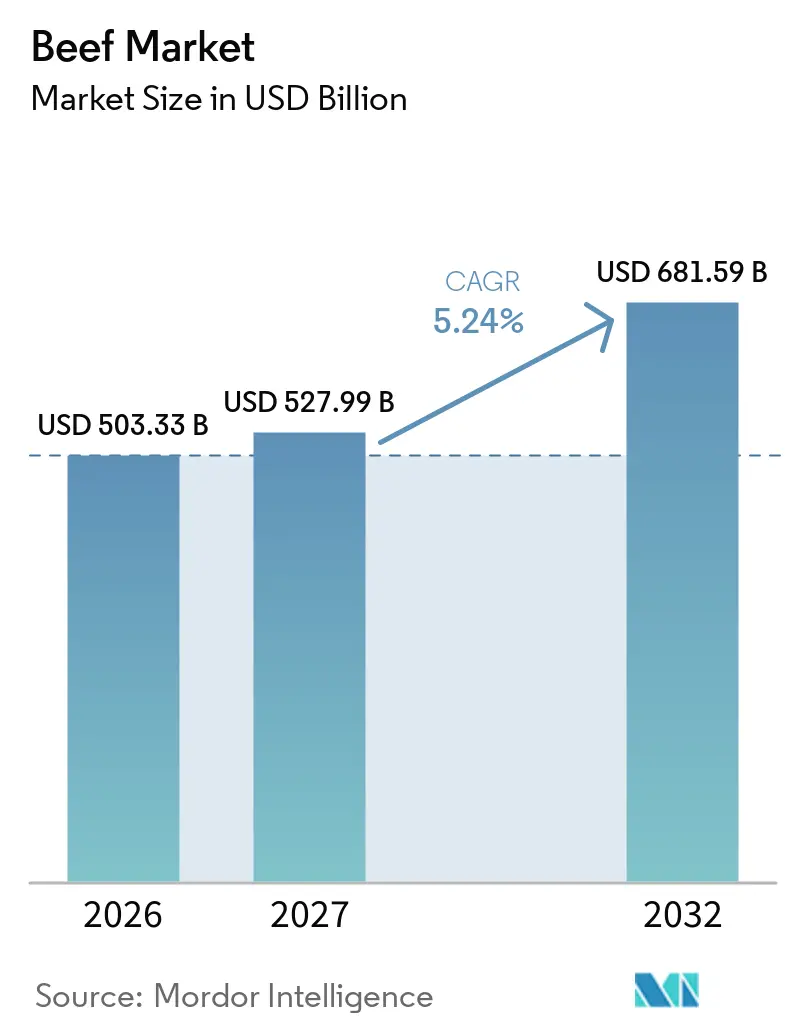
The beef market size is expected to grow from USD 503.33 billion in 2026 to USD 527.99 billion in 2027 and is forecast to reach USD 681.59 billion by 2032 at a 5.24% CAGR over 2027-2032. The market is supported by established consumer preferences, diverse culinary applications, and demand across retail and foodservice channels. Regional market development reflects evolving dietary habits, changing consumer preferences, and improvements in distribution networks. Product diversification, including convenient formats, processed products, and premium offerings, continues to expand consumer choice. The competitive landscape features established meat processors with extensive supply chains, alongside companies differentiating themselves through product quality, branding, and value-added offerings. Continued product innovation, evolving consumption patterns, and expanding foodservice applications contribute to the market’s ongoing development.
Key Report Takeaways
- By product type, fresh/chilled beef led with 65.13% share in 2026, while processed beef recorded the highest projected CAGR at 6.72% through 2032.
- By cut type, ground beef held 32.50% share in 2026 and is forecast to grow at a 5.80% CAGR through 2032.
- By distribution channel, off-trade held 61.87% share in 2026, while on-trade recorded the highest projected CAGR at 5.49% through 2032.
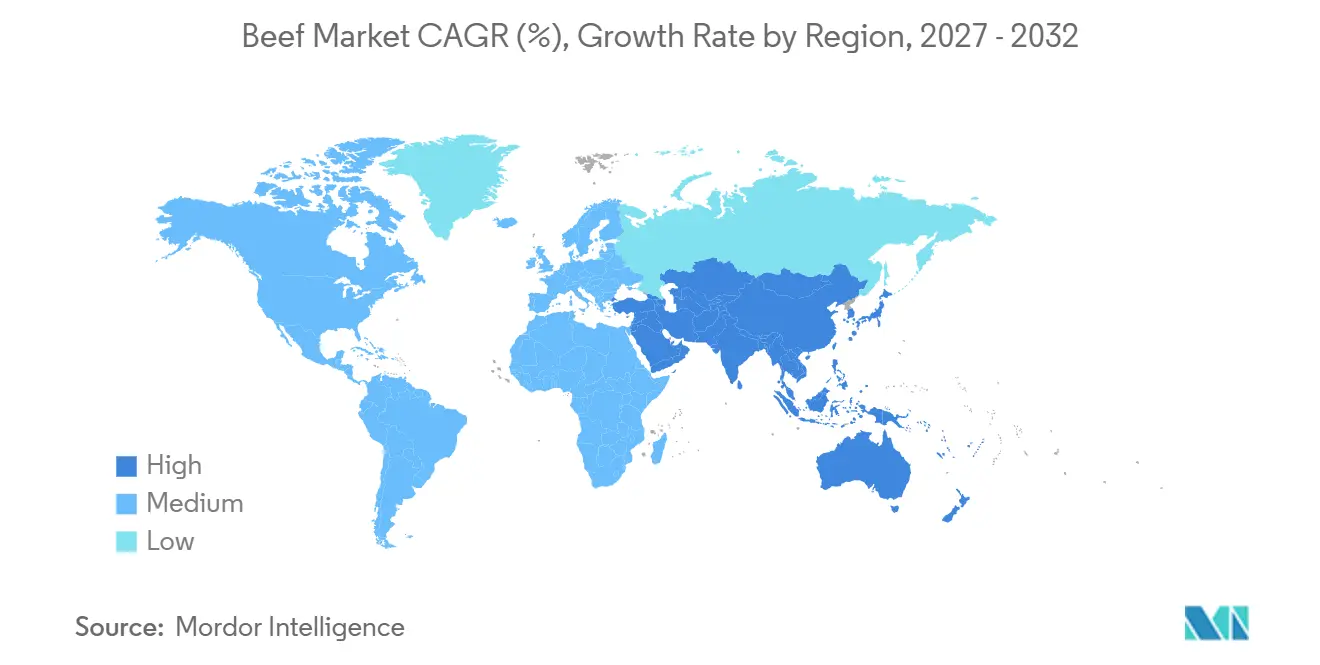
- By geography, North America accounted for 35.13% share in 2026, while Asia-Pacific is projected to grow at a 6.20% CAGR through 2032.
Note: Market numbers in this report are based on Mordor Intelligence's proprietary estimation framework, which combines nine months of actuals with Q4 projections for base year 2026.
Market Trends and Insights
Drivers Impact Analysis of Beef Market*
| Driver | (~) % Impact on CAGR Forecast | Geographic Relevance | Impact Timeline |
|---|---|---|---|
| Resilient consumer demand for beef | +1.4% | Global, particularly North America and Asia-Pacific emerging markets | Medium term (2–4 years) |
| Demand for convenient and affordable ground beef products | +0.9% | North America, Europe, Asia-Pacific urban centres | Short term (≤ 2 years) |
| Premiumization through branded and certified beef | +0.7% | North America, Middle East, East Asia | Long term (≥ 4 years) |
| Expansion of foodservice demand for beef | +0.8% | Global; Asia-Pacific, Middle East and Africa growing fastest | Medium term (2–4 years) |
| Rising demand for high-protein animal-based foods | +0.7% | Global; Canada, United States, and Australia leading | Medium term (2–4 years) |
| Expansion of processed and ready-to-cook beef products | +0.6% | Asia-Pacific, Europe, North America | Long term (≥ 4 years) |
| Source: Mordor Intelligence | |||
Resilient Consumer Demand for Beef
Consumer demand for beef is supported by established dietary preferences, taste, and its role as a protein source across everyday meals and special occasions. According to the National Cattlemen’s Beef Association’s 2026 consumer research, 74% of consumers reported eating beef at least weekly, while more than 80% intended to maintain or increase their beef consumption[1]. Taste remains a key factor supporting these preferences, alongside beef’s versatility across different meals and cuisines. Its use in a wide range of traditional dishes, burgers, and other prepared meals helps maintain its relevance across diverse consumption occasions. Continued consumer interest in familiar beef-based foods supports recurring purchases and sustains demand across retail and foodservice channels.
Demand for Convenient and Affordable Ground Beef Products
Demand for convenient and affordable ground beef products is supported by their versatility, ease of preparation, and suitability for everyday meals. According to the National Cattlemen’s Beef Association’s 2025 year-end consumer review, 62% of consumers had eaten ground beef as an ingredient at home during the preceding week, while 52% had consumed hamburger or ground beef patties[2]. Ground beef also recorded 3.1% year-on-year growth in retail sales volume during 2025, reflecting continued purchasing across different price points. Its use in burgers, tacos, pasta dishes, and other familiar meals allows consumers to prepare varied dishes using a versatile ingredient. These attributes support repeat purchases and reinforce demand for convenient ground beef products across household and foodservice applications.
Premiumization Through Branded and Certified Beef
Premiumization through branded and certified beef supports market demand by catering to consumers seeking consistent quality, distinctive taste, and greater assurance regarding product standards. Branded beef offerings differentiate products through attributes such as breed, origin, production practices, and quality grading, allowing companies to serve a range of consumer preferences. Certification programs and quality assurance labels further help consumers identify products that meet specific standards, while premium cuts and specialized product ranges broaden purchasing options. These strategies enable producers and retailers to strengthen brand recognition, build consumer confidence, and encourage interest in higher-value beef products across retail and foodservice channels.
Expansion of Foodservice Demand for Beef
Expansion of foodservice demand for beef is supported by the inclusion of beef-based dishes across quick-service restaurants, casual dining outlets, and full-service establishments. According to the Agriculture and Horticulture Development Board, demand for beef-based Asian meals in the United Kingdom grew by 1.0%, Indian meals by 0.2%, and savoury pastries by 3.9% during the 52 weeks ending in September 2025[3]. These figures highlight opportunities for beef across diverse cuisines and meal formats. Its versatility in burgers, pastries, and internationally inspired dishes enables foodservice operators to cater to varied consumer preferences and broaden their menu offerings. The continued presence of beef in familiar dishes and innovative restaurant meals supports its relevance across different dining occasions and foodservice settings.
Restraints Impact Analysis of Beef Market*
| Restraint | (~) % Impact on CAGR Forecast | Geographic Relevance | Impact Timeline |
|---|---|---|---|
| Competition from alternative proteins and lower-cost meats | -0.3% | North America, Western Europe | Short term (≤ 2 years) |
| Environmental impact and animal-welfare concerns | -0.2% | Global institutional buyers | Long term (≥ 4 years) |
| Cost and substantiation requirements for premium beef claims | -0.1% | North America, Europe | Medium term (2–4 years) |
| Food-safety verification and regulatory compliance costs | -0.1% | Global, with highest intensity in Europe and Asia-Pacific export markets | Medium term (2–4 years) |
| Source: Mordor Intelligence | |||
Competition from Alternative Proteins and Lower-Cost Meats
Competition from alternative proteins and lower-cost meats presents a restraint for the beef market by providing consumers with additional choices across different price points and dietary preferences. Poultry and pork can appeal to price-conscious consumers seeking affordable protein options, while plant-based meat alternatives cater to individuals interested in reducing their consumption of animal products. Differences in preparation time, perceived health benefits, and suitability for specific dietary preferences can further influence purchasing decisions. As consumers balance affordability, taste, and nutritional considerations, some may substitute beef with other protein sources for selected meals. This competition encourages beef producers and retailers to maintain product quality, strengthen value propositions, and diversify their offerings to retain consumer interest.
Environmental Impact and Animal-Welfare Concerns
Environmental impact and animal-welfare concerns present a restraint for the beef market as consumers, regulators, and food industry stakeholders increasingly consider the sustainability and ethical implications of livestock production. Beef production is associated with greenhouse gas emissions, land use, and water consumption, placing greater emphasis on responsible resource management across the supply chain. Animal-welfare expectations also influence livestock rearing, transportation, and slaughter practices, encouraging producers to adopt appropriate welfare standards and improve transparency. These considerations can affect consumer perceptions and purchasing preferences, particularly among individuals who prioritise environmentally responsible and ethically sourced food products. As a result, beef producers face increasing expectations to demonstrate responsible production practices while maintaining product quality and consumer confidence.
*Our forecasts treat driver/restraint impacts as directional, not additive. The impact forecasts reflect baseline growth, mix effects, and variable interactions.
Beef Market Segment Analysis
By Product Type:
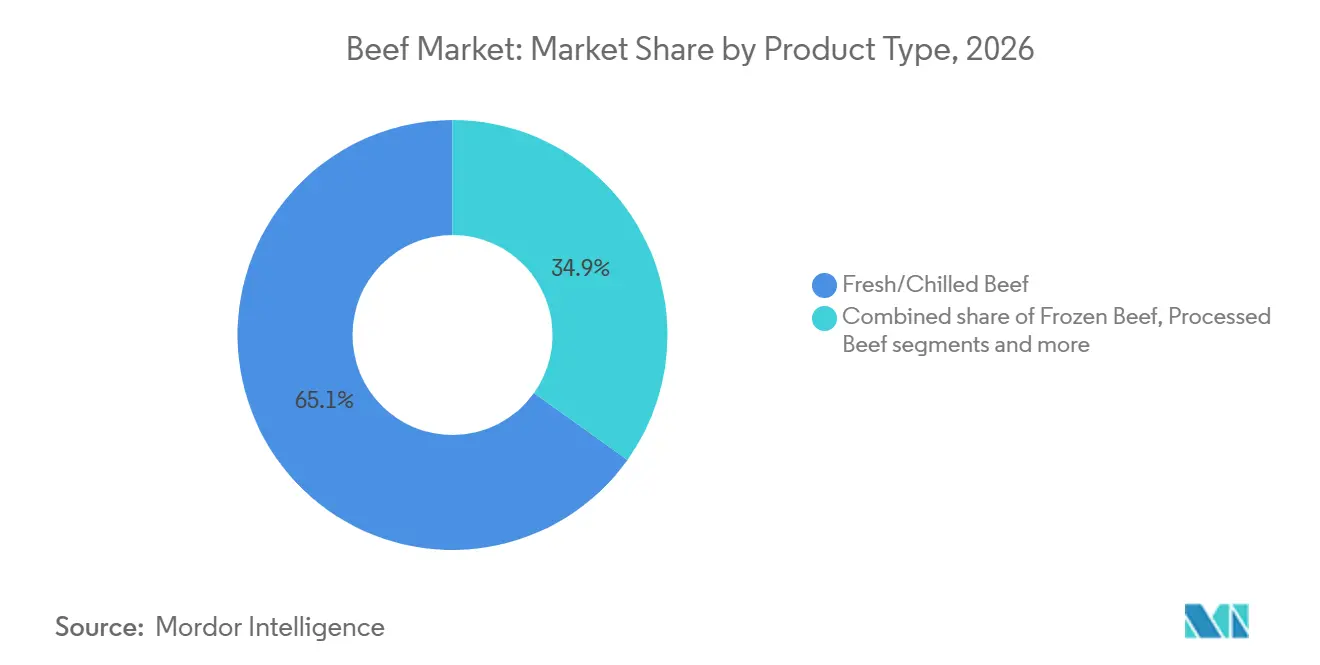
Processed Formats Outpace Fresh in the Value ChainFresh and chilled beef holds the largest product-type share, accounting for 65.13% of market revenue in 2026, supported by consumer preferences for fresh meat and its widespread use in household cooking and foodservice applications. Its established presence in retail meat departments and suitability for preparing a variety of dishes sustain demand across multiple consumption occasions. Foodservice operators also rely on fresh and chilled beef for products where freshness, appearance, and quality are important considerations. These applications reinforce the segment’s leading position across the beef market.
Processed beef is the fastest-growing product type, projected to expand at a compound annual growth rate of 6.72% during 2027–2032, driven by demand for convenient, ready-to-cook, ready-to-eat, and heat-and-serve products. Product launches featuring beef-based burgers, skillet meals, and enchiladas illustrate the expansion of convenient meal options. Premium value-added offerings, including fully cooked brisket, seasoned ground beef, and shaved steak, further diversify the segment by catering to consumers seeking both convenience and differentiated products. These developments support broader product choice and continued growth in processed beef demand.



By Cut Type:
Ground Beef Commands LeadershipGround beef holds the largest cut-type share at 32.50% of market revenue in 2026 and is the fastest-growing segment, with a projected compound annual growth rate of 5.80% during 2027–2032. Its versatility across household cooking, foodservice burgers, and institutional meal preparation supports demand across a wide range of consumption occasions. Its suitability for dishes such as meat sauces, tacos, and meatballs further reinforces its role in everyday cooking and commercial food preparation.
The remaining cut types, including steaks, roasts, brisket, short ribs, cubed or diced beef, and other beef cuts, cater to diverse culinary preferences and preparation methods. Steaks serve premium dining and home-cooking occasions, while roasts and brisket are suited to slow cooking and traditional meals. Short ribs and cubed or diced beef support specialised preparations across different cuisines, including hotpot and barbecue dishes. This diversity of applications allows the segment to serve varied consumer preferences across retail and foodservice channels.
By Distribution Channel:
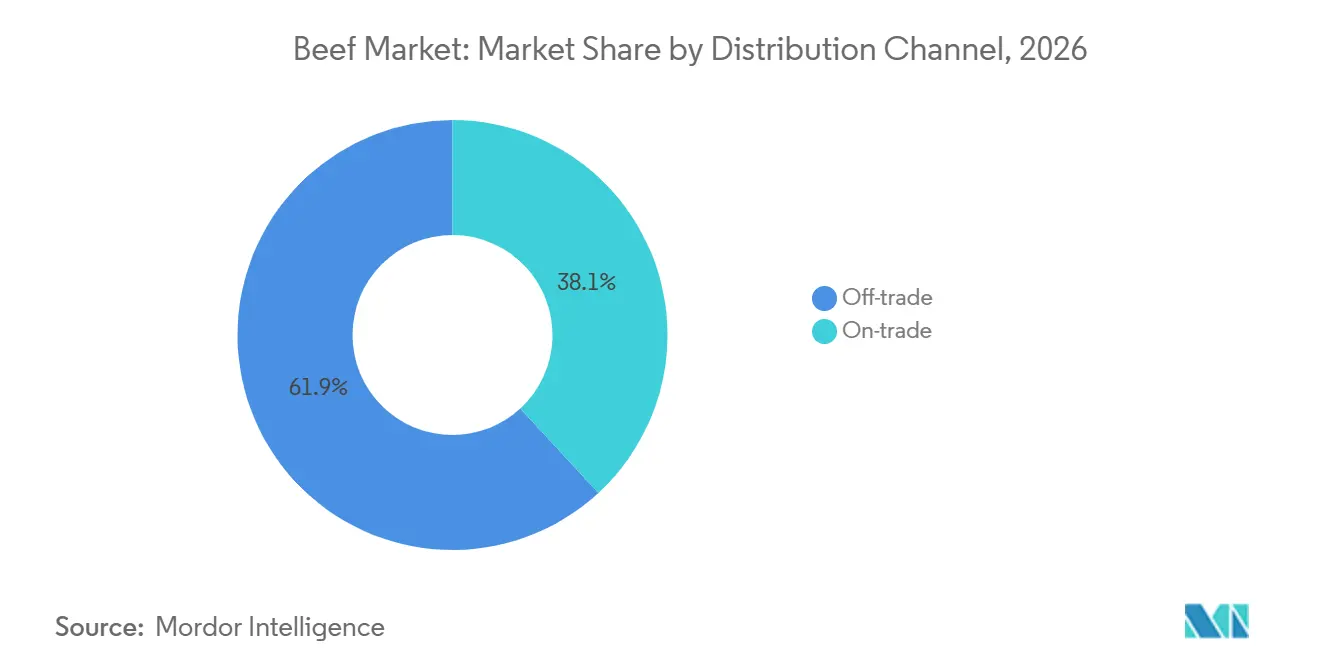
Off-Trade Holds Revenue Lead While On-Trade AcceleratesOff-trade channels hold the largest distribution share, accounting for 61.87% of beef market revenue in 2026, supported by supermarkets, hypermarkets, specialty stores, independent butchers, and online retail. Supermarkets and hypermarkets serve as key purchasing locations by offering fresh, chilled, frozen, and packaged beef products for household consumption. Specialty stores and independent butchers cater to consumers seeking premium cuts, specialised products, and traceable sourcing, while online retail provides additional convenience through home delivery and broader product accessibility. These channels collectively serve diverse purchasing preferences and household requirements.
On-trade channels are projected to grow at a compound annual growth rate of 5.49% during 2027–2032, supported by demand from restaurants, hotels, and other foodservice establishments. Beef remains a versatile menu ingredient across dining formats, with steaks featured in restaurant offerings and Mexican-inspired dishes, including tacos and burritos, providing additional applications. Foodservice demand also benefits from the diversity of culinary traditions and dining experiences across regions. The combination of household purchasing through off-trade channels and prepared beef dishes through on-trade establishments supports demand across the distribution landscape.

Geography Analysis
North America Beef Market
North America holds the largest share of the beef market, accounting for 35.13% of revenue in 2026, supported by established beef consumption patterns, integrated supply chains, and extensive retail and foodservice networks across the United States, Canada, and Mexico. The region benefits from strong household demand for ground beef, steaks, and other beef products, alongside continued interest in premium and grass-fed offerings. In Canada, retail beef demand reached its strongest level since the early 1980s in 2025, while sustained demand for ground beef contributed to an upward revision of the country's 2026 consumption forecast. These factors reinforce North America's established position in global beef consumption and distribution.
APAC Beef Market
Asia-Pacific is the fastest-growing regional market, projected to expand at a compound annual growth rate of 6.20% during 2027–2032, supported by evolving dietary preferences, population growth, and expanding demand across diverse foodservice and household consumption channels. India contributes to regional development through its large buffalo-meat production base and rising domestic consumption, which is forecast to increase by approximately 2% in 2026. Meanwhile, demand patterns across China and other Asian markets reflect varying consumer preferences, purchasing conditions, and foodservice requirements. The region's diverse consumption base and expanding food distribution networks support opportunities for beef suppliers across multiple markets.
EMEA and South America Beef Market
Europe, South America, and the Middle East and Africa represent important markets with distinct consumption and supply characteristics. Europe combines established beef consumption with international sourcing, while South America benefits from substantial cattle production and a strong export-oriented processing industry. Brazil exported a record 3.5 million tonnes of beef in 2025, while Argentina continued to serve international markets with a broad range of beef products. In the Middle East, demand is supported by foodservice activity, tourism, and reliance on imported beef, with halal certification remaining important for market access. Across Africa, urbanisation and the development of formal retail and foodservice channels provide opportunities for the beef market to expand.
Competitive Landscape
Market Concentration
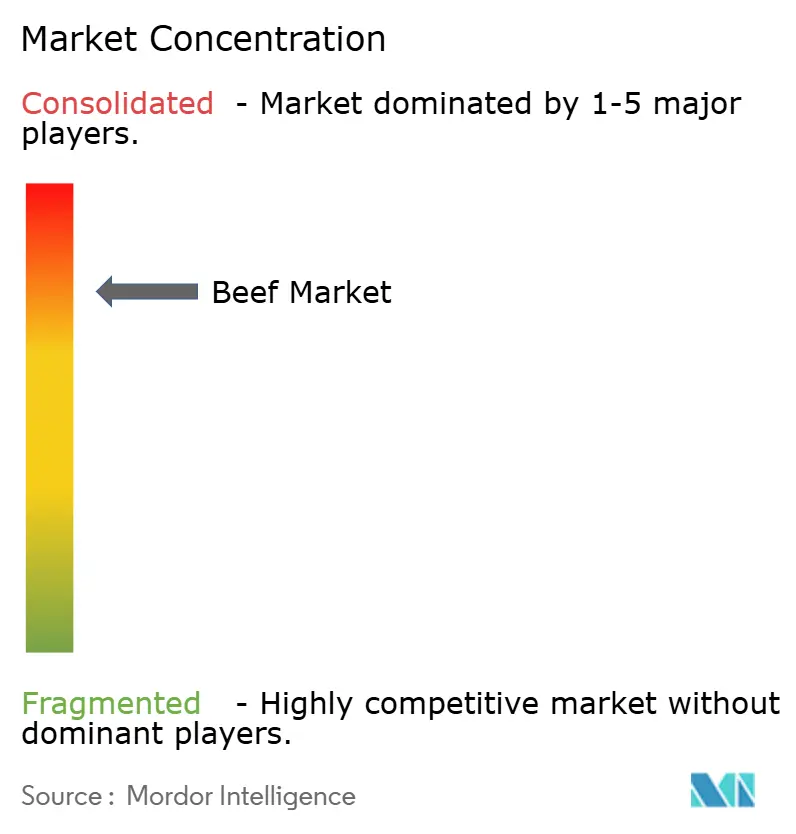
The beef market is consolidated, with a relatively small group of established processors maintaining significant positions through extensive production facilities, livestock sourcing networks, and distribution capabilities. Major players include JBS Foods, Tyson Foods, Inc., Cargill, Incorporated, Marfrig Global Foods S.A., and American Foods Group, LLC. Their established operations across key beef-producing regions, combined with access to domestic and international markets, support their competitive positions across fresh, frozen, and processed beef categories.
Leading companies continue to pursue capacity expansion, operational optimisation, and supply chain integration to strengthen their market presence. JBS has outlined substantial capital investment plans for 2026, including projects involving beef processing capacity and geographic expansion. Tyson Foods announced changes to its United States beef processing network in August 2026, focusing operations around selected facilities. Meanwhile, Cargill completed its acquisition of full ownership of Teys Australia in November 2025, strengthening its involvement across beef processing and associated supply chain activities. These developments reflect differing approaches to capacity management, operational efficiency, and geographic reach.
Other participants contribute to the competitive landscape by serving specific regional markets, customer groups, and product categories. Competition extends across fresh, chilled, frozen, and processed beef, with companies differentiating themselves through product quality, processing capabilities, sourcing arrangements, and distribution reach. Continued investment in production infrastructure, product development, and supply chain management allows market participants to respond to evolving customer requirements and maintain their positions across the beef market.
Beef Industry Leaders
-
JBS Foods
-
Tyson Foods, Inc.
-
Cargill, Incorporated
-
Marfrig Global Foods S.A.
-
American Foods Group, LLC
- *Disclaimer: Major Players sorted in no particular order
Beef Market Companies Covered in this Report
- JBS Foods
- Tyson Foods, Inc.
- Cargill, Incorporated
- ButcherBox, Inc.
- Marfrig Global Foods S.A.
- American Foods Group, LLC
- Hormel Foods Corporation
- Conagra Brands, Inc.
- Smithfield Foods, Inc.
- OSI Group
- Greater Omaha Packing Co.
- Agri Beef
- Harris Ranch Beef Company
- Certified Angus Beef LLC
- Creekstone Farms Premium Beef LLC
- Wolverine Packing Co.
- Omaha Steaks International, Inc.
- Teton Waters Ranch
- Boar’s Head Brand
- The Kraft Heinz Company
Recent Industry Developments in Beef Market
- August 2026: Tyson Foods announced plans to concentrate its beef operations around facilities in Dakota City, Nebraska; Holcomb, Kansas; and Amarillo, Texas. The restructuring includes ending operations at its Joslin, Illinois, beef facility and Eagle Mountain, Utah, case-ready facility, while pursuing the sale of its Pasco, Washington, facility. The company aims to improve operating efficiency and align capacity with constrained cattle supplies.
- February 2026: JBS USA broke ground on an expansion of its Cactus, Texas, beef production facility. The project includes a new fabrication floor and an expanded ground beef room, intended to improve operational efficiency and increase production capacity. Construction was expected to be completed by early 2027, strengthening the company's beef-processing infrastructure.
- January 2026: ButcherBox introduced fresh beef products in more than 1,400 Target stores across the United States, extending its distribution beyond its established subscription business. The assortment includes ground beef, ribeye steak, New York strip steak and top sirloin steak. The launch expands access to its grass-fed, grass-finished beef through a major brick-and-mortar retail partner.
- November 2025: Cargill completed its acquisition of the Teys family’s ownership interest, taking full ownership of Teys Australia and Teys USA. The transaction consolidates the two businesses under Cargill following a longstanding partnership. Teys continues to supply fresh beef and value-added products to retail, foodservice and manufacturing customers, as well as international markets.
Global Beef Market Report Scope
The beef market comprises the production, processing, and distribution of beef products for household consumption and foodservice applications. The market is segmented by product type, including fresh and chilled beef, frozen beef, processed beef, and canned beef. By cut type, the market covers ground beef, steaks, roasts, brisket, short ribs, cubed and diced beef, and other beef cuts. By distribution channel, the market is divided into on-trade and off-trade. Geographically, the market covers North America, Europe, Asia-Pacific, South America, and the Middle East and Africa. Market forecasts are provided in terms of value in USD and volume in units.
Segmentation Overview
| Fresh/Chilled Beef |
| Frozen Beef |
| Processed Beef |
| Canned Beef |
| Ground Beef |
| Steaks |
| Roasts |
| Brisket |
| Short Ribs |
| Cubed/Diced Beef |
| Other Beef Cuts |
| On-Trade | |
| Off-Trade | Supermarkets/Hypermarkets |
| Specialty Stores | |
| Online Retailers | |
| Others |
| North America | United States |
| Canada | |
| Mexico | |
| Rest of North America | |
| Europe | Germany |
| United Kingdom | |
| Italy | |
| France | |
| Spain | |
| Netherlands | |
| Poland | |
| Belgium | |
| Sweden | |
| Rest of Europe | |
| Asia-Pacific | China |
| India | |
| Japan | |
| Australia | |
| Indonesia | |
| South Korea | |
| Thailand | |
| Singapore | |
| Rest of Asia-Pacific | |
| South America | Brazil |
| Argentina | |
| Colombia | |
| Chile | |
| Peru | |
| Rest of South America | |
| Middle East and Africa | South Africa |
| Saudi Arabia | |
| United Arab Emirates | |
| Nigeria | |
| Egypt | |
| Morocco | |
| Turkey | |
| Rest of Middle East and Africa |
| By Product Type | Fresh/Chilled Beef | |
| Frozen Beef | ||
| Processed Beef | ||
| Canned Beef | ||
| By Cut Type | Ground Beef | |
| Steaks | ||
| Roasts | ||
| Brisket | ||
| Short Ribs | ||
| Cubed/Diced Beef | ||
| Other Beef Cuts | ||
| By Distribution Channel | On-Trade | |
| Off-Trade | Supermarkets/Hypermarkets | |
| Specialty Stores | ||
| Online Retailers | ||
| Others | ||
| By Geography | North America | United States |
| Canada | ||
| Mexico | ||
| Rest of North America | ||
| Europe | Germany | |
| United Kingdom | ||
| Italy | ||
| France | ||
| Spain | ||
| Netherlands | ||
| Poland | ||
| Belgium | ||
| Sweden | ||
| Rest of Europe | ||
| Asia-Pacific | China | |
| India | ||
| Japan | ||
| Australia | ||
| Indonesia | ||
| South Korea | ||
| Thailand | ||
| Singapore | ||
| Rest of Asia-Pacific | ||
| South America | Brazil | |
| Argentina | ||
| Colombia | ||
| Chile | ||
| Peru | ||
| Rest of South America | ||
| Middle East and Africa | South Africa | |
| Saudi Arabia | ||
| United Arab Emirates | ||
| Nigeria | ||
| Egypt | ||
| Morocco | ||
| Turkey | ||
| Rest of Middle East and Africa | ||
Key Questions Answered in the Report
What is the projected value of the global beef sector by 2032?
The beef market is projected to reach USD 681.59 billion by 2032, growing at a 5.24% CAGR from 2027.
Which product type is growing fastest in beef?
Processed beef is projected to grow at a 6.72% CAGR through 2032.
Which region leads global beef revenue?
North America held 35.13% of global revenue in 2026.
Which region is forecast to grow fastest?
Asia-Pacific is forecast to grow at a 6.20% CAGR through 2032.