
Bee Bread Market Size and Share
Market Overview
| Study Period | 2021 - 2031 |
|---|---|
| Market Size (2026) | USD 329.83 Million |
| Market Size (2031) | USD 459.37 Million |
| Growth Rate (2026 - 2031) | 6.85 % |
| Fastest Growing Market | Asia-Pacific |
| Largest Market | North America |
| Market Concentration | Low |
Major Players
*Disclaimer: Major Players sorted in no particular order Image © Mordor Intelligence. Reuse requires attribution under CC BY 4.0. |
|
Bee Bread Market Analysis by Mordor Intelligence
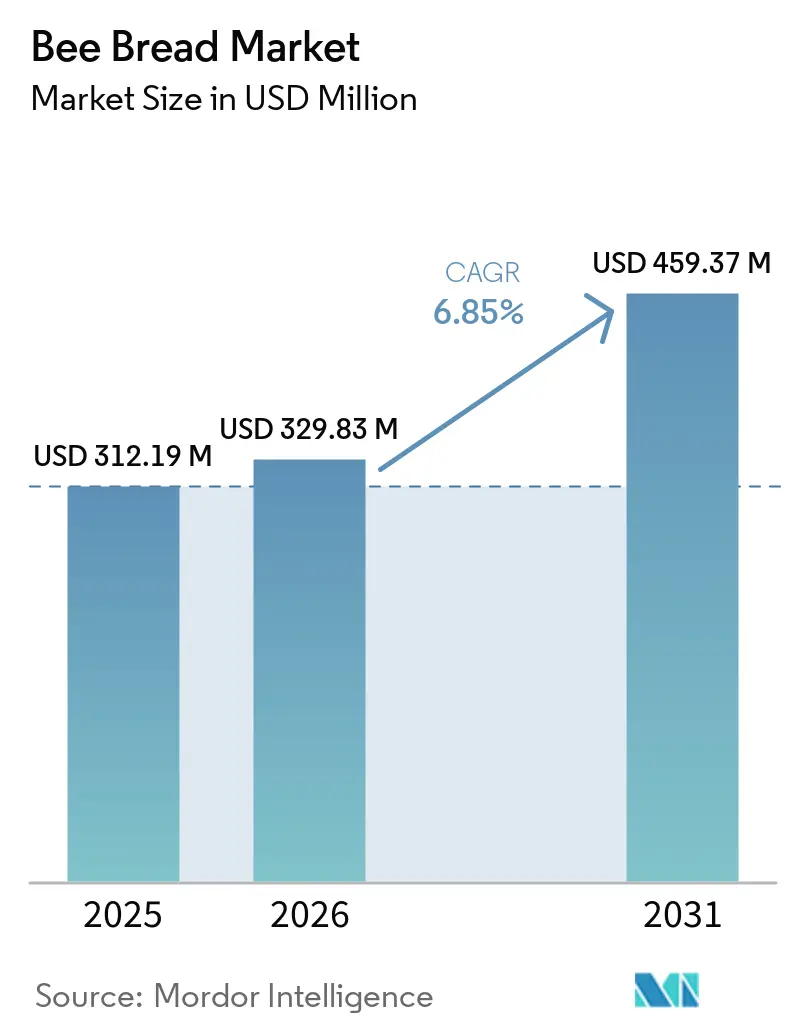
The bee bread market size was valued at USD 312.19 million in 2025 to USD 329.83 million in 2026, and is forecast to reach USD 459.37 million by 2031 at a 6.85% CAGR over 2026-2031. The category is evolving from a niche apitherapy product into a broader ingredient for dietary supplements and functional foods. Fermentation supports this transition by improving access to nutrients within the pollen wall. Consumers’ familiarity with supplements provides producers with an established audience for products that offer clear quality and sourcing information. The bee bread market depends on limited hive-level supply, making consistent harvesting, testing, and traceability critical competitive priorities. Producers that document fermentation processes and bioactive composition are better positioned to serve premium retail and ingredient buyers. Growing demand for naturally derived, multifunctional ingredients is also encouraging manufacturers to incorporate bee bread into standardized powders, capsules, and functional food formulations. This shift is increasing the importance of scalable processing technologies that preserve the product’s nutritional and bioactive characteristics while improving consistency across commercial batches.
Key Report Takeaways
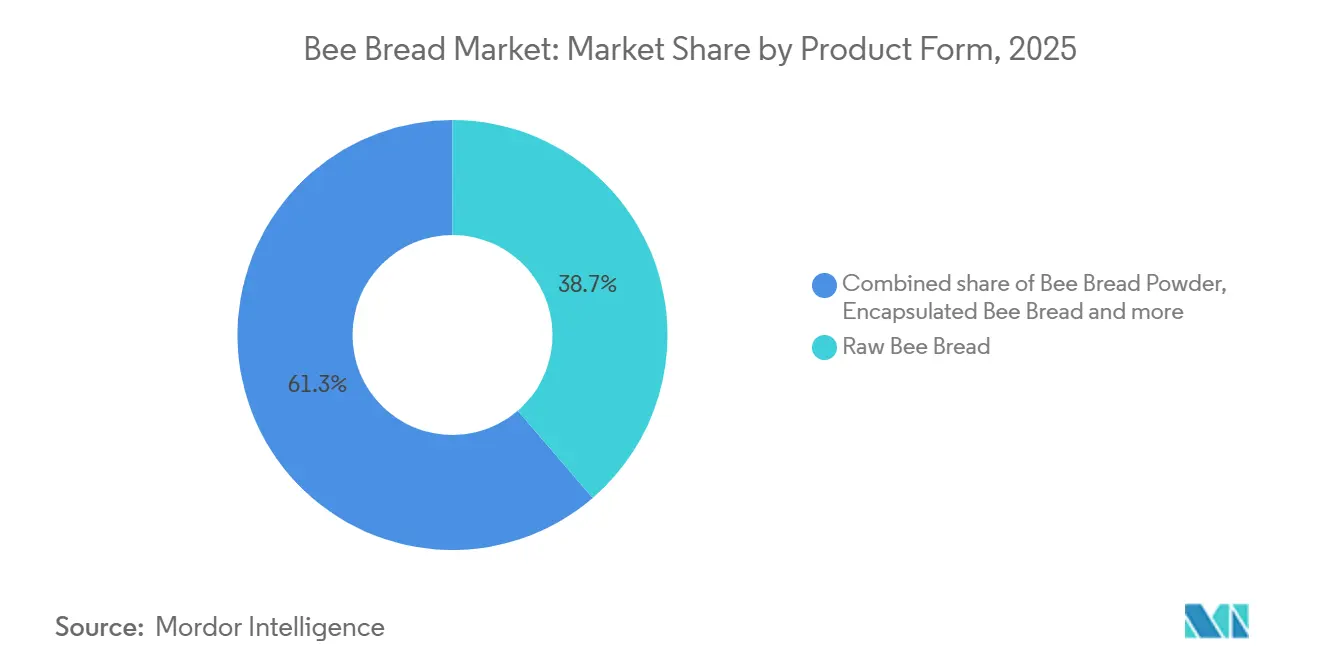
- By product form, raw bee bread led the bee bread market with a share of 38.70% in 2025, while encapsulated bee bread is anticipated to register the fastest CAGR of 7.85% during 2026-2031.
- By nature, conventional retained a 72.10% share in 2025, whereas organic is forecast to expand at an 8.15% CAGR through 2031.
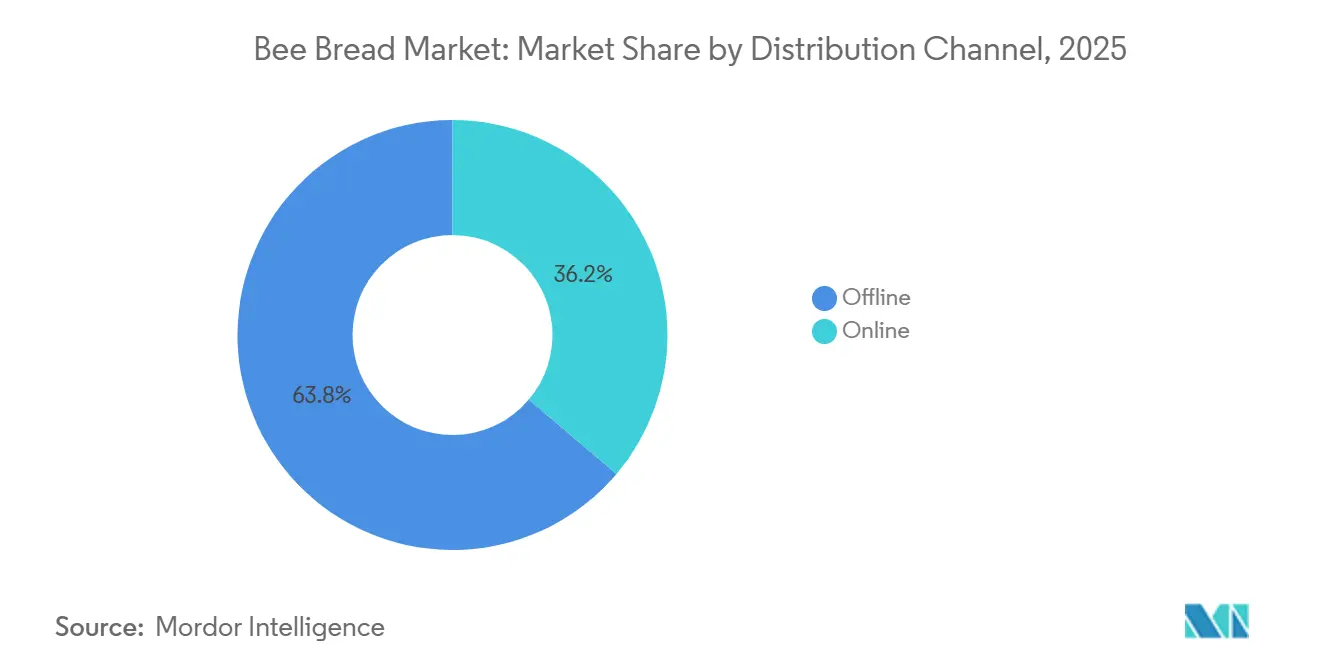
- By distribution channel, offline led the market with a share of 63.82% in 2025, while online is anticipated to register the fastest CAGR of 7.92% during 2026-2031.
- By geography, North America led the bee bread market in 2025 with a 38.78% share, while Asia-Pacific is projected to advance at a 7.71% CAGR through 2031.
Note: Market size and forecast figures in this report are generated using Mordor Intelligence’s proprietary estimation framework, updated with the latest available data and insights as of January 2026.
Global Bee Bread Market Trends and Insights
Drivers Impact Analysis*
| Driver | (~) % Impact on CAGR Forecast | Geographic Relevance | Impact Timeline |
|---|---|---|---|
| Rising demand for natural and functional foods | +2.1% | Global, strongest in North America and Europe | Medium term (2-4 years) |
| Increasing demand for antioxidant-rich ingredients | +1.2% | Global, with emphasis in North America and Asia-Pacific | Medium term (2-4 years) |
| Nutritional benefits of fermented bee pollen | +1.0% | Global, strongest where supplement-science literacy is high | Long term (≥ 4 years) |
| Expansion of nutraceutical and preventive-wellness applications | +0.9% | Global, with fastest uptake in North America and Asia-Pacific | Medium term (2-4 years) |
| Commercial interest in stingless-bee products and meliponiculture | +0.5% | Asia-Pacific, with spillover to South America and the Middle East and Africa | Long term (≥ 4 years) |
| Premiumization of specialty apiculture products | +0.4% | North America and Western Europe | Short term (≤ 2 years) |
| Source: Mordor Intelligence | |||
Rising Demand for Natural and Functional Foods
Consumers increasingly seek foods and supplements that provide health benefits beyond basic nutrition. Bee bread aligns with this preference because in-hive fermentation modifies the pollen matrix and can improve nutrient availability. A 2025 review published in Animal Biology reported higher availability of free amino acids, B-complex vitamins, and other bioactive compounds after fermentation weakened the pollen exine [1]Source: Animal Biology, " Microbial fermentation of bee bread," aminbiol.com.ua. This differentiation enables the bee bread market to compete with raw pollen products within functional food portfolios. The Council for Responsible Nutrition reported that 77% of United States adults used dietary supplements in 2025, supporting a large potential consumer base. Producers can strengthen buyer confidence by disclosing hive locations, floral sources, fermentation conditions, and batch test results.
Increasing Demand for Antioxidant-Rich Ingredients
Interest in antioxidant ingredients supports demand for bee bread with verified phenolic content and antioxidant profiles. The study reported FRAP antioxidant activity ranging from 17.778 to 49.752 μmol FeSO4·7H2O/g, highlighting the effects of floral source and harvest conditions. A 2025 mouse study found that bee bread supplementation at 500 mg/kg of body weight reduced disulfide levels and improved thiol/disulfide balance in obese mice. The bee bread market can benefit when suppliers use methods such as 2,2-diphenyl-1-picrylhydrazyl (DPPH), Ferric Reducing Antioxidant Power (FRAP), and High-Performance Liquid Chromatography (HPLC) to provide measurable product documentation. Such testing can support ingredient procurement by functional food manufacturers that require certificates of analysis.
Nutritional Advantages of Fermented Bee Pollen
The distinction between fermented bee bread and raw bee pollen is becoming increasingly important for product positioning. A 2026 co-fermentation study published by MDPI, using Lactobacillus plantarum, reported a 67.57% cell wall disruption rate under simulated intestinal conditions [2]Source: MDPI, " Improvement of Nutritional Value and Bioactivity of Bee Pollen," mdpi.com. The study also recorded 77.46% DPPH radical scavenging activity and 37.38% hyaluronidase inhibition. Research on yeasts isolated from bee bread identified probiotic characteristics and antioxidant activity 70% higher than the Codex commercial standard among the tested strains. These findings provide the bee bread market with a scientific basis for positioning fermentation as a product characteristic, rather than relying solely on natural-product claims. They also support the potential future use of bee bread in probiotic and postbiotic supplement formats.
Expansion of Nutraceutical and Preventive-Wellness Applications
Bee bread can be incorporated into formulations that support gut health and deliver antioxidant benefits. These applications align with multifunctional supplement formats that address multiple wellness needs in a single product. Consumer spending patterns in the United States organic dietary supplement market indicate a premium segment that certified bee bread products can target. The bee bread market can also address demand from sports nutrition and healthy-aging consumers through powders, microencapsulated formats, sprays, and combination products. Regular supplement use for immune support and gut health further supports these applications. Growing consumer preference for multifunctional supplements also creates opportunities to position bee bread as a premium, multi-benefit natural ingredient.
Restraints Impact Analysis*
| Restraint | (~) % Impact on CAGR Forecast | Geographic Relevance | Impact Timeline |
|---|---|---|---|
| Limited harvestability and commercial supply | -1.1% | Global, most acute in North America and Western Europe | Short term (≤ 2 years) |
| High variability in nutritional and bioactive composition | -0.6% | Global | Medium term (2-4 years) |
| Lack of widely accepted international quality standards | -0.7% | Global, particularly acute in emerging-market trade corridors | Long term (≥ 4 years) |
| Food-safety and allergenicity concerns | -0.4% | North America and Europe, where regulatory scrutiny is highest | Medium term (2-4 years) |
| Source: Mordor Intelligence | |||
Limited Harvestability and Low Commercial Supply
Commercial supply remains limited, as each honeybee colony produces only 0.5–2 kg of bee bread annually. A 2025 MDPI study on bee bread production found that this volume is significantly lower than the 13–27 kg of honey produced by the same hive. Harvesting bee bread requires producers to remove it from the comb and separate it from beeswax, increasing labor and equipment requirements. These supply constraints support premium retail pricing, particularly in Western Europe and North America. They also limit the bee bread market's ability to increase production volumes solely by adding hives. Producers therefore need harvesting systems that preserve product quality while improving the recovery of saleable granules. Consequently, improvements in extraction efficiency and hive-level harvesting practices will be critical to expanding commercial supply without compromising colony health or product quality.
High Variability in Nutritional and Bioactive Composition
Bee bread composition varies based on local flora, season, geography, and weather conditions. A 2025 study of Polish apiaries found significant year-to-year variations in phenolic composition, although all tested samples exhibited antioxidant activity above 90%. This variability complicates the use of fixed label claims and multi-year ingredient specifications by large supplement manufacturers. Suppliers without laboratory testing may face documentation gaps when serving institutional buyers. Therefore, the bee bread market requires standardized, repeatable analytical protocols and batch-level records to reduce perceived sourcing risks. Quality standards can also address food safety and allergen concerns in markets subject to stringent regulatory scrutiny. Greater standardization would enable manufacturers to maintain consistent product specifications across sourcing regions and production cycles, supporting broader adoption among large-scale food and supplement companies.
*Our forecasts treat driver/restraint impacts as directional, not additive. The impact forecasts reflect baseline growth, mix effects, and variable interactions.
Segment Analysis
By Product Form: Raw Products Lead While Encapsulation Supports Faster Growth
Raw bee bread accounted for 38.70% of the bee bread market share in 2025, making it the leading product form. Buyers often value its visible connection to traditional hive practices. Health-food retail consumers commonly associate limited processing with product integrity, familiar sourcing, and the ability to evaluate products based on origin information. Bee bread powder serves formulators requiring flexible dosing, easy blending, and compatibility with smoothies, beverage mixes, and protein products. Encapsulated Bee Bread is projected to expand at a CAGR of 7.85% during the forecast period, driven by demand for standardized portions, improved handling, and products suited to pharmacy and mainstream dietary supplement channels.
Microencapsulation technologies support the market for encapsulated bee bread formats by protecting sensitive bioactive components during handling and use. A 2024 study found that chitosan nanoparticle encapsulation preserved the antimicrobial and antioxidant properties of bee bread under tested conditions [3]Source: Tandem Online, " Report on Raw Products," tandfonline.com. This capability makes encapsulated products more suitable for supplements, where reliable delivery is important to brands and consumers. Liquid extracts and topical forms remain smaller product formats, primarily used in cosmetics and dermatological applications. Compared with raw products, powder and encapsulated formats provide companies with clearer pathways for standardized dosing, product testing, pharmacy listings, and clinical study designs.



By Nature: Conventional Products Dominate While Organic Products Gain Faster
Conventional Bee Bread accounted for 72.10% of the bee bread market share in 2025, reflecting its wider geographic availability and lower price points than certified organic products. Organic Bee Bread is projected to grow at a CAGR of 8.15% from 2026 to 2031. Organic claims appeal to buyers who value pesticide-residue controls, source verification, and production practices that can be documented from the apiary to the finished product.
Organic production faces several practical constraints, including restrictions related to apiary locations, the use of surrounding land, and compliance with certification requirements. Apiaries must operate in areas that meet organic standards, which can limit the availability of suitable locations and restrict production capacity. These requirements can constrain local supply across North America, leading producers and processors to rely more heavily on imported certified raw materials to meet demand. In the European Union, national Common Agricultural Policy Strategic Plans support apiculture interventions aimed at strengthening the sector and facilitating transitions in producing regions. The European Union allocates an annual apiculture budget of EUR 60 million to support these initiatives.
By Distribution Channel: Offline Retail Leads While Online Sales Expand Faster
Offline channels accounted for 63.82% of the bee bread market share in 2025, with health food stores, pharmacies, specialty apiculture retailers, and hypermarkets serving as established consumer access points. These outlets remain important for consumers who prefer to inspect unfamiliar products before purchase and consult store staff regarding product use, form, and sourcing. Online channels are projected to grow at a CAGR of 7.92% through 2031. Digital storefronts provide brands with more space than shelf labels to communicate information on fermentation, traceability, product applications, and supporting batch-level evidence. Through direct-to-consumer websites, participants in the bee bread market can link each product to its hive, floral source, and testing records.
Online channels can also provide QR code-linked certificates of analysis covering antioxidant activity, microbiological load, and heavy metal content. Subscription models offer brands an opportunity to retain consumers following initial trial purchases. Business-to-business platforms can connect nutraceutical formulators directly with certified producers, potentially reducing dependence on traditional distribution intermediaries. While these platforms can improve price transparency, they require suppliers to maintain consistent documentation. Digital content can also support premium pricing by providing clear product details that are difficult to communicate in physical retail settings.
Geography Analysis
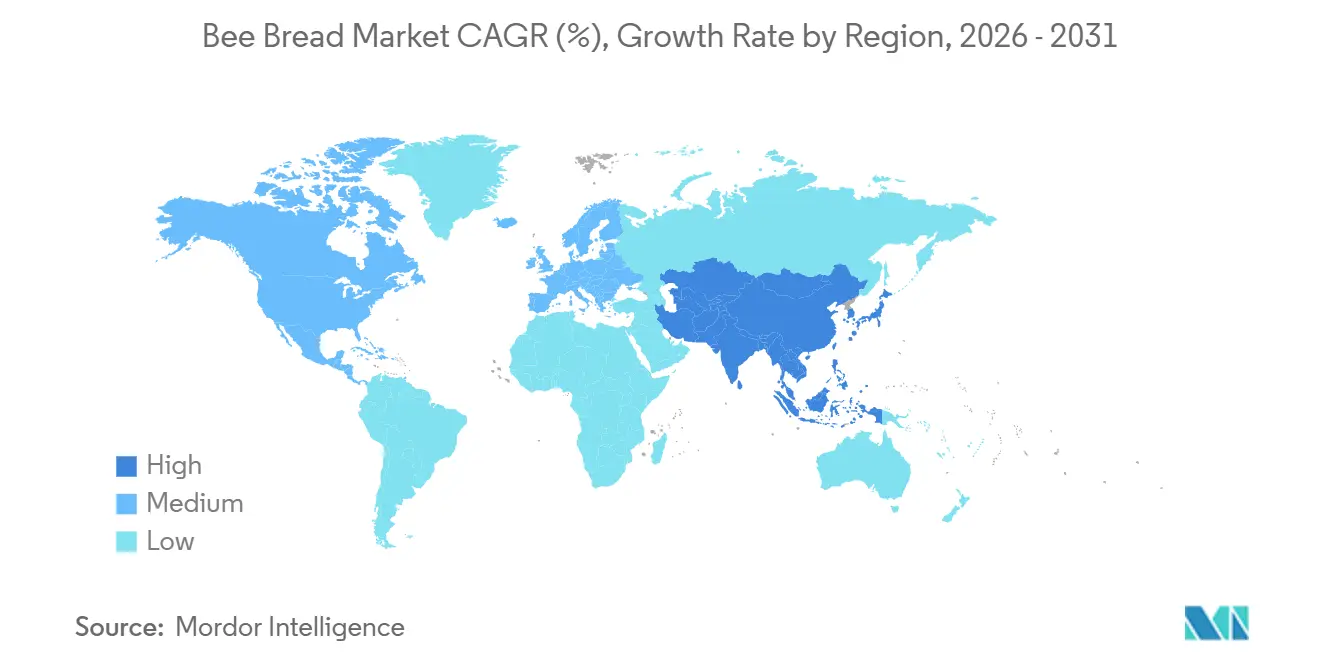
North America accounted for 38.78% of the bee bread market share in 2025, supported by a mature dietary supplement ecosystem across pharmacies, health food chains, specialty stores, and e-commerce platforms. The United States accounted for the largest share of regional demand, particularly for capsule and powder formats used in immune-support and gut-health products. Canada is emerging as a secondary growth contributor as direct-to-consumer natural health brands incorporate bee bread into premium wellness product lines.
Europe holds a significant production position, particularly in Lithuania, Latvia, Poland, and Romania, which supply raw materials to specialty health channels across several markets. Belgium, Germany, France, and the United Kingdom represent key consumption markets for premium and organic products. European Union guidance requires detailed safety information for relevant bee-product innovations entering the region. The bee bread market benefits when established suppliers meet these quality requirements with complete batch-level and safety documentation.
Asia-Pacific is forecast to grow at a CAGR of 7.71% through 2031, making it the fastest-growing region. China, India, and Japan serve as the primary demand anchors, while Southeast Asia is emerging as both a sourcing region and a consumption market. Rising incomes and greater awareness of apitherapy are supporting demand for premium bee-derived wellness products across the region. South America and the Middle East and Africa remain smaller in revenue terms; however, Brazil, Egypt, Turkey, Saudi Arabia, and the United Arab Emirates offer sourcing and distribution opportunities.

Competitive Landscape
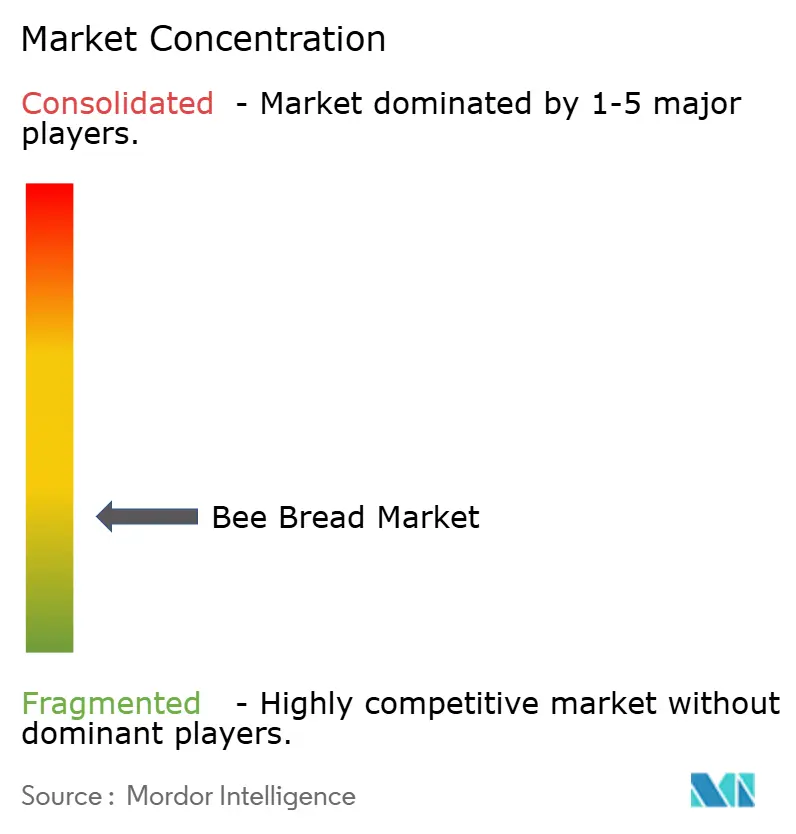
The Bee bread market remains fragmented among regional apiaries and specialty supplement brands. Bee Baltic, Medaus Namai, Bryła Miodu, API produktai, and Makoshen Bee Bread compete based on product origin, quality, and direct consumer relationships. Their limited global scale restricts any single company’s ability to influence prices across the category. Certification and analytical documentation have become important differentiators from suppliers that cannot verify product composition or traceability. This structure favors companies that can demonstrate consistent quality while maintaining the local sourcing characteristics valued by many buyers.
BEE&YOU is among the more vertically integrated operators in the broader bee-product category. Its portfolio includes propolis, royal jelly, honey, and bee bread, and the company reports sales in more than 37 countries. The company is expected to highlight an FDA-registered, over-the-counter propolis nasal spray in June 2026, demonstrating one pathway for bee-product technologies to enter more regulated product formats. Suppliers can also differentiate their offerings by combining bee bread with probiotics or adaptogens. Pharmacy distribution partnerships and third-party laboratory validation can help brands reach consumers and ingredient buyers that require formal quality assurances.
Regulatory compliance can provide an advantage to firms that can fund safety, fermentation, and traceability documentation. The European Food Safety Authority’s Novel Food guidance increases the value of detailed product dossiers for relevant innovations. Companies that meet European and North American manufacturing requirements can address both consumer and business-to-business demand. Competition is likely to center on verified quality, reliable supply, and product formats suited to regulated distribution channels.
Bee Bread Industry Leaders
-
Bee Baltic
-
Primal Eats
-
Bienenherz GmbH
-
Aravali Honey Industries
-
Bee and You
- *Disclaimer: Major Players sorted in no particular order

Recent Industry Developments
- July 2026: A Bulgarian producer of bee bread, pollen, royal jelly, and propolis has opened an Enterprise Europe Network opportunity for commercial agreements with distributors, wholesalers, retailers, and industrial partners. The company offers private-label manufacturing and customized packaging solutions.
- July 2025: A Turkish producer of perga (bee bread), propolis, royal jelly, and apilarnil is seeking international commercial and supplier agreements to expand its distribution network. The company operates an ISO 22000:2018-certified facility and sources its bee products from Turkey’s high-altitude regions.
- July 2021: Rosita launched Rosita Bee Bread, a wild, raw, lacto-fermented bee pollen product produced by Apis dorsata bees in India. The launch positioned bee bread as a premium functional superfood and differentiated it through its natural hive fermentation process.


Global Bee Bread Market Report Scope
Bee bread is a naturally fermented bee product produced when honeybees collect pollen, mix it with nectar, honey, and enzymes, and store it in honeycomb cells for fermentation.
The bee bread market is segmented by product form, nature, distribution channel, and geography. By product form, the market is segmented into raw bee bread, bee bread powder, encapsulated bee bread, and others. By nature, the market is segmented into organic and conventional. By distribution channel, the market is segmented into online and offline. Based on geography, the market is classified into North America, Europe, South America, Asia-Pacific, and the Middle East and Africa. The Market Forecasts are Provided in Terms of Value (USD).
| Raw Bee Bread |
| Bee Bread Powder |
| Encapsulated Bee Bread |
| Others |
| Organic |
| Conventional |
| Online |
| Offline |
| North America | United States |
| Canada | |
| Mexico | |
| Rest of North America | |
| Europe | Germany |
| United Kingdom | |
| Italy | |
| France | |
| Belgium | |
| Rest of Europe | |
| Asia-Pacific | China |
| India | |
| Japan | |
| Australia | |
| Rest of Asia-Pacific | |
| South America | Brazil |
| Argentina | |
| Rest of South America | |
| Middle East and Africa | South Africa |
| Saudi Arabia | |
| United Arab Emirates | |
| Egypt | |
| Turkey | |
| Rest of Middle East and Africa |
| By Product Form | Raw Bee Bread | |
| Bee Bread Powder | ||
| Encapsulated Bee Bread | ||
| Others | ||
| By Nature | Organic | |
| Conventional | ||
| By Distribution Channel | Online | |
| Offline | ||
| By Geography | North America | United States |
| Canada | ||
| Mexico | ||
| Rest of North America | ||
| Europe | Germany | |
| United Kingdom | ||
| Italy | ||
| France | ||
| Belgium | ||
| Rest of Europe | ||
| Asia-Pacific | China | |
| India | ||
| Japan | ||
| Australia | ||
| Rest of Asia-Pacific | ||
| South America | Brazil | |
| Argentina | ||
| Rest of South America | ||
| Middle East and Africa | South Africa | |
| Saudi Arabia | ||
| United Arab Emirates | ||
| Egypt | ||
| Turkey | ||
| Rest of Middle East and Africa | ||


Key Questions Answered in the Report
What is the current and projected size of the bee bread market, and what is its growth rate?
The bee bread market was valued at USD 312.19 million in 2025 and is projected to grow from USD 329.83 million in 2026 to USD 459.37 million by 2031, registering a CAGR of 6.85% during 2026-2031.
Which product form held the largest share of the bee bread market in 2025?
Raw bee bread was the leading product form segment, accounting for 38.70% of the market share in 2025
Which nature segment dominated the bee bread market in 2025?
The conventional segment dominated the market with a 72.10% share in 2025.
Which distribution channel accounted for the largest market share in 2025?
The offline distribution channel held the largest share, representing 63.82% of the bee bread market in 2025.
Which region led the bee bread market in 2025?
North America was the largest regional market, accounting for 38.78% of the market share in 2025.
Page last updated on:





