
BBQ Seasoning Market Size and Share
Market Overview
| Study Period | 2021 - 2031 |
|---|---|
| Market Size (2026) | USD 12.12 Billion |
| Market Size (2031) | USD 15.63 Billion |
| Growth Rate (2026 - 2031) | 5.21 % |
| Fastest Growing Market | Asia-Pacific |
| Largest Market | North America |
| Market Concentration | Low |
Major Players
*Disclaimer: Major Players sorted in no particular order Image © Mordor Intelligence. Reuse requires attribution under CC BY 4.0. |
|
BBQ Seasoning Market Analysis by Mordor Intelligence
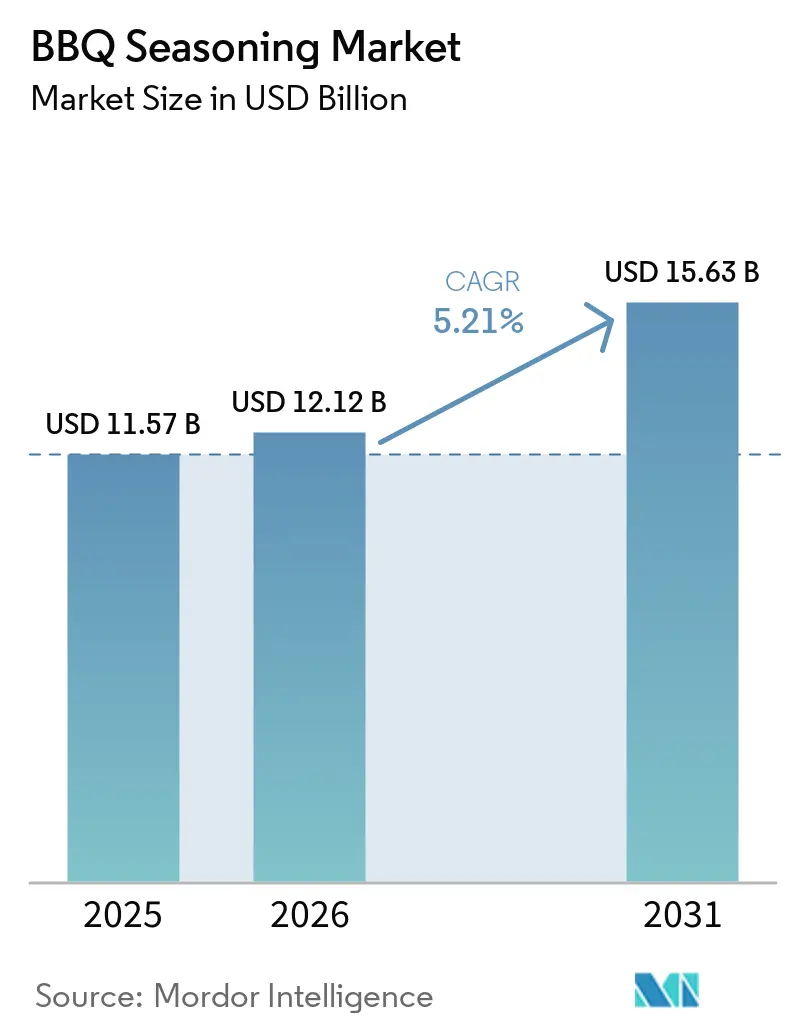
The BBQ seasoning market size was valued at USD 11.57 billion in 2025 to USD 12.12 billion in 2026, and is forecast to reach USD 15.63 billion by 2031 at a 5.21% CAGR over 2026-2031. The BBQ seasoning market is benefiting from a shift toward year-round outdoor cooking, as consumers increasingly view grilling as part of regular meal preparation. Rising restaurant costs have also encouraged consumers to prepare restaurant-style meals at home, supporting demand for seasoning blends, rubs, sauces, marinades, and finishing products. Foodservice menus remain an important channel for introducing regional flavors, as restaurant exposure can build consumer familiarity before related retail products reach stores. As a result, the BBQ seasoning market gives suppliers the chance to align foodservice placements, retail launches, packaging strategies, and flavor development across the year, not just during a single seasonal period.
Key Report Takeaways
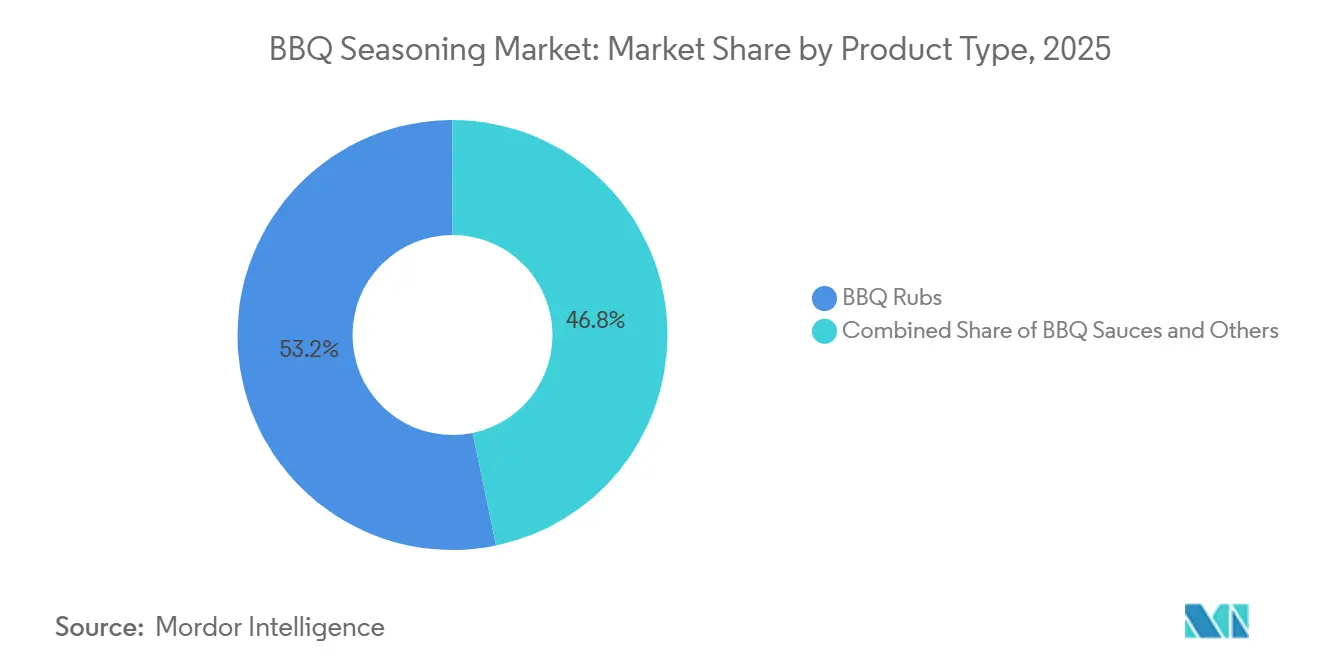
- By product type, BBQ rubs led the BBQ seasoning market with a share of 53.24% in 2025, while BBQ sauces are anticipated to register the fastest CAGR of 6.03% during 2026-2031.
- By packaging, bottles retained a 46.43% share in 2025, while sachets are forecast to expand at a 5.85% CAGR through 2031.
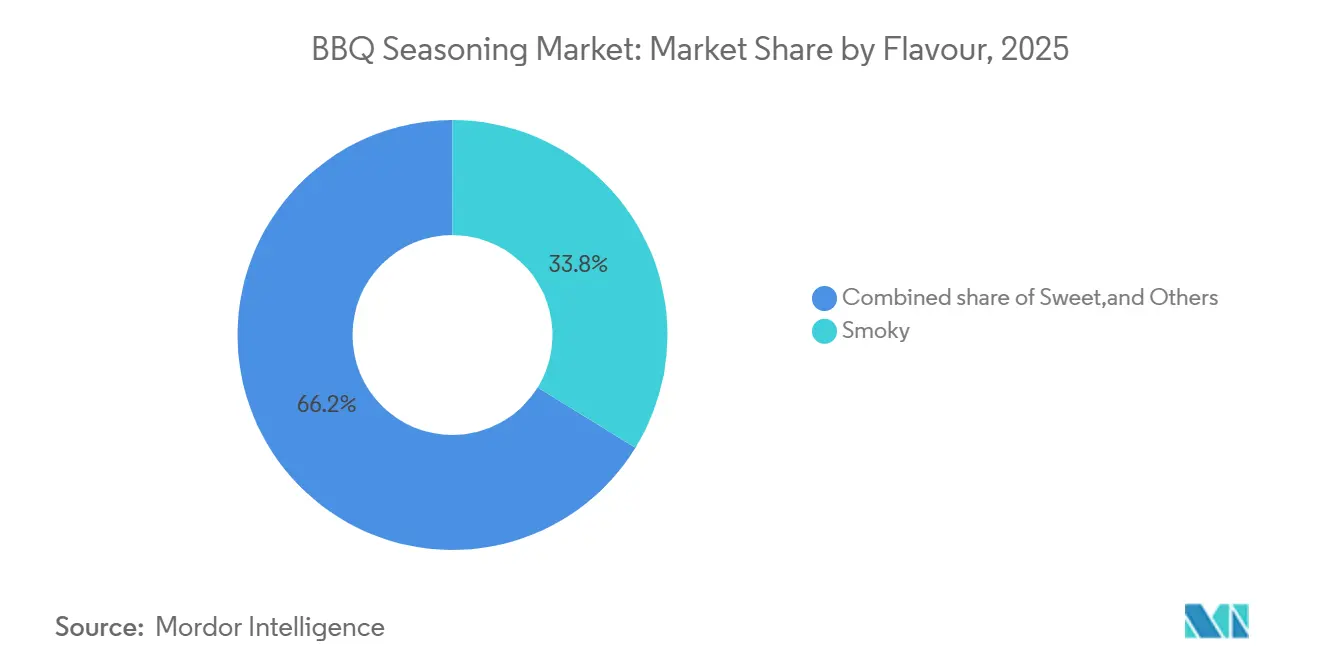
- By flavour, smoky led the market with a share of 33.78% in 2025, whereas sweet is anticipated to register the fastest CAGR of 5.88% during 2026-2031.
- By distribution channel, HoReCa and supermarkets led the market with a share of 63.45% in 2025, while retail is anticipated to register the fastest CAGR of 6.19% during 2026-2031.
- By geography, North America led the global BBQ seasoning market in 2025 with a 44.12% share, while Asia-Pacific is projected to advance at a 6.34% CAGR through 2031.
Note: Market size and forecast figures in this report are generated using Mordor Intelligence’s proprietary estimation framework, updated with the latest available data and insights as of January 2026.
Global BBQ Seasoning Market Trends and Insights
Drivers Impact Analysis*
| Drivers | (~) % Impact on CAGR Forecast | Geographic Relevance | Impact Timeline |
|---|---|---|---|
| Rising popularity of outdoor grilling and bbq occasions | +1.1% | Global, with concentration in North America, Europe, and Australia | Short term (≤ 2 years) |
| Growing consumer demand for bold and flavor-enhanced foods | +0.8% | Global, particularly North America, Western Europe, and East Asia | Medium term (2-4 years) |
| Increasing interest in global and fusion bbq flavors | +0.7% | Asia-Pacific core, with spillover to North America and Europe | Medium term (2-4 years) |
| Premiumization of home cooking and grilling experiences | +0.6% | North America and Europe | Medium term (2-4 years) |
| Demand for clean-label and natural seasonings | +0.5% | North America, Europe, and Australia | Medium term (2-4 years) |
| Consumption of processed and convenience foods | +0.4% | Asia-Pacific and Middle East and Africa | Long term (≥ 4 years) |
| Source: Mordor Intelligence | |||
Rising popularity of outdoor grilling and BBQ occasions
The BBQ seasoning market benefits from the growing adoption of outdoor grilling as a regular cooking practice among a broader range of households and consumer groups. According to a 2025 report by the Hearth, Patio & Barbecue Association, at least two-thirds of premium grill owners use their grills several times per week during spring, summer, and fall [1]Source: Hearth, Patio & Barbecue Association, " HPBA Insights for July’s National Grilling Month," hpba.org. The report also found that 43% of premium grill owners regularly cook for groups of 10 or more people, which increases seasoning consumption per occasion. Frequent grilling and larger group gatherings drive repeat purchases and higher consumption volumes of rubs, marinades, and seasoning blends. The BBQ seasoning market can cater to these consumers through convenient pack sizes, a wider variety of flavors, and products tailored to apartment, patio, and group-cooking occasions.
Growing consumer demand for bold and flavor-enhanced foods
Consumers increasingly use multiple products during a single grilling occasion, supporting demand for rubs, marinades, glazes, and sauces. McCormick identified layered flavor use as a key grilling pattern, with 64% of protein consumers stating that marinades improve the taste of meat. This behavior can increase the number of products purchased for a single meal, as consumers may apply a rub before cooking and add a sauce or glaze afterward. According to the National Cattlemen’s Beef Association’s 2026 report, grilling was the second-most popular method for preparing beef at home, and more than 60% of consumers identified grilled food as a favorite [2]Source: Beef Research " Beef’s Summer Grilling Outlook 2026," beefresearch.org. These preferences keep BBQ seasonings relevant for traditional proteins while supporting their use with poultry, seafood, vegetables, and prepared foods. The BBQ seasoning market benefits when suppliers simplify flavor layering through recipes, packaging instructions, and coordinated product ranges.
Increasing interest in global and fusion BBQ flavors
The BBQ seasoning market is expanding its flavor offerings as consumers explore international grilling traditions through accessible retail formats. Korean BBQ, Brazilian churrasco, Hawaiian sweet-smoke profiles, and Sichuan-style spice applications provide suppliers with additional opportunities to differentiate products while remaining within familiar grilling occasions. These products reduce the perceived risk of trying unfamiliar cuisines by offering consumers a ready-made flavor profile for home use. Korean-inspired products are particularly relevant, as gochujang-based profiles have moved from restaurant menus to broader retail demand across North America, including Canada. The BBQ seasoning market can capitalize on this demand by balancing recognizable descriptors, such as sweet, smoky, tangy, and spicy, with regional references that differentiate products.
Premiumization of home cooking and grilling experiences
The BBQ seasoning market benefits from consumers who view outdoor cooking equipment and related food products as long-term household investments. The Hearth, Patio & Barbecue Association reported in 2025 that premium outdoor kitchen owners spent an average of USD 10,600 on these spaces; 98% included a grill, and 73% used the space at least three times per week. Ownership of premium equipment encourages repeat usage and increases the value of seasonings that help consumers achieve consistent cooking results. Bottled seasonings support this usage pattern by providing convenient storage, visible labeling, and repeat use across multiple meals. Consumers who maintain outdoor kitchens may purchase seasonings as pantry staples rather than for occasional events. This trend increases the relevance of direct-to-consumer channels, club-store packs, and replenishment-oriented formats in the BBQ seasoning market.
Restraints Impact Analysis*
| Restraint | (~) % Impact on CAGR Forecast | Geographic Relevance | Impact Timeline |
|---|---|---|---|
| Volatility in spice and agricultural raw material prices | -0.7% | Global, particularly sourcing hubs in India, Vietnam, and South America | Short term (≤ 2 years) |
| Health concerns related to high sodium and sugar content | -0.5% | North America and Europe | Medium term (2-4 years) |
| Competition and price pressure | -0.4% | Global | Short term (≤ 2 years) |
| Food safety, labeling, and ingredient regulations | -0.3% | North America, Europe, and Asia-Pacific | Medium term (2-4 years) |
| Source: Mordor Intelligence | |||
Volatility in spice and agricultural raw material prices
Raw material volatility directly constrains producers, as chili, coriander, pepper, turmeric, paprika, solvents, packaging, and energy inputs influence formulation costs. In April 2026, Plant Lipids reported that prices for key solvents increased by 50% to 60%, with certain prices more than doubling amid logistics disruptions associated with conflict in the Middle East. The company also reported that coriander prices in India were 40% to 50% higher than in the previous year, while black pepper carry-forward stocks in Vietnam had fallen to multi-year lows. The BBQ seasoning market faces pressure when companies depend on a single sourcing origin and must absorb higher costs, reformulate products, or increase retail prices. Producers that diversify sourcing across India, Vietnam, and South America are better positioned to manage spot-price volatility and maintain supply continuity.
Health concerns related to high sodium and sugar content
Rising health concerns are increasing demand for seasoning formulations that preserve taste while reducing sodium and sugar. The International Food Information Council reported that 37% of Americans actively limited their sodium intake in 2024. Among these consumers, 65% aimed to improve their overall health, while 56% viewed foods marketed as low sodium positively [3]Source: The International Food Information Council, " American Consumer Perceptions of Sodium in the Diet," ific.org. However, Ajinomoto reported that one in two Americans considered low-sodium foods bland or tasteless, creating a significant reformulation challenge. Consequently, the BBQ seasoning market requires products that meet health expectations without compromising the flavor cues consumers associate with barbecue. Traditional formulations continue to support high-volume foodservice applications, while reduced-sodium and sugar-free alternatives are gaining greater attention in the retail segment. Umami ingredients and sodium-reduction systems can help address this gap; however, consumer products must continue to deliver clear flavor profiles and competitive pricing.
*Our forecasts treat driver/restraint impacts as directional, not additive. The impact forecasts reflect baseline growth, mix effects, and variable interactions.
Segment Analysis
By Product Type: Rubs Lead Volume, Sauces Lead Growth
BBQ rubs accounted for 53.24% of the BBQ seasoning market in 2025, making them the leading product type. Consumers use rubs for dry application, moisture retention, crust formation, and flavor layering across a broad range of proteins and cooking methods. Their versatility provides an advantage among consumers seeking a single product for use before, during, or after cooking. Foodservice operators also use rubs to standardize flavor profiles across menus and locations. Marinades and multi-use blends represent smaller segments within the Others category but are gaining traction through meal kits and occasion-specific flavor kits.
BBQ sauces are projected to grow at a CAGR of 6.03% through 2031, the highest growth rate among product types. Their format encourages trial and does not require a specialized application method. Consumers can use sauces as dips, glazes, sandwich spreads, or finishing products, extending their applications beyond grilling. The Kraft Heinz Flavor Tour collection introduced Korean-inspired sweet and tangy BBQ, Thai-inspired sweet chili, and Mexican-inspired street corn flavors at retail.



By Packaging: Bottles Anchor Premium Spend, Sachets Outpace Growth
Bottles accounted for 46.43% of category revenue in 2025, driven by repeat purchases among engaged home cooks. This format supports kitchen storage, product visibility, and higher-volume usage. It also gives brands space to communicate ingredients, nutritional information, and clean-label claims at the point of purchase. The resealable format helps maintain freshness and enables convenient repeated use, making bottles suitable for regular household grilling occasions. Bulk containers remain important for foodservice buyers seeking cost efficiency and consistency across preparation lines.
Sachets are projected to grow at a CAGR of 5.85% through 2031, outpacing other packaging formats. Single-use and small-format packs support product trials, on-the-go consumption, gifting, and online bundle offerings. They also allow brands to offer lower entry price points in markets where bottles are less accessible. Their lightweight, compact design reduces storage and transportation requirements, supporting broader distribution across retail and e-commerce channels.
By Flavor: Smoky Profiles Retain Leadership, Sweet Profiles Accelerate
Smoky flavors hold a 33.78% revenue share in 2025, maintaining the leading position among flavor categories. Smoke is closely associated with barbecue traditions in the United States, South Africa, and West Africa, making it familiar across diverse food cultures. This flavor profile is suitable for dry rubs, sauces, marinades, and finishing seasonings. It also provides consumers with a recognizable barbecue cue when cooking indoors or using equipment that does not produce a strong natural smoke flavor. As a result, smoky products are less reliant on short-lived flavor trends than more narrowly defined profiles. Their broad applicability supports stable demand across both foodservice and retail channels.
Sweet flavors are forecast to grow at a CAGR of 5.88% through 2031, the fastest rate among flavor categories. Honey barbecue, maple smoke, and sweet-heat combinations offer consumers a lower-risk way to explore emerging barbecue formats. These products combine familiar sweetness with controlled heat or smokiness, appealing to consumers who do not prefer intensely hot products. Spicy and hot seasonings remain significant in South Korea, India, and Southeast Asia, where heat tolerance differs from that in Western markets. The Others category includes tangy, vinegar-forward, and herb-focused profiles that cater to localized demand in Europe and South America.
By Distribution Channel: HoReCa Retains Scale, Retail Grows Faster
HoReCa accounted for a 63.45% share of distribution revenue in 2025, driven by the high volume of professional cooking activity. Restaurants, catering operators, quick-service chains, and food processors use rubs and proprietary sauces to deliver consistent flavors across repeated servings. Contract-based purchasing provides more stable demand than household purchases, as recipes and menus require regular replenishment. Restaurant menus also expose consumers to regional rubs, sauces, and fusion flavors before similar products reach grocery stores, reducing the time required for new flavors to gain retail awareness.
Retail is projected to grow at a CAGR of 6.19% through 2031, the fastest growth rate among distribution channels. Hypermarkets, supermarkets, convenience stores, and online retailers benefit as consumers seek restaurant-quality grilling experiences at home. Online channels are particularly important for small-batch and premium brands that lack access to extensive physical shelf space. These channels also enable suppliers to offer subscription packs, curated bundles, and products tailored to specific cooking occasions. The BBQ seasoning market benefits when retail and foodservice strategies complement each other rather than operate independently.
Geography Analysis
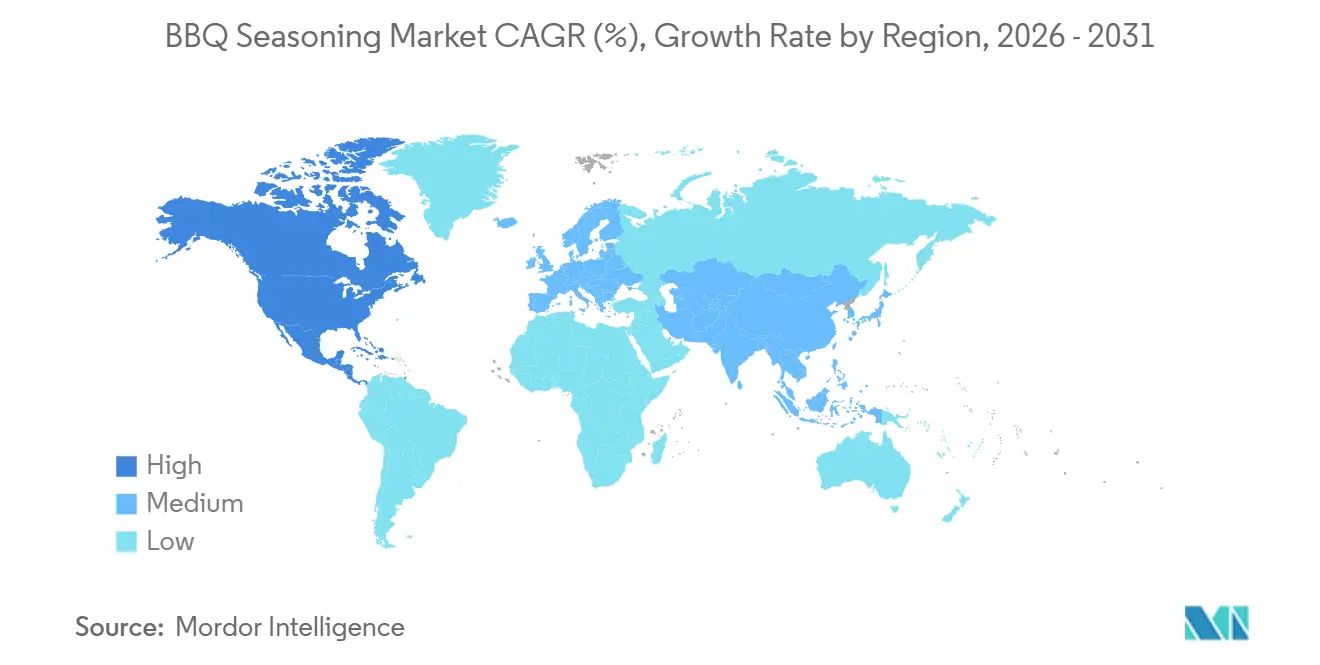
North America holds a 44.12% regional revenue share in 2025, supported by established grilling habits, high grill ownership, and demand for premium seasoning formats. Traditional American barbecue remains central to regional demand, while Korean, Japanese, and Latin American influences are expanding mid-priced and premium product offerings. Mexico drives demand for chili-based and adobo-style barbecue products through its street-food and taco culture, while Canada provides an avenue for globally inspired flavors that complement established grilling occasions.
Europe has a diverse grilling base, with country-level differences in cooking traditions and flavor preferences. Germany remains a major grilling market, with 40% of consumers expected to grill every two weeks during the peak season in 2026. In 2025, McCormick’s Schwartz brand is expected to launch Rubs of the World in Morrisons and ASDA, featuring Texas-inspired sweet and smoky, Greek-inspired citrus and herb, and Mexico-inspired garlic and lime products. Southern European consumers often prefer herb-forward flavor profiles, while Northern European consumers show growing interest in American-style rubs. Food safety, ingredient, and front-of-pack labeling requirements also influence retail product formulations.
Asia-Pacific is projected to record a 6.34% CAGR through 2031, the fastest growth rate among geographic regions. Rising disposable incomes, urbanization, and interest in internationally influenced meal occasions support demand across China, India, Japan, Australia, South Korea, Indonesia, Thailand, and Singapore. Japan’s yakitori and yakiniku traditions provide a familiar foundation for barbecue sauces and seasonings, while newer global variants expand product choices. The Middle East and Africa remain smaller markets by value; however, the growth of organized foodservice and regional traditions, such as suya, peri-peri, and braai, create product development and export opportunities for the BBQ seasoning market.

Competitive Landscape
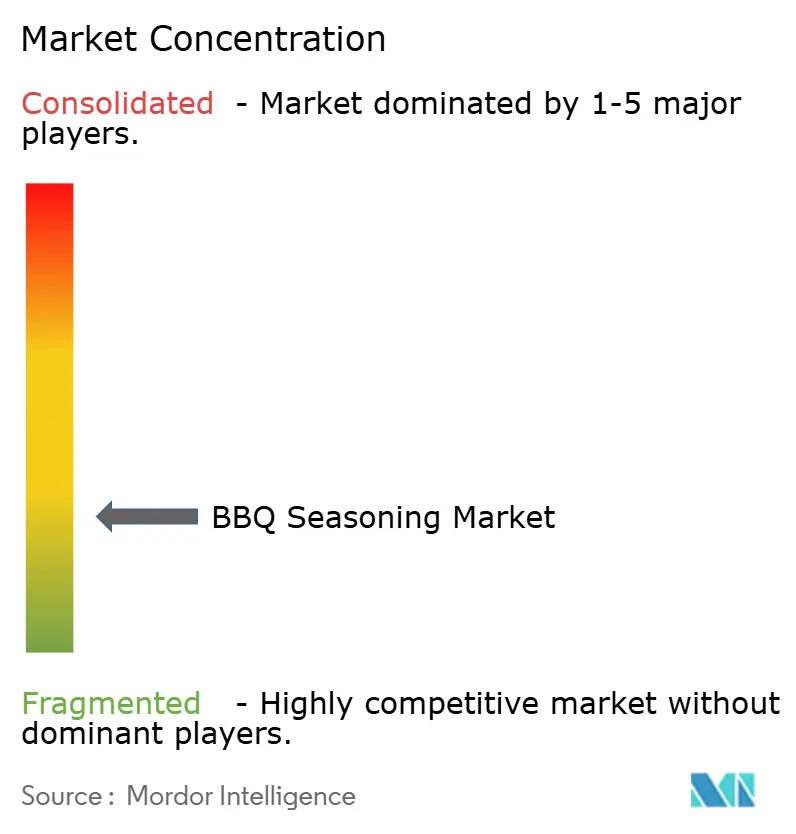
The BBQ seasoning market is fragmented, with large multinational companies, regional brands, and artisanal suppliers competing across distinct price points and distribution channels. McCormick & Company, The Kraft Heinz Company, Conagra Brands, and Kerry Group compete through extensive distribution networks, strong retail shelf presence, and frequent product launches. Smaller producers differentiate themselves through regional heritage, clean-label credentials, specialized recipes, and direct relationships with barbecue consumers. Price pressure is most pronounced in retail, where private-label alternatives have gained shelf space as consumers balance flavor preferences with household budgets. Companies must therefore balance value, ingredient quality, and pack size rather than rely solely on premium pricing.
Restaurant-to-retail flavor conversion is expected to be a major competitive strategy in 2025 and 2026. In March 2026, McCormick partnered with MISSION BBQ to introduce four regional sauces, using restaurant familiarity to support a national retail launch. McCormick also partnered with Peg Leg Porker in 2025 to bring West Tennessee barbecue flavors to national retail. Kraft Heinz follows a similar approach through its Flavor Tour sauce collection, applying Korean, Thai, and Mexican flavor profiles to mass-market retail products. These initiatives allow larger brands to leverage established restaurant and regional flavor credibility while increasing consumer awareness at the shelf.
Reduced-sodium products represent an opportunity, as health-conscious consumers seek options that retain the expected barbecue flavor profile. The International Food Information Council’s 2024 findings on sodium reduction support the need for more accessible retail options. Online-first brands can also build loyalty through subscriptions, curated flavor bundles, and product communities that do not depend on retail shelf space. African suya blends, South American chimichurri-barbecue combinations, and Korean gochujang rubs remain relevant product areas for brands seeking to introduce non-Western barbecue traditions at a broader retail scale.
BBQ Seasoning Industry Leaders
-
McCormick & Company, Inc.
-
The Kraft Heinz Company
-
Kerry Group plc
-
Conagra Brands, Inc.
-
Weber Inc.
- *Disclaimer: Major Players sorted in no particular order

Recent Industry Developments
- May 2026: The Marzetti Company completed its acquisition of Bachan’s, Inc., a fast-growing Japanese barbecue sauce brand known for its authentic, clean-label products. The company financed the USD 400 million transaction with cash on hand and a USD 200 million term loan.
- March 2026: McCormick & Company partnered with MISSION BBQ to launch a retail line of four regionally inspired barbecue sauces: Memphis Belle, Blue Ridge Smoky Mountain, Texas Twang, and KC Classic. The products are available online and at major retailers nationwide.
- July 2025: RubRub launched three Korean BBQ-inspired rubs Original, Spicy, and Yuzu and announced a partnership with Croft Alley in Beverly Hills. With an expanding lineup of versatile rubs, as well as sauces and finishing salts in development, RubRub offers more than a spice blend; it introduces a new flavor format.


Global BBQ Seasoning Market Report Scope
BBQ seasoning comprises blends of spices, herbs, salts, sugars, and flavoring ingredients that enhance the taste, aroma, and color of foods prepared through grilling, barbecuing, smoking, or roasting. It includes dry rubs, seasoning blends, marinades, and related flavoring products used with meat, poultry, seafood, vegetables, and plant-based foods.
The BBQ seasoning market is segmented by product type, packaging, flavour, distribution channel, and geography. By product type, the market is segmented into BBQ sauces, BBQ rubs, and others. By packaging, the market is segmented into sachets, bottles, and bulk containers. By flavour, the market is segmented into smoky, sweet, spicy/hot, and others. By distribution channel, the market is segmented into HoReCa and retail (supermarkets and hypermarkets, convenience stores, online retail, and other distribution channels). Based on geography, the market is classified into North America, Europe, South America, Asia-Pacific, and the Middle East and Africa. The Market Forecasts are Provided in Terms of Value (USD).
| BBQ Sauces |
| BBQ Rubs |
| Others |
| Sachets |
| Bottles |
| Bulk Containers |
| Smoky |
| Sweet |
| Spicy/Hot |
| Others |
| HoReCa | |
| Retail | Hypermarkets and Supermarkets |
| Convenience Stores | |
| Online Retail | |
| Other Distribution Channels |
| North America | United States |
| Canada | |
| Mexico | |
| Rest of North America | |
| Europe | Germany |
| United Kingdom | |
| Italy | |
| France | |
| Spain | |
| Netherlands | |
| Poland | |
| Belgium | |
| Sweden | |
| Rest of Europe | |
| Asia-Pacific | China |
| India | |
| Japan | |
| Australia | |
| Indonesia | |
| South Korea | |
| Thailand | |
| Singapore | |
| Rest of Asia-Pacific | |
| South America | Brazil |
| Argentina | |
| Colombia | |
| Chile | |
| Peru | |
| Rest of South America | |
| Middle East and Africa | South Africa |
| Saudi Arabia | |
| United Arab Emirates | |
| Nigeria | |
| Egypt | |
| Morocco | |
| Turkey | |
| Rest of Middle East and Africa |
| By Product Type | BBQ Sauces | |
| BBQ Rubs | ||
| Others | ||
| By Packaging | Sachets | |
| Bottles | ||
| Bulk Containers | ||
| By Flavour | Smoky | |
| Sweet | ||
| Spicy/Hot | ||
| Others | ||
| By Distribution Channel | HoReCa | |
| Retail | Hypermarkets and Supermarkets | |
| Convenience Stores | ||
| Online Retail | ||
| Other Distribution Channels | ||
| By Geography | North America | United States |
| Canada | ||
| Mexico | ||
| Rest of North America | ||
| Europe | Germany | |
| United Kingdom | ||
| Italy | ||
| France | ||
| Spain | ||
| Netherlands | ||
| Poland | ||
| Belgium | ||
| Sweden | ||
| Rest of Europe | ||
| Asia-Pacific | China | |
| India | ||
| Japan | ||
| Australia | ||
| Indonesia | ||
| South Korea | ||
| Thailand | ||
| Singapore | ||
| Rest of Asia-Pacific | ||
| South America | Brazil | |
| Argentina | ||
| Colombia | ||
| Chile | ||
| Peru | ||
| Rest of South America | ||
| Middle East and Africa | South Africa | |
| Saudi Arabia | ||
| United Arab Emirates | ||
| Nigeria | ||
| Egypt | ||
| Morocco | ||
| Turkey | ||
| Rest of Middle East and Africa | ||


Key Questions Answered in the Report
What is the current and projected size of the global BBQ seasoning market?
The global BBQ seasoning market was valued at USD 11.57 billion in 2025, is estimated to reach USD 12.12 billion in 2026, and is forecast to grow to USD 15.63 billion by 2031, registering a CAGR of 5.21% during 2026-2031.
Which product type held the largest share of the BBQ seasoning market in 2025?
BBQ Rubs were the leading product type, accounting for 53.24% of the market in 2025.
Which packaging format dominated the market in 2025?
Bottles held the largest packaging segment share, accounting for 46.43% of the market in 2025.
Which flavor segment accounted for the largest market share in 2025?
The Smoky flavor segment led the market with a 33.78% share in 2025.
Which distribution channel generated the highest revenue in 2025?
The HoReCa (Hotels, Restaurants, and Cafés) channel dominated the market, holding 63.45% of total revenue in 2025.
Which region led the global BBQ seasoning market in 2025?
North America was the largest regional market, accounting for 44.12% of global revenue in 2025.
Page last updated on:


 Your data is secure and never sold or shared.



