
Battery Electrolyte Additives Market Size and Share
Market Overview
| Study Period | 2021 - 2031 |
|---|---|
| Market Size (2026) | USD 2.11 Billion |
| Market Size (2031) | USD 3.92 Billion |
| Growth Rate (2026 - 2031) | 13.18 % |
| Fastest Growing Market | Asia-Pacific |
| Largest Market | Asia-Pacific |
| Market Concentration | Medium |
Major Players *Disclaimer: Major Players sorted in no particular order Image © Mordor Intelligence. Reuse requires attribution under CC BY 4.0. | |
Battery Electrolyte Additives Market Analysis by Mordor Intelligence
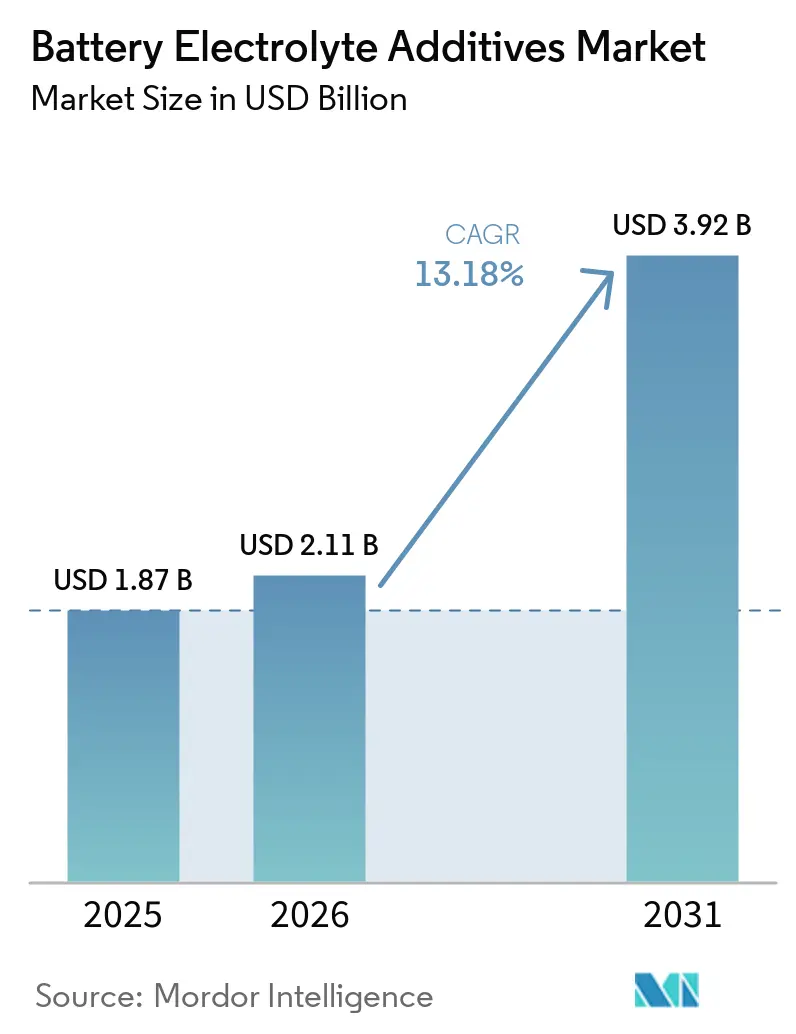
The battery electrolyte additives market size was estimated at USD 1.87 billion in 2025 and is estimated to grow from USD 2.11 billion in 2026 to USD 3.92 billion by 2031, at a CAGR of 13.18% during the forecast period (2026-2031). Electric vehicle production provides the primary base for the battery electrolyte additives market, while grid storage creates demand for formulations designed for long calendar life and deep cycling. The market also depends on repeated qualification work, as each cell program can require a distinct additive specification. Higher-voltage cathodes, high-nickel cells, and silicon-rich anodes are expanding the role of additives that protect electrode interfaces. This shift gives suppliers opportunities to combine high-purity materials with formulation support and technical service. Regulatory scrutiny of fluorinated chemistries and concentrated precursor supply can also influence which additive families gain adoption.
Key Report Takeaways
- By chemistry, vinylene carbonate held 34.67% of the battery electrolyte additives market share in 2025, while fluoroethylene carbonate is forecast to grow at a 13.84% CAGR through 2031.
- By battery type, lithium-ion batteries held 70.35% of the battery electrolyte additives market share in 2025, while next-generation platforms are forecast to grow at a 13.93% CAGR through 2031.
- By application, electric vehicles held 60.13% of the battery electrolyte additives market share in 2025, while energy storage systems are forecast to grow at a 14.21% CAGR through 2031.
- By end-user industry, battery cell manufacturers held 64.74% of the battery electrolyte additives market share in 2025, while energy storage integrators are forecast to grow at a 14.67% CAGR through 2031.
- By geography, Asia-Pacific held 47.02% of the battery electrolyte additives market share in 2025 and is forecast to grow at a 14.05% CAGR through 2031.
Note: Market size and forecast figures in this report are generated using Mordor Intelligence’s proprietary estimation framework, updated with the latest available data and insights as of January 2026.
Market Trends and Insights
Drivers Impact Analysis of Battery Electrolyte Additives Market*
| Drivers | (~) % Impact on CAGR Forecast | Geographic Relevance | Impact Timeline |
|---|---|---|---|
| Electric Vehicle Battery Production Growth | +3.5% | Global | Short term (≤ 2 years) |
| Expansion of Grid-Scale Energy Storage Systems | +2.4% | North America, APAC core, spillover to Europe | Medium term (2-4 years) |
| Demand for Higher Voltage and Longer-Life Cells | +1.9% | Global | Medium term (2-4 years) |
| Commercialization of Silicon-Rich Anodes and High-Nickel Cathodes | +1.6% | APAC core, spillover to North America | Medium term (2-4 years) |
| Formulation Localization for Regional Gigafactory Qualification | +1.3% | North America and the EU | Medium term (2-4 years) |
| Additive Co-Optimization with Battery Manufacturing Data Systems | +0.8% | APAC and North America | Long term (≥ 4 years) |
| Source: Mordor Intelligence | |||
Electric Vehicle Battery Production Growth
Electric vehicle battery production is increasing the demand for electrolyte additives across major cell chemistries. The International Energy Agency reported nearly 22 million electric cars produced in 2025, with China accounting for around three-quarters of global output. The agency projects 23 million electric cars globally in 2026. The battery electrolyte additives market benefits from this growth because new regional gigafactories must qualify materials for their own cell programs. A supplier can therefore gain from material quantities and from recurring work needed to validate additives. North American qualification is also increasingly shaped by Foreign Entity of Concern requirements that affect material-sourcing eligibility for federal tax credits.
Expansion of Grid-Scale Energy Storage Systems
Grid-scale storage is becoming a core grid asset rather than a limited demand-response tool. The U.S. Energy Information Administration projected 24 GW of utility-scale battery storage additions in 2026, following a record 15 GW added in 2025. This expansion supports the battery electrolyte additives market because stationary batteries prioritize 15-20 years of calendar life and deep-cycle performance. These applications require sultone-based and borate-based additives, including LiBOB and LiDFOB, over materials designed mainly for fast charging. The resulting chemistry requirement is distinct from that of many electric vehicle programs. Energy storage integrators are also taking a more direct role in setting electrolyte performance requirements.
Demand for Higher Voltage and Longer-Life Cells
Higher-voltage cathode programs are increasing the need for additives that stabilize electrodes and reduce electrolyte oxidation. Nickel-rich nickel manganese cobalt (NMC) cells can operate above 4.3 V, while lithium manganese iron phosphate (LMFP) cells can operate above 3.65 V. Legacy vinylene carbonate packages were designed for operating windows of 4.1-4.2 V and may not provide the required protection at higher voltages. Acidic byproducts can corrode aluminum current collectors and damage cathode surface layers. This supports demand in the battery electrolyte additives market for high-voltage stabilizers and phosphate-based passivators. Mitsubishi Chemical Group Corporation licensed electrolyte patents related to cell longevity and lithium-ion mobility to CATL in May 2025, indicating that licensing can complement direct material supply.
Commercialization of Silicon-Rich Anodes and High-Nickel Cathodes
Silicon-rich anodes require more fluoroethylene carbonate (FEC) per kWh than conventional graphite cells because silicon expands during lithiation. Group14 Technologies began commercial production of SCC55 silicon-carbon anode material at its Sangju facility in South Korea in March 2026. The facility is designed to produce 2,000 metric tons annually and support 10 GWh of extreme-fast-charging battery capacity. Silicon can fracture the interphase formed by conventional vinylene carbonate, whereas FEC helps form a more flexible protective layer[1]. This makes FEC and related co-additives important as silicon adoption expands into broader electric vehicle programs. The battery electrolyte additives market is therefore likely to see demand rise faster than silicon-rich applications' cell unit output.
Restraints Impact Analysis of Battery Electrolyte Additives Market*
| Restraints | (~) % Impact on CAGR Forecast | Geographic Relevance | Impact Timeline |
|---|---|---|---|
| High Qualification Costs and Long Cell-Validation Cycles | -1.5% | Global | Short term (≤ 2 years) |
| Raw-Material Price Volatility and Limited High-Purity Supply | -1.2% | Global | Short term (≤ 2 years) |
| Additive Loading Trade-Offs with Energy Density | -0.7% | Global | Medium term (2-4 years) |
| Per- and Polyfluoroalkyl Substances (PFAS) Compliance Uncertainty and Fluorinated Chemistry Substitution Risk | -1.0% | EU, with global spillover | Medium term (2-4 years) |
| Source: Mordor Intelligence | |||
High Qualification Costs and Long Cell-Validation Cycles
A new electrolyte additive must pass several cell-level qualification steps before it is approved for automotive use. These steps include initial electrolyte screening, extended cycling at various temperatures, gas evolution tests, safety abuse tests, and Original Equipment Manufacturer (OEM) integration tests. Automotive programs can take 2-4 years to complete this process. Validation service fees for a single additive candidate range from USD 200,000 to USD 800,000 per program. Existing formulations can therefore retain a 2-4-year advantage in a validated program, even when competing molecules claim better performance. UN 38.3 transport compliance and OEM engineering-change procedures can add further testing requirements when an additive is changed.
Raw-Material Price Volatility and Limited High-Purity Supply
Battery-grade additives depend on specialized inputs such as fluorinated alcohols, high-grade acetylene, and oxalic acid derivatives. These inputs come from a limited number of facilities and can be affected by commodity price movements and environmental compliance shutdowns. The battery electrolyte additives market faces margin pressure when suppliers have fixed-price agreements with cell makers, but their precursor costs change rapidly. Limited regional sources for lithium bis(fluorosulfonyl)imide (LiFSI) and fluoroethylene carbonate (FEC) synthesis also create supply exposure for formulators. The requirement for high purity makes rapid supplier substitution difficult. This constraint can favor producers who have secured precursor supply and maintain qualified production processes.
*Our forecasts treat driver/restraint impacts as directional, not additive. The impact forecasts reflect baseline growth, mix effects, and variable interactions.
Battery Electrolyte Additives Market Segment Analysis
By Chemistry:
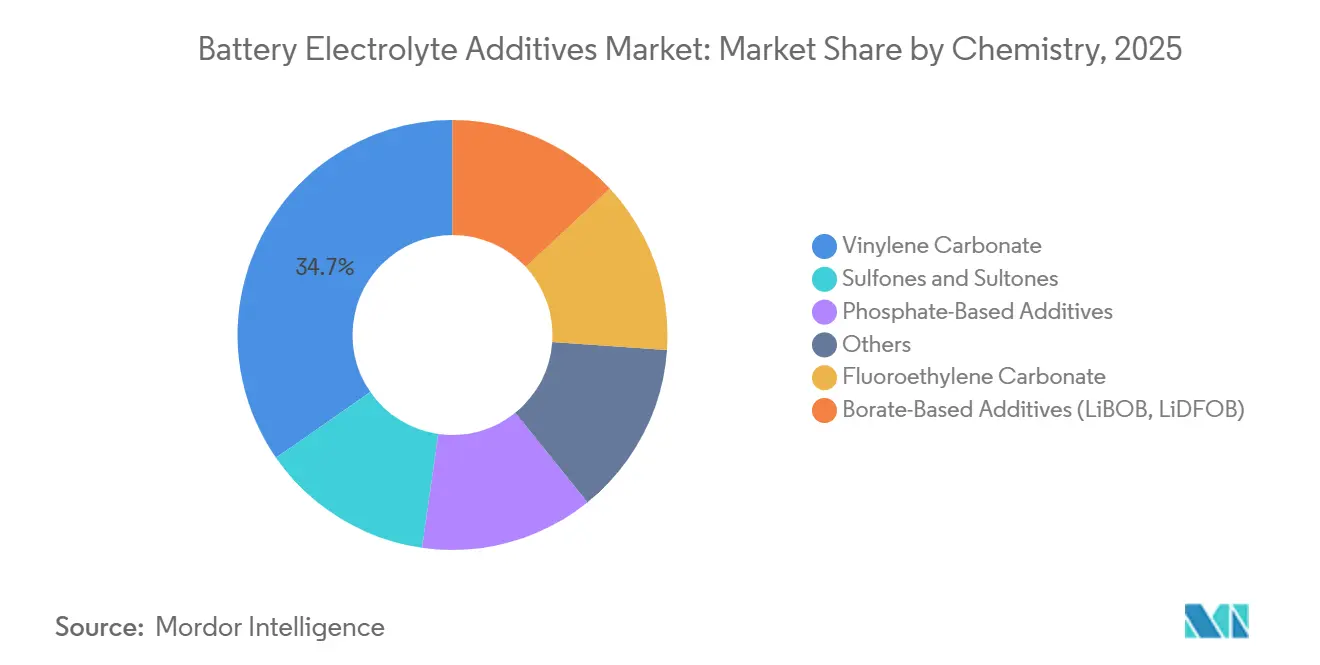
Vinylene Carbonate Commands the Formulation StackVinylene carbonate (VC) held 34.67% of the battery electrolyte additives market share in 2025. Its reduction behavior at the anode surface forms a dense interphase that conducts lithium ions and limits solvent co-intercalation. This function reduces initial capacity loss in graphite-anode lithium-ion cells. As a result, vinylene carbonate has remained a standard film-forming material in commercial lithium-ion formulations. The battery electrolyte additives market size for this chemistry is supported by the continued scale of graphite-anode cells. Its established qualification history also gives cell makers a familiar starting point for additive packages.
Fluoroethylene carbonate (FEC) is the fastest-growing chemistry, with a forecast CAGR of 13.84% through 2031. FEC is suited to silicon-rich anodes because the interphase must remain intact through repeated silicon expansion and contraction. Borate-based additives, including lithium bis(oxalato)borate (LiBOB) and lithium difluoro(oxalate)borate (LiDFOB), provide cathode protection in high-voltage systems and can complement VC rather than replace it. Sulfones and sultones, including 1,3-propane sultone and propene sultone, act as cathode passivators and overcharge protectors. Phosphate-based materials, such as tris(trimethylsilyl)phosphate, enhance flame retardancy and protect aluminum current collectors in high-nickel cells. The use of these material families reflects the need to balance interphase stability, cathode protection, safety, and cycle life in a single formulation.

By Battery Types:
Lithium-Ion Leads as Next-Generation Technologies Drive Additive Chemistry ChangesLithium-ion batteries accounted for 70.35% of the battery electrolyte additives market share in 2025. Their large installed manufacturing base keeps VC the highest-tonnage additive across conventional cell production. Lithium iron phosphate (LFP) and lithium manganese iron phosphate (LMFP) batteries require formulations designed for long calendar life and high cycle counts rather than maximum energy density. This requirement supports demand for specialized sultone and borate packages in grid storage applications. Lithium-ion batteries will remain the output foundation across the forecast period, and their continuing scale preserves the importance of robust qualification and consistent purity.
Next-generation platforms are forecast to grow at a 13.93% CAGR through 2031. These platforms include silicon-rich anode, sodium-ion, and lithium-metal batteries. Each platform requires a different additive approach because sodium coordination differs from lithium coordination in common solvent systems, and lithium-metal cells impose dendrite-suppression requirements. Group14 Technologies' commercial SCC55 production illustrates the movement of silicon anode materials from pilot activity toward commercial supply. Solid-state batteries remain limited to premium and defense applications through 2030, according to the International Energy Agency. Idemitsu Kosan's 2026 final investment decision for a solid-electrolyte pilot plant, targeted for completion in 2027, points to a possible later shift in demand.
By Application:
EV Programs Drive Demand While ESS Reshapes Growth DynamicsElectric vehicles accounted for 60.13% of the battery electrolyte additives market share in 2025. Multi-year automotive qualification cycles create a stable consumption base once an additive is specified in a cell program. Consumer electronics continue to use lithium-ion additives, although conventional cell energy density is closer to practical limits in this application. Silicon-anode materials in consumer devices provide some offset to that maturity. Industrial uses, including forklifts, rail equipment, and marine traction, add steady demand as heavy equipment electrifies. The battery electrolyte additives industry remains closely linked to vehicle production because electric vehicle programs dominate present consumption.
Energy storage systems (ESS) are the fastest-growing application, with a forecast CAGR of 14.21% from 2026 to 2031. Stationary systems often target more than 15 years of calendar life at fixed sites, so their electrolyte packages must limit decomposition through long cycling periods at near-ambient temperatures. This chemistry requirement differs from that used for fast-charging cells in electric vehicles. The separation between EV and ESS requirements is creating distinct additive product lines. Suppliers that provide formulation support for both applications can protect their specification positions as ESS procurement expands.
By End-User Industry:
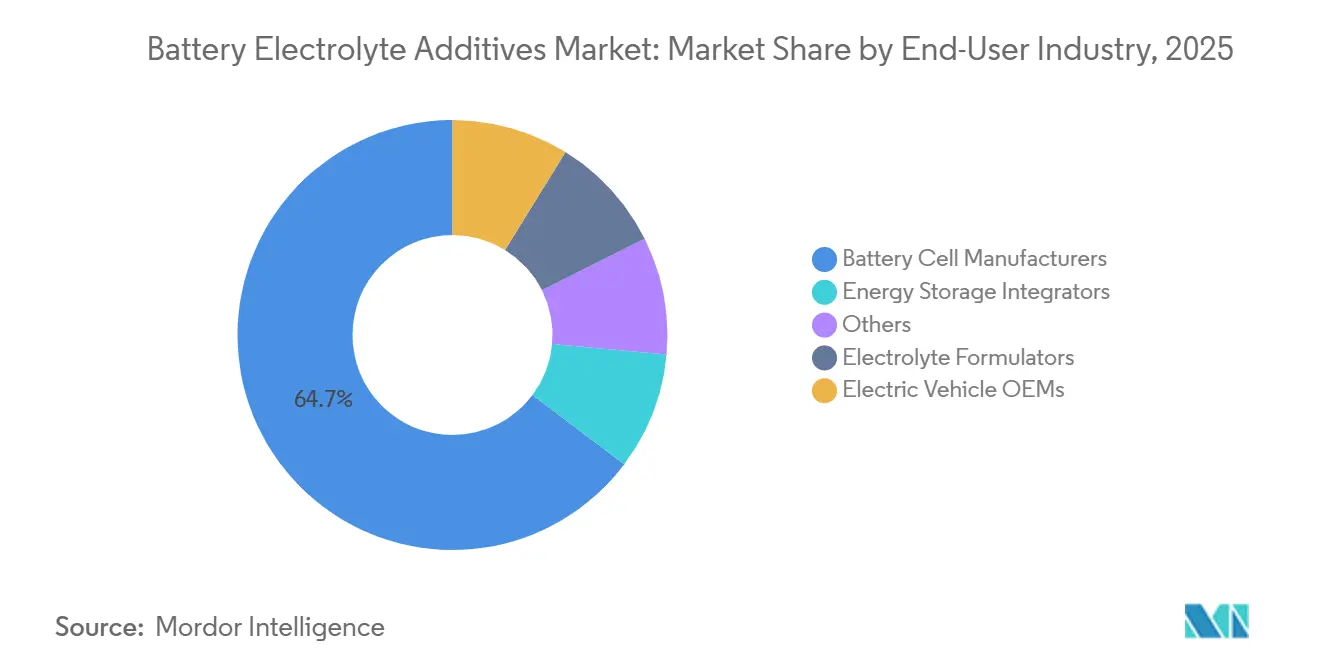
Cell Manufacturers Dominate, Integrators AccelerateBattery cell manufacturers held 64.74% of the battery electrolyte additives market share in 2025. They select additive packages, often specifying the molecular structure and purity level required for a cell design. Additive producers need Approved Vendor status before commercial supply can begin. This gatekeeping role makes cell manufacturers the central decision makers in the battery electrolyte additives market. Electrolyte formulators generally must source materials that meet the cell maker's stated requirements, making qualification history and technical service important competitive factors.
Energy storage integrators are forecast to grow at a 14.67% CAGR through 2031. Utility-scale developers and grid operators are increasingly embedding performance requirements in long-term offtake agreements. A tender that specifies a 20-year calendar-life electrolyte can create additional demand at the project level, giving suppliers another channel beyond the conventional cell-maker validation process. Electrolyte formulators are also consolidating as battery-grade blending facilities require more capital. Electric vehicle OEMs are increasingly specifying electrolyte additive requirements in cell-sourcing agreements, raising the strategic importance of additive producers in the supply chain.
Geography Analysis
APAC Battery Electrolyte Additives Market
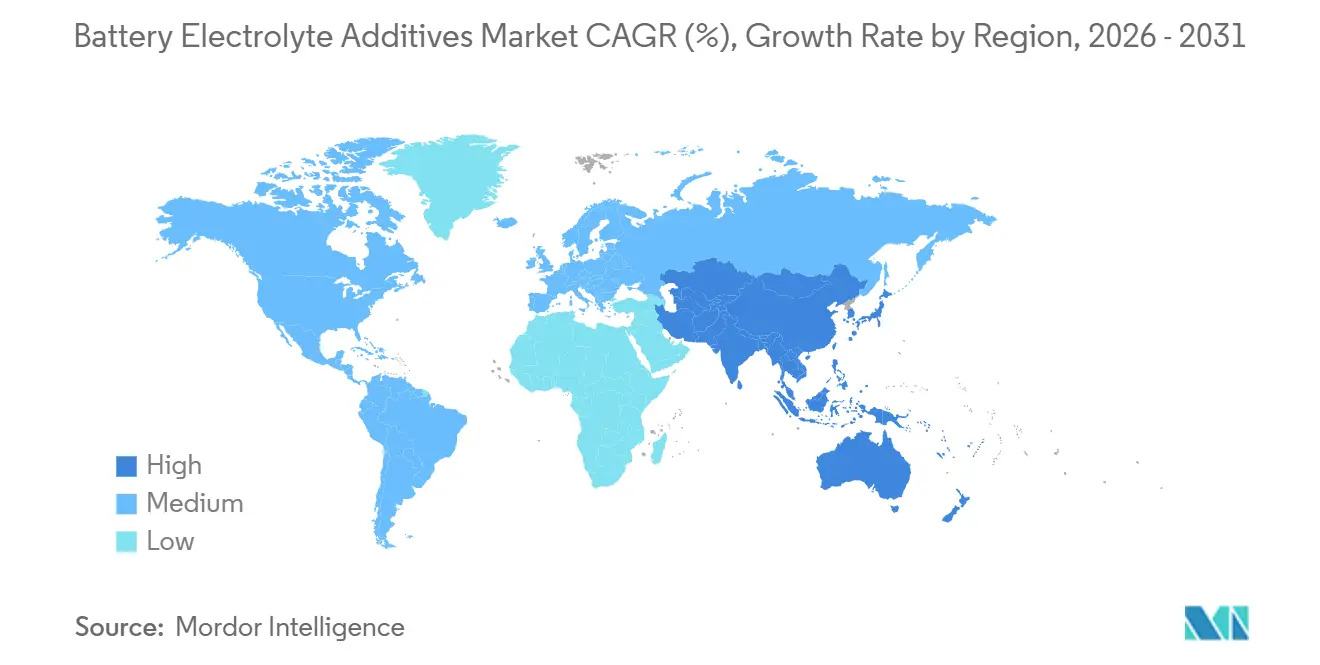
Asia-Pacific held 47.02% of the battery electrolyte additives market share in 2025 and is forecast to grow at a 14.05% CAGR through 2031. China accounted for more than 80% of global battery cell production capacity in 2025, giving the region a large base for procurement and manufacturing[2]. Suppliers without China-based manufacturing or technical service capabilities may be at a disadvantage in this procurement environment. South Korean companies such as Enchem, Soulbrain, Chunbo, and Dongwha Electrolyte supply major Korean cell makers and compete in China's energy storage system (ESS) market. Japan's Mitsubishi Chemical, through MU Ionic Solutions, and UBE Corporation retain positions as IP-rich incumbents with original additive patents.
North America and Europe Battery Electrolyte Additives Market
North America and Europe are growing from lower bases as domestic cell manufacturing investment increases. In the United States, the U.S. Energy Information Administration (EIA) projects 24 GW of new utility-scale storage capacity in 2026, supporting regional demand for battery materials. Regional cell production, including Ultium Cells, Samsung SDI facilities, and Honda-LG Energy Solution joint ventures, is increasing the need for locally blended and imported additives. Europe presents a different demand profile, as recyclability requirements and per- and polyfluoroalkyl substances (PFAS)-related regulations can affect the selection of chemistry. As a result, the battery electrolyte additives market in Europe may require formulations that differ from globally standard products. Localization for regional gigafactory qualifications is likely to become more important as each manufacturing hub develops its own approved supply base.
MEA and South America Battery Electrolyte Additives Market
South America, the Middle-East, and Africa remain early-stage regions but are becoming more relevant to the battery electrolyte additives market. Brazil and Argentina have seen growing electric vehicle assembly activity linked to Chinese OEM expansion, creating initial demand for imported additives and potentially supporting local supply as cell manufacturing follows. In July 2026, the African Development Bank approved a EUR 100 million loan (~USD 113.7 million) for Gotion Power Morocco's integrated lithium iron phosphate (LFP) gigafactory. The project targets 10 GWh in Phase 1 and 100 GWh at full build-out. Saudi Arabia's petrochemical base also provides a potential foundation for supplying carbonate solvents. These regions are unlikely to materially shift global market shares before 2028-2029, but they offer supply chain options for firms that establish regional capabilities early.
Competitive Landscape
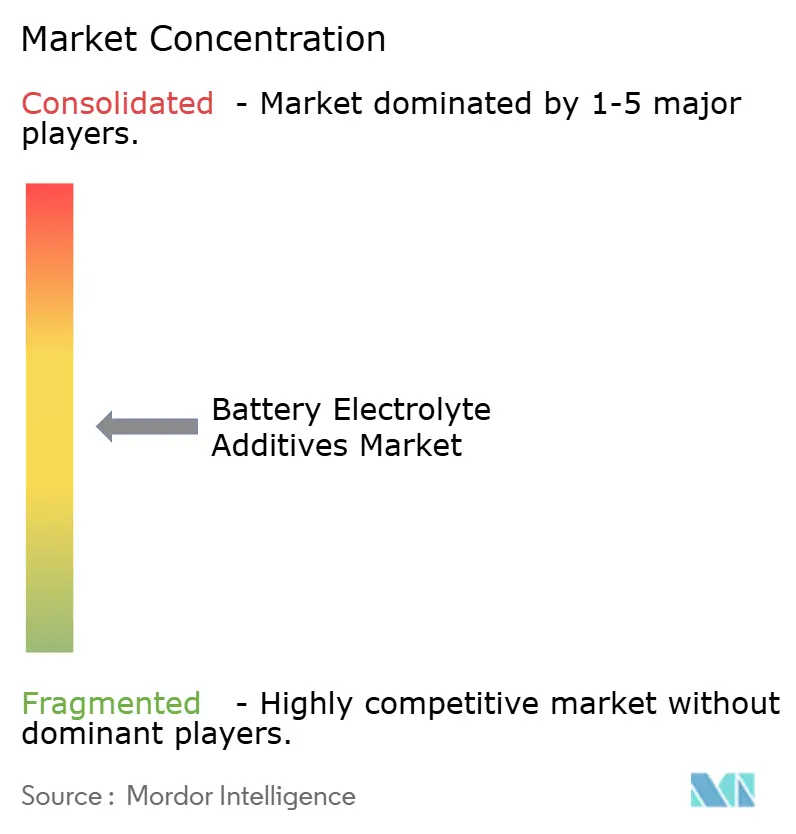
The battery electrolyte additives market is moderately fragmented. Guangzhou Tinci Materials, Capchem, and Zhangjiagang Guotai Huarong compete through production scale and proximity to CATL, BYD, and CALB. ENCHEM, Soulbrain, and Chunbo compete through purity control, molecule portfolios, and co-development work with LG Energy Solution, Samsung SDI, and SK On. BASF and Solvay bring high-purity synthesis and fluorinated chemistry capabilities, although Chinese suppliers are narrowing this quality gap. Competition, therefore, depends on material performance, qualification status, local service, and supply reliability.
ENCHEM became the largest shareholder of Joongang Advanced Materials in December 2025, seeking to internalize LiPF6 and LiFSI production and establish a supply chain independent of Chinese inputs by 2027. This move demonstrates how upstream integration can reduce exposure to restricted precursor supply. Tinci Materials also advanced its molecular innovation program by filing patents for electrolyte additives in late 2024 and 2026. The market is also being shaped by closer links between formulation work and manufacturing data systems. Inline electrolyte quality sensors and formation protocols can favor suppliers that design additives in collaboration with cell makers over those that only provide standard data sheets. These technical relationships can support a preference for specifications over suppliers focused solely on commodity output.
High-concentration and localized high-concentration electrolytes are an active research direction that could reduce demand for conventional additives if they reach commercial scale. Their high salt loading currently limits near-term use to premium applications due to cost. This makes conventional additive packages relevant for broad electric vehicle and Energy Storage System (ESS) production. The market is also responding to scrutiny of fluorinated chemistry by considering non-fluorinated materials, such as Vinylene Carbonate (VC) and borate-based additives. Suppliers with a broader molecule portfolio can manage this substitution risk more effectively.
Battery Electrolyte Additives Industry Leaders
-
Guangzhou Tinci Materials Technology Co., Ltd.
-
Capchem Electricals Limited
-
ENCHEM Co., Ltd.
-
Mitsubishi Chemical Corporation
-
Zhangjiagang Guotai Huarong New Chemical Materials Co.,Ltd.
- *Disclaimer: Major Players sorted in no particular order
Battery Electrolyte Additives Market Companies Covered in this Report
- 3M
- Asahi Kasei Corporation
- BASF
- Capchem Electricals Limited
- Central Glass Co., Ltd.
- Chunbo Co., Ltd.
- Dongwha Group
- ENCHEM Co., Ltd.
- Guangzhou Tinci Materials Technology Co., Ltd.
- Idemitsu Kosan Co.,Ltd.
- LG Chem
- Mitsubishi Chemical Corporation
- NEI Corporation
- Solvay
- Soulbrain Co., Ltd.
- UBE Corporation
- Zhangjiagang Guotai Huarong New Chemical Materials Co.,Ltd.
- Zhejiang Yongtai Technology Co., Ltd.
Recent Industry Developments in Battery Electrolyte Additives Market
- May 2026: Tesla announced an incremental investment of approximately USD 250 million in battery cell production at Giga Berlin, doubling the capacity target to 18 GWh and bringing total site investment to approximately EUR 1 billion (~USD 1.2 billion). Cell production is expected to begin in the first half of 2027, adding a European gigafactory-scale demand node for electrolyte additives qualified to Tesla's specifications.
- March 2026: Group14 Technologies commenced commercial production of its SCC55 silicon-carbon anode material at its Sangju, South Korea facility, designed for 2,000 metric tons per year and enabling 10 GWh of extreme-fast-charging battery capacity. SCC55 requires substantially higher fluoroethylene carbonate (FEC) loadings than graphite anodes, thereby increasing additive demand from cell manufacturers integrating silicon anodes.
Global Battery Electrolyte Additives Market Report Scope
Battery electrolyte additives are chemical compounds added in small quantities to a battery's liquid electrolyte to improve lifespan, safety, and performance. They form protective coatings on battery components and prevent unwanted chemical reactions.
The battery electrolyte additives market is segmented by chemistry, battery types, application, end-user industry, and geography. By chemistry, the market is segmented into vinylene carbonate, fluoroethylene carbonate, borate-based additives (LiBOB, LiDFOB), sulfones and sultones, phosphate-based additives, and others. by battery types, the market is segmented into lithium-ion batteries, LFP and LMFP batteries, next-generation batteries (silicon-rich anode, sodium-ion, lithium-metal), solid-state batteries, and others. by application, the market is segmented into electric vehicles, energy storage systems, consumer electronics, industrial applications, and others. by end-user industry, the market is segmented into battery cell manufacturers, electrolyte formulators, electric vehicle OEMs, energy storage integrators, and others. The report also covers market size and forecasts for battery electrolyte additives across 17 countries in major regions. The market sizes and forecasts are provided in terms of value (USD).
Segmentation Overview
| Vinylene Carbonate |
| Fluoroethylene Carbonate |
| Borate-Based Additives (LiBOB, LiDFOB) |
| Sulfones and Sultones |
| Phosphate-Based Additives |
| Others |
| Lithium-Ion Batteries |
| LFP and LMFP Batteries |
| Next-Generation Batteries (Silicon-Rich Anode, Sodium-Ion, Lithium-Metal) |
| Solid-State Batteries |
| Others |
| Electric Vehicles |
| Energy Storage Systems |
| Consumer Electronics |
| Industrial Applications |
| Others |
| Battery Cell Manufacturers |
| Electrolyte Formulators |
| Electric Vehicle OEMs |
| Energy Storage Integrators |
| Others |
| Asia-Pacific | China |
| India | |
| Japan | |
| South Korea | |
| ASEAN Countries | |
| Rest of Asia-Pacific | |
| North America | United States |
| Canada | |
| Mexico | |
| Europe | Germany |
| United Kingdom | |
| France | |
| Italy | |
| Spain | |
| NORDIC Countries | |
| Russia | |
| Rest of Europe | |
| South America | Brazil |
| Argentina | |
| Rest of South America | |
| Middle-East and Africa | Saudi Arabia |
| South Africa | |
| Rest of Middle-East and Africa |
| By Chemistry | Vinylene Carbonate | |
| Fluoroethylene Carbonate | ||
| Borate-Based Additives (LiBOB, LiDFOB) | ||
| Sulfones and Sultones | ||
| Phosphate-Based Additives | ||
| Others | ||
| By Battery Types | Lithium-Ion Batteries | |
| LFP and LMFP Batteries | ||
| Next-Generation Batteries (Silicon-Rich Anode, Sodium-Ion, Lithium-Metal) | ||
| Solid-State Batteries | ||
| Others | ||
| By Application | Electric Vehicles | |
| Energy Storage Systems | ||
| Consumer Electronics | ||
| Industrial Applications | ||
| Others | ||
| By End-User Industry | Battery Cell Manufacturers | |
| Electrolyte Formulators | ||
| Electric Vehicle OEMs | ||
| Energy Storage Integrators | ||
| Others | ||
| By Geography | Asia-Pacific | China |
| India | ||
| Japan | ||
| South Korea | ||
| ASEAN Countries | ||
| Rest of Asia-Pacific | ||
| North America | United States | |
| Canada | ||
| Mexico | ||
| Europe | Germany | |
| United Kingdom | ||
| France | ||
| Italy | ||
| Spain | ||
| NORDIC Countries | ||
| Russia | ||
| Rest of Europe | ||
| South America | Brazil | |
| Argentina | ||
| Rest of South America | ||
| Middle-East and Africa | Saudi Arabia | |
| South Africa | ||
| Rest of Middle-East and Africa | ||
Key Questions Answered in the Report
What is current market size of Battery Electrolyte Additives Market?
The battery electrolyte additives market size was estimated at USD 1.87 billion in 2025 and is estimated to grow from USD 2.11 billion in 2026 to USD 3.92 billion by 2031, at a CAGR of 13.18% during the forecast period (2026-2031).
Which chemistry leads battery electrolyte additive demand?
Vinylene carbonate led with a 34.67% share in 2025 because it remains a widely used Solid Electrolyte Interphase (SEI) film-forming additive for graphite-anode lithium-ion cells.
Which battery platform is growing fast for electrolyte additives?
Next-generation battery platforms, including silicon-rich anode, sodium-ion, and lithium-metal batteries, are forecast to grow at a CAGR of 13.93% through 2031.
Why are energy storage systems important for electrolyte additive suppliers?
Energy storage systems are forecast to grow at a CAGR of 14.21% through 2031 and need additives that support deep cycling and long calendar life.