
Bath Salts Market Size and Share
Market Overview
| Study Period | 2022 - 2032 |
|---|---|
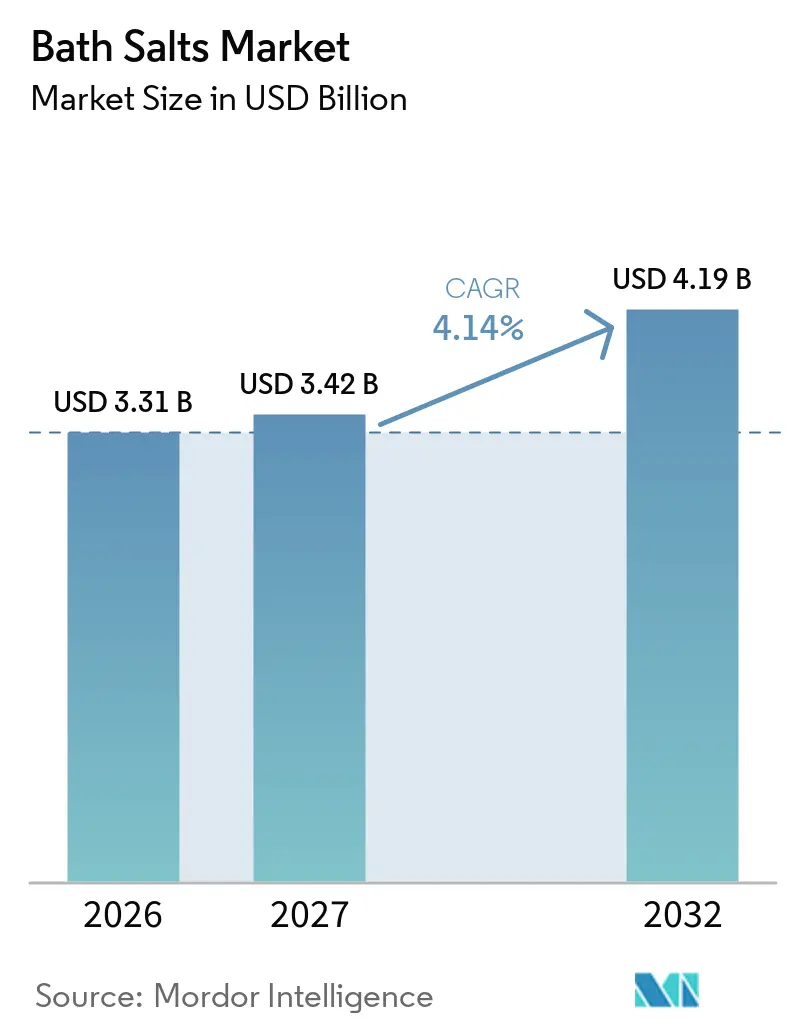
| Market Size (2027) | USD 3.42 Billion |
| Market Size (2032) | USD 4.19 Billion |
| Growth Rate (2027 - 2032) | 4.14 % |
| Fastest Growing Market | North America |
| Largest Market | Asia-Pacific |
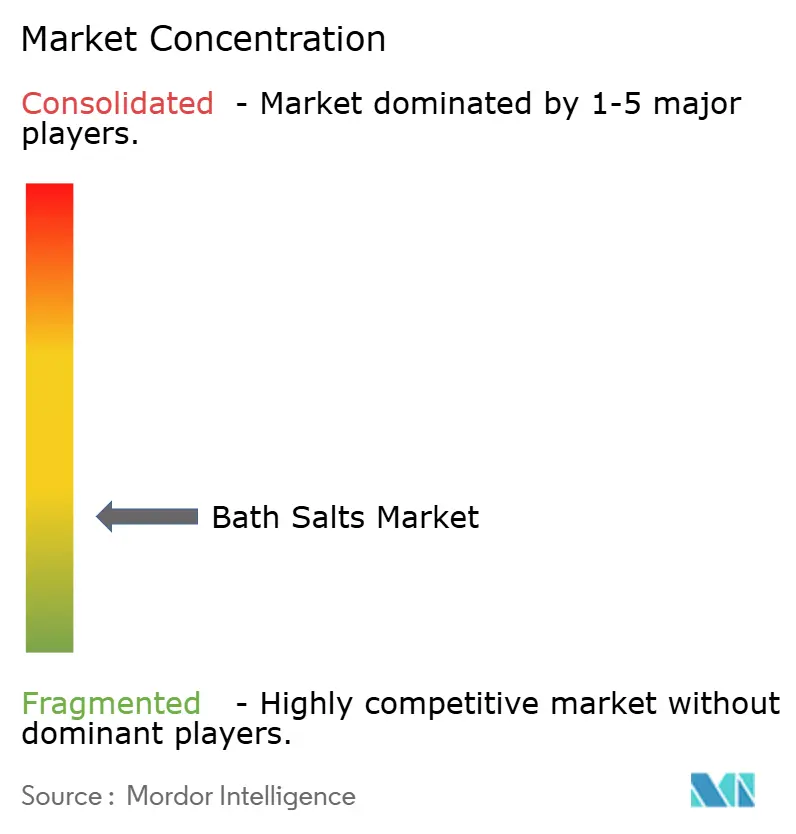
| Market Concentration | Low |
Major Players *Disclaimer: Major Players sorted in no particular order Image © Mordor Intelligence. Reuse requires attribution under CC BY 4.0. | |
Bath Salts Market Analysis by Mordor Intelligence
The bath salts market size is expected to grow from USD 3.31 billion in 2026 to USD 3.42 billion in 2027 and is forecast to reach USD 4.19 billion by 2032 at 4.14% CAGR over 2027-2032. The bath salts market is supported by consumers who use home bathing as a regular part of personal relaxation, recovery, and time set aside from daily routines. Urban stress, rising disposable income in Asia-Pacific, and continued spending on self-care support demand for mineral bathing products across both mass and premium retail settings. Spending on premium bath products can replace some spa visits for urban consumers, rather than simply add another discretionary purchase, particularly when the home bathroom is designed for longer and more intentional bathing. Product makers are responding with mineral sourcing stories, simpler ingredient lists, fragrance options, sustainable packaging efforts, and wider access through physical and digital retail.
Key Report Takeaways
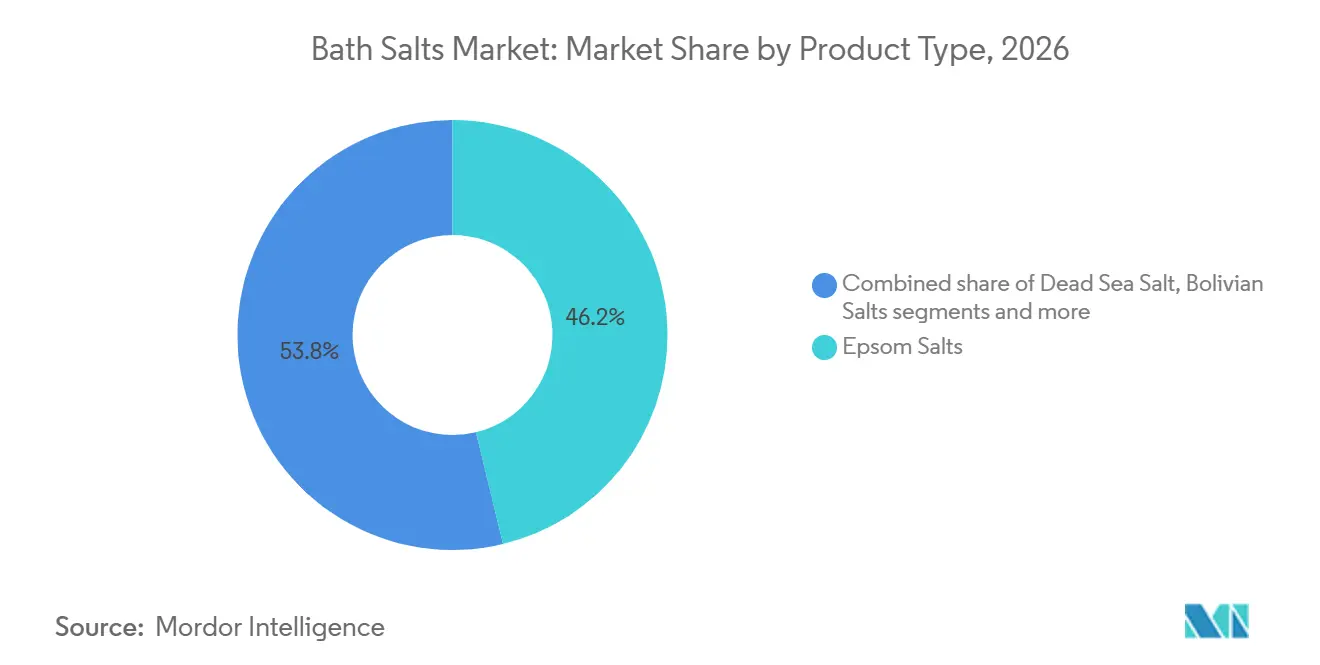
- By product type, epsom salts held 46.22% revenue share in 2026, while dead sea salt is forecast to expand at a 5.46% CAGR through 2032.
- By form, crystals held 42.37% revenue share in 2026, while flakes are forecast to expand at a 5.69% CAGR through 2032.
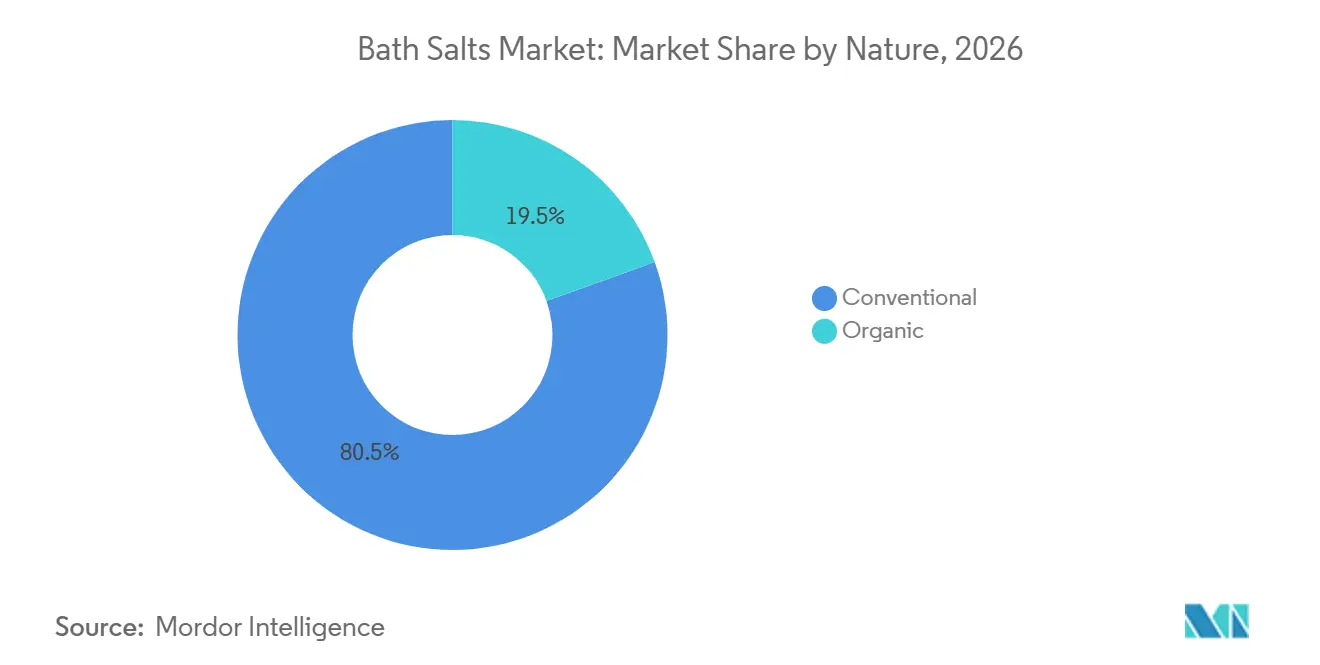
- By nature, conventional bath salts held 80.51% revenue share in 2026, while organic bath salts are forecast to expand at a 5.57% CAGR through 2032.
- By distribution channel, supermarkets and hypermarkets held 36.81% revenue share in 2026, while online retail stores are forecast to expand at a 5.94% CAGR through 2032.
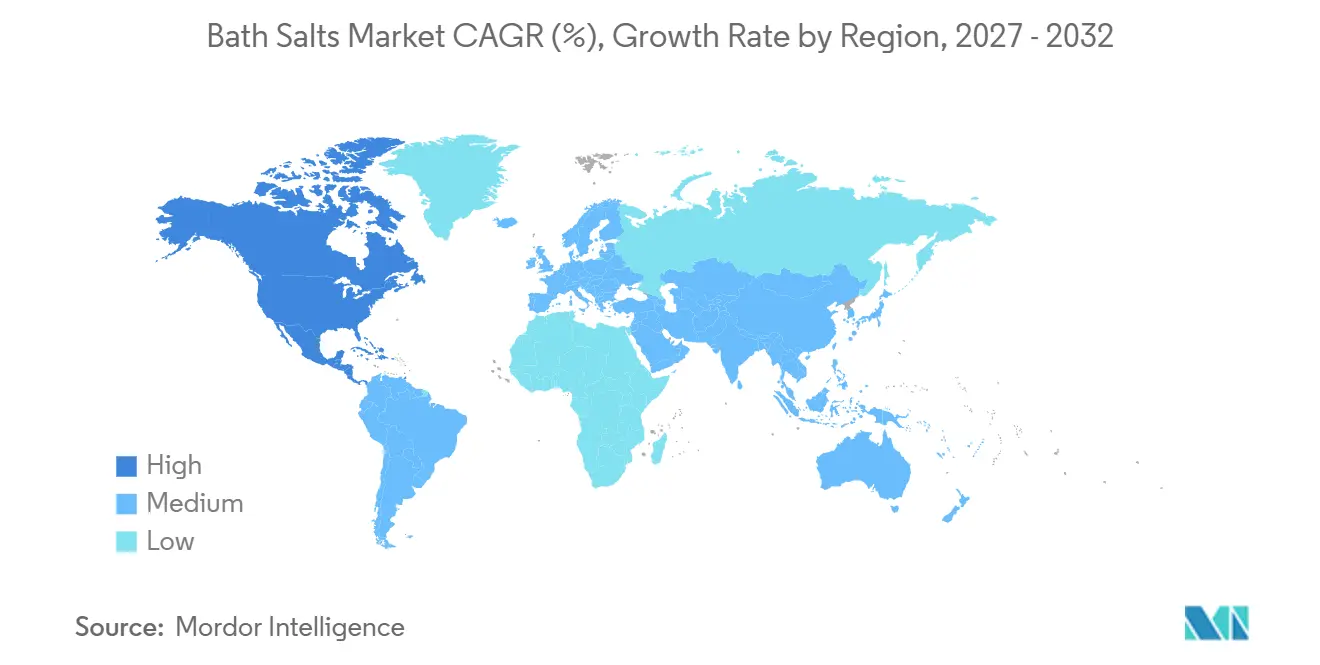
- By geography, Asia-Pacific held 32.38% revenue share in 2026, while North America is forecast to expand at a 5.96% CAGR through 2032.
Note: Market numbers in this report are based on Mordor Intelligence's proprietary estimation framework, which combines nine months of actuals with Q4 projections for base year 2026.
Market Trends and Insights
Drivers Impact Analysis of Bath Salts Market*
| Driver | (~) % Impact on CAGR Forecast | Geographic Relevance | Impact Timeline |
|---|---|---|---|
| Rising consumer demand for home-based relaxation and wellness products | +1.2% | Global | Medium term (2–4 years) |
| Increasing awareness of stress management and self-care routines | +0.9% | Global, led by North America and Europe | Medium term (2–4 years) |
| Growing popularity of spa-inspired bathing experiences at home | +0.7% | North America, Europe, Japan | Short term (≤ 2 years) |
| Rising demand for aromatherapy and fragrance-infused bath products | +0.6% | Global, Asia-Pacific core, spill-over to Middle East and Africa | Medium term (2–4 years) |
| Increasing consumer interest in mineral-based and natural personal care products | +0.5% | North America and European-Union | Long term (≥ 4 years) |
| Growing influence of social media and beauty and wellness trends | +0.4% | Global, led by North America, Asia-Pacific | Short term (≤ 2 years) |
| Source: Mordor Intelligence | |||
Rising Consumer Demand for Home-Based Relaxation and Wellness Products
Home wellness spending provides an important demand base for the bath salts market because it supports repeat use rather than occasional gifting alone. The National Kitchen and Bath Association reported in 2025 that 79% of surveyed bath design professionals expected health and wellness to drive primary bathroom design during the next 3 years. The same report found that 70% expected soaking tubs for physical healing and recovery to become part of mainstream residential specifications[1]. These changes raise expectations for bath accessories and create space for premium mineral salts that consumers can use in regular home routines, rather than only during a spa visit. Bath & Body Works reintroduced its True Blue Spa line in July 2025 to meet demand for spa-like bathing experiences at home. The bath salts market benefits when consumers view a home spa routine as an alternative to outside wellness spending and look for products that make the routine feel more complete.
Growing Influence of Social Media and Beauty and Wellness Trends
Social media shortens the time between discovering a bathing routine and buying a related product, especially when product use can be easily shown in short visual content. Vogue reported that the TikTok #Bath hashtag had reached 15.5 billion views in 2025, with mineral soaks appearing alongside candles and essential oils in home-bathing content. Bath & Body Works introduced its Restore Magnesium Body Care Collection in July 2025 after the viral “sleepy girl mocktail” trend gained attention on TikTok. This faster discovery cycle gives smaller brands a way to explain their mineral sourcing, scent profile, and product use directly to consumers without relying only on store displays. It also increases the value of product formats that work well in visual, repeatable home rituals and can be presented as part of a wider self-care routine. The bath salts market is therefore influenced by product launches that can move quickly from cultural interest to retail availability.
Increasing Consumer Interest in Mineral-Based and Natural Personal Care Products
Interest in mineral provenance gives producers another way to differentiate bath salt products and to show why one source or blend differs from another. A 2025 randomized controlled trial reported lower knee osteoarthritis pain scores after 7 days among participants receiving Epsom salt treatment, with a WOMAC score of 25.62 for the intervention group and 73.21 for the control group. The study does not make a general consumer-health claim, but it supports continued interest in Epsom salt as part of recovery-focused routines. Origins such as the Dead Sea, the Himalayas, and regional Epsom salt sources can become visible product attributes instead of procurement details that remain hidden from shoppers. Brands with authenticated mineral sources, careful handling information, and clear ingredient information can strengthen trust among consumers who assess personal-care inputs closely.
Rising Demand for Aromatherapy and Fragrance-Infused Bath Products
Aromatherapy is moving bath salts toward blends that pair minerals with botanical and fragrance ingredients, making the product a more complete part of a sensory bathing routine. Kneipp launched its Hibiscus & Fig bath salt in Japan in August 2025 with hibiscus and fig extracts. In September 2026, its White Birch Bath Salt recorded the highest presale shipment volume for a Kneipp product in Japan, according to the company announcement described in the supplied material. These launches show why brands are linking scent, botanical ingredients, and mineral products in one offer while giving consumers a clear reason to select a more premium item.
Restraints Impact Analysis of Bath Salts Market*
| Restraint | (~) % Impact on CAGR Forecast | Geographic Relevance | Impact Timeline |
|---|---|---|---|
| Limited consumer awareness of bath salts in emerging markets | -0.7% | South America, Middle East and Africa, Southeast Asia | Long term (≥ 4 years) |
| Availability of low-cost substitutes such as bath oils, bath bombs, and shower gels | -0.6% | Global | Short term (≤ 2 years) |
| Risk of skin irritation and allergic reactions from fragrances and additives | -0.3% | North America and European-Union | Medium term (2–4 years) |
| Stringent regulations governing cosmetic ingredients, labeling, and product claims | -0.4% | European-Union, North America | Medium term (2–4 years) |
| Source: Mordor Intelligence | |||
Risk of Skin Irritation and Allergic Reactions from Fragrances and Additives
Fragrance and additive risks can constrain premium bath formulations, particularly when consumers use several cosmetic products in the same routine and are concerned about cumulative exposure. The European Commission’s Scientific Committee on Consumer Safety issued 2025 opinions that found butylparaben unsafe for children aged 0.5 to 10 years in specified combined-use scenarios and found limits for salicylic acid use[2]. Regulation (EU) 2025/877 added 21 CMR substances to the prohibited list under Annex II of the Cosmetics Regulation in September 2025. Manufacturers must manage ingredient disclosures, safety reviews, reformulation requirements, and product claims across markets with different rules. Brands with short and transparent ingredient lists may find it easier to explain their products to consumers and to respond to scrutiny.
Availability of Low-Cost Substitutes Such as Bath Oils, Bath Bombs, and Shower Gels
Bath oils, bath bombs, and shower gels compete for the same home-bathing occasion and can be easier for first-time consumers to understand. These substitutes can offer fragrance, visual effects, and skin-conditioning at lower per-use prices. This constraint is stronger where consumers have limited knowledge of mineral bathing benefits and compare products mostly on immediate sensory appeal, price, and convenience. The bath salts market needs clear product education when lower-priced formats dominate personal-care spending and when mineral benefits are not widely understood. Affordable entry products, simple usage guidance, and clear product stories can reduce the barrier for first-time users. Product differentiation remains particularly important in regions where bathing additives are still an emerging category and where consumers must be given a direct reason to move beyond familiar formats.
*Our forecasts treat driver/restraint impacts as directional, not additive. The impact forecasts reflect baseline growth, mix effects, and variable interactions.
Bath Salts Market Segment Analysis
By Product Type:
Epsom Salts Lead Volume While Dead Sea Salt Builds Premium DemandEpsom Salts held 46.22% of the bath salts market share in 2026, supported by broad availability in pharmacies, grocery stores, mass retail, and familiar home-care routines. Consumers recognize the product as an accessible option for bathing after exercise, easing sore muscles, and building a simple evening relaxation routine. A 2025 randomized controlled trial found significant differences in pain and daily-living scores among knee osteoarthritis participants who received Epsom salt treatment[3]. The clinical result supports interest in recovery-oriented positioning, while it does not replace cosmetic safety review or product-specific evidence for retail products. Epsom Salts therefore remain the accessible foundation of the bath salts market for mainstream users and give retailers a recognizable entry item in the category.
Dead Sea Salt is forecast to grow at a 5.46% CAGR through 2032. Its mineral profile and established Dead Sea origin support a premium skincare-oriented proposition that differs from the everyday positioning of Epsom Salt. Himalayan Pink Salt provides a visible mid-premium option for specialty wellness retail, where color, texture, and origin can support the product story at the shelf. Bolivian salts and other specialty products serve consumers seeking distinct mineral profiles and wellness narratives, although their reach is more specialized. In the bath salts industry, origin identification can help specialist products stand apart from commodity salt offers and communicate why a higher-priced product may fit a consumer’s routine.

By Form:
Crystals Retain Shelf Presence While Flakes Support Aromatherapy BlendsCrystals accounted for 42.37% of 2026 sales. Their texture and visible mineral appearance suit gift packaging and premium jars, where the product itself can be seen before purchase. Crystals also offer a familiar format for consumers who use bath additives at home and want a simple product that can be measured by hand. Retail presentation can reinforce a product’s mineral origin and perceived quality, especially when a brand uses clear packaging and source information. This keeps crystals relevant across both everyday and premium bath routines, even as other forms gain attention.
Flakes are forecast to grow at a 5.69% CAGR through 2032, the fastest rate among form types. Their faster dissolution and larger surface area make them suitable for essential-oil absorption in aromatherapy products, which need mineral and fragrance ingredients to work together in the bath. Granules provide a cost-efficient format for private-label products and professional spa supply, where value and consistency often matter most. Powder is used where rapid dissolution and controlled dosing are more important than retail presentation, including selected spa, physiotherapy, and hotel-amenity uses. The bath salts market size for flakes is supported by fragrance-led products that rely on efficient blending with essential oils and a smoother at-home product experience.
By Nature:
Conventional Products Maintain Scale While Organic Products Gain Premium InterestConventional products commanded 80.51% of 2026 revenue. Their position reflects large-scale extraction, broad retail distribution, and price points that are accessible in mass channels where shoppers often purchase bath products with other routine personal-care items. Conventional products also give consumers a familiar route into the category without requiring a certification premium or specialist retail access. They remain important for supermarkets, hypermarkets, pharmacies, and value-oriented retail formats that serve a wide range of household budgets. This segment continues to provide the volume base for the bath salts market and supports category visibility across everyday retail locations.
Organic bath salts are forecast to grow at a 5.57% CAGR through 2032. Demand is linked to consumers who look for ingredient transparency, recognized clean-beauty standards, and mineral products that align with broader personal-care choices. Organic certifications can support premium shelf placement and clearer sourcing communication, particularly where retailers review ingredient standards before accepting products. The supplied material identifies ECOCERT, COSMOS Organic, and national organic bodies as relevant certification routes for producers seeking this positioning.
By Distribution Channel:
Supermarkets Preserve Reach While Online Retail Expands DiscoverySupermarkets and hypermarkets held 36.81% of the bath salts market in 2026. Their high traffic and broad price range make them important for routine and impulse purchases, including for consumers who do not actively seek specialty wellness products. Large stores also provide access for conventional Epsom Salt products and established bath brands, which benefit from being placed beside other body-care goods. Specialty stores serve a different purpose by allowing consumers to sample textures and fragrances before buying, an experience that can support premium product choice. The bath salts market continues to depend on physical retail because it combines availability, familiarity, and opportunities for product discovery.
Online retail stores are forecast to grow at a 5.94% CAGR through 2032. Digital channels give consumers access to specialized formats, origin-specific salts, and niche fragrance blends that are not always available in local stores. They also allow direct-to-consumer brands to explain mineral origin, ingredients, product use, and routine benefits in more detail than a physical package can carry. Subscription and bundle offers can support repeat purchase behavior for regular users and help brands present salts as part of a wider bathing routine. The bath salts market is supported by this combination of broad physical availability and online product discovery, rather than by a shift away from stores alone.
Geography Analysis
APAC Bath Salts Market
Asia-Pacific held 32.38% of 2026 revenue. Japan’s home-bathing culture, China’s expanding wellness consumer base, and South Korea’s interest in functional body care support the bath salts market across a mix of traditional and modern product use. The bath salts market in Japan benefits from established consumer familiarity with bath additives and the supplied material reports that its domestic bath-additive market grew 4% year over year during the first 8 months of 2026. Growth in single-serve formats and higher average unit prices also supports premium mineral bath products, particularly where convenience and product quality can be presented together.
North America and Europe Bath Salts Market
North America is forecast to grow at a 5.96% CAGR through 2032. The National Kitchen and Bath Association reported in 2025 that 90% of surveyed design professionals agreed that homeowners wanted their primary bathroom to be a retreat. The same survey found that 78% expected primary bathrooms to take inspiration from hotel and resort spa experiences in the following 3 years. These home-design preferences create a supportive setting for mineral soak products that consumers can use for recovery and relaxation, while Europe remains a mature market where consumers show interest in certified natural and organic bath products.
South America and MEA Bath Salts Market
South America has varied conditions across its main markets. Brazil has a large regional role in bath preparations, although premium bath salt spending remains below global averages in the supplied material and bath gels continue to capture much routine personal-care expenditure. Colombia and Guatemala are identified as countries with growing consumer interest as urbanization and income levels rise, creating room for entry-level bath additive offers. In the Middle East and Africa, the United Arab Emirates and Saudi Arabia offer more developed premium wellness and spa retail settings where mineral formats can fit established gift and hospitality channels.
Competitive Landscape
The bath salts market is characterized by highly fragmented landscape. Large consumer goods companies and specialist producers compete through different strengths, which leaves room for widely distributed brands and focused mineral specialists to operate at the same time. Large companies can use established retail networks and brand recognition from adjacent personal-care categories, while specialists can emphasize mineral origin, therapeutic positioning, and close consumer communities. This fragmented structure keeps product choice broad, limits the pricing power of any one brand, and makes shelf presence and brand credibility important competitive factors.
Companies are focusing on clean formulations, source transparency, more sustainable packaging, and digital direct-to-consumer channels. Westlab introduced an aromatherapy collection in May 2026 that paired Epsom salts with natural essential oils for exclusive sale through Morrisons. The launch extended the company’s mineral expertise into fragrance-focused bath products and gave the retailer an exclusive range that links mineral use with a more sensory ritual. Bath & Body Works used wellness ingredients in its 2025 Restore Magnesium Body Care Collection, showing how a large personal-care brand can apply a viral wellness theme to a broader bath offer.
Packaging can become a differentiator when a bath product must remain protected from moisture and still meet consumer expectations for more sustainable materials. The supplied material describes Kneipp’s October 2026 GreenCan trial with Sonoco for limited-edition bath crystals, using packaging with up to 98% paper content and 69% recycled fiber. This type of development can raise expectations for packaging across bath products, while the market also has room for targeted mineral blends that address sleep or post-exercise routines subject to product-claim rules.
Bath Salts Industry Leaders
-
Westlab Ltd
-
Kneipp GmbH
-
L’Occitane International S.A.
-
Kao Corporation
-
Arthēa
- *Disclaimer: Major Players sorted in no particular order
Bath Salts Market Companies Covered in this Report
- Arthēa
- Westlab Ltd
- L'Occitane International S.A.
- Kao Corporation
- Kneipp GmbH
- Bathorium Inc.
- Bathclin Corporation
- Dead Sea Ltd.
- The Midwest Sea Salt Company Inc.
- Better Bath Better Body LLC
- Indigo Wild, LLC
- Enviromedica
- STENDERS SIA
- Dadakarides Salt S.A.
- Herbivore Botanicals LLC
- Unilever plc
- Ahava Dead Sea Laboratories, Ltd.
- Aromatherapy Associates
- The Body Shop International Limited
- Bath and Body Works, Inc.
Recent Industry Developments in Bath Salts Market
- October 2026: Kneipp GmbH introduced a limited-edition bath crystal product in partnership with Sonoco, replacing conventional rigid plastic packaging with a high-paper-content GreenCan packaging solution designed to protect moisture-sensitive bath crystals while maintaining premium presentation.
- February 2026: NEHAN TOKYO launched two medicated bath salt products, EPSOLT Mingetsu and EPSOLT Onjitsu, featuring distinct nighttime and morning bathing concepts. The formulations incorporate hot-spring-inspired ingredients, Epsom salt, herbal ingredients, and differentiated fragrances, targeting daily wellness routines and gifting occasions.
- January 2026: LaMarriia Company Inc. launched its IDASELS natural bath soak collection, introducing three bath salt products made with premium ingredients and positioned around plant-based skincare, self-care, and environmentally conscious product development.
- December 2025: Ozco Goods launched its Mineral Milk Bath Soak, combining Dead Sea salt, Himalayan pink salt, kaolin clay, coconut milk powder, and colloidal oatmeal to position the product around mineral replenishment, skin conditioning, and restorative bathing experiences.
Global Bath Salts Market Report Scope
Bath salts are personal care products formulated from mineral salts, such as Epsom salt, sea salt, and Himalayan pink salt, that are dissolved in bathwater to enhance the bathing experience. The market is segmented by product type, form, nature distribution channel and geography. Based on product type, the market is segmented by epsom salts, dead sea salt, himalayan pink salt, bolivian salts and other types. Based on form, the market is segmented into crystals, granules, powder and flakes. Based on nature, the market is segmented into conventional and organic. Based on distribution channel, the market is segmented into supermarkets and hypermarkets, specialty stores, online retail stores and other distribution channels. By geography, the market is segmented into North America, Europe, Asia-Pacific, South America, and Middle-East and Africa. For each segment, the market sizing and forecasting have been done in value terms (USD billion).
Segmentation Overview
| Epsom Salts |
| Dead Sea Salt |
| Himalayan Pink Salt |
| Bolivian Salts |
| Other Types |
| Crystals |
| Granules |
| Powder |
| Flakes |
| Conventional |
| Organic |
| Supermarkets and Hypermarkets |
| Specialty Stores |
| Online Retail Stores |
| Other Distribution Channels |
| North America | United States |
| Canada | |
| Mexico | |
| Rest of North America | |
| Europe | United Kingdom |
| Germany | |
| France | |
| Italy | |
| Spain | |
| Sweden | |
| Belgium | |
| Poland | |
| Netherlands | |
| Rest of Europe | |
| Asia-Pacific | China |
| India | |
| Japan | |
| Thailand | |
| Singapore | |
| Indonesia | |
| South Korea | |
| Australia | |
| New Zealand | |
| Rest of Asia-Pacific | |
| South America | Brazil |
| Argentina | |
| Peru | |
| Colombia | |
| Chile | |
| Rest of South America | |
| Middle East and Africa | South Africa |
| Saudi Arabia | |
| United Arab Emirates | |
| Nigeria | |
| Egypt | |
| Morocco | |
| Rest of Middle East and Africa |
| By Product Type | Epsom Salts | |
| Dead Sea Salt | ||
| Himalayan Pink Salt | ||
| Bolivian Salts | ||
| Other Types | ||
| By Form | Crystals | |
| Granules | ||
| Powder | ||
| Flakes | ||
| By Nature | Conventional | |
| Organic | ||
| By Distribution Channel | Supermarkets and Hypermarkets | |
| Specialty Stores | ||
| Online Retail Stores | ||
| Other Distribution Channels | ||
| By Geography | North America | United States |
| Canada | ||
| Mexico | ||
| Rest of North America | ||
| Europe | United Kingdom | |
| Germany | ||
| France | ||
| Italy | ||
| Spain | ||
| Sweden | ||
| Belgium | ||
| Poland | ||
| Netherlands | ||
| Rest of Europe | ||
| Asia-Pacific | China | |
| India | ||
| Japan | ||
| Thailand | ||
| Singapore | ||
| Indonesia | ||
| South Korea | ||
| Australia | ||
| New Zealand | ||
| Rest of Asia-Pacific | ||
| South America | Brazil | |
| Argentina | ||
| Peru | ||
| Colombia | ||
| Chile | ||
| Rest of South America | ||
| Middle East and Africa | South Africa | |
| Saudi Arabia | ||
| United Arab Emirates | ||
| Nigeria | ||
| Egypt | ||
| Morocco | ||
| Rest of Middle East and Africa | ||
Key Questions Answered in the Report
What is driving demand in the bath salts market?
Home-based relaxation, recovery routines, aromatherapy, mineral-product interest, and digital product discovery support demand.
How large is the bath salts category?
It is projected to rise from USD 3.31 billion in 2026 to USD 4.19 billion by 2032 at a 4.14% CAGR.
Which bath salt type leads sales?
Epsom Salts led product-type revenue with a 46.22% share in 2026.
Which sales channel is growing fastest for bath salts?
Online retail stores are projected to grow at a 5.94% CAGR through 2032.
Which region is expected to grow fastest?
North America is forecast to grow at a 5.96% CAGR through 2032.