
Bangladesh Liquid Packaging Cartons Market Size and Share
Market Overview
| Study Period | 2021 - 2032 |
|---|---|
| Forecast Data Period | 2027 - 2032 |
| Base Year Market Size (2026) | USD 19.35 Million |
| Market Size (2027) | USD 20.81 Million |
| Market Size (2032) | USD 27.79 Million |
| Growth Rate (2027 - 2032) | 5.96 % |
| Market Concentration | High |
Major Players *Disclaimer: Major Players sorted in no particular order Image © Mordor Intelligence. Reuse requires attribution under CC BY 4.0. | |
Bangladesh Liquid Packaging Cartons Market Analysis by Mordor Intelligence
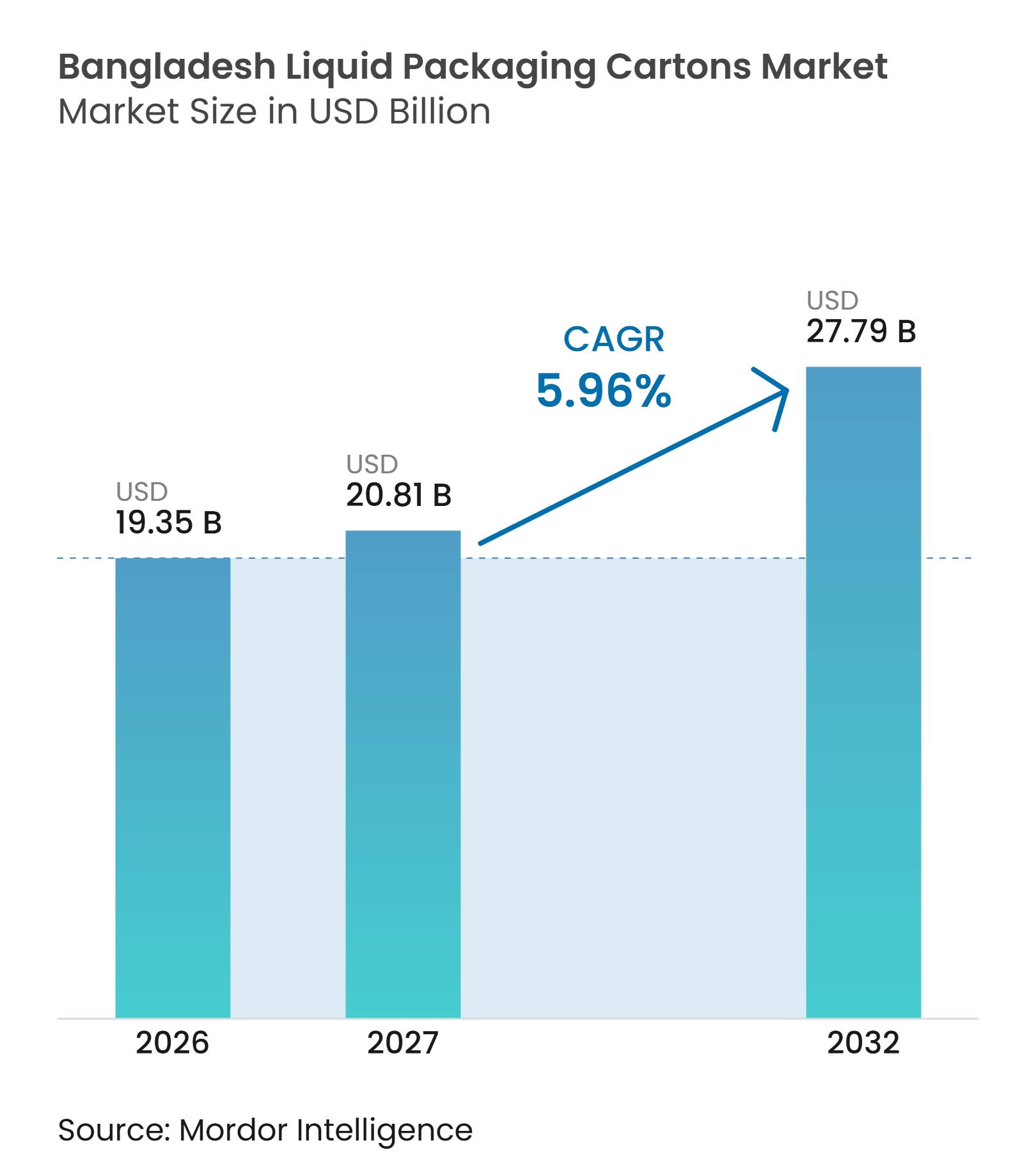
The Bangladesh Liquid Packaging Cartons Market size is expected to increase from USD 19.35 billion in 2026 to USD 20.81 billion in 2027 and reach USD 27.79 billion by 2032, growing at a CAGR of 5.96% over 2027-2032.
The Bangladesh liquid packaging cartons market is supported by the formalization of milk collection and processing, which shifts volume from informal channels into packaged UHT products. Aseptic cartons remain central because they enable dairy and beverage products to be distributed through areas with limited refrigeration. Smaller formats also support school milk programs and reduce cash outlays for consumers who frequently buy packaged drinks. Suppliers are responding by increasing regional production capacity, adopting flexible filling systems, and using lower-carbon barrier materials. Input costs for aluminum foil, paperboard, and polymers, together with weak carton collection systems, remain constraints for the Bangladesh liquid packaging cartons market.
Key Report Takeaways
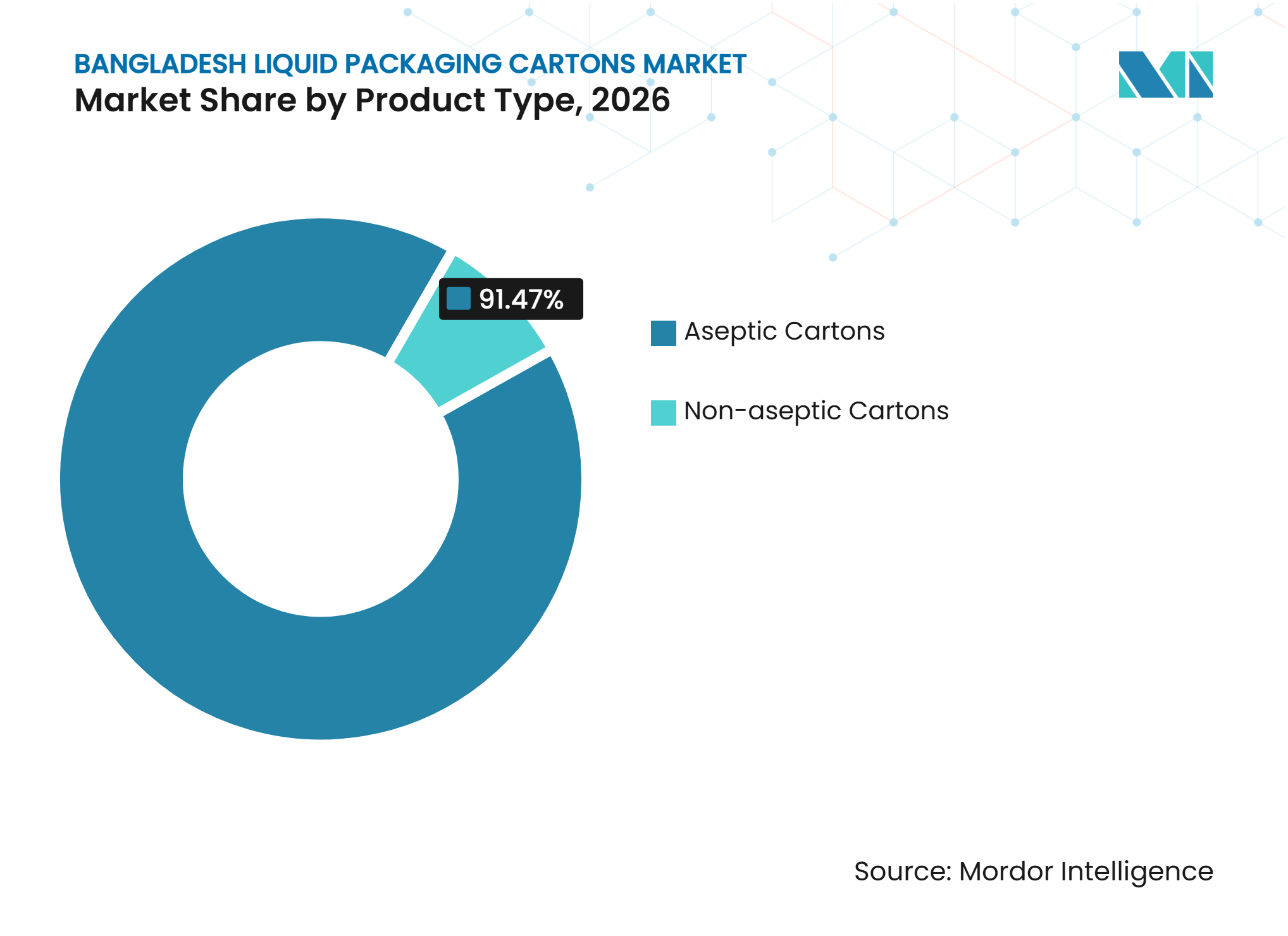
- By product type, aseptic cartons accounted for 91.47% of the Bangladesh liquid packaging carton market share in 2026 and are projected to expand at a 6.14% CAGR through 2032.
- By application, milk accounted for 57.12% of carton demand in 2026, while plant-based beverages are expected to expand at a 7.01% CAGR through 2032.
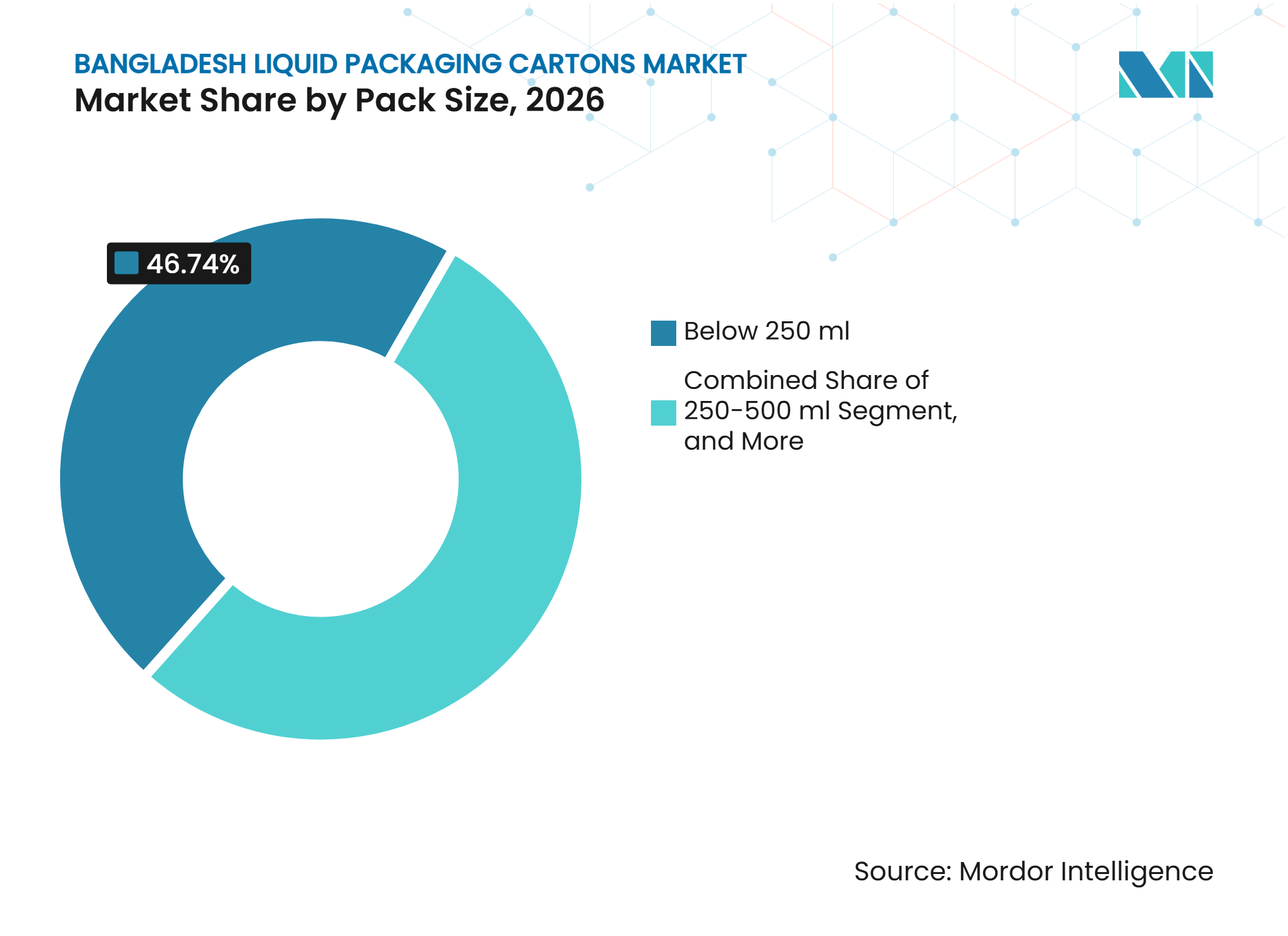
- By pack size, below-250 ml formats accounted for 46.74% of the Bangladesh liquid packaging cartons market in 2026 and are projected to expand at a 6.56% CAGR through 2032.
Note: Market numbers in this report are based on Mordor Intelligence's proprietary estimation framework, which combines nine months of actuals with Q4 projections for base year 2026.
Market Trends and Insights
Drivers Impact Analysis of Bangladesh Liquid Packaging Cartons Market*
| Driver | (~) % Impact on CAGR Forecast | Geographic Relevance | Impact Timeline |
|---|---|---|---|
| Dairy Supply Chain Formalization | +1.6% | National, with early gains in Dhaka and Rajshahi corridors | Medium term (2-4 years) |
| UHT Milk Distribution Beyond Major Cities | +1.4% | National, with highest impact in Chittagong, Rajshahi, and Khulna divisions | Medium term (2-4 years) |
| Juice and Functional Beverage Portfolios | +1.0% | Dhaka and Chittagong, with spillover to Sylhet | Short term (≤ 2 years) |
| Institutional and School Milk Programs | +0.8% | National, across 61 districts under the government program | Short term (≤ 2 years) |
| Low-Cold-Chain Distribution Requirements | +0.6% | Global, with a structural advantage in rural Bangladesh | Long term (≥ 4 years) |
| Food-Loss Reduction Through Shelf-Stable Liquid Food Packaging | +0.4% | National | Long term (≥ 4 years) |
| Source: Mordor Intelligence | |||
Formalization of Bangladesh's Dairy Supply Chain
Bangladesh's dairy supply chain has a large informal component, with 91% of milk moving through informal channels according to the cited research. This structure leaves milk exposed to inconsistent quality controls, distribution losses, and fragmented collection practices. The Dairy Development Board was formed in 2026 under the Ministry of Fisheries and Livestock to organize milk collection, strengthen quality standards, and regulate processing. The Bangladesh liquid packaging cartons market benefits when milk moves into formal processing because UHT products require a dependable ambient distribution format. The Green Dairy Partnership established 34 Village Milk Collection Centers in southwestern Bangladesh to strengthen formal procurement and processing links.[1] Research focused on Rajshahi also identified partial cold-chain coverage, intermediaries, and weak traceability as barriers that formal processing can address
Expansion of UHT Milk Distribution Beyond Major Cities
UHT milk in aseptic cartons provides a practical route to consumers who live outside refrigerated distribution networks. PRAN Dairy reported that annual UHT milk consumption was expanding by more than 10%, supported by over 16,000 contracted farmers, 7 regional hubs, and 120 Village Milk Collection Centers. Retailers in secondary cities can hold UHT stock without the energy and spoilage burdens associated with chilled inventory. This advantage supports the Bangladesh liquid packaging cartons market in Comilla, Barishal, Bogra, and Dinajpur, where distributors can serve smaller outlets with longer-life products. The planned school feeding program targets 31.3 lakh students across 19,419 primary schools and can create dependable local demand nodes. The wider distribution network may also improve the reach of juice and fortified drinks as processors add routes beyond major cities.
Growth of Juice and Functional Beverage Portfolios
Tax increases reduced Bangladesh's carbonated soft-drink category from BDT 10,000 crore in FY2022-23 to BDT 8,000 crore in FY2024-25, encouraging interest in juice, lower-calorie drinks, and products marketed around health attributes. A 2026 study on demand for packaged fruit juice in Dhaka found that health consciousness strongly influenced purchase intention among urban consumers. Aseptic cartons are suited to this product mix because they protect liquid products during ambient storage. The Bangladesh liquid packaging cartons market can therefore benefit from PRAN and Akij's portfolio expansion as they address urban consumers with juice and health-drink offerings. Cartons also provide the shelf life needed by retailers operating in high-temperature conditions. This product shift broadens demand beyond milk, although dairy remains the core volume application.
Institutional and School Milk Programs
School milk programs create predictable demand for 200 ml UHT packs and reduce exposure to discretionary household spending. In December 2025, the Livestock and Dairy Development Project expanded its School Milk Program to 600 primary schools across 61 districts, reaching 161,004 students with daily 200 ml UHT milk packets. BRAC Dairy and Food Products, Akij Dairy, PRAN Dairy, and Rangpur Dairy supplied the program under government supervision. The proposed national school feeding program can extend structured demand into underserved upazilas. The Directorate of Primary Education's role also makes quality compliance more important, while the DLS Quality Control Lab requires testing for school-distributed UHT milk. These requirements support established aseptic formats and reinforce demand for small cartons in the Bangladesh liquid packaging cartons market.
Restraints Impact Analysis of Bangladesh Liquid Packaging Cartons Market*
| Restraint | (~) % Impact on CAGR Forecast | Geographic Relevance | Impact Timeline |
|---|---|---|---|
| Premium Consumer Price Sensitivity | -0.9% | National, most acute in rural and semi-urban markets | Medium term (2-4 years) |
| Imported Material Cost Volatility | -0.8% | Global, with highest pass-through risk in import-dependent Bangladesh | Short term (≤ 2 years) |
| Limited Carton Collection and Recycling Infrastructure | -0.4% | National, most pronounced outside Dhaka | Long term (≥ 4 years) |
| Low Industrial Processing of Domestic Milk | -0.3% | National, most acute in the northern milk belt | Long term (≥ 4 years) |
| Source: Mordor Intelligence | |||
Premium Price Sensitivity Among Bangladeshi Consumers
The price difference between UHT milk in cartons and loose milk limits adoption among lower-income households. The supplied research placed daily per-capita milk consumption at 165 ml, below the World Health Organization recommendation of 250 ml, and linked affordability to this gap. A 2026 Dhaka study found that subsidized pricing influenced food choices more strongly than health or brand cues for low-income consumers. Smaller retailers may give more shelf space to loose or pouch-packed milk when carton products turn slowly. Pack-size innovation can reduce the absolute purchase price, but higher material costs can limit the room to lower retail prices. The Bangladesh liquid packaging cartons market therefore remains more exposed to household purchasing power outside affluent urban areas.
Volatility in Imported Paperboard, Aluminum Foil, and Polymer Inputs
Bangladesh imports the multilayer materials needed for aseptic cartons, including coated paperboard, aluminum foil, and polymer layers. Flexible Packaging Europe reported that geopolitical disruption increased BOPP film prices sharply in Q2 2026, while LDPE rose 31% and aluminum foil rose 12% during the period. Some input prices eased from Q2 peaks in Q3, but aluminum foil remained 11% above its Q3 2025 level.[2] Taka depreciation adds pressure because imports of carton materials are settled in foreign currency. Long-term supply contracts can delay price adjustments for converters and processors when commodity prices rise quickly. Regional production capacity in India and Vietnam can improve supply options over time, but it does not remove short-term commodity exposure.
*Our forecasts treat driver/restraint impacts as directional, not additive. The impact forecasts reflect baseline growth, mix effects, and variable interactions.
Bangladesh Liquid Packaging Cartons Market Segment Analysis
By Product Type:
Aseptic Cartons Define Ambient DistributionAseptic cartons held 91.47% of the Bangladesh liquid packaging cartons market share in 2026 and are projected to expand at a 6.14% CAGR through 2032. Their lead reflects the need to distribute milk and beverages without broad refrigerated logistics. Multilayer cartons combine paperboard, aluminum foil, and polyethylene to protect products from light and oxygen. This format gives processors an option for longer ambient shelf life without synthetic preservatives. Food-safety systems used by leading processors also support the use of validated aseptic packaging.
Non-aseptic cartons accounted for the remaining 8.53% of demand and are primarily used for chilled dairy formats in modern retail. Their addressable volume is limited because only 10% of milk is stored under cold-chain conditions at any point in the value chain, according to the supplied research. Supermarkets are expanding, but this channel remains smaller than Bangladesh's broader retail system. Tetra Pak introduced paper-based barrier technology with 92% renewable content and a reported carbon-footprint reduction of up to 43%, which may improve the environmental position of aseptic formats. The Bangladesh liquid packaging cartons market will continue to rely on aseptic technology, while chilled cartons remain concentrated in the modern trade of Dhaka and Chittagong.



By Application:
Milk Anchors Demand While Plant-Based Beverages ExpandMilk accounted for 57.12% of carton demand in 2026, making it the largest application within the Bangladesh liquid packaging cartons market. PRAN Dairy, BRAC Dairy, Milk Vita, and Akij's Farm Fresh brand support the formal UHT milk supply base. The school milk program served 161,004 students with daily 200 ml UHT milk packs, creating regular demand for cartons outside normal retail channels. Juice is the second-largest application, supported by consumer interest in packaged products with health-related positioning. Dairy products other than milk, energy drinks, functional beverages, and liquid foods add smaller but growing sources of demand.
Plant-based beverages are expected to expand at a 7.01% CAGR through 2032, the highest application rate in the supplied research. Rising awareness of lactose sensitivity, imports of international brands, and local work on oat and soy drinks support this early-stage category. These products need the same ambient-barrier protection as dairy products and may require tighter filling and quality control. This requirement favors aseptic suppliers that can support consistent conversion and filling performance. The Bangladesh liquid packaging cartons market therefore has an opportunity to diversify demand without relying only on conventional milk volumes. The category remains small compared with milk and juice, but it introduces a higher-specification use case for cartons.
By Pack Size:
Small Packs Support Affordability and Institutional DemandBelow-250 ml formats accounted for 46.74% of the Bangladesh liquid packaging cartons market size in 2026 and are expected to expand at a 6.56% CAGR through 2032. The format is important because it lowers the cash cost of each purchase for price-sensitive consumers. It also matches the 200 ml pack used by school milk programs. Urban commuters and small retailers can stock single-serve products more easily than larger formats. This combination supports both retail access and institutional demand.
The 250-500 ml segment serves household purchases of milk and juice, particularly in modern retail. Above-500 ml packs are used in foodservice, catering, bakery, hospital nutrition programs, and food processing, but face competition from bulk plastic packs in informal channels. Format changes can reduce filling-line productivity when producers run 100 ml and 1 liter formats on the same equipment. SIG's Neo platform supports format changes in under 15 minutes, responding to the need for varied pack sizes. The Bangladesh liquid packaging cartons market may favor suppliers that can offer flexible filling performance as pack-size demand becomes more varied.

Geography Analysis
Dhaka Division
Dhaka Division concentrates formal liquid-food consumption, organized dairy processing, and modern retail, making it the main demand center for the Bangladesh liquid packaging cartons market. The division's population exceeds 24 million and includes substantial rural-to-urban migration, which has shifted food-purchase habits toward packaged and shelf-stable liquids. PRAN Dairy's distribution hub and Akij Food and Beverage's Dhamrai facility sit in the greater Dhaka industrial corridor, and Akij opened a high-capacity packaged water production line there in September 2025. Shwapno's outlet expansion provides more organized shelf space for cartons. The Bangladesh Food Safety Authority's inspection activity makes compliance a stronger commercial factor for dairy and beverage suppliers.
Chittagong Division
Chittagong Division is an import gateway for carton substrates and a major consumption center for carton-packed dairy and beverages, so port efficiency affects the cost and availability of imported paperboard, aluminum foil, and polymer layers. PRAN and Akij are extending distribution into secondary-city outlets, while UHT milk allows retailers to avoid cold-storage costs. The Hill Tracts create a distinct opportunity because unreliable electricity makes ambient-stable products more practical than chilled alternatives, supporting carton distribution in Rangamati, Khagrachhari, and Bandarban. This dual role makes Chittagong important to Bangladesh's liquid packaging carton market.
Regional Markets Beyond Major Hubs
Rajshahi is important as an upstream milk region, covering the Sirajganj, Pabna, and Natore production belt. Milk Vita operates rural chilling depots there, while PRAN collection hubs channel milk into formal processing. Khulna benefits from the Green Dairy Partnership and its 34 Village Milk Collection Centers, which can increase the volume of formal milk available to processors. Sylhet's diaspora-linked consumer base and remittance-supported incomes support earlier adoption of premium packaged dairy and beverages, while IFC financing for Mymensingh Agro can add beverage capacity in the central-north corridor. Barishal and Rangpur remain less developed carton markets, but school milk coverage can establish an initial formal demand base.
Competitive Landscape
Market Concentration
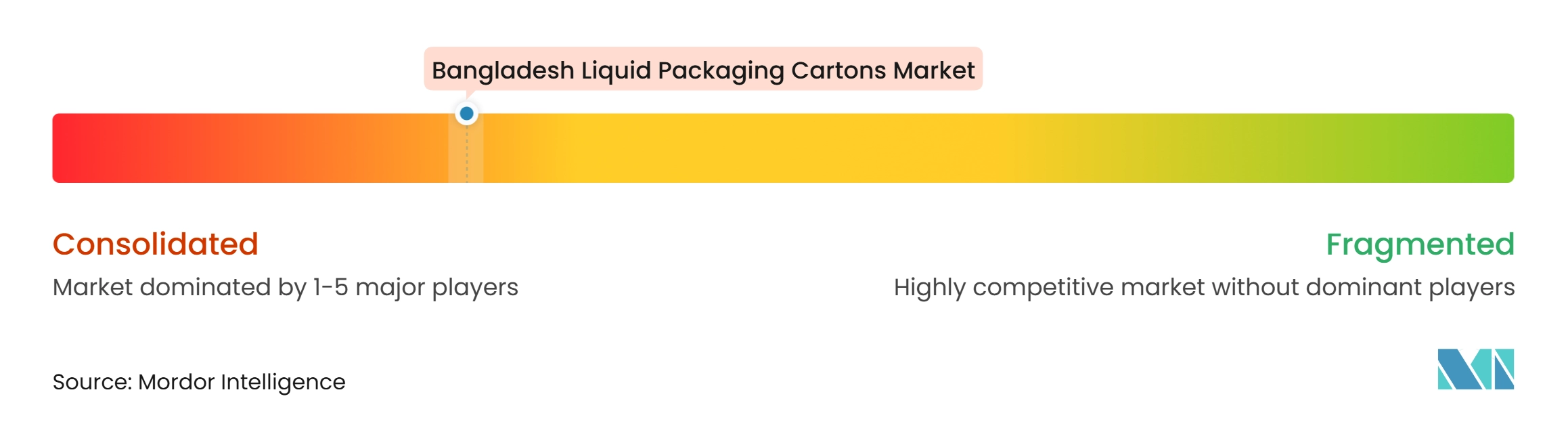
The Bangladesh liquid packaging cartons market is concentrated at the technology and carton-material supply tier. Tetra Pak is the leading supplier of aseptic filling systems and carton sleeves to major domestic dairy processors. Its position is reinforced by the interdependencies among filling equipment, sleeve formats, maintenance, and operating procedures, which create switching costs for processors invested in a single carton platform. Tetra Pak expanded its Binh Duong, Vietnam, facility in July 2025, raising annual capacity to above 30 billion packs and adding 15 packaging formats. The expanded plant strengthens regional supply capacity near South Asian trade routes.
SIG is the main challenger through its India and Bangladesh market unit and its Ahmedabad plant, which opened in February 2025. The company invested EUR 90 million (USD 101.7 million) in the facility, with an initial annual capacity of 4 billion packs and more than 300 jobs.[3] Its Neo platform can change formats in under 15 minutes, addressing demand for a variety of pack sizes. Greatview can compete through compatible sleeves for Tetra Pak-compatible lines, while IPI, now part of Oji Holdings, can build its regional supply role through new capacity.
Oji Liquid Pak broke ground on a USD 110 million aseptic carton plant in Vietnam in October 2026, with planned capacity of up to 8 billion packs a year when operations begin in 2028. Domestic processors, including PRAN Dairy, BRAC Dairy, Milk Vita, and Akij, compete to extend UHT milk distribution into districts where informal milk remains dominant. Their competition increases demand for formal filling and carton supply, even though they are purchasers rather than carton manufacturers. Small 100-125 ml cartons remain a potential opening, as no supplier has developed a Bangladesh-specific design that combines low unit cost with ambient stability. Tetra Pak's paper-based barrier and SIG's aluminum-free Terra Alu-free format point to future material improvements, while food-safety rules and DLS quality controls favor established suppliers.
Bangladesh Liquid Packaging Cartons Industry Leaders
-
Tetra Pak International SA
-
SIG Group AG
-
Elopak ASA
-
Greatview Aseptic Packaging Co. Ltd.
-
Nippon Paper Industries Co., Ltd.
- *Disclaimer: Major Players sorted in no particular order
Bangladesh Liquid Packaging Cartons Market Companies Covered in this Report
- Tetra Pak International SA
- SIG Group AG
- Elopak ASA
- Greatview Aseptic Packaging Co. Ltd.
- Nippon Paper Industries Co., Ltd.
- Pactiv Evergreen Inc.
- UFlex Limited
- IPI Srl
- Lami Packaging (Kunshan) Co. Ltd.
- Oji Holdings Corporation
- Stora Enso Oyj
- Smurfit Westrock plc
- Parksons Packaging Ltd.
- Lamipak (SuZhou) Co., Ltd.
- Shandong Bihai Packaging Materials Co. Ltd.
- Southern Packaging Group Ltd.
- Adam Pack SA
- Milk Vita
- PRAN Dairy Limited
- BRAC Dairy and Food Enterprise
- Akij Food and Beverage Ltd.
- Packmat Industries Limited
- Food Plast International
Recent Industry Developments in Bangladesh Liquid Packaging Cartons Market
- October 2026: Oji Group, through its Oji Liquid Pak subsidiary, broke ground on a USD 110 million aseptic carton packaging plant in Dong Nai Province, Vietnam. The 57,000 sqm facility targets annual production capacity of up to 8 billion packs and is scheduled for operations in 2028, expanding Asia-Pacific aseptic carton supply and creating a potential procurement option for Bangladesh-based dairy and beverage processors.
- June 2026: The IFC Board of Directors approved total financing of USD 35 million for PRAN Dairy Limited, USD 15 million, and Mymensingh Agro Limited, USD 20 million, to expand dairy production and processing capacity, establish dairy hubs and milk collection centers, and scale beverage manufacturing in Bangladesh.
- February 2026: Bangladesh's interim government formed the Dairy Development Board through a gazette notification by the Ministry of Fisheries and Livestock, establishing a statutory authority for dairy-sector quality, production, and market management.
- December 2025: Bangladesh's Livestock and Dairy Development Project expanded its World Bank-funded School Milk Programme to 600 primary schools across 61 districts, reaching 161,004 students with daily 200 ml UHT milk carton packets. BRAC Dairy, Akij Dairy, PRAN Dairy, and Rangpur Dairy were contracted to supply the program.
Bangladesh Liquid Packaging Cartons Market Report Scope
The Bangladesh liquid packaging cartons market encompasses the production, supply, and consumption of carton-based packaging solutions for storing, preserving, transporting, and distributing liquid and semi-liquid food and beverage products in Bangladesh. The market encompasses aseptic and non-aseptic cartons, typically manufactured using multiple layers of paperboard, plastic, and aluminum foil, which provide protection against external contaminants, light, oxygen, and moisture while helping maintain product quality and extend shelf life.
The Bangladesh Liquid Packaging Cartons Market Report is Segmented by Product Type (Aseptic Cartons and Non-Aseptic Cartons), Application (Milk, Juices, Plant-Based Beverages, Dairy Products (Excluding Milk), Energy and Functional Drinks, Liquid Food, and Other Applications), and Pack Size (Below 250 ml, 250-500 ml, and Above 500 ml). The Market Forecasts are Provided in Terms of Value (USD).
Segmentation Overview
| Aseptic Cartons |
| Non-Aseptic Cartons |
| Milk |
| Juices |
| Plant Based Beverages |
| Dairy Products (Excluding Milk) |
| Energy and Functional Drinks |
| Liquid Food |
| Other Applications |
| Below 250 ml |
| 250-500 ml |
| Above 500 ml |
| By Product Type | Aseptic Cartons |
| Non-Aseptic Cartons | |
| By Applications | Milk |
| Juices | |
| Plant Based Beverages | |
| Dairy Products (Excluding Milk) | |
| Energy and Functional Drinks | |
| Liquid Food | |
| Other Applications | |
| By Pack Size | Below 250 ml |
| 250-500 ml | |
| Above 500 ml |
Key Questions Answered in the Report
What is the Bangladesh liquid packaging cartons market size?
The Bangladesh liquid packaging cartons market size is expected to increase from USD 19.35 million in 2026 to USD 20.81 million in 2027 and reach USD 27.79 million by 2032.
What is driving demand for liquid packaging cartons in Bangladesh?
Formal dairy processing, UHT distribution beyond major cities, school milk programs, and juice and functional beverage portfolios support demand.
Which product type leads liquid packaging carton demand in Bangladesh?
Aseptic cartons led with 91.47% share in 2026 and are projected to expand at a 6.14% CAGR through 2032.
Which application has the highest projected expansion rate?
Plant-based beverages are expected to expand at a 7.01% CAGR through 2032, the highest rate among the applications provided.
Why are below-250 ml cartons important in Bangladesh?
Below-250 ml packs held 46.74% share in 2026 because they support affordable purchases, school milk distribution, and single-serve consumption. Their 6.56% projected CAGR also makes this the fastest-growing pack-size format.
What limits wider carton adoption in Bangladesh?
Consumer price sensitivity, imported material costs, limited recycling infrastructure, and low industrial milk processing remain constraints. These issues are most pronounced where purchasing power, collection systems, and formal distribution remain limited.