
B2B2X Partner Ecosystem Management Software Market Size and Share
Market Overview
| Study Period | 2020 - 2031 |
|---|---|
| Market Size (2026) | USD 4.92 Billion |
| Market Size (2031) | USD 18.47 Billion |
| Growth Rate (2026 - 2031) | 30.29 % |
| Fastest Growing Market | Asia-Pacific |
| Largest Market | North America |
| Market Concentration | Medium |
Major Players *Disclaimer: Major Players sorted in no particular order Image © Mordor Intelligence. Reuse requires attribution under CC BY 4.0. | |
B2B2X Partner Ecosystem Management Software Market Analysis by Mordor Intelligence
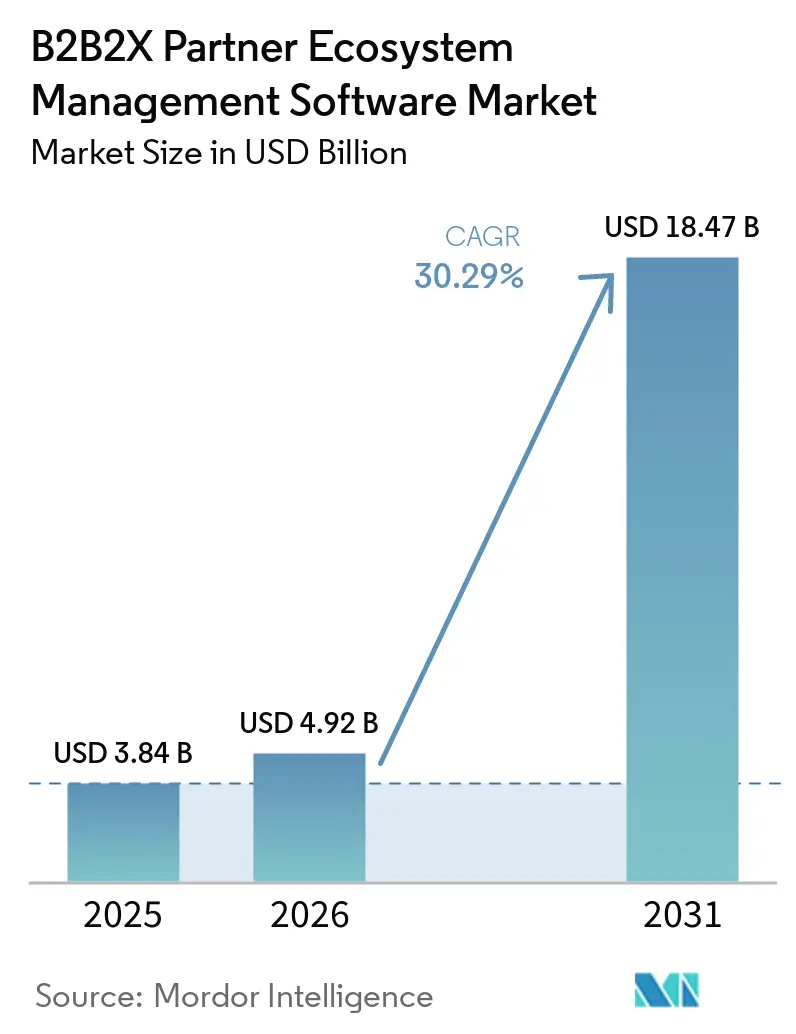
The B2B2X partner ecosystem management software market size is projected to expand from USD 3.84 billion in 2025 to USD 4.92 billion in 2026, and to USD 18.47 billion by 2031, registering a CAGR of 30.29% between 2026 and 2031. Indirect channels are playing a larger role in enterprise software revenue, making structured partner operations more important for vendors with complex routes to market. Cloud marketplaces also bring more participants into a single transaction, increasing the need to coordinate referrals, offers, approvals, and revenue attribution. AI-enabled workflow tools are shifting buyer expectations from basic portal management toward systems that can complete routine partner tasks across connected business applications. Data security, privacy controls, and system integration remain important buying considerations, especially for regulated organizations. The B2B2X partner ecosystem management software market, therefore, favors providers that combine partner workflow automation, marketplace connectivity, and verifiable data governance.
Key Report Takeaways
- By component, software held 67.32% of the B2B2X partner ecosystem management software market share in 2025, while services are projected to expand at a 30.69% CAGR through 2031.
- By deployment, cloud-based platforms accounted for 69.19% of the B2B2X partner ecosystem management software market share in 2025, while hybrid deployment is projected to advance at a 30.71% CAGR through 2031.
- By enterprise size, large enterprises represented 68.43% of the B2B2X partner ecosystem management software market share in 2025, while SMEs are projected to expand at a 30.67% CAGR through 2031.
- By partner program type, reseller and distributor programs accounted for 31.57% of the B2B2X partner ecosystem management software market share in 2025, while marketplace and multi-party ecosystems are projected to expand at a 31.49% CAGR through 2031.
- By end-user industry, IT and Telecom held 26.71% of the B2B2X partner ecosystem management software market share in 2025, while software and internet companies are projected to expand at a 31.89% CAGR through 2031.
- By geography, North America held 34.79% of the B2B2X partner ecosystem management software market share in 2025, while Asia-Pacific is projected to expand at a 31.29% CAGR through 2031.
Note: Market size and forecast figures in this report are generated using Mordor Intelligence’s proprietary estimation framework, updated with the latest available data and insights as of January 2026.
Market Trends and Insights
Drivers Impact Analysis of B2B2X Partner Ecosystem Management Software Market*
| Driver | (~) % Impact on CAGR Forecast | Geographic Relevance | Impact Timeline |
|---|---|---|---|
| Growth in Indirect and Partner-Transacted Revenue | +8.2% | Global, concentrated in North America and Europe | Long term (≥ 4 years) |
| Expansion of Multi-Partner Cloud Marketplace Selling | +6.7% | North America, Western Europe, and Asia-Pacific | Long term (≥ 4 years) |
| AI Automation of Partner Operations | +5.4% | Global, with early gains in North America | Medium term (2-4 years) |
| Demand for Unified Partner Data and Attribution | +3.8% | Global, strongest in North America and Western Europe | Medium term (2-4 years) |
| Permissioned Account Mapping and Privacy-Safe Collaboration | +2.4% | North America and the European Union | Medium term (2-4 years) |
| Agentic Partner Recommendations and Workflow Execution | +1.9% | North America, Singapore, Japan, and Australia | Short term (≤ 2 years) |
| Source: Mordor Intelligence | |||
Growth in Indirect and Partner-Transacted Revenue
The B2B2X partner ecosystem management software market benefits as more enterprise software revenue moves through partners. ICONIQ reported that indirect and partner-transacted revenue rose from 21% to 31% of total B2B software revenue in 1 year. Direct sales fell from 73% to 57% over the same period, which changes the operational importance of partner programs. The survey also found that channel-sourced deals had win rates 12 percentage points above marketing-sourced opportunities. High-growth companies below USD 100 million obtained 27% of pipeline from channel activity, compared with 19% among similar-sized peers. As vendors work with more partner types and territories, automated deal rules and shared records become more important than manual CRM configurations.
Expansion of Multi-Partner Cloud Marketplace Selling
Cloud marketplaces are becoming a more central route to market for software vendors and their partners. Microsoft expanded multiparty private offers to 36 customer billing-account markets in July 2026, including Australia, Japan, and South Africa. The program allows partners to sell bundled multi-ISV solutions against committed Azure spending. AWS also introduced cross-vendor, multi-product solutions that let independent software vendors, systems integrators, and distributors package multiple applications into a single purchasable offering. Each additional participant creates new requirements for collaboration, attribution, and settlement. Impartner launched HyperscalerGTM in October 2025 to connect deal registration, co-sell collaboration, private offers, and revenue synchronization across AWS, Azure, and Google Cloud. These changes support demand in the B2B2X partner ecosystem management software market for platforms that manage multi-party transactions in 1 workflow.[1]Amazon Web Services, “Evolving the Cloud Marketplace to Support Solution-Centric Procurement,” AWS Marketplace Blog, aws.amazon.com
AI Automation of Partner Operations
AI is moving from a supporting feature to an operating layer for partner programs. AWS introduced Partner Central agents in 2026, powered by Amazon Bedrock AgentCore. The agents can help complete opportunity records and execute partner funding requests from information in meeting transcripts. AWS stated that partner examples showed deal registration entry times falling from 16-30 minutes to under 2 minutes per opportunity. WorkSpan reported that Boomi achieved 30× year-over-year expansion on the AWS Marketplace and a 146% increase in referrals sent to AWS after adopting its agentic co-sell architecture. These tools can reduce repetitive work in deal registration, lead routing, incentives, and fund management. The B2B2X partner ecosystem management software market gains relevance when teams can support more partner relationships without expanding operating headcount at the same pace.
Demand for Unified Partner Data and Attribution
Partner ecosystems often use several disconnected systems for deals, incentives, marketing activity, and marketplace transactions. A Forrester Consulting study commissioned by Ansira found that partner ecosystem marketers used an average of 6 tools. The same study found that 63% used 7 or more tools. This fragmentation can make it difficult to establish which partner sourced or influenced a transaction. Incomplete attribution can weaken partner confidence when contributors believe that their work is not recorded fairly. Platforms that integrate deal registration, CRM records, and marketplace data into 1 partner profile address this operational problem. The B2B2X partner ecosystem management software market also benefits from configurable data localization because partner data may be subject to jurisdiction-specific processing requirements.
Restraints Impact Analysis of B2B2X Partner Ecosystem Management Software Market*
| Restraint | (~) % Impact on CAGR Forecast | Geographic Relevance | Impact Timeline |
|---|---|---|---|
| Partner Data Security and Privacy Exposure | -2.4% | Global, particularly the European Union and regulated markets | Long term (≥ 4 years) |
| Integration and Customization Complexity | -2.1% | Global, most acute in mid-market and emerging-market deployments | Medium term (2-4 years) |
| Multi-Party Attribution and Revenue-Share Disputes | -1.6% | Global, concentrated in North America and Europe | Medium term (2-4 years) |
| Partner Adoption Fatigue From Portal and Workflow Fragmentation | -1.0% | Global | Short term (≤ 2 years) |
| Source: Mordor Intelligence | |||
Partner Data Security and Privacy Exposure
Partner platforms hold sensitive records such as customer names, pricing information, deal status, and competitive information. CVE-2024-49035 affected Microsoft Partner Center and was disclosed in November 2024. The National Vulnerability Database assigned the vulnerability a CVSS score of 9.8. CISA added the vulnerability to its Known Exploited Vulnerabilities catalog and required remediation by March 18, 2025, for US Federal Civilian Executive Branch agencies. The event showed how a weakness in partner infrastructure can expose connected customer environments. Security certifications can therefore influence procurement decisions for the B2B2X partner ecosystem management software market. ZINFI achieved SOC 2 Type 2 compliance in August 2025, which supports its position with organizations that require documented operational controls.[2]National Institute of Standards and Technology, “CVE-2024-49035 Detail,” National Vulnerability Database, nvd.nist.gov
Integration and Customization Complexity
A partner platform must often connect with CRM, marketing automation, ERP, data warehouses, and cloud marketplace APIs. These systems have different data models, authentication approaches, and approval procedures. ZINFI reported an average implementation period of 2.4 months, even for well-resourced customers. An additional ERP connection for incentive settlement or a separate data warehouse can extend the implementation process. Organizations may also operate portal software, spreadsheets for market development funds, and distributor systems that are not connected to one another. Legacy technology can require middleware and custom engineering before a common workflow is available. This complexity can delay the realization of value from the B2B2X partner ecosystem management software market, particularly for mid-sized organizations with limited technical resources.
*Our forecasts treat driver/restraint impacts as directional, not additive. The impact forecasts reflect baseline growth, mix effects, and variable interactions.
B2B2X Partner Ecosystem Management Software Market Segment Analysis
By Component:
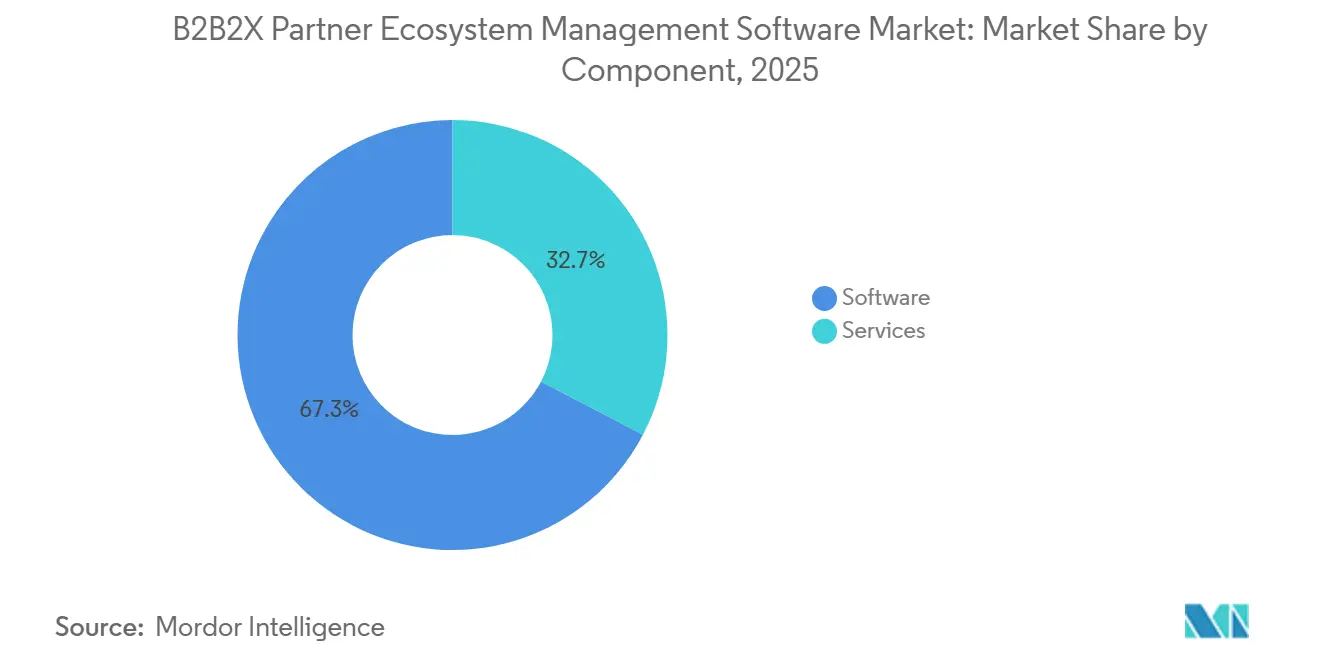
Services Reflect More Complex Ecosystem RequirementsSoftware held 67.32% of the B2B2X partner ecosystem management software market share in 2025. This position reflected the subscription-based nature of partner relationship management platforms. Vendors use software to centralize onboarding, deal registration, incentives, partner enablement, and co-sell activity. A common platform also gives administrators a more consistent record of partner activity. Recurring licenses support ongoing product updates and can increase switching costs once workflows are embedded. The B2B2X partner ecosystem management software industry, therefore, remains centered on platforms that provide a single operating environment for partner programs.
Services are projected to expand at a 30.69% CAGR from 2026 to 2031. Demand rises when vendors combine resellers, ISV alliances, managed service providers, and marketplace participants into a single program. These environments require implementation work, API integration, configuration, and program design support. The Ansira-commissioned Forrester study found that organizations with partner ecosystems used an average of 6 tools, which indicates why integration work remains necessary. Service providers can help reconcile data and design workflows across these systems. Their role can be especially relevant when an organization needs to adapt standard platform capabilities to its partner policies. The B2B2X partner ecosystem management software market consequently has a services opportunity alongside software subscriptions.


By Deployment:
Hybrid Models Address Control and Flexibility NeedsCloud-based deployment accounted for 69.19% of the B2B2X partner ecosystem management software market share in 2025. SaaS vendors and digitally mature enterprises favor cloud delivery because it supports scalability and regular product updates. Cloud platforms also support marketplace integrations, private-offer workflows, and API-led CRM synchronization. These capabilities are useful when partner programs operate in several countries. The model can reduce the buyer's internal infrastructure requirements. It remains the principal deployment route for organizations that prioritize consistent access to new features.
Hybrid deployment is projected to expand at a 30.71% CAGR from 2026 to 2031. Regulated buyers may need on-premises control over sensitive partner deal data while using cloud analytics and automation. Banking, healthcare, and defense-adjacent manufacturing can have more restrictive data-handling requirements. Hybrid configurations can separate data control from workflow scalability. India’s Digital Personal Data Protection Act and European data requirements increase the value of deployment options that support local compliance needs. On-premises models continue to serve some large organizations with legacy systems, although dedicated support options are becoming less common. The B2B2X partner ecosystem management software market is therefore broadening beyond an exclusively cloud-first model.[3]Ministry of Electronics and Information Technology, “Digital Personal Data Protection Act, 2023,” Government of India, meity.gov.in
By Enterprise Size:
SMEs Gain Access to Partner Operations ToolsLarge enterprises held 68.43% of the B2B2X partner ecosystem management software market share in 2025. These organizations were early users of formal partner programs because they could fund configuration and integration projects. Their programs often include several partner tiers, geographic regions, and routes to market. This scale makes automated governance a practical operating requirement. Large buyers also need structured controls for incentives, approvals, and partner access. Their continued participation supports demand for broad enterprise platform capabilities.
SMEs are projected to expand at a 30.67% CAGR from 2026 to 2031. No-code portals, modular configurations, and consumption-based pricing reduce the barrier to entry for companies with fewer than 500 employees. ZINFI reported that 85% of its small-business customers completed deployment within 2.4 months. It also reported average payback periods of 10 months for that cohort. PartnerBridge introduced RelateIQ AI for partner discovery in 2026, targeting early-stage SaaS businesses. These developments show why smaller firms are becoming a more visible customer group in the B2B2X partner ecosystem management software market.
By Partner Program Type:
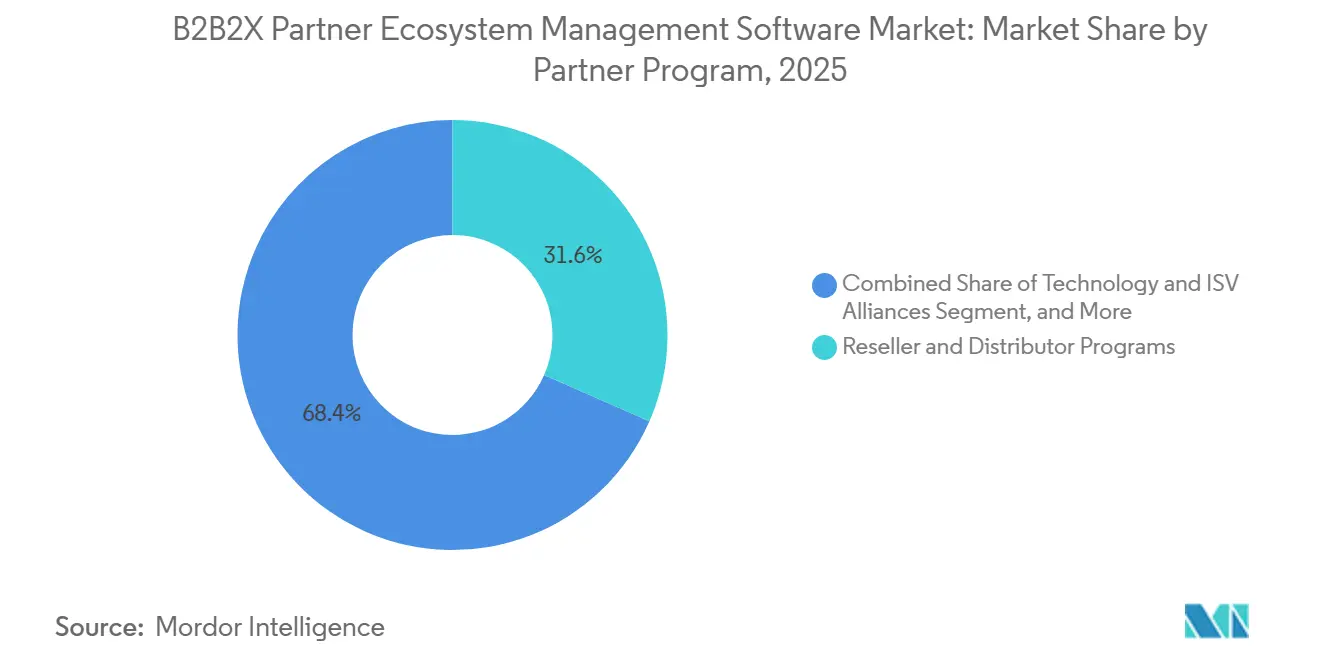
Marketplace Programs Change Coordination NeedsReseller and distributor programs accounted for 31.57% of the B2B2X partner ecosystem management software market share in 2025. Long-established channel structures and familiar processes for deal registration, tiering, rebates, and market development funds support these programs. Platform features for distributor relationships are also relatively mature. Deep connections to distributor ERP systems can support inventory allocation and rebate settlement. Traditional resale remains important for enterprise technology providers with broad partner networks. It continues to provide a core demand base for the B2B2X partner ecosystem management software market.
Marketplace and multi-party ecosystems are projected to expand at a 31.49% CAGR from 2026 to 2031. Microsoft’s multiparty private offers and AWS multi-product bundles increase the number of organizations participating in a transaction. Technology alliances, managed service providers, systems integrators, referrals, and affiliate partners further diversify partner routes. Each model needs clear rules for opportunity ownership, incentives, and shared customer engagement. PartnerStack’s network included more than 138,000 B2B partners when AppDirect acquired the company in April 2026. The acquisition underscores the growing value of platforms that pair programming tools with established partner networks.

By End-User Industry:
Software and Internet Firms Extend Partner-Led SalesIT and Telecom accounted for 26.71% of the B2B2X partner ecosystem management software market share in 2025. The sector adopted formal partner programs early because it relies on distributors, resellers, cloud providers, and service partners. Telecom operators also manage IoT partners and wholesale settlement arrangements. These relationships can create requirements beyond standard partner portals. Platforms serving telecom environments may need to account for 5G network slicing revenue sharing and event-based IoT billing. The sector remains a major source of platform demand because it combines large partner networks with complex commercial processes.
Software and internet companies are projected to expand at a 31.89% CAGR from 2026 to 2031. SaaS vendors increasingly add partner-led activity to product-led sales models to extend coverage without matching increases in direct sales headcount. Banking, financial services, insurance, manufacturing, healthcare, and life sciences also use partner platforms where compliance and governance are important. These buyers may need auditable controls for standards such as PCI DSS, HIPAA, and ISO 13485. Professional services, energy, and utilities are earlier in adoption and often enter through cloud or managed-service intermediaries. The B2B2X partner ecosystem management software industry has scope to serve these vertical needs through more specialized data controls and workflow configurations.
Geography Analysis
North America B2B2X Partner Ecosystem Management Software Market
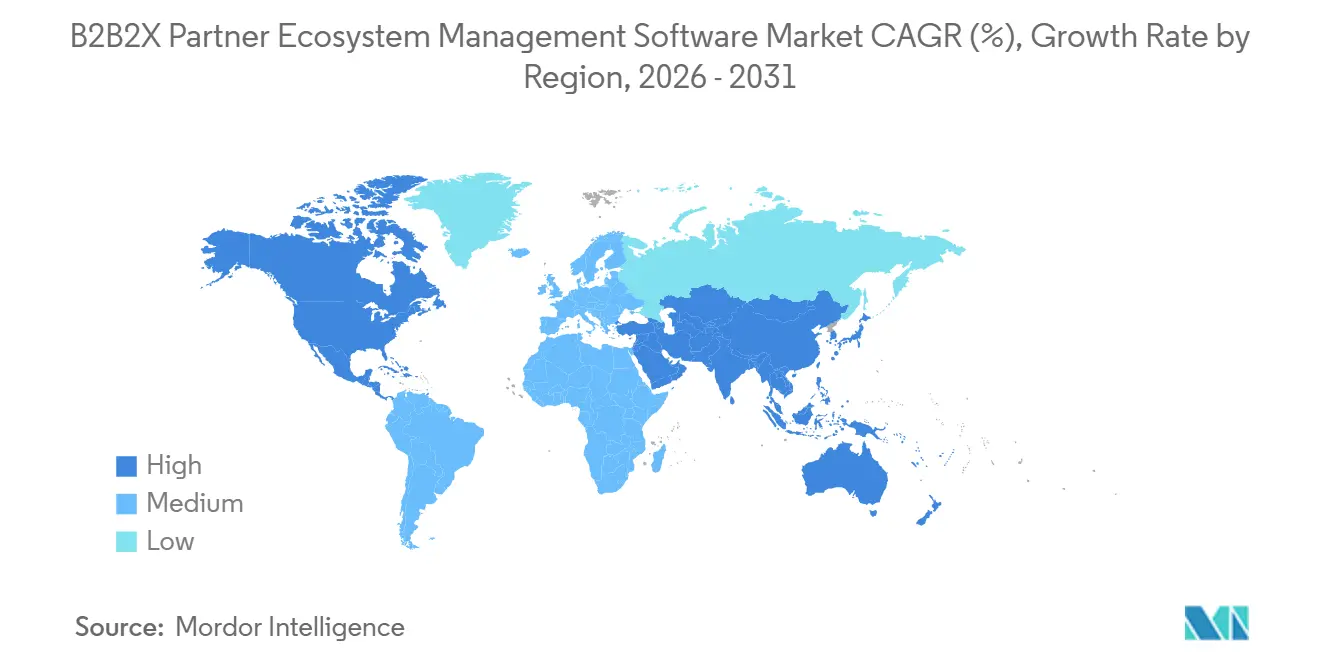
North America held 34.79% of the B2B2X partner ecosystem management software market share in 2025. The region has a high concentration of enterprise software vendors, hyperscaler operations, and established co-sell programs. ICONIQ reported that high-growth software companies below USD 100 million obtained 27% of their pipeline through channels. Infor revised its partner program in January 2025 to align lifetime SaaS commissions with its cloud-first ERP direction. Microsoft’s marketplace-first model also increases the need to manage direct, co-sell, and marketplace activity together. These conditions support continued demand for structured ecosystem operations in the region.
APAC B2B2X Partner Ecosystem Management Software Market
Asia-Pacific is projected to expand at a 31.29% CAGR from 2026 to 2031. Large telecom and cloud providers in China, India, Japan, and Australia manage multi-tier networks for 5G services, IoT connectivity, and cloud infrastructure. Indirect channels can help technology vendors reach tier-2 and tier-3 locations in India. Partner+ formed a strategic partnership with Impartner in September 2025 to address regional demand for partner ecosystem tools. Japan and South Korea were included in Microsoft’s expansion of multiparty private offers in July 2026. Privacy rules in Japan and Australia also make partner data handling a procurement consideration. The B2B2X partner ecosystem management software market has room to expand as marketplace infrastructure becomes more available across the region.
EMEA and South America B2B2X Partner Ecosystem Management Software Market
Europe has a substantial position supported by established channel ecosystems, particularly in the DACH region. GDPR places clear obligations on how partner data is processed and protected. This favors platforms with transparent access controls and audit trails. The EU AI Act entered into force in August 2024 and creates additional compliance considerations for AI-enabled platform features. South America, the Middle East, and Africa remain in the earlier stages of adoption. Brazil, the United Arab Emirates, and South Africa are likely to be entry points as vendors expand cloud marketplace programs. Microsoft’s July 2026 additions included South Africa, while a later planned expansion to Nigeria and Gulf Cooperation Council markets may require additional infrastructure for formal partner program management.

Competitive Landscape
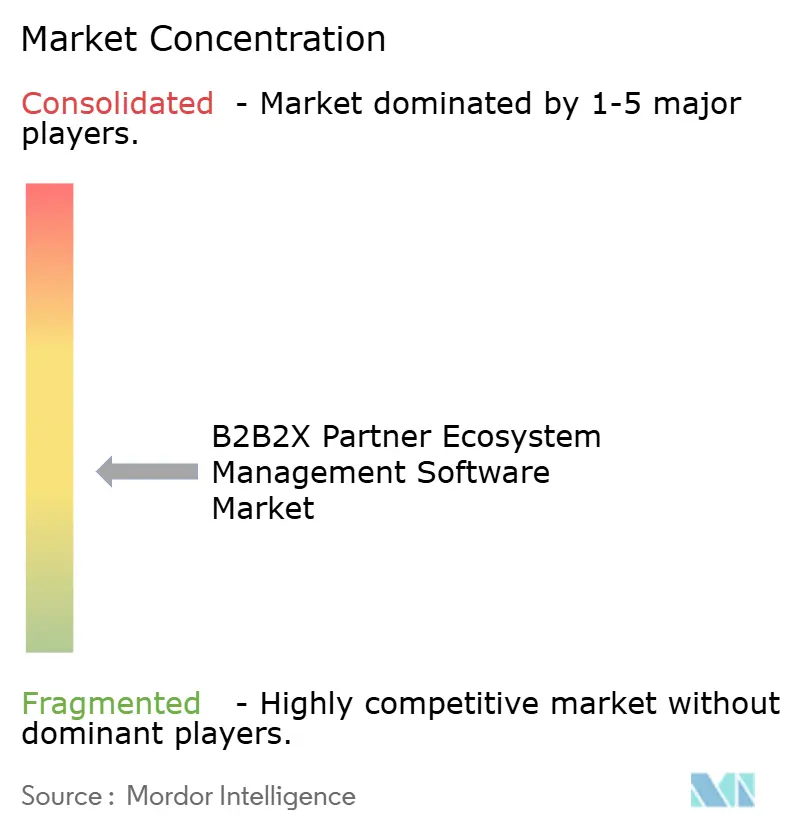
The B2B2X partner ecosystem management software market is moderately fragmented because vendors specialize in different program needs and deployment models. Impartner and ZINFI compete through broad partner relationship management capabilities. WorkSpan and Crossbeam focus more closely on co-sell intelligence and ecosystem mapping. Channelscaler provides tools for complex multi-tier programs. This specialization means that 1 platform does not dominate every route-to-market model. Buyers often evaluate vendors based on their CRM integration, marketplace connections, automation features, and data controls. The competitive field remains active because partner programs differ widely by company size and vertical requirements.
AppDirect acquired PartnerStack in April 2026. The combination brought PartnerStack’s more than 138,000 B2B partners and USD 3 billion in partner-generated customer revenue into AppDirect’s subscription-commerce platform. AppDirect reported more than USD 20 billion in hyperscaler marketplace transaction infrastructure. Impartner launched HyperscalerGTM in October 2025 to connect partner activity to workflows on AWS, Azure, and Google Cloud. WorkSpan and Work4Flow launched WorkSpan.AI on the ServiceNow Store in January 2026. These moves show that leading providers are adding marketplace coverage, subscription-commerce capabilities, and CRM-based partner processes.
AI automation is another important area of competition. Channelscaler’s Scailyn automates deal registration, lead routing, market development fund management, and incentive calculations. Impartner introduced Aimi in December 2025 to support lead-to-deal processes, enablement, opportunity management, and co-selling. ZINFI’s August 2025 SOC 2 Type 2 compliance also highlights the value of security posture for regulated buyers. Smaller providers such as Kiflo, PartnerBridge, and Journeybee seek opportunities among SMEs and organizations that need faster onboarding. Providers with agent-callable APIs and Model Context Protocol connections may be better placed as partner teams use AI tools to initiate work across applications.
B2B2X Partner Ecosystem Management Software Industry Leaders
Impartner, Inc.
WorkSpan, Inc.
ZINFI Technologies, Inc.
PartnerStack Inc.
Channelscaler, Inc.
- *Disclaimer: Major Players sorted in no particular order
B2B2X Partner Ecosystem Management Software Market Companies Covered in this Report
- Impartner, Inc.
- WorkSpan, Inc.
- ZINFI Technologies, Inc.
- PartnerStack Inc.
- Channelscaler, Inc.
- Zift Solutions, Inc.
- Allbound, Inc.
- Channeltivity, LLC
- Mindmatrix, Inc.
- Magentrix Corporation
- PartnerTap, Inc.
- Crossbeam, Inc.
- Reveal SAS
- Kiflo PRM SAS
- LogicBay Corporation
- Performance Horizon Group Limited
- AppDirect, Inc.
- IntroCept Pty Ltd.
- ChannelXperts GmbH
- PartnerPortal.io Inc.
- Journeybee, Inc.
- CoSell, Inc.
- Introw, Inc.
- Euler, Inc.

Recent Industry Developments in B2B2X Partner Ecosystem Management Software Market
- July 2026: Microsoft expanded multiparty private offers to Australia, Japan, and South Africa, bringing the total to 36 customer billing-account markets. The expansion enables partners in Asia-Pacific and Africa to transact multi-ISV bundled solutions against committed Azure spend, extending hyperscaler-enabled co-sell infrastructure into markets where partner ecosystem management platform demand is accelerating.
- June 2026: Impartner announced expanded native CRM Sync for HubSpot, enabling companies to align partner relationship management and customer relationship management in a single workflow. The upgrade provides HubSpot users with real-time visibility into partner-sourced and partner-influenced revenue while streamlining collaboration across channel, sales, and revenue operations teams.
- April 2026: AppDirect acquired PartnerStack, creating the first unified platform combining PRM, subscription-commerce infrastructure, and a built-in network of over 138,000 commission-earning B2B affiliates, co-sell, and channel partners. The combination adds PartnerStack's USD 3 billion in partner-generated customer revenue to AppDirect's over USD 20 billion in hyperscaler marketplace transaction infrastructure, establishing a new competitive floor in ecosystem platform consolidation.
- March 2026: Impartner announced a major advancement in partner marketing automation, unifying automation, AdTech, and AI into its PRM platform to produce measurable revenue attribution. The platform's predictive AI integration enables automated optimization across paid-ad keywords, bids, audiences, and budgets using conversion data aggregated from all partner campaigns across geographies.


Global B2B2X Partner Ecosystem Management Software Market Report Scope
The B2B2X Partner Ecosystem Management Software Market comprises software platforms and associated services that enable businesses to establish, manage, automate, and optimize complex partner ecosystems in which products, services, technologies, or solutions are delivered to end customers through one or more business partners. The market covers solutions that facilitate partner recruitment and onboarding; partner relationship and lifecycle management; program administration; deal and lead registration; referral management; partner enablement and training; incentive and commission management; co-selling; marketplace and multi-party ecosystem coordination; performance tracking; analytics; and partner engagement.
The B2B2X Partner Ecosystem Management Software Market Report is Segmented by Component (Software, and Services), Deployment (Cloud-Based, On-Premises, and Hybrid), Enterprise Size (Large Enterprises, and Small and Medium-Sized Enterprises), Partner Program Type (Reseller and Distributor Programs, Technology and ISV Alliances, Managed Service Provider Programs, Referral and Affiliate Programs, Systems Integrator and Consulting Partnerships, and Marketplace and Multi-Party Ecosystems), End-User Industry (IT and Telecom, BFSI, Manufacturing and Industrial, Retail and Consumer Goods, Healthcare and Life Sciences, Professional Services, and Energy and Utilities), and Geography (North America, South America, Europe, Asia-Pacific, Middle East, and Africa). The Market Forecasts are Provided in Terms of Value (USD).
| Software |
| Services |
| Cloud-Based |
| On-Premises |
| Hybrid |
| Large Enterprises |
| Small and Medium-Sized Enterprises |
| Reseller and Distributor Programs |
| Technology and ISV Alliances |
| Managed Service Provider Programs |
| Referral and Affiliate Programs |
| Systems Integrator and Consulting Partnerships |
| Marketplace and Multi-Party Ecosystems |
| IT and Telecom |
| Banking, Financial Services, and Insurance |
| Manufacturing and Industrial |
| Retail and Consumer Goods |
| Healthcare and Life Sciences |
| Professional Services |
| Energy and Utilities |
| North America | United States |
| Canada | |
| Mexico | |
| South America | Brazil |
| Argentina | |
| Rest of South America | |
| Europe | United Kingdom |
| Germany | |
| France | |
| Russia | |
| Rest of Europe | |
| Asia-Pacific | China |
| India | |
| Japan | |
| Australia | |
| Rest of Asia-Pacific | |
| Middle East | United Arab Emirates |
| Saudi Arabia | |
| Turkey | |
| Rest of Middle East | |
| Africa | South Africa |
| Nigeria | |
| Rest of Africa |
| By Component | Software | |
| Services | ||
| By Deployment | Cloud-Based | |
| On-Premises | ||
| Hybrid | ||
| By Enterprise Size | Large Enterprises | |
| Small and Medium-Sized Enterprises | ||
| By Partner Program Type | Reseller and Distributor Programs | |
| Technology and ISV Alliances | ||
| Managed Service Provider Programs | ||
| Referral and Affiliate Programs | ||
| Systems Integrator and Consulting Partnerships | ||
| Marketplace and Multi-Party Ecosystems | ||
| By End-User Industry | IT and Telecom | |
| Banking, Financial Services, and Insurance | ||
| Manufacturing and Industrial | ||
| Retail and Consumer Goods | ||
| Healthcare and Life Sciences | ||
| Professional Services | ||
| Energy and Utilities | ||
| By Geography | North America | United States |
| Canada | ||
| Mexico | ||
| South America | Brazil | |
| Argentina | ||
| Rest of South America | ||
| Europe | United Kingdom | |
| Germany | ||
| France | ||
| Russia | ||
| Rest of Europe | ||
| Asia-Pacific | China | |
| India | ||
| Japan | ||
| Australia | ||
| Rest of Asia-Pacific | ||
| Middle East | United Arab Emirates | |
| Saudi Arabia | ||
| Turkey | ||
| Rest of Middle East | ||
| Africa | South Africa | |
| Nigeria | ||
| Rest of Africa | ||


Key Questions Answered in the Report
What is the size of the B2B2X partner ecosystem management software market?
The market was valued at USD 3.84 billion in 2025 and is projected to reach USD 18.47 billion by 2031, at a 30.29% CAGR from 2026 to 2031.
What is driving adoption of partner ecosystem management software?
Indirect revenue, cloud marketplace selling, workflow automation, and the need for consistent partner data are increasing adoption.
Which component leads demand for B2B2X partner ecosystem management software?
Software held 67.32% share in 2025, while services are projected to expand at a 30.69% CAGR through 2031.
Which deployment model is most widely used?
Cloud-based deployment accounted for 69.19% share in 2025, although hybrid deployment is projected to expand at a 30.71% CAGR.
Which region is expanding fastest for partner management platforms?
Asia-Pacific is projected to expand at a 31.29% CAGR from 2026 to 2031, supported by telecom, cloud, and marketplace activity.
Which end-user group is expanding fastest?
Software and internet companies are projected to expand at a 31.89% CAGR through 2031 as SaaS vendors add partner-led sales motions.
Page last updated on:





