
B2B Signal Intelligence Platform Market Size and Share
Market Overview
| Study Period | 2020 - 2031 |
|---|---|
| Market Size (2026) | USD 3.23 Billion |
| Market Size (2031) | USD 7.52 Billion |
| Growth Rate (2026 - 2031) | 18.41% CAGR |
| Fastest Growing Market | Asia-Pacific |
| Largest Market | North America |
| Market Concentration | Medium |
Major Players *Disclaimer: Major Players sorted in no particular order Image © Mordor Intelligence. Reuse requires attribution under CC BY 4.0. | |
B2B Signal Intelligence Platform Market Analysis by Mordor Intelligence
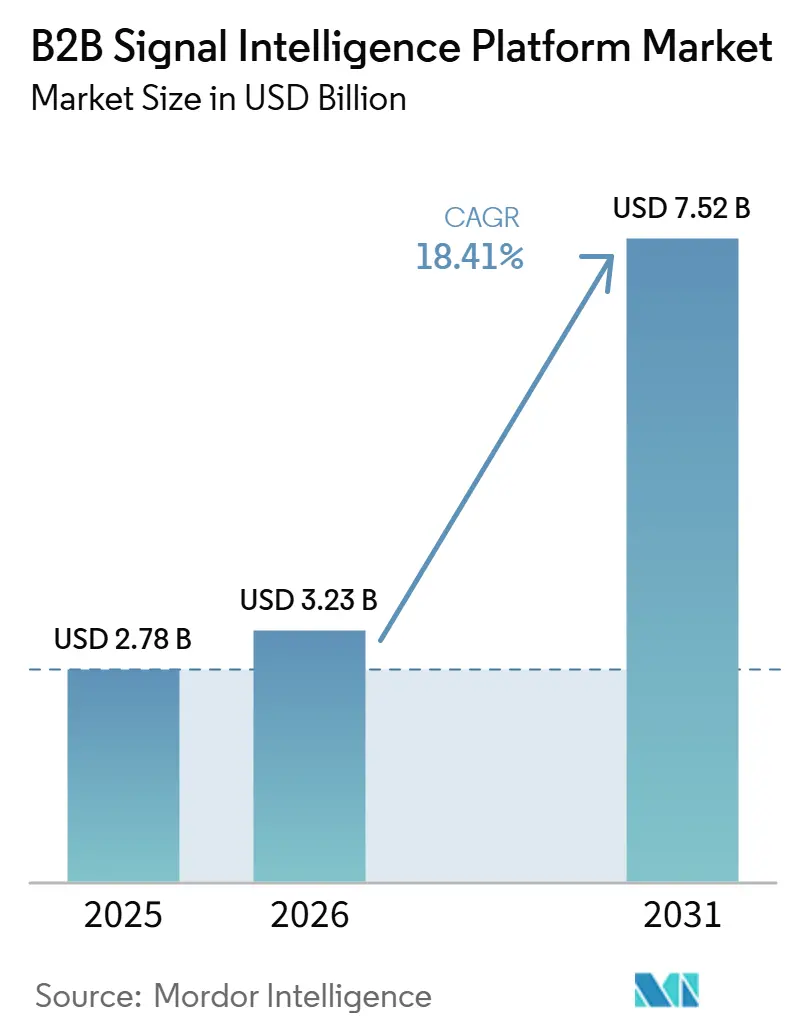
The B2B Signal Intelligence Platform Market size was USD 2.78 billion in 2025, USD 3.23 billion in 2026, and is forecast to reach USD 7.52 billion by 2031, at a CAGR of 18.41% during 2026-2031. The B2B Signal Intelligence Platform Market is expanding as revenue teams move away from static prospecting lists toward continuous account monitoring that guides timing, channel choice, and sales follow-up with greater precision. Buyers continue to prefer integrated platforms over standalone tools, which keeps suite-based offerings at the center of product strategy and makes cross-team workflow orchestration more important than isolated data access. Deployment choices are also shifting as enterprises seek cloud speed while still needing stronger control over data handling, residency, and internal security policies. Competitive activity is increasingly focused on product consolidation, AI-led scoring, deeper workflow automation, and API-ready delivery models that connect signal data with broader sales and marketing systems. The strongest near-term openings remain in SME adoption, healthcare-focused use cases, and Asia-Pacific expansion, while compliance obligations in Europe and North America are raising the bar for platform design, vendor diligence, and long-term customer retention.
Key Report Takeaways
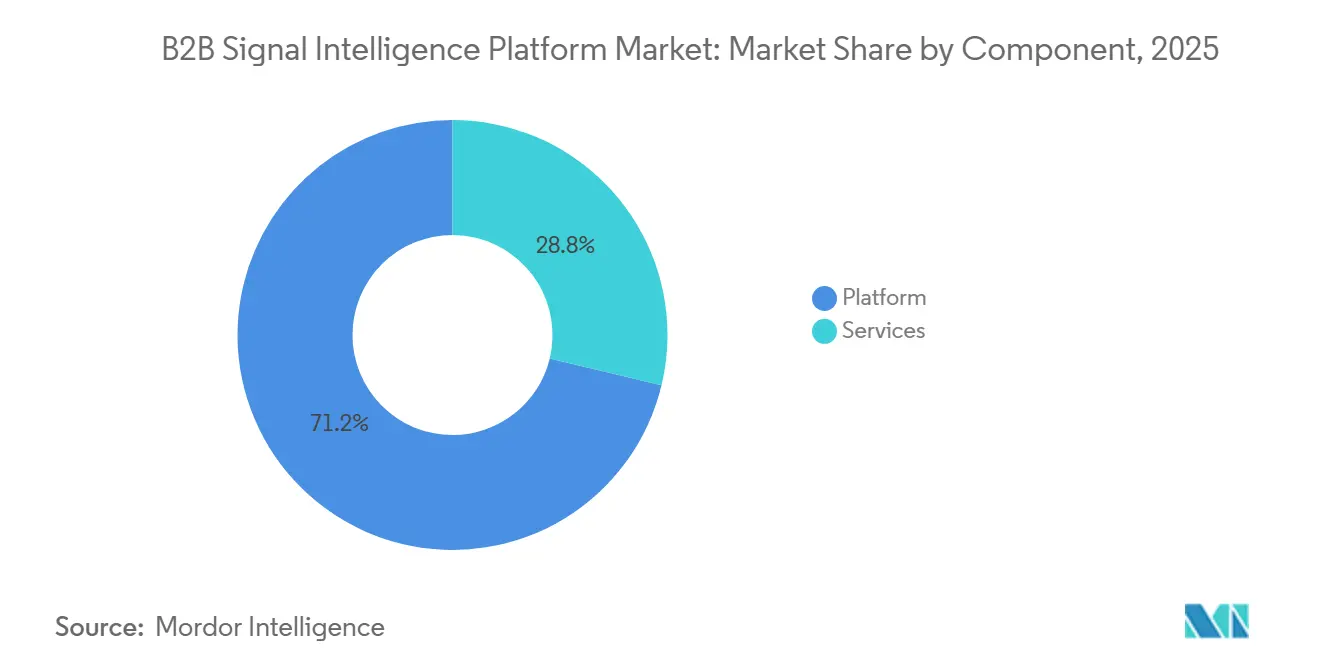
- By component, platforms held 71.24% of revenue in 2025 in the B2B Signal Intelligence Platform Market, while services are projected to expand at a 19.82% CAGR through 2031.
- By deployment mode, cloud accounted for 68.41% of revenue in 2025, while hybrid deployment is expected to grow at a 20.69% CAGR through 2031.
- By enterprise size, large enterprises represented 64.83% of revenue in the B2B Signal Intelligence Platform Market in 2025, while SMEs are projected to record the highest CAGR at 21.43% through 2031.
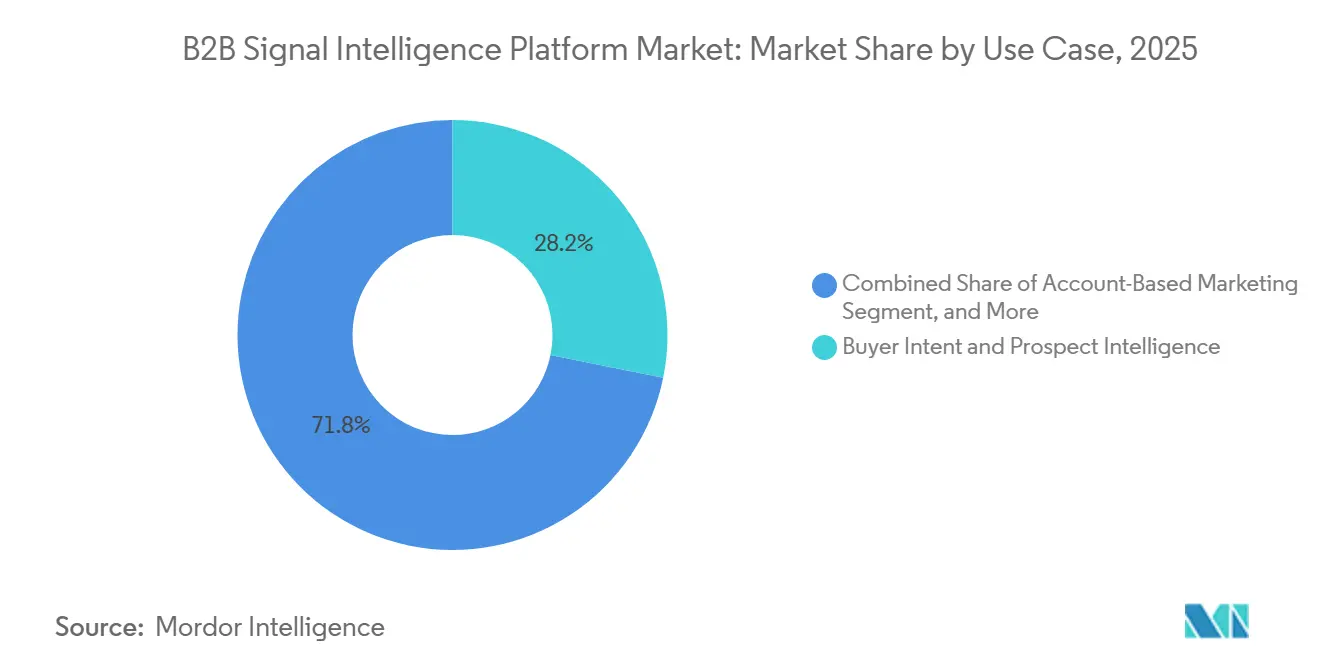
- By use case, Buyer Intent and Prospect Intelligence captured 28.19% of revenue in 2025, while Account-Based Marketing is expected to expand at a 20.24% CAGR through 2031.
- By end user, IT and Telecommunication held a 24.36% share in the B2B Signal Intelligence Platform Market in 2025, while Healthcare and Life Sciences are projected to grow at a 21.91% CAGR through 2031.
- By geography, North America accounted for 34.62% of revenue in 2025, while Asia-Pacific is expected to advance at a 22.18% CAGR through 2031.
Note: Market size and forecast figures in this report are generated using Mordor Intelligence’s proprietary estimation framework, updated with the latest available data and insights as of January 2026.
Global B2B Signal Intelligence Platform Market Trends and Insights
Drivers Impact Analysis*
| Driver | (~) % Impact on CAGR Forecast | Geographic Relevance | Impact Timeline |
|---|---|---|---|
| AI-Native Prospect Prioritization | +5.2% | Global, with early concentration in North America and Western Europe | Short term (≤ 2 years) |
| RevOps Unification Around Shared Account Signals | +3.8% | Global, strongest in North America, followed by Europe and Asia-Pacific | Medium term (2-4 years) |
| Privacy-Safe First-Party and Partner-Shared Intent Data | +3.1% | North America and Europe first, with Asia-Pacific following | Medium term (2-4 years) |
| Continuous Account Monitoring Across Buyer Committees | +2.4% | Global, especially for large enterprises in North America and EMEA | Medium term (2-4 years) |
| API-Ready Orchestration With CRM and MAP Stacks | +1.8% | North America and Europe, with growing use in Asia-Pacific | Short term (≤ 2 years) |
| Embedded Signal Intelligence in Vertical SaaS Workflows | +1.5% | Global, with early traction in North America | Long term (≥ 4 years) |
| Source: Mordor Intelligence | |||
Ai Native Prospect Prioritization Replaces Manual Research
AI-led prioritization is now a core buying requirement in the B2B Signal Intelligence Platform Market because sales teams want fewer low-conviction leads and better use of seller time. 6sense reported that 99% of business development representatives used AI in 2026, up from 62% in 2025 and 53% in 2024, which shows how quickly AI tools have moved into daily prospecting work.[1]6sense, “6sense Releases 2026 State of BDR Report, Revealing AI Adoption at an All-Time High,” Morningstar, morningstar.com The same report stated that 53% of organizations increased BDR quota targets in 2026, which suggests that management teams now expect AI assistance to support higher productivity from the same headcount base. This changes the operating model because human effort shifts away from early filtering and toward conversations with accounts that already show stronger buying conditions. It also favors vendors that can make model outputs easier to understand, route, and use within broader account workflows.
Revops Unification Around Shared Account Signals
The B2B Signal Intelligence Platform Market is also benefiting from the push to place marketing, sales, and customer success around a common account record rather than separate activity views. When the same signal layer feeds targeting, routing, and follow-up, organizations can reduce handoff friction and keep account timing more consistent across teams. 6sense opened RevvyAI to all Revenue Marketing customers in May 2026 and added SSO Role and Group Mapping, SCIM, and Audit Log Exports, which show how platform vendors are linking AI workflow support with enterprise-grade control requirements. The July 2026 launch of the 6sense MCP Server extended this pattern by making account intelligence callable by any MCP-compatible AI agent without custom integration.[2]6sense, “6sense Launches MCP Server, Bringing Proprietary GTM Intelligence Into Any AI Agent,” 6sense Newsroom, 6sense.com As more teams rely on the same signal layer, platform value depends less on dashboards alone and more on how well the vendor supports shared execution across the revenue stack.[3]6sense, “6sense Opens RevvyAI to All Customers and Expands Enterprise Security Capabilities,” BusinessWire, businesswire.com
Expansion of Privacy Safe First Party and Partner Shared Intent Data
Privacy-safe signal sourcing is becoming a major growth driver in the B2B Signal Intelligence Platform Market because buyers want usable data that does not create avoidable legal exposure. The California Consumer Privacy Act entered a new effective phase in January 2026, and the statute provides for civil penalties of up to USD 7,988 per intentional violation, which increased scrutiny of vendor data practices in professional and commercial settings.[4]California Privacy Protection Agency, “CCPA Statute Effective January 1, 2026,” California Privacy Protection Agency, cppa.ca.gov That environment makes first-party data, direct publisher relationships, and controlled partner-sharing models more attractive than broad third-party collection methods with weaker traceability. It also reduces the room for generic intent feeds that cannot clearly show how data was collected, processed, and passed into downstream systems. Vendors that build defensible data networks and document their collection methods well are in a stronger position to win enterprise evaluations and preserve renewal confidence.
Continuous Account Monitoring Across Buyer Committees
Continuous monitoring across account stakeholders is supporting the B2B Signal Intelligence Platform Market, as complex buying paths no longer flow through a single contact. Revenue teams need systems that can detect new activity, shifting interest, and changes in engagement patterns across several roles within the same account. Doceree launched Clinical Intent Signals in June 2026 and reported 38% faster stage progression, 27% higher contextual engagement, and a 21% improvement in media efficiency, demonstrating how multi-stakeholder tracking is being turned into a commercial product in vertical settings. This matters especially in healthcare and other long-cycle categories, where procurement, technical review, and business sponsorship often move in parallel. Vendors that can track signal density across multiple contacts within a single account are better positioned to support more accurate timing, better personalization, and stronger pipeline progression.
Restraints Impact Analysis*
| Restraint | (~) % Impact on CAGR Forecast | Geographic Relevance | Impact Timeline |
|---|---|---|---|
| Rising Scrutiny on Web Scraping and Third-Party Signal Collection | -2.3% | Europe and North America first, with global spillover | Short term (≤ 2 years) |
| Data Lineage Gaps Reduce Trust in Intent Signals | -1.8% | Global, strongest in large enterprises with formal compliance review | Medium term (2-4 years) |
| High Integration Friction Across Fragmented Sales Stacks | -1.5% | Global, especially in mid-market deployments | Medium term (2-4 years) |
| Model Drift and Signal Noise Hurt Roi Visibility | -1.2% | Global, most visible in SME deployments with lean technical support | Long term (≥ 4 years) |
| Source: Mordor Intelligence | |||
Rising Scrutiny on Web Scraping and Third Party Signal Collection
The B2B Signal Intelligence Platform Market faces tighter operating limits as regulators pay more attention to web scraping and downstream data use. The European Data Protection Board released Guidelines 03/2026 in July 2026 and stated that personal data taken from public sources still requires a lawful basis under the GDPR, while data brokers that share pre-scraped data may have Article 14 notification duties toward affected individuals. California also moved the market toward more formalized deletion handling and broker accountability through its 2026 compliance structure. These rules increase the cost of collection, documentation, and customer assurance for providers that rely on large-scale behavioral signal sourcing. They also make strong compliance a competitive requirement rather than a secondary feature.
Data Lineage Gaps Reduce Trust In Intent Signals
Trust remains a restraint in the B2B Signal Intelligence Platform Market because many buyers still struggle to verify the source of a signal and how it was generated. Enterprise procurement teams increasingly want proof of consent logic, collection methods, transformation steps, and downstream handling before treating signal outputs as decision-grade inputs. When lineage is unclear, customers may hesitate to scale deployment, even if the platform experience is strong. This concern becomes more serious when signal data is mixed from multiple upstream sources and then scored inside opaque models. Vendors that cannot show clearer provenance, governance, and audit trails may face slower sales cycles, lower expansion rates, and greater renewal pressure.
*Our forecasts treat driver/restraint impacts as directional, not additive. The impact forecasts reflect baseline growth, mix effects, and variable interactions.
Segment Analysis
By Component: Platforms Lead As The Integrated Spine of GTM Execution
Platforms accounted for 71.24% of revenue in 2025, keeping this category at the center of the B2B Signal Intelligence Platform Market and showing that buyers still prefer suite-based delivery over fragmented point tools. Platforms combine signal ingestion, scoring, workflow automation, CRM integration, and reporting into a single operating layer, enabling teams to act on account movement without switching between tools. This design matters because the signal value rises when marketing, sales, and customer success use the same account view and the same triggers. It also reduces the friction that often arises when one team qualifies intent in one system and another team must execute in another.
The B2B Signal Intelligence Platform Market has been reinforcing this platform-first pattern as vendors move from interface-led products toward infrastructure roles within wider revenue systems. The 6sense MCP Server launched in July 2026 and made proprietary account intelligence callable from any MCP-compatible AI agent without custom integration, which strengthened the case for keeping core signal functions within broader platforms rather than separate utilities. Services are projected to expand at a 19.82% CAGR through 2031, as many customers still need implementation support, process alignment, and operational support after purchase. That demand reflects a practical gap between buying signal software and using it well across teams, systems, and daily workflows. In that setting, services grow not because platforms are weak, but because adoption depth depends on onboarding quality, data mapping, and operating discipline after deployment.


By Deployment Mode: Hybrid Infrastructure Balances Speed With Data Sovereignty
Cloud accounted for 68.41% of revenue in 2025, making it the largest segment in the B2B Signal Intelligence Platform Market and reflecting demand for rapid activation, scalable computing, and easier software maintenance. Cloud delivery remains attractive because vendors can update models faster, ship features continuously, and connect with common SaaS systems without local infrastructure work. It also fits organizations that want broad access across distributed revenue teams and external sales partners. For many buyers, cloud still offers the shortest route from contract signing to production use.
Hybrid deployment is projected to grow at a 20.69% CAGR through 2031, as regulated customers seek a middle path between performance and control in the B2B Signal Intelligence Platform Market. Enterprises in healthcare, financial services, government procurement, and other sensitive environments want modern enrichment and automation, but they also want tighter control over where account data is stored and how it moves. The EDPB guidance issued in July 2026 added further pressure for architectures with clearer data flow visibility and stronger processing controls. On-premises deployment remains relevant for a smaller group of organizations with legacy environments, restricted network policies, or strict external API limits. Over time, vendors that can blend cloud intelligence with controlled local handling are likely to capture the most demanding enterprise programs.
By Enterprise Size: Large Enterprises Anchor Revenue While SMEs Drive Incremental Growth
Large enterprises accounted for 64.83% of revenue in 2025, indicating that the B2B Signal Intelligence Platform Market still draws much of its current value from organizations with larger budgets, broader account coverage, and more complex buying processes. These buyers often require multi-layer account hierarchies, custom permissions, advanced integrations, and stronger security controls before a deployment can scale. That increases implementation effort but also increases stickiness once the platform becomes part of day-to-day revenue operations. The large enterprise position, therefore, reflects both spending power and the operational depth needed to use these platforms fully.
SMEs are projected to grow at a 21.43% CAGR through 2031, which makes them the main expansion engine for the B2B Signal Intelligence Platform Market across the forecast period. This shift is being helped by lighter pricing models, easier onboarding paths, and simpler integration options that fit leaner teams with smaller technical benches. Cognism launched its native HubSpot 2 Way Sync in February 2026 and said early users saw 50 70% faster prospect to CRM data entry, up to 80% fewer duplicate records, and a 20 30% increase in SDR outreach activity per day. That example shows why smaller organizations are becoming more addressable: they respond well to tools that reduce manual work without requiring a lengthy systems project. As simpler workflows become easier to buy and connect, the B2B Signal Intelligence Platform Industry is expanding beyond the traditional pool of large enterprise adopters.
By Use Case: Intent And Prospect Intelligence Anchors Adoption While ABM Expands Fastest
Buyer Intent and Prospect Intelligence accounted for 28.19% of the B2B Signal Intelligence Platform Market in 2025, confirming that account discovery and early prioritization still drive initial platform investment more than any other use case. Most buying teams first want better visibility into which accounts are active, which topics they are researching, and when outreach should begin. That makes intent capture the logical entry point for adoption, especially when commercial leaders want faster proof of value. It also explains why other use cases often grow from the same data layer after the first deployment proves effective.
Account-based marketing is projected to expand at a 20.24% CAGR through 2031 as the B2B Signal Intelligence Platform Market shifts from campaign calendars toward signal-led orchestration. In this model, channel timing, message selection, and account sequencing depend more on observed behavior and less on fixed campaign schedules. The 6sense MCP Server and the broader push toward agent-ready data flows support this transition by enabling signal outputs to flow directly into downstream systems and AI workflows. Sales intelligence, opportunity management, and market intelligence remain important adjacent use cases because buyers increasingly want one platform to support both demand capture and competitive response. As a result, the B2B Signal Intelligence Platform Industry is becoming less defined by a single team or workflow and more by how effectively signal data guides the entire revenue cycle.

By End User: It And Telecom Defines The Core While Healthcare Builds The Fastest Growth Path
IT and Telecommunication held a 24.36% share in 2025, making it the largest vertical in the B2B Signal Intelligence Platform Market and reflecting its high volume of software buying, strong ABM maturity, and early adoption of revenue technology. These organizations often manage large prospect universes, active vendor competition, and fast-moving product cycles, which makes external buying signals particularly useful. They also tend to have stronger CRM and marketing automation foundations, enabling signal platforms to be activated faster than in less digitized sectors. This combination keeps IT and telecom at the front of current spending.
Healthcare and Life Sciences is projected to grow at a 21.91% CAGR through 2031, which gives it the fastest outlook among end users in the B2B Signal Intelligence Platform Market. The category suits healthcare because vendor selection often involves clinical, technical, procurement, and compliance stakeholders who move through different information paths at different times. Doceree launched Clinical Intent Signals in June 2026, followed by Daily Command in July 2026, demonstrating how healthcare-specific signal workflows are moving into dedicated commercial tools. BFSI and retail also remain relevant because both sectors track trigger events that can change outreach urgency and account prioritization. Industrial manufacturing, education, media, government, energy, and other verticals are still earlier in adoption, but they represent a meaningful long-term pool as digital procurement routines continue to spread.
Geography Analysis
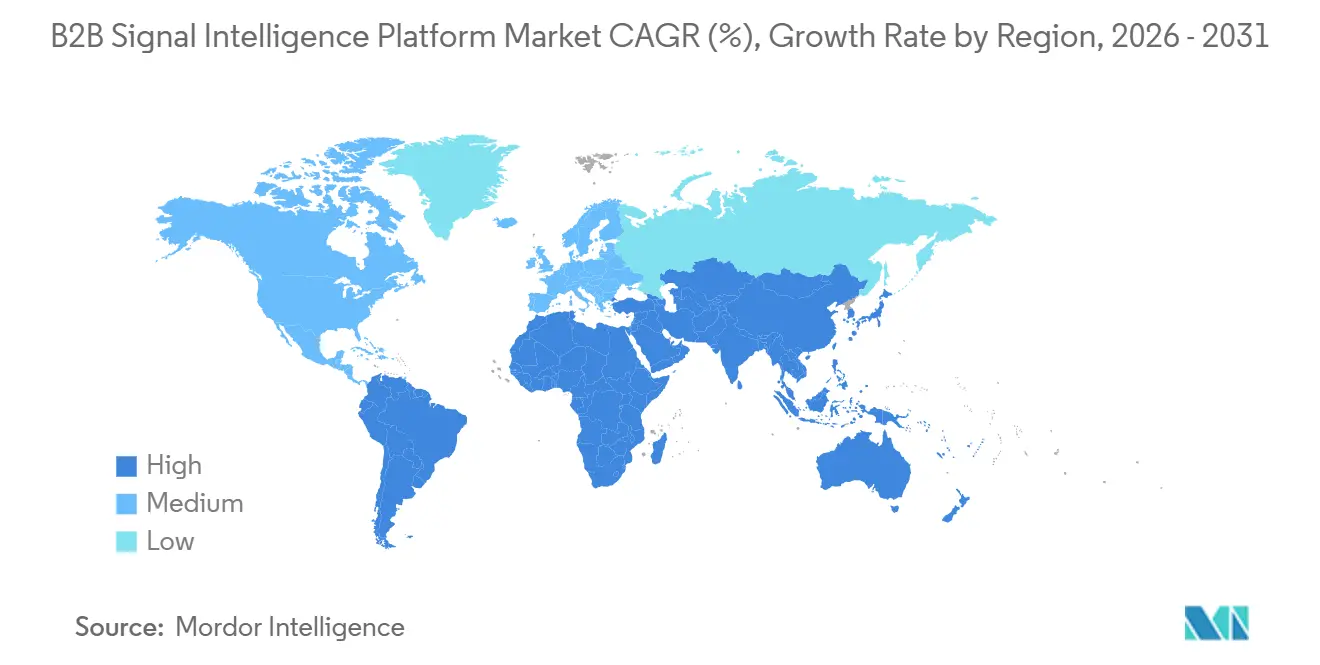
North America accounted for 34.62% of the B2B Signal Intelligence Platform Market in 2025, maintaining its lead, as the region combines strong software vendor density, mature CRM adoption, and more established revenue operations structures. The United States remains the core of this position because many category leaders are based there and because enterprise buyers in the country are usually early adopters of sales and marketing technology. The California Consumer Privacy Act and its 2026 enforcement structure are also reshaping vendor operations by raising the level of documentation, deletion handling, and broker accountability expected by enterprise customers. Canada and Mexico add support to regional growth as mid-market firms increase software adoption and more cloud-delivered platforms become easier to deploy across distributed sales teams.
Europe held an important place in the B2B Signal Intelligence Platform Market because vendor selection in the region is shaped strongly by compliance architecture rather than feature breadth alone. GDPR obligations have made lawful processing, documented data handling, and customer assurance central to procurement decisions, especially in the UK, Germany, France, and the DACH region. Cognism strengthened its regional position in July 2026 when Corporate Traveler selected the company for GDPR-compliant mobile numbers, real-time UK market coverage, and intent-to-buy signals. South America remains earlier in adoption, with usage still more concentrated among multinationals and technology-focused firms than across the broader native B2B base.
Asia Pacific is projected to expand at a 22.18% CAGR through 2031, making it the fastest-growing region in the B2B Signal Intelligence Platform Market. Rising B2B digitization, a larger software vendor base, and a stronger interest in AI-assisted selling across India, South Korea, China, and Southeast Asia are supporting growth. The region is also attractive because many organizations are now building modern revenue systems rather than replacing older ones, thereby reducing transition friction and accelerating platform adoption. China adds demand through its large B2B software and manufacturing base, where supplier discovery and export-oriented selling both benefit from improved signal visibility. Japan presents a more specialized opening because localization, language handling, and domestic compliance expectations matter more than in many other markets, which creates room for vendors willing to invest in tailored signal capture and workflow design.

Competitive Landscape
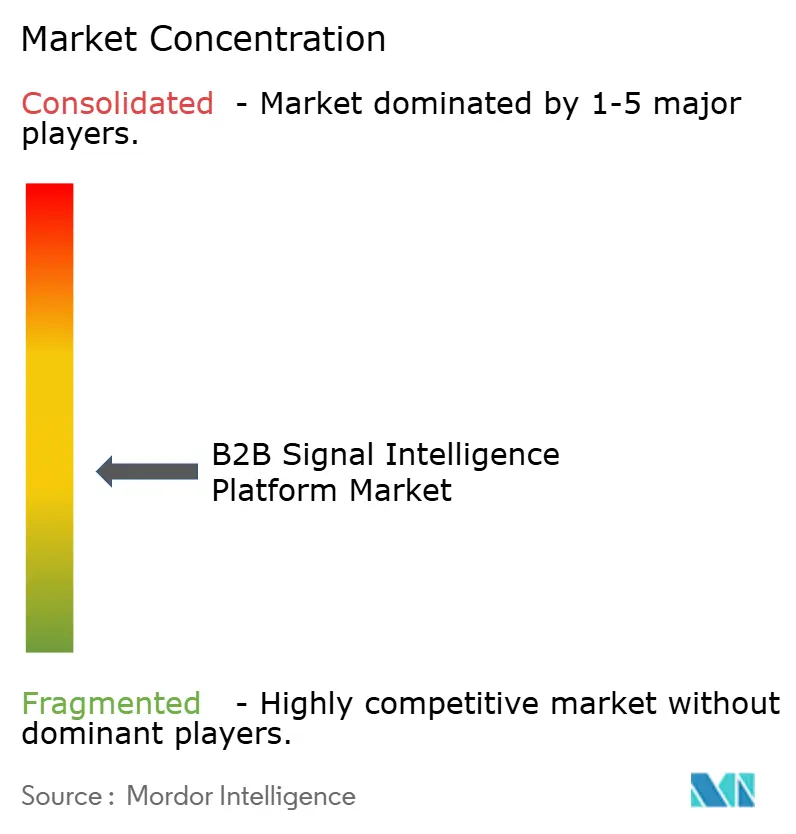
The B2B Signal Intelligence Platform Market remains moderately fragmented at the top tier, with several vendors occupying strong yet distinct positions rather than a single company controlling the category. Some providers are strongest in predictive AI and workflow guidance, others in data breadth, others in ABM execution, and others in upstream intent collection. This split keeps competition active because buyers often compare platforms on architecture and fit rather than on a single dominant benchmark. It also means that competitive advantage can shift when one vendor improves interoperability, compliance posture, or vertical relevance faster than its peers.
A clear pattern in the B2B Signal Intelligence Platform Market is the shift from dashboard-centric products to reusable intelligence layers that can serve multiple downstream workflows. 6sense reinforced that direction in July 2026 by launching its MCP Server, which enabled proprietary account intelligence to be called from any MCP-compatible AI agent without custom integration. The company had already widened everyday AI access in May 2026 by opening RevvyAI to all Revenue Marketing customers and pairing it with stronger enterprise security controls. These moves suggest that product leadership now increasingly depends on how well a vendor can embed intelligence into execution systems rather than just a standalone application. In practical terms, switching costs rise when signal data becomes part of a company’s broader AI and revenue workflow stack.
Consolidation is also shaping the B2B Signal Intelligence Platform Market, as vendors try to own more of the signal-capture, scoring, and activation chain. Apollo.io acquired Pocus in March 2026 to bring AI-driven signal scoring and prioritized workflow recommendations into its broader platform, which signaled a stronger push toward unified go-to-market execution. Cognism is taking a different route by reinforcing compliance-led differentiation and easier CRM integration, which helps it compete well in European accounts and SME settings. White space remains strongest in vertical solutions, mid-market usability, and clearer data lineage, because not every customer wants the same balance of scale, governance, and activation depth. Providers that can support regulated deployments, simpler integrations, and more precise use-case targeting are likely to defend stronger positions even as the leading group continues to expand platform scope.
B2B Signal Intelligence Platform Industry Leaders
6sense Insights, Inc.
Bombora, Inc.
ZoomInfo Technologies Inc.
Demandbase, Inc.
TechTarget, Inc.
- *Disclaimer: Major Players sorted in no particular order

Recent Industry Developments
- July 2026: 6sense launched its MCP Server on July 14, 2026, in open beta, making proprietary account intelligence, including predictive buying stages, keyword intent, and advertising performance, callable by any MCP-compatible AI agent without custom integration. General availability is planned for August 2026. This positions 6sense as infrastructure-grade GTM middleware and materially raises platform switching costs as customers embed its intelligence into broader agentic AI workflows.
- July 2026: Doceree launched Daily Command on July 14, 2026, the first AI-powered commercial operating system for pharmaceutical marketing, built on its Clinical Intent Signals layer. Closed beta results showed a 1.4x TRx lift among signal-exposed healthcare professionals, a 57% AI recommendation adoption rate, and a 41% reduction in campaign execution hours, establishing vertical-specific signal intelligence as a measurable commercial category.
- June 2026: Doceree launched Clinical Intent Signals on June 9, 2026, the industry's first real-time clinical intent detection layer for omnichannel healthcare marketing. Early results showed 38% faster stage progression through the healthcare professional decision journey and 27% higher contextual engagement versus matched control cohorts, alongside a 21% improvement in media efficiency.
- May 2026: Bombora deepened its integration with ZoomInfo on May 30, 2026, expanding API connectivity to extend intent data reach into ZoomInfo's mid-market customer base, enabling combined firmographic and intent signals for organizations with fewer than 500 employees.


Global B2B Signal Intelligence Platform Market Report Scope
The B2B signal intelligence platform market refers to the ecosystem of software platforms and associated services designed to capture, aggregate, and analyze external data signals to provide actionable insights into the behavior, intent, and buying readiness of target business accounts. These platforms monitor digital footprints, including website visits, content consumption, technology stack changes, hiring patterns, and financial triggers, to generate real-time alerts and predictive scores. Deployed across cloud, on-premise, or hybrid environments, these solutions cater to organizations of all sizes across diverse industries, including IT, BFSI, healthcare, and manufacturing. By leveraging advanced analytics and AI, B2B signal intelligence platforms empower sales, marketing, and revenue teams to identify high-intent buyers early, execute highly targeted account-based marketing (ABM) strategies, manage sales opportunities more effectively, and gain a competitive edge through continuous market and competitive intelligence, ultimately reducing sales cycles and improving conversion rates.
The B2B Signal Intelligence Platform Market Report is Segmented by Component (Platform, and Services), Deployment Mode (Cloud, On-Premise, and Hybrid), Enterprise Size (Large Enterprises and Small and Medium Enterprises), Use Case (Buyer Intent and Prospect Intelligence, Account-Based Marketing, Sales Intelligence and Opportunity Management, and Market and Competitive Intelligence), End-user Industry (IT and Telecommunication, BFSI, Healthcare and Life Sciences, Retail and E-Commerce, Industrial Manufacturing, Education and Research Institutions, Media and Entertainment, Government and Administration, Energy and Utilities, and Other End-User Industries), and Geography (North America, South America, Europe, Asia-Pacific, and Middle East and Africa). The Market Forecasts are Provided in Terms of Value (USD).
| Platform |
| Services |
| Cloud |
| On-Premise |
| Hybrid |
| Large Enterprises |
| Small and Medium Enterprises |
| Buyer Intent and Prospect Intelligence |
| Account-Based Marketing |
| Sales Intelligence and Opportunity Management |
| Market and Competitive Intelligence |
| IT and Telecommunication |
| BFSI |
| Healthcare and Life Sciences |
| Retail and E-Commerce |
| Industrial Manufacturing |
| Education and Research Institutions |
| Media and Entertainment |
| Government and Administration |
| Energy and Utilities |
| Other End-user Industries |
| North America | United States | |
| Canada | ||
| Mexico | ||
| South America | Brazil | |
| Argentina | ||
| Rest of South America | ||
| Europe | Germany | |
| United Kingdom | ||
| France | ||
| Russia | ||
| Spain | ||
| Rest of Europe | ||
| Asia-Pacific | China | |
| Japan | ||
| India | ||
| South Korea | ||
| Southeast Asia | ||
| Rest of Asia-Pacific | ||
| Middle East and Africa | Middle East | Saudi Arabia |
| United Arab Emirates | ||
| Rest of Middle East | ||
| Africa | South Africa | |
| Nigeria | ||
| Rest of Africa | ||
| By Component | Platform | ||
| Services | |||
| By Deployment Mode | Cloud | ||
| On-Premise | |||
| Hybrid | |||
| By Enterprise Size | Large Enterprises | ||
| Small and Medium Enterprises | |||
| By Use Case | Buyer Intent and Prospect Intelligence | ||
| Account-Based Marketing | |||
| Sales Intelligence and Opportunity Management | |||
| Market and Competitive Intelligence | |||
| By End-user Industry | IT and Telecommunication | ||
| BFSI | |||
| Healthcare and Life Sciences | |||
| Retail and E-Commerce | |||
| Industrial Manufacturing | |||
| Education and Research Institutions | |||
| Media and Entertainment | |||
| Government and Administration | |||
| Energy and Utilities | |||
| Other End-user Industries | |||
| By Geography | North America | United States | |
| Canada | |||
| Mexico | |||
| South America | Brazil | ||
| Argentina | |||
| Rest of South America | |||
| Europe | Germany | ||
| United Kingdom | |||
| France | |||
| Russia | |||
| Spain | |||
| Rest of Europe | |||
| Asia-Pacific | China | ||
| Japan | |||
| India | |||
| South Korea | |||
| Southeast Asia | |||
| Rest of Asia-Pacific | |||
| Middle East and Africa | Middle East | Saudi Arabia | |
| United Arab Emirates | |||
| Rest of Middle East | |||
| Africa | South Africa | ||
| Nigeria | |||
| Rest of Africa | |||


Key Questions Answered in the Report
What is the current and forecast value of the B2B signal intelligence platform space?
The B2B Signal Intelligence Platform Market size was USD 2.78 billion in 2025, USD 3.23 billion in 2026, and is forecast to reach USD 7.52 billion by 2031, at a CAGR of 18.41% during 2026-2031.
Which component leads current revenue in this category?
Platforms led the category with a 71.24% revenue share in 2025 because buyers prefer integrated suites that combine signal capture, scoring, automation, and CRM connectivity.
Which deployment model is growing fastest for signal intelligence platforms?
Hybrid deployment is expected to record the fastest growth at a 20.69% CAGR through 2031 because enterprises want cloud agility along with stronger control over sensitive data flows.
Why are SMEs becoming more important customers for these platforms?
SMEs are projected to grow at a 21.43% CAGR through 2031 as vendors offer easier onboarding, lighter pricing, and CRM-first integrations that reduce manual work and implementation complexity.
Which use case is expanding fastest across revenue teams?
Account-Based Marketing is forecast to grow at a 20.24% CAGR through 2031 as teams increasingly use real-time account behavior to guide timing, channels, and follow-up actions.
Which region and end-user vertical show the strongest growth outlook?
Asia-Pacific is the fastest-growing region at a 22.18% CAGR through 2031, while Healthcare and Life Sciences is the fastest-growing end-user segment at a 14.91% CAGR over the same period.
Page last updated on:






