
Automotive Windshield Washer System Market Size and Share
Market Overview
| Study Period | 2020 - 2032 |
|---|---|
| Market Size (2027) | USD 4.49 Billion |
| Market Size (2032) | USD 5.69 Billion |
| Growth Rate (2027 - 2032) | 4.85 % |
| Fastest Growing Market | Asia-Pacific |
| Largest Market | Asia-Pacific |
| Market Concentration | Low |
Major Players *Disclaimer: Major Players sorted in no particular order Image © Mordor Intelligence. Reuse requires attribution under CC BY 4.0. | |
Automotive Windshield Washer System Market Analysis by Mordor Intelligence
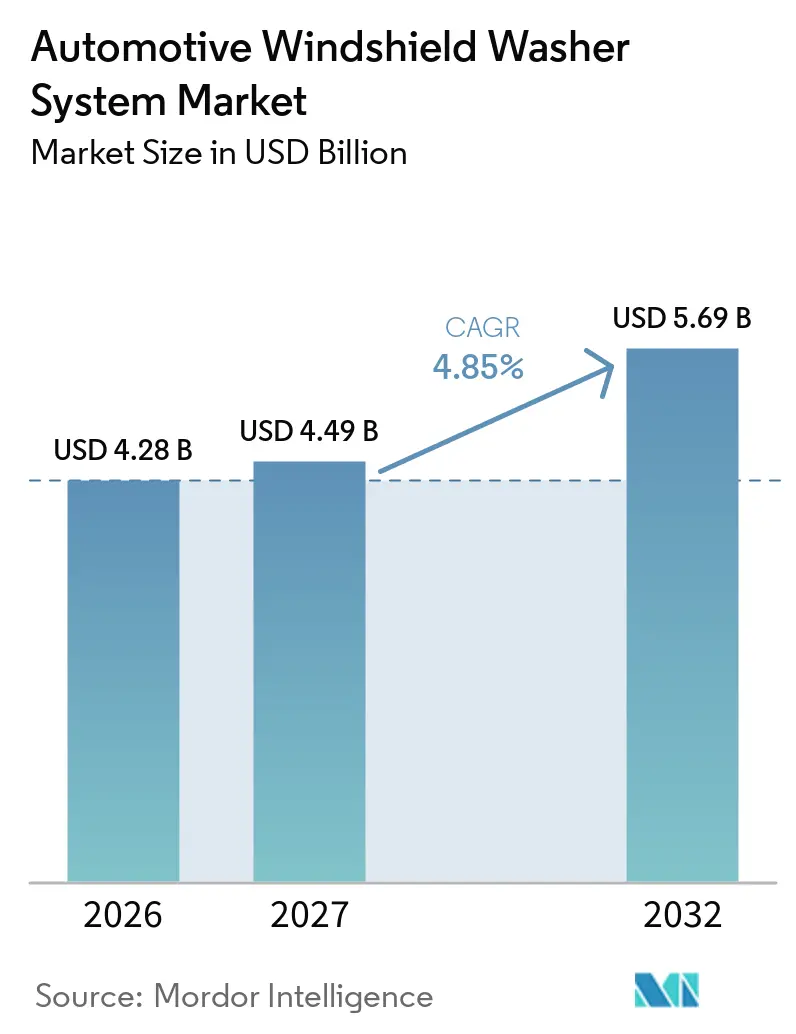
The automotive windshield washer System market was valued at USD 4.28 billion in 2026, is estimated at USD 4.49 billion in 2027, and is projected to reach USD 5.69 billion by 2032, growing at a CAGR of 4.85% from 2027 to 2032. Clear forward visibility supports demand across vehicle classes and powertrains. Vehicle production supports original-equipment demand, while the installed base supports replacement sales. Global production reached 96.4 million units in 2025, compared with 92.7 million units in 2024. More exposed cameras and sensors are expanding cleaning requirements beyond the windshield. This favors suppliers that integrate fluid storage, pumping, routing, nozzles, and controls.
Key Report Takeaways
- By component, pump/motor held 44.53% of the automotive windshield washer system market share in 2026, while others, including heaters and level sensors, are projected to grow at a 7.03% CAGR through 2032.
- By position, front windshield held a 72.87% share in 2026, while others, including headlamp, camera, and sensor cleaning, are projected to grow at a 7.91% CAGR through 2032.
- By nozzle mounting, hood-mounted held an 82.99% share in 2026, while wiper arm/blade-integrated, also known as wet arm, is projected to grow at an 8.79% CAGR through 2032.
- By vehicle type, passenger cars held a 60.73% share in 2026, while light commercial vehicles are projected to grow at a 5.71% CAGR through 2032.
- By sales channel, original equipment manufacturer held a 56.68% share in 2026, while aftermarket is projected to grow at a 5.04% CAGR through 2032.
- By geography, Asia-Pacific held 26.32% share in 2026 and is projected to grow at a 5.45% CAGR through 2032.
Note: Market numbers in this report are based on Mordor Intelligence's proprietary estimation framework, which combines nine months of actuals with Q4 projections for base year 2026.
Market Trends and Insights
Drivers Impact Analysis of Automotive Windshield Washer System Market*
| Driver | (~) % Impact on CAGR Forecast | Geographic Relevance | Impact Timeline |
|---|---|---|---|
| Global Vehicle Production and Installed-Vehicle Base Expansion | +1.3% | Global | Short term (≤ 2 years) |
| ADAS Camera and Sensor Cleaning Integration | +1.1% | Global; highest intensity in North America, Europe, and Asia-Pacific | Medium term (2–4 years) |
| Visibility and Road-Safety Requirements in Rain, Snow, Dust, and Road Spray | +0.8% | Global; peak regulatory activity in Europe and North America | Medium term (2–4 years) |
| OEM Adoption of Integrated Wet-Arm and Low-Mist Washer Delivery | +0.6% | Europe (highest adoption), expanding to Asia-Pacific | Medium term (2–4 years) |
| Washer-Tank Thermal Reuse in Electric Vehicles | +0.4% | Asia-Pacific, Europe | Long term (≥ 4 years) |
| Software-Controlled Metering to Reduce Fluid Use and Packaging Footprint | +0.3% | Europe, North America | Long term (≥ 4 years) |
| Source: Mordor Intelligence | |||
Global Vehicle Production and Installed-Vehicle Base Expansion
Vehicle output gives the automotive windshield washer system market a stable source of original-equipment demand because every new vehicle requires a cleaning system. The installed base then creates a separate replacement opportunity for pumps, nozzles, hoses, reservoirs, and wiper-related parts. Global production increased to 96.4 million vehicles in 2025 from 92.7 million in 2024[1]. This rise supports a wider future vehicle population without requiring any change in washer-system fitment rules. The automotive windshield washer system market therefore has exposure to both initial vehicle build volumes and the service needs that follow after vehicles enter use. Suppliers with a broad catalog can use this pattern to serve vehicle manufacturers and repair channels without relying on a single type of demand.
ADAS Camera and Sensor Cleaning Integration
Camera and sensor cleaning expands the automotive windshield washer system market beyond the traditional windshield application. Cameras, radar housings, and other sensing surfaces must remain usable in rain, dust, road spray, and insect accumulation. This creates a need for added routing, targeted nozzle design, and control logic within a vehicle’s cleaning system. The requirement also increases the engineering work required before a supplier receives approval for a vehicle program. Suppliers that can validate an integrated cleaning module can address more content on each vehicle than suppliers that sell only a standalone pump or nozzle. The automotive windshield washer system market consequently gives greater weight to system design and validation as sensing hardware becomes more common.
Visibility and Road-Safety Requirements in Rain, Snow, Dust, and Road Spray
Clear sightlines remain a basic vehicle safety need, especially in wet, dusty, snowy, and high-spray driving conditions. Washer systems support the driver’s field of view when wipers alone cannot remove contamination from the glass. This role gives the automotive windshield washer system market a durable place in vehicle design, even where other exterior features vary by trim level. It also creates a practical reason for replacement purchases when a pump, hose, nozzle, or reservoir fails. Vehicle manufacturers must consider washer performance together with windshield geometry, wiper coverage, and fluid storage. Suppliers that provide reliable delivery across varied climate conditions can remain relevant across conventional, electric, and connected vehicles.
OEM Adoption of Integrated Wet-Arm and Low-Mist Washer Delivery
Wet-arm designs deliver fluid closer to the wiping edge than a conventional hood-mounted nozzle. This approach can reduce fluid dispersion and can help maintain a cleaner area around forward-facing cameras. The automotive windshield washer system market is seeing greater interest in this approach where vehicle styling and sensor placement limit the usefulness of conventional nozzle locations. Integrated designs also require coordination between the wiper assembly, fluid path, pump behavior, and controls. That raises the value of suppliers that can deliver a complete validated assembly rather than an isolated part. The format can therefore create opportunities for established system suppliers while adding engineering demands for smaller component makers.
Restraints Impact Analysis of Automotive Windshield Washer System Market*
| Restraint | (~) % Impact on CAGR Forecast | Geographic Relevance | Impact Timeline |
|---|---|---|---|
| OEM Cost Pressure and Component Commoditization | -0.9% | Global | Short term (≤ 2 years) |
| Mature Vehicle Platforms and Cyclical Replacement Demand | -0.7% | Europe, North America | Medium term (2–4 years) |
| Freeze Protection, Fluid Compatibility, and Heater Energy Penalties | -0.5% | Northern Europe, North America, Russia | Medium term (2–4 years) |
| Sensor-Cleaning Validation, Contamination, and Product-Liability Exposure | -0.4% | Global; highest enforcement in North America and Europe | Long term (≥ 4 years) |
| Source: Mordor Intelligence | |||
OEM Cost Pressure and Component Commoditization
Conventional washer components face strong price pressure because many vehicle programs treat them as mature parts. Large vehicle platforms can concentrate purchasing volumes and give procurement teams greater leverage during supplier selection. This limits the scope for price gains on basic reservoirs, hoses, simple pumps, and conventional hood-mounted nozzles. The automotive windshield washer system market is therefore divided between mature products with cost-based competition and advanced systems with more design content. Suppliers often need efficient manufacturing of baseline products while allocating development spending to sensor cleaning and integrated delivery systems. This split can make it difficult for a supplier that lacks either scale or differentiated technology to maintain margins.
Mature Vehicle Platforms and Cyclical Replacement Demand
Long-running vehicle platforms can delay the adoption of new cleaning architectures. Existing specifications may remain in place for several production years, limiting near-term changes in content and pricing. In mature vehicle regions, replacement demand can also move with repair activity, ownership behavior, and vehicle scrappage. The automotive windshield washer system market consequently faces uneven growth across regions and channels. Suppliers centered on established vehicle programs need cost discipline and strong service coverage to manage that variability. Advanced cleaning features may take longer to reach high-volume vehicle lines when buyers prioritize platform continuity and affordability.
*Our forecasts treat driver/restraint impacts as directional, not additive. The impact forecasts reflect baseline growth, mix effects, and variable interactions.
Automotive Windshield Washer System Market Segment Analysis
By Component:
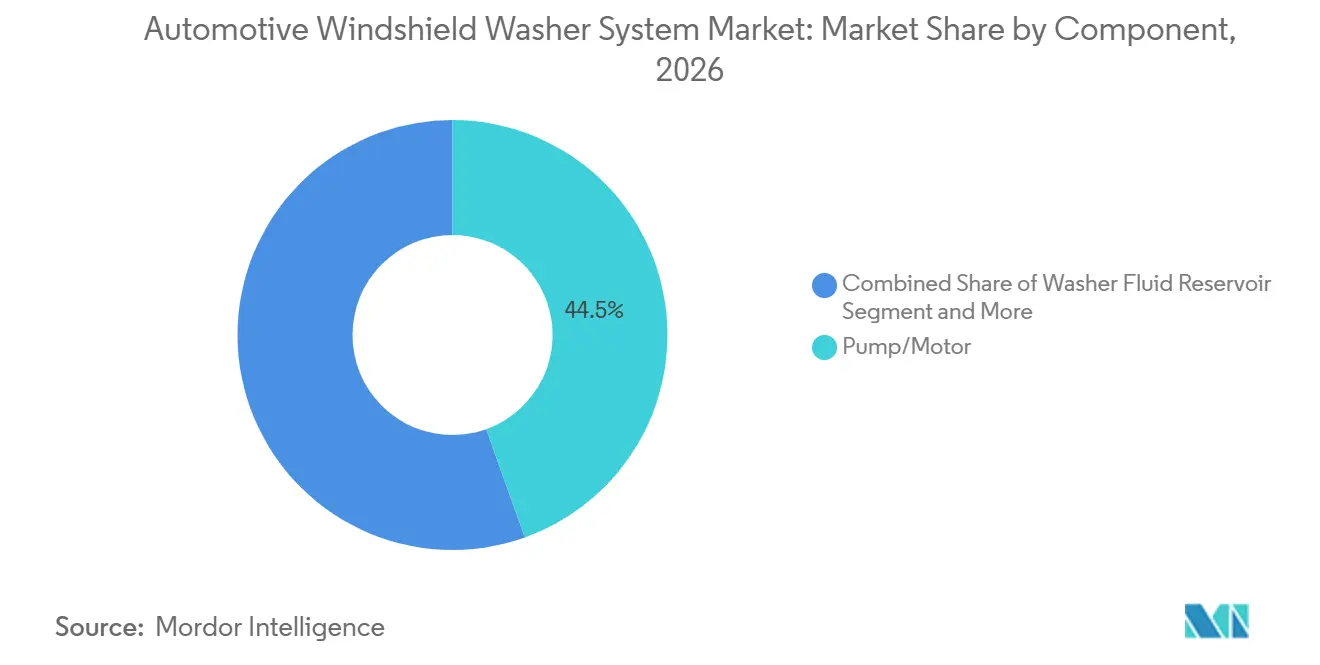
Pump/Motor Anchors System Value While Thermal Accessories GrowThe pump/motor component held a 44.53% share in 2026. It moves fluid from the reservoir to the cleaning surface, ensuring consistent washer fluid delivery during operation. Reservoirs store fluid, while nozzles determine spray coverage across the windshield. Hoses and valves route fluid through the vehicle, maintaining pressure and flow control. Reliable integration across these parts is important as they function as a single system. In the automotive windshield washer system market, any failure in one component can compromise overall system performance, making component quality and compatibility critical considerations for both OEMs and aftermarket suppliers.
Other components, including heaters and level sensors, are projected to grow at a 7.03% CAGR through 2032. Heaters help maintain operation in cold conditions by preventing washer fluid from freezing, while level sensors alert drivers when the fluid is low. Connected vehicle systems can display these alerts through vehicle interfaces, improving driver awareness. Combining thermal, sensing, pumping, and storage functions can reduce the number of system interfaces. As automotive windshield washer systems become more integrated with vehicle electronics, demand for these supplementary components is expected to increase steadily across passenger and commercial vehicle segments.

By Position:
Front Windshield Remains Central While Exterior Sensors Expand RequirementsFront windshields accounted for 72.87% in 2026. It remains the core position because it protects the driver’s forward view. Rear windshield systems serve body styles that require separate rear glass cleaning. The front system still depends on nozzle coverage, pump capacity, wiper movement, and fluid routing. This application provides stable demand as other cleaning positions develop.
Others, covering headlamp, camera, and sensor cleaning, are projected to grow at a 7.91% CAGR through 2032. Each surface has different geometry and exposure to contamination. The system may require separate fluid lines, tailored nozzles, and control logic. Vehicles with multiple exterior sensors cannot rely only on windshield cleaning. This shift broadens the washer equipment's function to include exterior cleaning.
By Nozzle Mounting:
Hood-Mounted Systems Retain Scale While Wet Arm Gains AttentionHood-mounted held an 82.99% share in 2026. The format uses familiar manufacturing processes and established vehicle packaging. It works with standard windshield and wiper arrangements. Its installed base also supports replacement demand for nozzles and plumbing. The format will remain relevant across many conventional vehicle programs.
Wiper arm/blade-integrated, also called wet arm, is projected to grow at an 8.79% CAGR through 2032. It delivers fluid closer to the wiping edge. This can reduce fluid dispersion and preserve camera sightlines. Integration requires coordination among the blade, arm, pump, and fluid path. The format supports tighter exterior packaging and advanced visibility needs.
By Vehicle Type:
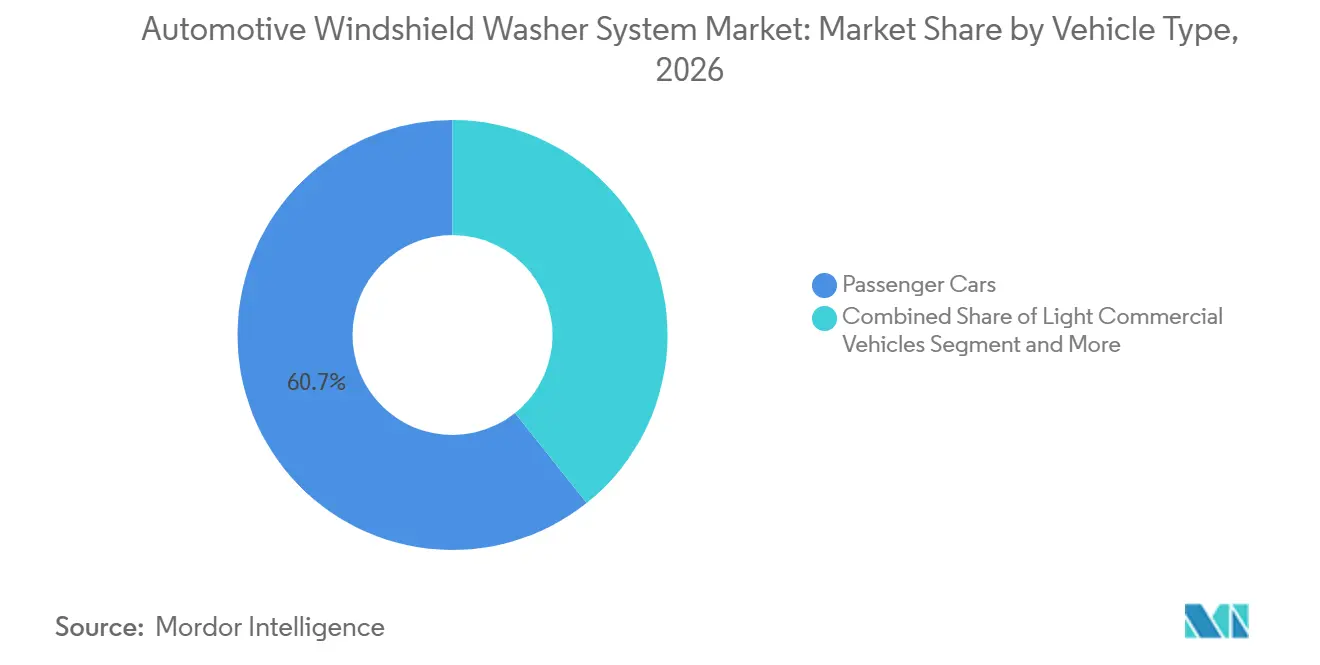
Passenger Cars Provide Volume While Light Commercial Vehicles Add New UsesPassenger cars held a 60.73% share in 2026. Their broad production base supports steady original-equipment demand. Rear cleaning equipment is also used on relevant body styles. Requirements vary by vehicle price point, climate, and feature content. Suppliers need flexible systems for different vehicle designs.
Light commercial vehicles are projected to grow at a 5.71% CAGR through 2032. Delivery, service, construction, and fleet use expose these vehicles to dirt and road spray. Camera-based safety functions can add cleaning needs beyond the windshield. Fleet operators value serviceability because downtime affects daily work. Durable parts and broad fitment can support this demand.
By Sales Channel:
OEM Programs Lead While Replacement Needs Support the AftermarketThe original equipment manufacturer held a 56.68% share in 2026. Suppliers are selected early in vehicle platform development. They must meet packaging, testing, quality, and delivery requirements. Original-equipment demand includes storage, pumping, routing, delivery, and controls. This channel rewards technical coordination and consistent manufacturing quality.
Aftermarket is projected to grow at a 5.04% CAGR through 2032. Pumps, nozzles, hoses, and reservoirs need replacement during a vehicle’s life. Accurate fitment information and dependable distribution are important for workshops. DENSO expanded European aftermarket coverage for Chinese-manufactured vehicles in June 2025. Broader catalog coverage can improve parts availability for independent repair networks.
Geography Analysis
Asia-Pacific Automotive Windshield Washer System Market
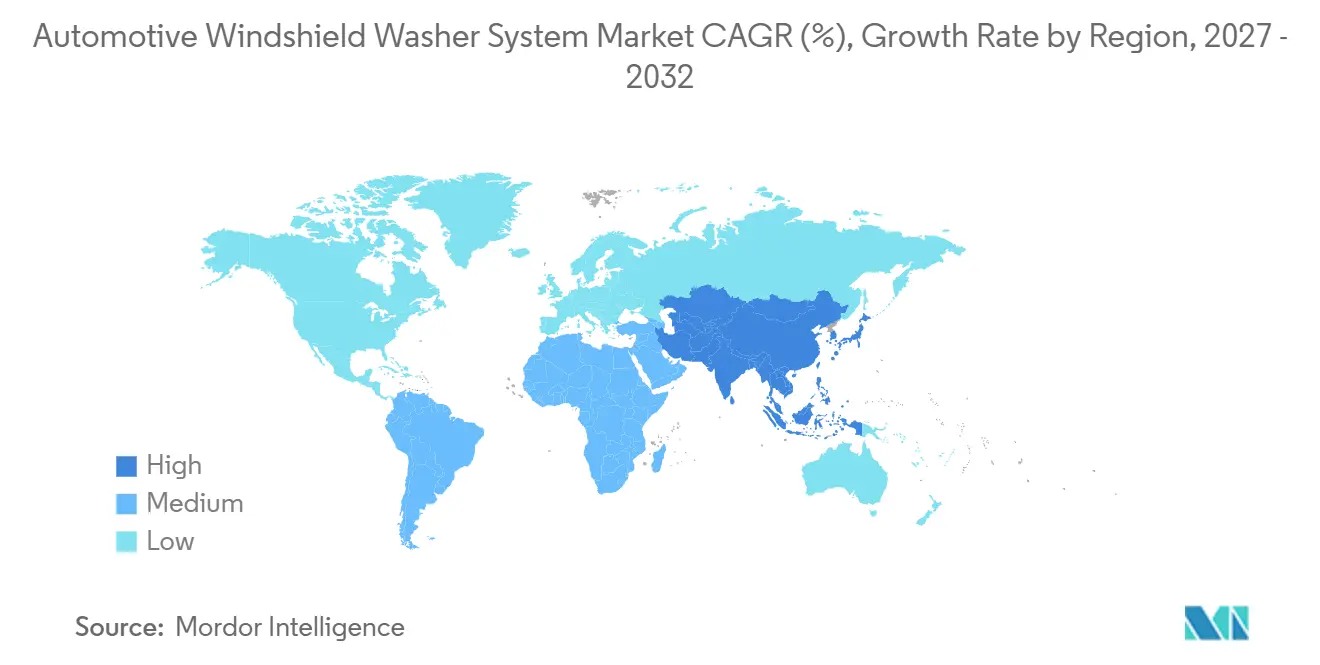
Asia-Pacific accounted for 26.32% of the market in 2024 and is projected to grow at a 5.45% CAGR through 2032. China, India, and Japan each contribute distinct strengths in production, demand, and engineering. The region accounted for more than 61% of global vehicle output in 2025. New vehicle platforms increasingly incorporate cameras and sensing hardware that require dedicated windshield washer and cleaning systems. Rising vehicle ownership across emerging economies in the region further expands the installed base. The growing vehicle parc also supports future demand for repairs and replacements of washer pumps, nozzles, and fluid reservoirs.
Europe Automotive Windshield Washer System Market
Europe influences the design of advanced windshield washer systems and supplier validation practices. Integrated wiper and fluid-delivery systems address styling, aerodynamic, and sensing requirements across premium and volume vehicle segments. The growing use of cameras and software-controlled driver assistance functions supports demand for advanced cleaning equipment, including heated nozzles and sensor wash systems. Suppliers must balance engineering investment against cost pressures from mature vehicle platforms. Stringent regulatory standards and emission norms also shape product development priorities. European engineering centers play a role in validating windshield washer systems for broader global vehicle deployment.
North America, South America, and Middle East and Africa Automotive Windshield Washer System Market
North America has a large vehicle base that supports steady replacement demand for windshield washer components, including pumps, reservoirs, and nozzles. South America benefits from activity in both passenger and commercial vehicle segments, where washer system maintenance remains a consistent service requirement. In the Middle East and Africa, dust, heat, rain, and road spray create demanding operating conditions that shape regional product requirements. Flexible product catalogs are important given the varied fleets and service practices across these regions. Suppliers can address this diversity by combining durable conventional washer systems with targeted advanced cleaning solutions.
Competitive Landscape
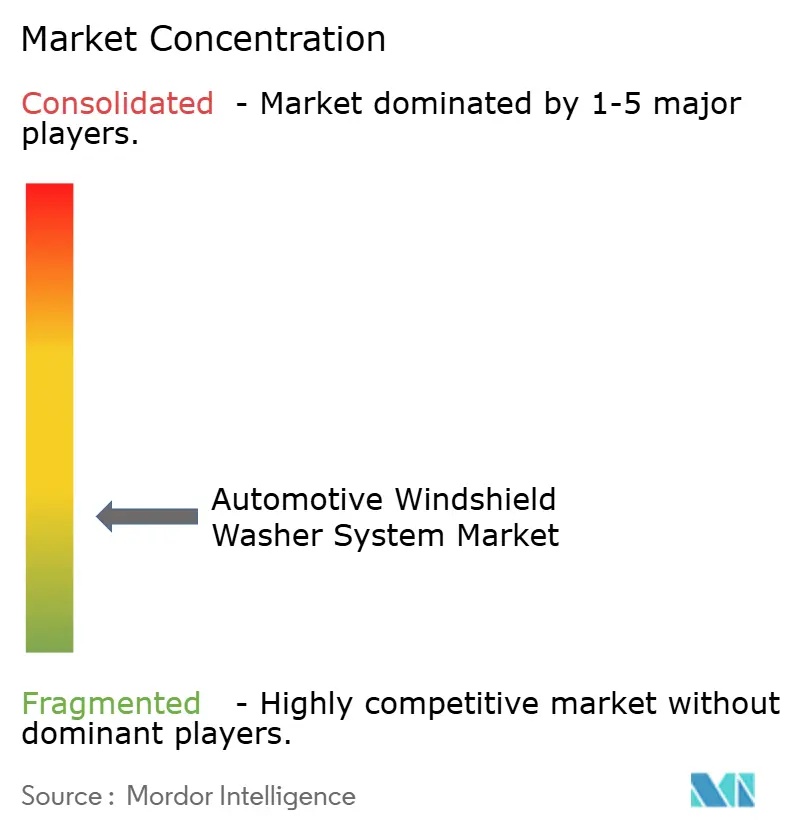
The automotive windshield washer system market is fragmented across system suppliers and component specialists. Large suppliers can provide reservoirs, pumps, nozzles, fluid lines, controls, and sensor-cleaning modules. Specialists compete through nozzle design, fluidics, fitment, or replacement parts. Competition depends on quality, development support, manufacturing reliability, and cost control. No supplier is shown in the supplied material to hold a controlling share.
Technology is becoming more important as cleaning needs extend beyond the windshield. Integrated fluid management, wiper movement, sensing hardware, and controls can reduce automaker integration work. ABC Technologies acquired TI Fluid Systems in April 2025, creating TI Automotive[2]. The transaction combined lightweight component and fluid-management capabilities. It illustrates the value of related engineering functions within one supplier.
Aftermarket coverage is also a competitive factor as vehicle fleets change. DENSO expanded coverage for Chinese-manufactured vehicles in Europe during 2025. Textron disclosed a plan to separate its industrial segment, including Kautex, in 2026. These moves show continued portfolio and catalog adjustment among suppliers. Competition will remain between broad Tier 1 suppliers, fluid-system companies, and aftermarket specialists.
Automotive Windshield Washer System Industry Leaders
-
Valeo SE
-
DENSO Corporation
-
Robert Bosch GmbH
-
FORVIA SE
-
Textron Inc.
- *Disclaimer: Major Players sorted in no particular order
Automotive Windshield Washer System Market Companies Covered in this Report
- Valeo SE
- Robert Bosch GmbH
- DENSO Corporation
- Mitsuba Corporation
- Textron Inc.
- Bowles Fluidics Corporation
- Doga, S.A.
- Ficosa International, S.A.
- Pricol Limited
- FORVIA SE
- Röchling SE and Co. KG
- Dorman Products, Inc.
- Astemo, Ltd.
- Mergon Group
- Cebi International S.A.
- Exo-s
- Minda Corporation Limited
Recent Industry Developments in Automotive Windshield Washer System Market
- October 2026: Ford expanded its Mustang recall to 86,782 vehicles worldwide built between September 2024 and February 2026, due to a low-temperature fault disabling the wiper and washer system. The initial United States filing in July 2026 covered 67,842 units.
- September 2026: India's Almighty Auto Ancillary (ALMiTY brand) showcased its commercial vehicle wiper systems at IAA Transportation 2026, seeking European expansion while most exports go to North America.
- August 2026: Valeo introduced its next-generation wiping and windscreen-cleaning portfolio to the Irish aftermarket through distributor Serfac.
Global Automotive Windshield Washer System Market Report Scope
The Automotive Windshield Washer System Market is segmented by Component, Position, Nozzle Mounting, Vehicle Type, Sales Channel, and Geography. By Component, the market is segmented into Washer Fluid Reservoir, Pump/Motor, Nozzles, Hoses and Valves, and Others (Heaters, Level Sensors). By Position, the market is segmented into Front Windshield, Rear Windshield, and Others (Headlamp, Camera/Sensor Cleaning). By Nozzle Mounting, the market is segmented into Hood-Mounted and Wiper Arm/Blade-Integrated (Wet Arm). By Vehicle Type, the market is segmented into Passenger Cars, Light Commercial Vehicles, and Heavy Commercial Vehicles. By Sales Channel, the market is segmented into Original Equipment Manufacturer and Aftermarket. By Geography, the market is segmented into North America (United States, Canada, and Rest of North America), Europe (Germany, France, United Kingdom, Italy, Spain, Russia, Poland, and Rest of Europe), Asia-Pacific (China, Japan, South Korea, India, Australia, and Rest of Asia-Pacific), South America (Brazil, Argentina, Chile, Colombia, and Rest of South America), and Middle East and Africa (Saudi Arabia, United Arab Emirates, Turkey, South Africa, Egypt, and Rest of Middle East and Africa). Market forecasts are provided in terms of Value (USD).
Segmentation Overview
| Washer Fluid Reservoir |
| Pump/Motor |
| Nozzles |
| Hoses and Valves |
| Others (Heaters, Level Sensors) |
| Front Windshield |
| Rear Windshield |
| Others (Headlamp, Camera/Sensor Cleaning) |
| Hood-Mounted |
| Wiper Arm/Blade-Integrated (Wet Arm) |
| Passenger Cars |
| Light Commercial Vehicles |
| Heavy Commercial Vehicles |
| Original Equipment Manufacturer |
| Aftermarket |
| North America | United States |
| Canada | |
| Rest of North America | |
| Europe | Germany |
| France | |
| United Kingdom | |
| Italy | |
| Spain | |
| Russia | |
| Poland | |
| Rest of Europe | |
| Asia-Pacific | China |
| Japan | |
| South Korea | |
| India | |
| Australia | |
| Rest of Asia-Pacific | |
| South America | Brazil |
| Argentina | |
| Chile | |
| Colombia | |
| Rest of South America | |
| Middle East and Africa | Saudi Arabia |
| United Arab Emirates | |
| Turkey | |
| South Africa | |
| Egypt | |
| Rest of Middle East and Africa |
| By Component | Washer Fluid Reservoir | |
| Pump/Motor | ||
| Nozzles | ||
| Hoses and Valves | ||
| Others (Heaters, Level Sensors) | ||
| By Position | Front Windshield | |
| Rear Windshield | ||
| Others (Headlamp, Camera/Sensor Cleaning) | ||
| By Nozzle Mounting | Hood-Mounted | |
| Wiper Arm/Blade-Integrated (Wet Arm) | ||
| By Vehicle Type | Passenger Cars | |
| Light Commercial Vehicles | ||
| Heavy Commercial Vehicles | ||
| By Sales Channel | Original Equipment Manufacturer | |
| Aftermarket | ||
| By Geography | North America | United States |
| Canada | ||
| Rest of North America | ||
| Europe | Germany | |
| France | ||
| United Kingdom | ||
| Italy | ||
| Spain | ||
| Russia | ||
| Poland | ||
| Rest of Europe | ||
| Asia-Pacific | China | |
| Japan | ||
| South Korea | ||
| India | ||
| Australia | ||
| Rest of Asia-Pacific | ||
| South America | Brazil | |
| Argentina | ||
| Chile | ||
| Colombia | ||
| Rest of South America | ||
| Middle East and Africa | Saudi Arabia | |
| United Arab Emirates | ||
| Turkey | ||
| South Africa | ||
| Egypt | ||
| Rest of Middle East and Africa | ||
Key Questions Answered in the Report
What is the projected growth rate for automotive windshield washer systems?
The automotive windshield washer system market is forecast to grow at a 4.85% CAGR from 2027 to 2032 and reach USD 5.69 billion by 2032, supported by original-equipment vehicle demand and the replacement needs of the installed vehicle base.
Which component leads automotive windshield washer system demand?
Pump/motor is the leading component, with a 44.53% share in 2026, because every washer architecture depends on a pumping function to move fluid through the system and deliver it to the intended cleaning surface.
What is driving demand for camera and sensor cleaning systems?
More exterior cameras and sensing hardware require targeted cleaning in rain, dust, road spray, and other contamination conditions, which increases the need for targeted nozzles, dedicated routing, and coordinated controls.
Why are wet-arm washer systems gaining attention?
Wet-arm systems place fluid closer to the wiping edge and are projected to grow at an 8.79% CAGR through 2032, helping vehicle manufacturers address fluid placement, exterior packaging, and camera sightline requirements.