
Automotive DRAM Market Size and Share
Market Overview
| Study Period | 2020 - 2031 |
|---|---|
| Market Size (2026) | USD 9.76 Billion |
| Market Size (2031) | USD 22.25 Billion |
| Growth Rate (2026 - 2031) | 17.91 % |
| Fastest Growing Market | Asia-Pacific |
| Largest Market | Asia-Pacific |
| Market Concentration | High |
Major Players *Disclaimer: Major Players sorted in no particular order Image © Mordor Intelligence. Reuse requires attribution under CC BY 4.0. | |
Automotive DRAM Market Analysis by Mordor Intelligence
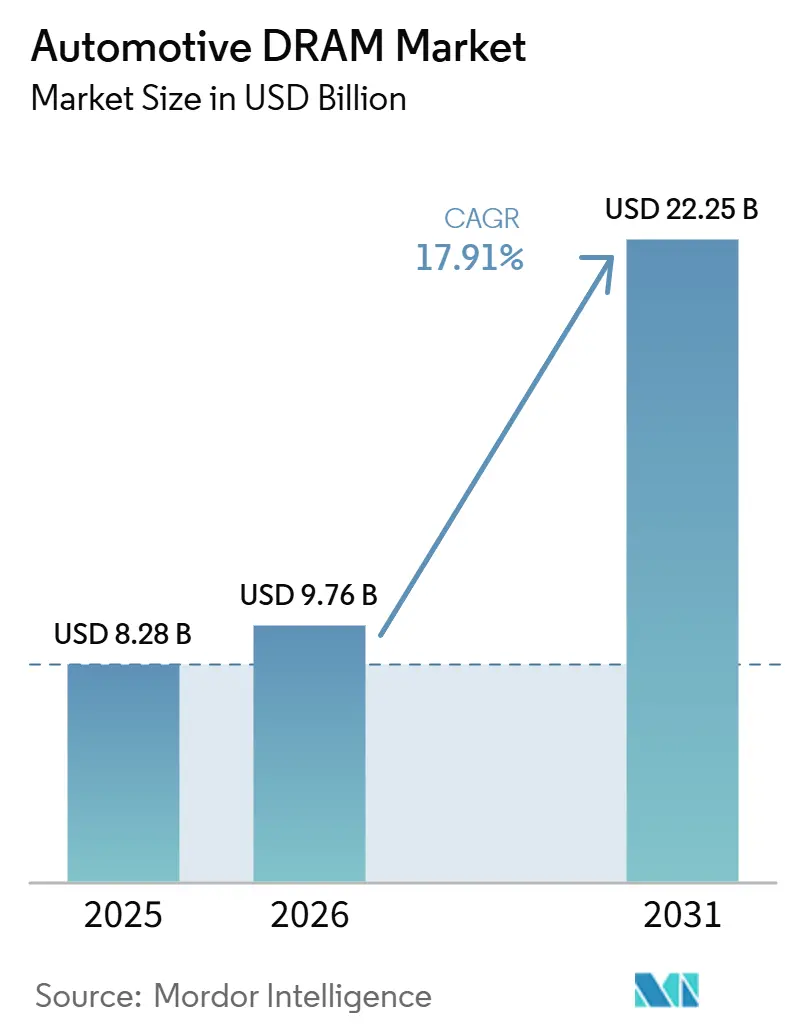
The automotive DRAM market size is expected to grow from USD 8.28 billion in 2025 to USD 9.76 billion in 2026 and is forecast to reach USD 22.25 billion by 2031 at 17.91% CAGR over 2026-2031. The automotive DRAM market is expanding as vehicle electronics shift from distributed controller layouts to centralized compute systems that require much larger working memory pools per vehicle. Average DRAM content per vehicle reached 16 GB in 2025, indicating that memory demand is rising with software-defined architectures, richer cockpit functions, and more advanced driver-assistance stacks. The automotive DRAM market is also being shaped by a supply mix that now favors newer LPDDR5 and LPDDR5X programs while legacy DDR4 and LPDDR4 platforms face tighter availability over the next design cycle. Competitive conditions remain concentrated, and that keeps qualification timing, long-life support, and supply assurance at the center of OEM sourcing decisions. Even with power, thermal, and redesign constraints in lower-cost vehicle trims, the automotive DRAM market continues to benefit from rising per-vehicle memory content across passenger and commercial platforms.
Key Report Takeaways
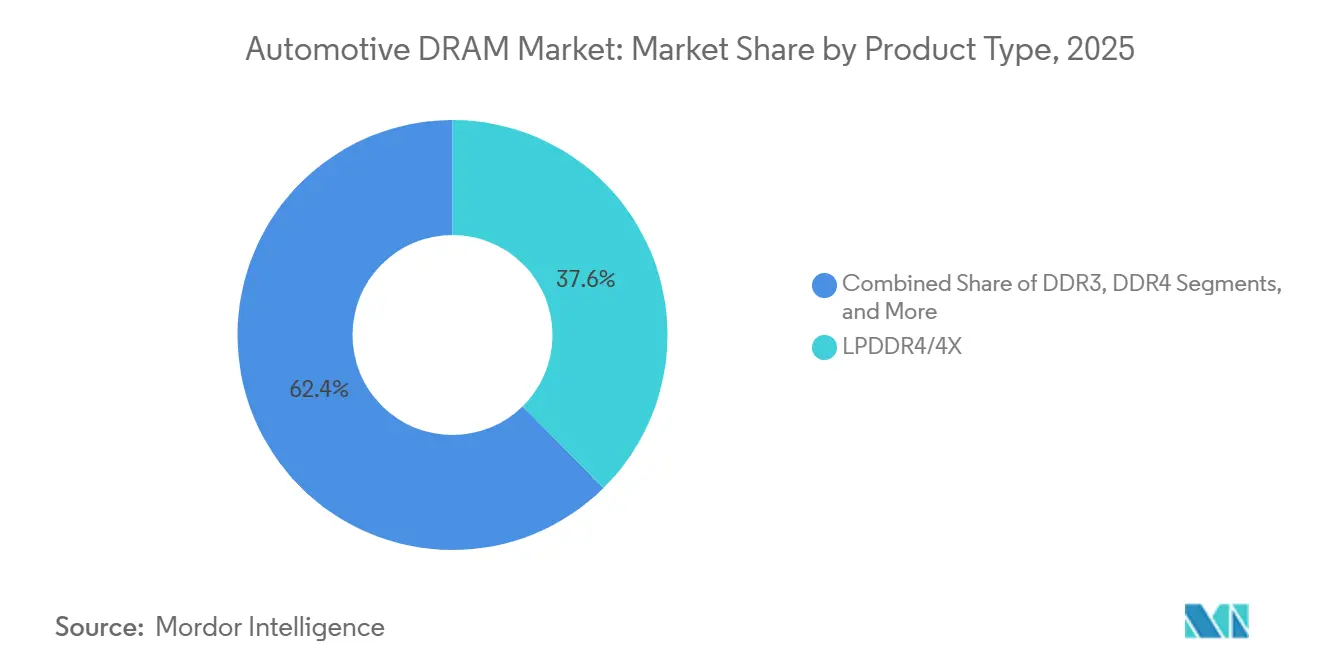
- By product type, LPDDR4/4X led with a 37.6% revenue share of the automotive DRAM market in 2025, while LPDDR5/5X is projected to expand at a 20.1% CAGR through 2031.
- By application, digital cockpit and infotainment accounted for 33.8% of the automotive DRAM market in 2025, while ADAS and automated driving are forecast to grow at a 19.9% CAGR through 2031.
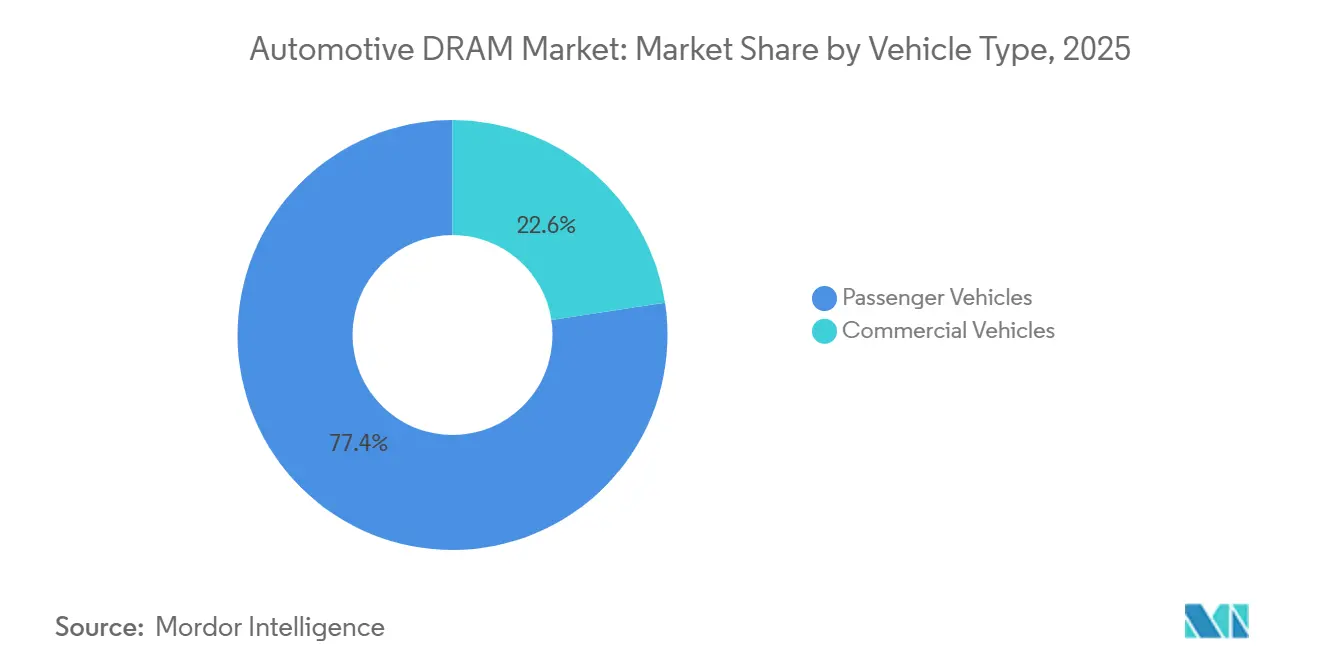
- By vehicle type, passenger vehicles accounted for 77.4% of revenue in 2025, while commercial vehicles are projected to record the highest CAGR of 20.4% through 2031.
- By memory density, the 1 GB to 2 GB tier accounted for 38.1% of the automotive DRAM market in 2025, while the above 2 GB tier is projected to grow at a 19.7% CAGR through 2031.
- By geography, Asia-Pacific accounted for 47.7% of revenue in 2025 and is forecast to expand at a 18.9% CAGR through 2031.
Note: Market size and forecast figures in this report are generated using Mordor Intelligence’s proprietary estimation framework, updated with the latest available data and insights as of January 2026.
Global Automotive DRAM Market Trends and Insights
Drivers Impact Analysis*
| Driver | (~) % Impact on CAGR Forecast | Geographic Relevance | Impact Timeline |
|---|---|---|---|
| Rising DRAM Content In ADAS And Central Compute Platforms | +4.8% | Global, with highest intensity in North America, Europe, and APAC core | Short term (≤ 2 years) |
| Expanding Digital Cockpit And Multi-Display Infotainment Memory Loads | +3.6% | Global, with early gains in China and Germany | Short term (≤ 2 years) |
| LPDDR5/5X Adoption In Software-Defined And Zonal Vehicles | +2.8% | North America, Europe, South Korea, China | Medium term (2-4 years) |
| Higher Electronics Content In EVs And Premium Vehicle Trims | +2.2% | China, Europe, North America | Medium term (2-4 years) |
| Functional-Safety Memory Features Reducing Redundant Compute Overhead | +1.6% | Global, with regulatory pull in EU and Japan | Medium term (2-4 years) |
| OTA-Enabled Feature Roadmaps Forcing Memory Headroom At Design-In | +1.2% | Europe, North America | Long term (≥ 4 years) |
| Source: Mordor Intelligence | |||
Rising DRAM Content In ADAS And Central Compute Platforms
The shift from domain-based layouts to zonal and centralized compute architectures remains the strongest volume driver in the automotive DRAM market. Each consolidation node now has to support workloads that were once spread across many separate controllers, so memory pooling rises as perception, planning, control, and fail-safe functions move closer together. Level 3 autonomy-capable platforms already require 8 GB to 16 GB of DRAM for sensor fusion and real-time processing, which keeps memory demand tied directly to functional capability rather than optional feature count. Micron noted that vehicle architectures are moving toward much heavier memory use as compute intensity rises across ADAS, infotainment, and connected services, and that trend is raising DRAM content well beyond earlier vehicle baselines.[1]Micron Technology, “Automotive Megatrends White Paper,” Micron Technology, micron.com The automotive DRAM market is also seeing a procurement effect from this transition, because early migration to newer memory standards gives OEMs more room to manage future supply stress. As a result, memory specification is now tied not only to performance targets, but also to platform resilience across longer vehicle production cycles.
Expanding Digital Cockpit And Multi-Display Infotainment Memory Loads
Cockpit systems are becoming larger memory consumers as display clusters, head-up displays, voice interfaces, and rear-seat entertainment are increasingly managed by a single controller. In 2026, mainstream infotainment systems still use 4 GB to 8 GB of DRAM, while premium platforms in advanced electric vehicles are already moving toward 16 GB to 32 GB configurations. That increase is not driven solely by screens, because real-time personalization, richer graphics, navigation, and voice processing all add persistent memory requirements throughout the software stack. The automotive DRAM market is also benefiting from over-provisioning at design-in, since OEMs want enough headroom for software upgrades that will be activated later in the vehicle life cycle. Micron's automotive memory view supports this pattern, showing that connected vehicle functions, richer user experiences, and expanding software content are driving higher memory requirements even before full autonomy becomes mainstream. The result is that cockpit DRAM demand is becoming more structural, keeping the automotive DRAM market exposed to sustained content growth in both premium and upper mid-range models.
LPDDR5/5X Adoption In Software-Defined And Zonal Vehicles
LPDDR5 and LPDDR5X are becoming the reference products for new high-compute vehicle programs, redefining the performance ceiling of the automotive DRAM market. Samsung's 12nm-class automotive LPDDR5X supports speeds up to 9,600 Mbps and densities from 3 GB to 24 GB per device, while meeting ISO 26262 ASIL-D and AEC-Q100 Grade 1 requirements for harsh automotive conditions.[2]Samsung Semiconductor, “Samsung’s 12nm-Class Automotive LPDDR5X, DRAM for Safety-Critical Centralized Automotive Systems,” Samsung Semiconductor, samsung.com Micron also shipped customer samples of its 1-gamma automotive LPDDR5X in early 2025, and the product was positioned to deliver higher capacity and 9,600 MT/s performance for next-generation cockpit and ADAS designs. The automotive DRAM market is therefore moving toward a new baseline in which bandwidth, power efficiency, and safety certification have to advance together rather than as separate product attributes. Suppliers that already hold the right qualifications can move earlier into new program nominations, while slower migration leaves older platforms exposed to a compressed redesign schedule. This is why LPDDR5 and LPDDR5X adoption is carrying both a technology effect and a timing effect across the automotive DRAM market.
Higher Electronics Content In EVs And Premium Vehicle Trims
Electric vehicles and premium trims consume more DRAM because they typically ship with denser software stacks, broader connectivity, and deeper feature sets from launch. In the automotive DRAM market, that means growth is no longer linked only to vehicle production volume, because the value per unit also rises sharply with trim and compute intensity. Micron stated that the average vehicle sold in 2025 contained 16 GB of DRAM and 204 GB of NAND, representing a 3x increase in DRAM versus vehicles sold in 2021. EV platforms contribute even more to that pattern because centralized software stacks, telematics, battery management, driver assistance, and cabin intelligence all compete for working memory simultaneously. Premium trims amplify the same effect, since they are the first to absorb high-bandwidth memory configurations and multi-display cockpit features at production scale. That mix shift keeps the automotive DRAM market supported even when lower-cost models remain cautious on the densest memory configurations.
Restraints Impact Analysis*
| Restraint | (~) % Impact on CAGR Forecast | Geographic Relevance | Impact Timeline |
|---|---|---|---|
| Automotive Qualification Cycles And Long-Life Support Burdens | -0.8% | Global, with the highest exposure in North America and Europe | Long term (≥ 4 years) |
| AI/HBM Capacity Pull Tightening Auto-Grade DRAM Supply | -0.7% | Global, centered on South Korea and Taiwan fab capacity | Short term (≤ 2 years) |
| Legacy DDR4/LPDDR4 Platform Redesign Risk | -0.5% | North America, Europe, China | Medium term (2-4 years) |
| Power And Thermal Budgets Limiting Density In Mass-Market Vehicles | -0.4% | Global, with highest impact in the Asia-Pacific mass market | Long term (≥ 4 years) |
| Source: Mordor Intelligence | |||
Automotive Qualification Cycles And Long-Life Support Burdens
The automotive DRAM market still operates on development timelines that are much slower than those of consumer memory products. Vehicle programs often freeze electronic architecture 24 months to 36 months before the start of production, and once a part is qualified, OEMs expect supply support for 10 years to 15 years. That long support window conflicts with the much faster node migration cycle in mainstream DRAM manufacturing, so every product transition creates a timing gap. Micron secured ASIL-D certification for LPDDR5 and LPDDR5X in 2022; Samsung reached the same level in 2024; and SK Hynix announced ASIL-D certification for LPDDR5X in 2024, showing how qualification timing can separate suppliers even when all are major memory producers.[3]SK Hynix, “SK Hynix LPDDR5X Earns ASIL-D, Top Automotive Memory Safety Rating,” SK Hynix Newsroom, skhynix.com The automotive DRAM market, therefore, rewards suppliers that can qualify multiple generations in parallel and hold long-life commitments without disruption. OEMs that delayed LPDDR5 qualification now face a tighter migration window as legacy products move closer to supply rationalization.
AI/HBM Capacity Pull Tightening Auto-Grade DRAM Supply
The automotive DRAM market is competing for wafer allocation with products that now offer far higher revenue per start in the data center memory chain. When suppliers redirect capital and attention toward HBM, older automotive LPDDR4 and DDR4 programs become less attractive, even if vehicle demand remains healthy. This creates structural rather than temporary supply pressure, reflecting long-term investment priorities rather than a short-term inventory imbalance. The pressure is strongest where fabs must choose between high-margin memory categories and long-life automotive products that require strict qualification, extended support, and smaller absolute volumes. The automotive DRAM market is therefore exposed to tighter availability in legacy nodes even before demand weakens. That imbalance pushes OEMs to secure supply earlier, redesign faster, and treat memory roadmaps as strategic sourcing decisions rather than routine component choices.
*Our forecasts treat driver/restraint impacts as directional, not additive. The impact forecasts reflect baseline growth, mix effects, and variable interactions.
Segment Analysis
By Product Type: LPDDR5 And LPDDR5X Shift The Performance Baseline
LPDDR4/4X held 37.6% of the automotive DRAM market in 2025, supported by a large installed base of vehicle programs that were frozen several years before production began. DDR3 and DDR4 also retained relevant positions in body electronics, gateway modules, and powertrain systems, where mature cost structures and long support windows still matter more than peak bandwidth. LPDDR5/5X is projected to grow at a 20.1% CAGR through 2031, which makes it the fastest product category in the automotive DRAM market as new platforms move toward higher-bandwidth memory. GDDR6 and GDDR6X remain less widely used, but they are gaining relevance in GPU-linked automotive accelerators where graphics rendering and AI inference require sustained throughput. The product mix is therefore no longer moving in one direction at the same pace, because older generations continue to serve legacy and cost-sensitive modules while newer generations anchor compute-intensive systems.
That split explains why the automotive DRAM market is transitioning unevenly across product families. Automotive migration from DDR4 to newer standards is slower than in consumer electronics because each generation needs fresh qualification work before it can be used in production vehicles. Samsung's automotive LPDDR5X was designed for centralized safety-critical systems and combined high bandwidth with automotive-grade reliability and temperature performance, which shows why fifth-generation low-power DRAM is becoming central to future platform design. Micron's 1-gamma LPDDR5X samples reinforced the same direction by targeting next-generation cockpit and ADAS designs that need more capacity without extra board-area burden. Suppliers that do not have an automotive-qualified LPDDR5 or LPDDR5X path are likely to face design-out risk as SoC ecosystems standardize around higher-bandwidth interfaces. The automotive DRAM industry is therefore separating into products that sustain long-tail legacy demand and products that define the next program cycle.



By Application: Cockpit Leads Revenue While ADAS Sets The Pace
Digital cockpit and infotainment accounted for 33.8% of the automotive DRAM market size in 2025, which made cockpit systems the largest application in the market. That position reflects how unified cockpit controllers now support instrument clusters, navigation, media, voice services, and cabin displays from one compute domain rather than several isolated modules. Mainstream in-vehicle infotainment setups currently use 4 GB or 8 GB of DRAM, while premium electric vehicle platforms already specify 16 GB to 32 GB for richer cabin software and AI-assisted features. Telematics and connectivity remain a smaller share, but they continue to rise as 5G integration increases memory needs above earlier 4G implementations. Micron's automotive memory view showed that richer connected-car functions and software-defined experiences are steadily increasing the amount of memory required across the full application stack.
ADAS and automated driving are projected to expand at a 19.9% CAGR through 2031, which makes it the fastest-growing application in the automotive DRAM market. That growth reflects a clear change in system design, because advanced perception stacks need larger real-time buffers, higher throughput, and stronger support for concurrent workloads. Powertrain, battery management, and chassis applications are also moving higher in memory content as zonal integration replaces isolated controllers and adds software update capability. Body, comfort, and gateway controllers still use lower-density parts in many platforms, but even these applications are absorbing more DRAM as staging partitions and rollback support become normal software requirements. The application mix in the automotive DRAM market is therefore shifting toward bandwidth-heavy and safety-linked workloads rather than simple display or control tasks. The automotive DRAM industry is moving with that application shift, as memory is now a direct enabler of user experience, compute consolidation, and vehicle software longevity.
By Vehicle Type: Passenger Vehicles Hold Scale While Commercial Platforms Accelerate
Passenger vehicles accounted for 77.4% of revenue in 2025, making them the largest vehicle category in the automotive DRAM market. Their lead reflects both the scale of global production and the faster rise in DRAM content in premium and electric passenger models. A wide value spread exists within this category because entry-level passenger cars still carry relatively modest memory content, while premium vehicles with advanced driver assistance and richer cockpit software use much denser memory footprints. That means revenue growth in the automotive DRAM market is increasingly concentrated in the upper end of the passenger segment rather than evenly distributed across all trims. The passenger vehicle base, therefore, anchors market scale, while the internal mix toward software-defined features keeps value per vehicle rising.
Commercial vehicles are projected to grow at a 20.4% CAGR through 2031, which makes them the fastest-growing vehicle type in the automotive DRAM market. This rise reflects a structural change in truck and van electronics, as ADAS mandates, telematics, predictive maintenance, and OTA-capable control systems move into fleet platforms. Regulatory requirements for safety systems in heavy vehicles have created a stronger baseline for memory use in categories that historically relied on lower-content electronics. Light commercial vehicles in delivery and logistics fleets are also absorbing features that were once concentrated in passenger cars, including lane assistance, connectivity modules, and digital cabin functions. The automotive DRAM market is therefore gaining a broader demand base as commercial platforms narrow their content gap with passenger vehicles. The automotive DRAM industry benefits from this shift because it adds volume from a segment where memory content had previously been limited by simpler vehicle architectures.
By Memory Density: Higher-Density Devices Pull The Value Mix Upward
The above 1 GB to 2 GB tier accounted for 38.1% of revenue in 2025, making it the largest density band in the automotive DRAM market. This tier serves a wide range of mid-range infotainment, telematics, and entry-level ADAS applications where cost control and qualified supply remain critical. The 128-512 MB range remains relevant for body electronics, instrument clusters, and powertrain modules that do not require large buffers or very high throughput. The above 512 MB to 1 GB tier supports a broad middle layer of connected and cockpit applications that are spreading across more vehicle price points. Density demand is therefore not rising uniformly because automakers still need long-life, lower-density options for simpler, cost-sensitive modules.
The above 2 GB tier is projected to record a 19.7% CAGR through 2031, making it the fastest-growing density segment in the automotive DRAM market. The main driver is the spread of central compute nodes and advanced cockpit and ADAS controllers that require full-die LPDDR5-class packaging and much larger working memory pools. Micron's automotive white paper showed that average vehicle DRAM content had already reached 16 GB in 2025, which supports the move toward multi-die packages in higher-performance systems. Suppliers that can cover a broad density range under one qualified automotive portfolio hold an advantage because they reduce engineering burden across multiple trim levels and programs. Winbond's automotive LPDDR4/4X positioning around power efficiency and real-time processing shows why even lower-power families are being tailored more carefully for automotive use cases. The automotive DRAM market is therefore seeing higher-density growth without eliminating the long-tail demand that still supports mature density categories.
Geography Analysis
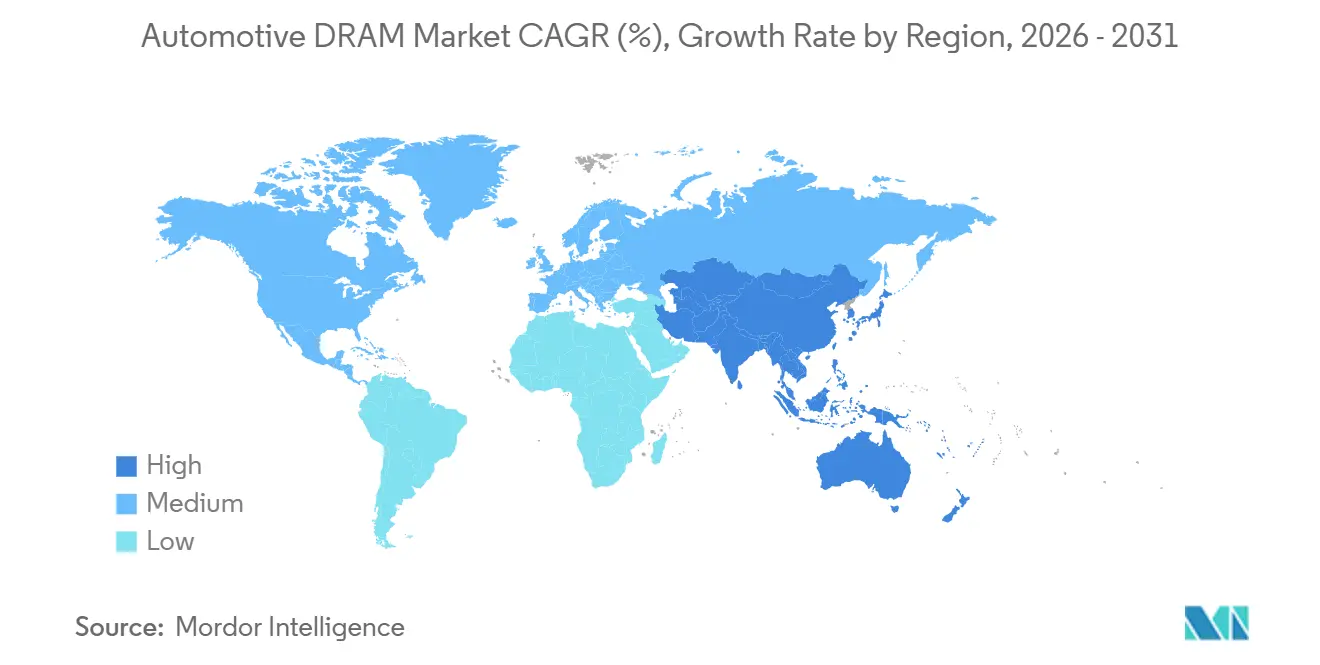
Asia-Pacific captured 47.7% of the automotive DRAM market share in 2025, and it is projected to expand at an 18.9% CAGR through 2031. This region leads the automotive DRAM market by combining China’s electric vehicle scale, South Korea’s memory manufacturing strength, and Taiwan’s specialty semiconductor role. China remains the largest demand engine in the region, as new-energy vehicle scale, connected cockpit adoption, and growth in driver-assistance features continue to lift per-vehicle memory content. South Korea matters not only because Samsung Electronics and SK Hynix are based there, but also because their automotive qualification progress shapes the supply roadmap for global OEM programs. Taiwan adds depth through suppliers that address lower-density and specialty requirements, which keeps the regional supply base broader across product tiers.
North America holds a strategically important position in the automotive DRAM market, combining strong ADAS intensity with Micron Technology’s deep automotive relationships. The United States vehicle mix, especially in pickups and SUVs, supports above-average memory content because these platforms often carry heavier software, display, and driver-assistance loads. Micron's automotive memory roadmap and long history in the segment continue to give the region weight far beyond its unit production share. Micron also emphasized that modern vehicles are moving toward centralized compute and richer connected services, which reinforces North America's role in higher-content platform adoption. Mexico strengthens regional demand because assembly programs there inherit memory architectures and platform specifications set by larger OEM groups across North America and Europe.
Europe remains important in the automotive DRAM market because premium OEM programs there have been early users of automotive-grade LPDDR5X and centralized software architectures. Germany, the United Kingdom, France, and Italy continue to influence the market through premium vehicle development, where compute consolidation and software-defined functionality are advancing faster than in lower-cost segments. Regulatory support for OTA software management has also raised the baseline for memory staging and rollback requirements in European programs. That effect spreads across vehicle classes, not only premium models, because compliance frameworks apply at the platform level. Rest of the World remains smaller, but it is still developing as higher-electronics-content vehicles enter production in South America, the Middle East, and emerging Asian sub-markets. India adds a meaningful demand vector through electrification programs and broader ADAS fitment in newer domestic models. Middle Eastern connected-vehicle deployments and South American model refreshes are smaller in scale, but they still widen the addressable base for the automotive DRAM market.

Competitive Landscape
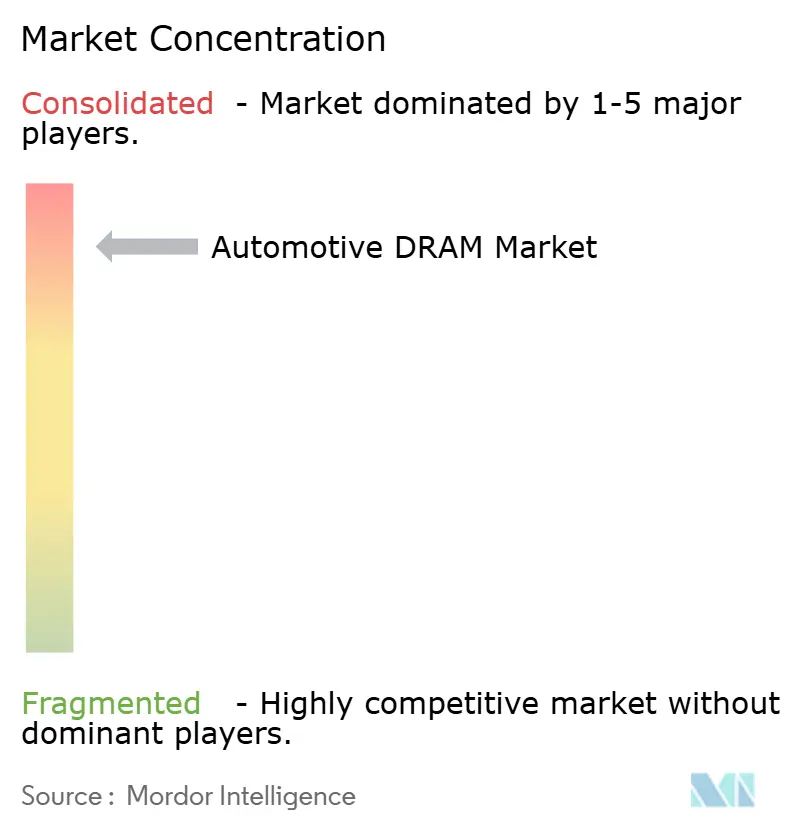
The automotive DRAM market is highly concentrated, with Micron Technology, Samsung Electronics, and SK Hynix controlling a significant share of the globally qualified supply. Even within that concentrated structure, the competitive positions are uneven because certification timing and direct automotive relationships matter more than headline manufacturing scale. Micron maintains a leading position in the automotive memory market, while Samsung Electronics and SK Hynix also hold notable shares, underscoring how early qualification translated into a design-win advantage. The automotive DRAM market, therefore, remains concentrated not simply because there are few memory makers, but because few suppliers can meet long-life support, automotive-grade validation, and performance requirements at the same time. That combination continues to protect incumbent positions across the automotive DRAM market.
Micron's early ASIL-D position and direct OEM alignment gave it a durable lead in the automotive DRAM market, and the company reinforced that position with its 1-gamma automotive LPDDR5X roadmap in 2025. Samsung has been closing the gap by building a stronger automotive offering around 12nm-class LPDDR5X with ASIL-D compliance, higher throughput, and broader density support for centralized systems. SK Hynix also improved its position through LPDDR5X ASIL-D certification, which strengthened its ability to compete for future vehicle programs where safety qualification is mandatory. These moves show that the competitive contest is now centered on qualified next-generation memory rather than only on raw wafer capacity.
Tier-2 players such as Winbond, Nanya Technology, ISSI, AP Memory Technology, and Etron Technology remain relevant in lower-density tiers where longevity, stable supply, and application fit matter more than scale leadership. Winbond's focus on automotive LPDDR4/4X with lower power use and real-time processing support reflects how smaller suppliers can defend specific parts of the automotive DRAM market even without broad leading-edge portfolios. CXMT stands out as the main emerging Chinese entrant referenced in the competitive discussion, though its long-term impact still depends on clearing wider OEM qualification cycles. A meaningful open space remains in multi-die automotive-qualified modules that combine memory functions more efficiently for central compute nodes. Entry barriers stay high because ISO 26262 ASIL-D and AEC-Q100 Grade 1 qualification are costly, slow, and difficult to replicate at scale. That is why the automotive DRAM market still favors incumbents with deep qualification libraries, strong customer support, and durable long-life supply commitments.
Automotive DRAM Industry Leaders
Micron Technology, Inc.
Samsung Electronics Co., Ltd.
SK hynix Inc.
Winbond Electronics Corporation
Nanya Technology Corporation
- *Disclaimer: Major Players sorted in no particular order

Recent Industry Developments
- May 2026: Micron Technology began production at its expanded Manassas, Virginia fabrication facility, a USD 2 billion investment that quadruples domestic DDR4 wafer output. The expansion is positioned to ease automotive and defense-sector supply constraints intensifying since late 2025 as global DRAM capacity was reallocated to HBM for AI data centers.
- May 2026: Nanya Technology Corporation announced that 4 customers had signed 3-year DRAM supply contracts, the longest-term agreements in recent years, alongside subscriptions to a TWD 78.7 billion (USD 2.49 billion) private placement to fund a new plant in New Taipei City's Taishan District. The move reflects OEM urgency to lock in automotive memory supply through the ongoing shortage cycle.
- March 2026: Micron Technology publicly stated it expects future autonomous vehicles to require 300+ GB of DRAM per unit, positioning its high-capacity LPDDR5X and next-generation memory roadmap for the Level 4 and 5 autonomy pipeline.
- February 2026: SK Hynix announced a USD 15 billion investment focused on HBM3, HBM3E, and early HBM4 capacity, with total committed capital across United States and South Korea plants expected to exceed USD 30 billion. The commitment further constrains legacy automotive DRAM capacity available to OEMs.


Global Automotive DRAM Market Report Scope
The Automotive DRAM market comprises dynamic random-access memory (DRAM) devices qualified for automotive applications and designed to meet stringent reliability, functional safety, temperature, and longevity requirements for deployment in passenger and commercial vehicles. The market includes DDR3, DDR4, DDR5, LPDDR4/4X, LPDDR5/5X, and GDDR6/GDDR6X memory solutions integrated into automotive electronic systems.
The Automotive DRAM Market Report is Segmented by Product Type (DDR3, DDR4, DDR5, LPDDR4/4X, LPDDR5/5X, and GDDR6/GDDR6X), Application (Digital Cockpit and Infotainment, ADAS and Automated Driving, Telematics and Connectivity, Powertrain, BMS and Chassis Control, and Body, Comfort and Gateway Controllers), Vehicle Type (Passenger Vehicles and Commercial Vehicles), Memory Density (128 Mb to 512 Mb, Above 512 Mb to 1 Gb, Above 1 Gb to 2 Gb, and Above 2 Gb), and Geography (North America, Europe, Asia-Pacific, and Rest of the World). The Market Forecasts are Provided in Terms of Value (USD).
| DDR3 |
| DDR4 |
| DDR5 |
| LPDDR4/4X |
| LPDDR5/5X |
| GDDR6/GDDR6X |
| Digital Cockpit and Infotainment |
| ADAS and Automated Driving |
| Telematics and Connectivity |
| Powertrain, BMS and Chassis Control |
| Body, Comfort and Gateway Controllers |
| Passenger Vehicles |
| Commercial Vehicles |
| 128 MB to 512 MB |
| Above 512 MB to 1 GB |
| Above 1 GB to 2 GB |
| Above 2 GB |
| North America | |
| Europe | |
| Asia-Pacific | China |
| Japan | |
| South Korea | |
| Taiwan | |
| Rest of Asia-Pacific | |
| Rest of the World |
| By Product Type | DDR3 | |
| DDR4 | ||
| DDR5 | ||
| LPDDR4/4X | ||
| LPDDR5/5X | ||
| GDDR6/GDDR6X | ||
| By Application | Digital Cockpit and Infotainment | |
| ADAS and Automated Driving | ||
| Telematics and Connectivity | ||
| Powertrain, BMS and Chassis Control | ||
| Body, Comfort and Gateway Controllers | ||
| By Vehicle Type | Passenger Vehicles | |
| Commercial Vehicles | ||
| By Memory Density | 128 MB to 512 MB | |
| Above 512 MB to 1 GB | ||
| Above 1 GB to 2 GB | ||
| Above 2 GB | ||
| By Geography | North America | |
| Europe | ||
| Asia-Pacific | China | |
| Japan | ||
| South Korea | ||
| Taiwan | ||
| Rest of Asia-Pacific | ||
| Rest of the World | ||


Key Questions Answered in the Report
What is driving growth in automotive DRAM market through 2031?
Growth is being driven by centralized compute architectures, richer digital cockpit functions, stronger ADAS adoption, and rising per-vehicle memory content, taking the value from USD 9.76 billion in 2026 to USD 22.25 billion by 2031 at a 17.91% CAGR.
Which product category leads current demand and which one is growing fastest?
LPDDR4/4X led with a 37.6% share in 2025 because it remains embedded in many active programs, while LPDDR5/5X is the fastest-growing category with a 20.1% CAGR through 2031.
Why are cockpit and infotainment systems still the largest memory application?
Cockpit systems combine clusters, displays, media, navigation, and voice functions in one compute domain, which kept digital cockpit and infotainment at 33.8% of demand in 2025.
Why is ADAS becoming the fastest-growing application for DRAM?
ADAS and automated driving needs larger buffers, higher throughput, and real-time sensor processing, which is why this application is projected to expand at a 19.9% CAGR through 2031.
Which vehicle category offers the strongest future upside?
Passenger vehicles remain the largest revenue base with 77.4% share in 2025, but commercial vehicles offer the strongest upside with a 20.4% CAGR as fleets adopt more ADAS, telematics, and software-defined controls.
Why is supplier concentration so important in this space?
Supplier concentration matters because automotive memory needs long qualification cycles, long-life support, and strict safety compliance, and more than 90% of qualified supply is controlled by Micron, Samsung, and SK Hynix.
Page last updated on:





