
Automated Pest Monitoring System Market Size and Share
Market Overview
| Study Period | 2022 - 2032 |
|---|---|
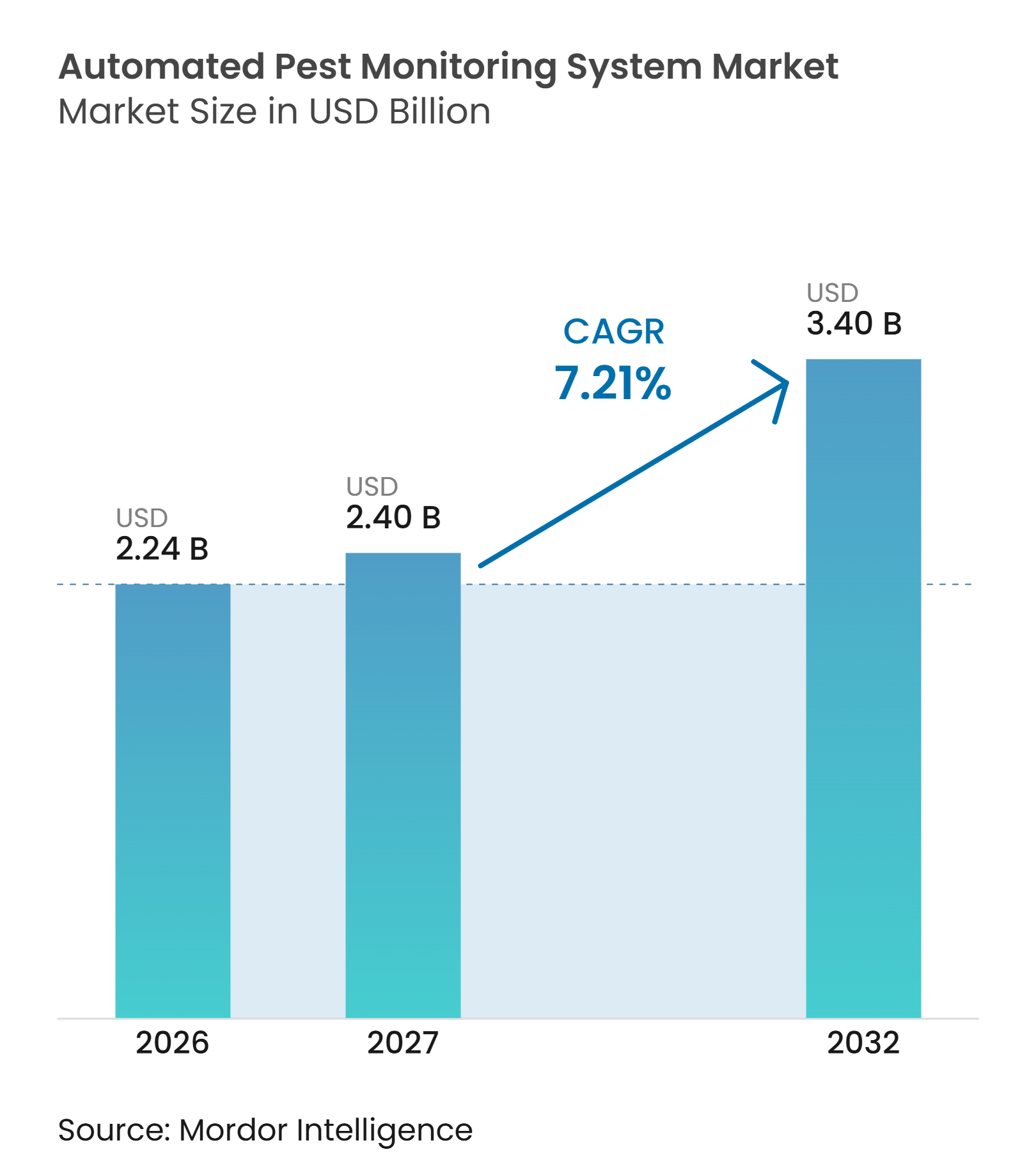
| Market Size (2027) | USD 2.40 Billion |
| Market Size (2032) | USD 3.40 Billion |
| Growth Rate (2027 - 2032) | 7.21 % |
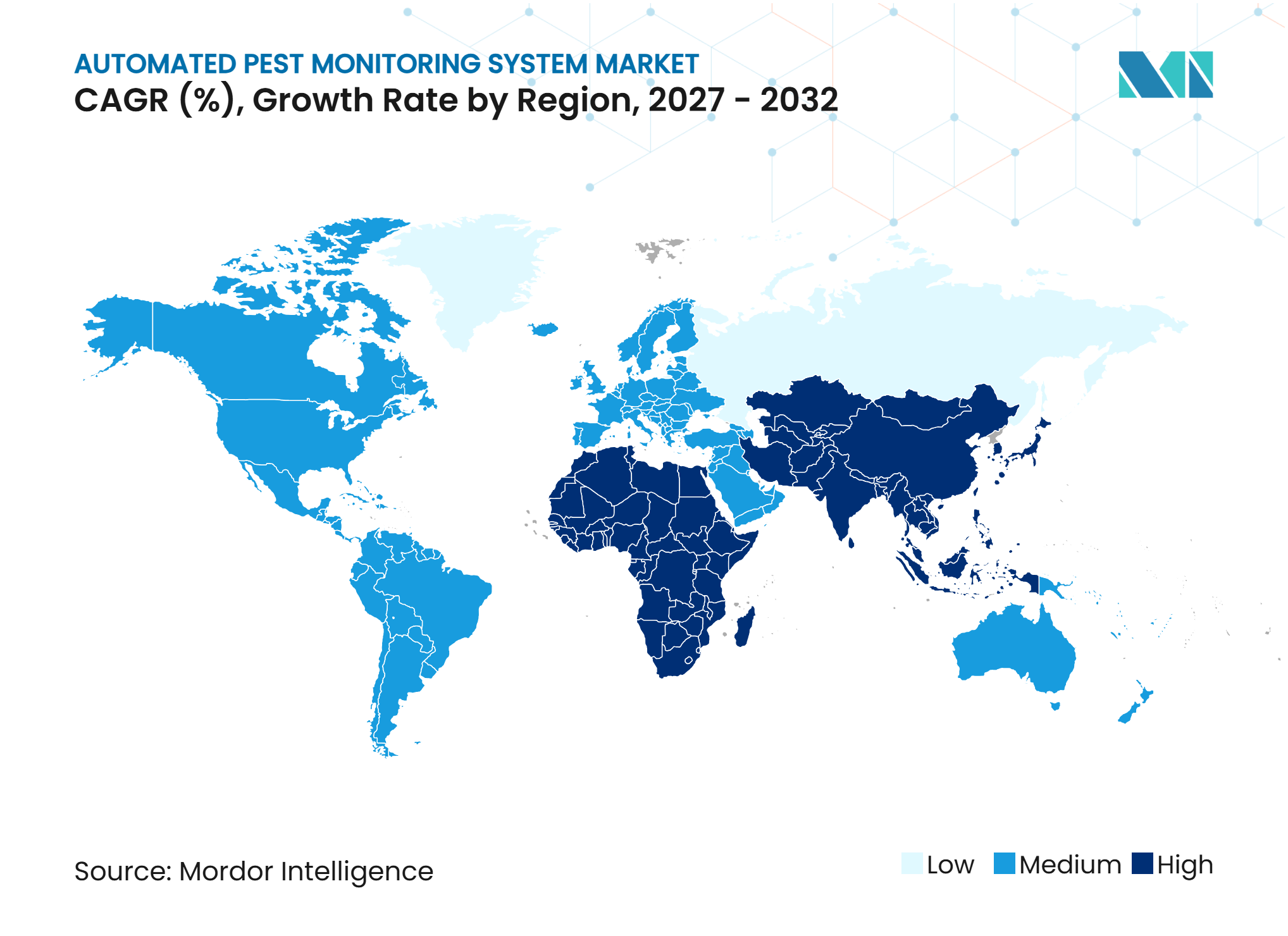
| Fastest Growing Market | Asia-Pacific |
| Largest Market | North America |
| Market Concentration | Medium |
Major Players *Disclaimer: Major Players sorted in no particular order Image © Mordor Intelligence. Reuse requires attribution under CC BY 4.0. | |
Automated Pest Monitoring System Market Analysis by Mordor Intelligence
The automated pest monitoring system market size was valued at USD 2.24 billion in 2026 and is forecast to grow from USD 2.40 billion in 2027 to USD 3.40 billion by 2032 at a CAGR of 7.21% from 2027 to 2032. The market is shifting away from periodic manual scouting and calendar-based spraying toward continuous surveillance that records pest activity in real time. Declining sensor costs, broader rural connectivity, and stricter chemical-use regulations are changing how growers, food processors, and pest-control providers make treatment decisions. Early demand came primarily from high-value horticulture, but commercial food facilities and warehouse operators are also adopting connected monitoring. This wider user base creates opportunities for suppliers that combine monitoring devices with reliable data transmission and actionable treatment records. Competition centers on installed-device scale, species identification accuracy, and the ability to integrate monitoring data with existing operating systems.
Key Report Takeaways
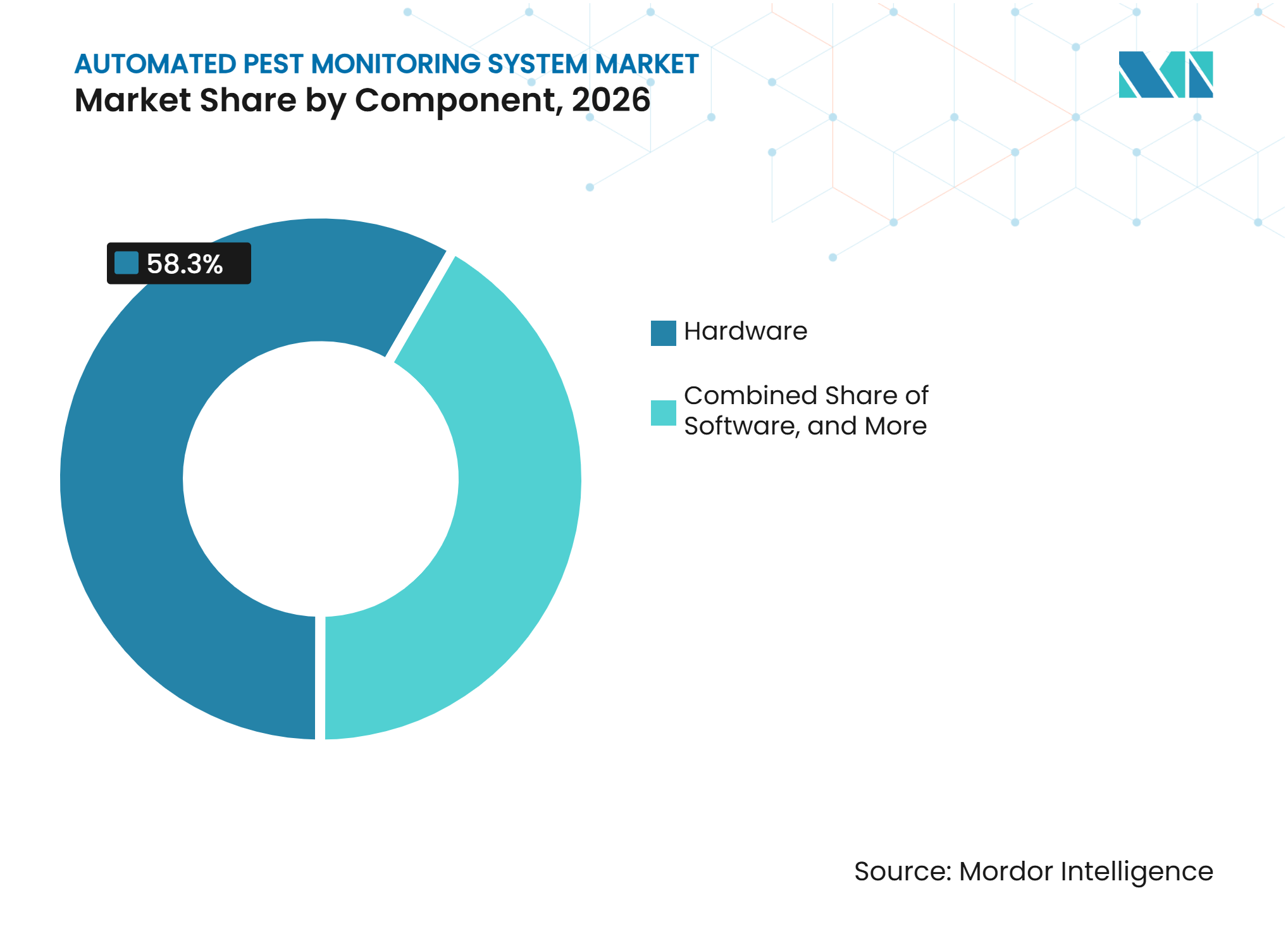
- By component, hardware accounted for 58.3% of the automated pest monitoring system market share in 2026, while services are forecast to grow at a CAGR of 9.4% from 2027 to 2032.
- By monitoring technology, trap monitoring devices accounted for 27% of the automated pest monitoring system market size in 2026, while image recognition monitoring is forecast to grow at a CAGR of 8.1% from 2027 to 2032.
- By pest type, insects accounted for 32% of the market share in 2026, while rodents are forecast to grow at a CAGR of 8.5% from 2027 to 2032.
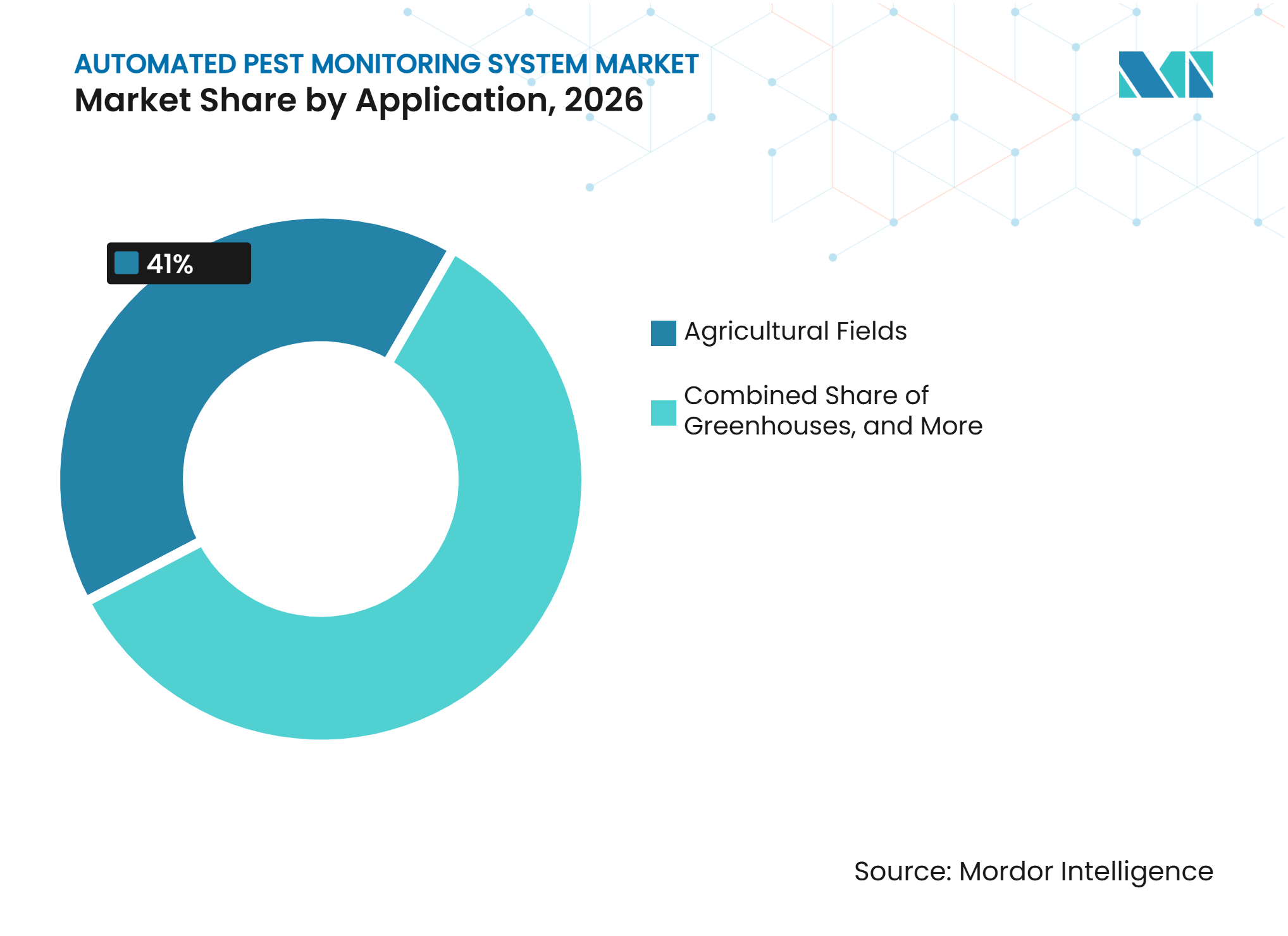
- By application, agricultural fields accounted for 41% of the market share in 2026, while greenhouses are forecast to grow at a CAGR of 8.3% from 2027 to 2032.
- By geography, North America accounted for 45% of the market share in 2026, while Asia-Pacific is forecast to grow at a CAGR of 8.2% from 2027 to 2032.
Note: Market numbers in this report are based on Mordor Intelligence's proprietary estimation framework, which combines nine months of actuals with Q4 projections for base year 2026.
Market Trends and Insights
Drivers Impact Analysis of Automated Pest Monitoring System Market*
| Driver | (~) % Impact on CAGR Forecast | Geographic Relevance | Impact Timeline |
|---|---|---|---|
| Rising Chemical-Use Restrictions and Residue-Compliance Pressure | +1.2% | Global, concentrated in the European Union, United States, Brazil, and China | Medium term (2-4 years) |
| Labor Shortages and Reduced Scouting Costs | +1.1% | North America, Europe, Australia, and Japan | Short term (≤ 2 years) |
| IoT and AI Integration in Precision Pest Management | +1.4% | Global, led by the United States, Canada, China, Japan, and South Korea | Medium term (2-4 years) |
| Export Crop Traceability and Digital Audit Requirements | +0.9% | United States, Mexico, Brazil, Spain, Netherlands, and Australia | Medium term (2-4 years) |
| Pest Pressure Volatility from Climate Variability | +1.0% | Global, with high intensity in the United States, India, China, Brazil, and South Africa | Long term (≥ 4 years) |
| Falling Sensor Costs and Rural Connectivity Expansion | +0.8% | Asia-Pacific, Middle East, Africa, and South America, including India, China, Brazil, and Indonesia | Long term (≥ 4 years) |
| Source: Mordor Intelligence | |||
Rising Chemical-Use Restrictions and Residue-Compliance Pressure
Pesticide residue regulations are increasing the need for reliable records of pest activity and treatment decisions. In July 2025, the European Commission adopted Commission Regulation (EU) 2025/1305, amending maximum residue levels for eight active substances across certain agricultural commodities [1]. In the United States, the Environmental Protection Agency (EPA) establishes pesticide residue tolerances under 40 CFR Part 180, which specifies the maximum legally permitted residue levels in or on food [2]. Automated traps provide timely pest-catch data, helping growers make treatment decisions based on observed pest activity rather than relying solely on fixed schedules. When integrated with farm-management systems, these platforms can link monitoring data with treatment records, creating dated documentation to support inspections, supplier reviews, and food-retail certification requirements. As a result, the automated pest monitoring system market benefits from demand for more consistent pest surveillance and digital records that support compliance.
Labor Shortages and Reduced Scouting Costs
Labor shortages are increasing the need for more efficient field-monitoring practices across developed agricultural markets. Workforce constraints have been reported in North America, Europe, Australia, and Japan, particularly in labor-intensive agricultural operations. Connected traps and image-based counting systems can reduce the need for repeated manual inspections, particularly across large areas of high-value crops. Their value is especially relevant when pest activity needs to be monitored frequently across multiple locations during short periods of elevated risk. Remote monitoring also allows managers to prioritize field visits based on alerts and detected pest activity rather than conducting routine inspection rounds at every site. This supports demand in the automated pest monitoring system market among agricultural operations seeking to manage scouting costs while maintaining regular pest surveillance.
IoT and AI Integration in Precision Pest Management
Internet of Things (IoT) sensors, computer vision, and predictive models are improving the collection and analysis of pest-monitoring data for agricultural decision-making. A 2025 review published in Frontiers in Plant Science discussed the use of agricultural sensor networks, including LoRaWAN, 5G, and satellite connectivity, to transmit data to cloud-based platforms for artificial intelligence (AI)-driven analysis and predictive insights. The review also identified optoelectronic, acoustic, and impedance sensors as technologies for detecting pest activity. These capabilities enable monitoring systems to collect diverse pest-related information and support more timely detection. SemiosBio Technologies Inc. stated that it has deployed more than 10,000 automated insect camera traps, providing growers with daily trap images, pest counts, and pest-pressure alerts through its digital platform. By converting monitoring data into actionable alerts, these technologies enable earlier pest management decisions and drive demand for automated pest monitoring systems.
Export Crop Traceability and Digital Audit Requirements
Export supply chains increasingly require documented records of food movement and production practices. In August 2025, the Food and Drug Administration (FDA) proposed extending the compliance date for its Food Traceability Rule to July 20, 2028 [3]. In Canada, the Safe Food for Canadians Regulations require most food businesses that export food, including those that grow and harvest fresh fruits and vegetables for export, to maintain traceability records. Automated pest-monitoring systems can complement these requirements by timestamping pest observations, linking alerts to recorded management responses, and transferring monitoring data to farm-management or compliance platforms. This can improve record consistency and reduce reliance on manual logs that may be incomplete or delayed. These capabilities address demand in the automated pest monitoring system market among produce growers, packhouses, and exporters seeking to strengthen digital documentation for buyer audits and supply chain reviews.
Restraints Impact Analysis of Automated Pest Monitoring System Market*
| Restraint | (~) % Impact on CAGR Forecast | Geographic Relevance | Impact Timeline |
|---|---|---|---|
| High Upfront Deployment and Integration Cost | -1.2% | Global, with high intensity in India, Brazil, South Africa, Mexico, and Indonesia | Short term (≤ 2 years) |
| Rural Connectivity and Power Reliability Gaps | -0.8% | Asia-Pacific, Middle East, Africa, and South America, including India, Indonesia, Brazil, South Africa, and Kenya | Medium term (2-4 years) |
| Model Accuracy Gaps Across Local Pest Species | -0.7% | India, China, Brazil, South Africa, and Australia | Medium term (2-4 years) |
| Fragmented Data Ownership and Interoperability Standards | -0.6% | United States, Germany, United Kingdom, China, and Australia | Long term (≥ 4 years) |
| Source: Mordor Intelligence | |||
High Upfront Deployment and Integration Cost
The total cost of an automated pest monitoring program includes hardware, installation, connectivity, software access, system integration, and recurring support. These expenses can limit adoption among smallholders and food-facility operators with restricted capital budgets. A 2025 review published in Frontiers in Plant Science reported that agricultural drones used in precision agriculture can cost between USD 1,000 and USD 25,000, depending on their features. Costs can increase further when monitoring platforms need to integrate with farm management tools, compliance systems, or service provider workflows. Although large commercial farms and enterprise food facilities can distribute these expenses across multiple locations and higher-value operations, smaller operators may find the investment difficult to justify. As a result, the automated pest monitoring system market faces adoption constraints when the expected operational benefits do not outweigh the combined costs of acquisition, deployment, and integration.
Rural Connectivity and Power Reliability Gaps
Reliable data transmission and power supply are important for automated pest monitoring systems that depend on continuous connectivity and remote access. A 2025 assessment by the World Economic Forum highlighted inadequate rural connectivity as a constraint on digital agriculture adoption, particularly where reliable broadband infrastructure is unavailable. Although solar charging and battery backup can improve system reliability, they add installation and maintenance requirements. These constraints can affect deployment in remote agricultural areas across parts of Asia-Pacific, Africa, the Middle East, and South America. As a result, the automated pest monitoring system market may experience slower adoption in areas where connectivity and power infrastructure cannot support reliable data transmission at an economically viable cost.
*Our forecasts treat driver/restraint impacts as directional, not additive. The impact forecasts reflect baseline growth, mix effects, and variable interactions.
Automated Pest Monitoring System Market Segment Analysis
By Component:
Hardware Leads While Services Register Faster GrowthHardware accounted for 58.3% of the automated pest monitoring system market share in 2026, reflecting the need for smart traps, automated cameras, and sensor-equipped bait stations at each monitored location. These devices form the physical layer of any deployment and remain essential even when the buyer chooses a subscription-based service. Hardware demand is driven by the replacement of conventional traps with connected units that record and transmit activity data. The installed base also provides providers with a path to sell analytics, service, and reporting functions later in the customer relationship. Hardware's leading share reflects the continued importance of physical devices in automated monitoring deployments.
Services are forecast to grow at a CAGR of 9.4% from 2027 to 2032, the fastest rate among all components in the automated pest monitoring system market. Managed monitoring shifts maintenance, model updates, alert review, and pest interpretation from the buyer to the provider. This approach can benefit growers and facilities that lack internal staff with digital or agronomic expertise. It also creates recurring revenue after an initial device installation. Software connects the two component groups by routing alerts, organizing reports, and translating sensor readings into actionable information for treatment decisions.



By Monitoring Technology:
Trap Monitoring Devices Lead While Image Recognition Monitoring Gains MomentumTrap monitoring devices accounted for 27% of the market share in 2026, as pheromone and food-bait traps are already widely used on farms and in food facilities. Connected electronics and automated cameras allow existing trapping practices to generate more frequent and consistent data. The approach is familiar to users, which can reduce training requirements during deployment. It also supports routine surveillance in locations where a fixed trap position is appropriate. Trap systems therefore provide a practical starting point for many buyers in the automated pest monitoring system market.
Image recognition monitoring is forecast to grow at a CAGR of 8.1% from 2027 to 2032, as computer vision can classify pest species from field images under suitable lighting and background conditions. Sensor-based trigger monitoring uses motion, weight, or optical sensors to detect pest activity and activate alerts, particularly in rodent-control settings and other applications where immediate detection is more important than species identification. This option can be useful in rodent-control settings and other cost-sensitive programs. Image models require careful local testing because similar species can produce identification errors when training data does not match the deployment area. Pessl Instruments GmbH addressed a specific identification need with its iSCOUT Popillia add-on, which uses a customized design for Japanese beetle monitoring.
By Pest Type:
Insects Lead Deployment and Rodents Gain Strategic RelevanceInsects accounted for 32% of the market share in 2026, as insect monitoring is required across fields, greenhouses, food storage sites, and processing facilities. Aphids, thrips, whiteflies, fruit flies, and stored-product beetles can threaten crop quality, yield, or stored commodities. High-value crops provide a strong reason to closely track insect activity, as treatment timing can affect both crop damage and residue risk. In food storage, insect detection helps protect product quality and reduce the risk of contamination. The range of affected settings gives insect monitoring a broad role in the automated pest monitoring system market.
Rodents are forecast to grow at a CAGR of 8.5% from 2027 to 2032, as food processors, warehouses, and hospitality sites add connected bait stations and smart traps. These users need dated detection records to support brand protection, customer audits, and service reviews. Bell Laboratories Inc. offers Mouse iQ, a smart mouse-trapping system featuring integrated sensors, Bluetooth connectivity, and app-based rodent activity monitoring. The differing monitoring requirements across insects and rodents support demand for systems tailored to specific pest behaviors.
By Application:
Agricultural Fields Lead While Greenhouses Record Faster GrowthAgricultural fields accounted for 41% of the market share in 2026, supported by the value of protecting orchard, vegetable, and specialty-crop acreage. Growers also need digital scouting records when buyers or export channels require proof of pest management practices. Field use can be challenging because devices must operate across large areas with unequal connectivity and power access. These conditions favor durable traps and devices that require minimal maintenance. Agricultural fields remain the largest demand base because crop loss prevention and treatment documentation are both important considerations.
Greenhouses are forecast to grow at a CAGR of 8.3% from 2027 to 2032, as controlled environments simplify the installation of fixed cameras, sensors, and connected control systems. Operators can link pest data to climate-control and irrigation processes within a single managed setting. In July 2025, Biobest acquired Ecoation's Crop-Scanner monitoring and scouting tool, OKO 2 IPM and yield-prediction solution, and associated intellectual property to strengthen its automated greenhouse monitoring and IPM capabilities. Food processing facilities, warehouses, and logistics facilities also require automated detection between scheduled service visits. Their documentation needs create an additional use case for the automated pest monitoring system market beyond crop production.

Geography Analysis
North America
North America accounted for 45% of the automated pest monitoring system market share in 2026, supported by a large installed base of commercial pest-detection infrastructure. Rentokil Initial reported that its PestConnect Optix platform processed 4.1 million images from customer premises through its cloud-based AI system during 2025. This scale reflects demand across food service, hospitality, retail, and commercial facilities, where dated records can support food safety and operational controls. The Environmental Protection Agency's pesticide residue tolerance framework establishes legally permitted residue levels in food, reinforcing the importance of appropriate pesticide use practices and supporting treatment documentation.
Asia-Pacific
Asia-Pacific is forecast to grow at a CAGR of 8.2% from 2027 to 2032. India's National Pest Surveillance System (NPSS), launched on August 15, 2024, uses artificial intelligence (AI) and machine learning (ML) to identify pests and diseases across 61 crops and provide real-time crop-protection advisories. The government-developed platform comprises a mobile application and a web portal that support digital pest surveillance and pest management services for farmers. This public system increases awareness of real-time pest information and supports the broader use of digital advisory tools. Research published in Nature Food found that El Niño–Southern Oscillation (ENSO)-related climate anomalies in mainland Southeast Asia can facilitate the migration of crop pests to China, contributing to crop-yield losses. Japan and South Korea also present opportunities in controlled-environment horticulture, where connectivity and domestic hardware capabilities support advanced deployments.
Europe, South America, Africa, and the Middle East
Europe's automated pest monitoring system market is supported by greenhouse automation and demand for digital audit records in export horticulture. Trapview formed a partnership with Doktar in November 2025 to integrate automated insect traps and AI-based forecasting with an IoT and satellite platform. South America, the Middle East, and Africa also present growth opportunities as agricultural digitization and demand for automated pest surveillance increase.
Competitive Landscape
Market Concentration
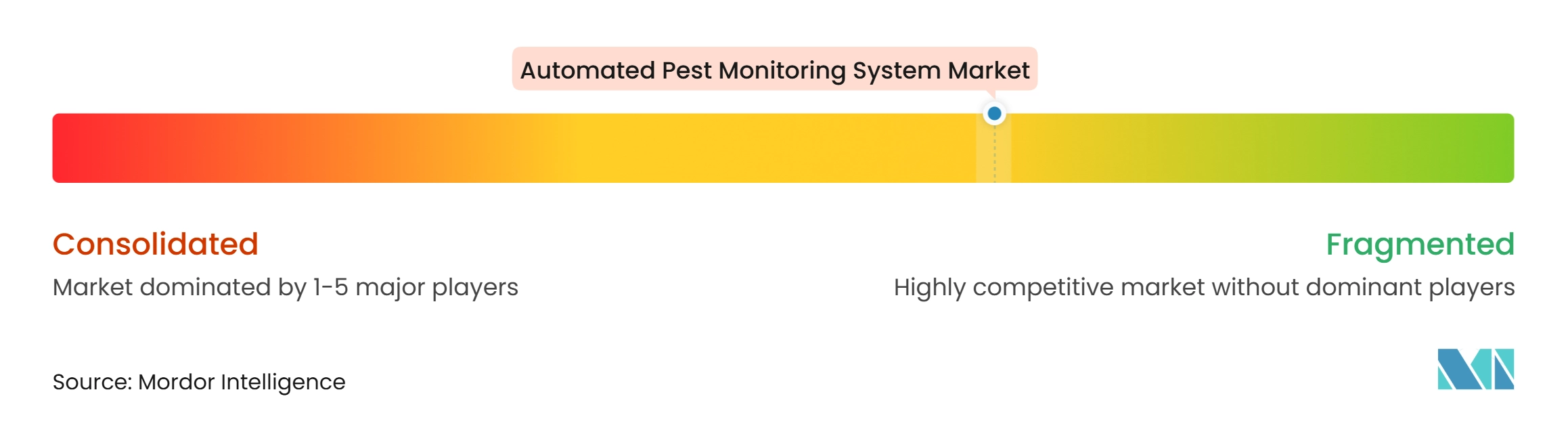
The automated pest monitoring system market was moderately fragmented in 2026, with large service providers and specialist technology companies competing from different positions. Rentokil Initial plc, Anticimex International AB, and Ecolab Inc. use device scale, customer relationships, and broader service portfolios in commercial settings. SemiosBio Technologies Inc., EFOS d.o.o., and Pessl Instruments GmbH compete through species-specific models, agricultural data, and integration options. Ecolab Inc.'s Pest Intelligence platform integrates pest monitoring into a broader facility-management data environment. The market remains open to providers that can connect monitoring alerts with treatment decisions.
Rentokil Initial acquired 36 businesses in 2025, comprising 31 in Pest Control and 5 in Hygiene & Wellbeing, for a total consideration of USD 115 million. These acquisitions generated approximately USD 63 million in revenue in the year prior to purchase. Biobest expanded its greenhouse offering through the July 2025 acquisition of Ecoation's Crop-Scanner and OKO 2 technologies. Pessl Instruments GmbH launched the iSCOUT Popillia add-on in March 2025 for a specific invasive beetle-monitoring requirement. These moves reflect the use of acquisition, product specialization, and system integration to expand market position.
Smaller providers such as RapidAIM, Spotta Limited, and FarmSense, Inc. pursue opportunities in rodent detection, bed bug monitoring, and field insect identification. Their edge-AI designs can be useful where connectivity is intermittent, or users need focused systems. Scaling these systems requires local species data, distribution capacity, and customer support. Partnership models remain important where a technology company needs the operating reach of a service provider or distributor.
Automated Pest Monitoring System Industry Leaders
-
Anticimex International AB
-
Rentokil Initial plc
-
Ecolab Inc.
-
SemiosBio Technologies Inc.
-
EFOS d.o.o.
- *Disclaimer: Major Players sorted in no particular order
Automated Pest Monitoring System Market Companies Covered in this Report
- Anticimex International AB
- Rentokil Initial plc
- Ecolab Inc.
- SemiosBio Technologies Inc.
- EFOS d.o.o.
- Russell IPM Ltd
- Pessl Instruments GmbH
- Spotta Limited
- FarmSense, Inc.
- DTN, LLC
- Bell Laboratories, Inc.
- Pelsis Limited
- Pro AgroTech Ltd
- Flyttr Limited
- Sys-Control Ltd.
Recent Industry Developments in Automated Pest Monitoring System Market
- November 2025: Trapview Group partnered with Netherlands-headquartered Doktar to integrate automated insect traps and AI-based pest forecasting into Doktar's digital agriculture platform, combining pest-activity data with IoT hardware, satellite insights, and digital analytics.
- October 2025: Microshare launched EverSmart Pest, an AI-enabled remote-monitoring platform that integrates camera images and sensor data from existing traps and bait stations to detect rodent and insect activity and generate alerts.
- July 2025: Biobest acquired Ecoation's Crop-Scanner monitoring tool, OKO 2 IPM and yield-prediction solution, associated intellectual property, and personnel to expand its automated greenhouse monitoring capabilities.
Global Automated Pest Monitoring System Market Report Scope
Automated pest monitoring systems are technology-based solutions that use cameras, sensors, image recognition, and connected traps to detect, identify, and monitor pest activity. These systems collect and analyze pest-activity data and generate alerts to support timely monitoring and pest-management decisions across agricultural, commercial, and industrial facilities.
The Automated Pest Monitoring System Market is Segmented by Component (Hardware, Software, and Services), by Monitoring Technology (Image Recognition Monitoring, Sensor-Based Trigger Monitoring, Trap Monitoring Devices, and Other Monitoring Technologies), by Pest Type (Insects, Rodents, and Others), by Application (Agricultural Fields, Greenhouses, Food Processing Facilities, Warehouses and Logistics Facilities, and Other Applications), and by Geography (North America, South America, Europe, Asia-Pacific, Middle East, and Africa). The Market Forecasts are Provided in Terms of Value (USD).
Segmentation Overview
| Hardware |
| Software |
| Services |
| Image Recognition Monitoring |
| Sensor-Based Trigger Monitoring |
| Trap Monitoring Devices |
| Other Monitoring Technologies |
| Insects |
| Rodents |
| Others |
| Agricultural Fields |
| Greenhouses |
| Food Processing Facilities |
| Warehouses and Logistics Facilities |
| Other Applications |
| North America | United States |
| Canada | |
| Mexico | |
| Rest of North America | |
| South America | Brazil |
| Argentina | |
| Rest of South America | |
| Europe | Germany |
| United Kingdom | |
| France | |
| Italy | |
| Spain | |
| Russia | |
| Rest of Europe | |
| Asia-Pacific | China |
| India | |
| Japan | |
| Australia | |
| South Korea | |
| Rest of Asia-Pacific | |
| Middle East | Turkey |
| Saudi Arabia | |
| United Arab Emirates | |
| Rest of Middle East | |
| Africa | South Africa |
| Egypt | |
| Rest of Africa |
| By Component | Hardware | |
| Software | ||
| Services | ||
| By Monitoring Technology | Image Recognition Monitoring | |
| Sensor-Based Trigger Monitoring | ||
| Trap Monitoring Devices | ||
| Other Monitoring Technologies | ||
| By Pest Type | Insects | |
| Rodents | ||
| Others | ||
| By Application | Agricultural Fields | |
| Greenhouses | ||
| Food Processing Facilities | ||
| Warehouses and Logistics Facilities | ||
| Other Applications | ||
| By Geography | North America | United States |
| Canada | ||
| Mexico | ||
| Rest of North America | ||
| South America | Brazil | |
| Argentina | ||
| Rest of South America | ||
| Europe | Germany | |
| United Kingdom | ||
| France | ||
| Italy | ||
| Spain | ||
| Russia | ||
| Rest of Europe | ||
| Asia-Pacific | China | |
| India | ||
| Japan | ||
| Australia | ||
| South Korea | ||
| Rest of Asia-Pacific | ||
| Middle East | Turkey | |
| Saudi Arabia | ||
| United Arab Emirates | ||
| Rest of Middle East | ||
| Africa | South Africa | |
| Egypt | ||
| Rest of Africa | ||
Key Questions Answered in the Report
What is the forecast value of the automated pest monitoring system market?
The market is forecast to grow from USD 2.40 billion in 2027 to USD 3.40 billion by 2032, at a CAGR of 7.21% from 2027 to 2032.
Which component leads the automated pest monitoring system market?
Hardware accounted for 58.3% of the market share in 2026, supported by demand for smart traps, cameras, and sensor-equipped bait stations.
Which region holds the largest share of the automated pest monitoring systems market?
North America accounted for 45% of the market share in 2026, supported by established commercial pest-monitoring infrastructure.
Why are automated pest monitoring systems used in food facilities?
Food processors, warehouses, and hospitality facilities use these systems to detect pest activity, maintain monitoring records, and support food-safety audits.