
Australia Turf Protection Market Size and Share
Market Overview
| Study Period | 2022 - 2032 |
|---|---|
| Forecast Data Period | 2027 - 2032 |
| Base Year Market Size (2026) | USD 128.93 Million |
| Market Size (2027) | USD 138.41 Million |
| Market Size (2032) | USD 197.32 Million |
| Growth Rate (2027 - 2032) | 7.35 % |
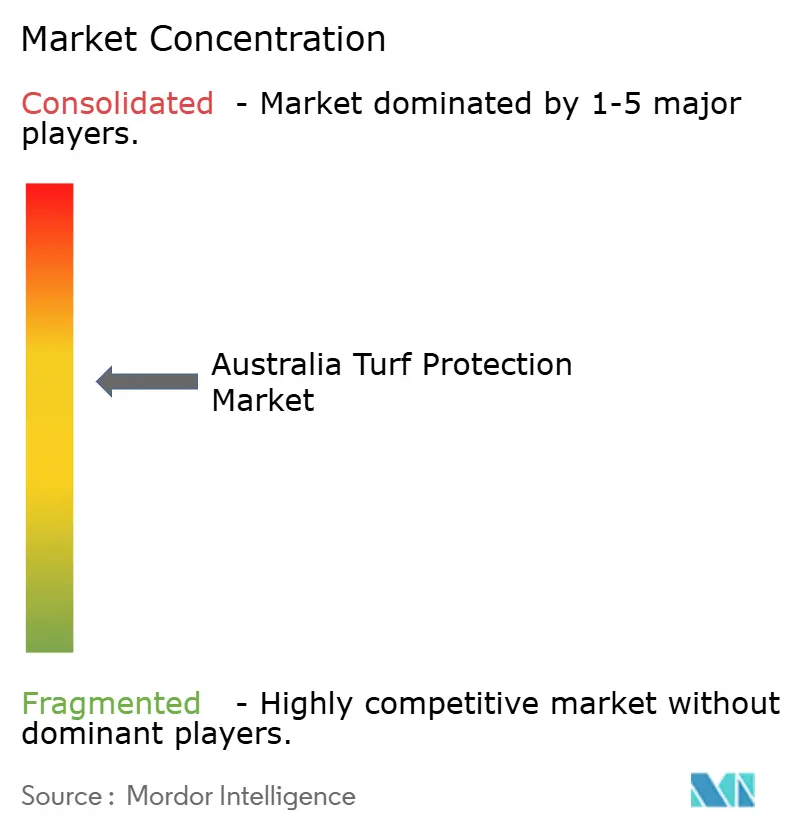
| Market Concentration | Medium |
Major Players *Disclaimer: Major Players sorted in no particular order Image © Mordor Intelligence. Reuse requires attribution under CC BY 4.0. | |
Australia Turf Protection Market Analysis by Mordor Intelligence
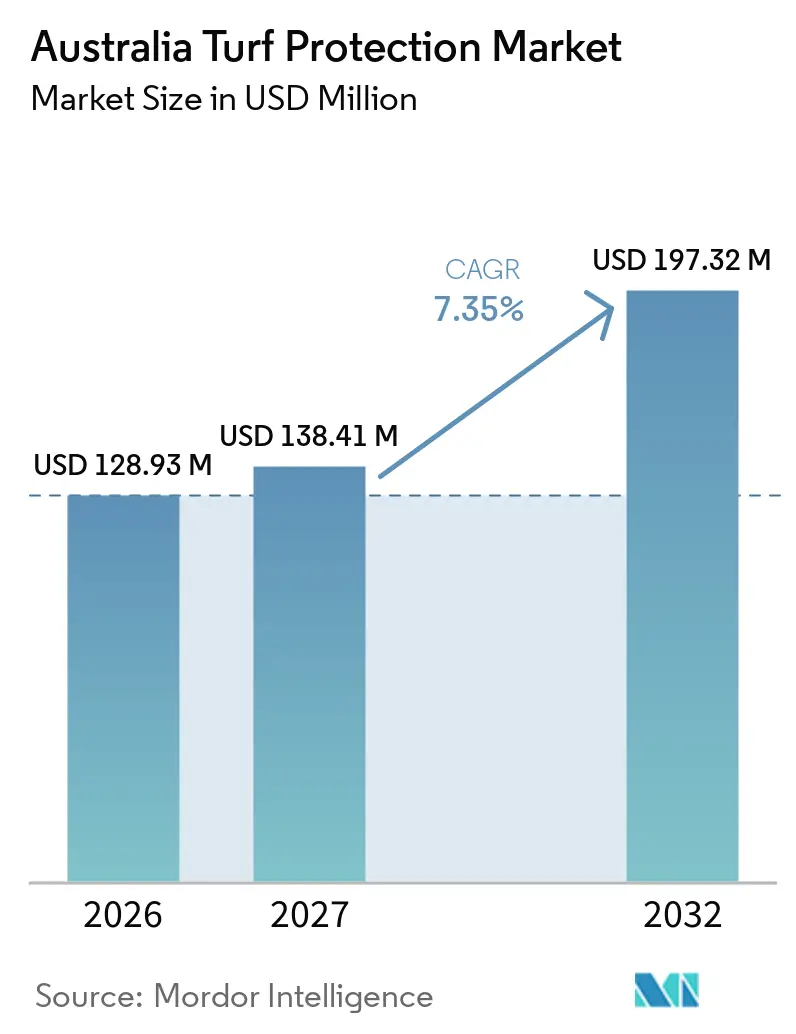
The Australia turf protection market size was valued at USD 128.93 million in 2026 and is forecast to grow from USD 138.41 million in 2027 to USD 197.32 million by 2032, at a CAGR of 7.35% from 2027 to 2032. Water restrictions are supporting demand for products that help turf retain moisture under limited irrigation. Professional sports venues and golf facilities are maintaining demand for planned turf protection programs. Climate variability is extending periods when disease and weeds require active intervention. Suppliers are responding with biological inputs, digital application support, and products that fit resistance-management programs. Regulatory review requirements and resistance within established chemical groups continue to shape product availability and purchasing decisions.
Key Report Takeaways
- By product type, fungicides accounted for 34.8% of the Australia turf protection market share in 2026, while biostimulants and bio-fertilizers are forecast to grow at a CAGR of 10.4% from 2027 to 2032.
- By application, landscaping accounted for 39% of the Australia turf protection market size in 2026, while sports fields are forecast to grow at a CAGR of 9.8% from 2027 to 2032.
- By end user, residential customers accounted for 42% of market share in 2026, while sports facility owners are forecast to grow at a CAGR of 9.6% from 2027 to 2032.
- By mode of action, chemical products accounted for 63% of the market share in 2026, while biological products are forecast to grow at a CAGR of 11.2% from 2027 to 2032.
- By formulation, Liquid concentrate accounted for 55% of the market share in 2026 and are forecast to grow at a CAGR of 9.9% from 2027 to 2032.
Note: Market numbers in this report are based on Mordor Intelligence's proprietary estimation framework, which combines nine months of actuals with Q4 projections for base year 2026.
Market Trends and Insights
Drivers Impact Analysis of Australia Turf Protection Market*
| Driver | (~) % Impact on CAGR Forecast | Geographic Relevance | Impact Timeline |
|---|---|---|---|
| Water Restrictions Increasing Demand for Water-Efficient Turf Programs | +1.4% | Australia-wide, with higher relevance in Western Australia, New South Wales, and South Australia | Short term (≤ 2 years) |
| Expansion of Sports and Recreation Surfaces | +1.5% | Queensland, New South Wales, and South Australia, with national spillover | Medium term (2-4 years) |
| Rising Disease and Weed Pressure Under Climate Variability | +1.2% | Australia-wide, with higher relevance in Queensland, Northern Territory, and coastal New South Wales | Short term (≤ 2 years) |
| Shift Toward Biologicals, Biostimulants, and Integrated Pest Management | +1.1% | Australia-wide | Medium term (2-4 years) |
| Digitally Guided Application and Irrigation Decisions | +0.8% | New South Wales, Victoria, and Queensland | Medium term (2-4 years) |
| Adoption of Localized Soil-Wetting and Salinity-Management Programs | +0.9% | Western Australia, South Australia, and coastal Queensland | Short term (≤ 2 years) |
| Source: Mordor Intelligence | |||
Water Restrictions Increasing Demand for Water-Efficient Turf Programs
Permanent and stage-based water restrictions are supporting demand for soil-wetting agents and moisture-management programs across Australia. In Greater Sydney, the Blue Mountains and the Illawarra, Sydney Water's Water Wise Guidelines permit drinking-water irrigation of lawns and gardens before 10 a.m. and after 4 p.m. year-round, although specified commercial users, including those maintaining sports surfaces, are exempt from these timing restrictions [1]. In Western Australia, Water Corporation's six-month trial of an adjusted sprinkler roster commenced on 1 April 2026, reducing watering frequency from every second day to three days per week across Karratha, Roebourne, Dampier, Wickham and Point Samson [2]. A two-year field study conducted on kikuyugrass (Pennisetum clandestinum) in southwestern Australia found that soil wetting agents reduced soil water repellency and improved turfgrass color during summer at water allocations of 6,250 and 7,500 kL/ha/year. However, at the lowest tested allocation of 5,000 kL/ha/year, reduced soil water repellency did not translate into improved turfgrass color.
Expansion of Sports and Recreation Surfaces
Investment in sports and recreation infrastructure is increasing the area of professionally maintained turf that requires scheduled establishment and maintenance programs. The Brisbane 2032 Games program includes a planned 63,000-seat stadium at Victoria Park in Brisbane, with initial site-preparation works commencing on 1 June 2026 [3]. In South Australia, the government announced the redevelopment of the North Adelaide Public Golf Course on 18 December 2025. The project includes an 18-hole championship course, a driving range, and practice areas, with construction activity on the South Course commencing on 27 April 2026. These developments involve the establishment and maintenance of sports turf, supporting potential demand for turf-protection and maintenance products as the facilities are developed and brought into use.
Rising Disease and Weed Pressure Under Climate Variability
Temperature and soil-moisture conditions influence turf disease development and the timing of preventive treatments in Australia. Spring dead spot infection primarily occurs in late summer and autumn as soil temperatures cool. Pathogen growth is most rapid when soil temperatures are between 10°C and 20°C, with peak activity around 15°C. Preventive fungicide applications are therefore recommended during late summer and autumn to limit infection. In October 2024, the Australian Pesticides and Veterinary Medicines Authority registered cyclobutrifluram under the TREFINTI Turf Nematicide label for the control of plant-parasitic nematodes in turf. Nutgrass (Cyperus rotundus) is also recognized as a common weed of Australian lawns and turf. These disease, nematode, and weed-management requirements support demand for fungicides, nematicides, and herbicides in the Australian turf protection market.
Shift Toward Biologicals, Biostimulants, and Integrated Pest Management
Professional turf management programs are incorporating biological products and biostimulants alongside conventional crop protection products. A June 2024 study published by Gilba Solutions Pty Ltd found that 2,3-butanediol and β-cyclocitral in a 133-day pot trial on perennial ryegrass. The findings indicated potential applications for these compounds in turf management, although several measured differences in rootzone organic matter were not statistically significant. Agrimm Pty Ltd distributes PlantMate Turf Pro in Australia, a biological product containing the LU132 Trichoderma strain in a wettable powder formulation. The manufacturer states that the product has a level of tolerance to commonly used chemical fungicides, subject to product-specific compatibility and application instructions. Biological products may also complement chemical resistance-management programs where they provide effective control of the relevant disease or pest and their registered or permitted uses support the application.
Restraints Impact Analysis of Australia Turf Protection Market*
| Restraint | (~) % Impact on CAGR Forecast | Geographic Relevance | Impact Timeline |
|---|---|---|---|
| APVMA Registration and Re-registration Requirements | -1.5% | Australia-wide | Long term (≥ 4 years) |
| Resistance to Fungicide and Herbicide Modes of Action | -1.2% | Australia-wide, with higher relevance in high-traffic areas of Queensland and New South Wales | Medium term (2-4 years) |
| Fragmented Buyer Base and Seasonal Purchasing | -0.8% | Australia-wide | Short term (≤ 2 years) |
| Water Quality, Runoff, and Applicator-Safety Scrutiny | -1% | Coastal and riparian areas nationally | Medium term (2-4 years) |
| Source: Mordor Intelligence | |||
APVMA Registration and Re-registration Requirements
The Australian Pesticides and Veterinary Medicines Authority (APVMA) registration framework under the Agricultural and Veterinary Chemicals Code Act 1994 can increase the time and compliance requirements associated with introducing new turf protection products and expanding approved uses. Turf applications may be included in an initial product registration or added through an application to vary an existing product registration or approved label. Minor-use permits provide an alternative regulatory pathway where the proposed use meets the APVMA's eligibility criteria. Suppliers must also manage applicable renewal requirements for product registrations and regulatory obligations associated with changes to approved product particulars and conditions. In addition, APVMA reconsiderations of existing active constituent approvals, product registrations, and label approvals can require additional information and may result in changes to approved uses and conditions. These regulatory processes can increase compliance costs and extend the time required to make new products and turf-specific uses available, potentially limiting the pace at which additional chemical options enter the Australian turf protection market.
Resistance to Fungicide and Herbicide Modes of Action
Fungicide resistance is narrowing the choices available to managers of golf courses, sports fields, and other professionally maintained turf surfaces. CropLife Australia's turf resistance-management guidance identifies FRAC Groups 1, 2, 4, 7 (N3), 11, and 21 as medium-to-high risk for resistance development and recommends rotating these groups to reduce selection pressure. Resistance-management directions vary by registered product and must be followed as stated on the approved label. Gilba Solutions Pty Ltd's 2025 Australian Turf Fungicide Resistance Chart groups registered turf fungicides by active ingredient and mode of action, helping turf managers identify different fungicide groups when planning treatment programs. Herbicide resistance in annual ryegrass has also been documented in Australian golf-course situations, adding to the challenge of maintaining effective weed-control programs. These resistance concerns can limit treatment options and increase the need for alternative active ingredients and modes of action in the Australian turf protection market.
*Our forecasts treat driver/restraint impacts as directional, not additive. The impact forecasts reflect baseline growth, mix effects, and variable interactions.
Australia Turf Protection Market Segment Analysis
By Product Type:
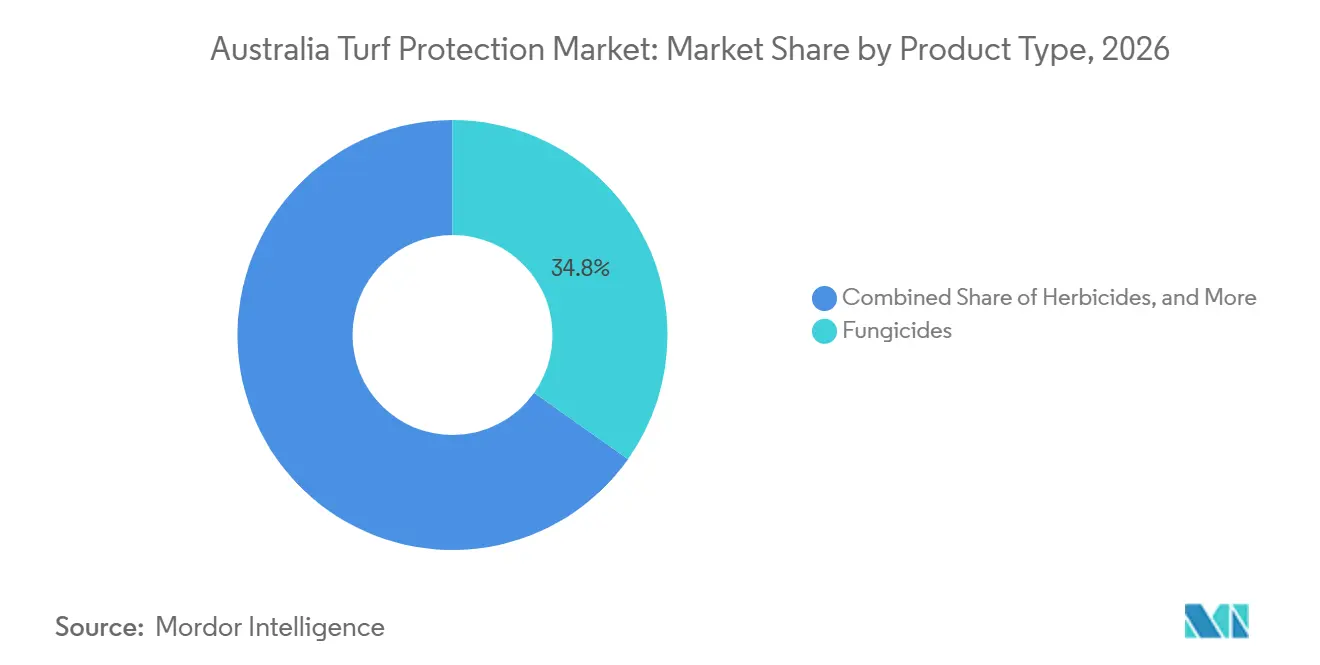
Fungicides Lead, while Biostimulants and Bio-fertilizers Grow FastestFungicides accounted for 34.8% of the Australia turf protection market share in 2026. Preventive programs at golf courses, bowling greens, and elite sports surfaces support repeat purchases. Dollar spot, brown patch, pythium blight, and spring dead spot require regular treatment under favorable conditions. BASF SE presents Lexicon, Xzemplar, and Maxtima as the Turf Trio rotation program for resistance management. This approach shifts supplier engagement toward a coordinated program rather than a single product sale. Herbicides support weed control across turf surfaces. In January 2025, the APVMA registered FlexAg Propyzamide 500 SC Herbicide (Registration No. 95423), a 500 g/L propyzamide suspension concentrate, for the selective control of certain grasses and broadleaf weeds in sports turf and home lawns, as well as specified agricultural uses. Insecticides address Argentine stem weevil, army worm, and couch mite, while plant growth regulators help manage mowing frequency on fine turf.
Biostimulants and bio-fertilizers are forecast to grow at a CAGR of 10.4% from 2027 to 2032. Demand for these inputs is increasing as turf managers seek complementary products and lower-residue management options. Domestic trial work is supporting purchasing decisions by professional users. Gilba Solutions Pty Ltd reported root-growth benefits from specific biostimulant compounds in perennial ryegrass. Trichoderma-based products may be incorporated alongside chemical fungicides in established programs, subject to product-specific compatibility and application instructions. Their effectiveness depends on the target disease, product efficacy, and treatment conditions. Therefore, biological products may complement conventional fungicides but should not be considered a universal substitute, particularly when disease pressure requires rapid and reliable control. This creates room for a wider range of product offerings in the Australia turf protection market.

By Application:
Landscaping Provides Scale and Sports Fields Record the Fastest GrowthLandscaping accounted for 39% of the Australia turf protection market share in 2026. The application includes residential lawns, commercial landscapes, and municipal parks. Its broad customer base provides demand across suburban areas and managed public spaces. Landscaping activity continues through different disease and weather conditions. Water restrictions increase the use of wetting agents and water-efficiency inputs within this application. Retail and specialist distribution support access for household and small commercial buyers. Herbicides, fungicides, insecticides, and plant growth regulators each serve distinct maintenance needs. The scale of landscaping makes supplier volume and channel coverage important. It also gives product manufacturers a route to both professional and consumer purchasers.
Sports fields are forecast to grow at a CAGR of 9.8% from 2027 to 2032, the fastest rate among applications. The 2032 Brisbane Olympic and Paralympic Games are supporting a multi-year pipeline of venue and training-surface work. The AUD 7.1 billion (USD 4.5 billion) venue program includes the planned new Brisbane stadium. New natural turf fields require establishment, disease prevention, weed management, and ongoing surface care. Sports managers also work within narrow time windows between events and seasons. These conditions favor planned product programs and reliable technical support. Golf courses form a related professional demand base because surface quality is central to daily operations. The AUD 45 million (USD 28.3 million) North Adelaide Golf Course redevelopment further supports demand for products used in turf establishment and ongoing golf-course maintenance. Sports facilities therefore provide an important growth path for the Australia turf protection market.
By End User:
Residential Customers Lead Revenue and Sports Facility Owners Grow FastestResidential customers accounted for 42% of the market share in 2026. Retail and specialist distribution channels serve homeowners across Australia's suburban areas. Lawn management is a recurring household maintenance activity for this customer group. These customers often buy products in smaller packs and through retail channels. Their purchase patterns differ from those of professional users who follow planned spray schedules. Residential users may be less familiar with label rotation requirements. Commercial landscape contractors link residential demand with institutional maintenance work. State applicator safety requirements also shape how these contractors use the product.
Sports facility owners are forecast to grow at a CAGR of 9.6% from 2027 to 2032. Their demand is tied to new venues, upgraded grounds, and the premium placed on reliable playing surfaces. The planned Brisbane stadium is part of the AUD 7.1 billion (USD 4.5 billion) venue infrastructure program for the 2032 Games. Facility managers must protect turf quality through periods of intensive use. They also manage disease, weed, insect, irrigation, and mowing requirements simultaneously. This favors suppliers that can provide technical guidance and a complete rotation program. Sports facilities are more likely to use professional application equipment and scheduled treatments. Their requirements support demand for liquid concentrates and multi-product programs. This end-user group is strengthening the professional side of the Australia turf protection market.
By Mode of Action:
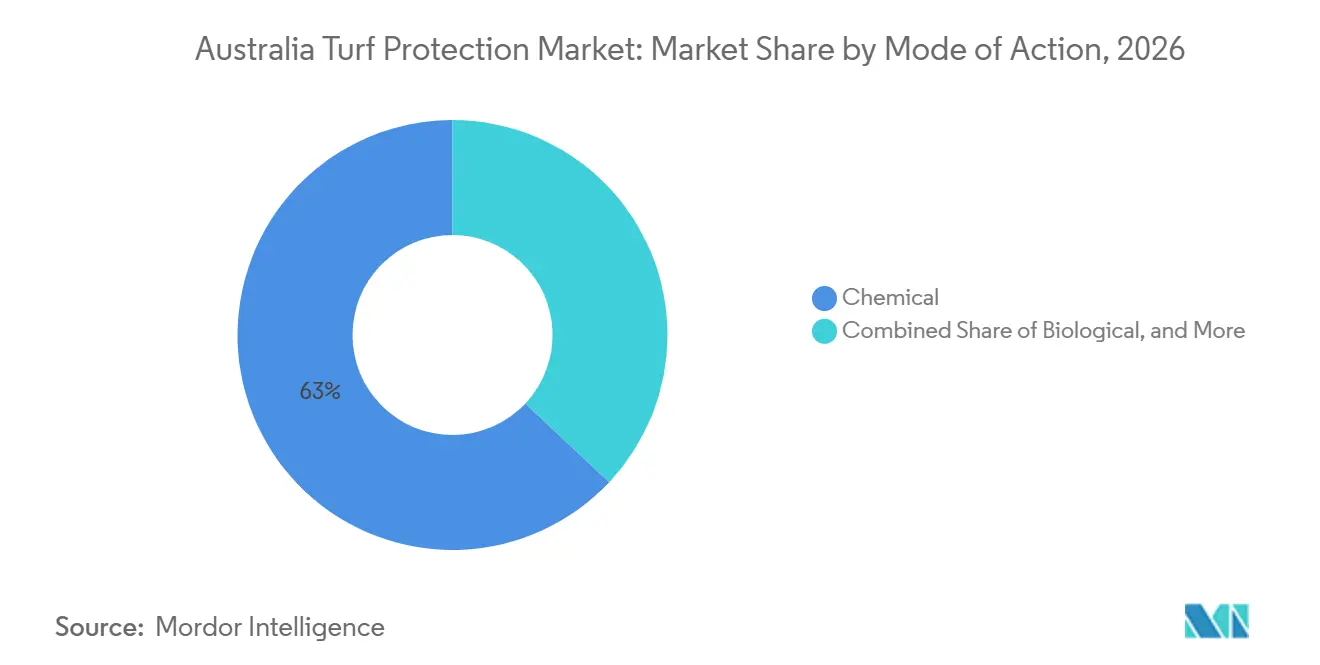
Chemical Products Lead and Biological Products Grow FastestChemical products accounted for 63% of the market share in 2026. Their established performance and speed of cure remain important during acute disease pressure. Fine turf at golf courses and sports venues often requires a rapid response when disease appears. Chemical fungicides, herbicides, and insecticides remain central to those responses. Product familiarity also supports their use across professional and consumer settings. Resistance-management requirements vary by product and should follow the approved label and relevant resistance-management guidelines. This makes portfolio breadth important for suppliers serving the professional surfaces market. Chemical products consequently remain the main revenue base within the Australia turf protection market. Their use continues alongside, rather than separately from, biological alternatives.
Biological products are forecast to grow at a CAGR of 11.2% from 2027 to 2032. Trichoderma-based fungicides, microbial inoculants, and stress-protection biostimulants are moving into routine turf programs. Resistance-management requirements vary by product and should follow the approved label, while CropLife Australia's guidance recommends rotation across fungicide groups to manage resistance risk. Biological products may support rotation when their function and efficacy are appropriate for the target disease or pest and their permitted uses allow the intended application. Their uptake is therefore linked to compliance and resistance management as well as sustainability objectives. Integrated programs combine a chemical product for acute disease control with a biological input for root-zone support. This combination retains a role for both approaches on professionally managed turf. Biological growth is expanding the product mix used in the Australia turf protection market.
By Formulation:
Liquid Concentrates Lead and Grow FastestLiquid concentrates accounted for 55% of the market share in 2026 and are forecast to grow at a CAGR of 9.9% from 2027 to 2032. The format is used across professional spray programs and consumer products. It offers concentration efficiency for storage and transport. Liquid concentrates can be diluted and applied through conventional spray equipment, subject to product label directions. They are sold in pack sizes that range from 1-litre consumer containers to larger commercial formats. This helps suppliers address buyers with different application volumes. Many biological inoculants and biostimulants are also supplied as liquid concentrates. Some liquid formulations can be applied using existing compatible spray equipment, subject to label directions. The format therefore supports both conventional chemistry and newer biological products.
Granular products remain important for targeted use, including soil-applied insecticides for grub control and pre-establishment work on sod farms. Wettable powders provide another option for applications where a dry formulation is suitable. Formulation choices depend on the product, the target pest or disease, the equipment available, and the site conditions. Liquid formats remain suited to frequent, planned treatments on golf courses and sports fields. They are also practical for retail buyers seeking ready access to measured products. Multi-mode rotation programs can increase the number of liquid products used within a treatment schedule. APVMA label conditions and resistance guidance reinforce the need for planned product selection. This keeps liquid concentrates central to current purchasing patterns. Formulation availability also affects how manufacturers position products across retail and professional channels.
Geography Analysis
New South Wales holds the leading position in the Australia turf protection market. Population concentration and professionally managed facilities in Greater Sydney support demand across residential, commercial, and sports uses. Permanent Water Wise Guidelines require irrigation before 10 a.m. and after 4 p.m. These rules support year-round interest in water-efficient turf programs. Victoria has comparable depth through Melbourne's golf facilities, major venues, and landscape contractor base. Its cool-season conditions create defined periods of disease pressure. Queensland is the fastest-growing geography due to the 2032 Games infrastructure, a subtropical climate, and a dense network of sports venues. The Australia turf protection market size in Queensland is supported by annual fungicide use across an extended active season.
South Australia is developing as a high-value location for professionally managed golf turf. The government committed AUD 45 million (USD 28.3 million) for the North Adelaide Golf Course redevelopment. The project is intended to support future major golf events by 2028. Western Australia has a different demand profile because sandy soils can become hydrophobic. Its year-round sprinkler roster makes wetting agents and moisture-management programs important beyond the normal disease season. Water Corporation introduced a three-day-per-week sprinkler roster for Karratha in April 2026. Tighter irrigation conditions increase the operational importance of products that improve water movement in soil. These conditions distinguish Western Australia from states where disease cycles are the primary driver of product use.
Tasmania and the Northern Territory hold the smallest revenue positions in the Australia turf protection market. Tasmania's maritime climate and cooler growing season create demand for products effective against Microdochium patch and cool-season pythium, making its product needs different from those in warmer mainland areas. The Northern Territory has wet-and-dry seasonal contrasts that shape turf protection needs. Army worm and invasive grass weeds during the wet season support insecticide and herbicide demand. Tropical turf species also require products suited to local growing conditions. Suppliers need to match their product range to these climate and pest differences. Geographic variation in soil, irrigation rules, disease pressure, and surface type supports distinct purchasing patterns across the country.
Competitive Landscape
The Australia turf protection market was moderately concentrated in 2026, with major suppliers including Syngenta Group, BASF SE, Bayer AG, Nufarm Limited, and ICL Group Ltd. These suppliers compete through product registrations, technical support networks, and broad active-ingredient portfolios. Broad portfolios help customers meet rotation needs across multiple product groups, which is important where approved product labels and relevant resistance-management guidelines recommend rotation across different modes of action. BASF SE has organized Lexicon, Xzemplar, and Maxtima within its Turf Trio resistance-management program. This strategy presents a coordinated treatment program rather than a collection of separate products and strengthens the supplier's relationship with professional venue accounts.
Australian specialist distributors and manufacturers include Greenway Turf Solutions, Gilba Solutions Pty Ltd, Turf Culture Pty Ltd, Barmac Pty Ltd, and Fernland Agencies Pty Ltd. These businesses compete through local agronomic knowledge, resistance-management advice, and access to products from more than one registrant. Their relationships with golf course superintendents and sports ground managers are important in a technical purchasing environment. They can tailor recommendations to site conditions and existing treatment programs. This gives them a defined role alongside larger suppliers with national product portfolios.
Biological products provide an area where domestic specialist suppliers can build a stronger position. Agrimm Pty Ltd supplies PlantMate Turf Pro, a Trichoderma-based product for turf programs. Biological products fit programs that need alternatives to repeated use of high-risk fungicide groups. Large chemical suppliers have less extensive registration coverage in this category. The gap gives domestic biological suppliers a route into professional turf programs. It may also attract international biological suppliers seeking entry into Australia. Suppliers are increasingly competing on program design, technical knowledge, and the ability to offer both chemical and biological inputs.
Australia Turf Protection Industry Leaders
-
Syngenta Group
-
BASF SE
-
Bayer AG
-
Nufarm Limited
-
ICL Group Ltd
- *Disclaimer: Major Players sorted in no particular order
Australia Turf Protection Market Companies Covered in this Report
- Syngenta Group
- Bayer AG
- BASF SE
- Nufarm Limited
- ICL Group Ltd
- Sumitomo Chemical Co., Ltd.
- ADAMA Agricultural Solutions Ltd.
- Environmental Science AU Pty Ltd (Envu)
- Greenway Turf Solutions
- Gilba Solutions Pty Ltd
- Turf Culture Pty Ltd
- Colin Campbell (Chemicals) Pty Ltd
- DuluxGroup (Australia) Pty. Ltd.
- Barmac Pty Ltd
- Fernland Agencies Pty Ltd
Recent Industry Developments in Australia Turf Protection Market
- October 2026: ADAMA Australia introduced Quali-Pro Witch-Hunt, an insecticide containing 480 g/L spirotetramat (Group 23), for couch mite management in turf. The product provides systemic control and offers turf managers an additional mode of action for insecticide rotation.
- September 2024: BASF SE released a Turf Trio technical manual presenting Lexicon, Xzemplar, and Maxtima as an integrated resistance-management rotation program for turf disease control and resistance management. The program combines multiple fungicide modes of action and supports resistance-management practices across professional turf applications.
- August 2024: The Australian Pesticides and Veterinary Medicines Authority (APVMA) published a Public Release Summary on Syngenta Australia Pty Ltd's application to register TREFINTI Turf Nematicide, containing 450 g/L cyclobutrifluram, for controlling plant-parasitic nematodes in turf. The proposed uses included golf courses, sports fields, racetracks, parklands, and residential and commercial lawns.
Australia Turf Protection Market Report Scope
The turf protection market is defined as products and solutions used to prevent, control, and reduce pest, disease, and stress damage in natural turfgrass across residential, commercial, and sports surfaces.
The Australia Turf Protection Market is Segmented by Product Type (Fungicides, Herbicides, Insecticides, Plant Growth Regulators, and Biostimulants and Bio-fertilizers), by Application (Landscaping, Golf Courses, Sports Fields, and Sod Farms), by End User (Residential Customers, Commercial Landscape Contractors, Sports Facility Owners, and Municipalities and Schools), by Mode of Action (Chemical, Biological, and Integrated Solutions), and by Formulation (Granular, Liquid Concentrate, and Wettable Powder). The Market Forecasts are Provided in Terms of Value (USD).
Segmentation Overview
| Fungicides |
| Herbicides |
| Insecticides |
| Plant Growth Regulators |
| Biostimulants and Bio-fertilizers |
| Landscaping |
| Golf Courses |
| Sports Fields |
| Sod Farms |
| Residential Customers |
| Commercial Landscape Contractors |
| Sports Facility Owners |
| Municipalities and Schools |
| Chemical |
| Biological |
| Integrated Solutions |
| Granular |
| Liquid Concentrate |
| Wettable Powder |
| By Product Type | Fungicides |
| Herbicides | |
| Insecticides | |
| Plant Growth Regulators | |
| Biostimulants and Bio-fertilizers | |
| By Application | Landscaping |
| Golf Courses | |
| Sports Fields | |
| Sod Farms | |
| By End User | Residential Customers |
| Commercial Landscape Contractors | |
| Sports Facility Owners | |
| Municipalities and Schools | |
| By Mode of Action | Chemical |
| Biological | |
| Integrated Solutions | |
| By Formulation | Granular |
| Liquid Concentrate | |
| Wettable Powder |
Key Questions Answered in the Report
What is the forecast growth rate for Australia turf protection market?
The Australia turf protection market is forecast to grow from USD 138.41 million in 2027 to USD 197.32 million by 2032, at a CAGR of 7.35% from 2027 to 2032.
Which product category holds the largest revenue share in Australia turf protection?
Fungicides held the largest product-type share at 34.8% in 2026 as professional turf requires regular preventive disease programs.
Why are biological turf products gaining adoption in Australia?
Biological products support resistance-management rotation programs and are forecast to grow at a CAGR of 11.2% from 2027 to 2032.
Which application is expanding fastest for turf protection products?
Sports fields are forecast to grow at a CAGR of 9.8% from 2027 to 2032, supported by venue and turf-surface investment related to the 2032 Games.
What role do water restrictions play in turf management?
Water restrictions support demand for soil-wetting agents and moisture-management products that help maintain turf under limited irrigation.