
Asia-Pacific Turf Protection Market Size and Share
Market Overview
| Study Period | 2021 - 2031 |
|---|---|
| Forecast Data Period | 2026 - 2031 |
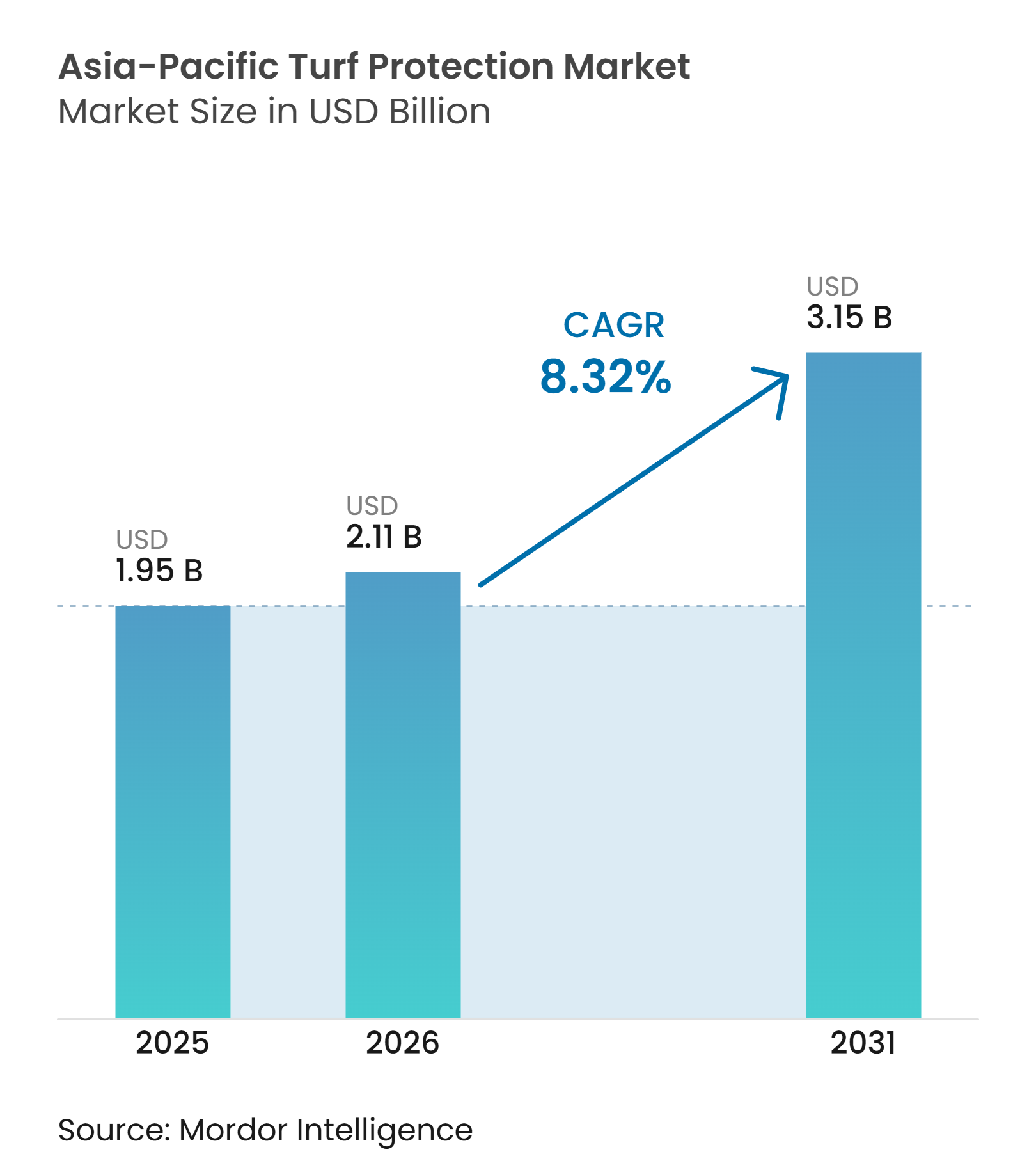
| Base Year Market Size (2025) | USD 1.95 Billion |
| Market Size (2026) | USD 2.11 Billion |
| Market Size (2031) | USD 3.15 Billion |
| Growth Rate (2026 - 2031) | 8.32 % |
| Market Concentration | Medium |
Major Players *Disclaimer: Major Players sorted in no particular order Image © Mordor Intelligence. Reuse requires attribution under CC BY 4.0. | |
Asia-Pacific Turf Protection Market Analysis by Mordor Intelligence
The Asia-Pacific turf protection market size was valued at USD 1.95 billion in 2025 and is estimated to grow from USD 2.11 billion in 2026 to reach USD 3.15 billion by 2031, at a CAGR of 8.32% during the forecast period (2026-2031). Sports construction managed green space programs, and increasingly demanding turf conditions drive demand across the region. Tropical and subtropical climates extend disease pressure beyond the seasonal patterns observed in cooler climates. Professional operators are increasingly combining chemical products, biological inputs, and field monitoring tools within single maintenance programs. China and India account for major demand volumes, while Australia and Japan support higher product spending per managed hectare. Golf and resort development in Vietnam, Cambodia, the Philippines, Thailand, and Indonesia also contributes to market growth.
Key Report Takeaways
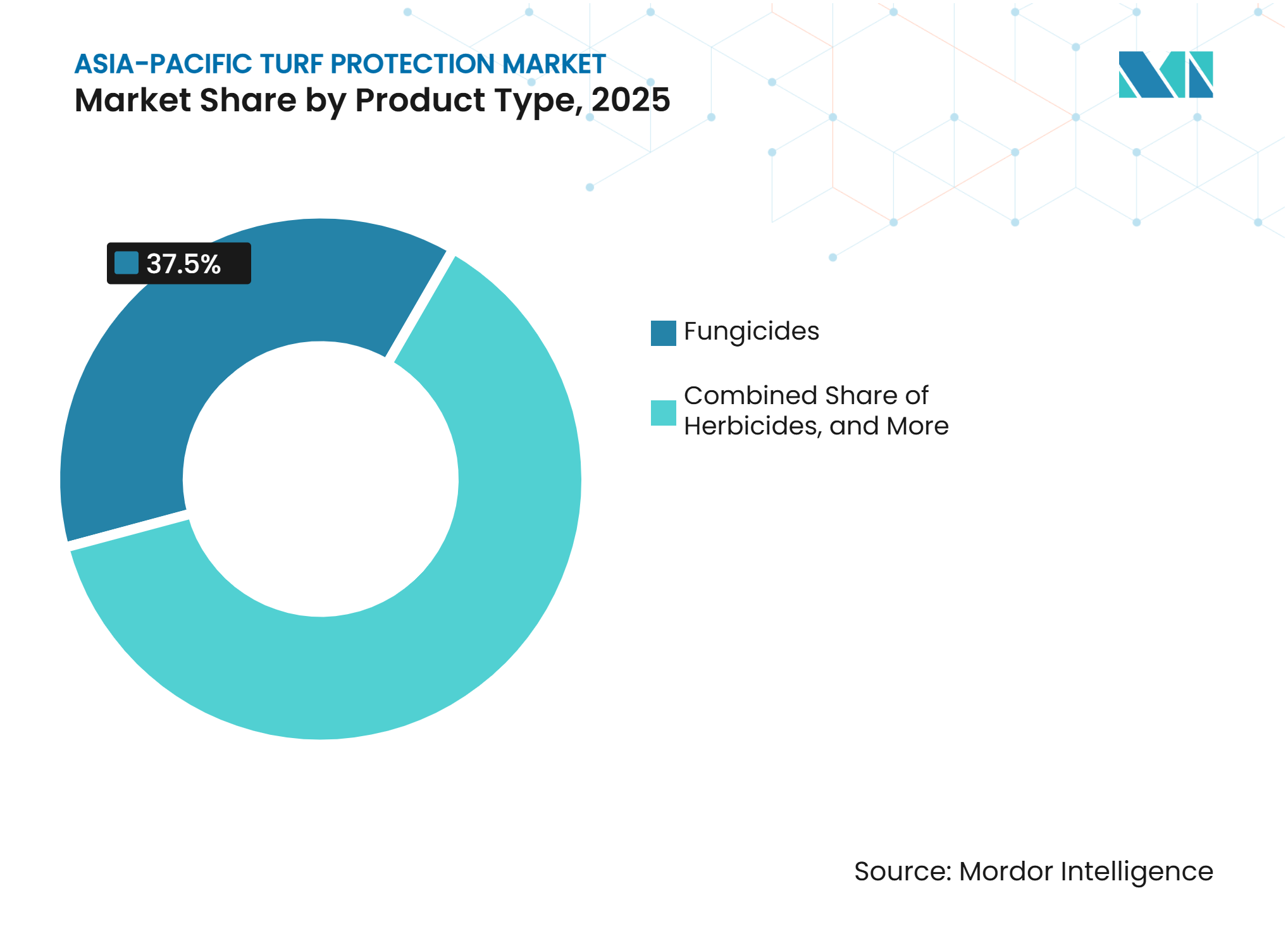
- By product type, fungicides accounted for 37.5% of the Asia-Pacific turf protection market share in 2025, while biostimulants and bio-fertilizers are forecast to grow at a CAGR of 10.8% from 2026 to 2031.
- By application, landscaping accounted for 42.1% of the Asia-Pacific turf protection market size in 2025, while sports fields are forecast to grow at a CAGR of 9.3% from 2026 to 2031.
- By end user, residential customers accounted for 45.4% of the market share in 2025, while sports facility owners are forecast to grow at a CAGR of 8.9% from 2026 to 2031.
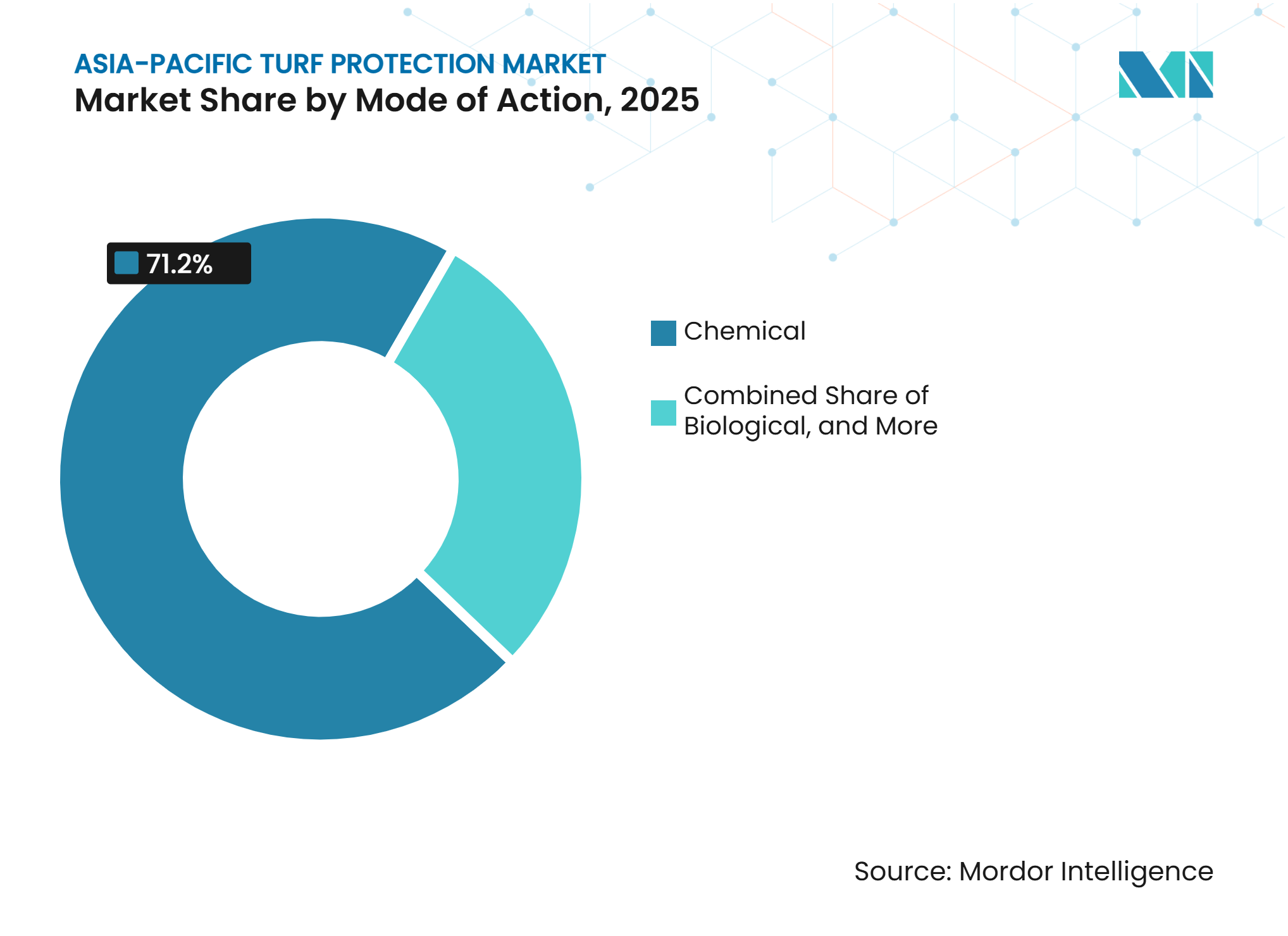
- By mode of action, chemical products accounted for 71.2% of the market share in 2025, while biological products are forecast to grow at a CAGR of 11.6% from 2026 to 2031.
- By formulation, liquid concentrates accounted for 57.3% of market share in 2025 and are forecast to grow at a CAGR of 10.3% from 2026 to 2031.
Note: Market size and forecast figures in this report are generated using Mordor Intelligence’s proprietary estimation framework, updated with the latest available data and insights as of January 2026.
Market Trends and Insights
Drivers Impact Analysis of Asia-Pacific Turf Protection Market*
| Driver | (~) % Impact on CAGR Forecast | Geographic Relevance | Impact Timeline |
|---|---|---|---|
| Expansion of Golf, Cricket, Football, and Multi-Sport Venues | +1.8% | China, India, Japan, Australia, South Korea, Vietnam, Philippines | Short term (≤ 2 years) |
| Urban Green-Space and Premium Landscaping Investment | +1.5% | China, India, Indonesia, Vietnam, Australia | Medium term (2-4 years) |
| Intensifying Turf Disease and Pest Pressure | +1.4% | China, India, Japan, Australia | Short term (≤ 2 years) |
| Shift Toward Biologicals and Integrated Pest Management | +1.2% | Japan, Australia, South Korea, China | Medium term (2-4 years) |
| Sensor-Based Irrigation and Precision Turf Management | +0.9% | Australia, Japan, Singapore, South Korea | Medium term (2-4 years) |
| Monsoon, Heat, Drought, and Salinity Stress Mitigation | +1.3% | India, Australia, China, Thailand | Short term (≤ 2 years) |
| Source: Mordor Intelligence | |||
Expansion of Golf, Cricket, Football, and Multi-Sport Venues
Sports venue construction is the most visible structural driver of turf protection demand across Asia-Pacific. India's Karnataka Housing Board issued a Rs 943 crore (USD 112 million) tender in 2025 for an 80,000-capacity international cricket stadium in Bengaluru, incorporating a 75-acre multi-sport complex in the first development phase. Meghalaya simultaneously advanced a Rs 732 crore (USD 87 million) FIFA- and AFC-standard football stadium project with a 2028 completion target, where natural-turf specifications are mandated by the governing bodies. In Southeast Asia, Vinpearl committed VND 3,942 billion (USD 158 million) to a second 18-hole golf complex in Nha Trang, targeting completion of the infrastructure by December 2026. The cumulative project pipeline points to sustained demand for fungicides, herbicides, and biostimulants across the region. Turf specifications and playing-surface requirements set by governing bodies such as the International Cricket Council and FIFA support continued demand for natural-turf maintenance products at professional venues.
Urban Green-Space and Premium Landscaping Investment
Urban greening has shifted from a municipal amenity to a climate-adaptation requirement, expanding the treated turf base across major cities in the Asia-Pacific. Japan's Ministry of Land, Infrastructure, Transport and Tourism has formalized green-infrastructure guidelines prioritizing urban park development and street greening as part of the country's carbon-absorption strategy[1]. The Asian Development Bank estimates that the Asia-Pacific region requires up to USD 1.7 trillion annually to address its infrastructure gap and climate adaptation needs, a pipeline that includes substantial urban green space components. Premium residential estates and resort developments across Indonesia, Vietnam, and Thailand further expand the commercial landscaping segment beyond what government programs alone generate. These requirements can increase interest in biological and integrated turf-management programs among municipal buyers.
Intensifying Turf Disease and Pest Pressure
Warming and humidity trends are restructuring the disease calendar for managed turf across Asia-Pacific, generating demand for additional protective applications beyond historical program norms. In 2025, the International Turfgrass Society Research Journal published research documenting disease incidence trends in creeping bentgrass in Japan, with disease diagnoses increasing during summer and September samples increasing in recent years amid consistently high temperatures[2]. In India's mid-hill regions, regression analysis directly linked relative humidity and rainfall to brown patch severity in both cool-season and warm-season grasses. The findings highlight the role of relative humidity and rainfall in brown patch severity and underscore the importance of weather conditions in turf disease management decisions[3]. DLF's turfgrass science team reported in 2025 that elevated overnight temperatures have lengthened brown patch and dollar spot epidemics at major stadium venues, a dynamic directly applicable to Asia-Pacific's high-humidity coastal and monsoon-affected markets. Resistant biotypes of key pests and pathogens add further pressure by reducing the effective lifespan of existing chemical modes of action.
Shift Toward Biologicals and Integrated Pest Management
Buyer sustainability targets and regulatory requirements are pulling Asia-Pacific turf managers toward biological and integrated programs at a faster pace than seen in conventional crop agriculture. Japan's Ministry of Agriculture, Forestry and Fisheries issued updated guidelines for the registration of microbial pesticides in April 2024, creating a clearer regulatory framework that is accelerating product launches for biological turf inputs. Golf clubs in Australia and Japan have begun including biological performance specifications in procurement tender documents, a demand-side development that favors companies with registered biological portfolios over those that rely solely on conventional chemistries. The transition is not uniform, price gaps between biological and chemical products remain significant in Southeast Asia, where smallholder applicators dominate the landscaping and sod-farm segments and technical knowledge of biological program management is limited. Companies offering combination products, lower-cost biological formulations, and digital integration tools may have opportunities to address adoption barriers in price-sensitive markets.
Restraints Impact Analysis of Asia-Pacific Turf Protection Market*
| Restraint | (~) % Impact on CAGR Forecast | Geographic Relevance | Impact Timeline |
|---|---|---|---|
| Regulatory Scrutiny of Conventional Turf Chemistries | -1.5% | Japan, Australia, New Zealand, South Korea | Short term (≤ 2 years) |
| Artificial Turf Substitution in Selected Venues | -0.8% | China, India, Japan | Medium term (2-4 years) |
| Registration and Reformulation Costs for Specialty Products | -1.2% | China, India, Japan, Australia | Medium term (2-4 years) |
| Fragmented Distributor and Applicator Capability | -1.1% | India, Indonesia, Vietnam, Philippines | Long term (≥ 4 years) |
| Source: Mordor Intelligence | |||
Regulatory Scrutiny of Conventional Turf Chemistries
Active-ingredient attrition is accelerating across the region's most demanding regulatory markets, creating label uncertainty that complicates purchasing decisions and forces reformulation investment. Australia's Australian Pesticides and Veterinary Medicines Authority (APVMA) published its final regulatory decision on fenitrothion in August 2025, restricting turf and ornamental label claims and directly narrowing the chemical toolbox available to golf course superintendents. A parallel diazinon review completed in 2024 applied additional worker-safety and residue constraints across multiple turf and ornamental applications, compounding the restriction trend. Japan's compliance framework, administered by the Ministry of Agriculture, Forestry and Fisheries under the Agricultural Chemicals Regulation Law, enforces one of Asia-Pacific's most stringent pre-registration evaluation timelines, typically requiring 3–5 years from initial submission to commercial availability for a new turf active ingredient. The shift toward lower-residue and biological products provides alternatives as conventional products face regulatory restrictions, although replacement products may require additional time to obtain registrations across multiple countries.
Artificial Turf Substitution in Selected Venues
Synthetic surfaces are gaining ground in specific venue categories where water costs, labor scarcity, or maintenance budgets constrain natural-surface investment. Indoor and simulated golf venues are growing in China, where GOLFZON China opened its second CITYGOLF facility in Yanji in April 2025, with a total investment of approximately CNY 145 million (USD 20 million), thereby reducing the need for maintenance of natural-turf surfaces in urban settings. Competitive sporting venues governed by international federations, ICC-standard cricket pitches, and FIFA-category football fields, remain structurally protected from synthetic substitution under current playing regulations. This limits the artificial surface threat to recreational, municipal, and lower-tier commercial segments rather than the premium-spend venues driving per-hectare product consumption growth.
*Our forecasts treat driver/restraint impacts as directional, not additive. The impact forecasts reflect baseline growth, mix effects, and variable interactions.
Asia-Pacific Turf Protection Market Segment Analysis
By Product Type:
Fungicides Support Current Demand, While Biostimulants and bio-fertilizers Inputs Grow FasterFungicides accounted for 37.5% of the Asia-Pacific turf protection market share in 2025. Warm and humid conditions across China, Japan, India, and Australia support regular disease-control programs. Dollar spot, brown patch, anthracnose, and patch diseases affect surface quality at high-value facilities. Herbicides control weed competition that can damage playing surfaces. Insecticides address root and surface damage from mole crickets, grubs, and nematodes. Plant growth regulators remain a smaller category used for growth management and stress protection. Together, these categories meet the immediate performance needs of golf courses, sports fields, and commercial landscapes.
Biostimulants and bio-fertilizers are forecast to grow at a 10.8% CAGR from 2026 to 2031, reflecting greater interest in resilience and lower-residue maintenance programs. Syngenta Group launched TREFINTI Turf nematicide through Nuturf in Australia in 2025. The product introduced cyclobutrifluram for nematode and soilborne disease management. Envu introduced Fiata Boost, a microbial biostimulant for golf and sports turf, in July 2026. Conventional products are likely to retain significant volume, while biological inputs grow faster within integrated maintenance plans.



By Application:
Landscaping Provides Scale While Sports Fields Grow FasterLandscaping accounted for 42.1% of the Asia-Pacific turf protection market share in 2025. The segment includes residential, commercial, municipal, and resort turf across dense urban areas. Government greening programs add a stable base of managed surfaces, while premium residential projects and resort development contribute further demand. Golf courses cover less acreage but spend more per hectare due to stricter surface standards. Sod farms are smaller users but require early fungicide and herbicide treatments for certified turf, connecting new construction activity with protection-product demand.
Sports fields are forecast to grow at a 9.3% CAGR from 2026 to 2031. New stadium construction creates demand during establishment and throughout routine maintenance. High-use venues require consistent playing conditions and rapid disease response, favoring premium products where turf failure has operational consequences. Natural grass requirements at professional venues limit the ability to replace inputs with alternative surfaces. Sports-field operators also require disease, insect, weed, and stress-management products, supporting broader product use than basic landscape maintenance programs.
By End User:
Residential Customers Lead, While Sports Facility Owners Grow FasterResidential customers accounted for 45.4% of the Asia-Pacific turf protection market share in 2025. Growing household spending on lawn appearance supports this position in China, India, and Southeast Asia. Commercial landscape contractors serve resorts, corporate campuses, and public parks, with buyers increasingly requesting efficiency and safety credentials as part of vendor qualification requirements. Municipalities and schools constitute a distinct group that places greater emphasis on low-residue maintenance, particularly in Australia and Japan. The broad residential base provides steady demand across multiple product categories.
Sports facility owners are forecast to grow at an 8.9% CAGR from 2026 to 2031. Cricket, football, and multisport projects in South and Southeast Asia support professional management budgets. Facility owners often require technical advice in addition to product supply. This favors suppliers with technical service capabilities and established brands. Golf and stadium operators require close control of disease risk and surface condition. Institutional buyers also create repeat purchasing cycles because maintenance cannot be deferred for extended periods, supporting a shift from single products toward coordinated turf-care programs.
By Mode of Action:
Chemical Products Retain Scale While Biological Products AccelerateChemical products accounted for 71.2% of the market share in 2025. This position reflects established distribution, broad label coverage, and rapid performance during disease events. Fungicides, herbicides, and insecticides remain important under high humidity and intense use, with their predictable results difficult to replace during acute outbreaks. Regulatory reviews are narrowing some conventional options in Australia and Japan. That pressure encourages operators to assess alternatives without removing the need for chemical tools.
Biological products are forecast to grow at an 11.6% CAGR through 2031. Japan and Australia support adoption through regulation and buyer sustainability requirements. Koppert B.V. confirms Sportnem-T use on lawns, stadiums, golf courses, and cricket pitches. BioSafe Systems, LLC provides ZeroTol 2.0 for professional grounds and turf applications. Integrated solutions combine biological and chemical products where a full biological program remains unaffordable, offering operators a practical route to meet both efficacy and environmental requirements.

By Formulation:
Liquid Concentrates Lead and Grow FasterLiquid concentrates accounted for 57.3% of market share in 2025 and are forecast to grow at a 10.3% CAGR from 2026 to 2031. Professional golf, sports fields, and commercial landscaping operators commonly use spray equipment. Liquid products offer flexible dilution and compatibility with tank-mix programs. These qualities suit trained applicators managing large turf areas. BASF SE introduced Aramax Intrinsic for golf fairways in May 2024, with a dual-active formulation that controls 26 cool-season and warm-season turf diseases. Granular products remain useful in controlled-release fertilizer blends and selected herbicide applications. Municipal parks and residential lawns may use them where spray equipment is unavailable. Wettable powders retain a role where storage stability and lower formulation cost matter most. These formats can suit inland distribution networks across Southeast Asia and South Asia. Liquid systems align more closely with precision spray equipment. Formulation choices therefore reflect operator capability, product purpose, and the local distribution environment.
Geography Analysis
China and India remain the largest volume centers for the Asia-Pacific turf protection market. China's demand spans golf, resort, and urban green-space activity across a broad base of managed surfaces. GOLFZON began a second CITYGOLF facility in Yanji during April 2025. The project was valued at CNY 145 million (USD 20 million). India's monsoon variability, salinity stress in coastal venues, and soil-borne nematode pressure create a demand profile weighted toward fungicides, nematicides, and stress-mitigation biostimulants rather than purely weed-management products, differentiating it from China's demand structure.
Japan and Australia have the highest value per managed hectare in the region. Their professional turf culture supports regular input use and strict performance standards. BASF SE launched Pure-Star Floable in Japan in February 2025 for bentgrass turf. Australia's 2025 fenitrothion decision restricted turf and ornamental uses. Australia and New Zealand together sustain a premium wetting-agent and biostimulant category that is disproportionately large relative to their managed-turf acreage, driven by water-scarcity policies and the quality standards maintained by elite golf-course associations. South Korea mirrors Japan in per-application investment levels and regulatory rigor, with the National Institute of Agricultural Sciences actively supporting biopesticide research and registration pathways that have facilitated the entry of biological turf products at the premium end of the market.
Southeast Asia and the rest of Asia-Pacific offer the strongest expansion opportunity in the region. Golf development is progressing in Vietnam, Cambodia, and the Philippines. Resort landscaping supports demand in Thailand and Bali. Singapore maintains high-standard publicly managed green spaces. Singapore's National Parks Board awarded contracts for turf and landscape management totaling more than SGD 20.1 million (USD 14.9 million) across two procurement rounds in April and May 2025, reflecting the government's commitment to high-standard managed green spaces. These markets have a growing base of professionally managed turf, though distributor capability constraints and limited application training continue to restrain adoption of higher-value programs.
Competitive Landscape
Market Concentration
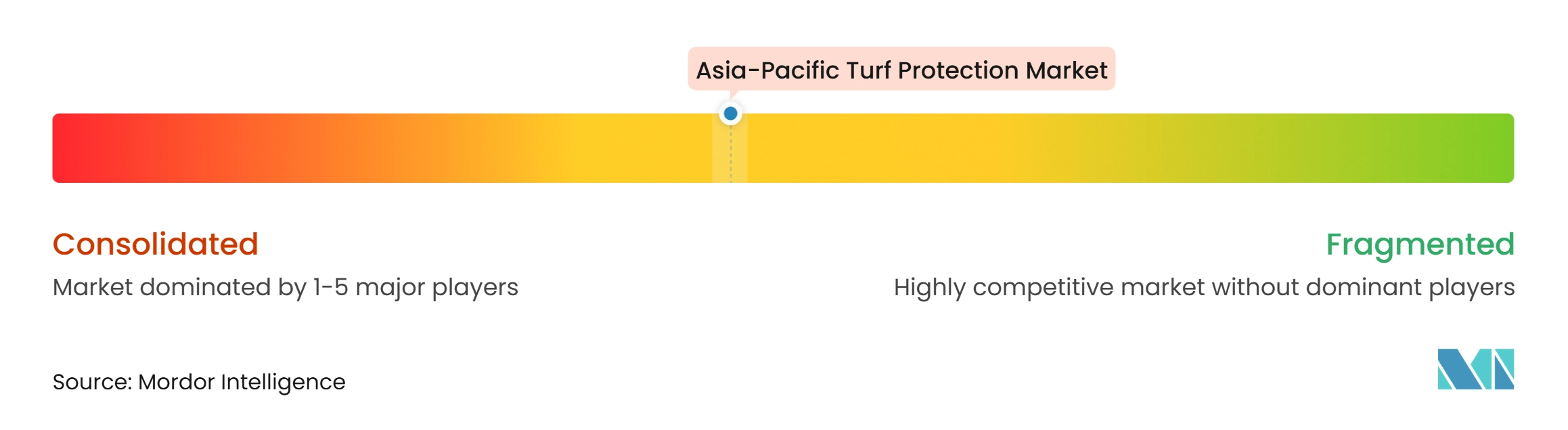
The Asia-Pacific turf protection market is moderately concentrated, with major players including Syngenta Group, BASF SE, Envu, Koppert B.V., and BioSafe Systems, LLC, as well as regional and specialist suppliers. Syngenta Group combines conventional products with the Spiio soil sensor offer in Australia, integrating field data into its customer relationships. Envu expanded its specialty portfolio through the acquisition of FMC's Global Specialty Solutions business. The portfolio rose from 180 to 250 brands and added more than 40 active ingredients. Envu partnered with Greencell to introduce Fiata Boost in July 2026. Koppert B.V. and BioSafe Systems, LLC serve growing biological niches for professional turf managers. Opportunities remain for low-residue programs serving public venues in India and Southeast Asia. Coastal markets also require products that address heat and salinity stress. Digital tools can support mid-sized operators that lack access to full agronomic consulting. Turfcare Australia aggregates products from suppliers such as Envu and Sumitomo Chemical Co, Ltd for specialist customers. Suppliers relying on a single conventional active ingredient face greater regulatory exposure. Portfolio breadth and technical support are becoming more important competitive factors.
Asia-Pacific Turf Protection Industry Leaders
-
Syngenta Group
-
BASF SE
-
Nufarm Limited
-
Corteva Agriscience, Inc.
-
ICL Group Ltd.
- *Disclaimer: Major Players sorted in no particular order
Asia-Pacific Turf Protection Market Companies Covered in this Report
- Syngenta Group
- BASF SE
- Nufarm Limited
- Corteva Agriscience, Inc.
- Ishihara Sangyo Kaisha, Ltd.
- ICL Group Ltd.
- SDS Biotech K.K. (Idemitsu Kosan Co., Ltd.)
- AMVAC Chemical Corporation (American Vanguard Corporation)
- Rallis India Limited
- Kumiai Chemical Industry Co., Ltd.
- BioSafe Systems, LLC
- Koppert B.V.
- Envu (Cinven)
- Sumitomo Chemical Co., Ltd.
- Turfcare Australia
Recent Industry Developments in Asia-Pacific Turf Protection Market
- July 2026: Envu partnered exclusively with Greencell to launch Fiata Boost, a patent-pending microbial biostimulant for golf, sports turf, and ornamentals. The partnership expands Envu’s biological turf protection portfolio and addresses plant resilience under drought, heat, and intensive turf use.
- March 2026: Rain Bird and Centaur Asia Pacific expanded their golf irrigation partnership into Malaysia and Brunei, extending Rain Bird’s integrated control and pump station solutions to additional ASEAN golf facilities. The expansion supports water-use efficiency and automation in golf irrigation systems.
- February 2026: Husqvarna partnered with Nuturf in Australia to expand robotic and battery-powered mowing solutions across golf courses, elite sports facilities, and municipal environments, supporting the adoption of automated and battery-powered turf equipment.
Asia-Pacific Turf Protection Market Report Scope
The turf protection market is defined as products and solutions used to prevent, control, and reduce pest, disease, and stress damage in natural turfgrass across residential, commercial, and sports surfaces, with market value measured at the point of sale in USD.
The Asia-Pacific Turf Protection Market Report is Segmented by Product Type (Fungicides, Herbicides, Insecticides, Plant Growth Regulators, and Biostimulants and Bio-Fertilizers), by Application (Landscaping, Golf Courses, Sports Fields, and Sod Farms), by End User (Residential Customers, Commercial Landscape Contractors, Sports Facility Owners, and Municipalities and Schools), by Mode of Action (Chemical, Biological, and Integrated Solutions), by Formulation (Granular, Liquid Concentrate, and Wettable Powder), and by Geography (China, India, Japan, Australia, South Korea, and Rest of Asia-Pacific). The Market Forecasts are Provided in Terms of Value (USD).
Segmentation Overview
| Fungicides |
| Herbicides |
| Insecticides |
| Plant Growth Regulators |
| Biostimulants and Bio-Fertilizers |
| Landscaping |
| Golf Courses |
| Sports Fields |
| Sod Farms |
| Residential Customers |
| Commercial Landscape Contractors |
| Sports Facility Owners |
| Municipalities and Schools |
| Chemical |
| Biological |
| Integrated Solutions |
| Granular |
| Liquid Concentrate |
| Wettable Powder |
| China |
| India |
| Japan |
| Australia |
| South Korea |
| Rest of Asia-Pacific |
| By Product Type | Fungicides |
| Herbicides | |
| Insecticides | |
| Plant Growth Regulators | |
| Biostimulants and Bio-Fertilizers | |
| By Application | Landscaping |
| Golf Courses | |
| Sports Fields | |
| Sod Farms | |
| By End User | Residential Customers |
| Commercial Landscape Contractors | |
| Sports Facility Owners | |
| Municipalities and Schools | |
| By Mode of Action | Chemical |
| Biological | |
| Integrated Solutions | |
| By Formulation | Granular |
| Liquid Concentrate | |
| Wettable Powder | |
| By Geography | China |
| India | |
| Japan | |
| Australia | |
| South Korea | |
| Rest of Asia-Pacific |
Key Questions Answered in the Report
What is the forecast value for the Asia-Pacific turf protection market?
The market is forecast to grow from USD 2.11 billion in 2026 to USD 3.15 billion by 2031, at a 8.32% CAGR from 2026 to 2031.
Which product category leads regional demand?
Fungicides accounted for 37.5% of the market share in 2025 because disease pressure is persistent in warm, humid regions.
What application creates the largest demand?
Landscaping accounted for 42.1% of the market share in 2025, supported by municipal, residential, commercial, and resort surfaces.
Why are biological turf products gaining use?
Regulations, sustainability requirements, and demand for integrated maintenance programs support biological products, which are forecast to grow at an 11.6% CAGR.