
Asia-Pacific Pump Rental Market Size and Share
Market Overview
| Study Period | 2022 - 2032 |
|---|---|
| Forecast Data Period | 2027 - 2032 |
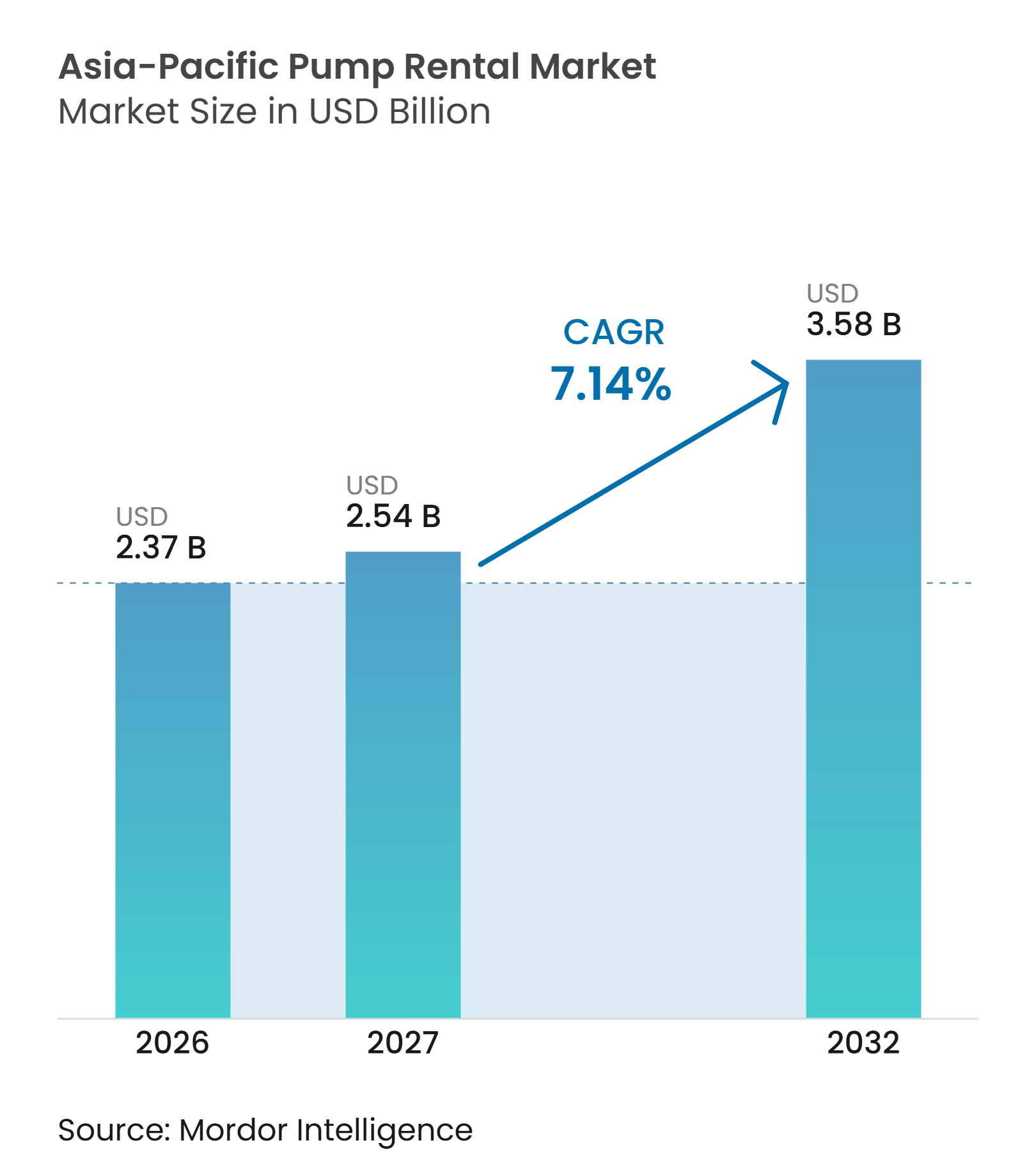
| Base Year Market Size (2026) | USD 2.37 Billion |
| Market Size (2027) | USD 2.54 Billion |
| Market Size (2032) | USD 3.58 Billion |
| Growth Rate (2027 - 2032) | 7.14 % |
| Market Concentration | Low |
Major Players *Disclaimer: Major Players sorted in no particular order Image © Mordor Intelligence. Reuse requires attribution under CC BY 4.0. | |
Asia-Pacific Pump Rental Market Analysis by Mordor Intelligence
The Asia-Pacific Pump Rental Market size was valued at USD 2.37 billion in 2026 and is estimated to grow from USD 2.54 billion in 2027 to reach USD 3.58 billion by 2032, at a CAGR of 7.14% during the forecast period (2027-2032). Public investment in water systems, transport corridors, industrial parks, and mining projects is sustaining demand for temporary dewatering and fluid-management equipment across the region. China completed USD 178.1 billion (CNY 1.28 trillion) in water-conservancy investment in 2025, while the Asian Development Bank reported USD 11.4 billion in committed water investment through its Water Financing Partnership Facility.[1] These projects favor rental providers because contractors and utilities need equipment quickly without committing capital to assets that may be used only during construction, maintenance, or emergency work. The Asia-Pacific pump rental market is also shifting toward managed services that combine equipment, remote monitoring, maintenance, and discharge-compliance support, which gives digitally capable providers a stronger position in higher-value contracts. Compliance requirements, technician shortages, and high mobilization costs remain material constraints, especially for remote operations in Australia, Indonesia, and Japan.
Key Report Takeaways
- By pump type, centrifugal pumps held 57.6% of Asia-Pacific pump rental market share in 2026, while positive displacement pumps are forecast to grow at a 7.5% CAGR through 2032.
- By end-user industry, water and wastewater utilities accounted for 32.3% of the Asia-Pacific pump rental market size in 2026, while manufacturing and industrial processing are projected to expand at an 8.2% CAGR through 2032.
- By geography, China captured 37.1% of Asia-Pacific pump rental market share in 2026, while India is forecast to grow at a 7.9% CAGR through 2032.
Note: Market numbers in this report are based on Mordor Intelligence's proprietary estimation framework, which combines nine months of actuals with Q4 projections for base year 2026.
Market Trends and Insights
Drivers Impact Analysis of Asia-Pacific Pump Rental Market*
| Driver | (~) % Impact on CAGR Forecast | Geographic Relevance | Impact Timeline |
|---|---|---|---|
| Infrastructure And Urban Water Investment | +2.1% | China, India, and Southeast Asia | Long term (≥ 4 years) |
| Short-Term Capital Flexibility Versus Pump Ownership | +1.5% | Asia-Pacific | Medium term (2-4 years) |
| Mining, Construction, And Industrial Dewatering Intensity | +1.8% | Australia, Indonesia, South Korea, and China | Long term (≥ 4 years) |
| Extreme-Rainfall And Emergency-Flood Response Demand | +1.2% | Southeast Asia, South Asia, and East Asia | Short term (≤ 2 years) |
| Remote Monitoring And Energy-Efficient Rental Fleets | +0.8% | Australia, Japan, India, and Southeast Asia | Medium term (2-4 years) |
| Outcome-Based Water Management Contracts | +0.5% | Australia, India, Vietnam, and Indonesia | Medium term (2-4 years) |
| Source: Mordor Intelligence | |||
Infrastructure And Urban Water Investment Underpins Sustained Demand
Water infrastructure programs extend the need for temporary pumping during construction, rehabilitation, and emergency repair work. India approved 3,568 water-supply projects under the Atal Mission for Rejuvenation and Urban Transformation (AMRUT) 2.0, with a value of INR 1.14 trillion, or USD 13.6 billion, for treatment and distribution upgrades in 500 cities.[1] These programs create recurring bypass-pumping needs when utilities renew mains, upgrade treatment systems, or isolate sections of an operating network. Japan has also outlined a five-year national-resilience plan exceeding JPY 20 trillion, or USD 133 billion, for fiscal years 2026 through 2030, with water and sewage resilience among the stated priorities. Large project pipelines can create short periods when locally available equipment is limited, making depot coverage and rapid mobilization important commercial advantages. The Asia-Pacific pump rental market benefits when providers can position suitable units close to public works sites and offer installation, monitoring, and maintenance alongside the equipment.
Flexible Rental Models Support Contractors and Utilities
Rental gives contractors and utilities access to high-capacity equipment without absorbing the purchase price, storage cost, or maintenance burden of owning a large fleet. This is particularly relevant for bypass work, flood response, mine dewatering, and construction excavation, where equipment requirements change by site and project stage. The commercial benefit is strongest where a customer needs a pump system for a defined period but faces uncertain volumes, changing water conditions, or a limited project schedule. Providers can respond with dry-hire arrangements for customers that have operating staff or wet-hire packages for projects that require trained personnel and managed operations. The approach also gives customers access to specialized centrifugal, positive displacement, submersible, diaphragm, vacuum, axial-flow, and mixed-flow equipment without having to maintain each technology internally. As outcome-based arrangements become more common, customers increasingly pay for measured pumping performance and compliance support rather than simply for the time a unit spends on site.
Mining, Construction, And Industrial Dewatering Support Equipment Demand
Mining, construction, and industrial sites require reliable dewatering because standing water can delay excavation, affect safety, damage equipment, and interrupt production. Indonesia remains a significant opportunity because mine operators need large pumping systems for coal and nickel operations, while construction projects add demand for temporary groundwater control. Sumitomo Corporation acquired PT Resource Equipment Indonesia through Aver Asia in January 2025, identifying the company’s large-pump rental activity in Indonesia’s mining sector as a strategic asset. The transaction supports the view that mine dewatering is being treated more often as a managed service rather than an ad hoc operating expense. In Australia, high-head and high-volume systems remain important at mineral and infrastructure sites that operate far from major population centers. Industrial plants also need pumping during wastewater treatment work, shutdowns, drainage, and maintenance, which creates demand that is less tied to new project starts alone. The Asia-Pacific pump rental market can therefore benefit from providers that match equipment selection, field support, and transport planning to difficult site conditions.
Flood Response and Digital Fleets Raise Service Requirements
Water-related hazards and infrastructure gaps remain material risks to water security across Asia and the Pacific, increasing the importance of emergency pumping capacity. Flood events can create urgent demand because public agencies and site operators cannot defer procurement while assets, roads, or excavations are inundated. Coates was appointed to the Australian Government’s National Emergency Management Stockpile panel through June 2027, providing an approved route for agencies to obtain dewatering and flood-mitigation equipment. Remote monitoring is also changing what customers expect from rental providers, particularly where discharge quality, runtime, fuel use, or maintenance status must be documented. Coates has rolled out a digital workflow platform across more than 145 branches and workshops, supporting connected fleet management and field processes. These capabilities support outcome-based contracts in which providers assume part of the mobilization, monitoring, and environmental-compliance responsibility, a model that has gained relevance in Australia, India, Vietnam, and Indonesia.
Restraints Impact Analysis of Asia-Pacific Pump Rental Market*
| Restraint | (~) % Impact on CAGR Forecast | Geographic Relevance | Impact Timeline |
|---|---|---|---|
| Remote-Site Logistics And Mobilization Costs | -0.9% | Australia, Indonesia, Vietnam, and remote mine and construction sites | Long term (≥ 4 years) |
| Skilled Dewatering Technician Shortages | -0.7% | Australia, Japan, South Korea, and India | Medium term (2-4 years) |
| Discharge Permitting And Environmental Liability | -0.5% | Australia, Japan, and India | Medium term (2-4 years) |
| Used-Equipment Reliability And Compatibility Risk | -0.3% | Southeast Asia and South Asia | Short term (≤ 2 years) |
| Source: Mordor Intelligence | |||
Remote-Site Logistics, Equipment Reliability, And Mobilization Costs
Remote locations can make pump rental costly even when project demand is strong, since freight, fuel, site access, personnel, and unit repositioning all add to the delivered price. This problem is pronounced in northern Australia, Kalimantan, Papua New Guinea, and other areas where resource projects are far from equipment depots. National Pump & Energy commissioned its 500th Cummins-powered pump skid in June 2025, reflecting continued investment in fleet capacity for mining, construction, and oil-and-gas applications.[2] Providers without a local or regional depot network may be unable to offer competitive lead times or transport costs beyond their practical haulage range. Used equipment can add a separate challenge when unit condition, spare-parts availability, and control systems do not suit the intended duty. These constraints can push smaller providers toward basic dry-hire work and limit their ability to serve sites that need engineered systems, rapid replacement units, or a guaranteed operating outcome.
Technician Availability and Compliance Requirements Limit Service Expansion
Wet-hire contracts require personnel who can operate and maintain equipment while meeting electrical-safety, discharge, and site-specific rules. A shortage of qualified technicians can reduce fleet use even when equipment demand is available, particularly in Australia and Japan where workforce constraints affect construction-related services. ACTIO has identified personnel shortages and digital substitution among its operational challenges, and the company is expanding remote-operation capabilities using Internet of Things (IoT) and Information and Communications Technology (ICT) tools. Compliance adds another layer of complexity because discharge, groundwater extraction, and site operating conditions may be subject to state or local controls. New South Wales has temporary water exemptions intended to support housing-related infrastructure, but the measures expire in June 2029, leaving contractors to plan for changes in the approval environment.[3] In Western Australia, water management requirements also affect dewatering activity and place a premium on providers that can document how equipment is used and how water is handled. Operators with trained teams, reliable telemetry, and clear compliance processes can compete for more complex contracts, while those without these capabilities may remain confined to lower-margin equipment supply.
*Our forecasts treat driver/restraint impacts as directional, not additive. The impact forecasts reflect baseline growth, mix effects, and variable interactions.
Asia-Pacific Pump Rental Market Segment Analysis
By Pump Type:
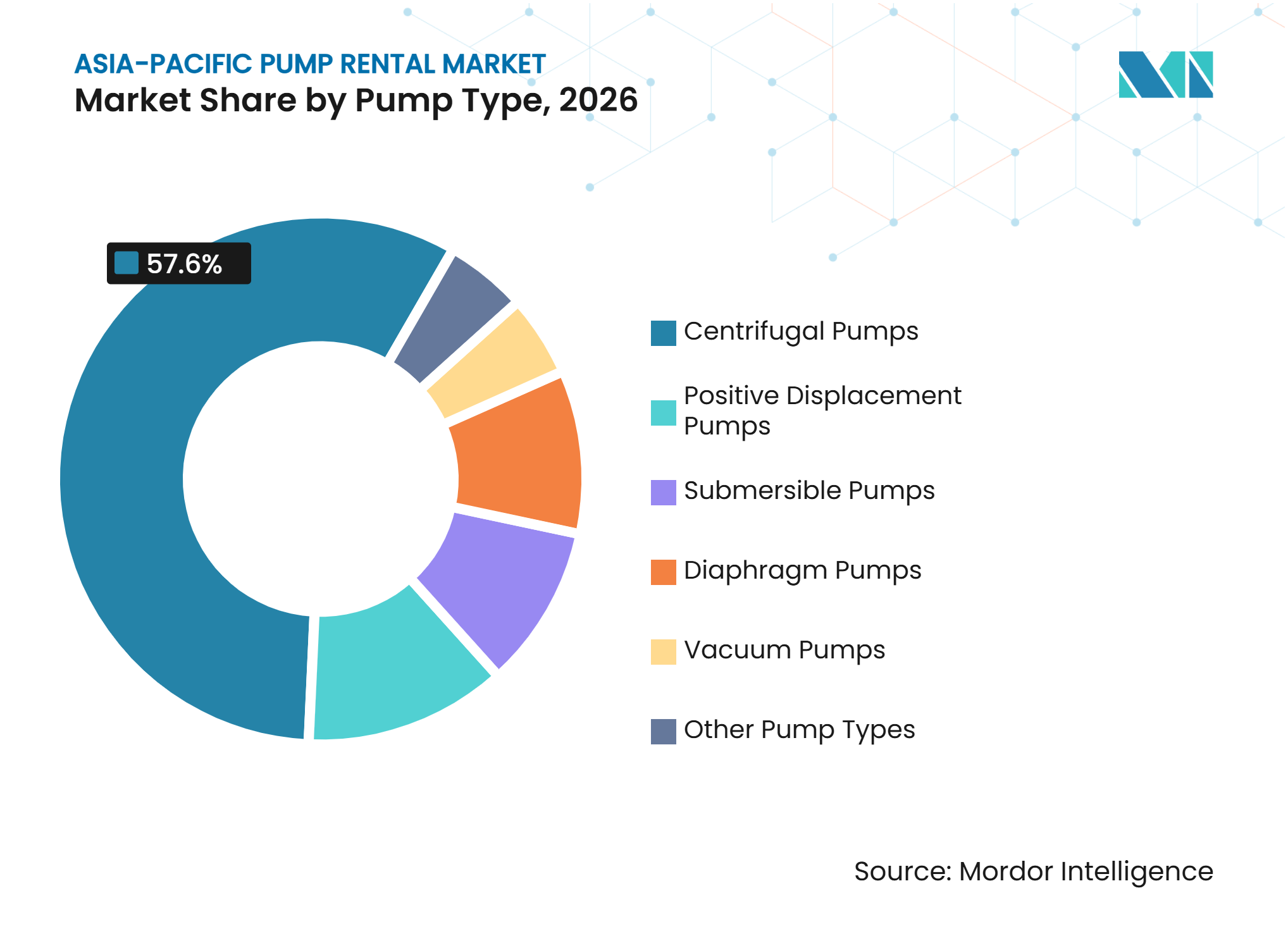
Centrifugal Pumps Lead While Positive Displacement Pumps Gain GroundCentrifugal pumps held 57.6% of Asia-Pacific pump rental market share in 2026 because they serve a wide range of high-volume, low-to-medium-head duties. Construction dewatering, municipal bypass, agricultural transfer, and surface-water drainage commonly use these units because they are adaptable and relatively straightforward to maintain. Rental operators value this simplicity because asset availability has a direct effect on utilization and revenue. Atlas Copco supplied self-priming centrifugal dewatering equipment for the Dipolog-Dapitan bridge project in the Philippines, demonstrating how this pump category supports work in demanding coastal construction settings. Centrifugal fleets also give providers a flexible base for temporary works where flow requirements may change through different construction stages.
Submersible pumps remain important in underground mining, confined urban excavations, and applications where equipment must operate directly in the water being removed. Fujimaru Sangyo operates a fleet of more than 1,350 submersible pumps and has completed more than 2,000 installation projects in Japan. The company became a wholly owned subsidiary of Tsurumi Manufacturing in March 2026, linking its rental and installation activity more closely with a pump manufacturer. Positive displacement pumps are forecast to expand at a 7.5% CAGR through 2032 as customers need dependable flow for viscous fluids and solids-laden wastewater. The Asia-Pacific pump rental market size for this segment is supported by stronger wastewater-treatment requirements, where extracted water may need treatment instead of simple removal. Coates added electric BBA positive displacement piston pumps to its engineered dewatering fleet in 2025, with flow capacity ranging from 30 cubic meters per hour to 200 cubic meters per hour. Diaphragm pumps support corrosive-fluid applications, vacuum pumps serve wellpoint dewatering, and axial-flow or mixed-flow units are used for large drainage schemes.



By End-User Industry:
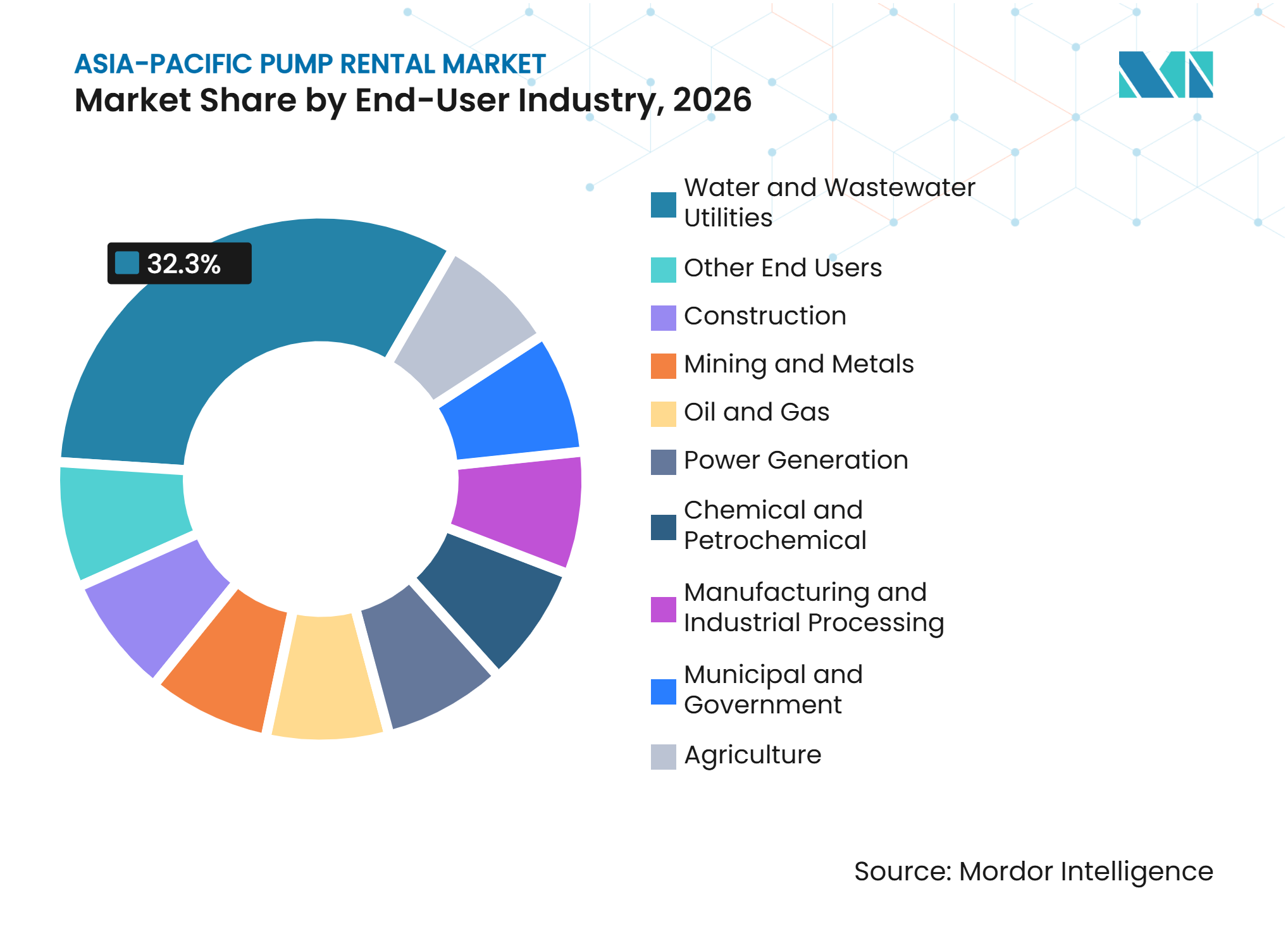
Utilities Provide Scale While Manufacturing Gains MomentumWater and wastewater utilities accounted for 32.3% of the Asia-Pacific pump rental market size in 2026, supported by treatment-plant upgrades, pipeline rehabilitation, and bypass work during maintenance. India’s Atal Mission for Rejuvenation and Urban Transformation (AMRUT) 2.0 projects provide a clear example because water-supply upgrades require temporary pumping whenever operating mains are isolated or renewal works are carried out. The work is recurring because aging water assets require ongoing maintenance after initial construction is complete. Xylem reported USD 2.46 billion in 2025 revenue for its Water Solutions and Services segment, which includes mobile dewatering equipment and rental services under the Godwin and Grindex brands. This portfolio shows how equipment providers can combine products, field services, and temporary systems for municipal and industrial applications.
Manufacturing and industrial processing is projected to record the highest end-user growth rate, at an 8.2% CAGR through 2032. New industrial parks and special economic zones in India, Indonesia, and Vietnam need temporary dewatering during construction, while operating facilities need support during maintenance and wastewater-system upgrades. Tightening effluent controls can increase demand for rental packages that combine pumps with treatment and monitoring systems. Construction continues to generate significant volumes through roads, metro projects, urban redevelopment, and foundation work that requires groundwater exclusion. Mining and metals remain important in Australia and Indonesia, while chemical and petrochemical sites create specific demand in China and South Korea. Agriculture uses large numbers of pumps but rental penetration is lower in smallholder markets where customers often own lower-cost equipment, which limits the role of rental in that part of the Asia-Pacific pump rental industry.

Geography Analysis
China
China held 37.1% of Asia-Pacific pump rental market share in 2026, supported by large and sustained investment in water-conservancy projects. The State Council reported USD 29.72 billion or CNY 198.81 billion in water-conservancy investment during the first quarter of 2025, with 6,034 new projects started in the period. The same update stated that deployment of local-government special bonds for water conservancy rose 37% year over year. This investment profile supports long-duration construction and water-management activity rather than only occasional spot demand. Operators with large, committed fleets and the capital to maintain equipment availability are better placed to serve multi-year projects. Demand is likely to favor providers that can organize depot coverage, maintenance support, and a broad pump mix for municipal drainage, pipeline work, and construction. The Asia-Pacific pump rental market size in China is therefore linked closely to public works schedules and the ability of suppliers to support complex, long-running project contracts.
India
India is forecast to record a 7.9% CAGR through 2032, the fastest growth rate among the reported Asia-Pacific geographies. The Jal Jeevan Mission was extended through 2028 with a revised budget of INR 67,000 crore, or USD 8 billion. AMRUT 2.0 also included 586 sewerage projects with approved treatment capacity of 6,964 million liters per day as of August 2025. These programs support temporary pumping during new construction, network rehabilitation, wastewater works, and system commissioning. The market is served by regional and national rental businesses that often offer broad equipment portfolios rather than only pump-specialist services. Bureau of Indian Standards requirements for applicable pump categories can influence supplier selection and create a compliance advantage for operators with locally compliant fleets. Providers that pair equipment with field teams, monitoring, and project support may have an opportunity to serve more complex municipal and industrial requirements.
Japan, South Korea, Australia, Indonesia, Vietnam, And Thailand
Japan and South Korea are more mature equipment-rental markets, where elevated rental use is balanced by workforce pressure and a gradual shift toward digitally managed fleets. ACTIO generated USD 1.59 billion (JPY 251.9 billion) in fiscal 2025 revenue and is using remote-operation technologies to address operational pressures. Australia combines mining demand with urban infrastructure work, but environmental and water-management rules make discharge documentation and permitted dewatering services important differentiators. The New South Wales Water Management Act framework and related water rules can affect how operators manage extraction and discharge at project sites. Indonesia and Vietnam present a different opportunity because mining, industrial parks, and water infrastructure are adding demand for large pumps and managed services. Sumitomo’s acquisition of PT Resource Equipment Indonesia demonstrates interest in large-pump rental capacity for Indonesian mines. Thailand and Vietnam also benefit from the presence of Japanese rental groups, including Rent Corporation, which operates overseas subsidiaries in Thailand, Vietnam, and Indonesia. Across these mixed geographies, remote monitoring, energy-use visibility, and the capacity to meet local compliance requirements can separate managed-service providers from equipment-only suppliers.
Competitive Landscape
Market Concentration
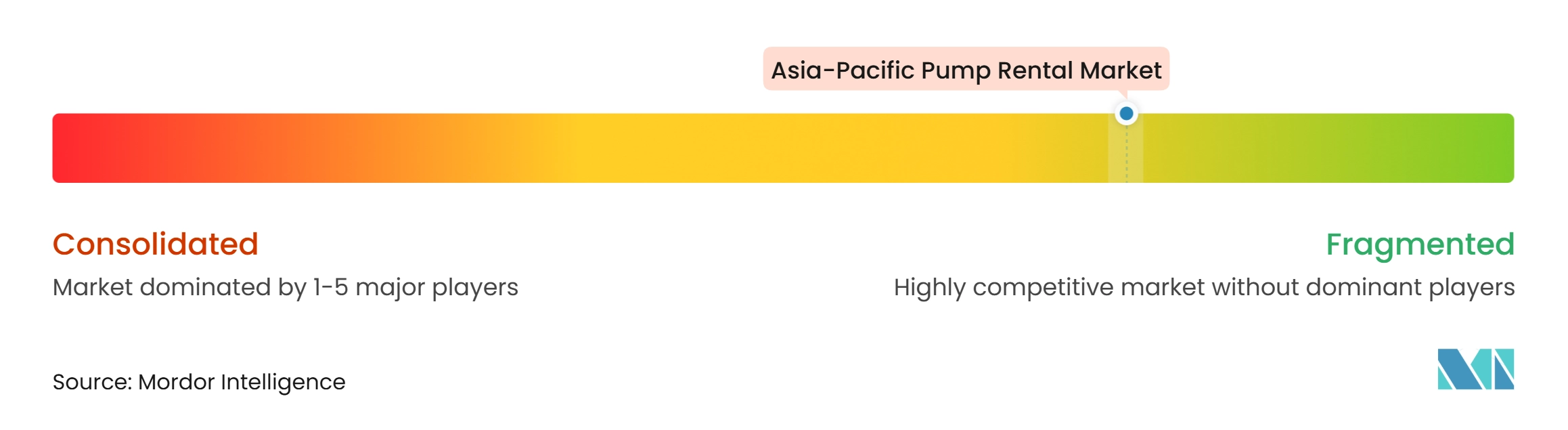
The Asia-Pacific pump rental market is fragmented across the region, although specialist dewatering and managed-service categories are becoming more concentrated. Large international suppliers compete with national rental groups and local contractors that retain a meaningful position in Tier 2 and Tier 3 locations. Atlas Copco combines pump manufacturing, specialty rental, and field support, and it acquired Integrated Pump Rental in August 2025 to add dewatering-rental capability and technical expertise. Xylem also participates through its Water Solutions and Services business, which includes its Godwin and Grindex brands. Japanese participants include ACTIO, Nishio Rent All, Rent Corporation, and Tsurumi Manufacturing through Fujimaru Sangyo, while Australian competition includes Coates, Kennards Hire, National Pump & Energy, and local dewatering specialists.
Technology and operating coverage are increasingly important sources of differentiation. Coates has invested in connected workflows and fleet visibility through its partnership with Inauro, which supports asset monitoring, fuel management, reporting, and job coordination across its branch network. Atlas Copco India introduced a Pay-per-Outcome model in 2025, showing how rental providers can package measured operating results rather than equipment time alone. Fujimaru Sangyo’s integration into Tsurumi Manufacturing is another strategic move because it links a large submersible-pump rental fleet with manufacturing, installation, and drainage-service capability. Providers with remote monitoring and predictive-maintenance capabilities can offer clearer uptime commitments and stronger documentation for environmental requirements, while smaller businesses can compete through local response capacity and site knowledge.
Compliance can reinforce this gap in Australia and other jurisdictions where discharge quality, water use, and mine-site dewatering are closely managed. Customers working on public infrastructure, mining, and complex construction sites may prefer providers that can supply technical records, trained personnel, and maintenance support along with the pump fleet. The competitive opportunity is strongest in managed dewatering, where the provider assumes a larger share of project execution and environmental risk. This reduces the relevance of simple equipment availability alone and places more weight on operational capability, fleet condition, and service responsiveness.
Asia-Pacific Pump Rental Industry Leaders
-
Xylem Inc.
-
Atlas Copco AB
-
Coates Hire Operations Pty Ltd
-
Nishio Rent All Co., Ltd.
-
Kennards Hire Pty Ltd
- *Disclaimer: Major Players sorted in no particular order
Asia-Pacific Pump Rental Market Companies Covered in this Report
- ACTIO Corporation
- Aggreko Limited
- Atlas Copco AB
- Coates Hire Operations Pty Ltd
- Crightons
- Flexihire Pty Ltd
- Fujimaru Sangyo Co., Ltd.
- Hire Power NT
- Hireworks NT
- Kawashima Kikai Co., Ltd.
- Kennards Hire Pty Ltd
- Master Hire Pty Ltd
- Modern Hiring Service
- National Pump & Energy Pty Ltd
- Nishio Rent All Co., Ltd.
- PremiAir Hire Pty Ltd
- Rent Corporation
- Technology Service Hojo Co., Ltd.
- Tutt Bryant Hire Pty Ltd
- Xylem Inc.
Recent Industry Developments in Asia-Pacific Pump Rental Market
- March 2026: Tsurumi Manufacturing completed the acquisition of Fujimaru Sangyo Co., Ltd. as a wholly owned subsidiary effective March 5, 2026.
- October 2025: Coates contracted Inauro to deploy the Perspio platform across more than 145 branches and workshops.
- August 2025: Atlas Copco’s Specialty Rental Division acquired Integrated Pump Rental, adding dewatering-rental capability and service expertise to its offering.
- July 2025: Coates entered a five-year agreement with Totalmobile to deploy the Field First platform across its national operations.
Asia-Pacific Pump Rental Market Report Scope
Pump rental is a service that provides temporary or long-term access to specialized pumping equipment without requiring an outright purchase.
Asia-Pacific pump rental market is segmented into pump type, end-use industry, and geography. By pump type, the market is segmented into centrifugal pumps, positive displacement pumps, submersible pumps, diaphragm pumps, vacuum pumps, and other pump types. By end-use industry, the market is divided among construction, mining and metals, oil and gas, water and wastewater utilities, power generation, chemical and petrochemical, manufacturing and industrial processing, municipal and government, agriculture, and other end users. The report also covers the market size and forecasts for the Asia-Pacific pump rental market across 8 countries in key countries. For each segment, the market sizing and forecasts have been provided on the basis of value (USD).
Segmentation Overview
| Centrifugal Pumps |
| Positive Displacement Pumps |
| Submersible Pumps |
| Diaphragm Pumps |
| Vacuum Pumps |
| Other Pump Types |
| Construction |
| Mining and Metals |
| Oil and Gas |
| Water and Wastewater Utilities |
| Power Generation |
| Chemical and Petrochemical |
| Manufacturing and Industrial Processing |
| Municipal and Government |
| Agriculture |
| Other End Users |
| China |
| India |
| Japan |
| South Korea |
| Australia |
| Indonesia |
| Vietnam |
| Thailand |
| Rest of Asia-Pacific |
| By Pump Type | Centrifugal Pumps |
| Positive Displacement Pumps | |
| Submersible Pumps | |
| Diaphragm Pumps | |
| Vacuum Pumps | |
| Other Pump Types | |
| By End-User Industry | Construction |
| Mining and Metals | |
| Oil and Gas | |
| Water and Wastewater Utilities | |
| Power Generation | |
| Chemical and Petrochemical | |
| Manufacturing and Industrial Processing | |
| Municipal and Government | |
| Agriculture | |
| Other End Users | |
| By Geography | China |
| India | |
| Japan | |
| South Korea | |
| Australia | |
| Indonesia | |
| Vietnam | |
| Thailand | |
| Rest of Asia-Pacific |
Key Questions Answered in the Report
What is the size of the Asia-Pacific pump rental market?
The Asia-Pacific pump rental market is valued at USD 2.37 billion in 2026 and is forecast to reach USD 3.58 billion by 2032 at a 7.14% CAGR.
Which pump type has the largest share in Asia-Pacific?
Centrifugal pumps lead with 57.6% share in 2026 because they serve construction dewatering, municipal bypass, agricultural transfer, and surface drainage applications.
Which end-user segment is growing fastest?
Manufacturing and industrial processing is forecast to grow at an 8.2% CAGR through 2032, supported by industrial-park development and wastewater-management needs.
Which Asia-Pacific country is growing fastest for pump rental?
India is forecast to grow at a 7.9% CAGR through 2032, supported by water-supply and sewerage investments under the Jal Jeevan Mission and AMRUT 2.0.
What factors support demand for rented pumps?
Water infrastructure investment, mining activity, construction work, industrial maintenance, flood response, and the need for flexible access to specialized equipment support demand.
What challenges affect pump rental providers in Asia-Pacific?
Key challenges include remote-site logistics, qualified technician shortages, discharge-permitting requirements, environmental liability, and equipment reliability issues.