
Asia-Pacific Low Smoke Zero Halogen (LSZH) Cables Market Size and Share
Market Overview
| Study Period | 2020 - 2031 |
|---|---|
| Forecast Data Period | 2026 - 2031 |
| Base Year Market Size (2025) | USD 2.08 Billion |
| Market Size (2026) | USD 2.27 Billion |
| Market Size (2031) | USD 3.54 Billion |
| Growth Rate (2026 - 2031) | 9.29 % |
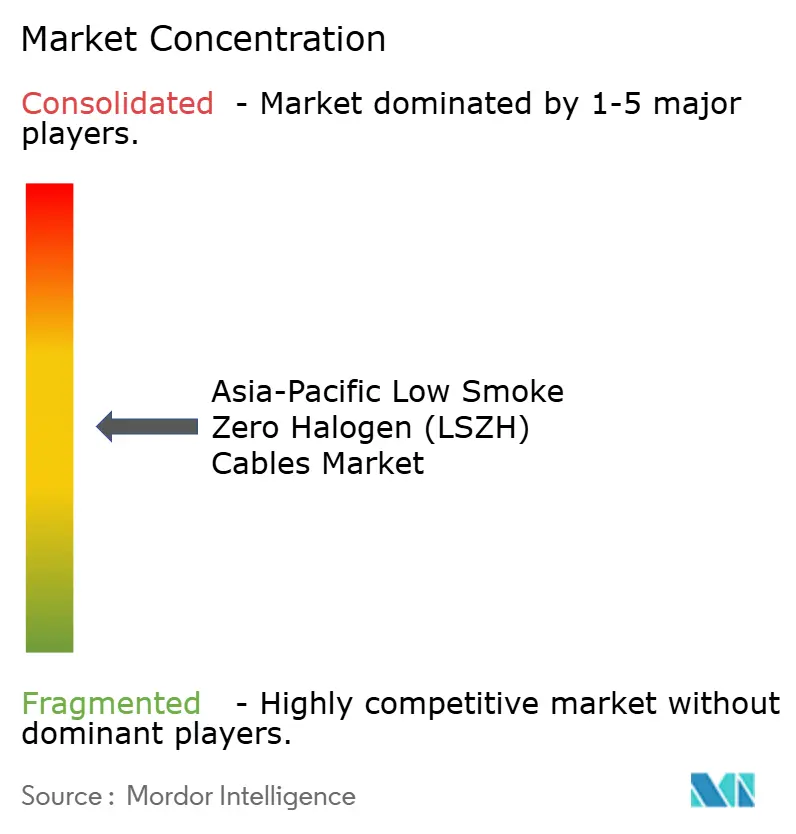
| Market Concentration | Medium |
Major Players *Disclaimer: Major Players sorted in no particular order Image © Mordor Intelligence. Reuse requires attribution under CC BY 4.0. | |
Asia-Pacific Low Smoke Zero Halogen (LSZH) Cables Market Analysis by Mordor Intelligence
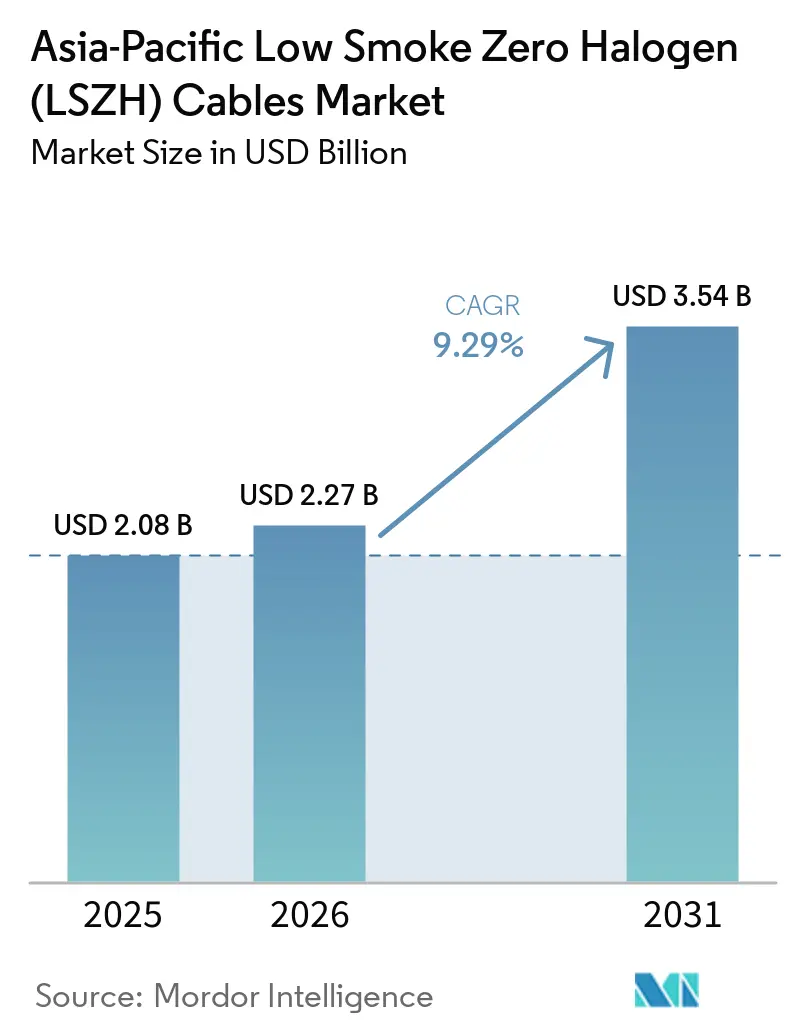
The Asia-Pacific low smoke zero halogen (LSZH) cables market size is projected to expand from USD 2.08 billion in 2025 to USD 2.27 billion in 2026, and to USD 3.54 billion by 2031, registering a CAGR of 9.29% from 2026 to 2031. Data center construction, urban transport projects, and power network investment are supporting demand for low-smoke zero-halogen cable systems across the region. These projects require cables that limit exposure to smoke and corrosive gases in enclosed or equipment-intensive spaces. China’s GB/T 31247 B1 requirements, India’s IS 17048:2018 requirements, and related IEC standards are raising the minimum performance expected in major procurement programs. Suppliers are responding through certification, compound development, and products designed for data center, transit, and grid applications. Higher material costs and copper-price exposure remain important considerations, particularly where private procurement does not require high fire-performance specifications.
Key Report Takeaways
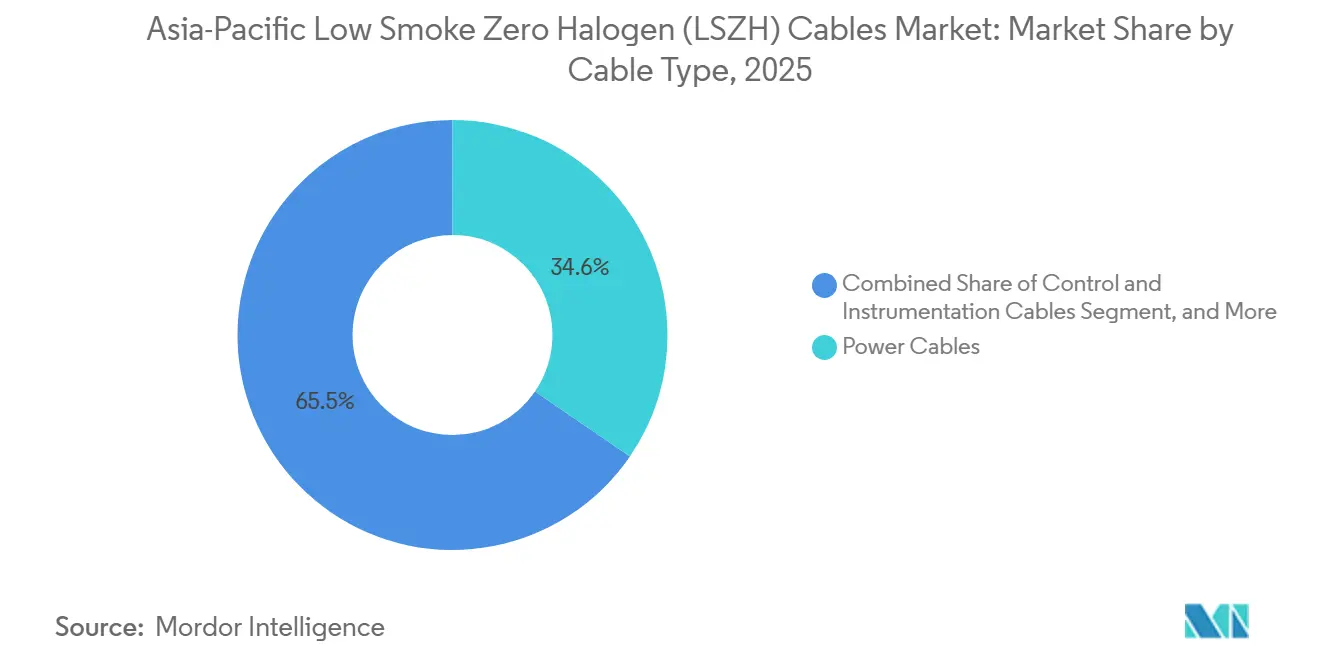
- By cable type, power cables held a 34.55% share of the Asia-Pacific low smoke zero halogen (LSZH) market in 2025, while fiber-optic cables are projected to expand at an 11.78% CAGR through 2031.
- By voltage rating, the less-than-1-kV category commanded 61.12% share of the Asia-Pacific low smoke zero halogen (LSZH) market in 2025, while the 1-35 kV medium-voltage category is projected to expand at a 10.56% CAGR through 2031.
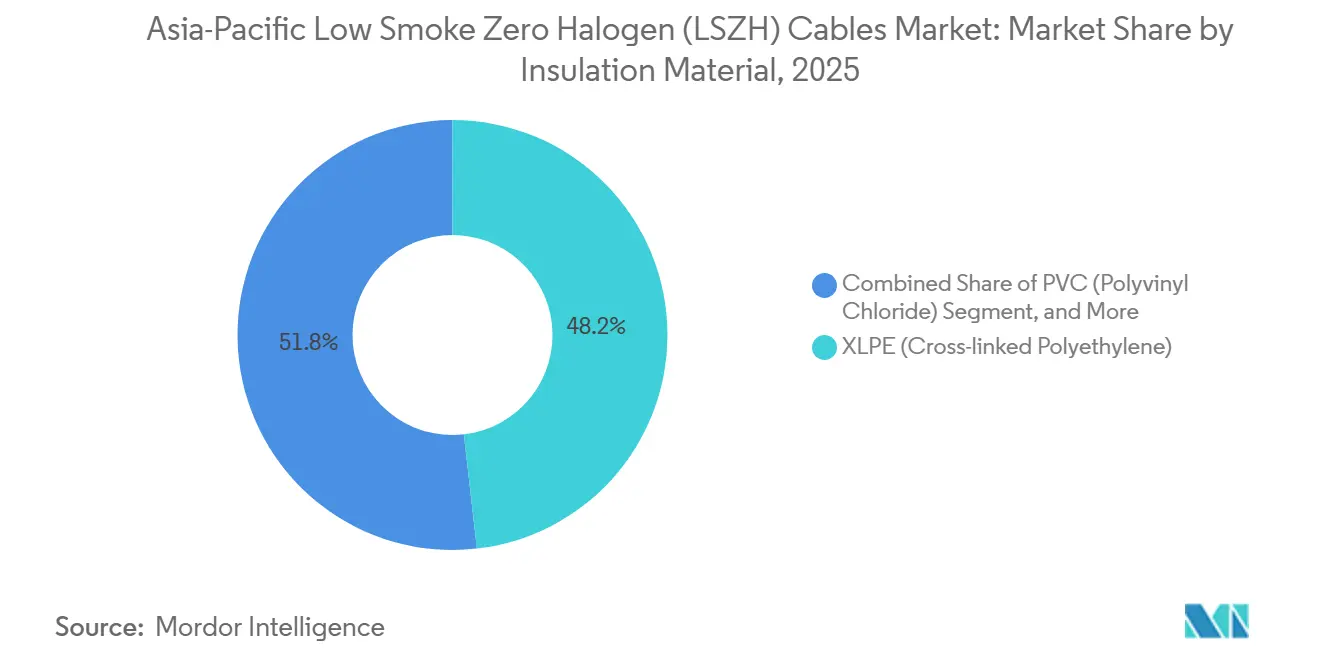
- By insulation material, XLPE (Cross-linked Polyethylene) held 48.19% share of the Asia-Pacific low smoke zero halogen (LSZH) market in 2025, while other specialty insulation materials are expected to expand at an 11.20% CAGR through 2031.
- By end-user industry, industrial manufacturing accounted for 21.59% of the Asia-Pacific low smoke zero halogen (LSZH) market in 2025, while data centers are projected to expand at a 13.19% CAGR through 2031.
- By country, China held 43.21% share of the Asia-Pacific low smoke zero halogen (LSZH) market in 2025, while India is expected to expand at a 12.41% CAGR through 2031.
Note: Market size and forecast figures in this report are generated using Mordor Intelligence’s proprietary estimation framework, updated with the latest available data and insights as of January 2026.
Asia-Pacific Low Smoke Zero Halogen (LSZH) Cables Market Trends and Insights
Drivers Impact Analysis*
| Driver | (~) % Impact on CAGR Forecast | Geographic Relevance | Impact Timeline |
|---|---|---|---|
| Hyperscale Data Center and AI Infrastructure Buildout | +2.1% | Asia-Pacific core, China, India, Singapore, Japan, and South Korea, with spillover to Southeast Asia and Australia | Short term (≤ 2 years) |
| Fire-Safety Code Adoption in High-Occupancy and Enclosed Spaces | +1.9% | Global, with concentrated enforcement in China, India, Japan, Singapore, and South Korea | Medium term (2-4 years) |
| Electrification of Rail, Metro, Ports, and Commercial Transport | +1.6% | Asia-Pacific core, with spillover to Southeast Asia and Australia | Medium term (2-4 years) |
| Renewable Power, Grid Modernization, and Battery Storage Expansion | +1.4% | Asia-Pacific core, with spillover to Australia and Southeast Asia | Long term (≥ 4 years) |
| Industrial Automation and High-Density Manufacturing Cabling | +0.8% | China, India, South Korea, and Japan | Medium term (2-4 years) |
| Export-Oriented Procurement Requiring International Fire-Performance Certification | +0.5% | China and India export-oriented manufacturing hubs | Long term (≥ 4 years) |
| Source: Mordor Intelligence | |||
Hyperscale Data Center and AI Infrastructure Buildout
Digital Edge announced a USD 4.5 billion investment in January 2026 for a 500 MW AI-ready hyperscale campus in Bekasi, Indonesia, a project built around large-scale power, fiber, and supporting facility systems. The company secured a USD 665 million green loan for the project’s first phase in March 2026.[1] AI-optimized racks can require 50-120 kW per rack, increasing cable density in enclosed tray systems and underscoring the importance of equipment protection during a fire. LSZH cable is important in these settings because hydrogen chloride (HCl) from burning PVC can corrode active equipment before conditions become unsafe for evacuation, affecting servers, signaling equipment, and grid protection systems. SK Telecom announced in July 2026 that it was pursuing up to 15 GW of AI data center capacity in South Korea, starting with an initial cluster above 2 GW in the southeast. These developments extend the Asia-Pacific low smoke zero halogen (LSZH) cables market opportunity beyond conventional building wiring into high-density power, fiber, and control systems.
Fire-Safety Code Adoption in High-Occupancy and Enclosed Spaces
China’s GB/T 31247 standard requires B1-class performance for commercial and public-sector cables, establishing a high minimum requirement in the region’s largest cable procurement base. The standard assesses heat release, flaming droplets, and corrosive gas performance beyond the IEC 60332-3 flame-propagation baseline. India’s National Building Code 2016, Part 4, requires IS 17048:2018 halogen-free, flame-retardant cables in hospitals, underground metro stations, airports, and residential buildings above G+15 floors, where both evacuation and asset protection are important. The Bureau of Indian Standards identifies IS 17048:2018 as the standard for halogen-free flame-retardant cables rated up to 1,100 V.[2] Singapore has required LSZH cables in life-safety and transport systems for more than a decade, and similar project practices influence procurement in Malaysia, Thailand, and Vietnam through publicly funded infrastructure and financing requirements. South Korea applies KS C IEC 60754-2 and KS C IEC 61034-2, while Japan uses JIS C 3665 and JIS C 3666 for enclosed applications, leaving the Asia-Pacific low smoke zero halogen (LSZH) cables market shaped by multiple national compliance frameworks.
Electrification of Rail, Metro, Ports, and Commercial Transport
Metro and rail projects are major demand channels because occupied underground spaces require halogen-free cable systems that limit smoke and corrosive emissions. EN 45545-2, IS 17048:2018, and equivalent national standards support this requirement in rail applications, including passenger stations, tunnels, signaling spaces, and communication pathways. India plans to add 115 km of metro lines in Delhi, while Vietnam, Indonesia, Thailand, and the Philippines are building early-generation metro networks with new electrical and communication infrastructure. Vietnam has directed more than USD 15 billion toward urban rail projects through 2030. Malaysia’s East Coast Rail Link was valued at MYR 50.27 billion (USD 11.3 billion) and was 92.62% complete in February 2026. Australia’s Sydney Metro West is valued at USD 25 billion, while the Melbourne Metro Tunnel opened in 2026 with EN 45545-2 cable compliance, creating reference points for transport procurement across the Asia-Pacific low smoke zero halogen (LSZH) cables market.
Renewable Power, Grid Modernization, and Battery Storage Expansion
The Asian Development Bank launched a USD 70 billion regional initiative in May 2026, including a USD 50 billion Pan-Asia Power Grid Initiative focused on regional interconnection. The program targets 22,000 circuit-kilometers of cross-border transmission and 20 GW of variable renewable integration.[3] Transgrid shortlisted 9 battery energy storage system projects totaling up to 2 GW for New South Wales in March 2026. Sungrow commissioned Malaysia’s first grid-forming 100 MW/400 MWh battery energy storage system for Tenaga Nasional Berhad in Terengganu in July 2026. The Asia-Pacific low smoke zero halogen (LSZH) cables market benefits where battery rooms, inverter stations, enclosed cable-management systems, and substation buildings require low-smoke materials that protect equipment and support safer evacuation. The Lao-Thailand-Malaysia-Singapore connection, which secured financing in 2025, specifies XLPE LSZH cable for medium-voltage runs in humid and saline-soil conditions, showing how grid projects can make performance requirements part of their technical design.
Restraints Impact Analysis*
| Restraint | (~) % Impact on CAGR Forecast | Geographic Relevance | Impact Timeline |
|---|---|---|---|
| Higher Upfront Cost Versus PVC Cable Systems | -1.2% | Southeast Asia and South Asia price-sensitive markets | Medium term (2-4 years) |
| Copper Price Volatility and Material-Cost Pass-Through Risk | -0.9% | Global, with acute impact in China and India | Short term (≤ 2 years) |
| Fragmented National Standards and Approval Requirements | -0.6% | Rest of Asia-Pacific, especially Southeast Asia | Long term (≥ 4 years) |
| Processing Trade-Offs Between Smoke Performance, Flexibility, and Installability | -0.3% | Global, with emphasis in high-installation-volume markets | Medium term (2-4 years) |
| Source: Mordor Intelligence | |||
Higher Upfront Cost Versus PVC Cable Systems
LSZH compounds cost 15-30% more than standard PVC sheaths at the cable level. This difference is especially significant in Indonesia, Vietnam, and the Philippines, where private construction buyers often do not require IEC 61034 compliance. ADB and Japan International Cooperation Agency project-finance agreements may require LSZH cable, which helps bridge the gap until domestic building codes change. In data centers and health care facilities, post-fire corrosion can require extensive decontamination and may cost more than the initial cable premium. Greater regional compounding output and manufacturing capacity in China and India are reducing this constraint. Installer familiarity with PVC and the tighter bending-radius requirements of some LSZH compounds still slow switching in cost-sensitive parts of the Asia-Pacific low smoke zero halogen (LSZH) cables market.
Copper Price Volatility and Material-Cost Pass-Through Risk
The International Energy Agency reported that copper briefly exceeded USD 14,500 per tonne on the London Metal Exchange in January 2026. It had first moved above USD 12,000 per tonne in December 2025, amid supply disruptions, tariff-related inventory accumulation in the United States, and demand expectations tied to electrification and AI infrastructure. Copper accounts for 70-85% of cable production costs, leaving manufacturers exposed in fixed-price tenders lasting 12-24 months. The annual copper treatment and refining charge benchmark settled at USD 0 per tonne in January 2026, adding uncertainty for the supply chain. Cable producers are shifting toward London Metal Exchange-indexed formula pricing with quarterly adjustments, although contract renegotiation can delay infrastructure tender processes. Copper-to-aluminum ratios above 4.0 in June 2026 also increased customer interest in aluminum-conductor LSZH cables, affecting revenue per meter for copper-focused suppliers.
*Our forecasts treat driver/restraint impacts as directional, not additive. The impact forecasts reflect baseline growth, mix effects, and variable interactions.
Segment Analysis
By Cable Type: Fiber Optic Demand Strengthens the Premium Tier
LSZH power cables accounted for 34.55% of the cable-type segment in 2025, supported by recurring procurement for commercial buildings, industrial sites, utility distribution systems, and data center low-voltage panels. LSZH fiber-optic cables are projected to grow at an 11.78% CAGR from 2026 to 2031, supported by hyperscale data center interconnect requirements and government-backed fiber rollout programs. Furukawa Electric began mass production of 13,824-count optical fiber cable at Mie Works No. 2 in March 2026. The company stated that the new facility more than doubled capacity compared with 2023 and was designed to serve dense optical cable requirements. LSZH data and communication cables, plus control and instrumentation cables, continue to serve building management, process automation, supervisory control and data acquisition systems, and industrial network installations.
LSZH building wires remain linked to residential and commercial construction in India, China, and Australia, where code revisions are expanding the use of lower-smoke-cable systems. Specialty cables for nuclear, marine, and hydrogen-transit uses occupy smaller but higher-value application areas because their environmental and safety requirements are more demanding. The Asia-Pacific low smoke zero halogen (LSZH) cables market size for power cables was supported by their 34.55% share in 2025. IEC 60332 and IEC 61034 provide a common technical baseline for fiber-optic cables produced in Japan, South Korea, and China, enabling compatible products to be specified for cross-border infrastructure projects. Hydrogen transit, nuclear recommissioning in Japan and South Korea, and marine electrification are expected to support specialty applications that require both LSZH performance and salt-spray-resistant jacket performance.

By Voltage Rating: Low-Voltage Uses Remain Broad While Medium-Voltage Demand Accelerates
The less-than-1-kV segment accounted for 61.12% of the Asia-Pacific low smoke zero halogen (LSZH) cables market share in 2025. It serves building wiring, data center power distribution, transit-station circuits, light industrial automation, and low-voltage panels in commercial and factory facilities. This broad base of applications makes the segment less exposed to volume displacement, as its demand is tied to urban construction and distributed electricity use. The 1-35 kV medium-voltage category is projected to expand at a 10.56% CAGR from 2026 to 2031. Industrial parks, renewable energy substation connections, grid distribution extensions, and new development zones across China, India, and Southeast Asia support this demand.
The Lao-Thailand-Malaysia-Singapore connection specifies XLPE LSZH cable for medium-voltage runs in humid and saline-soil conditions. This requirement provides a procurement reference point for regional grid programs where moisture resistance and fire performance must be addressed together. IEC 60502-1 and IEC 60332-3 are widely used engineering submission frameworks for the installation of grouped cables. The 36-65 kV and above-65 kV categories serve extra-high-voltage grid upgrades and the enclosed portions of substations and converter stations. Tokyo Electric Power Company is undergrounding overhead distribution lines through a program running from 2024 to 2027, which supports demand for LSZH-sheathed underground extra-high-voltage cable. Co-extrusion can produce XLPE insulation and an LSZH sheath in a single pass, narrowing the cost gap with PVC constructions and facilitating specification migration for medium-voltage and industrial applications.
By Insulation Material: XLPE Leads While Specialty Compounds Serve Harsh Environments
XLPE insulation accounted for 48.19% of the Asia-Pacific low smoke zero halogen (LSZH) cables market in 2025. It is widely used as a dielectric in cable systems that face demanding thermal conditions and extended service requirements. Asia-Pacific held 47.52% of the global XLPE cable market in 2025. China’s State Grid Corporation and India’s National Electricity Plan both specify XLPE in grid expansion programs, which supports its continued role in power applications. Specialty insulation materials, including fluoropolymers such as PTFE and ETFE, EPDM, and silicone rubber, are projected to expand at an 11.20% CAGR from 2026 to 2031.
Chemical plants, semiconductor cleanrooms, and hydrogen-transit systems use specialty materials where XLPE cannot meet thermal, chemical-resistance, and LSZH requirements together. India’s IS 17048:2018 and China’s YD/T 1113-2025 favor thermoplastic or cross-linked halogen-free compounds rather than PVC in LSZH applications. PE insulation remains relevant for direct-burial telecommunications cables and submarine fiber drops because chemical inertness and water-tree resistance guide selection. The Asia-Pacific low smoke zero halogen (LSZH) cables industry is also seeing greater use of co-extrusion among Tier 1 manufacturers, which reduces the cost premium of XLPE-LSZH construction compared with PVC designs. Avient Corporation and Borealis AG are developing mineral-hydrate-free and synergist-based formulations to preserve flexibility at low installation temperatures during northern China’s winter construction cycle.
By End-User Industry: Data Centers Increase Demand Alongside Manufacturing
Industrial manufacturing held 21.59% of end-user demand in 2025. Factory automation panels, process instrumentation, and semiconductor fabrication facilities drive this use across South Korea, Japan, and China. Semiconductor manufacturing in South Korea and battery gigafactory construction in China support demand for control and instrumentation cables that meet IEC 60754-2 halogen-acid-gas limits. Data centers are projected to expand at a 13.19% CAGR from 2026 to 2031. This segment requires specialized power, fiber, and building-management cable systems that can operate reliably in dense, equipment-intensive environments.
Commercial buildings are a large and widely distributed channel in which building code enforcement is expanding LSZH cable specifications. This demand is stable but more price-sensitive than industrial and data center demand. Energy and utilities, transport infrastructure, telecommunications, and renewable energy provide further diversification for the Asia-Pacific low smoke zero halogen (LSZH) cables market. Battery energy storage integration requires LSZH cables within battery enclosures, inverter stations, and enclosed cable management systems. Indian manufacturers are expanding LSZH capabilities for data centers, metro rail, and high-rise construction as IS 17048:2018 certification becomes increasingly important, enabling suppliers to meet high-specification demand rather than compete solely on volume.
Geography Analysis
China held a 43.21% market share in the Asia-Pacific low smoke zero halogen (LSZH) cables market in 2025, reflecting mandatory LSZH requirements, extensive ultra-high-voltage grid projects, 5G deployment, and rail-transit cabling. China’s operating high-speed rail network exceeded 45,000 km at the end of 2024. Hengtong Optic-Electric reported CNY 66.855 billion (USD 9.2 billion) in 2025 revenue, an increase of 11.45%, supported by ultra-high-voltage grid, AI data center, and marine-energy cable activities. China’s YD/T 1113-2025 standard became effective in November 2025 and raised requirements for halogen-free, low-smoke compounds used in telecommunications and fiber optic cables.
India is projected to expand at a 12.41% CAGR from 2026 to 2031, the fastest country rate in the region. Mandatory IS 17048:2018 requirements, metro rail expansion, and data center construction are central to this demand. Adani Group announced in February 2026 a USD 100 billion investment in renewable-energy-powered hyperscale AI data centers through 2035, covering 5 GW of deployment. Polycab India Limited surpassed INR 285 billion (USD 3.4 billion) in FY26 revenue, commissioned a high-voltage cable plant in Gujarat, and saw advanced demand from Japan and South Korea through semiconductor fabrication, metro expansion, and AI data center programs.
The Rest of Asia-Pacific, including Vietnam, Indonesia, Thailand, the Philippines, Australia, and other countries, is increasing LSZH cable procurement as regulations and project-finance requirements become more aligned. Australia has major projects such as Sydney Metro West, Western Sydney Airport Metro, and the Sunshine Coast Rail expansion that specify LSZH cable for enclosed passenger infrastructure. Digital Edge’s USD 4.5 billion 500 MW CGK Campus in Indonesia and Vantage Data Centers’ USD 1.6 billion Asia-Pacific platform investment show the scale of regional data center investment. Vietnam’s urban rail program exceeds USD 15 billion through 2030, while Philippine metro projects are supporting a move from PVC-based systems toward LSZH cable. Inconsistent enforcement between national standards and individual project requirements remains a constraint, although multilateral development bank financing is helping close this gap.
Competitive Landscape
The Asia-Pacific low smoke zero halogen (LSZH) cables market is moderately concentrated in high-specification applications. Prysmian S.p.A. and Nexans S.A. compete with LS Cable and System Ltd., Sumitomo Electric Industries, Ltd., and Fujikura Ltd. through certification coverage, compound capability, and local manufacturing scale. LS Cable and System reported KRW 7.58 trillion (USD 5.60 billion) in 2025 revenue and a KRW 7.63 trillion (USD 5.50 billion) order backlog, representing a 22% increase. Indian suppliers, including Polycab India Limited, KEI Industries Limited, Finolex Cables Limited, and Havells India Limited, are expanding LSZH product lines and BIS certification for data centers, metro projects, and high-rise buildings.
Sumitomo Electric published its Mid-Term Management Plan 2028 in May 2026 and identified a higher hyperscale data center share as a strategic priority. Prysmian introduced a reduced-copper power cable design rated for 110°C in Southeast Asia in January 2026, intended to lower material use and support deployment in data center and grid projects. Chinese suppliers, including Hengtong Group Co., Ltd. and Jiangsu Zhongtian Technology Co., Ltd., are building IEC-certified LSZH export capability. This is increasing price competition in the mid-tier certification range.
Specialty compounds for hydrogen transit, nuclear, and marine uses remain less crowded because they require layered certifications. Medium-voltage cable for battery energy storage systems and renewable energy in Southeast Asia and Australia is another area where local supply remains limited. AI data center intra-rack power and optical cable also require compound systems that exceed the performance limits of legacy designs. Avient Corporation and Borealis AG influence competition because the availability of compounds affects the fire-performance certification a cable producer can achieve. In-house compound research and development can shorten certification cycles and support pricing in government and data center tenders. Regional and domestic competitors remain material alongside the global manufacturers that serve premium applications.
Asia-Pacific Low Smoke Zero Halogen (LSZH) Cables Industry Leaders
-
Prysmian S.p.A.
-
Nexans S.A.
-
LS Cable & System Ltd.
-
Furukawa Electric Co., Ltd.
-
Hengtong Group Co., Ltd.
- *Disclaimer: Major Players sorted in no particular order
Recent Industry Developments
- July 2026: SK Telecom announced plans to build out up to 15 GW of AI data centers in South Korea, targeting an initial cluster of over 2 GW in the southeastern region, positioning Korea as Asia’s AI infrastructure hub and signaling sustained demand for high-density cable infrastructure procurement.
- May 2026: Fujikura Ltd. announced plans to invest up to JPY 260 billion (USD 1.63 billion) in expanding United States fiber-optic cable production for data centers, with the new plant targeting full production by fiscal year 2035.
Asia-Pacific Low Smoke Zero Halogen (LSZH) Cables Market Report Scope
The Asia-Pacific low smoke zero halogen (LSZH) cable market revenue is generated through the sale of LSZH power, control and instrumentation, data and communication, fiber optic, building wire, and specialty cables across multiple voltage ratings and insulation materials, as well as associated value-added cable solutions supplied to end-user industries including commercial buildings, industrial manufacturing, data centers, energy and utilities, transportation infrastructure, and telecommunications throughout the region.
The Asia-Pacific low smoke zero halogen (LSZH) cables market report is segmented by cable type (LSZH power cables, LSZH control and instrumentation cables, LSZH data and communication cables, LSZH fiber optic cables, LSZH building wires, and specialty LSZH cables), voltage rating (less than 1 kV, 1-35 kV, 36-65 kV, and above 65 kV), insulation material (PVC (polyvinyl chloride), XLPE (cross-linked polyethylene), PE (polyethylene), and other specialty insulation materials), end-user industry (commercial buildings, industrial manufacturing, data centers, energy and utilities, transportation infrastructure, telecommunications, renewable energy, and other end-user industries), and country (China, India, Japan, South Korea, and the rest of Asia-Pacific). The market forecasts are provided in terms of value (USD).
| LSZH Power Cables |
| LSZH Control and Instrumentation Cables |
| LSZH Data and Communication Cables |
| LSZH Fiber Optic Cables |
| LSZH Building Wires |
| Specialty LSZH Cables |
| Less Than 1 kV |
| 1-35 kV |
| 36-65 kV |
| Above 65 kV |
| PVC (Polyvinyl Chloride) |
| XLPE (Cross-linked Polyethylene) |
| PE (Polyethylene) |
| Other Specialty Insulation Materials |
| Commercial Buildings |
| Industrial Manufacturing |
| Data Centers |
| Energy and Utilities |
| Transportation Infrastructure |
| Telecommunications |
| Renewable Energy |
| Other End-User Industries |
| China |
| India |
| Japan |
| South Korea |
| Rest of Asia-Pacific |
| By Cable Type | LSZH Power Cables |
| LSZH Control and Instrumentation Cables | |
| LSZH Data and Communication Cables | |
| LSZH Fiber Optic Cables | |
| LSZH Building Wires | |
| Specialty LSZH Cables | |
| By Voltage Rating | Less Than 1 kV |
| 1-35 kV | |
| 36-65 kV | |
| Above 65 kV | |
| By Insulation Material | PVC (Polyvinyl Chloride) |
| XLPE (Cross-linked Polyethylene) | |
| PE (Polyethylene) | |
| Other Specialty Insulation Materials | |
| By End-User Industry | Commercial Buildings |
| Industrial Manufacturing | |
| Data Centers | |
| Energy and Utilities | |
| Transportation Infrastructure | |
| Telecommunications | |
| Renewable Energy | |
| Other End-User Industries | |
| By Country | China |
| India | |
| Japan | |
| South Korea | |
| Rest of Asia-Pacific |
Key Questions Answered in the Report
What is the Asia-Pacific low smoke zero halogen (LSZH) cables market size?
The Asia-Pacific LSZH cables market was USD 2.27 billion in 2026 and is forecast to reach USD 3.54 billion by 2031 at a 9.29% CAGR, supported by data center, transit, and grid investment.
Which cable type has the largest share in Asia-Pacific?
Within the Asia-Pacific LSZH cables market, LSZH power cables held 34.55% of the cable type segment in 2025, supported by power distribution in buildings, industry, and data centers.
Which voltage category is expanding fastest?
In the Asia-Pacific LSZH cables market, the 1-35 kV medium-voltage category is projected to expand at a 10.56% CAGR through 2031, supported by substations, industrial parks, and grid extensions.
Why are data centers important for LSZH cable demand?
Across the Asia-Pacific LSZH cables market, data centers are projected to expand at a 13.19% CAGR through 2031 and need dense power, fiber, and control cabling in enclosed equipment areas.
Which country leads regional demand?
China held 43.21% share in the Asia-Pacific LSZH cables market in 2025, supported by rail, 5G, and ultra-high-voltage grid programs.
What limits wider adoption of low-smoke zero-halogen cables?
Higher upfront compound costs, copper-price volatility, fragmented standards, and installation trade-offs can delay adoption, especially in private projects that do not require high fire-performance specifications.