
Asia-Pacific Irrigation Pumps Market Size and Share
Market Overview
| Study Period | 2022 - 2032 |
|---|---|
| Forecast Data Period | 2027 - 2032 |
| Base Year Market Size (2026) | USD 38.01 Billion |
| Market Size (2027) | USD 41.04 Billion |
| Market Size (2032) | USD 60.33 Billion |
| Growth Rate (2027 - 2032) | 8.01 % |
| Market Concentration | Medium |
Major Players *Disclaimer: Major Players sorted in no particular order Image © Mordor Intelligence. Reuse requires attribution under CC BY 4.0. | |
Asia-Pacific Irrigation Pumps Market Analysis by Mordor Intelligence
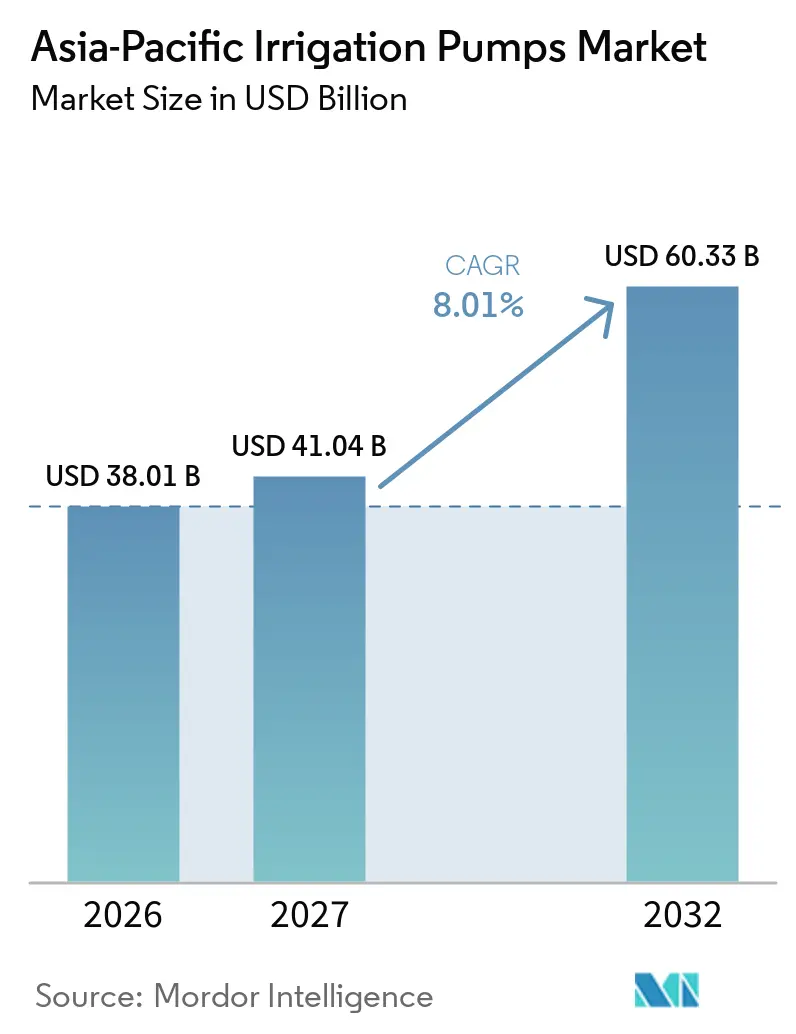
The Asia-Pacific irrigation pumps market size was valued at USD 38.01 billion in 2026 and is forecast to grow from USD 41.04 billion in 2027 to USD 60.33 billion by 2032 at a CAGR of 8.01% from 2027 to 2032. Demand is supported by agricultural water needs and a move from flood irrigation toward precision water delivery across major farming economies. Food security programs in China and India, rural electrification, and the adoption of micro-irrigation support demand for compatible pressure-controlled equipment [1]. Water stress across South and Southeast Asia also increases the need for efficient water extraction and delivery systems. The Asia-Pacific irrigation pumps market is also moving beyond equipment sales as connected and solar systems create opportunities for monitoring, maintenance, and performance services.
Key Report Takeaways
- By type, centrifugal pumps accounted for 38% of the Asia-Pacific irrigation pumps market share in 2026, while submersible pumps are forecast to grow at a CAGR of 8.6% from 2027 to 2032.
- By geography, China accounted for 34% of the Asia-Pacific irrigation pumps market size in 2026, while India is forecast to grow at a CAGR of 8.2% from 2027 to 2032.
Note: Market numbers in this report are based on Mordor Intelligence's proprietary estimation framework, which combines nine months of actuals with Q4 projections for base year 2026.
Market Trends and Insights
Drivers Impact Analysis of Asia-Pacific Irrigation Pumps Market*
| Driver | (~) % Impact on CAGR Forecast | Geographic Relevance | Impact Timeline |
|---|---|---|---|
| Expansion of Micro-Irrigation and Water-Saving Farm Systems | +1.8% | India, China, Vietnam, Thailand, Indonesia, and the Philippines | Medium term (2-4 years) |
| Government Subsidies for Solar and Efficient Irrigation Pumps | +1.5% | India, China, Bangladesh, and Nepal | Short term (≤ 2 years) |
| Agricultural Mechanization Across Smallholder Economies | +1.2% | Vietnam, Indonesia, the Philippines, and South Asia | Medium term (2-4 years) |
| Food Security Investment in China and India | +1.1% | China and India, with regional supply chain effects | Long term (≥ 4 years) |
| Localized Pump Manufacturing and Service Networks | +0.8% | China, India, Vietnam, and Rest of Asia-Pacific | Medium term (2-4 years) |
| Remote Monitoring for Intermittent Grid and Groundwater Conditions | +0.7% | India, China, and Indonesia | Long term (≥ 4 years) |
| Source: Mordor Intelligence | |||
Expansion of Micro-Irrigation and Water-Saving Farm Systems
The shift from open-channel flood irrigation to drip and sprinkler systems is raising demand for pumps with controlled flow and pressure. Conventional centrifugal and monoblock pumps designed for high-volume, low-head delivery may not suit drip lines that need stable inlet pressure. The Food and Agriculture Organization (FAO) identified precision irrigation and water-use efficiency as important parts of agricultural transformation in India and China [2]. The Asia-Pacific irrigation pumps market can benefit from demand for higher-value pumping systems as farmers adopt more efficient irrigation technologies. Pump upgrades associated with micro-irrigation conversion may not be reflected in total unit volumes, but they support demand for premium models.
Government Subsidies for Solar and Efficient Irrigation Pumps
Government subsidies support the adoption of solar-powered irrigation pumps across the Asia-Pacific. In India, under Component B of the Pradhan Mantri Kisan Urja Suraksha evam Utthaan Mahabhiyan (PM-KUSUM) scheme, the central government provides financial assistance equivalent to 30% of the benchmark cost or tender-discovered cost, whichever is lower, for eligible standalone solar agricultural pumps in most states. The assistance increases to 50% in specified northeastern, hilly, and island regions. As of September 30, 2026, the scheme had recorded 902,028 installed standalone solar pumps against 990,327 sanctioned under Component B. These subsidies reduce farmers’ upfront investment requirements and support demand for solar irrigation pumps and associated equipment, although competitive procurement may constrain product margins. After-sales services, spare parts, and system retrofits can provide additional revenue opportunities in the Asia-Pacific irrigation pumps market.
Agricultural Mechanization Across Smallholder Economies
Mechanization is supporting demand for irrigation pumps as farmers and agricultural service providers increasingly use powered equipment for irrigation operations. Service providers that operate irrigation equipment across multiple farms can purchase and deploy multiple pumps in different fields, increasing equipment utilization compared with individual farms. This shared-use model can support demand for powered irrigation systems, including centrifugal and submersible pumps, by enabling service providers to serve multiple farms and distribute equipment costs across a wider customer base. As irrigation becomes increasingly mechanized, demand can shift from individual smallholder purchases to equipment operated by service providers that serve multiple farms. Fragmented landholdings therefore do not necessarily constrain demand for irrigation pumps, as service providers can aggregate equipment needs across multiple smallholder farms. This can support demand for durable pumps and reliable maintenance services, particularly during critical irrigation periods.
Food Security Investment in China and India
Public spending on agricultural infrastructure supports demand for irrigation pumps in China and India. In China, high-standard farmland development initiatives support improvements to irrigation infrastructure, while national energy-efficiency standards establish requirements for applicable centrifugal pumps and submersible motor-pumps. In India, the Pradhan Mantri Krishi Sinchayee Yojana (PMKSY) Per Drop More Crop program provides financial assistance for eligible micro-irrigation systems, supporting investment in irrigation equipment, including compatible pumps. These initiatives can create opportunities for pump suppliers that meet applicable technical specifications and project requirements, while procurement conditions and efficiency standards may limit the suitability of non-compliant equipment.
Restraints Impact Analysis of Asia-Pacific Irrigation Pumps Market*
| Restraint | (~) % Impact on CAGR Forecast | Geographic Relevance | Impact Timeline |
|---|---|---|---|
| Fragmented Landholdings and Low Per-Farm Budgets | -1.0% | India, Indonesia, the Philippines, Bangladesh, and Myanmar | Long term (≥ 4 years) |
| High Installation and Lifecycle-Service Costs | -1.2% | Asia-Pacific, especially India and Southeast Asia | Medium term (2-4 years) |
| Groundwater Regulation and Seasonal Pump Utilization | -0.8% | China, India, and Japan | Medium term (2-4 years) |
| Limited Rural Technician Coverage for Smart and Solar Systems | -0.9% | India, Southeast Asia, and Rest of Asia-Pacific | Long term (≥ 4 years) |
| Source: Mordor Intelligence | |||
Fragmented Landholdings and Low Per-Farm Budgets
India's agricultural sector is dominated by small and marginal landholdings, which can constrain individual farmers' ability to invest in high-cost irrigation equipment. Smaller farms may also face longer payback periods when adopting more efficient pumps. A 2025 study published in the Journal of Developing Societies identified fragmented landholdings and high machinery costs as key barriers to agricultural mechanization in Indonesia, Vietnam, and the Philippines [3]. These barriers can limit farmers’ ability to invest in mechanized agricultural equipment, including irrigation pumps. Subsidy support and access to financing can improve affordability, while unsubsidized replacement demand may remain price-sensitive. Consequently, demand in smallholder markets can depend on policy continuity, financing availability, and distribution through cooperatives, farmer-producer organizations, and public agencies.
High Installation and Lifecycle-Service Costs
Solar irrigation systems require investment beyond the pump itself, including borewell work, mounting structures, wiring, and commissioning. Under PM-KUSUM Component C, subsidy arrangements vary by implementation model. For individual pump solarization, central financial assistance generally covers 30% of the applicable benchmark or tender cost, with state governments expected to provide an additional 30%. If state assistance is unavailable, farmers must cover the remaining 70% of the cost. Feeder-level solarization follows a different assistance structure. These upfront expenses, together with maintenance and servicing requirements, can discourage farmers from upgrading existing conventional electric pumps. High installation and ownership costs may therefore slow replacement demand in the Asia-Pacific irrigation pumps market.
*Our forecasts treat driver/restraint impacts as directional, not additive. The impact forecasts reflect baseline growth, mix effects, and variable interactions.
Asia-Pacific Irrigation Pumps Market Segment Analysis
By Type:
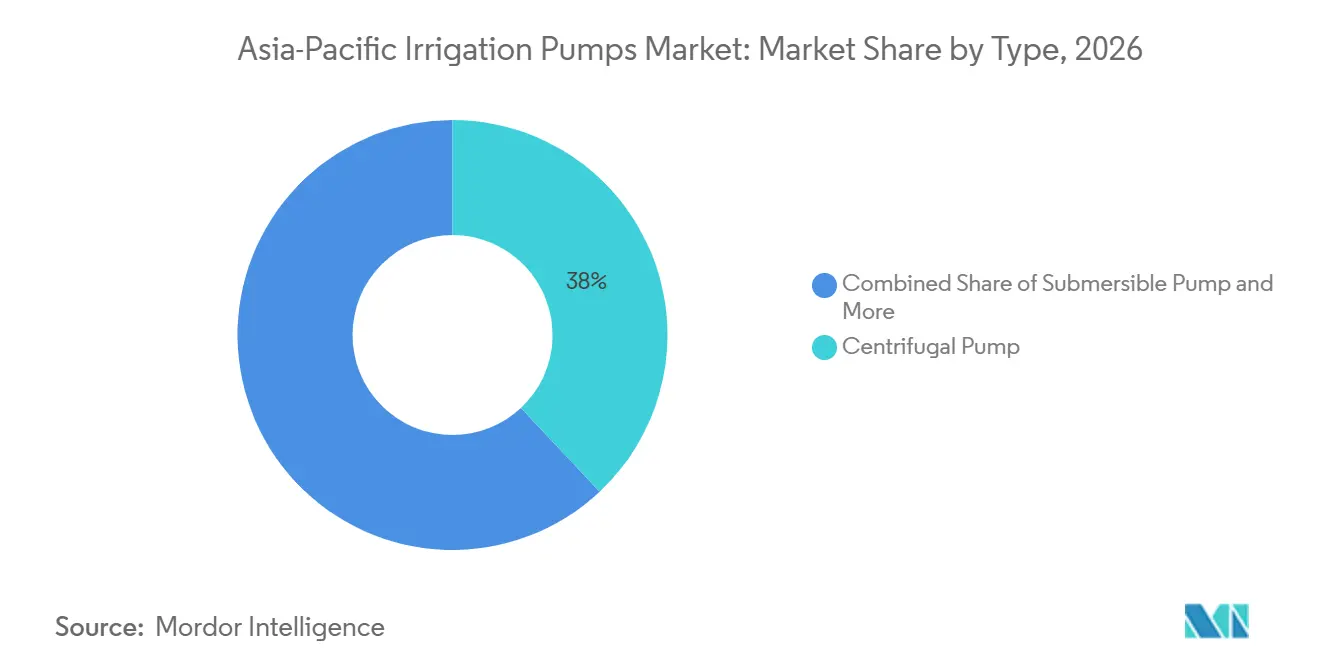
Centrifugal Pump Segment Lead, While Submersible Pumps Grow FastestThe centrifugal pump segment accounted for 38% of the Asia-Pacific irrigation pumps market size in 2026. They are suited to surface-water irrigation, canal-fed paddy systems, and high-volume delivery across China, India, and mainland Southeast Asia. Their lower cost compared with submersible and multistage systems supports use in government-funded flood irrigation projects. Vortex pumps can serve selected applications involving water with suspended solids, but their suitability for silt-laden river and pond water depends on sediment abrasiveness, particle characteristics, pump construction, and manufacturer specifications. Peripheral and self-priming pumps serve applications requiring specific pressure or suction capabilities, while axial-flow pumps are suited to high-volume, low-head water transfer, including some irrigation pump-station applications.
Submersible pumps are forecast to grow at a CAGR of 8.6% from 2027 to 2032. Declining groundwater levels are increasing pumping depths in some areas, making surface-suction pumps less suitable where groundwater lies beyond their practical suction limits. Solar pump programs also favor submersible units for their compatibility with borewells. Demand is especially important in groundwater-stressed Indian states that rely on borewell irrigation. In December 2025, Franklin Electric expanded its 8-inch VSI stainless-steel cast submersible pump range with the addition of the VSI74 and VSI104 models.

Geography Analysis
China accounted for 34% of the Asia-Pacific irrigation pumps market in 2026. Chinese manufacturers supply centrifugal pumps, variable-frequency drives, and solar-compatible systems to markets across Southeast Asia and South Asia. China's Regulations on Water Conservation, effective May 1, 2024, require local governments to strengthen agricultural irrigation water-metering infrastructure, with time-bound implementation in areas facing severe water shortages or groundwater over-exploitation. The regulations also promote water-saving irrigation technologies, supporting the focus on efficient water management in China's agricultural sector.
India is forecast to grow at a CAGR of 8.2% from 2027 to 2032. The expansion of solar-powered irrigation and government support for agricultural pump systems is likely to strengthen demand for efficient and reliable irrigation equipment. The PM-KUSUM scheme supports the deployment of standalone solar agricultural pumps and the solarization of existing grid-connected agricultural pumps, creating opportunities for pump manufacturers and suppliers of related equipment. Increasing adoption of solar irrigation systems, along with the need to replace and upgrade existing pumping equipment support market growth in India during the forecast period.
The Rest of Asia-Pacific comprises diverse irrigation markets, ranging from Vietnam's irrigated rice areas to Australia's precision farming operations. The Asian Development Bank noted that technology quality and after-sales service in the Mekong region remain less developed than in North Asia. This creates an upgrade opportunity for brands with effective rural distribution and repair coverage.
Competitive Landscape
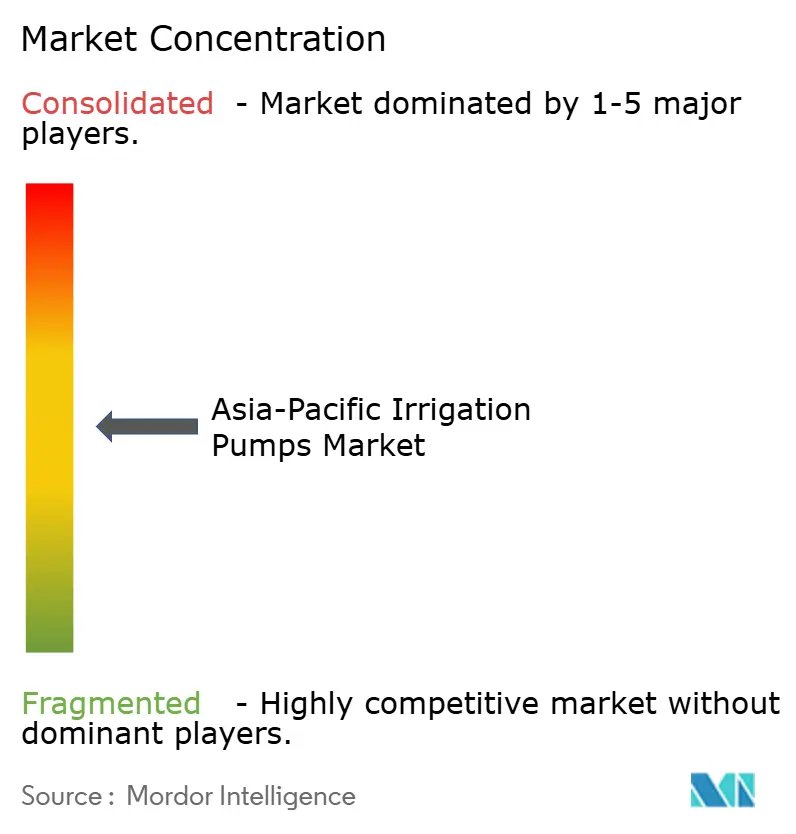
The Asia-Pacific irrigation pumps market was moderately concentrated in 2026, with major players including Grundfos Group, Xylem Inc., Shakti Pumps (India) Ltd, Kirloskar Brothers Limited, Jain Irrigation Systems Ltd., and Franklin Electric competing alongside regional and domestic manufacturers. Price competition is strongest in lower-cost products, particularly in China and India, where domestic manufacturers and regional specialists compete with multinational companies. Competition also varies by application, with suppliers differentiating through pump efficiency, product durability, solar compatibility, connectivity, and after-sales support.
Grundfos Group and Xylem Inc. compete through portfolios that include submersible borehole, centrifugal surface, solar-compatible, and connected systems. Shakti Pumps (India) Ltd, Kirloskar Brothers Limited, and Jain Irrigation Systems Ltd. benefit from local production, tender participation, and alignment with Indian subsidy requirements. Franklin Electric launched two agricultural series in February 2026, the MHp self-priming horizontal multistage range and the NCV vertical multistage range.
After-sales support is an important competitive factor for solar and connected systems. Authorized service networks, remote diagnostics, and reliable parts availability can strengthen customer retention alongside equipment performance and price. These capabilities can provide an advantage to suppliers with established technical service networks, while smaller suppliers may compete through lower equipment costs or localized service. Competition in the Asia-Pacific irrigation pumps market therefore extends beyond initial equipment pricing to encompass product performance, service coverage, and support for solar-powered and connected irrigation systems.
Asia-Pacific Irrigation Pumps Industry Leaders
-
Grundfos Group
-
Xylem Inc.
-
Shakti Pumps (India) Ltd
-
Kirloskar Brothers Limited
-
Jain Irrigation Systems Ltd.
- *Disclaimer: Major Players sorted in no particular order
Asia-Pacific Irrigation Pumps Market Companies Covered in this Report
- Grundfos Group
- Xylem Inc.
- Shakti Pumps (India) Ltd
- Jain Irrigation Systems Ltd.
- C.R.I. Pumps (Pvt.) Ltd.
- Kirloskar Brothers Limited
- Franklin Electric
- EBARA Corporation
- LEO GROUP PUMP(ZHEJIANG)CO., LTD
- CNP Pumps India Pvt. Ltd.
- Davey Water Products Pty Ltd (Waterco Limited)
- WILO SE
- KSB SE & Co. KGaA
- Sulzer Ltd
- Flowserve Corporation
Recent Industry Developments in Asia-Pacific Irrigation Pumps Market
- September 2026: Jain Irrigation Systems Ltd. received a Letter of Empanelment from Maharashtra State Electricity Distribution Company Limited (MSEDCL) to supply and install 5,000 off-grid solar photovoltaic water-pumping systems across Maharashtra. The INR 117.96 crore contract covers 3 HP, 5 HP, and 7.5 HP pumps under the Magel Tyala Saur Krushi Pump Yojana
- February 2026: Franklin Electric Europe launched two new pump series for agricultural applications, the MHp Series of self-priming horizontal multistage pumps and the NCV Series of vertical multistage pumps. The products cover flow rates up to 18 m³/h and heads up to 180 m.
- August 2025: Shakti Pumps received empanelment from the Maharashtra State Electricity Distribution Company Limited (MSEDCL) for 34,720 off-grid DC solar water pumping systems in Maharashtra. Farmers selected all 10,000 units offered under the first tranche within 1.5 hours of the portal opening.
Asia-Pacific Irrigation Pumps Market Report Scope
Irrigation pumps are mechanical devices that draw water from sources such as wells, rivers, or reservoirs and distribute it to agricultural fields for irrigation.
The Asia-Pacific Irrigation Pumps Market Report is Segmented by Type (Submersible Pump, Vortex Pump, Centrifugal Pump, and Other Types) and by Geography (China, India, Japan, Australia, and the Rest of Asia-Pacific). The Market Forecasts are Provided in Terms of Value (USD).
Segmentation Overview
| Submersible Pump |
| Vortex Pump |
| Centrifugal Pump |
| Other Types |
| China |
| India |
| Japan |
| Australia |
| Rest of Asia-Pacific |
| By Type | Submersible Pump |
| Vortex Pump | |
| Centrifugal Pump | |
| Other Types | |
| By Geography | China |
| India | |
| Japan | |
| Australia | |
| Rest of Asia-Pacific |
Key Questions Answered in the Report
What is the size of the Asia-Pacific irrigation pumps market?
The Asia-Pacific irrigation pumps market size was valued at USD 38.01 billion in 2026 and is forecast to grow from USD 41.04 billion in 2027 to USD 60.33 billion by 2032, at a CAGR of 8.01% from 2027 to 2032.
Which pump type leads irrigation pump demand in Asia-Pacific?
Centrifugal pumps accounted for 38% of the Asia-Pacific irrigation pumps market share in 2026, supported by their widespread use in surface irrigation and canal-fed systems.
Why is India the fastest-growing market for irrigation pumps?
India is forecast to grow at a CAGR of 8.2% from 2027 to 2032, supported by solar pump programs, increasing borewell reliance, and investments in irrigation infrastructure.
What limits solar irrigation pump adoption?
High installation costs, limited farmer budgets, groundwater restrictions, and shortages of trained rural technicians can constrain solar irrigation pump adoption and equipment replacement.