
Asia-Pacific Fresh Herbs Market Size and Share
Market Overview
| Study Period | 2021 - 2031 |
|---|---|
| Forecast Data Period | 2026 - 2031 |
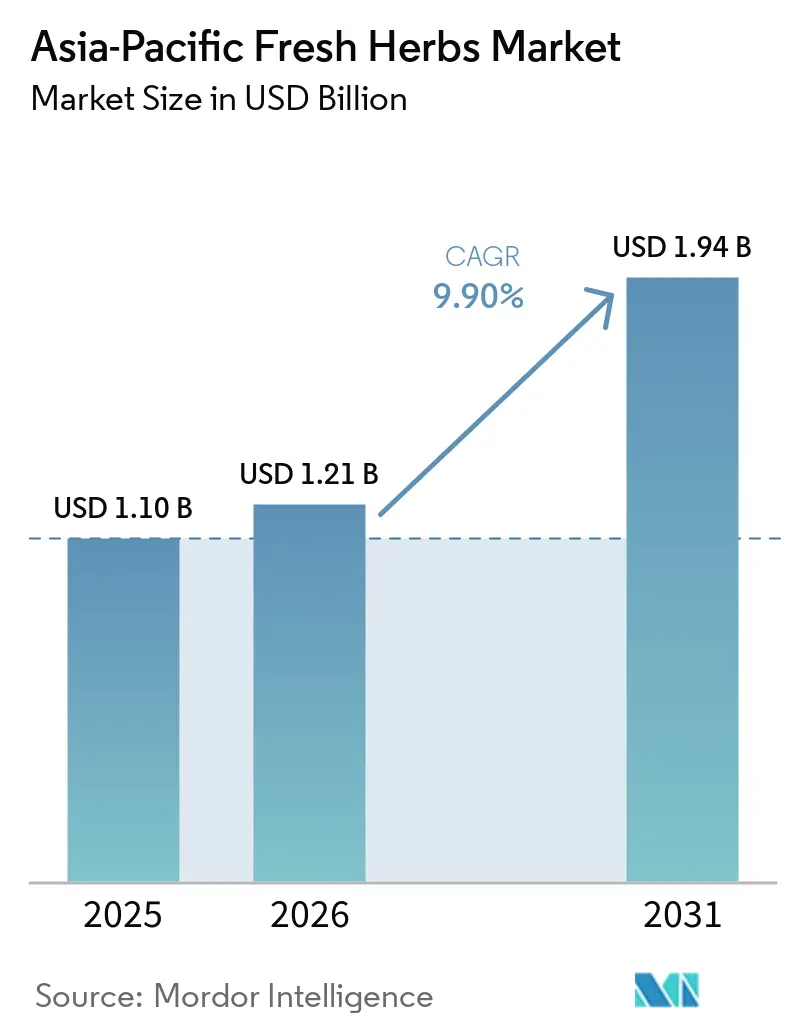
| Base Year Market Size (2025) | USD 1.10 Billion |
| Market Size (2026) | USD 1.21 Billion |
| Market Size (2031) | USD 1.94 Billion |
| Growth Rate (2026 - 2031) | 9.90 % |
| Market Concentration | Low |
Major Players *Disclaimer: Major Players sorted in no particular order Image © Mordor Intelligence. Reuse requires attribution under CC BY 4.0. | |
Asia-Pacific Fresh Herbs Market Analysis by Mordor Intelligence
The Asia-Pacific fresh herbs market size was valued at USD 1.10 billion in 2025 and is forecast to grow from USD 1.21 billion in 2026 to USD 1.94 billion by 2031 at a CAGR of 9.90% from 2026 to 2031. Culinary use of fresh herbs in Chinese, Indian, Thai, Vietnamese, and Japanese cuisines remains a key source of demand. The expansion of supermarkets, convenience stores, online grocery services, restaurants, cloud kitchens, and quick-service restaurants is increasing demand for a reliable supply of fresh herbs with consistent quality and packaging. Controlled-environment agriculture is gaining importance near major cities because it shortens delivery times and reduces exposure to weather-related disruptions. Retailers and foodservice buyers increasingly prioritize traceability, consistent quality, and reliable availability. The market remains divided between controlled-environment suppliers serving premium urban retail and foodservice channels and traditional producers supplying wet markets, local retailers, and food-processing customers.
Key Report Takeaways
- By product type, cilantro/coriander accounted for 40.8% of the Asia-Pacific fresh herbs market share in 2025, while basil is forecast to grow at a CAGR of 12.2% from 2026 to 2031.
- By category, conventional accounted for 71.0% of the Asia-Pacific fresh herbs market size in 2025, while organic is forecast to grow at a CAGR of 14.3% from 2026 to 2031.
- By cultivation method, open-field cultivation accounted for 63.0% of the market in 2025, while vertical indoor cultivation is forecast to grow at a 14.1% CAGR from 2026 to 2031.
- By end user, foodservice accounted for 52.0% of the market in 2025, while pharmaceutical and nutraceutical is forecast to grow at a CAGR of 12.6% from 2026 to 2031.
- By geography, China accounted for 39.3% of the market in 2025, while India is forecast to grow at a CAGR of 13.3% from 2026 to 2031.
Note: Market size and forecast figures in this report are generated using Mordor Intelligence’s proprietary estimation framework, updated with the latest available data and insights as of January 2026.
Market Trends and Insights
Drivers Impact Analysis of Asia-Pacific Fresh Herbs Market*
| Driver | (~) % Impact on CAGR Forecast | Geographic Relevance | Impact Timeline |
|---|---|---|---|
| Expanding Modern Retail and Food-Service Demand | +2.5% | Asia-Pacific, strongest in China, India, and Southeast Asia | Short term (≤ 2 years) |
| Controlled-Environment Farming Near Dense Cities | +2.2% | China, Japan, Singapore, South Korea, and Australia | Medium term (2-4 years) |
| Clean-Label and Fresh-Ingredient Preference | +1.8% | Asia-Pacific urban markets | Medium term (2-4 years) |
| Shorter Farm-to-Shelf Cycles Through Hyper-Local Supply | +1.3% | China, Japan, Singapore, and Australia | Short term (≤ 2 years) |
| Organic and Premium Herb Assortment Expansion | +1% | Australia, Japan, China, and India | Medium term (2-4 years) |
| Resistant Seed Commercialization for Year-Round Production | +0.8% | Asia-Pacific | Long term (≥ 4 years) |
| Source: Mordor Intelligence | |||
Expanding Modern Retail and Food-Service Demand
Organized retail is shifting fresh herb purchases from irregular wet-market transactions to repeat purchases of packaged products. Supermarkets, hypermarkets, convenience stores, and online fresh-food services are expanding their herb assortments, supporting steady demand for consistent products from locally controlled-environment farms and regional aggregators. The effect is especially evident in China and India, where growth in grocery outlets is outpacing farmgate supply capacity. Restaurant growth, cloud kitchens, and quick-service formats also require daily deliveries and dependable supply. These buyers support the Asia-Pacific fresh herbs market because traditional supply chains do not always meet their delivery and quality requirements. As modern retail and foodservice channels expand, suppliers are increasingly required to provide standardized quality, reliable volumes, and more frequent deliveries. This shift is encouraging investment in organized production and distribution networks, strengthening the role of structured supply chains in supporting fresh herb market growth across the region.
Controlled-Environment Farming Near Dense Cities
Vertical farms and urban greenhouses reduce the distance and climate exposure that can affect herb quality during transport. MIRAI Co., Ltd. operates the Kashiwanoha Factory in Kashiwa, Chiba, Japan, an artificial-light plant factory that produces and sells leafy vegetables and herbs[1]. The company has also developed commercial experience supplying herbs for foodservice applications. Artisan Green expanded its Singapore facility through a SGD 15 million (USD 11.2 million) investment and planned to produce 30 metric tons of fresh herbs and leafy greens per month in Phase 1. Controlled environments can reduce exposure to some field-level pests and weather-related crop risks, although compliance and residue-testing requirements vary by market. These conditions give controlled-environment suppliers a stronger position when retailers negotiate on freshness and supply reliability. Shorter distribution routes also allow producers to replenish retailers and foodservice operators more frequently, which is particularly valuable for highly perishable herbs. This proximity-based production model is creating an additional supply option for cities where conventional farms face longer transport distances or seasonal production constraints.
Clean-Label and Fresh-Ingredient Preference
Urban consumers increasingly favor recognizable and minimally processed ingredients in meals prepared at home and outside the home. This preference supports the use of fresh herbs over dried herbs and blended flavor additives. Cooking content on short-video platforms has also made herbs more familiar as routine kitchen ingredients in China, Thailand, and Indonesia. Food manufacturers seeking products with natural flavors and fresh-herb-derived ingredients are increasingly sourcing herbs directly from controlled-environment growers. Longer-term supply agreements can provide growers with more predictable demand and greater production-planning stability. The wider use of fresh herbs in everyday cooking is increasing repeat purchasing across retail and foodservice channels, rather than limiting demand to occasional culinary use. This broadening of consumption is creating a more consistent demand base for fresh herbs across the region.
Shorter Farm-to-Shelf Cycles Through Hyper-Local Supply
Proximity to the point of sale is an important consideration for fresh-herb suppliers because freshness and shelf life influence product quality. Fresh basil can deteriorate within 48 to 72 hours at ambient temperature, making rapid distribution important for retail and foodservice channels[2]. Urban controlled-environment farms in Singapore, Japan, and coastal China can supply nearby modern retailers and foodservice customers shortly after harvest, reducing transportation time and exposure to adverse storage conditions. Retailers and foodservice buyers prioritize reliable delivery schedules, consistent quality, and freshness when selecting suppliers. This creates opportunities for urban growers to serve premium retail and foodservice channels that value short delivery cycles. Peri-urban open-field farms continue to supply traditional wet markets and local retailers, where competitive pricing remains an important purchasing factor. For modern retail and foodservice buyers, shorter delivery cycles reduce the time between harvest and consumption, helping preserve the appearance and quality of fresh herbs. Consequently, geographic proximity, alongside price, quality, and supply reliability, plays an important role in supplier selection.
Restraints Impact Analysis of Asia-Pacific Fresh Herbs Market*
| Restraint | (~) % Impact on CAGR Forecast | Geographic Relevance | Impact Timeline |
|---|---|---|---|
| Short Shelf Life and Post-Harvest Losses | -1.5% | Asia-Pacific, strongest in India and Southeast Asia | Short term (≤ 2 years) |
| Weather-Driven Price and Supply Volatility | -1.2% | Typhoon corridors and Indian monsoon zones | Short term (≤ 2 years) |
| Fragmented Cold-Chain and Wet-Market Infrastructure | -1% | Asia-Pacific, strongest in India and Southeast Asia | Medium term (2-4 years) |
| High Compliance Cost for Residue and Authentication Testing | -0.9% | Japan, Australia, and regional export corridors | Medium term (2-4 years) |
| Source: Mordor Intelligence | |||
Short Shelf Life and Post-Harvest Losses
Fresh herbs are among the most perishable fresh-food products. Basil can deteriorate within 48 to 72 hours at ambient temperature, and losses can continue even under refrigeration. Unsold stock directly reduces revenue for farms, wholesalers, and retailers. High spoilage rates can make fresh herbs less attractive for smaller retailers to stock. Modified-atmosphere packaging and cooling can reduce waste, but both require investment. These costs are difficult to recover in wet markets and lower-priced second-tier city channels. This risk is particularly significant for smaller operators with limited cold-chain and inventory-management capabilities. As a result, spoilage and post-harvest handling costs can restrict distribution into lower-value channels and limit the profitability of expanding fresh herb volumes.
Weather-Driven Price and Supply Volatility
Monsoons, typhoons, heat events, and irregular rainfall can damage herb harvests within a short period. A single disruption can restrict availability and raise wholesale prices for retailers and foodservice buyers. Heat-wave events during 2024 and 2025 affected coriander availability for Australian supermarket customers supplied from open-field production[3]. These events strengthen the case for controlled-environment production, although new facilities require time and capital to build. Supply gaps are likely to remain where investment has not yet created sufficient protected growing capacity. For buyers that require consistent volumes, sudden changes in availability and pricing can complicate procurement planning and supplier commitments. Until protected cultivation and other supply-buffering systems become more widespread, weather-related disruptions will continue to create uncertainty across fresh herb supply chains in the region.
*Our forecasts treat driver/restraint impacts as directional, not additive. The impact forecasts reflect baseline growth, mix effects, and variable interactions.
Asia-Pacific Fresh Herbs Market Segment Analysis
By Product Type:
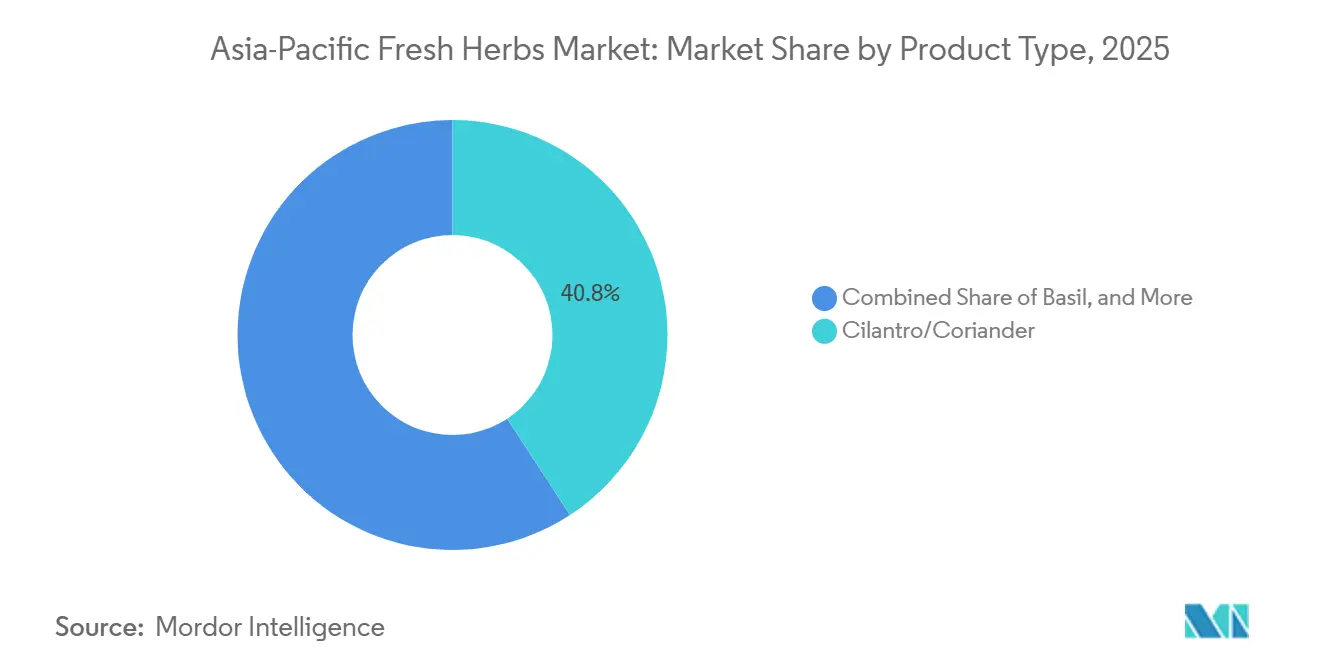
Cilantro/Coriander Leads, While Basil Grows FastestCilantro/coriander accounted for 40.8% of the Asia-Pacific fresh herbs market share in 2025. Its dominant position reflects its central role in South Asian, Southeast Asian, and Chinese cooking. Large-scale cultivation across India, China, and Thailand supports availability for households, foodservice businesses, and processors. Demand is further supported by the herb's use in fresh preparations, sauces, garnishes, and ready-to-eat meals, driving consumption across both household and commercial channels. Its established role in regional cuisines provides a broad and recurring demand base compared with herbs used primarily in premium or Western-style dishes.
Basil is forecast to grow at a CAGR of 12.2% from 2026 to 2031. Thai basil, holy basil, and lemon basil support demand across Asian cuisines. Basil also benefits from growth in Italian and Mediterranean foodservice across Japan, Singapore, and urban China. Its use across Asian and Western cuisines gives growers access to a broader range of foodservice and retail applications. The expansion of packaged fresh herbs and controlled-environment production is supporting more consistent basil availability in urban markets. Mint, parsley, chives, and rosemary hold mid-tier positions supported by premium dining and home cooking. Thyme, sage, oregano, and dill remain smaller by volume but command higher prices in hotel and restaurant channels.

By Category:
Conventional Leads and Organic Is Forecast to Grow FastestConventional fresh herbs accounted for 71.0% of the Asia-Pacific fresh herbs market size in 2025, supported by cost-efficient open-field cultivation across India, China, Thailand, and eastern Australia. Lower production costs and a wider range of available cultivars support conventional herbs across high-volume market channels. Wet markets, food processors, and price-sensitive foodservice operators continue to rely on this supply. Established cultivation, handling, and distribution systems also enable conventional producers to serve existing retail and foodservice networks efficiently. The broad availability and competitive pricing of conventionally grown herbs sustain their dominant position in regional consumption.
Organic fresh herbs are forecast to grow at a CAGR of 14.3% from 2026 to 2031, driven by expanding retail availability and increasing consumer interest in certified organic produce in Australia, Japan, China, and Singapore. China revised its Implementation Rules for Organic Product Certification in 2025, with the updated rules taking effect on January 1, 2026. Organic certification can help growers access premium market segments and meet the sourcing requirements of retailers seeking differentiated fresh-produce offerings. Demand is also supported by consumer preferences for products with verified production standards and traceable origins. However, organic herbs are unlikely to displace conventional supply significantly in price-sensitive channels, as both categories continue to serve distinct retail and foodservice requirements across the Asia-Pacific fresh herbs market.
By Cultivation Method:
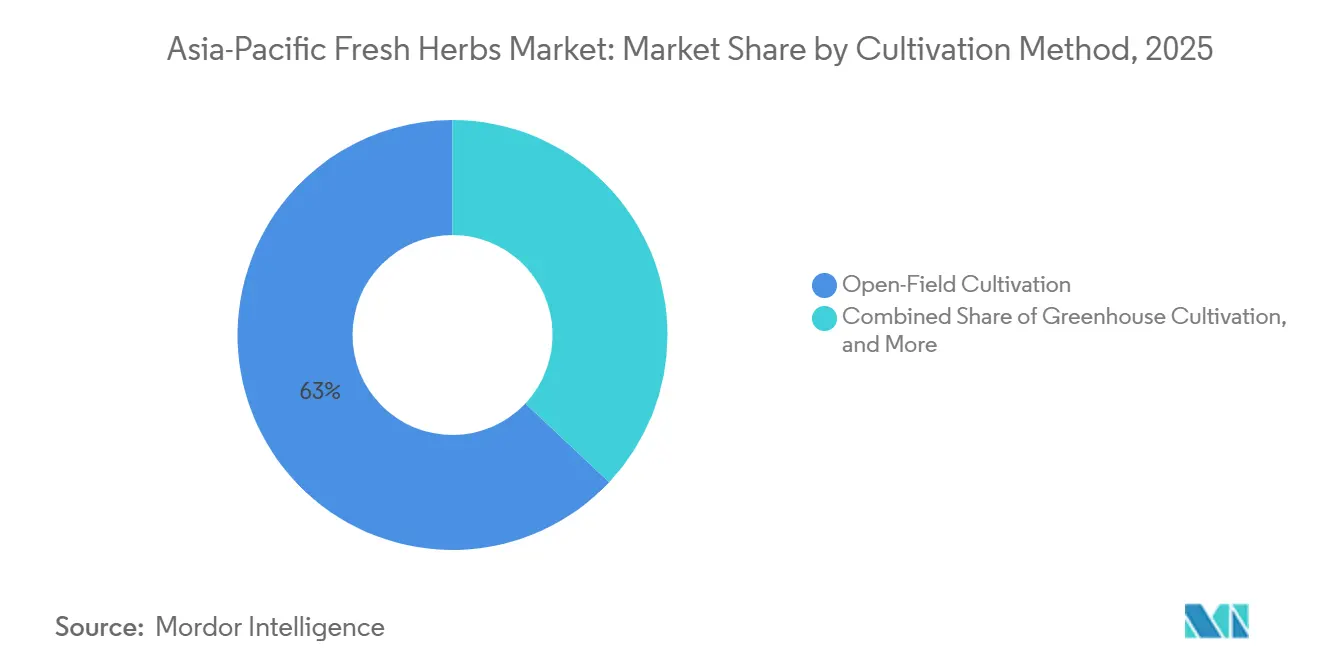
Open-Field Cultivation Leads and Vertical Indoor Cultivation Is Forecast to Grow FastestOpen-field cultivation accounted for 63.0% of the Asia-Pacific fresh herbs market in 2025. Its position reflects cost and scale advantages in India, China, Thailand, and Australian agricultural regions. The method supplies a large share of wet-market and processing demand. Greenhouses provide an intermediate option between open fields and artificial-light facilities, offering climate protection with lower energy use than fully indoor systems. Greenhouse cultivation is important in Australia and Japan, where retailers require dependable year-round supply.
Vertical indoor cultivation is forecast to grow at a CAGR of 14.1% from 2026 to 2031, making it the fastest-growing cultivation method. Investment is expanding in Japan, Singapore, South Korea, and coastal China. MIRAI Co., Ltd. has used high-density artificial-light production to provide year-round output and signed memoranda of understanding between December 2025 and February 2026 for projects in Mongolia, Tajikistan, and the Philippines. Hydroponics is also expanding in Singapore and South Korea due to its suitability for urban, soil-free systems. Holla-Fresh Pty Ltd. has supplied Australian supermarkets with hydroponically grown herbs. Aeroponics remains the smallest commercial method, although its water efficiency may support longer-term use in water-constrained cities.
By End User:
Foodservice Leads and Pharmaceutical and Nutraceutical Use Is Forecast to Grow FastestFoodservice accounted for 52.0% of the Asia-Pacific fresh herbs market in 2025. Restaurants, cloud kitchens, caterers, and quick-service outlets require daily herb procurement and favor suppliers that can deliver consistent quality and reliable timing. Food processing is also significant in India and China, where herb pastes and ready-to-eat products provide a stable outlet for large growers.
Pharmaceutical and nutraceutical use is forecast to grow at a CAGR of 12.6% from 2026 to 2031, making it the fastest-growing end-user segment. Consumers are showing greater interest in herbs as recognizable plant-sourced ingredients. Controlled-environment growers are targeting these higher-value channels rather than competing solely on commodity foodservice pricing. MIRAI Co., Ltd. positions produce from its plant-factory model for nutraceutical-grade applications. This channel gives growers an additional outlet for consistent and traceable supply. Foodservice nevertheless remains the main volume channel for the Asia-Pacific fresh herbs market.
Geography Analysis
China accounted for 39.3% of the Asia-Pacific fresh herbs market share in 2025. This position reflects its scale as a producer and consumer, as well as its established use of coriander, garlic chives, and Asian basil. Demand is supported by rising disposable income, an expanding restaurant sector, and premium packaged herb sales in modern retail. Indoor production near major cities helps buyers manage weather-related risks in southern growing areas.
India is forecast to grow at a CAGR of 13.3% from 2026 to 2031, making it the fastest-growing country within the Asia-Pacific fresh herbs market. Its role as a coriander and mint producer supports both domestic demand and exports. Organized foodservice growth in second-tier cities is increasing demand for dependable supply. The Agricultural and Processed Food Products Export Development Authority framework supports exports and certification for regional trade. Australia has a well-developed, organized retail channel for fresh herbs.
Japan is distinguished by strict quality requirements and plant-factory supply for convenience stores and restaurants. The rest of Asia-Pacific includes Southeast Asia, Taiwan, South Korea, and other regional markets. Singapore is a notable controlled-environment hub with a 2-hectare Artisan Green site awarded in April 2024. Thailand's retail groups distribute packaged herbs throughout metropolitan Bangkok. Southeast Asia continues to face the most significant cold-chain constraints, although shared storage and digital systems are improving conditions on selected routes.
Competitive Landscape
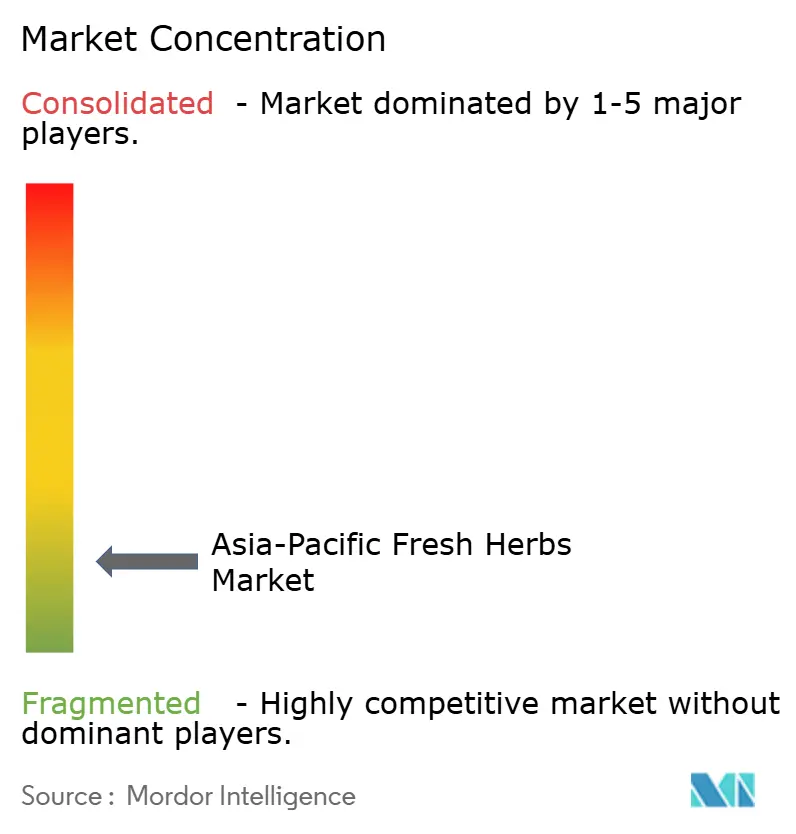
The Asia-Pacific fresh herbs market is fragmented, with a dispersed structure across growers, wet-market wholesalers, controlled-environment operators, and retail distributors. Woolworths Group Limited, Coles Group Limited, CP Axtra Public Company Limited, Central Retail Corporation Public Company Limited, and NTUC FairPrice Co-operative Limited are among the notable participants in the market. Retail groups control important routes to consumers, while producers compete on freshness, traceability, and production consistency. This structure gives local suppliers a role even when larger retailers dominate shelf access.
Technology use is an important competitive factor in the Asia-Pacific fresh herbs market. MIRAI Co., Ltd. uses IoT-based cultivation and remote-management technologies in its plant-factory operations and is expanding its plant-factory technology through projects in overseas markets. Artisan Green partnered with Siemens on a digital farm-management system for its Singapore facility. Coles used its 2025 Nurture Fund to support cardboard-punnet adoption by an Australian fresh-herbs grower. These initiatives focus on supply consistency, packaging, and operational control rather than volume alone.
Premium cold-chain routes between peri-urban farms and organized retail remain underserved in India and Southeast Asia. Modified-atmosphere packaging for wet-market products also lacks a dominant regional supplier. Cross-border traceability tools remain difficult for smallholder networks to adopt at low cost. These gaps present opportunities for producers and distributors that can improve quality control and compliance. The Asia-Pacific fresh herbs market is therefore competitive at both the production and distribution levels.
Asia-Pacific Fresh Herbs Industry Leaders
-
Woolworths Group Limited
-
Coles Group Limited
-
CP Axtra Public Company Limited (Lotus's)
-
Central Retail Corporation Public Company Limited
-
NTUC FairPrice Co-operative Limited
- *Disclaimer: Major Players sorted in no particular order
Asia-Pacific Fresh Herbs Market Companies Covered in this Report
- MIRAI Co., Ltd.
- Holla-Fresh Pty Ltd
- Coolibah Herbs Pty Ltd
- Herb-Ivore Fresh Herbs Pty Ltd
- Riverdale Herbs
- Artisan Green
- CropCiti
- Monoluxury Sdn. Bhd.
- Sam AgriTech Limited
- Woolworths Group Limited
- Coles Group Limited
- CP Axtra Public Company Limited (Lotus's)
- Central Retail Corporation Public Company Limited (Tops)
- NTUC FairPrice Co-operative Limited
Recent Industry Developments in Asia-Pacific Fresh Herbs Market
- February 2026: MIRAI Co., Ltd. signed memoranda of understanding with four companies across Mongolia, Tajikistan, and the Philippines between December 2025 and February 2026 to introduce and operate artificial-light plant factories. The Philippines project includes plans to produce basil and other leafy crops, with equipment installation scheduled for 2026–2027.
- November 2024: Growy, a Dutch indoor-farming company, opened an 8,000 m² vertical farm in Singapore. The facility marked the company's transition from research and development to commercial operations and supplies 34 products, including basil, parsley, shiso, and microgreens, to more than 40 hotels and restaurants.
- October 2023: Gobi Partners invested in Malaysian AgriTech company BoomGrow’s Pre-Series A funding round to support its expansion across Southeast Asia. BoomGrow produces leafy greens, microgreens, and herbs through its controlled-environment Machine Farms and had expanded operations into Manila, Philippines.
Asia-Pacific Fresh Herbs Market Report Scope
The fresh herbs market refers to the production, cultivation, distribution, and commercialization of fresh culinary and aromatic herbs, such as basil, cilantro, mint, parsley, oregano, rosemary, and thyme. It includes conventionally and organically grown herbs supplied in fresh form to foodservice, food retail, food processing, and other end users.
The Asia-Pacific fresh herbs market report is segmented by product type (basil, cilantro/coriander, mint, parsley, chives, oregano, rosemary, thyme, sage, dill, and other fresh herbs), by category (conventional and organic), by cultivation method (open-field cultivation, greenhouse cultivation, hydroponic cultivation, aeroponic cultivation, and vertical indoor cultivation), by end user (foodservice, food retail, food processing, pharmaceutical and nutraceutical, and other end users), and by geography (Australia, China, India, Japan, and the rest of Asia-Pacific). The market sizes and forecasts are provided in terms of value (USD) for all the Above Segments.
Segmentation Overview
| Basil |
| Cilantro/Coriander |
| Mint |
| Parsley |
| Chives |
| Oregano |
| Rosemary |
| Thyme |
| Sage |
| Dill |
| Other Fresh Herbs |
| Conventional |
| Organic |
| Open-Field Cultivation |
| Greenhouse Cultivation |
| Hydroponic Cultivation |
| Aeroponic Cultivation |
| Vertical Indoor Cultivation |
| Foodservice |
| Food Retail |
| Food Processing |
| Pharmaceutical and Nutraceutical |
| Other End Users |
| Asia-Pacific | Australia |
| China | |
| India | |
| Japan | |
| Rest of Asia-Pacific |
| By Product Type | Basil | |
| Cilantro/Coriander | ||
| Mint | ||
| Parsley | ||
| Chives | ||
| Oregano | ||
| Rosemary | ||
| Thyme | ||
| Sage | ||
| Dill | ||
| Other Fresh Herbs | ||
| By Category | Conventional | |
| Organic | ||
| By Cultivation Method | Open-Field Cultivation | |
| Greenhouse Cultivation | ||
| Hydroponic Cultivation | ||
| Aeroponic Cultivation | ||
| Vertical Indoor Cultivation | ||
| By End User | Foodservice | |
| Food Retail | ||
| Food Processing | ||
| Pharmaceutical and Nutraceutical | ||
| Other End Users | ||
| By Geography | Asia-Pacific | Australia |
| China | ||
| India | ||
| Japan | ||
| Rest of Asia-Pacific | ||
Key Questions Answered in the Report
What is the forecast growth rate for the Asia-Pacific fresh herbs market?
The Asia-Pacific fresh herbs market is forecast to grow at a CAGR of 9.9% from 2026 to 2031, rising from USD 1.21 billion in 2026 to USD 1.94 billion by 2031.
Which product type leads the Asia-Pacific fresh herbs market?
Cilantro/coriander led product demand with 40.8% share in 2025, supported by widespread use in South Asian, Southeast Asian, and Chinese cuisines.
Why are controlled-environment farms important for fresh herbs supply?
These farms reduce weather exposure, shorten delivery time, and help suppliers provide consistent products to modern retail and foodservice customers.
Which country holds the largest regional share?
China held the largest share of the Asia-Pacific fresh herbs market in 2025, accounting for 39.3% of the regional market, supported by its large-scale production, substantial consumer base, and widespread use of fresh herbs in traditional cuisine.