
Asia-Pacific Data Center Risk Engineering and Management Market Size and Share
Market Overview
| Study Period | 2021 - 2032 |
|---|---|
| Forecast Data Period | 2027 - 2032 |
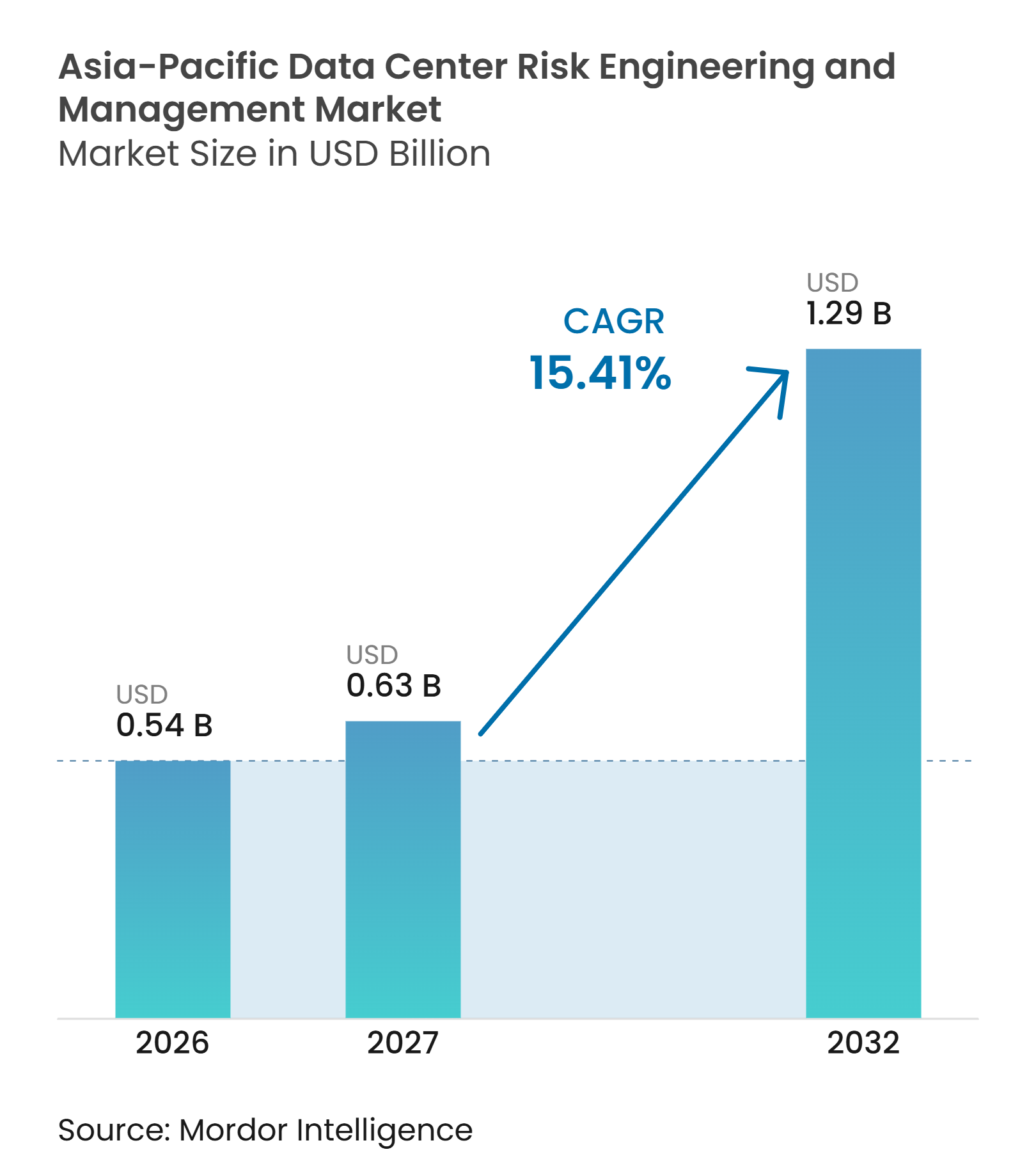
| Base Year Market Size (2026) | USD 0.54 Billion |
| Market Size (2027) | USD 0.63 Billion |
| Market Size (2032) | USD 1.29 Billion |
| Growth Rate (2027 - 2032) | 15.41 % |
| Market Concentration | Medium |
Major Players *Disclaimer: Major Players sorted in no particular order Image © Mordor Intelligence. Reuse requires attribution under CC BY 4.0. | |
Asia-Pacific Data Center Risk Engineering and Management Market Analysis by Mordor Intelligence
The Asia-Pacific data center risk engineering and management market size is expected to grow from USD 0.54 billion in 2026 to USD 1.29 billion by 2032 at a 15.41% CAGR over 2027-2032. New hyperscale campuses are increasing the need for integrated assessment of electrical, cooling, structural, and climate risks. AI workloads are broadening risk assignments because high-density computing affects multiple building systems at once. Insurers, lenders, and large customers are seeking documented controls across design, construction, and operations. This is creating demand for providers that can combine engineering knowledge with certification and ongoing verification. High specialist costs and the limited supply of qualified engineers may constrain delivery capacity in several active Asia-Pacific locations.
Key Report Takeaways
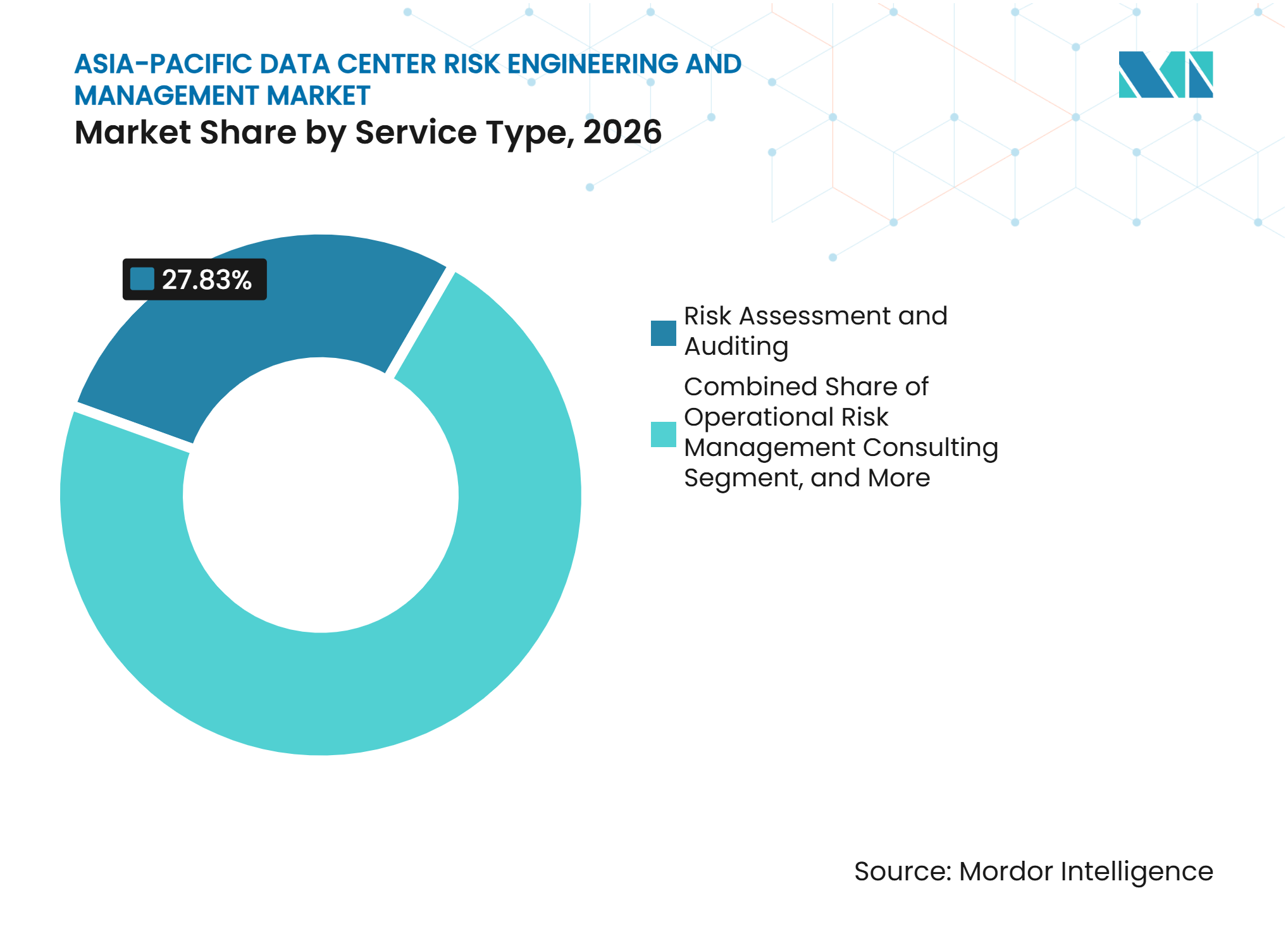
- By service type, Risk Assessment and Auditing held 27.83% of the Asia-Pacific data center risk engineering and management market share in 2026, while Reliability and Availability Engineering is projected to expand at a 16.13% CAGR through 2032.
- By risk category, Electrical and Power Infrastructure Risk accounted for 26.94% of the market in 2026, while Cooling and Thermal Management Risk is projected to grow at a 16.24% CAGR through 2032.
- By assessment method, Qualitative Risk Assessment accounted for 29.68% of revenue in 2026, while Continuous Risk Assessment and Monitoring is projected to grow at a 16.09% CAGR through 2032.
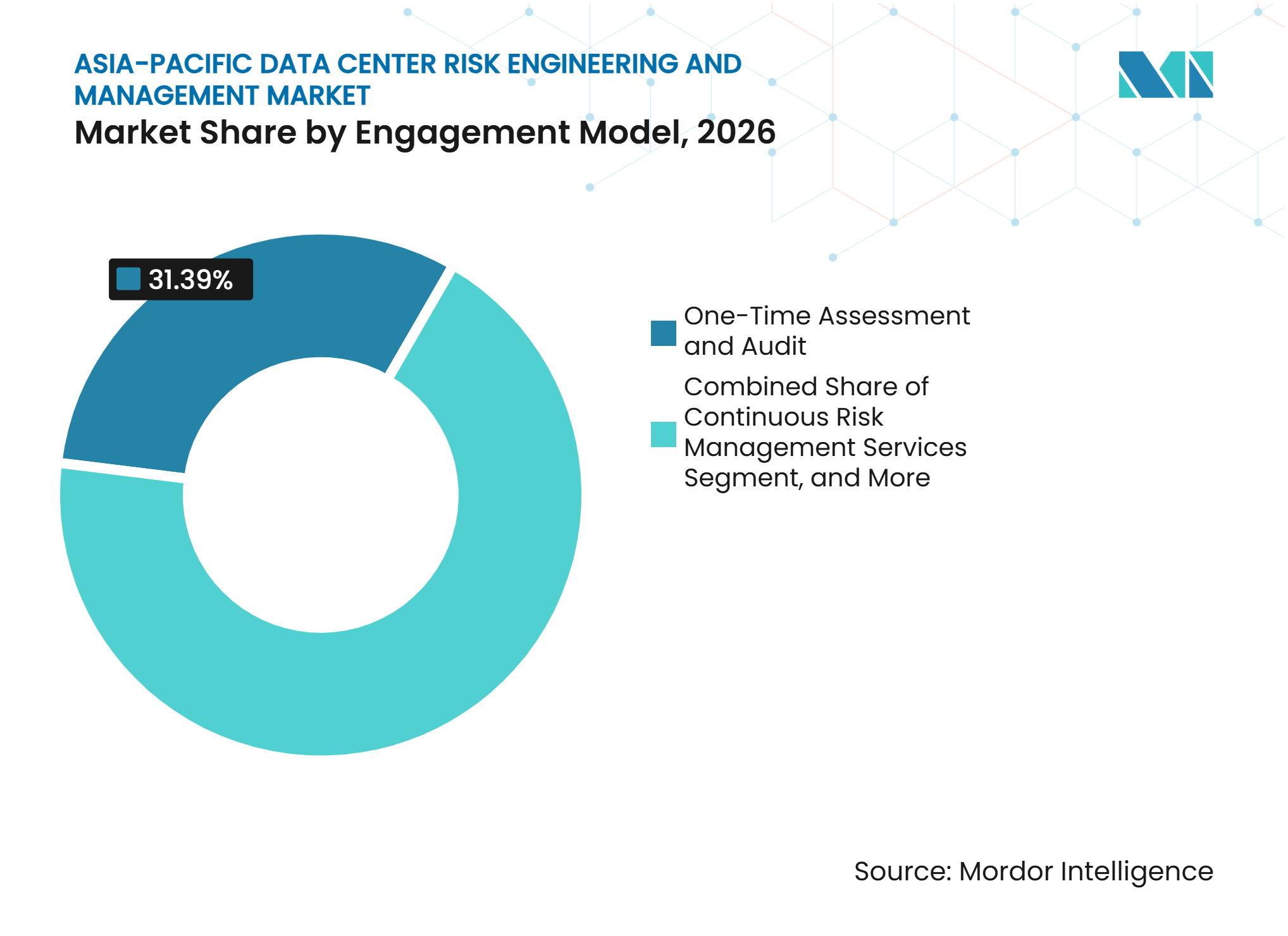
- By engagement model, One-Time Assessment and Audit accounted for 31.39% of the market in 2026, while Continuous Risk Management Services is projected to grow at a 16.38% CAGR through 2032.
- By project lifecycle stage, Operational Risk Management held a 32.76% share in 2026, while Expansion, Retrofit, and Modernization are projected to expand at a 16.52% CAGR through 2032.
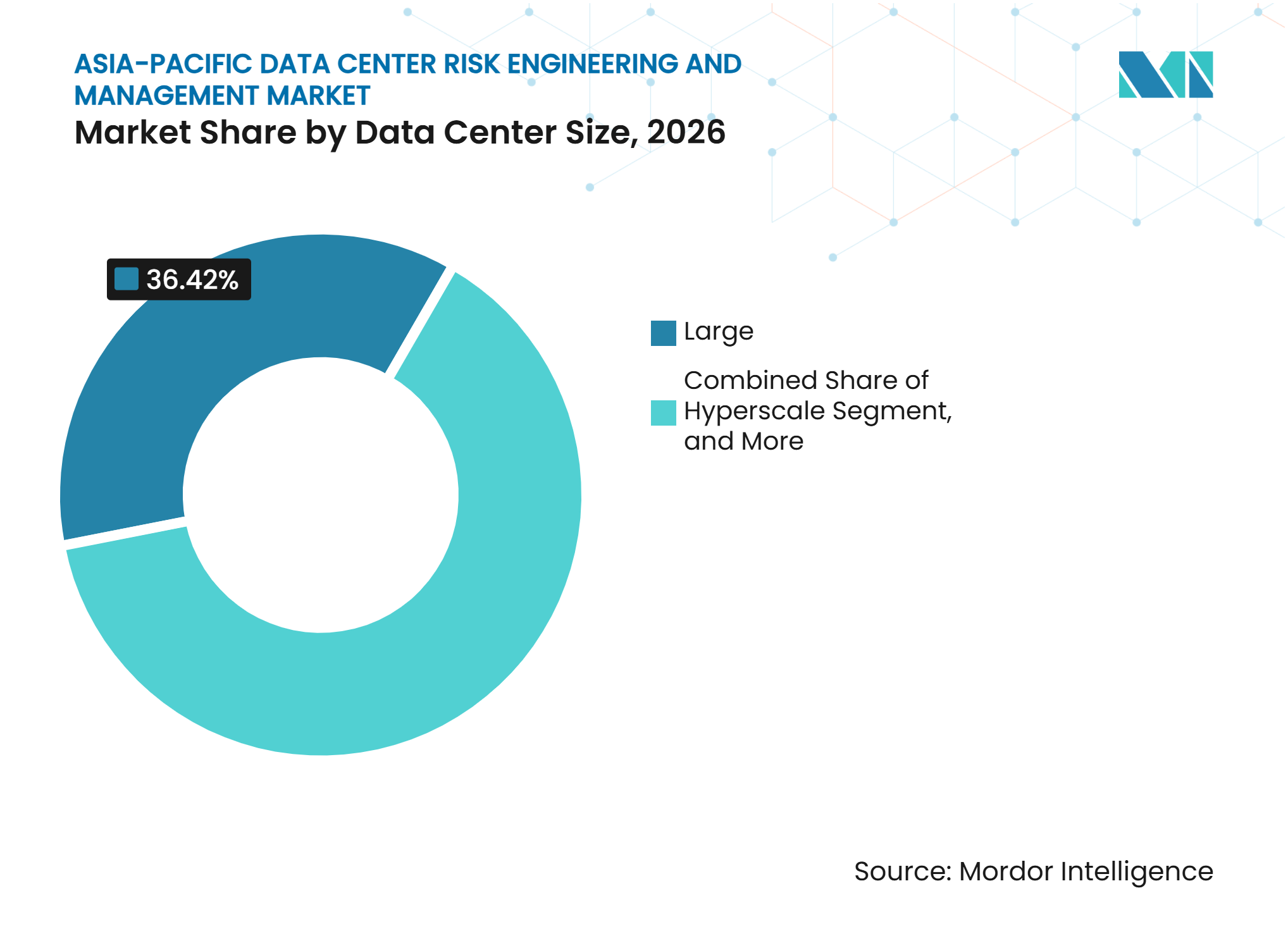
- By data center size, Large data centers accounted for 36.42% share in 2026, while Hyperscale facilities are projected to grow at a 16.06% CAGR through 2032.
- By data center type, Colocation facilities held 39.27% share in 2026, while Cloud Service Providers are projected to advance at a 16.21% CAGR through 2032.
- By geography, China accounted for 33.05% of the Asia-Pacific data center risk engineering and management market share in 2026, while India is projected to expand at a 16.26% CAGR through 2032.
Note: Market numbers in this report are based on Mordor Intelligence's proprietary estimation framework, which combines nine months of actuals with Q4 projections for base year 2026.
Market Trends and Insights
Drivers Impact Analysis of Asia-Pacific Data Center Risk Engineering and Management Market*
| Driver | (~) % Impact on CAGR Forecast | Geographic Relevance | Impact Timeline |
|---|---|---|---|
| Increasing AI Workload Density and Critical Power Complexity | +3.5% | Global, with APAC concentration in China, Japan, India, and South Korea | Short term (≤ 2 years) |
| Expansion of Hyperscale and Colocation Capacity | +3.2% | Asia-Pacific, anchored in China, India, Australia, Japan, and Malaysia | Short term (≤ 2 years) |
| Rising Reliability, Uptime, and Availability Requirements | +2.8% | Global, concentrated in hyperscale markets across Asia-Pacific | Medium term (2-4 years) |
| Insurer, Lender, Investor, and Customer Demand for Documented Risk Controls | +2.1% | Global, with spillover to Asia-Pacific from lender and insurer policy shifts | Medium term (2-4 years) |
| Insurability Pressure from Climate, Grid, and Aggregation Risk | +1.5% | Asia-Pacific, strongest in coastal China, India, Japan, and Australia | Medium term (2-4 years) |
| Lifecycle Risk Engineering From Site Selection Through Operations | +1.0% | Global, advancing fastest in mature Asia-Pacific locations | Long term (≥ 4 years) |
| Source: Mordor Intelligence | |||
Increasing AI Workload Density and Critical Power Complexity
AI inference workloads are changing the risk profile of data center design and operations. High-density GPU clusters place greater demand on electrical distribution, backup generation, cooling loops, and structural systems than conventional cloud deployments. Higher density affects UPS sizing, bus duct sizing, structural loading, generator fuel logistics, and redundancy design. These connected systems require risk reviews that examine failure paths across disciplines rather than separate engineering checks. Operators must also confirm that upgrades preserve power quality, resilience, and safe operating conditions throughout the facility. The Asia-Pacific data center risk engineering and management market therefore benefits when operators need repeated validation during equipment upgrades and operational changes.
Expansion of Hyperscale and Colocation Capacity
Hyperscale and colocation development is creating a sustained flow of site, design, commissioning, and operating assignments across Asia-Pacific. Each large project must document how power access, cooling systems, physical security, fire protection, and operating procedures will perform under failure conditions. Colocation operators carry direct obligations for tenant uptime, environmental performance, and physical security. Those obligations make independent documentation more important during construction, handover, and later expansions. The International Energy Agency reported that grid and resilience issues could delay 20% of planned data center projects worldwide.[1] Such constraints make early reviews of power, resilience, site selection, and commissioning more valuable in the Asia-Pacific data center risk engineering and management market.
Rising Reliability, Uptime, and Availability Requirements
Hyperscale tenants increasingly require Tier III Concurrently Maintainable or Tier IV Fault-Tolerant availability. These requirements make reliability engineering central to contract delivery and not merely an optional technical service. The Uptime Institute, ISO/IEC 22237, and ANSI/TIA-942 frameworks require evidence that design, maintenance, and operating controls can support the stated resilience level. The IEA identified unresolved grid and resilience conditions as a material cause of possible project delays. Digital modeling, failure analysis, and integrated systems testing can provide the evidence needed for certification, lender review, and customer assurance. This requirement supports recurring work in the Asia-Pacific data center risk engineering and management market as facilities are expanded, retrofitted, or upgraded.
Insurer, Lender, Investor, and Customer Demand for Documented Risk Controls
Formal risk documentation is becoming important to financing, insurance placement, and major tenant decisions. Aon expanded its Data Center Lifecycle Insurance Program to USD 2.5 billion in January 2026, adding risk engineering and cyber impact modeling to its offering. Willis and Zurich launched Digital Infrastructure Protector in April 2026 with more than USD 3 billion in capacity and an eight-point risk engineering framework. These programs show that engineering findings can shape insurance terms, financing conditions, and project decisions before a facility enters service. FM Global updated its Data Sheet DS 5-32 in July 2026 to address data center hazards and modern facility conditions. Providers that verify design choices, test records, and operating controls can secure work beyond the initial project phase.
Restraints Impact Analysis of Asia-Pacific Data Center Risk Engineering and Management Market*
| Restraint | (~) % Impact on CAGR Forecast | Geographic Relevance | Impact Timeline |
|---|---|---|---|
| High Cost of Specialist Risk Engineering and Assessment Services | -2.3% | Asia-Pacific, most acute in Japan, Australia, and South Korea | Short term (≤ 2 years) |
| Limited Availability of Data Center-Specific Engineers and Operations Leaders | -1.8% | Asia-Pacific, most severe in India, Southeast Asia, and Japan | Medium term (2-4 years) |
| Fragmented Risk Data and Non-Standardized Scoring Across Stakeholders | -1.2% | Global, pronounced in multi-jurisdiction Asia-Pacific settings | Medium term (2-4 years) |
| Short Construction Schedules, Live-Site Constraints, and Incomplete Commissioning Evidence | -0.8% | Global, intensified in high-velocity Asia-Pacific locations | Short term (≤ 2 years) |
| Source: Mordor Intelligence | |||
High Cost of Specialist Risk Engineering and Assessment Services
Specialist risk engineers need skills in high-voltage power, precision cooling, fire protection, structural review, and digital commissioning. This mix of skills creates a cost premium over general property risk assessment. Complex AI facilities need larger teams, more disciplines, and longer review periods, which increases assignment costs. Operators must balance these costs against construction budgets, financing terms, insurance requirements, and the potential disruption of an unplanned outage. Smaller operators may limit engagement to commissioning milestones instead of using lifecycle services. This can reduce spending per facility even when underlying construction activity remains strong.
Limited Availability of Data Center-Specific Engineers and Operations Leaders
The supply of experienced data center engineers limits delivery capacity in several Asia-Pacific locations. Liquid cooling requires skills that differ from conventional air-cooling commissioning, maintenance, and operations. Research on liquid cooling has identified interface standardization and operational capabilities as significant issues for deployment. The need to adapt global methods to local grid conditions, weather exposure, permitting, and construction practice also increases training needs. Higher prices, software tools, and remote monitoring cannot immediately replace experienced engineering judgment during a complex review. The shortage may therefore continue to restrict the number of risk assignments that service providers can complete.
*Our forecasts treat driver/restraint impacts as directional, not additive. The impact forecasts reflect baseline growth, mix effects, and variable interactions.
Asia-Pacific Data Center Risk Engineering and Management Market Segment Analysis
By Service Type:
Risk Assessment Leads While Reliability Engineering Grows FastestRisk Assessment and Auditing captured a 27.83% share of revenue in 2026. It is the entry point for insurance underwriting, construction finance, and pre-occupancy certification. Assignments commonly cover site hazards, electrical systems, fire protection, documentation, and clear evidence that design controls have been tested. ANSI/TIA-942, Uptime Institute Tier Certification, and ISO/IEC 22237 establish important compliance factors for this work. Operational Risk Management Consulting, Compliance, and Engineering Certification Support extend their support throughout the operating lifecycle.
Reliability and Availability Engineering is projected to record a 16.13% CAGR through 2032. Faster equipment refresh cycles require new reviews of power and cooling infrastructure after commissioning. Failure Mode and Effects Analysis, fault tree analysis, and hazard evaluation are used where a single failure could interrupt critical workloads. SGS provides lifecycle services, including testing, commissioning, and operational support for hyperscale facilities. The Asia-Pacific data center risk engineering and management industry is moving toward engagements that continue through successive technology upgrades.



By Risk Category:
Electrical Infrastructure Holds the Largest Share While Thermal Risk AcceleratesElectrical and Power Infrastructure Risk accounted for 26.94% of revenue in 2026. A stable electrical supply supports cooling, computing, fire protection, security systems, and the monitoring tools used to identify emerging operational issues. High-density AI clusters place greater demands on bus ducts, UPS systems, switchgear, and backup generation. A single electrical failure can disrupt both computing capacity and liquid cooling pumps. Fire and Life Safety Risk is also gaining attention as lithium-ion UPS systems are deployed more widely.
Cooling and Thermal Management Risk is projected to expand at a 16.24% CAGR through 2032. Liquid cooling introduces risks from pump malfunction, coolant degradation, leaks, incompatible metals, and pressure loss. Schneider Electric identifies these failures as causes of downtime, infrastructure damage, and service-level exposure in AI data centers. Environmental and climate risks add pressure in locations exposed to heat, flooding, and water constraints. These conditions expand the role of specialist assessment frameworks in the Asia-Pacific data center risk engineering and management market.
By Assessment Method:
Qualitative Reviews Lead While Continuous Monitoring ExpandsQualitative Risk Assessment held a 29.68% revenue share in 2026. It supports initial audits, compliance reviews, and insurer pre-risk surveys. Its lower cost and broad applicability are useful where operational performance data is limited. This is common in new-build locations that are receiving their first major data center developments. Quantitative assessment and scenario-based analysis are used for more technical assignments with sufficient operating data.
Continuous Risk Assessment and Monitoring is projected to grow at a 16.09% CAGR through 2032. Sensor integration, digital twin tools, and data center infrastructure management systems allow persistent review of critical system conditions. ISO/IEC 22237 and EN 50600 include ongoing surveillance within their certification approaches. This makes continuing assessment relevant to large colocation operators and their lenders. Simulation and digital modeling also support retrofit decisions before a physical change is made.
By Engagement Model:
One-Time Audits Lead While Continuous Services Change DeliveryOne-Time Assessment and Audit held a 31.39% share in 2026. New facilities often need a commissioning-stage review to meet insurance, certification, or financing requirements. Periodic Risk Review and Managed Risk Engineering serve operators that require scheduled governance support. Integrated Engineering and Advisory Services are used where risk engineering is linked with capital planning and corporate governance. This mix keeps project-based assignments important across the Asia-Pacific data center risk engineering and management market.
Continuous Risk Management Services is projected to advance at a 16.38% CAGR through 2032. Ongoing advisory arrangements give operators current evidence of how critical controls are performing. Willis stated in July 2026 that global demand for data center insurance capacity was nearing USD 15 billion.[2] Large multi-site operators also need comparable risk scores across different local codes and commissioning practices. Providers with engineering depth and cross-border delivery capacity are better placed for this work.

By Project Lifecycle Stage:
Operations Lead While Modernization Gains MomentumOperational Risk Management accounted for 32.76% of revenue in 2026. The segment reflects the large installed base of data centers that require continued control reviews. Facilities designed for conventional cloud workloads may need new assessments before they support high-density AI racks. Site Selection and Feasibility, Design and Engineering, and Construction and Commissioning cover the earlier phases of development. Each stage creates distinct requirements for evidence, validation, and risk control.
Expansion, Retrofit, and Modernization is projected to grow at a 16.52% CAGR through 2032. New GPU generations may require material power or cooling upgrades during a facility's operating life. This makes retrofit engineering a repeatable service event rather than an occasional assignment. China’s East Data, West Computing program also creates demand for assessing adaptation of facilities to new computing uses. The Asia-Pacific data center risk engineering and management industry therefore gains recurring work from the gap between building life cycles and equipment refresh cycles.
By Data Center Size:
Large Facilities Lead While Hyperscale Sets the Growth RateLarge data centers accounted for 36.42% of revenue share in 2026. They represent a major share of current capacity for colocation operators and large internet companies. Their scale requires broad reviews of electrical distribution, cooling, structural systems, and operating controls. Medium and small facilities have lower complexity per assignment. Their combined volume still supports meaningful demand for risk engineering services.
Hyperscale facilities are projected to grow at a 16.06% CAGR through 2032. Each campus requires work across site selection, design review, construction commissioning, and operating assurance. This produces more billable scope than smaller facility types. The IEA expects data center electricity demand to increase as AI adoption expands. Greater power use makes resilience, grid connection, and thermal management central to the service needs of hyperscale operators.
By Data Center Type:
Colocation Leads While Cloud Service Providers Grow FastestColocation facilities accounted for 39.27% of revenue in 2026. Operators have direct accountability for tenant uptime, environmental compliance, and physical security. These commitments make engineering review a recurring operational requirement. Enterprise and edge facilities serve more distributed workloads. Edge deployments are becoming relevant for latency-sensitive uses in financial services, healthcare, and industrial automation.
Cloud Service Providers are projected to grow at a 16.21% CAGR through 2032. Their AI infrastructure investments are changing facility design, cooling requirements, and governance needs. As operators and tenants, these providers require internal controls that can also withstand external review. The Asia-Pacific data center risk engineering and management market can benefit where independent verification is sought by regulators and institutional investors. This setting favors firms that can address both engineering resilience and documented governance requirements.
Geography Analysis
China
China accounted for 33.05% of the Asia-Pacific data center risk engineering and management market size in 2026. The country has the region’s largest operational capacity base and a large pipeline of AI and high-performance computing facilities. Energy performance and power availability are important compliance considerations for new facilities. The East Data, West Computing program directs capacity across regions and increases the need for site-specific power and resilience review. The country’s expansion supports demand for providers capable of assessing electrical infrastructure, cooling, and documented controls across multiple locations.
India
India is projected to expand at a 16.26% CAGR through 2032 in the Asia-Pacific data center risk engineering and management market. Data residency obligations under the Digital Personal Data Protection Act support local hosting of AI inference workloads. This increases the importance of domestic delivery capability for risk engineering and assurance services. Power availability, grid variability, and monsoon exposure require local adaptation of global risk frameworks. These conditions make construction-phase commissioning and operating resilience central requirements for new capacity.
Japan, South Korea, Australia, and Emerging Asia-Pacific
Japan faces complex power infrastructure conditions, including long grid connection timelines in Greater Tokyo. Japan’s grid monitor projected a 5.3% rise in national electricity demand over the following decade, with data centers and chip production among the drivers. South Korea’s AI Data Center Special Act takes effect in the first quarter of 2027 and creates a one-stop permit approach for qualifying facilities outside the capital region. Australia’s Security of Critical Infrastructure Act and the mandatory 5-star NABERS rating for federal workload-hosting facilities create auditable resilience and energy performance requirements.[3] Malaysia, Indonesia, Thailand, and Vietnam need services that consider local power, climate, permitting, and commissioning conditions.
Competitive Landscape
Market Concentration
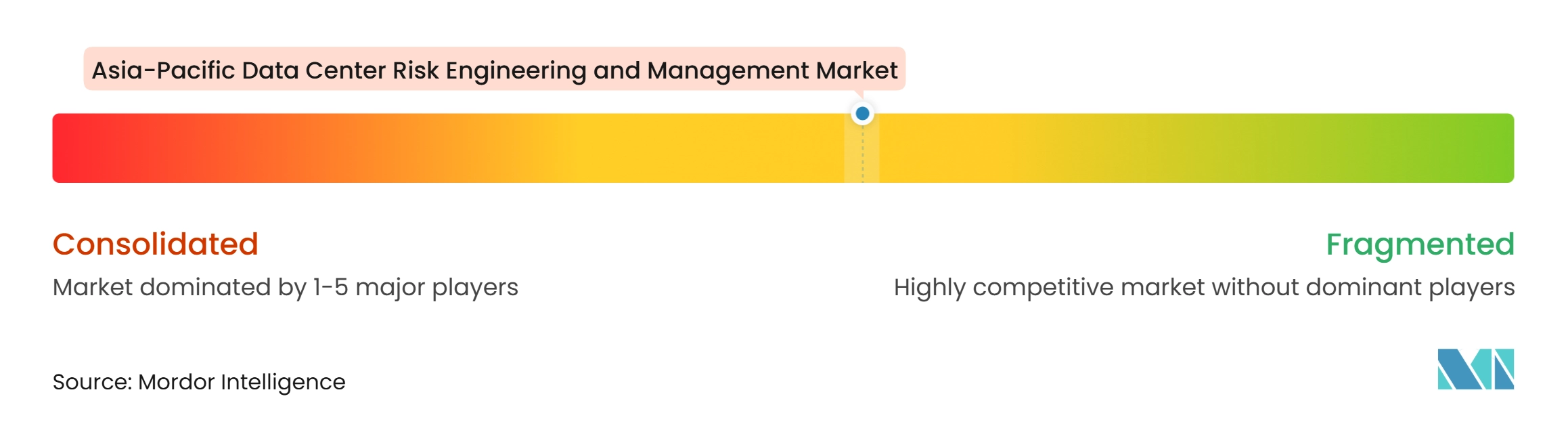
The Asia-Pacific data center risk engineering and management market includes global insurers, specialist risk engineering firms, testing, inspection, and certification providers, engineering consultancies, and real estate-linked advisers. Competition is strongest for lifecycle assurance, pre-risk surveys, and documented resilience work. Zurich Resilience Solutions formed a dedicated data center risk advisory practice with more than 100 engineers in January 2026. Aon expanded its lifecycle program to USD 2.5 billion in January 2026, showing that integrated engineering and insurance capacity are becoming important competitive features.
Willis and Zurich co-launched Digital Infrastructure Protector in April 2026 with more than USD 3 billion in capacity. The product combines construction, operational property, marine, and cargo coverage with a structured risk engineering framework. Bureau Veritas agreed to acquire Lotusworks in April 2026, creating a stronger commissioning and quality assurance platform for data centers and semiconductor facilities. TÜV SÜD’s Global Risk Consultants acquired Aon’s U.S. Field Services business in January 2026 to add specialist property risk engineers.
Certification and standards expertise are also becoming more important as AI infrastructure changes facility requirements. DNV awarded its first AI management certification in Japan under ISO/IEC 42001 in October 2026. Uptime Institute Tier Certification, TIA-942, ISO/IEC 22237, NABERS, and local energy rules set the basic requirements against which firms differentiate. Providers that give comparable reporting across countries can serve hyperscalers, colocation operators, lenders, and insurers with multi-market portfolios. Specialist depth, credible testing records, and cross-border consistency are likely to remain important buying criteria.
Asia-Pacific Data Center Risk Engineering and Management Industry Leaders
-
FM Insurance Company Limited
-
Zurich Insurance Company Ltd
-
Marsh & McLennan Companies, Inc.
-
Willis Towers Watson Public Limited Company
-
Aon plc
- *Disclaimer: Major Players sorted in no particular order
Asia-Pacific Data Center Risk Engineering and Management Market Companies Covered in this Report
- FM Insurance Company Limited
- Zurich Insurance Company Ltd
- Marsh & McLennan Companies, Inc.
- Willis Towers Watson Public Limited Company
- Aon plc
- Howden Broking Group Limited
- Lockton Companies, LLC
- Swiss Reinsurance Company Ltd
- Munich Reinsurance Company
- Allianz SE
- Sompo Holdings, Inc.
- HDI Global SE
- Bureau Veritas SA
- SGS Société Générale de Surveillance SA
- Intertek Group plc
- TÜV SÜD AG
- DNV AS
- Jones Lang LaSalle Incorporated
- CBRE Group, Inc.
- Cushman & Wakefield plc
- AECOM
- Arup Group Limited
- Jacobs Solutions Inc.
- WSP Global Inc.
- Salute Mission Critical LLC
- Schneider Electric SE
- Siemens AG
- Johnson Controls International plc
- Honeywell International Inc.
Recent Industry Developments in Asia-Pacific Data Center Risk Engineering and Management Market
- July 2026: FM Global issued an interim revision to Data Sheet DS 5-32 (Data Centers and Related Facilities), updating hazard guidance, cooling system terminology, and IT load definitions to reflect liquid cooling and Li-Ion UPS deployments, a revised engineering standard against which risk assessors and insurers now validate new and existing facility designs.
- July 2026: Willis (WTW) published guidance urging data center owners globally to rethink insurance purchasing as capacity demand neared USD 15 billion, advocating evidence-based, risk-engineering-led quantification of exposures to avoid overinsurance and ensure limits reflect actual facility risk profiles.
- June 2026: Bloomberg reported China's preparation of a CNY 2 trillion (USD 295 billion) five-year national AI data center investment program, the largest single national digital infrastructure initiative on record, creating a structurally expanded multi-year risk engineering demand cycle in China.
- April 2026: Bureau Veritas SA signed an agreement to acquire Lotusworks, a global leader in mission-critical commissioning, quality assurance, and quality control, for EUR 300 million (USD 339 million), creating a dedicated data center and semiconductor commissioning platform with EUR 131 million (USD 148 million) in 2025 revenue from hyperscaler and semiconductor manufacturer clients.
Asia-Pacific Data Center Risk Engineering and Management Market Report Scope
The Asia-Pacific data center risk engineering and management market encompasses services, solutions, and technologies that help data center operators identify, assess, mitigate, and manage operational, physical, cybersecurity, environmental, and regulatory risks. These offerings support business continuity, infrastructure resilience, regulatory compliance, and the reliable operation of data center facilities across the region.
The Asia-Pacific Data Center Risk Engineering and Management Market Report is Segmented by Service Type (Risk Assessment and Auditing, Reliability and Availability Engineering, Failure Mode and Effects Analysis [FMEA], Fault Tree and Root Cause Analysis, Hazard Identification and Risk Evaluation, Risk Mitigation Planning, Operational Risk Management Consulting, and Compliance and Engineering Certification Support), Risk Category (Electrical and Power Infrastructure Risk, Cooling and Thermal Management Risk, Fire and Life Safety Risk, Structural and Building Infrastructure Risk, Environmental and Climate Risk, Operational and Human Error Risk, Supply Chain and Equipment Availability Risk, and Physical Security and Access Risk), Assessment Method (Qualitative Risk Assessment, Quantitative Risk Assessment, Reliability-Centered Assessment, Scenario-Based Risk Analysis, Simulation and Digital Modeling, and Continuous Risk Assessment and Monitoring), Engagement Model (One-Time Assessment and Audit, Periodic Risk Review, Continuous Risk Management Services, Managed Risk Engineering, and Integrated Engineering and Advisory Services), Project Lifecycle Stage (Site Selection and Feasibility, Design and Engineering, Construction and Commissioning, Operational Risk Management, and Expansion, Retrofit, and Modernization), Data Center Size (Small, Medium, Large, and Hyperscale), Data Center Type (Colocation, Cloud Service Providers [CSPs], and Enterprise and Edge), and Geography (China, India, Japan, South Korea, Australia, and Rest of Asia-Pacific). The Market Forecasts are Provided in Terms of Value (USD).
Segmentation Overview
| Risk Assessment and Auditing |
| Reliability and Availability Engineering |
| Failure Mode and Effects Analysis (FMEA) |
| Fault Tree and Root Cause Analysis |
| Hazard Identification and Risk Evaluation |
| Risk Mitigation Planning |
| Operational Risk Management Consulting |
| Compliance and Engineering Certification Support |
| Electrical and Power Infrastructure Risk |
| Cooling and Thermal Management Risk |
| Fire and Life Safety Risk |
| Structural and Building Infrastructure Risk |
| Environmental and Climate Risk |
| Operational and Human Error Risk |
| Supply Chain and Equipment Availability Risk |
| Physical Security and Access Risk |
| Qualitative Risk Assessment |
| Quantitative Risk Assessment |
| Reliability-Centered Assessment |
| Scenario-Based Risk Analysis |
| Simulation and Digital Modeling |
| Continuous Risk Assessment and Monitoring |
| One-Time Assessment and Audit |
| Periodic Risk Review |
| Continuous Risk Management Services |
| Managed Risk Engineering |
| Integrated Engineering and Advisory Services |
| Site Selection and Feasibility |
| Design and Engineering |
| Construction and Commissioning |
| Operational Risk Management |
| Expansion, Retrofit, and Modernization |
| Small |
| Medium |
| Large |
| Hyperscale |
| Colocation |
| Cloud Service Providers (CSPs) |
| Enterprise and Edge |
| China |
| India |
| Japan |
| South Korea |
| Australia |
| Rest of Asia-Pacific |
| By Service Type | Risk Assessment and Auditing |
| Reliability and Availability Engineering | |
| Failure Mode and Effects Analysis (FMEA) | |
| Fault Tree and Root Cause Analysis | |
| Hazard Identification and Risk Evaluation | |
| Risk Mitigation Planning | |
| Operational Risk Management Consulting | |
| Compliance and Engineering Certification Support | |
| By Risk Category | Electrical and Power Infrastructure Risk |
| Cooling and Thermal Management Risk | |
| Fire and Life Safety Risk | |
| Structural and Building Infrastructure Risk | |
| Environmental and Climate Risk | |
| Operational and Human Error Risk | |
| Supply Chain and Equipment Availability Risk | |
| Physical Security and Access Risk | |
| By Assessment Method | Qualitative Risk Assessment |
| Quantitative Risk Assessment | |
| Reliability-Centered Assessment | |
| Scenario-Based Risk Analysis | |
| Simulation and Digital Modeling | |
| Continuous Risk Assessment and Monitoring | |
| By Engagement Model | One-Time Assessment and Audit |
| Periodic Risk Review | |
| Continuous Risk Management Services | |
| Managed Risk Engineering | |
| Integrated Engineering and Advisory Services | |
| By Project Lifecycle Stage | Site Selection and Feasibility |
| Design and Engineering | |
| Construction and Commissioning | |
| Operational Risk Management | |
| Expansion, Retrofit, and Modernization | |
| By Data Center Size | Small |
| Medium | |
| Large | |
| Hyperscale | |
| By Data Center Type | Colocation |
| Cloud Service Providers (CSPs) | |
| Enterprise and Edge | |
| By Geography | China |
| India | |
| Japan | |
| South Korea | |
| Australia | |
| Rest of Asia-Pacific |
Key Questions Answered in the Report
What is the size of the Asia-Pacific data center risk engineering and management market?
The Asia-Pacific data center risk engineering and management market is valued at USD 0.54 billion in 2026 and is forecast to reach USD 1.29 billion by 2032, at a 15.41% CAGR over 2027-2032. The forecast reflects the expanding need for specialist risk work across new AI-oriented infrastructure.
What is driving demand for data center risk engineering services in Asia-Pacific?
Higher AI workload density, new hyperscale capacity, and stronger requirements from insurers, lenders, and tenants are increasing demand. The Asia-Pacific data center risk engineering and management market also benefits when power, cooling, commissioning, and operational controls must be independently documented.
Which service type leads Asia-Pacific data center risk engineering and management?
Risk Assessment and Auditing leads with 27.83% revenue share in 2026. It supports site reviews, electrical and fire protection checks, and documentation needed for finance, insurance, certification, and pre-occupancy decisions.
Which risk category is expected to grow fastest through 2032?
Cooling and Thermal Management Risk is projected to grow at a 16.24% CAGR, supported by liquid cooling requirements. The Asia-Pacific data center risk engineering and management market is exposed to new assessment needs as liquid systems introduce risks linked to pumps, coolant, leaks, pressure, and materials.
Which country is the largest Asia-Pacific market for these services?
China leads with 33.05% market share in 2026, supported by its large operating base and infrastructure programs. Its broad AI and high-performance computing buildout requires attention to power, cooling, site conditions, and documented resilience controls.