
Asia-Pacific Bottling Line Sterilization Machinery Market Size and Share
Market Overview
| Study Period | 2021 - 2032 |
|---|---|
| Forecast Data Period | 2027 - 2032 |
| Base Year Market Size (2026) | USD 9.86 Million |
| Market Size (2027) | USD 11.42 Million |
| Market Size (2032) | USD 23.28 Million |
| Growth Rate (2027 - 2032) | 15.31 % |
| Market Concentration | Medium |
Major Players *Disclaimer: Major Players sorted in no particular order Image © Mordor Intelligence. Reuse requires attribution under CC BY 4.0. | |
Asia-Pacific Bottling Line Sterilization Machinery Market Analysis by Mordor Intelligence
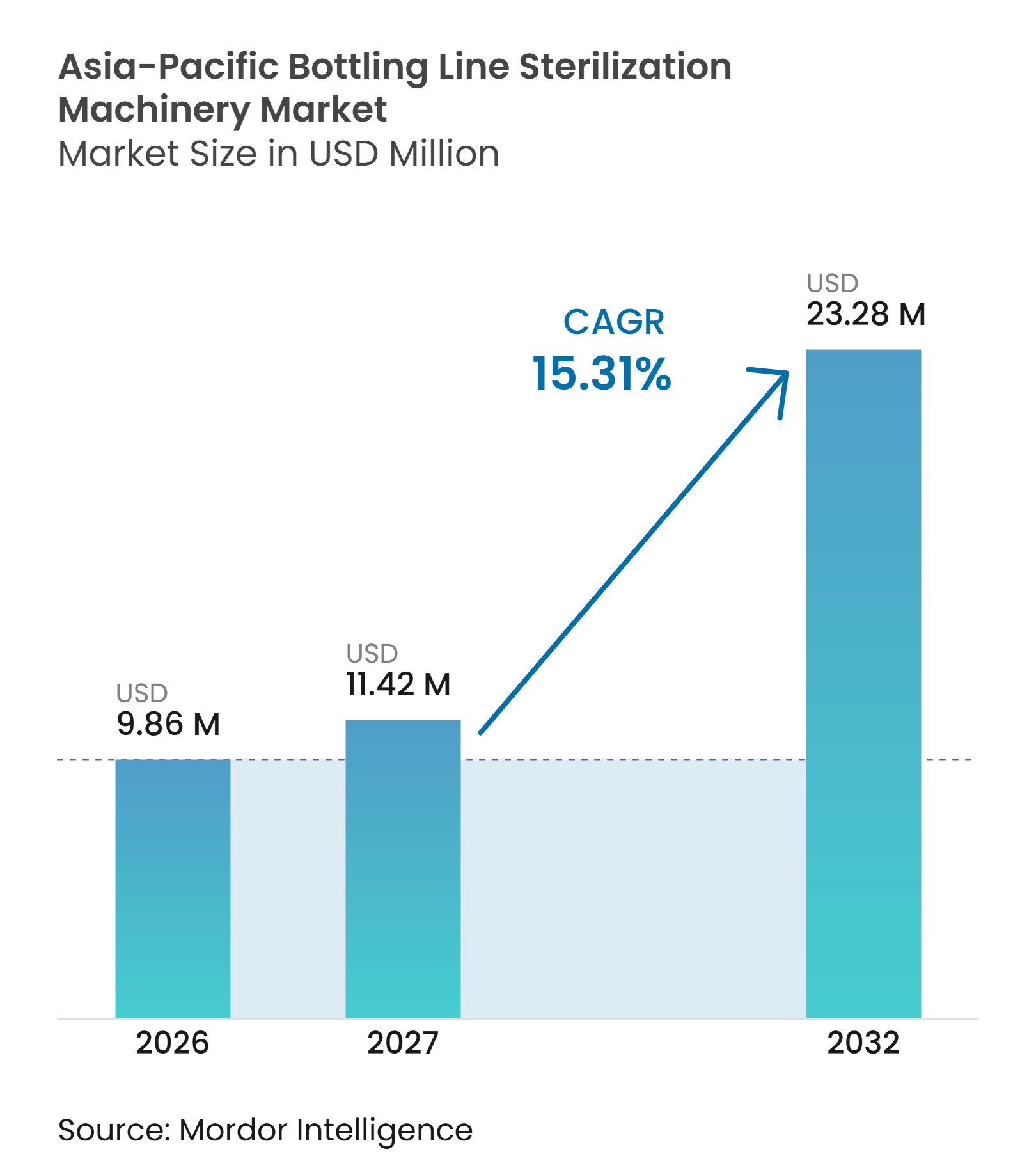
The Asia-Pacific Bottling Line Sterilization Machinery Market size is projected to expand from USD 9.86 million in 2026 and USD 11.42 million in 2027 to USD 23.28 million by 2032, registering a CAGR of 15.31% between 2027 and 2032.
Limited cold-chain coverage across Southeast Asia, India, and lower-tier Chinese cities makes ambient shelf life an operating requirement for many food and beverage producers. This need supports investment in certified aseptic lines that can serve distributed retail networks without relying on refrigerated distribution. Rising production of dairy, ready-to-drink tea, functional drinks, and plant-based beverages is moving investment toward sterilization-critical filling capacity. Sterile fill-finish projects for pharmaceuticals and biologics also extend demand beyond beverage applications, especially in South Korea, Singapore, Taiwan, and India. Equipment suppliers are responding through local manufacturing, validation support, and enclosed line designs, while smaller operators continue to face cost, skills, and qualification barriers.
Key Report Takeaways
- By equipment type, integrated sterilization-filling-capping monoblocs held 49.79% of the Asia-Pacific bottling line machinery sterilization market share in 2026, while preform sterilization modules are projected to expand at a 16.28% CAGR through 2032.
- By sterilization technology, hydrogen peroxide held 43.09% of the market share in 2026, while electron beam and other emerging technologies are projected to expand at a 16.34% CAGR through 2032.
- By format, PET bottles accounted for 38.15% of the regional machinery market size in 2026 in the Asia-Pacific bottling line machinery sterilization market, while preforms are projected to expand at a 16.37% CAGR through 2032.
- By line configuration, rotary systems held a 35.95% share in 2026, while integrated systems are projected to expand at a 16.22% CAGR through 2032.
- By end user, dairy and plant-based beverage producers held a 25.31% share in 2026, while pharmaceutical and biopharmaceutical manufacturers are projected to expand at a 16.18% CAGR through 2032.
- By geography, China held 43.48% of the regional machinery market share in 2026, while India is projected to expand at a 16.34% CAGR through 2032.
Note: Market numbers in this report are based on Mordor Intelligence's proprietary estimation framework, which combines nine months of actuals with Q4 projections for base year 2026.
Market Trends and Insights
Drivers Impact Analysis of Asia-Pacific Bottling Line Sterilization Machinery Market*
| Driver | (~) % Impact on CAGR Forecast | Geographic Relevance | Impact Timeline |
|---|---|---|---|
| Expansion of Shelf-Stable Beverage Production | +3.5% | Asia-Pacific core, especially China, India, Vietnam, and Indonesia | Short term (≤ 2 years) |
| Stricter Food and Beverage Sterility Compliance | +2.8% | China, Japan, India, South Korea, and ASEAN | Medium term (2-4 years) |
| Growth of Dairy, Juice, Tea, and Functional Beverage Categories | +2.2% | China, India, and Southeast Asia | Short term (≤ 2 years) |
| Pharmaceutical and Biopharmaceutical Capacity Expansion | +1.8% | South Korea, Singapore, India, and Taiwan | Medium term (2-4 years) |
| Shorter Validation Cycles Through Localized Aseptic Engineering | +1.2% | China, India, and Japan | Medium term (2-4 years) |
| Dry Preform Sterilization Reducing Water and Chemical Intensity | +0.9% | Asia-Pacific, with early adoption in China and Japan | Long term (≥ 4 years) |
| Source: Mordor Intelligence | |||
Expansion of Shelf-Stable Beverage Production
Cold-chain availability remains uneven across Southeast Asia and much of India, making ambient-stable packaging a practical distribution choice rather than a premium format. Food and beverage producers therefore need aseptic lines with certified sterilization capability to reach dispersed retail outlets. Tetra Pak completed a second line at its Binh Duong facility in Vietnam in July 2025, bringing total site investment to EUR 217 million (USD 234 million) and increasing capacity to more than 30 billion cartons annually. The added output serves Vietnam and several Asia-Pacific export markets, indicating sustained demand for continuous, validated filling and sterilization operations. The Asia-Pacific bottling line sterilization machinery market benefits directly when packaging capacity increases because new formats and longer production runs require dependable contamination control
Stricter Food and Beverage Sterility Compliance
Food-contact and product-safety rules are raising the performance threshold for bottling lines across the Asia-Pacific bottling line sterilization machinery market. China introduced revised standards for sterilized milk in 2025 that prohibited the use of reconstituted milk in these products and tightened ingredient requirements. The change supports UHT production that relies on compliant sterilization and aseptic filling arrangements. India also continued to update its food-contact material framework, thereby increasing the importance of validated compatibility between packaging materials and sterilization processes. These compliance factors make replacement decisions less discretionary for producers using older configurations in the Asia-Pacific bottling line sterilization machinery market, especially where audits require documented validation.
Growth of Dairy, Juice, Tea, and Functional Beverage Categories
Dairy and plant-based drinks require aseptic processing when producers seek stable products that can move through ambient distribution channels. Pure Mylk opened a plant-based milk innovation hub in Malaysia in 2025, using aseptic UHT production to produce shelf-stable oat and rice beverages. SIG also supported Thailand's first high-protein UHT milk launch with flexible aseptic filling, enabling distribution through a nationwide convenience-store network. Fonterra committed NZD 150 million (USD 87 million) to expand UHT cream capacity at Edendale, New Zealand, with initial production expected in August 2026 for foodservice demand in China and Asia. These developments support demand for high-speed monoblocs designed for sensitive, low-acid beverages.
Pharmaceutical and Biopharmaceutical Capacity Expansion
Sterile fill-finish investment is broadening the addressable base for pharmaceutical-grade sterilization and aseptic filling equipment. WuXi XDC's DP4 facility in Singapore achieved GMP release in 2026 after commissioning aseptic filling systems with hydrogen peroxide bio-decontamination and a capacity of 300 vials per minute. The facility expands capacity for antibody-drug conjugates and reflects the higher process-control requirements of sterile injectable production. Adimmune added a third automated aseptic filling line in Taiwan during 2026 for high-value, small-batch biologics. Such installations favor isolator-integrated systems and validated contamination-control practices that reduce human intervention.
Restraints Impact Analysis of Asia-Pacific Bottling Line Sterilization Machinery Market*
| Restraint | (~) % Impact on CAGR Forecast | Geographic Relevance | Impact Timeline |
|---|---|---|---|
| High Capital and Qualification Costs | -2.1% | Asia-Pacific, most acute in ASEAN and India where small and mid-sized enterprises dominate | Medium term (2-4 years) |
| Uneven Availability of Sterile-Process Engineering Skills | -1.5% | Southeast Asia, India, and Rest of Asia-Pacific | Long term (≥ 4 years) |
| Residual-Chemical Management and Worker-Safety Requirements | -0.8% | Asia-Pacific, with stricter enforcement in Japan and South Korea | Medium term (2-4 years) |
| Format-Specific Changeover Complexity in Multi-SKU Lines | -0.6% | China, India, and Southeast Asia | Short term (≤ 2 years) |
| Source: Mordor Intelligence | |||
High Capital and Qualification Costs
A complete aseptic PET line with sterilization, filling, and capping monobloc requires significant upfront spending. Installation, operational, and performance qualification add expense and lengthen commissioning schedules after equipment is purchased. The burden is more acute for small and mid-sized producers in ASEAN markets, where financing options for manufacturing equipment can be limited. Chinese full-line suppliers may reduce purchase-price pressure for mid-tier projects, but pharmaceutical-grade aseptic systems remain high-cost. Qualification costs also remain necessary regardless of equipment origin, preserving the total-cost barrier for certified lines.
Uneven Availability of Sterile-Process Engineering Skills
Experienced sterile-process engineers are concentrated in Japan, South Korea, and larger Chinese manufacturing centers. Many operators in Southeast Asia and India still depend on external teams for validation, commissioning, and sustained compliance. Modern dry preform, electron-beam, and isolator-integrated systems require different skills than conventional hot-fill or pasteurized production. Krones expanded its Taicang site in China by adding an aseptic laboratory to support local process validation and customer qualification activities. Building comparable local capability across Vietnam, the Philippines, and Bangladesh will take time, leaving service availability and labor cost as continuing constraints.[1]
*Our forecasts treat driver/restraint impacts as directional, not additive. The impact forecasts reflect baseline growth, mix effects, and variable interactions.
Asia-Pacific Bottling Line Sterilization Machinery Market Segment Analysis
By Equipment Type:
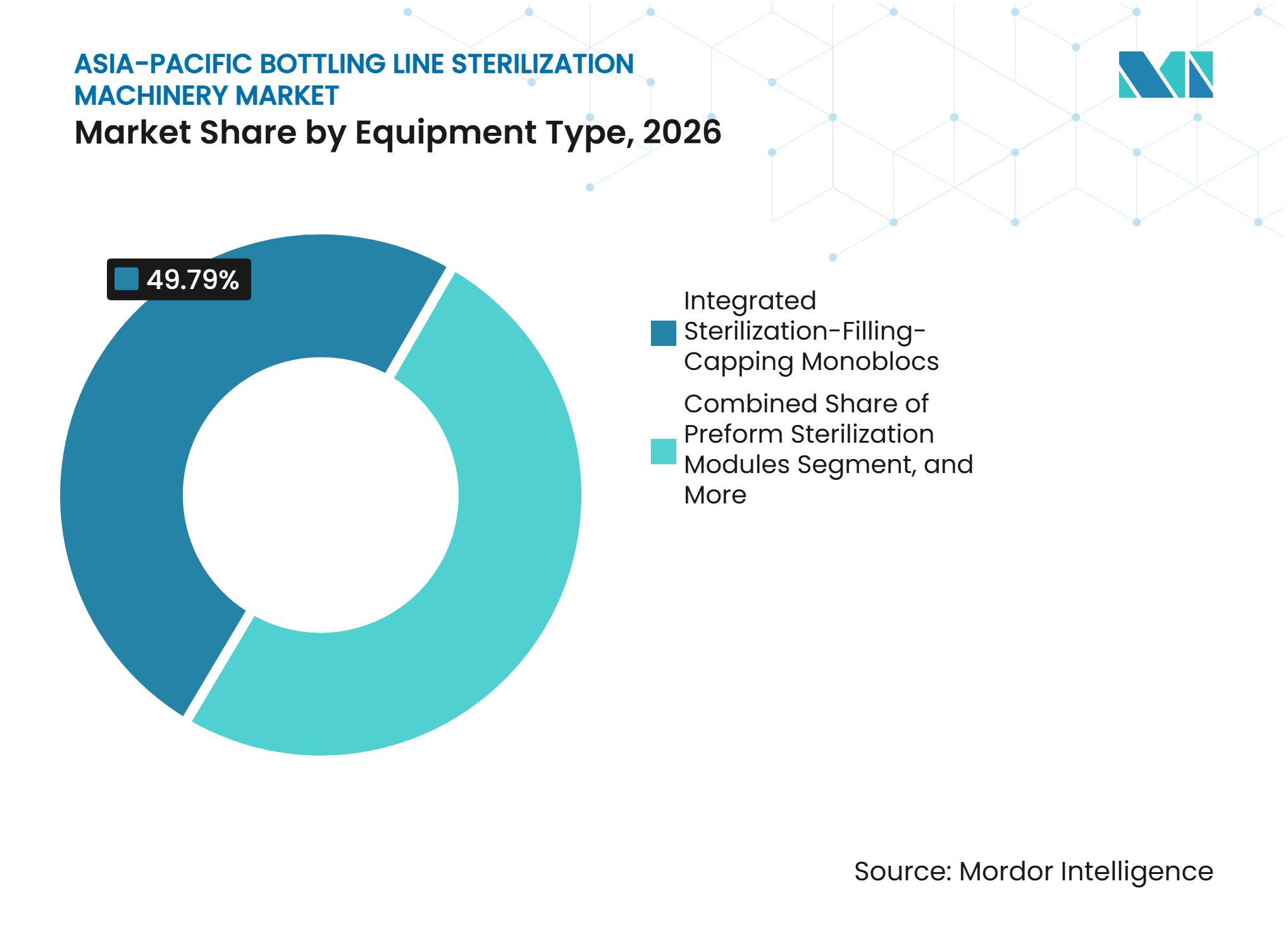
Integrated Monoblocs Support Enclosed Aseptic OperationIntegrated sterilization-filling-capping monoblocs held 49.79% of 2026 revenue in the Asia-Pacific bottling line sterilization machinery market, reflecting demand for a single aseptic enclosure that limits transfer points. The configuration combines sterilization, filling, and capping while reducing potential entry points for contamination. It also helps line teams manage the critical clean zone as one process. Sidel installed 3 high-speed Aseptic Combi Predis lines for China Resources Beverage at Yixing and Chengdu. Those lines produced 54,000 bottles per hour in the 450 ml format and reached rated capacity within 90 days in January 2025.
Preform sterilization modules are projected to expand at a 16.28% CAGR from 2027 to 2032. Treating the preform before blow molding can eliminate the sterile water rinse required for a finished bottle. This can reduce utilities use and bring the critical control point earlier in the production sequence. Bottle-rinsing modules still serve brownfield upgrades where the filling carousel remains in place. Krones stated that its Taicang facility would add local assembly of aseptic systems, including preform sterilization modules, from the second half of 2026.



By Sterilization Technology:
Hydrogen Peroxide Leads as Electron Beam Gains GroundHydrogen peroxide held 43.09% of the 2026 technology segment in the Asia-Pacific bottling line sterilization machinery market. It benefits from established validation practices, familiarity among quality teams, and compatibility with bottle and preform applications. Sidel's Predis process applies hydrogen peroxide mist to a preform before the container enters the blow-molding oven. Peracetic acid remains relevant for wet applications, while GEA’s EcoSpin 2 incorporates water and chemical recovery. Steam, hot water, UV-C, pulsed light, dry heat, and hot air are used in applications where residual limits or container geometry favor another method.
Electron beam and other emerging technologies are projected to expand at a 16.34% CAGR from 2027 to 2032. The electron beam avoids chemical sterilants and water rinsing during the treatment stage. This can lower residual monitoring and utility needs in appropriate applications. Shibuya’s systems use high-energy electron irradiation and have been deployed in more than 150 aseptic systems globally. The company reports mechanical efficiency above 95% and operation for more than 200 continuous hours before cleaning cycles.
By Format:
PET Bottles Remain Established While Preforms Gain RelevancePET bottles held 38.15% of 2026 revenue in the Asia-Pacific bottling line sterilization machinery market. Their low weight, flexible design, and compatibility with wet and dry sterilization keep them central to beverage production. PET also aligns with recycling pathways receiving greater regulatory attention. HDPE remains important where opacity or chemical resistance is needed, while glass remains relevant for premium beverages and pharmaceutical presentations. Caps, closures, pouches, and multilayer laminates require controlled treatment through dedicated or specialized equipment configurations.
Preforms are projected to expand at a 16.37% CAGR from 2027 to 2032. Moving sterilization upstream before blow molding can lower hydrogen peroxide use, water demand, and line footprint. The approach matters for producers facing higher utility costs and stricter discharge standards. DNP Group developed a two-step process that combines preform and bottle treatment while maintaining aseptic performance. This shows how suppliers are adapting sterilization pathways to changing PET and recycled-content requirements.
By Line Configuration:
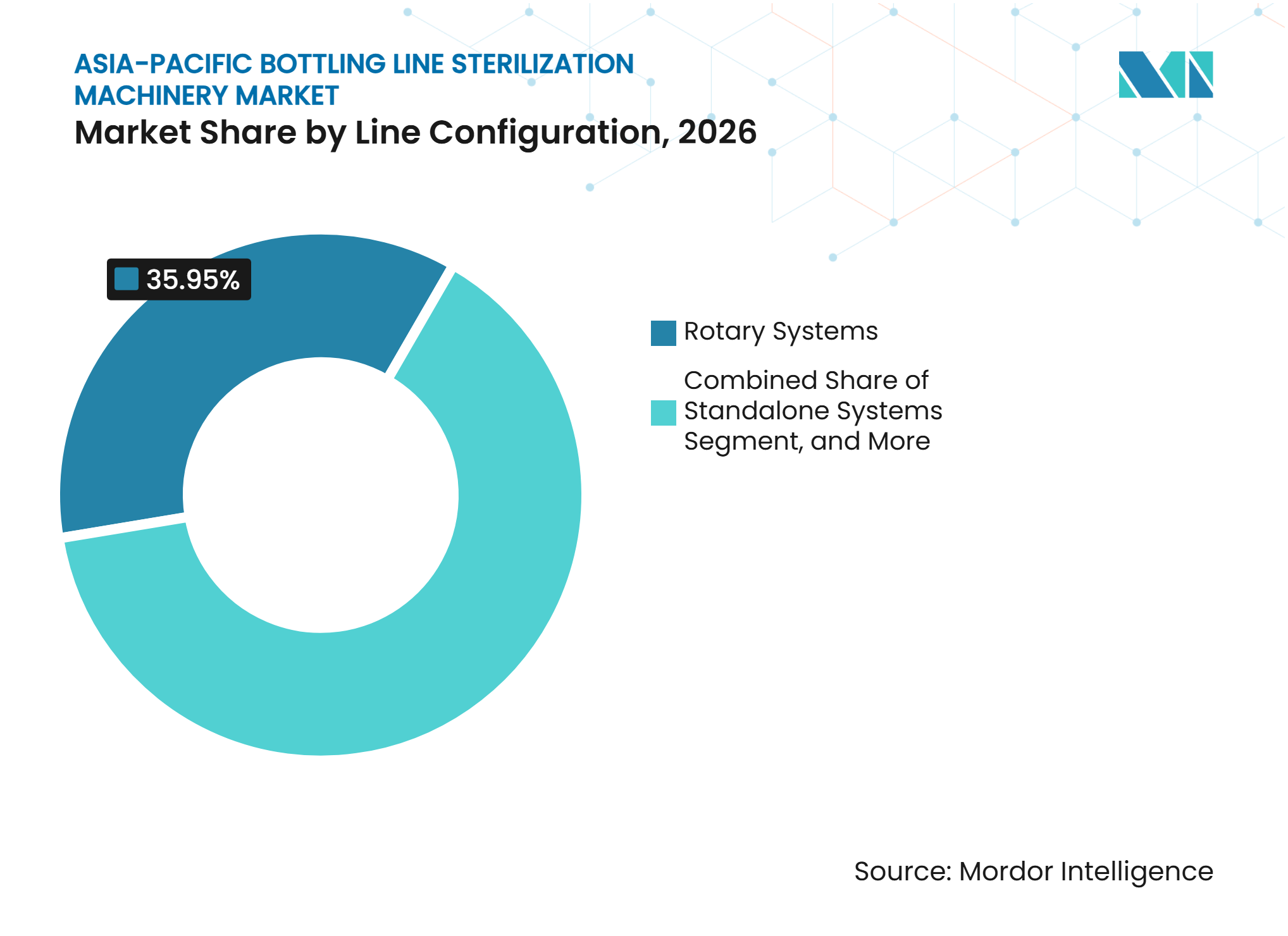
Rotary Systems Retain Scale Advantages as Integrated Systems AccelerateRotary systems held 35.95% of the 2026 line configuration segment in the Asia-Pacific bottling line sterilization machinery market. They remain established at high-throughput beverage plants in China, Japan, and South Korea that use carousel-based filling systems. Linear and inline systems are used in mid-speed or retrofit applications where layout and format flexibility are important. Standalone systems provide an entry point for smaller bottlers that cannot fund a full monobloc. Automatic and semi-automatic systems sit between integrated aseptic lines and manual operations.
Integrated systems are projected to expand at a 16.22% CAGR from 2027 to 2032. They bring contamination-critical steps into a single validated enclosure and reduce monitoring complexity across units. This design supports audit-ready records and more controlled handoffs across the line. Newamstar demonstrated integrated blow-fill-cap systems with digital twin and artificial intelligence features at Interpack 2026. The shift from individual machines toward coordinated lines reflects demand for combined physical containment and digital monitoring.

By End User:
Dairy Leads Current Demand While Pharmaceutical Manufacturing Expands FasterDairy and plant-based beverage producers accounted for 25.31% of the 2026 Asia-Pacific bottling line sterilization machinery market. UHT conversion in China and India supports their need for aseptic infrastructure capable of distributing products without refrigeration. Plant-based products use comparable sterile processing routes when producers seek shelf-stable formats. Sidel delivered an Aseptic Combi Predis PET line to Britannia’s Winkin Cow in India in 2025 with an output of 24,000 bottles per hour. Juice, tea, functional beverages, bottled water, contract packing, and personal-care production provide additional demand.
Pharmaceutical and biopharmaceutical manufacturers are projected to expand at a 16.18% CAGR from 2027 to 2032. Contract development and manufacturing organizations are commissioning isolator-integrated fill-finish lines for regulated markets. Adimmune passed a Taiwan FDA inspection in 2026 for a third automated aseptic filling line for high-value, small-batch biologics. The single-use configuration allows clinical and commercial production to operate in parallel. These projects make pharmaceutical-grade sterilization equipment a more significant source of demand for the Asia-Pacific bottling line sterilization machinery market.
Geography Analysis
China
China held a 43.48% share in 2026, which made it the largest national base in the Asia-Pacific bottling line sterilization machinery market. Its large beverage production base is matched by domestic and international aseptic equipment suppliers, while the Food Safety Law and GB 4806.1 requirements sustain demand for controlled sterilization parameters. Sidel’s Beijing plant supplied more than 20 Aseptic Predis Combi sets to customers in China and elsewhere in Asia over the past 5 years, and it signed a November 2026 framework agreement with China Resources Beverage for tea, juice, and electrolyte water lines. Krones expanded Taicang to add local aseptic assembly and validation support starting in the second half of 2026, while revised sterilized-milk requirements reinforce UHT investment and the validation of aseptic processes.
India
India is projected to expand at a 16.34% CAGR from 2027 to 2032. Low packaged-milk penetration supports UHT conversion and wider ambient distribution, while the Food Safety and Standards Authority of India guides compatibility between food packaging and sterilization. SIG opened its first aseptic carton plant in Ahmedabad in February 2025, with an annual capacity of 4 billion packs, and will add a local extrusion line by 2027. Krones’ INR 315 crore USD 37 million) Vemagal facility opened in August 2026 for bottling and packaging assembly, helping strengthen the local supply and service base for the Asia-Pacific bottling line sterilization machinery market.
Japan, South Korea, and Rest of Asia-Pacific
Japan’s beverage base favors high-specification equipment and chemical-free options when efficiency justifies higher initial costs. Shibuya’s electron beam systems have been deployed by Japanese beverage producers and are designed for long production periods with mechanical efficiency above 95%. South Korea’s demand is linked to biopharmaceutical manufacturing and sterile vial filling, where GMP expectations drive investment in barrier systems, including Daewoong Bio’s 6-million-vial-per-year facility, which was reviewed in October 2026. Vietnam, Indonesia, Thailand, Taiwan, and Australia form a mixed cluster with new beverage and sterile-fill capacity. Tetra Pak’s July 2025 expansion in Vietnam added 15 formats and more than doubled site capacity, while uneven cold-chain coverage and rising compliance expectations are supporting the adoption of enclosed, water-efficient systems across the Asia-Pacific bottling line sterilization machinery market.[2]
Competitive Landscape
Market Concentration
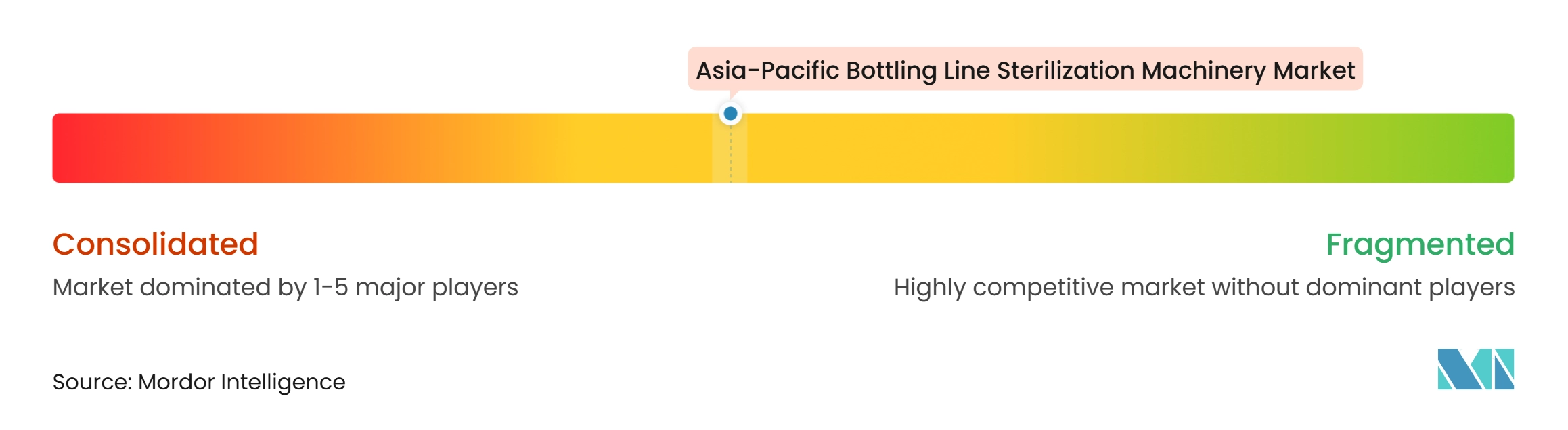
The Asia-Pacific bottling line sterilization machinery market is moderately concentrated and has a two-tier structure. Krones, Sidel, GEA, KHS, and Tetra Pak compete in technology-intensive aseptic applications through proprietary processes, qualification packages, and service relationships. Krones’ Contipure AseptBloc DA, Sidel’s Aseptic Predis, and GEA’s EcoSpin designs illustrate the process technologies used to retain premium positions. Krones is expanding Taicang production and validation support, while Sidel’s Beijing base has supplied high-speed aseptic systems for China and the region.
Tech-Long, Newamstar, and Jiangsu Jinrong are moving from individual machines toward integrated line solutions. Their domestic delivery speed and lower purchase costs are important in mid-tier applications, particularly in China. Global suppliers retain advantages in validated systems and pharmaceutical-grade documentation. Localized assembly is a direct response because it shortens lead times while keeping established process-control models. The competitive gap is narrowing fastest in standard beverage applications within the Asia-Pacific bottling line sterilization machinery market.
Opportunities remain in pharmaceutical-grade bottle and preform treatment, modular systems for smaller ASEAN bottlers, and retrofit electron beam upgrades. Electron beam, digital process monitoring, and recycled-PET-compatible protocols are increasingly useful forms of differentiation. Sidel renewed its relationship with China Resources Beverage in November 2026, Syntegon launched the SynTiso automated fill-finish line in November 2025, and Krones opened its Indian assembly facility in August 2026. These moves focus competition on automation, local service, and regulated-product applications. This pattern supports continued technology competition across the Asia-Pacific bottling line sterilization machinery market.[3]
Asia-Pacific Bottling Line Sterilization Machinery Industry Leaders
-
Krones AG
-
Sidel Group
-
GEA Group Aktiengesellschaft
-
Shibuya Corporation
-
KHS GmbH
- *Disclaimer: Major Players sorted in no particular order
Asia-Pacific Bottling Line Sterilization Machinery Market Companies Covered in this Report
- Krones AG
- Sidel Group
- GEA Group Aktiengesellschaft
- Tetra Pak International S.A.
- KHS GmbH
- Syntegon Technology GmbH
- Shibuya Corporation
- Aseptic Systems Co., Ltd.
- Serac Group
- Guangzhou Tech-Long Packaging Machinery Co., Ltd.
- Newamstar Packaging Machinery Co., Ltd.
- Jiangsu Jinrong Machinery Co., Ltd.
- Nissei ASB Machine Co., Ltd.
- SACMI Imola S.C.
- IMA Group S.p.A.
- JBT Corporation
- ProMach, Inc.
- Barry-Wehmiller Companies, Inc.
- FBR-ELPO S.p.A.
- Tofflon Science and Technology Co., Ltd.
- Shikoku Kakoki Co., Ltd.
Recent Industry Developments in Asia-Pacific Bottling Line Sterilization Machinery Market
- November 2026: Sidel Group signed a purchase cooperation agreement with China Resources Beverage at the ninth China International Import Expo in Shanghai, covering Aseptic Predis technology and large-format PET bottled-water production lines for tea, juice, and electrolyte waters. The deal renewed an 11-year collaboration and extended the customer’s portfolio into sugar-free and plant-based beverages using dry preform sterilization that eliminates bottle rinsing.
- October 2026: Daewoong Bio in South Korea passed a preliminary GMP review by the Ministry of Food and Drug Safety for its new aseptic vial filling facility, designed with an EU GMP Annex 1-aligned contamination-control strategy and restricted access barrier system technology. The plant targets 6 million vials per year, with a planned expansion to 12 million vials through 2 additional production lines.
- August 2026: Krones AG officially opened its Vemagal, Bangalore production facility in India, an INR 315 crore, USD 37 million, plant built in 18 months across 30 acres, adding local assembly of bottling and packaging systems including components for aseptic lines, and creating more than 400 jobs.
- April 2026: Zhejiang Tailingood Biotech exhibited its vaporized H₂O₂ sterilization integral solution for beverage filling lines at CBST 2026 in Shenzhen, China, covering full-chain sterilization from empty bottles and caps through filling-line environments, achieving a 10⁻⁶ sterility assurance level using food-grade H₂O₂ that decomposes to water and oxygen.
Asia-Pacific Bottling Line Sterilization Machinery Market Report Scope
The Asia-Pacific Bottling Line Sterilization Machinery Market includes machinery, equipment, and integrated systems used to sterilize bottles, preforms, caps, closures, and other packaging components in the production of beverages, pharmaceuticals, personal care products, and other liquid products. These systems operate across bottling and packaging lines to eliminate or minimize microbial contamination, preserve product hygiene, and comply with food safety, pharmaceutical, and aseptic packaging standards.
The Asia-Pacific Bottling Line Sterilization Machinery Market Report is Segmented by Equipment Type (Bottle Sterilization and Rinsing Modules, Preform Sterilization Modules, Cap and Closure Sterilization Modules, Integrated Sterilization-Filling-Capping Monoblocs), Sterilization Technology (Hydrogen Peroxide, Peracetic Acid, Steam and Hot Water, Dry Heat and Hot Air, UV-C and Pulsed Light, Electron Beam and Other Emerging Technologies), Format (PET Bottles, HDPE Bottles, Glass Bottles, Preforms, Caps and Closures, and Other Formats), Line Configuration (Rotary Systems, Linear and Inline Systems, Standalone Systems, Integrated Systems, Automatic and Semi-Automatic Systems), End User (Dairy and Plant-Based Beverage Producers, Juice, Tea, and Functional Beverage Producers, Bottled Water Producers, Pharmaceutical and Biopharmaceutical Manufacturers, Contract Beverage and Aseptic Packaging Organizations, Cosmetics, Personal Care, and Other Liquid Product Producers), and Geography (China, India, Japan, South Korea, and Rest of Asia-Pacific). The Market Forecasts are Provided in Terms of Value (USD).
Segmentation Overview
| Bottle Sterilization and Rinsing Modules |
| Preform Sterilization Modules |
| Cap and Closure Sterilization Modules |
| Integrated Sterilization-Filling-Capping Monoblocs |
| Hydrogen Peroxide |
| Peracetic Acid |
| Steam and Hot Water |
| Dry Heat and Hot Air |
| UV-C and Pulsed Light |
| Electron Beam and Other Emerging Technologies |
| PET Bottles |
| HDPE Bottles |
| Glass Bottles |
| Preforms |
| Caps and Closures |
| Other Formats |
| Rotary Systems |
| Linear and Inline Systems |
| Standalone Systems |
| Integrated Systems |
| Automatic and Semi-Automatic Systems |
| Dairy and Plant-Based Beverage Producers |
| Juice, Tea, and Functional Beverage Producers |
| Bottled Water Producers |
| Pharmaceutical and Biopharmaceutical Manufacturers |
| Contract Beverage and Aseptic Packaging Organizations |
| Cosmetics, Personal Care, and Other Liquid Product Producers |
| China |
| India |
| Japan |
| South Korea |
| Rest of Asia-Pacific |
| By Equipment Type | Bottle Sterilization and Rinsing Modules |
| Preform Sterilization Modules | |
| Cap and Closure Sterilization Modules | |
| Integrated Sterilization-Filling-Capping Monoblocs | |
| By Sterilization Technology | Hydrogen Peroxide |
| Peracetic Acid | |
| Steam and Hot Water | |
| Dry Heat and Hot Air | |
| UV-C and Pulsed Light | |
| Electron Beam and Other Emerging Technologies | |
| By Format | PET Bottles |
| HDPE Bottles | |
| Glass Bottles | |
| Preforms | |
| Caps and Closures | |
| Other Formats | |
| By Line Configuration | Rotary Systems |
| Linear and Inline Systems | |
| Standalone Systems | |
| Integrated Systems | |
| Automatic and Semi-Automatic Systems | |
| By End User | Dairy and Plant-Based Beverage Producers |
| Juice, Tea, and Functional Beverage Producers | |
| Bottled Water Producers | |
| Pharmaceutical and Biopharmaceutical Manufacturers | |
| Contract Beverage and Aseptic Packaging Organizations | |
| Cosmetics, Personal Care, and Other Liquid Product Producers | |
| By Geography | China |
| India | |
| Japan | |
| South Korea | |
| Rest of Asia-Pacific |
Key Questions Answered in the Report
What is the Asia-Pacific bottling line sterilization machinery sector size?
The regional bottling line sterilization machinery market is USD 11.42 million in 2027 and is projected to reach USD 23.28 million by 2032 at a 15.31% CAGR.
Which equipment type leads bottling line sterilization machinery demand in Asia-Pacific?
Integrated sterilization-filling-capping monoblocs lead with 49.79% share in 2026 because they combine critical operations inside one aseptic enclosure.
Which sterilization technology is expanding fastest in Asia-Pacific?
Electron beam and other emerging technologies are projected to expand at a 16.34% CAGR through 2032 as operators seek chemical-free treatment options.
Why are preform sterilization modules gaining adoption?
Preform modules are projected to expand at a 16.28% CAGR because they can remove bottle-rinsing steps and reduce water and chemical consumption.
Which end-user group is expanding fastest for sterilization systems?
Pharmaceutical and biopharmaceutical manufacturers are projected to expand at a 16.18% CAGR through 2032 as sterile fill-finish capacity increases.
Which country is expected to expand fastest in Asia-Pacific?
India is projected to expand at a 16.34% CAGR through 2032, supported by UHT dairy conversion, pharmaceutical production, and local equipment investment.