
Asia-Pacific Bathroom Furniture Market Size and Share
Market Overview
| Study Period | 2021 - 2031 |
|---|---|
| Forecast Data Period | 2026 - 2031 |
| Base Year Market Size (2025) | USD 9.42 Billion |
| Market Size (2026) | USD 9.94 Billion |
| Market Size (2031) | USD 14.35 Billion |
| Growth Rate (2026 - 2031) | 7.63 % |
| Market Concentration | Low |
Major Players *Disclaimer: Major Players sorted in no particular order Image © Mordor Intelligence. Reuse requires attribution under CC BY 4.0. | |
Asia-Pacific Bathroom Furniture Market Analysis by Mordor Intelligence
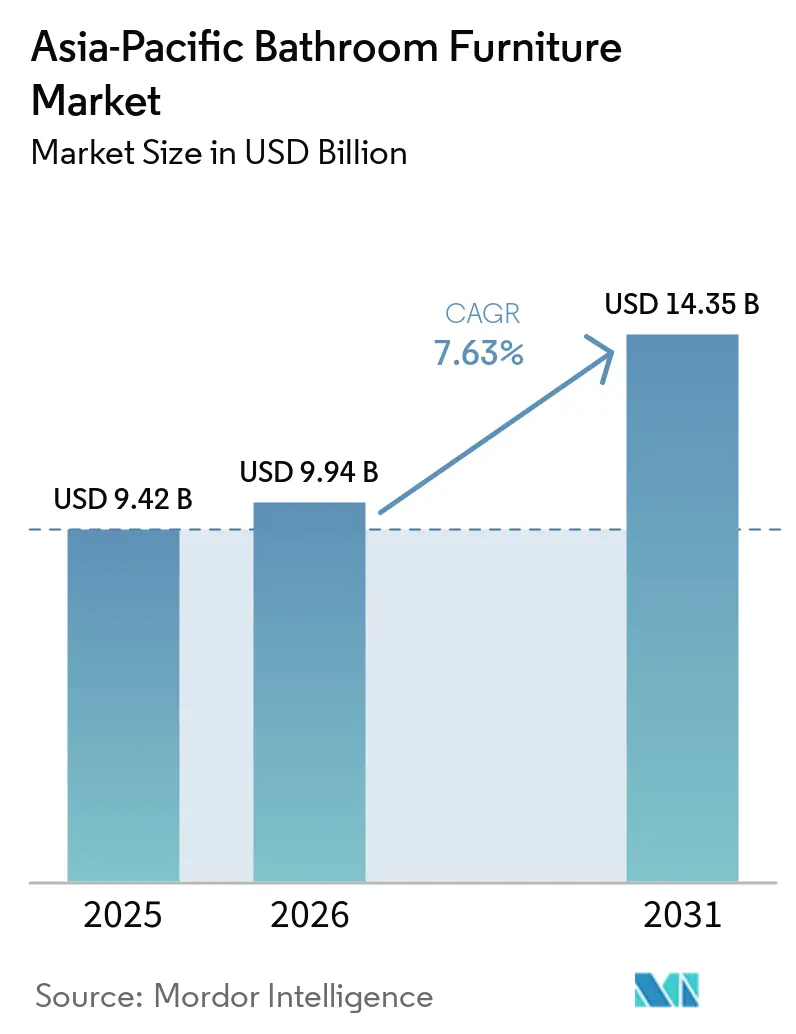
The Asia-Pacific bathroom furniture market is expected to grow from USD 9.42 billion in 2025 to USD 9.94 billion in 2026 and is forecast to reach USD 14.35 billion by 2031 at a 7.63% CAGR over 2026-2031. The Asia-Pacific bathroom furniture market is supported by urban housing development, replacement purchases, and renovation activity across major regional economies. Buyers are placing greater value on compact layouts, dependable moisture resistance, and coordinated finishes, which raises the value of specifications beyond basic storage. Public renovation support in China is directing demand toward eligible bathroom upgrades, including water-efficient and aging-friendly products[1]. Manufacturers are therefore balancing broader retail coverage with direct relationships with developers, architects, and commercial buyers. The Asia-Pacific bathroom furniture market also faces pressure from material costs, low-priced local fabrication, humidity exposure, and varying installation standards across countries.
Key Report Takeaways
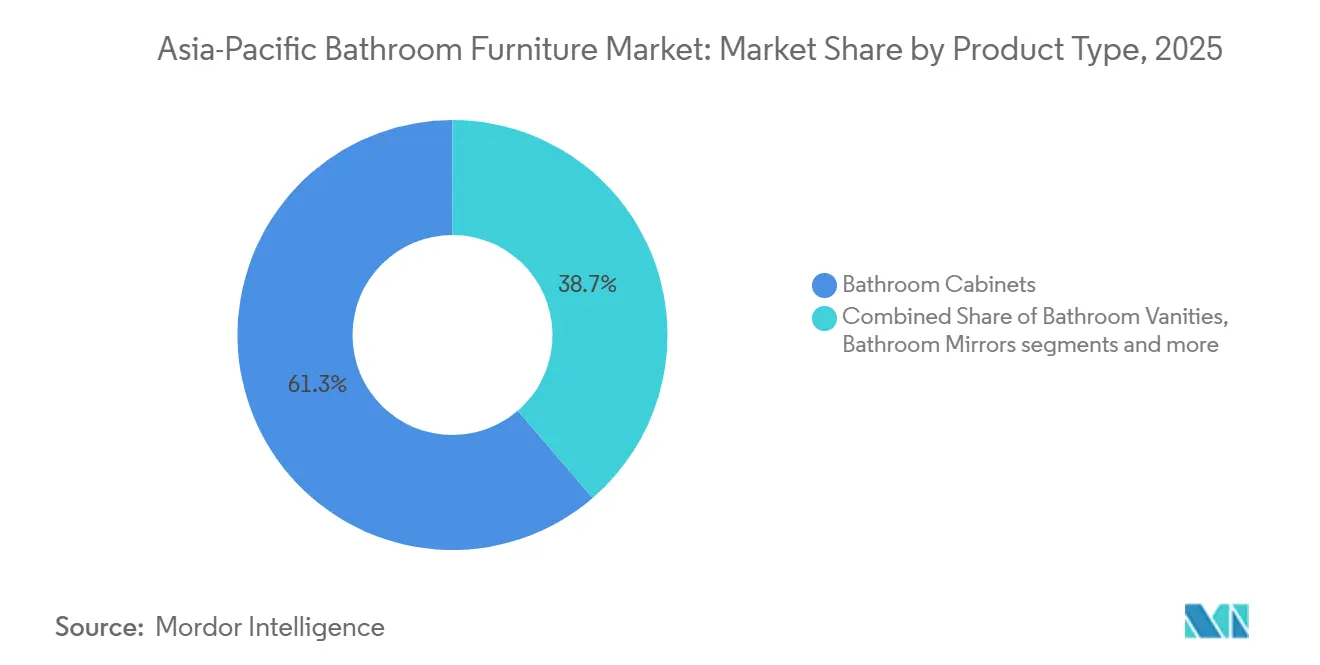
- By product type, bathroom cabinets accounted for 61.3% of the Asia-Pacific bathroom furniture market in 2025, while bathroom vanities are projected to register a CAGR of 9.14% through 2031.
- By material, wood accounted for 38.51% of the market in 2025, while plastic and polymer are projected to register a CAGR of 8.70% through 2031.
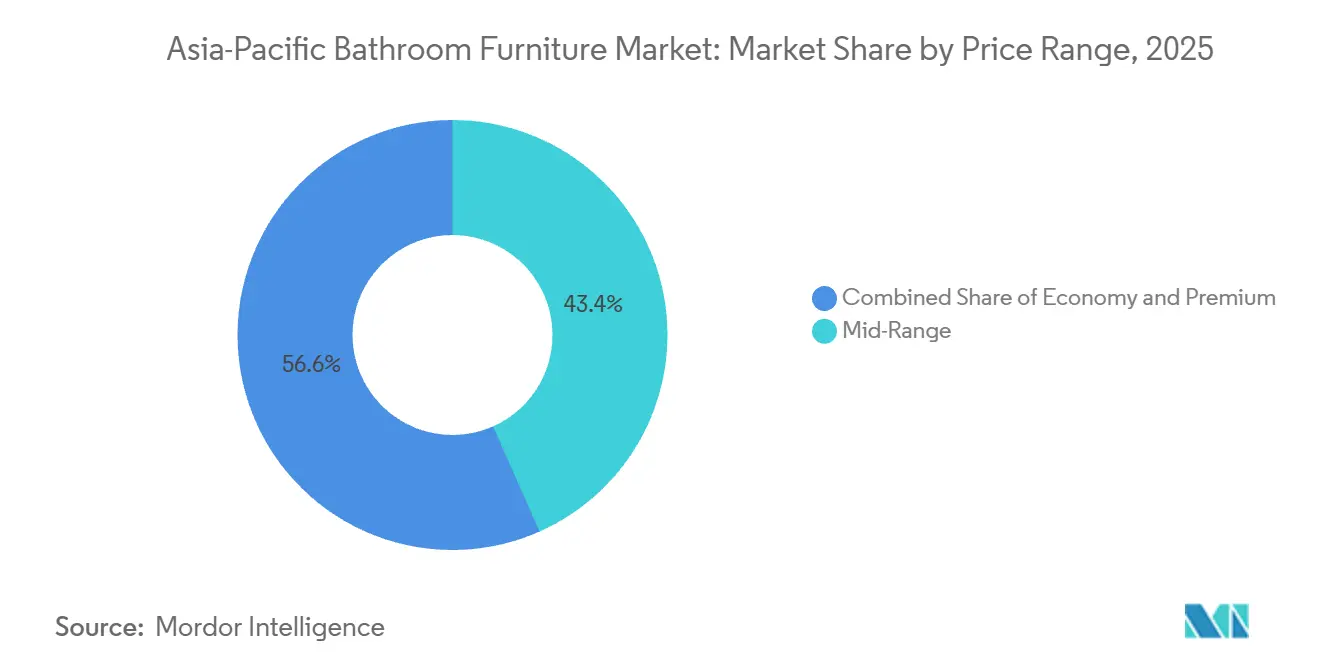
- By price range, the mid-range segment accounted for 43.4% of the market in 2025, while premium products are projected to register a CAGR of 8.86% through 2031.
- By end-user, the residential segment accounted for 75.6% of the market in 2025, while the commercial segment is projected to register a CAGR of 8.78% through 2031.
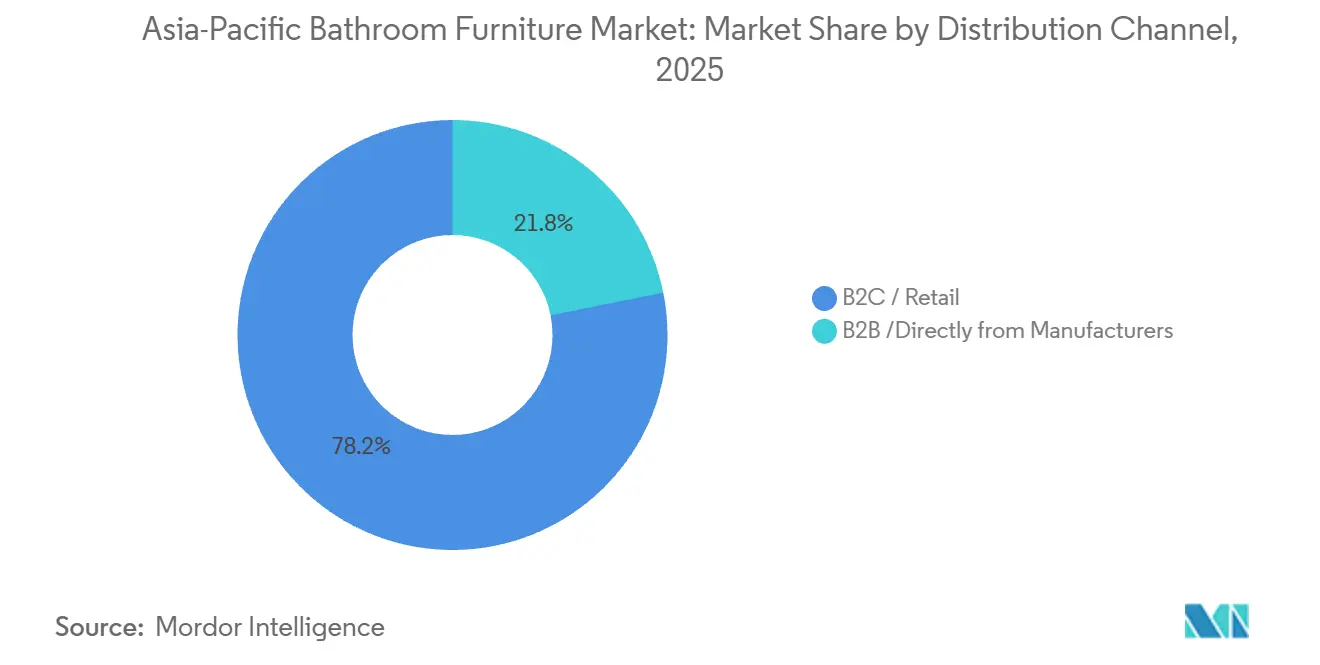
- By distribution channel, B2C and retail accounted for 78.2% of the market in 2025, while B2B and direct sales from manufacturers are projected to register a CAGR of 9.01% through 2031.
Note: Market size and forecast figures in this report are generated using Mordor Intelligence’s proprietary estimation framework, updated with the latest available data and insights as of January 2026.
Market Trends and Insights
Drivers Impact Analysis of Asia-Pacific Bathroom Furniture Market*
| Driver | (~) % Impact on CAGR Forecast | Geographic Relevance | Impact Timeline |
|---|---|---|---|
| Space-Saving and Modular Bathroom Demand | +1.8% | China, Japan, South Korea, urban India, Vietnam, Singapore | Short term (≤ 2 years) |
| Moisture-Resistant Materials and Finishes | +1.3% | Southeast Asia, coastal Australia, coastal South Asia | Medium term (2-4 years) |
| Residential Renovation and Replacement Demand | +1.5% | China, Japan, Australia, South Korea | Medium term (2-4 years) |
| Commercial Construction and Local Supply Expansion | +1.4% | India, Southeast Asia, Japan, Australia | Medium term (2-4 years) |
| Compact-Space Demand for Modular and Multifunctional Furniture | +0.8% | China, Japan, South Korea, Singapore | Medium term (2-4 years) |
| Local Manufacturing and E-Commerce Expansion in Emerging Asia-Pacific | +0.7% | India, Vietnam, Indonesia, Philippines, Thailand | Long-term (≥ 4 years) |
| Source: Mordor Intelligence | |||
Space-Saving and Modular Bathroom Demand
High-density housing and shrinking bathroom footprints are strengthening demand for space-efficient furniture across the Asia-Pacific bathroom furniture market. Wall-mounted vanities, slim cabinets, and modular storage systems help maximize usable floor space while maintaining functionality in compact urban homes. In Japan, the prevalence of single-person households supports demand for compact bathroom modules that integrate basin space, grooming functions, and storage. Similarly, China’s urban apartment developments are creating opportunities for space-saving bathroom furniture, as developers seek standardized solutions that optimize limited floor areas across residential projects. These requirements are extending the importance of functional design beyond premium housing into mid-range residential developments. Modular furniture that supports consistent installation across multiple apartment units offers manufacturers opportunities to serve large-scale housing projects while meeting the growing demand for practical, aesthetically coordinated bathroom interiors.
Moisture-Resistant Materials and Finishes
Humid climates are shifting product specifications away from standard wood products that can swell or delaminate. PVC foam board, moisture-resistant MDF, sealed edges, and durable coatings are gaining relevance in Southeast Asian residential and hospitality projects. Greenpanel markets its HDWR board for bathroom vanity and cabinet applications, with moisture, termite, and fungal resistance[2]. Geberit notes that repeated moisture exposure can damage bathroom furniture when construction and surface protection are inadequate[3]. These requirements raise the importance of substrate quality, coating systems, and warranty terms. The Asia-Pacific bathroom furniture market gives organized brands an advantage where buyers require documented material performance.
Residential Renovation and Replacement Demand
Renovation and replacement activity is emerging as an important source of demand for bathroom furniture across Asia-Pacific, particularly as governments promote residential upgrades and homeowners modernize aging properties. China’s 2025 home renovation program provides rebates of 15% for eligible products and 20% for products meeting Grade 1 water-efficiency requirements. Aging-friendly renovation products can receive a 30% rebate under the same program. China began renovation projects in 25,800 old urban residential communities during the first 11 months of 2025, exceeding its annual target of 25,000 communities. Replacement work brings demand for cabinets and vanities even where new-home activity is limited. Japan and Australia also have aging housing stock that supports replacement-led demand. The Asia-Pacific bathroom furniture market can benefit from products designed for accessible use and straightforward installation in existing homes. These trends are creating opportunities for manufacturers to strengthen replacement sales through accessible, water-efficient, and easy-to-install bathroom furniture, helping offset subdued demand from new residential construction.
Commercial Construction and Local Supply Expansion
Commercial buyers require durable bathroom furniture that can be repeated across rooms and delivered within defined schedules. Hospitality, healthcare, education, retail, and office projects each create separate needs for moisture resistance, hygiene, accessibility, and standardized dimensions. Kohler highlighted the InterContinental Khao Yai Resort and One Bangkok as regional projects in its 2025 distributor program[4]. Direct manufacturer engagement can help project buyers coordinate product specifications and delivery. Local production and regional showrooms can reduce response times and build stronger relationships with developers. The Asia-Pacific bathroom furniture market gains when suppliers can serve both retail consumers and project procurement teams.
Restraints Impact Analysis of Asia-Pacific Bathroom Furniture Market*
| Restraint | (~) % Impact on CAGR Forecast | Geographic Relevance | Impact Timeline |
|---|---|---|---|
| Material, Freight, and Installation Costs | -1.2% | Asia-Pacific, especially island and remote markets | Medium term (2-4 years) |
| Price Sensitivity and Unorganized Local Competition | -0.9% | India, Indonesia, Vietnam, Philippines, Bangladesh | Long term (≥ 4 years) |
| Humidity, Water Exposure, and Durability Failures | -0.7% | Southeast Asia, coastal Australia, coastal South Asia | Medium term (2-4 years) |
| Fragmented Codes, Installer Capability, and After-Sales Execution | -0.6% | ASEAN, especially Vietnam, Indonesia, Myanmar, and the Philippines | Long term (≥ 4 years) |
| Source: Mordor Intelligence | |||
Material, Freight, and Installation Costs
Moisture-resistant boards, precision hardware, and specialty finishes cost more than standard alternatives. The added expense can place compliant products beyond the budgets of economy buyers. Delivery and installation are particularly difficult in island markets that require multiple transport stages. These costs widen the gap between formal brands and local fabricators with simpler operating models. LIXIL consolidated its Thailand sanitaryware plants from 2 facilities to 1 during 2025, showing the importance of cost discipline across regional operations. The Asia-Pacific bathroom furniture market must manage these costs without reducing product durability or after-sales support.
Price Competition, Durability, and Execution Gaps
Local fabricators can offer custom sizes, familiar contractor relationships, and lower prices in many emerging markets. Their lower overhead can make it difficult for organized brands to compete in economy housing without a separate offering. CERA introduced POLIPLUZ in 2025 as an affordable bath-solutions brand for Tier 4 cities and rural India. Humidity also creates warranty and replacement risks when materials are not suited to local conditions. Different building codes and installer capabilities add further pressure to multi-country operations. The Asia-Pacific bathroom furniture market remains exposed when products, installation practices, and after-sales systems fail to match local requirements.
*Our forecasts treat driver/restraint impacts as directional, not additive. The impact forecasts reflect baseline growth, mix effects, and variable interactions.
Asia-Pacific Bathroom Furniture Market Segment Analysis
By Product Type:
Cabinets Hold Scale While Vanities Lead GrowthBathroom Cabinets held 61.3% of the Asia-Pacific bathroom furniture market share in 2025. Their broad appeal covers simple wall-hung products for affordable housing and customized cabinets for premium condominiums. Cabinets remain a practical purchase because they provide storage in bathrooms of different sizes. Their presence across price points supports their leading role in regional demand. Bathroom Vanities are the fastest-growing product category, with the Asia-Pacific bathroom furniture market size for the segment projected to expand at a 9.14% CAGR through 2031.
Vanities combine a basin and storage in one unit, which makes them relevant in smaller urban bathrooms. Buyers also see them as a visible design feature rather than only a storage item. JOMOO’s 2025 AI BATH platform presented the washing area as an interface with connected functions and ambient controls. This product direction supports higher-value configurations and more integrated bathroom planning. Bathroom Mirrors and Storage Furniture & Accessories retain supporting roles in the product mix. Smart mirrors, drawer systems, compact shelving, and towel storage add utility where floor space is limited.

By Material:
Wood Retains the Largest Base While Polymers ExpandWood held 38.5% of the Asia-Pacific bathroom furniture market share in 2025. Consumer familiarity, established fabrication capacity, and use across many price levels support its continued position. Wood-based products can also carry premium finishes that appeal in residential settings. Engineered wood improves the material’s suitability for wet areas when manufacturers use sealed edges and protective coatings. Greenpanel’s HDWR MDF uses MUF resin and is positioned for moisture-sensitive furniture applications.
Plastic and Polymer are forecast to grow at an 8.70% CAGR through 2031. PVC-based products are useful in humid areas because they can provide stronger resistance to water exposure than conventional plywood. The material is gaining traction in tropical residential and hospitality settings. Metal furniture has a narrower role in healthcare and high-traffic locations that need robust and easy-to-clean surfaces. Glass, acrylic composites, and natural stone are used mainly for premium differentiation. The Asia-Pacific bathroom furniture market therefore has room for both wood and polymer products, serving different performance and design needs.
By Price Range:
Mid-Range Leads Demand While Premium Grows FasterMid-Range held 43.4% of the Asia-Pacific bathroom furniture market share in 2025. This position reflects demand from urban households that need better quality without the cost of luxury products. Buyers in this category increasingly seek soft-close hardware, coordinated finishes, and more reliable moisture protection. These expectations make product consistency and service more important. The segment gives organized manufacturers room to offer visible upgrades without moving fully into premium pricing.
Premium is forecast to grow at an 8.86% CAGR through 2031. Higher-end buyers are seeking design-led products, tailored finishes, and better integrated technology. European and global brands are developing showroom and distribution networks to support architect and developer specification. The Economy tier remains important in rural India, Bangladesh, secondary Indonesian cities, and the Philippines. Brands need separate products and channels to serve this price-sensitive demand. The Asia-Pacific bathroom furniture industry must balance premium value creation with affordable products that meet basic durability needs.
By End-User:
Residential Leads While Commercial Purchases AccelerateResidential held 75.6% of the Asia-Pacific bathroom furniture market share in 2025. Housing construction and home renovation remain the foundation of demand across the region. China’s renovation program provides a defined route for bathroom replacement purchases in older communities. Residential buyers range from economy households seeking practical cabinets to premium buyers selecting coordinated vanity systems. This wide base makes residential demand important for every major product and price category.
Commercial is forecast to grow at an 8.78% CAGR through 2031. Hotels, hospitals, schools, offices, and retail projects need products that meet consistent design and performance specifications. Accessibility hardware, antimicrobial surfaces, and durable finishes can differentiate suppliers in these projects. Commercial customers also place greater importance on coordinated delivery across many rooms or sites. This gives direct manufacturers an opportunity to build long-term project relationships. The Asia-Pacific bathroom furniture market can expand commercial sales by developing ranges for hospitality and accessible design rather than adapting residential products after the fact.
By Distribution Channel:
Retail Remains Central While Direct Sales GrowB2C/Retail held 78.2% of the Asia-Pacific bathroom furniture market share in 2025. Home centers, specialty stores, and online channels remain the main route for household purchases. Physical stores are valuable where buyers want to examine finish quality, hardware movement, and product scale. Online discovery supports economy and lower mid-range products, especially where consumers already use digital platforms for home-related purchases. Retail will remain important because bathroom furniture is often selected alongside broader renovation decisions.
B2B/Directly from Manufacturers is forecast to grow at a 9.01% CAGR through 2031. Developers and institutional buyers use direct purchasing to align product specifications, volume pricing, and delivery schedules. JOMOO opened a flagship showroom in Jakarta in November 2025 to engage architects, developers, and interior designers. Direct sales can increase volumes, although project pricing may be lower than retail pricing. Suppliers need to manage profitability carefully while using project relationships to secure recurring work.
Geography Analysis
Northeast Asia Bathroom Furniture Market
China held 35.5% of the Asia-Pacific bathroom furniture market share in 2025. The country’s renovation program is a major source of replacement demand for qualified bathroom products. Rebates support water-efficient and aging-friendly upgrades, which can favor documented and compliant offerings. China also benefits from a large existing housing base and established manufacturing supply chains. Japan and South Korea are mature markets where replacement demand, accessible design, and smart features carry more weight than new housing volume.
India Bathroom Furniture Market
India is forecast to grow at a 9.61% CAGR through 2031, making it the fastest-growing country in the Asia-Pacific bathroom furniture market. Demand is supported by mass housing, urban construction, and commercial development. CERA expanded its experience-center footprint and product portfolio in FY2025, adding 431 new SKUs across the CERA and Senator brands. International suppliers are also strengthening local capacity and distribution. India’s mix of economy, mid-range, and premium demand requires brands to use distinct price and channel strategies.
ASEAN, South Asia and Oceania Bathroom Furniture Market
Southeast Asia combines premium demand in Singapore with cost-sensitive demand in Indonesia and the Philippines. Humidity and coastal conditions make material selection especially important across the sub-region. In Hanoi 2025, LIXIL opened a product experience center, extending its Southeast Asian specification network. Australia and New Zealand have higher average specifications and demand related to healthcare and aged care. Bangladesh, Sri Lanka, Nepal, and Pacific Island countries remain smaller in value terms but offer additional volume potential as construction becomes more formalized. The Asia-Pacific bathroom furniture market requires localized product, pricing, and service models across these varied markets.
Competitive Landscape
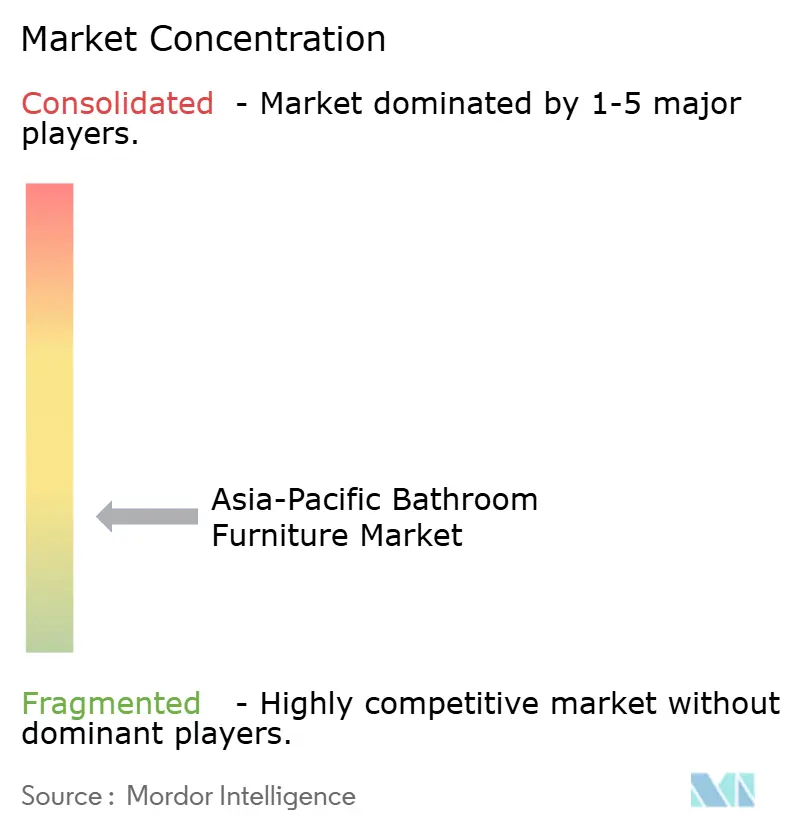
The Asia-Pacific bathroom furniture market is fragmented across price tiers and countries. LIXIL, TOTO, Kohler, Duravit, Villeroy & Boch, and Roca compete in premium and upper mid-range specifications. JOMOO, Huida, SHKL, Jaquar, CERA, and Hindustan Sanitaryware have strong relevance in regional mid-range and economy demand. Global brands are building product development, showroom, and technical capabilities closer to regional customers. Domestic suppliers are increasing their use of smart features and design-led products to move beyond price competition.
In July 2025, LIXIL opened its 1,654-square-meter International Competence Center in Guangzhou. The facility brings supply-chain collaboration, material analysis, and technical validation closer to South China’s bathroom manufacturing base. JOMOO’s AI BATH and Xiaomu YOUNG BATH launches in 2025 show its focus on connected bathroom functions. CERA launched POLIPLUZ to address affordable demand without changing the positioning of its premium Senator range. These moves show that leading companies are using separate platforms, channels, and product ranges for distinct customer groups.
Hospitality-grade products for 3-star and 4-star projects remain a potential gap between mass residential and luxury hotel offerings. Accessible bathroom systems also remain an opportunity as countries address aging populations and inclusive design requirements. Caroma’s Urbane Universal Accessories offer load-rated grab rails with a 20-year warranty and received the 2025 HIA Western Australia Product Innovation Award. Technology in coatings, LED mirrors, and modular systems can create differentiation where products otherwise look similar.
Asia-Pacific Bathroom Furniture Industry Leaders
-
LIXIL Corporation
-
TOTO LTD.
-
Kohler Co.
-
Roca Sanitario, S.A.
-
Jaquar Group
- *Disclaimer: Major Players sorted in no particular order
Asia-Pacific Bathroom Furniture Market Companies Covered in this Report
- LIXIL Corporation
- TOTO LTD.
- Kohler Co.
- Roca Sanitario, S.A.
- Jaquar Group
- RAK Ceramics P.J.S.C.
- Huida Sanitary Ware Co., Ltd.
- JOMOO Kitchen and Bath Co., Ltd.
- COTTO Public Company Limited
- CERA Sanitaryware Limited
- Hindustan Sanitaryware and Industries Limited
- Arrow Home Group
- Duravit AG
- Villeroy and Boch AG
- Geberit International AG
- Oppein Home Group Inc.
- Caroma Industries Limited
- Panasonic Housing Solutions Co., Ltd.
- Timberline Bathroom Furniture
- Rifco Pty Ltd
- Architectural Designer Products Pty Ltd
- SHKL Sanitary Ware Co., Ltd.
Recent Industry Developments in Asia-Pacific Bathroom Furniture Market
- November 2025: JOMOO opened its inaugural flagship showroom in Jakarta, Indonesia, establishing a platform for strategic engagement with APAC architects, developers, and interior designers. The facility anchors JOMOO's Southeast Asia expansion, supporting a network of over 40 retail outlets in Indonesia and reinforcing its health-and-hygiene-focused smart bathroom positioning for regional markets.
- July 2025: LIXIL Corporation inaugurated its 1,654-square-meter International Competence Center in Guangzhou, China, a cross-functional R&D hub designed to accelerate product development for GROHE and American Standard brands through deeper integration with South China's kitchen and bathroom supply-chain networks and manufacturing ecosystem.
- July 2025: CERA Sanitaryware Limited launched POLIPLUZ, a dedicated affordable bath-solutions brand targeting Tier 4 cities and rural India. Backed by a dedicated 70-member team with a separate channel and dealer ecosystem, the brand signals a dual-architecture strategy to capture mass-market volume without compromising CERA's premium Senator positioning.
- June 2025: Kohler Co. convened its 2025 Asian Pacific Distributor Conference in Bangkok, aligning regional distributors on its Statement and Anthem showering collections and reaffirming manufacturing and partnership investments across Thailand and Indonesia, including contributions to the InterContinental Khao Yai Resort and One Bangkok luxury developments.
Asia-Pacific Bathroom Furniture Market Report Scope
Segmentation Overview
| Bathroom Vanities |
| Bathroom Cabinets |
| Bathroom Mirrors |
| Storage Furniture & Accessories |
| Wood |
| Metal |
| Plastic and Polymer |
| Others |
| Economy |
| Mid-Range |
| Premium |
| Residential | |
| Commercial | Hospitality |
| Retail and Office | |
| Healthcare and Education | |
| Others Commercial End User |
| B2C / Retail | Home Centers |
| Specialty Furniture Stores | |
| Online | |
| Other Distribution Channels | |
| B2B /Directly from Manufacturers |
| India |
| China |
| Japan |
| Australia |
| South Korea |
| South-East Asia |
| Rest of Asia-Pacific |
| By Product Type | Bathroom Vanities | |
| Bathroom Cabinets | ||
| Bathroom Mirrors | ||
| Storage Furniture & Accessories | ||
| By Material | Wood | |
| Metal | ||
| Plastic and Polymer | ||
| Others | ||
| By Price Range | Economy | |
| Mid-Range | ||
| Premium | ||
| By End User | Residential | |
| Commercial | Hospitality | |
| Retail and Office | ||
| Healthcare and Education | ||
| Others Commercial End User | ||
| By Distribution Channel | B2C / Retail | Home Centers |
| Specialty Furniture Stores | ||
| Online | ||
| Other Distribution Channels | ||
| B2B /Directly from Manufacturers | ||
| By Country | India | |
| China | ||
| Japan | ||
| Australia | ||
| South Korea | ||
| South-East Asia | ||
| Rest of Asia-Pacific | ||
Key Questions Answered in the Report
What is the projected growth rate for Asia-Pacific bathroom furniture through 2031?
The sector is projected to grow at a 7.6% CAGR from 2026 to 2031, rising from USD 9.94 billion to USD 14.35 billion.
Which product category is growing fastest in Asia-Pacific bathroom furniture?
Bathroom Vanities are expected to rise fastest with CAGR of 9.14% during the forecast period.
Why are plastic and polymer bathroom furniture products gaining demand?
Plastic and Polymer products are growing at an 8.70% CAGR because humidity and water exposure increase demand for moisture-resistant materials.
Which end-user group creates the largest demand for bathroom furniture?
Residential users held a 75.6% share in 2025, supported by housing construction, renovation, and replacement purchases.
How are suppliers serving cost-sensitive buyers in India?
Suppliers are introducing separate affordable offerings, such as CERA’s POLIPLUZ, while maintaining premium brands for higher-value buyers.