
Asia-Pacific Animal Feed Organic Trace Minerals Market Size and Share
Market Overview
| Study Period | 2021 - 2031 |
|---|---|
| Forecast Data Period | 2026 - 2031 |
| Base Year Market Size (2025) | USD 620 Million |
| Market Size (2026) | USD 660 Million |
| Market Size (2031) | USD 880 Million |
| Growth Rate (2026 - 2031) | 5.92 % |
| Market Concentration | Medium |
Major Players *Disclaimer: Major Players sorted in no particular order Image © Mordor Intelligence. Reuse requires attribution under CC BY 4.0. | |
Asia-Pacific Animal Feed Organic Trace Minerals Market Analysis by Mordor Intelligence
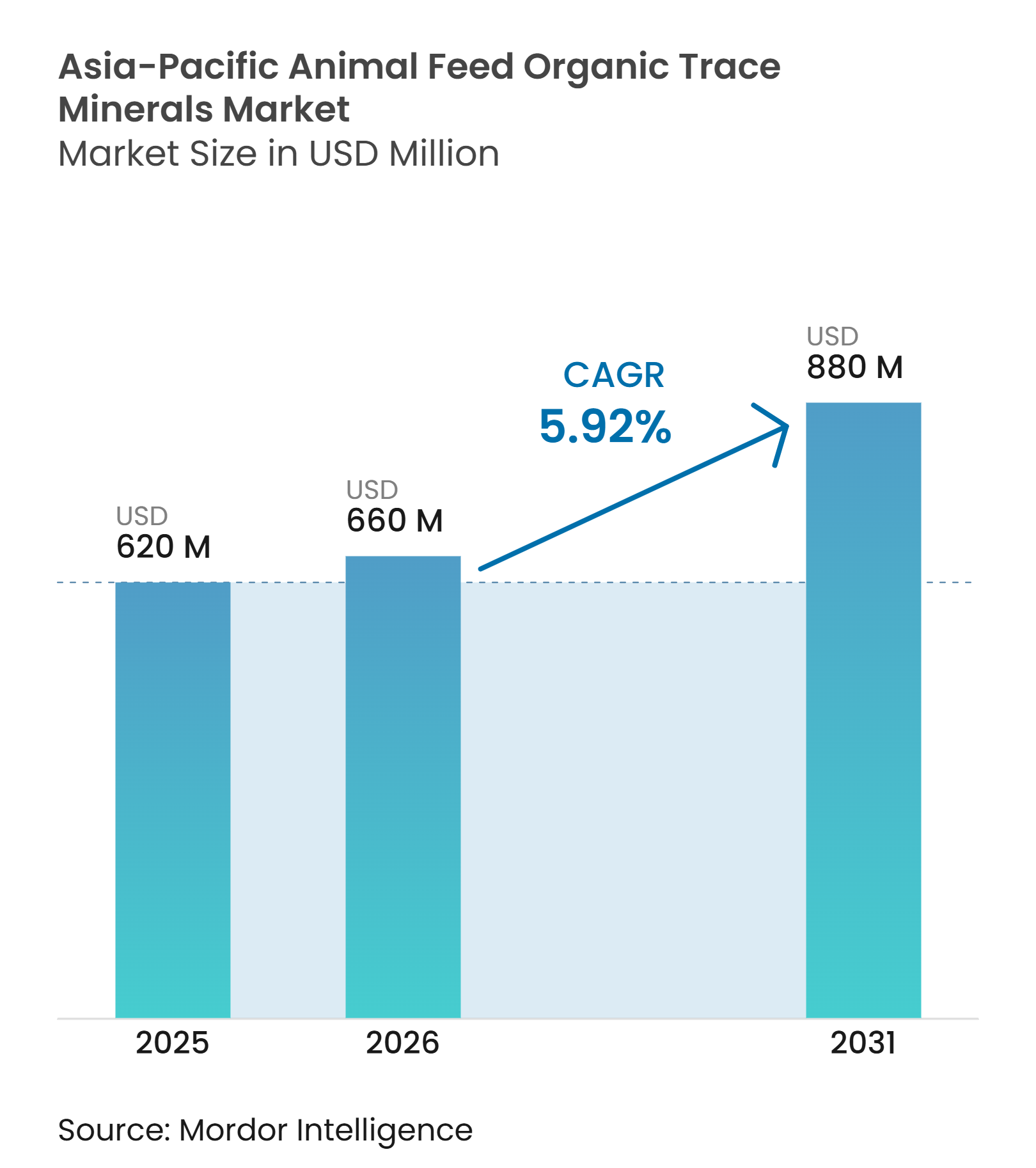
The Asia-Pacific animal feed organic trace minerals market size is projected to grow from USD 620 million in 2025 to USD 660 million in 2026 and is forecast to reach USD 880 million by 2031 at a 5.92% CAGR over 2026–2031. The market is expanding as intensive livestock and aquaculture systems place greater value on mineral utilization, feed stability, and consistent formulation quality. Producers are moving beyond commodity mineral selection, with reduced mineral antagonism, lower excretion, and improved animal health outcomes demonstrated. Regulatory specifications in China and export-oriented supply chains are raising the importance of validated mineral forms. The market also faces a clear cost hurdle because organic forms carry a 2–4 times price premium over inorganic salts. Suppliers with species-specific evidence, stable formulations, and technical support are better placed to serve large integrators and advanced feed manufacturers.
Key Report Takeaways
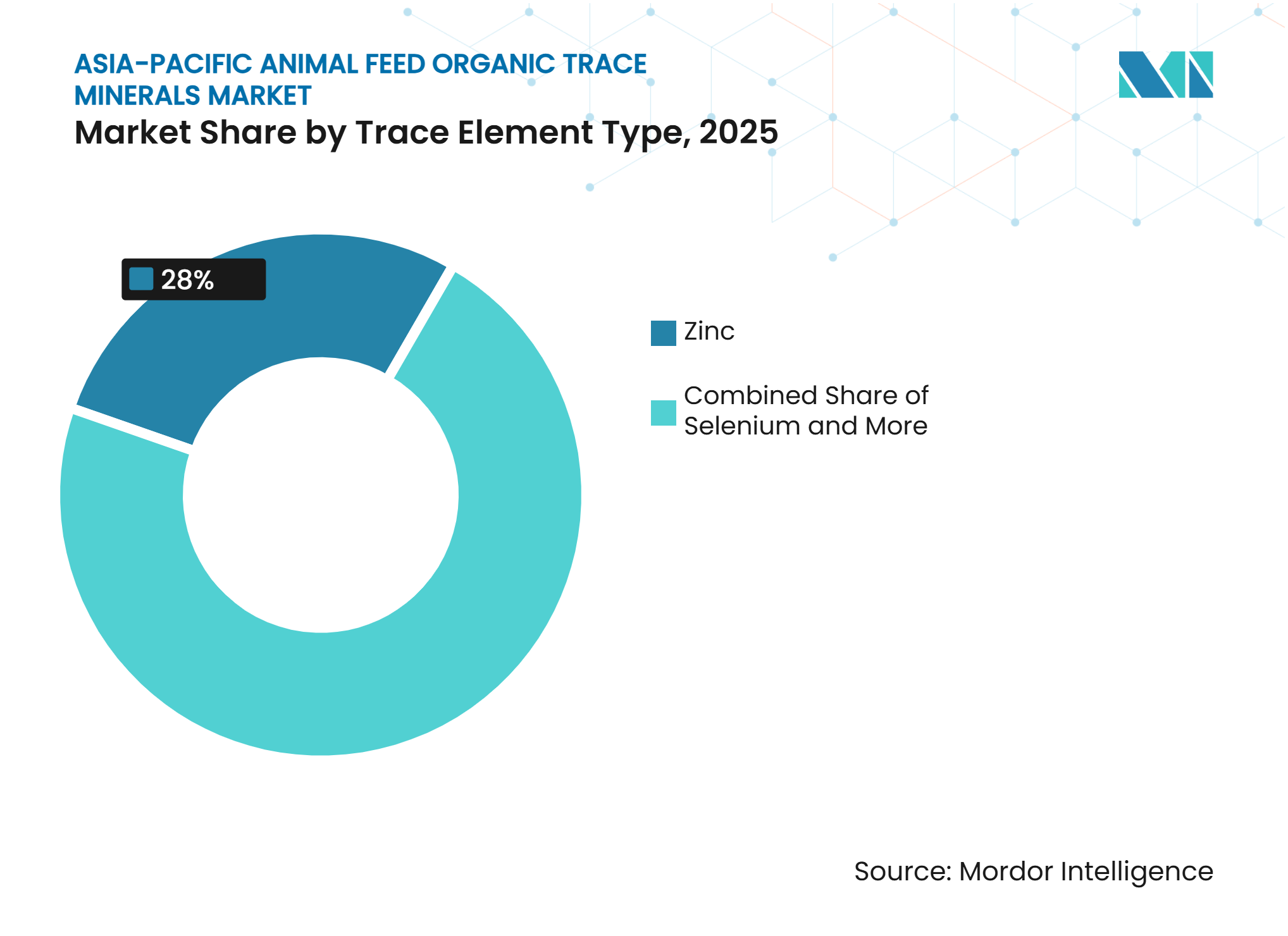
- By trace element type, zinc held 28% revenue share in 2025, while selenium is forecast to expand at a 7.8% CAGR during 2026–2031.
- By chelation type, amino-acid chelates accounted for 31% of the Asia-Pacific animal feed organic trace minerals market size in 2025, while hydroxy-trace minerals are forecast to expand at an 8.6% CAGR during 2026–2031.
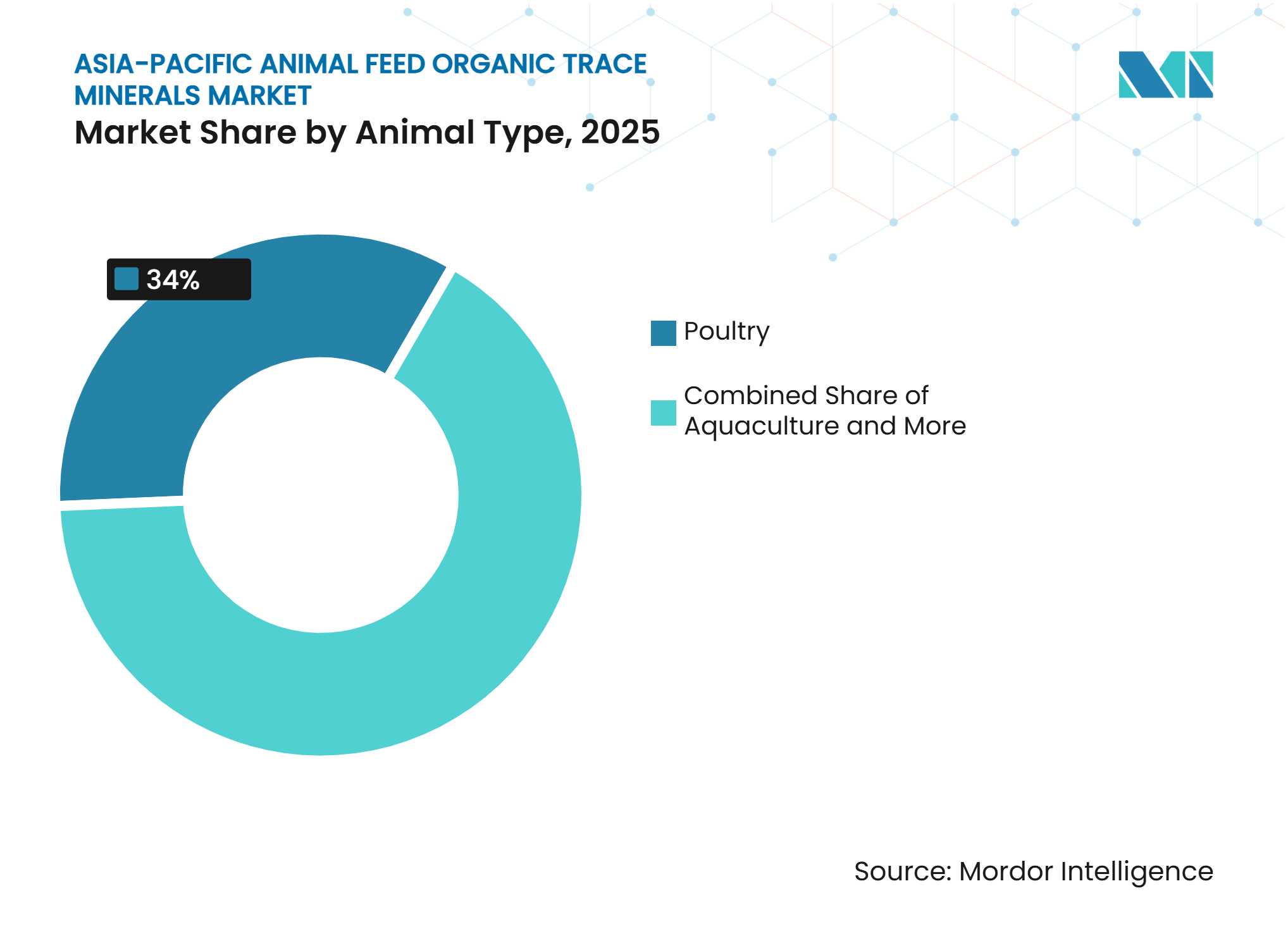
- By animal type, poultry held 34% revenue share in 2025, while aquaculture is forecast to expand at an 8.1% CAGR during 2026–2031.
- By geography, China held 38% of the Asia-Pacific animal feed organic trace minerals market share in 2025, while the rest of Asia-Pacific is forecast to expand at a 7.4% CAGR during 2026–2031.
Note: Market size and forecast figures in this report are generated using Mordor Intelligence’s proprietary estimation framework, updated with the latest available data and insights as of January 2026.
Market Trends and Insights
Drivers Impact Analysis of Asia-Pacific Animal Feed Organic Trace Minerals Market*
| Driver | (~) % Impact on CAGR Forecast | Geographic Relevance | Impact Timeline |
|---|---|---|---|
| Higher bioavailability requirements in intensive production | +1.4% | China, India, South Korea, Japan, Australia | Short term (≤ 2 years) |
| Expansion of aquaculture and high-density shrimp production | +1.2% | China, India, Rest of Asia-Pacific | Short term (≤ 2 years) |
| Greater use of stress- and health-oriented mineral programs | +0.9% | India, China, Rest of Asia-Pacific | Medium term (2–4 years) |
| Pressure to reduce mineral excretion from manure and aquaculture effluent | +0.8% | Japan, Australia, South Korea, China | Medium term (2–4 years) |
| Low-dose organic mineral substitution in plant-protein diets | +0.7% | China, India, Rest of Asia-Pacific | Medium term (2–4 years) |
| Demand for verified, application-specific chelation and traceability | +0.6% | Japan, Australia, South Korea, China | Long term (≥ 4 years) |
| Source: Mordor Intelligence | |||
Higher Bioavailability Requirements in Intensive Production
The market benefits from the move toward more intensive poultry, swine, and aquaculture production. High-density systems commonly use cereal and plant-protein diets, in which phytate, mycotoxins, and competing mineral ions can limit the availability of inorganic zinc, copper, and manganese. A 2025 review found that organic zinc, selenium, chromium, copper, and manganese supported stronger broiler performance, feed conversion, and antioxidant capacity than inorganic counterparts, particularly under heat stress. The importance of this evidence rises when producers work with dense housing, rapid growth cycles, and narrow margins for nutritional error. Large integrated operators increasingly require more consistent mineral specifications in their feed procurement processes, rather than accepting default sulfate specifications. This shifts supplier competition toward proven chelate stability, species-specific dosing, and practical evidence that lower inclusion rates can support production outcomes.
Expansion of aquaculture and high-density shrimp production
Aquaculture is driving major demand for the Asia-Pacific animal feed organic trace minerals market, as shrimp and finfish rations increasingly incorporate plant-based ingredients. Soy protein concentrate, insect meal, and fermented plant materials can increase the conditions under which free mineral ions interact poorly with feed components. A 2026 study of Pacific white shrimp found that partial replacement of inorganic trace elements with organic forms in Tenebrio molitor-based diets maintained growth, antioxidant status, and intestinal microbiota diversity more effectively than inorganic controls. High-density shrimp systems in Vietnam and India require mineral programs that perform under disease pressure, water-quality risk, and changing feed materials. Export supply chains also place greater emphasis on residue management for mineral inputs. These conditions favor shrimp and finfish formulations with mineral form and dose adjusted for the diet.
Low-dose organic mineral substitution in plant-protein diets
Plant-protein diets are becoming increasingly relevant to mineral formulation decisions in poultry, swine, shrimp, and finfish feeds. Soy protein concentrate, rapeseed meal, sunflower cake, and insect meal can contain components that bind free mineral ions, reducing their availability to the animal. Organic mineral forms may provide a useful alternative where feed manufacturers need to manage these interactions at lower inclusion rates. The 2026 shrimp trial found that partial organic trace-element replacement maintained performance in an insect-meal diet, underscoring the need to assess mineral form alongside the underlying feed matrix. Phytase remains an important part of plant-protein feed formulation, but its use does not remove the need to assess mineral interactions in each ration. Suppliers that can support a defined inclusion approach for plant-protein diets can address a practical reformulation need in China, India, and the Rest of Asia-Pacific.
Demand for Verified, Application-Specific Chelation and Traceability
Feed manufacturers increasingly need clear information on the mineral form, intended use, and handling characteristics of specialty products. This need is strongest where premium programs, formal certification, or export-oriented supply chains require closer review of feed inputs. Japan’s organic feed framework requires traceability from the ligand source to the finished product, underscoring the importance of documented sourcing. Application-specific evidence also matters because a mineral formulation can perform differently across species, diets, and production conditions. Novus International, Inc. emphasized bis-chelated mineral verification in 2025, illustrating how suppliers are using product verification to differentiate their offerings.
Restraints Impact Analysis of Asia-Pacific Animal Feed Organic Trace Minerals Market*
| Restraint | (~) % Impact on CAGR Forecast | Geographic Relevance | Impact Timeline |
|---|---|---|---|
| 2–4 times cost premium versus inorganic salts | -1.80% | India, Rest of Asia-Pacific, China | Short term (≤ 2 years) |
| Fragmented approval, labeling, and maximum-inclusion rules | -1.20% | All geographies, most acute in Rest of Asia-Pacific and India | Medium term (2–4 years) |
| Inconsistent benefit by mineral source, species, and basal diet | -0.90% | Global, spill-over to Asia-Pacific core | Medium term (2–4 years) |
| Chelation verification and precision-dosing capability gaps | -0.70% | India, Rest of Asia-Pacific | Long term (≥ 4 years) |
| Source: Mordor Intelligence | |||
2–4 Times Cost Premium Versus Inorganic Salts
The price premium for organic trace minerals is the most immediate adoption constraint in India, Rest of Asia-Pacific, and cost-sensitive areas of China. Zinc sulfate and copper sulfate remain established choices for feed manufacturers focused on minimizing input costs. Organic mineral returns vary by animal species, production stage, basal diet, health status, and chelation chemistry. Generic claims therefore do not resolve procurement concerns for integrators, especially when the benefit of a particular source is not consistent across every feed matrix. Suppliers need to show lower optimal inclusion rates, reduced veterinary intervention, or improved carcass yield within the specific production system under consideration. The commercial case is strongest when a product is evaluated against a clearly defined feed and animal application, rather than against inorganic minerals in general.
Inconsistent Benefit by Mineral Source, Species, and Basal Diet
Organic trace minerals do not yield the same outcome across all animal species, production stages, or feed matrices. The 2025 broiler evidence on organic selenium was generated under a defined inclusion level and dietary combination, rather than as a universal result for all organic minerals[1]. Likewise, the 2026 shrimp study evaluated partial replacement of insect meal in a specific insect-meal diet for Pacific white shrimp. These findings are useful, but they require nutritionists and procurement teams to assess the relevance of trial conditions before changing a commercial formulation. The need for application-specific evaluation can delay purchasing decisions and restrict broader adoption by cost-sensitive feed manufacturers. Suppliers, therefore, face a higher evidence burden when they seek to make performance claims across several species or diets.
*Our forecasts treat driver/restraint impacts as directional, not additive. The impact forecasts reflect baseline growth, mix effects, and variable interactions.
Asia-Pacific Animal Feed Organic Trace Minerals Market Segment Analysis
By Trace Element Type:
Zinc Is the Largest Segment and Selenium Is the Fastest-Growing SegmentZinc accounted for 28% of the Asia-Pacific animal feed organic trace minerals market by trace element type in 2025. Its position reflects its established role in immunity, reproductive performance, hoof integrity, and skin health across major animal species. Zinc is commonly included in regional premixes for poultry, swine, cattle, and aquaculture. Copper and manganese provide a secondary contribution to the material because they support enzyme activity and bone development in broilers and swine. Demand for iron proteinate is supported by its use in weanling-pig programs in China and India.
Selenium is the fastest-growing trace element type, with a projected CAGR of 7.8% during 2026–2031. The Asia-Pacific animal feed organic trace minerals industry is seeing demand shift from sodium selenite toward organic selenium forms, including L-selenomethionine and selenium yeast. These forms can build a wider tissue selenium reserve and support maternal nutrition programs. A 2025 study found that organic selenium in broiler diets improved carcass quality and immune response. In shrimp and finfish production, selenium is also attracting attention for its role in antioxidant defenses during disease challenge.



By Chelation Type:
Amino-Acid Chelates Are the Largest Segment and Hydroxy Forms Are the Fastest-Growing SegmentAmino-acid chelates accounted for 31% of the chelation-type segment in 2025, the largest share within the Asia-Pacific animal feed organic trace minerals market. Their established position reflects regulatory familiarity, species-specific trial history, and broad acceptance among formulators. These products include zinc, copper, manganese, and iron chelated with ligands such as glycine, methionine, and lysine. Proteinates are also widely used, particularly in ruminant nutrition, where protein hydrolysate binding supports functional stability through the rumen. Polysaccharide complexes, propionates, and yeast-based mineral complexes are used for more specialized applications in aquaculture, equine nutrition, and antibiotic-free poultry programs.
Hydroxy-trace minerals are the fastest-growing chelation type at an 8.6% CAGR during 2026–2031. Their gradual release as intestinal pH falls can reduce reactivity with vitamins and phytase in complex premixes. Orffa states that hydroxy copper can improve phytase efficacy in broiler premixes when used in place of copper sulfate, because sulfate-bound free ions can form complexes that limit enzyme activity[2]
By Animal Type:
Poultry Is the Largest Segment and Aquaculture Is the Fastest-Growing SegmentPoultry accounted for 34% of the animal type segment in 2025 and represented the largest source of demand. Large broiler and layer systems in China, India, Indonesia, Vietnam, and Thailand provide the underlying scale. Organic zinc, manganese, selenium, and copper are used in commercial nutrition programs where feed conversion and carcass yield can affect profitability at high production volumes. Swine is another important application, particularly in China, where organic zinc is used in weanling programs. Dairy and beef cattle provide a smaller but stable demand through transition-cow nutrition and reproductive-management programs.
Aquaculture is forecast to grow at an 8.1% CAGR during 2026–2031, making it the fastest animal type segment. The Asia-Pacific animal feed organic trace minerals market size for aquaculture benefits from demand in shrimp and high-value finfish production. A 2026 shrimp study showed that organic trace element replacement performed well in alternative insect-meal diets, supporting its use where feed ingredients differ from standard terrestrial rations. Pet and equine applications remain smaller, but premium nutrition requirements in Australia, Japan, and South Korea support their development. Japan’s certified organic feed requirements further reinforce the need for identified mineral sourcing in supply chains serving its livestock sector.

Geography Analysis
China held 38% of the Asia-Pacific animal feed organic trace minerals market share in 2025. Its position reflects the scale of compound feed manufacturing and vertically integrated poultry and swine production. The country also has a large aquaculture base that increases the range of animal-feed applications. Feed manufacturers in China can adopt specialized mineral products across several production systems rather than relying on a single livestock category. This breadth makes China the region’s primary commercial base for suppliers with an established product range.
India held the second-largest geographic share in 2025, while the Rest of Asia-Pacific is projected to expand at a 7.4% CAGR during 2026–2031. India’s demand is tied to the growth of organized poultry production and the gradual modernization of feed formulation practices. Vietnam, Indonesia, and Thailand provide a separate growth base through shrimp production and aquafeed manufacturing. These markets create different commercial requirements, with poultry producers seeking consistent premix supply and shrimp producers focused on mineral performance in plant-based aquafeed.
Japan, Australia, and South Korea form the region’s higher-value end of the Asia-Pacific animal feed organic trace minerals market. Their demand is linked to premium animal protein, documented input sourcing, and precision nutrition practices. Japan’s organic feed certification framework requires traceability from ligand source to finished product[3]
Competitive Landscape
Market Concentration
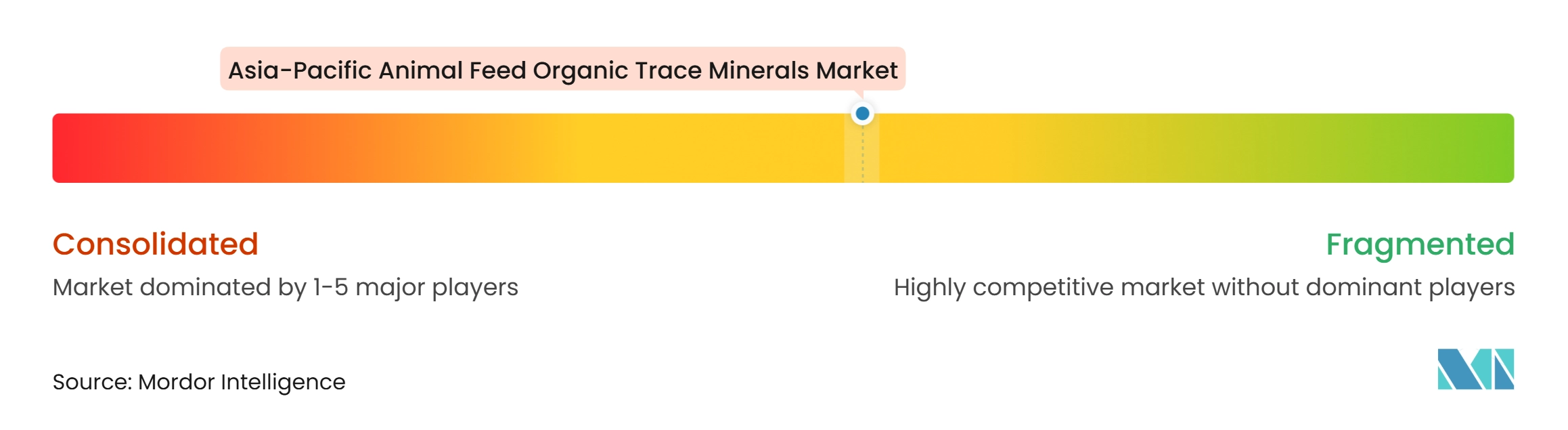
The Asia-Pacific animal feed organic trace minerals market is moderately concentrated, with multinational suppliers holding strong positions in premium formulations and technical support. Zinpro Corporation, DSM-Firmenich AG, Kemin Industries, Inc., Alltech, Inc., and Novus International, Inc. compete through organic-binding approaches, species-specific evidence, and service capabilities. Their offerings are relevant where feed manufacturers need consistent product quality and practical formulation guidance. Regional manufacturers remain important in price-sensitive segments, especially in India and the rest of the Asia-Pacific. This mix limits consolidation because suppliers serve different customer requirements and price points.
Strategic moves focus on product differentiation and the technical support surrounding a mineral program. Novus International, Inc. emphasized its bis-chelated and verified mineral offering in 2025, using product verification as a point of differentiation. The approach seeks to compete on more than mineral content alone. Available permitted sources do not establish a second Asia-Pacific-specific strategic move by an approved company. Global research expansions require an explicit link to regional commercialization before they can support this market’s competitive assessment.
Aquaculture-specific mineral systems are a key area for product differentiation because shrimp and finfish diets require different mineral combinations and inclusion levels from terrestrial livestock feeds. The 2026 shrimp study supports the need to evaluate organic trace-mineral use against the feed matrix and animal application rather than extrapolating from another production setting Specialized Asian producers may gain a cost advantage where local glycine and methionine supply is strong. Full-service suppliers retain an advantage where customers need stable products, technical dossiers, and practical formulation support. Competitive outcomes therefore depend on the fit between a supplier’s formulation, service model, and customer needs.
Asia-Pacific Animal Feed Organic Trace Minerals Industry Leaders
-
Alltech, Inc.
-
Kemin Industries, Inc.
-
Archer-Daniels-Midland Company
-
dsm-firmenich AG
-
Zinpro Corporation
- *Disclaimer: Major Players sorted in no particular order
Asia-Pacific Animal Feed Organic Trace Minerals Market Companies Covered in this Report
- Alltech, Inc.
- Archer-Daniels-Midland Company
- Balchem Corporation
- Biochem Zusatzstoffe Handels
- dsm-firmenich AG
- Adisseo France S.A.S.
- Cargill, Incorporated
- Kemin Industries, Inc.
- Novus International, Inc.
- Nutreco N.V.
- Orffa Additives B.V.
- Phibro Animal Health Corporation
- Zinpro Corporation
- Norel S.A.
- Phytobiotics Futterzusatzstoffe GmbH
Recent Industry Developments in Asia-Pacific Animal Feed Organic Trace Minerals Market
- July 2026: Kemin Industries, Inc. broke ground on the USD 35 million Kuriosity Center at its Asia-Pacific headquarters in Singapore. Its research and technical service functions for regional livestock and aquaculture nutrition strengthen the company’s ability to support specialty feed ingredients relevant to the Asia-Pacific animal feed organic trace minerals market.
- June 2025: China published GB 7300.307-2025 for zinc glycinate and GB 7300.308-2025 for zinc threoninate chelate as feed additives, effective Jul 1, 2026. The standards set product requirements for organic zinc forms in China, the region’s largest market, and raise specification requirements for suppliers serving the Asia-Pacific animal feed organic trace minerals market.
- April 2025: Alltech, Inc. positioned organic trace-mineral programs for Southeast Asian aquaculture at VIV Asia in Bangkok. Its focus on aquafeed applications in Vietnam, Thailand, and India directly addresses regional demand for organic trace minerals in shrimp and finfish feed.
Asia-Pacific Animal Feed Organic Trace Minerals Market Report Scope
The Animal Feed Organic Trace Minerals Market Report is Segmented by Trace Element Type (Zinc, Iron, Copper, Manganese, Selenium, Cobalt, Chromium, and Others), by Chelation Type (Amino-Acid Chelates, Proteinates, Polysaccharide Complexes, Hydroxy-Trace Minerals, Yeast-Based Complexes, and Others), by Animal Type (Dairy Cattle, Beef Cattle, Poultry, Swine, Aquaculture, Pets, Equine, and Others), and by Geography (China, India, Japan, Australia, South Korea, Rest of Asia-Pacific). The Market Forecasts are Provided in Terms of Value (USD).
Segmentation Overview
| Zinc |
| Copper |
| Iron |
| Manganese |
| Selenium |
| Cobalt |
| Chromium |
| Others |
| Amino-Acid Chelates |
| Proteinates |
| Polysaccharide Complexes |
| Hydroxy-Trace Minerals |
| Yeast-Based Complexes |
| Others |
| Dairy Cattle |
| Beef Cattle |
| Poultry |
| Swine |
| Aquaculture |
| Pets |
| Equine |
| Others |
| China |
| India |
| Japan |
| Australia |
| South Korea |
| Rest of Asia-Pacific |
| By Trace Element Type | Zinc |
| Copper | |
| Iron | |
| Manganese | |
| Selenium | |
| Cobalt | |
| Chromium | |
| Others | |
| By Chelation Type | Amino-Acid Chelates |
| Proteinates | |
| Polysaccharide Complexes | |
| Hydroxy-Trace Minerals | |
| Yeast-Based Complexes | |
| Others | |
| By Animal Type | Dairy Cattle |
| Beef Cattle | |
| Poultry | |
| Swine | |
| Aquaculture | |
| Pets | |
| Equine | |
| Others | |
| By Geography | China |
| India | |
| Japan | |
| Australia | |
| South Korea | |
| Rest of Asia-Pacific |
Key Questions Answered in the Report
What is the forecast for Asia-Pacific animal feed organic trace minerals through 2031?
The value is projected to reach USD 880 million by 2031.
Which trace element leads regional demand?
Zinc was the largest trace element type, holding 28% share in 2025.
Which chelation type is growing the fastest?
Hydroxy-trace minerals are forecast to grow at an 8.6% CAGR during 2026–2031.
Which country has the leading position in the region?
China held 38% share in 2025, supported by large compound-feed production.