
Asia-Pacific Bottling Line Cleaning Machinery Market Size and Share
Market Overview
| Study Period | 2021 - 2032 |
|---|---|
| Forecast Data Period | 2027 - 2032 |
| Base Year Market Size (2026) | USD 14.09 Million |
| Market Size (2027) | USD 15.31 Million |
| Market Size (2032) | USD 21.81 Million |
| Growth Rate (2027 - 2032) | 7.33 % |
| Market Concentration | Medium |
Major Players *Disclaimer: Major Players sorted in no particular order Image © Mordor Intelligence. Reuse requires attribution under CC BY 4.0. | |
Asia-Pacific Bottling Line Cleaning Machinery Market Analysis by Mordor Intelligence
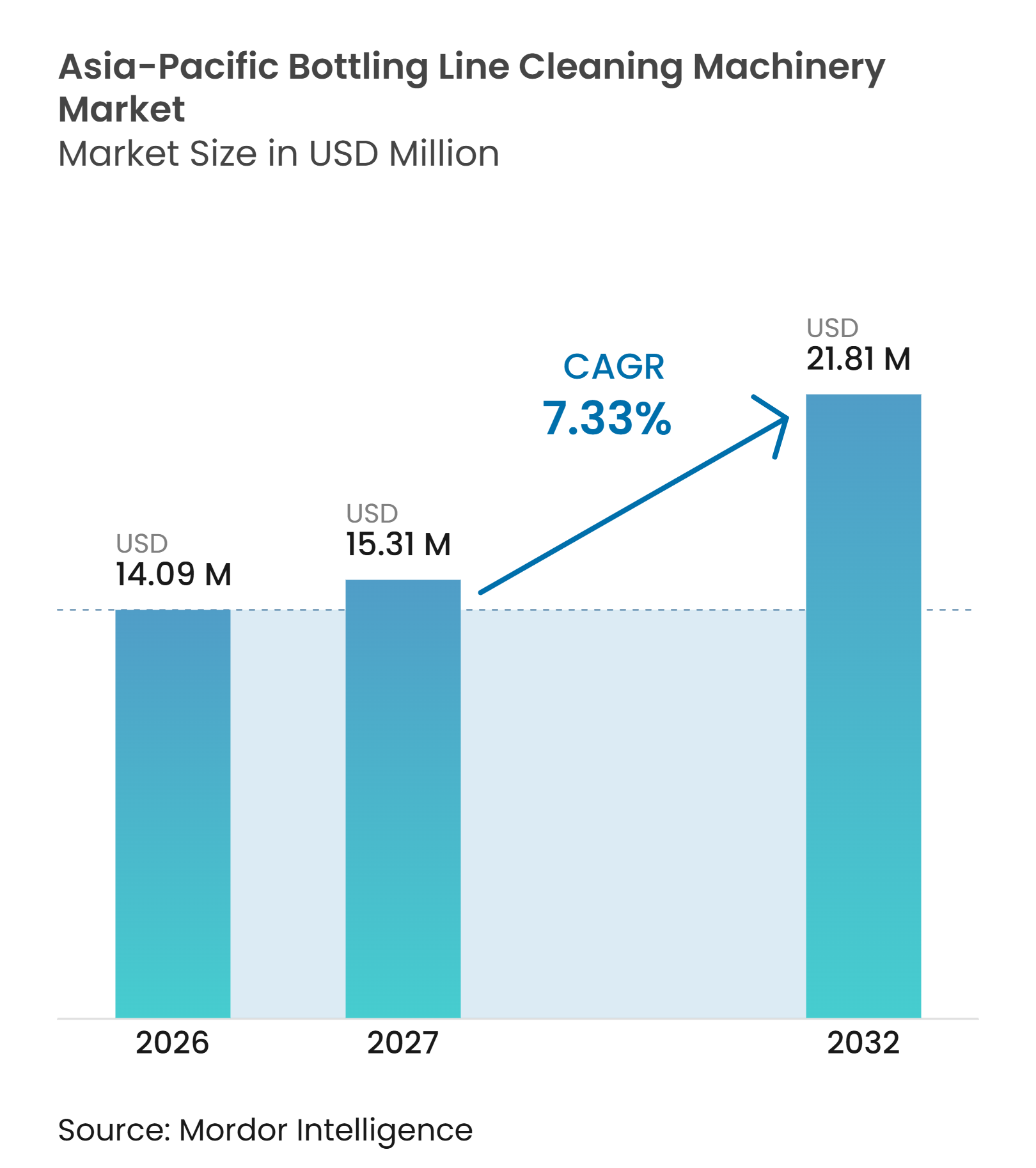
The Asia-Pacific Bottling Line Cleaning Machinery Market size is projected to expand from USD 14.09 million in 2026 and USD 15.31 million in 2027 to USD 21.81 million by 2032, registering a CAGR of 7.33% between 2027 and 2032.
New beverage plants, returnable-container requirements, and stricter food-safety controls are raising the technical specifications for washing and cleaning equipment. Producers are placing more value on automated systems that deliver consistent cleaning cycles and retain digital records for audits. Greenfield projects give suppliers an opportunity to supply cleaning equipment from the first stage of line design. Suppliers also face a divided buying environment because large multinationals can fund advanced equipment while smaller producers often defer replacement purchases.
Key Report Takeaways
- By machine type, rotary bottle washers held a 28.79% share in 2026, while combined washer-dryer systems are projected to expand at an 8.73% CAGR through 2032.
- By automation level, fully automatic systems accounted for 54.40% of the Asia-Pacific bottling line cleaning machinery market size in 2026 and were also the fastest-expanding automation tier through 2032.
- By bottle material, glass bottles held a 60.12% share in 2026, while plastic bottles are projected to expand at a 7.87% CAGR through 2032.
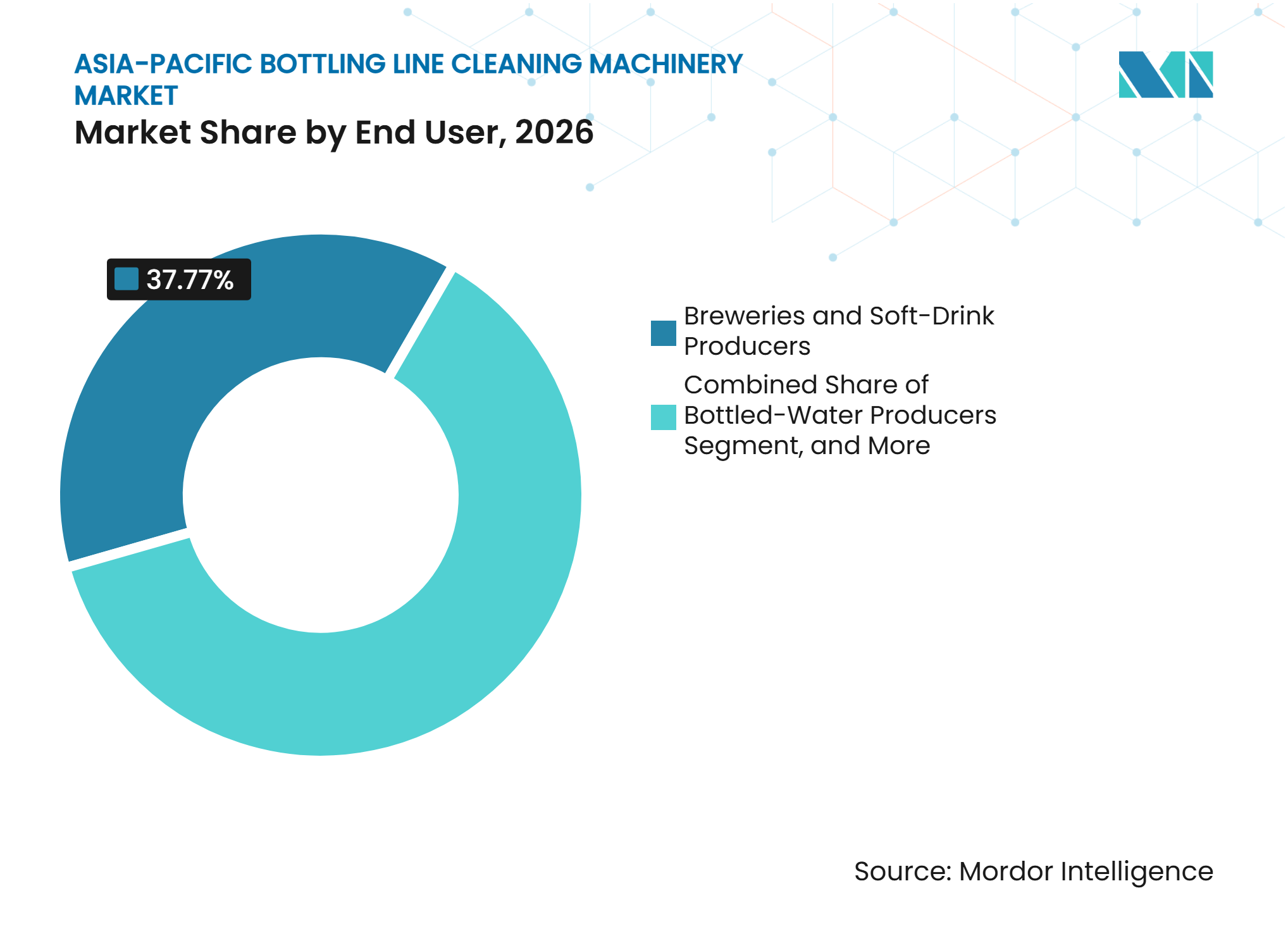
- By end user, breweries and soft-drink producers held a 37.77% share in 2026, while contract packaging and bottling companies are projected to expand at an 8.48% CAGR through 2032.
- By geography, China held a 41.84% share in 2026 of the Asia-Pacific bottling line cleaning machinery market, while India is projected to expand at an 8.14% CAGR through 2032.
Note: Market numbers in this report are based on Mordor Intelligence's proprietary estimation framework, which combines nine months of actuals with Q4 projections for base year 2026.
Market Trends and Insights
Drivers Impact Analysis of Asia-Pacific Bottling Line Cleaning Machinery Market*
| Driver | (~) % Impact on CAGR Forecast | Geographic Relevance | Impact Timeline |
|---|---|---|---|
| Expansion of Packaged Beverage Production | +1.8% | Asia-Pacific, led by India and Southeast Asia | Medium term (2-4 years) |
| Rising Automation for Labor and Throughput Constraints | +1.3% | China, India, Thailand, Indonesia | Short term (≤ 2 years) |
| Tightening Food Safety and Process Validation Requirements | +1.0% | Japan, Australia, India, South Korea | Short term (≤ 2 years) |
| Growth of Returnable Glass and Circular Packaging Systems | +0.7% | China, India, Japan, Southeast Asia | Medium term (2-4 years) |
| Digital Cleaning Monitoring and Predictive Maintenance Adoption | +0.5% | Asia-Pacific, with early gains in Japan and Australia | Medium term (2-4 years) |
| Expansion of Bottled Water and Pharmaceutical Manufacturing Capacity | +0.4% | India, Southeast Asia, China | Long term (≥ 4 years) |
| Source: Mordor Intelligence | |||
Expansion of Packaged Beverage Production Drives Machinery Procurement
New bottling capacity is driving demand for cleaning systems across the Asia-Pacific bottling-line cleaning machinery market. Coca-Cola bottlers SLMG Beverages, Hindustan Coca-Cola Beverages, and Kandhari Group committed INR 25,760 crore (USD 2.96 billion) to food-processing investments across 9 Indian states. SLMG’s Buxar facility operates 7 high-speed lines at more than 5,000 bottles per minute. China’s aseptic beverage volume reached 17.9 billion liters in 2026 after an 8.5% annual expansion since 2020. Each new line also creates a later need for validation, consumables, service support, and retrofits after line changes.
Rising Automation to Address Labor and Throughput Constraints
Labor costs and minimum-wage changes are strengthening the case for automated cleaning systems in the Asia-Pacific bottling line cleaning machinery market. Fully automatic equipment can reduce variation between cleaning cycles and limit the risk of cross-contamination. It also creates auditable records that support food-safety certification. Ecolab reported that digital clean-in-place monitoring can recover additional production capacity, while a multi-site dairy processor recovered substantial annual production time and productivity yield. Schneider Electric reported that its artificial intelligence-enabled clean-in-place software at Nestlé Waters reduced cleaning-cycle time and carbon dioxide emissions in its first year. These outcomes are encouraging equipment buyers to consider automation as a control and compliance tool, not only as a labor-saving purchase.
Tightening Food Safety and Process Validation Requirements
Food-safety rules are prompting replacements that some beverage plants would otherwise delay. Japan’s Cabinet Office Notification 95/2025 revised food-contact material specifications and entered into force in June 2026. India introduced pre-license inspections and annual third-party audits for packaged-water facilities from January 2026. FSSC 22000 Version 7 was published in May 2026 and requires documented, repeatable, and auditable cleaning cycles. Automatic systems with continuous data logging are better placed to provide that documentation across multi-shift operations.
Growth of Returnable Glass and Circular Packaging Systems
Returnable glass creates repeated cleaning demand because every container must be washed before refilling. A bottle designed for more than 60 filling cycles creates far more washer duty than a one-way container. BE WTR opened its BiG400 facility in Singapore in May 2025 with an automated washing, sanitizing, and refilling system capable of handling 2.5 million bottles annually. Each bottle is designed for 300 reuse cycles. Coca-Cola reported that refillable packaging accounted for 14% of its global beverage volume in 2025 and continues to support standardized, universal bottles across its bottling network.[1]
Restraints Impact Analysis of Asia-Pacific Bottling Line Cleaning Machinery Market*
| Restraint | (~) % Impact on CAGR Forecast | Geographic Relevance | Impact Timeline |
|---|---|---|---|
| High Capital Cost and Long Payback for Advanced Washers | -1.5% | Emerging Asia-Pacific, India, Southeast Asia, and smaller markets | Short term (≤ 2 years) |
| Water, Energy, Chemical, and Wastewater Operating Costs | -0.9% | Water-stressed Asia-Pacific, China, India, Indonesia, Vietnam | Medium term (2-4 years) |
| Fragmented Country-Level Compliance and Certification Requirements | -0.6% | Asia-Pacific | Medium term (2-4 years) |
| Integration Risk With Legacy Filling and Conveying Lines | -0.5% | China and India, particularly older facilities with multi-generation equipment | Medium term (2-4 years) |
| Source: Mordor Intelligence | |||
High Capital Cost and Long Payback for Advanced Washers
Advanced double-end washers combine ultrasound, digital controls, and resource-recovery systems, but their purchase cost can exceed the investment capacity of smaller producers. Krones introduced the Lavasonic HI in September 2025 with ultrasound pretreatment and high-intensity cleaning. Its operating benefits can be compelling, yet mid-sized plants may not achieve an acceptable payback period within their normal approval cycle. Large bottlers can assess returns across multiple sites and are more likely to fund replacement programs. Smaller regional producers may retain older washers, which limits near-term sales of premium equipment. This difference creates a two-tier procurement pattern across the Asia-Pacific bottling line cleaning machinery market.
Water, Energy, Chemical, and Wastewater Operating Costs
Operating expenses can discourage washer upgrades even when a plant recognizes the equipment’s technical benefits. Clean-in-place systems can account for more than 60% of water use at many beverage plants. A brewery that runs 300 clean-in-place cycles each year can use 5.3 kilowatt-hours per 100 liters of water to heat it to 60 degrees Celsius for each cycle. Wastewater treatment costs are also rising as industrial discharge rules tighten in parts of Southeast Asia. Kersia stated that its Optimall 360 program reduced cleaning costs by up to 20% and carbon dioxide emissions by up to 76% through optimized ambient cleaning chemistry. Such alternatives can postpone machinery purchases where utility costs are the most immediate operational concern.
*Our forecasts treat driver/restraint impacts as directional, not additive. The impact forecasts reflect baseline growth, mix effects, and variable interactions.
Asia-Pacific Bottling Line Cleaning Machinery Market Segment Analysis
By Machine Type:
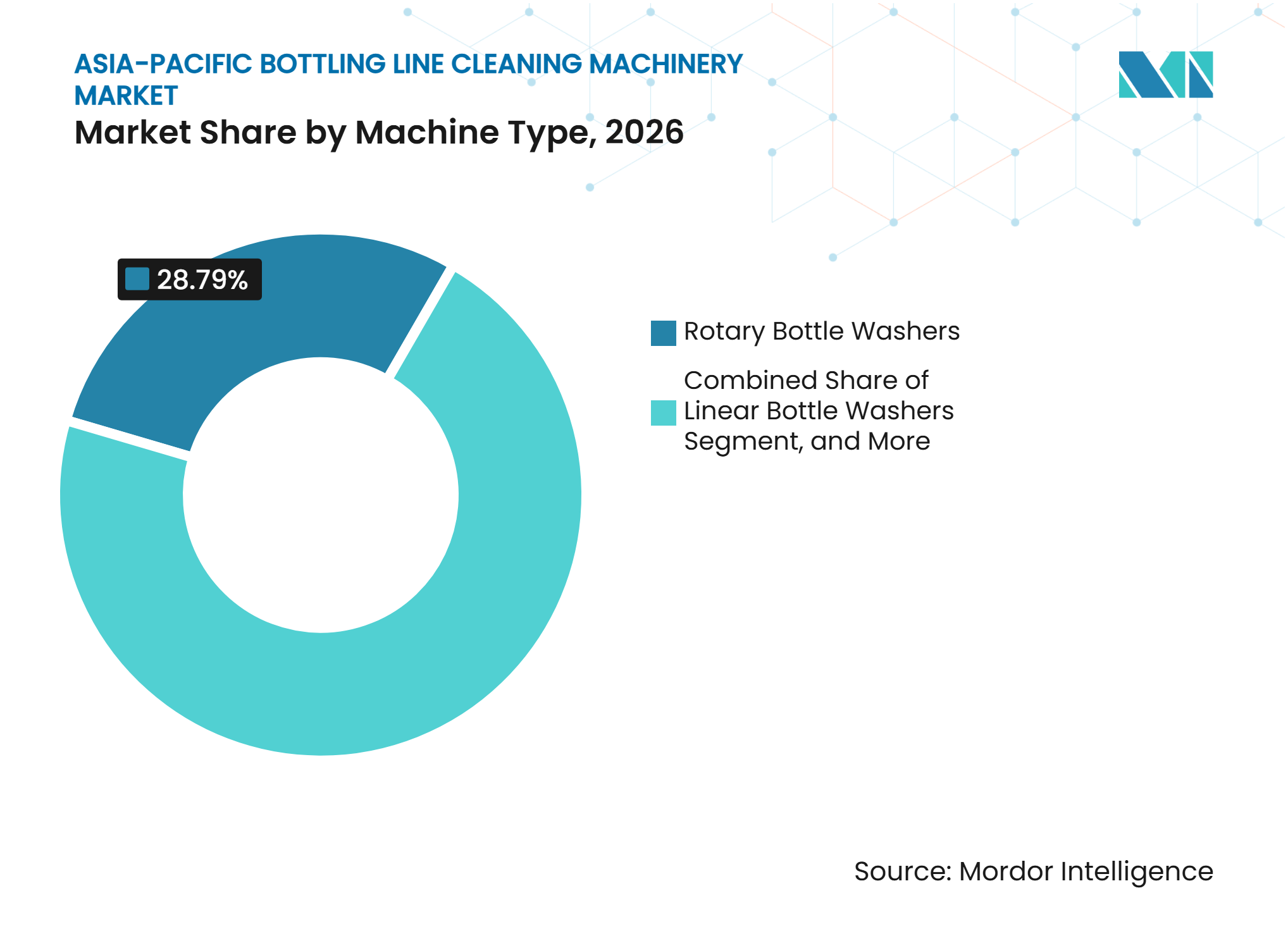
Rotary Washers Lead While Integrated Systems Gain GroundRotary bottle washers held a 28.79% share in 2026. Their leadership rests on an established installed base, operator familiarity, and the capacity needed on high-volume returnable-glass lines. The continuous drum design moves bottles through chemical and rinse stages without the dwell-time losses associated with batch equipment. This design suits breweries and carbonated soft-drink facilities that maintain long production runs. Linear washers serve smaller wineries and distilleries with low- to medium-output requirements. Tunnel and immersion washers remain relevant where containers require more intensive cleaning. Rinsers and blowers are commonly used on single-use polyethylene terephthalate and aluminum lines where chemical washing is not required. These machine categories allow plants to match cleaning intensity with container type and line speed.
Combined washer-dryer systems are projected to expand at an 8.73% CAGR through 2032. Producers use these systems to consolidate washing and drying stations when space is limited. The integrated design can shorten changeovers and reduce the number of line handoffs. Krones stated that Lavasonic HI can reduce treatment time by up to 40% and carbon footprint by up to 35% compared with conventional double-end washers. KHS reported that its Innoclean Cascade D reduces footprint by 10% and limits heat and liquid carryover through its ECO carrier 2.0 bottle pocket. These features target plant managers who need higher throughput without expanding the building footprint. Suppliers that combine compact layouts with measurable utility savings can address a clear need in new and constrained facilities.



By Automation Level:
Fully Automatic Equipment Sets the DirectionFully automatic systems accounted for 54.40% of the Asia-Pacific bottling line-cleaning machinery market in 2026. Their share reflects strong adoption in China and Australia, where large beverage producers have completed several rounds of line modernization. New plants in India and Southeast Asia are increasingly specified for full automation before construction begins. Fully automatic equipment provides repeatable cycles and reduces dependence on manual handling. It also makes audit records easier to retrieve during internal and external reviews. Semi-automatic systems face pressure where users need more consistency but cannot justify full system upgrades. Manual machines remain relevant in small wineries, craft breweries, and specialist food facilities with limited batches. These operations may continue to favor simpler equipment because their output does not support high capital spending.
Fully automatic systems are also the fastest-expanding automation tier through 2032. Their value extends beyond labor substitution because digital controls can reveal cleaning-cycle delays and recurring maintenance needs. Schneider Electric reported a 20% reduction in clean-in-place processing time and a 50% reduction in carbon dioxide emissions at Nestlé Waters in the first deployment year. These functions can improve equipment use and create documented proof of process completion. FSSC 22000 Version 7 requires cleaning procedures that are documented, repeatable, and auditable. Continuous data logging helps a multi-shift facility respond to that requirement. The Asia-Pacific bottling line cleaning machinery market therefore rewards automation suppliers that can connect hardware, controls, and compliance reporting.
By Bottle Material:
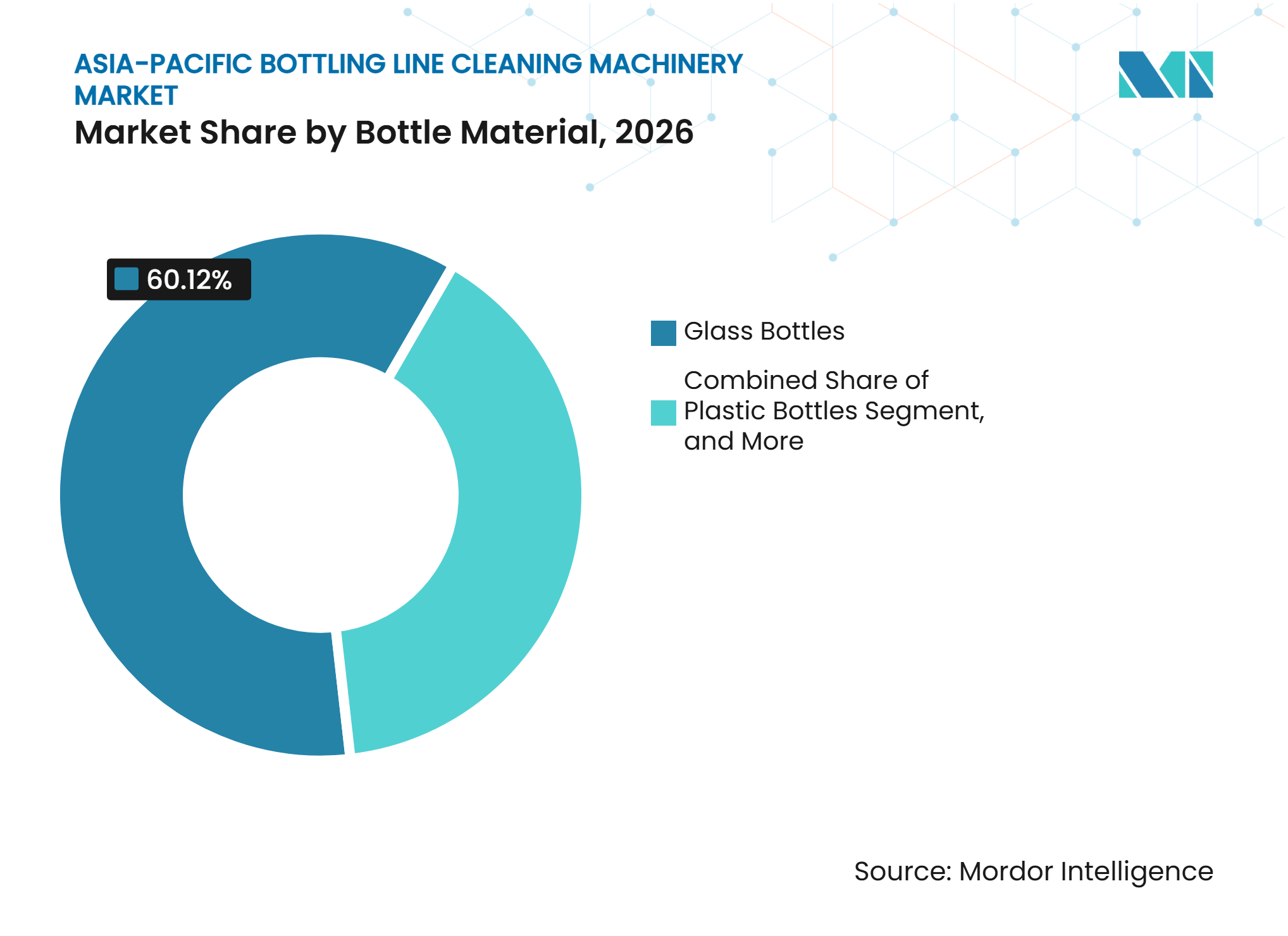
Glass Retains Scale and Plastic Expands ApplicationsGlass bottles held 60.12% of the Asia-Pacific bottling line cleaning machinery market share in 2026. Beer, wine, and carbonated soft-drink producers continue to use returnable glass systems across much of the region. Glass is chemically inert and can tolerate high-temperature caustic wash cycles. These properties support circular formats that require a bottle to be returned to a consistently hygienic condition before refilling. Japan’s deposit-return systems and China’s use of standardized reusable bottles sustain demand for glass-line cleaning. Metal and aluminum containers continue to play an important role in beer and energy drinks, especially in Australia and Japan. Those lines typically use modular, self-contained clean-in-place skids rather than large glass-bottle washers. The material mix therefore requires suppliers to offer equipment with different configurations for washing, rinsing, and sanitation.
Plastic bottles are projected to expand at a 7.87% CAGR through 2032. Growth is supported by bottled water, functional beverages, and returnable polyethylene terephthalate formats. Sidel introduced its Returnable PET Still Water format at Interpack 2026 for repeated washing and refilling cycles. The format can use bottle-washer configurations that were traditionally designed for glass applications. India’s Plastic Waste Management Amendment Rules, 2026 require 40% recycled content in rigid plastic packaging from April 2026. Recycled surfaces can introduce contamination profiles that differ from virgin material. This increases the importance of validated hygiene processes for refillable and recycled-content packaging lines.

By End User:
Breweries Retain Leadership and Contract Packagers AcceleratBreweries and soft-drink producers held a 37.77% share in 2026. Beer production has high cleaning requirements because returnable glass bottles may undergo 50 to 80 wash cycles before retirement. Carbonated soft-drink plants also operate at volumes that justify continuous-drum rotary systems around the clock. Bottled-water producers represent a major adjacent customer group because high-speed lines require dependable rinsing and washing capability. China has more than 800 registered mineral-water producers, supporting recurring demand for high-throughput equipment. Wineries and distilleries require specialist configurations that minimize chemical carryover into wine and spirits. Food and dairy producers increasingly use validated clean-in-place systems to meet multi-category food-safety requirements. The resulting demand base spreads cleaning-equipment opportunities across several beverage and food applications.
Contract packaging and bottling companies are projected to expand at an 8.48% CAGR through 2032. Co-packers operate lines for several clients and products, so validated cleaning is required before each product change. This raises machine utilization compared with a single-brand plant and supports the case for digitally monitored systems. Syntegon achieved good manufacturing practice release for the BCM3 production line and DP4 filling facility at WuXi XDC’s Singapore site in August 2026. The development illustrates the precise cleaning standards needed in pharmaceutical contract manufacturing. Contract operators need records demonstrating line cleanliness for each customer and regulator. That requirement makes integration between cleaning machinery and plant documentation increasingly important. It also broadens the Asia-Pacific bottling line cleaning machinery market beyond conventional beverage bottlers.
Geography Analysis
China: Large Installed Base and Localized Competition
China held 41.84% of the Asia-Pacific bottling line cleaning machinery market share in 2026. The country’s food-packaging machinery sector expanded by 8.4% in 2025, outpacing the national manufacturing average of 4.5%. This wider gap indicates sustained investment from beverage and food plants. Nongfu Spring reported record capital expenditure in fiscal year 2025 to support procurement needs for new processing and bottling lines. Domestic manufacturers have localized more than 65% of mid-tier bottling equipment. This puts pressure on European suppliers in standardized applications. Imported systems retain a stronger position in ultrasonic cleaning and applications with high overall equipment effectiveness. Suppliers need to differentiate through performance, documentation, and resource efficiency rather than price alone.
India: Greenfield Investment and Food-Safety Requirements
India is projected to expand at an 8.14% CAGR through 2032. Coca-Cola bottling partners announced INR 25,760 crore (USD 2.96 billion) in projects across 9 states, while SLMG targets INR 8,000 crore (USD 950 million) in capital expenditure over 5 years. Reliance Consumer Products received approval in June 2025 for an INR 1,622 crore (USD 193 million) beverage plant in Andhra Pradesh, with commercial operations planned to begin in December 2026. FSSAI’s high-risk classification for packaged water and pre-license inspections from January 2026 add a compliance requirement to plant design. Carlsberg India also announced brewing investments across Maharashtra, West Bengal, and Karnataka.[2] These investments support demand for high-throughput lines that meet validation requirements from the start.
Japan, Australia, and Rest of Asia-Pacific: Compliance and New Capacity Shape Demand
Japan’s beverage equipment purchases are driven more by precision and compliance requirements than by large new volumes. Cabinet Office Notification 95/2025 updated the requirements for food-contact glass and synthetic-resin apparatus in June 2026. KHS distributes the Innoclean Cascade D in Australasia to support users working under the Australia New Zealand Food Standards Code and export specifications. Vietnam and Thailand are adding modern beverage capacity. Suntory PepsiCo opened its USD 300 million Tay Ninh facility in July 2026, with an annual capacity exceeding 1.24 billion liters. Thailand is also receiving capacity additions from regional beverage producers. These projects create demand for contemporary cleaning specifications when lines are first commissioned.
Competitive Landscape
Market Concentration
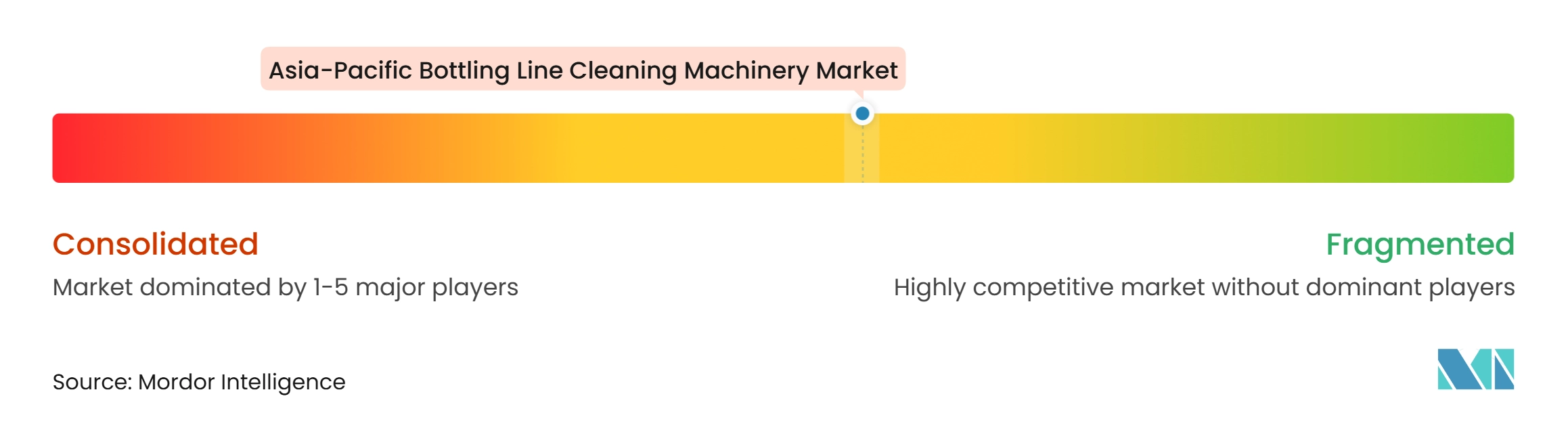
The Asia-Pacific bottling line cleaning machinery market is moderately fragmented. European full-line original equipment manufacturers retain a technical lead in high-performance washers. Chinese suppliers have a strong position in mid-tier systems through lower prices and improving product capability. Krones launched the Lavasonic HI in September 2025 with ultrasound pretreatment and high-intensity cleaning. KHS made the Innoclean Cascade D available starting mid-2026, with a redesigned maintenance structure and an ECO carrier 2.0 bottle pocket. These launches respond to buyer attention on operating costs and maintenance. They also show that technology leadership is being defended by measurable improvements in line performance.
Sidel installed its Hydra Ultrasonic bottle washer at ThaiNamthip’s Pathumthani plant in June 2026. The installation was the first deployment of this technology in Asia and supports returnable glass bottles used by Coca-Cola in Thailand. The project provides a regional reference for ultrasonic washing in future tenders. Suppliers are also bundling digital monitoring with equipment sales to establish recurring service revenue. KHS stated that it has 200 service engineers across Asia and the Pacific. This service presence is difficult for many mid-tier competitors to match.[3] A clear opportunity remains for combined washer-dryer systems that integrate hardware, cleaning chemistry, and process monitoring.
Apollo Global Management acquired a 37% minority stake in Syntegon in April 2026, valuing the packaging-machinery company at EUR 4 billion (USD 4.4 billion) on an enterprise value basis, including debt. The transaction supports Syntegon’s capacity to pursue food, beverage, and pharmaceutical filling applications in the region. The Asia-Pacific bottling line cleaning machinery market includes both established global manufacturers and increasingly capable local suppliers. Competition is therefore strongest in standard equipment, where price and service response are central to purchasing decisions. Advanced machines remain differentiated through ultrasonic processing, automation, and environmental performance. Buyers may favor suppliers that can document lifecycle cost reductions and cleaning outcomes. The available information does not disclose combined market shares for the leading suppliers, so a numerical concentration score cannot be assigned without creating unsupported market-share data.
Asia-Pacific Bottling Line Cleaning Machinery Industry Leaders
-
Guangzhou Tech-Long Packaging Machinery Co., Ltd.
-
Krones AG
-
KHS GmbH
-
Tetra Pak International S.A.
-
GEA Group AG
- *Disclaimer: Major Players sorted in no particular order
Asia-Pacific Bottling Line Cleaning Machinery Market Companies Covered in this Report
- Krones AG
- KHS GmbH
- GEA Group AG
- Tetra Pak International S.A.
- Guangzhou Tech-Long Packaging Machinery Co., Ltd.
- SACMI Cooperativa Meccanici Imola Soc. Coop.
- SIPA S.p.A.
- Serac Group
- Syntegon Technology GmbH
- Bausch+Ströbel SE + Co. KG
- Prosys Fillpack Equipment Pvt. Ltd.
- New England Machinery, Inc.
- Paxiom Group
- FBR-ELPO S.p.A.
- IC Filling Systems S.r.l.
- Neostarpack Co., Ltd.
- Pack Leader Machinery Inc.
- Arol S.p.A.
- Karmelle Liquid Filling and Capping
- JBT Corporation
- All-Fill Inc.
- Accutek Packaging Equipment Companies
- Zhangjiagang City New Crown Machinery Co., Ltd.
Recent Industry Developments in Asia-Pacific Bottling Line Cleaning Machinery Market
- August 2026: Apollo Global Management acquired a 37% minority stake in Syntegon Technology GmbH from CVC Capital Partners, valuing the packaging machinery maker at EUR 4 billion, equivalent to USD 4.4 billion, including EUR 1.25 billion in debt, in a transaction that positions Syntegon to deepen its presence in Asia-Pacific pharmaceutical and food-and-beverage filling and cleaning systems markets.
- August 2026: Syntegon Technology GmbH achieved GMP release of its BCM3 production line and DP4 filling facility at WuXi XDC's Singapore site, supplying filling technology with speeds up to 300 vials per minute with integrated hydrogen-peroxide bio-decontamination, expanding its pharmaceutical liquid filling and cleaning footprint across Southeast Asia.
- July 2026: Suntory PepsiCo Vietnam inaugurated a USD 300 million beverage manufacturing facility in Tay Ninh province, the company's largest plant in its Asian network, with designed annual capacity of more than 1.24 billion liters and highly automated production, filling, and warehousing systems that generate matched demand for high-throughput cleaning machinery.
- June 2026: Sidel installed its Hydra Ultrasonic bottle washer at ThaiNamthip Corporation's Pathumthani Plant in Thailand, the first deployment of this technology in Asia, supporting returnable glass bottle cleaning for Coca-Cola's Thailand operations and delivering up to 15% water savings and 20% steam reduction relative to conventional washing configurations.
Asia-Pacific Bottling Line Cleaning Machinery Market Report Scope
The Asia-Pacific Bottling Line Cleaning Machinery Market encompasses equipment and systems used to clean, wash, rinse, sanitize, and dry bottles and containers across beverage, food, dairy, pharmaceutical, and other packaging applications. Bottling and packaging facilities use these machines to eliminate dust, dirt, product residues, microorganisms, and other contaminants from containers before filling or further processing, thereby supporting hygiene, product safety, and compliance with industry standards.
The Asia-Pacific Bottling Line Cleaning Machinery Market Report is Segmented by Machine Type (Rotary Bottle Washers, Linear Bottle Washers, Tunnel Bottle Washers, Immersion Bottle Washers, Bottle Rinsers and Blowers, Combined Washer-Dryer Systems, ad Other Machine Types), Automation Level (Manual, Semi-Automatic, and Fully-Automatic), Bottle Material (Glass Bottles, Plastic Bottles, and Metal and Aluminum Containers), End User (Breweries and Soft-Drink Producers, Bottled Water Producers, Wineries and Distilleries, Food and Dairy Producers, Pharmaceutical Manufacturers, and Contract Packaging and Bottling Companies), and Geography (China, India, Japan, Australia, and Rest of Asia-Pacific). The Market Forecasts are Provided in Terms of Value (USD).
Segmentation Overview
| Rotary Bottle Washers |
| Linear Bottle Washers |
| Tunnel Bottle Washers |
| Immersion Bottle Washers |
| Bottle Rinsers and Blowers |
| Combined Washer-Dryer Systems |
| Other Machine Types |
| Manual |
| Semi-automatic |
| Fully-automatic |
| Glass Bottles |
| Plastic Bottles |
| Metal and Aluminum Containers |
| Breweries and Soft-Drink Producers |
| Bottled-Water Producers |
| Wineries and Distilleries |
| Food and Dairy Producers |
| Pharmaceutical Manufacturers |
| Contract Packaging and Bottling Companies |
| China | India |
| Japan | |
| Australia | |
| Rest of Asia-Pacific |
| By Machine Type | Rotary Bottle Washers | |
| Linear Bottle Washers | ||
| Tunnel Bottle Washers | ||
| Immersion Bottle Washers | ||
| Bottle Rinsers and Blowers | ||
| Combined Washer-Dryer Systems | ||
| Other Machine Types | ||
| By Automation Level | Manual | |
| Semi-automatic | ||
| Fully-automatic | ||
| By Bottle Material | Glass Bottles | |
| Plastic Bottles | ||
| Metal and Aluminum Containers | ||
| By End User | Breweries and Soft-Drink Producers | |
| Bottled-Water Producers | ||
| Wineries and Distilleries | ||
| Food and Dairy Producers | ||
| Pharmaceutical Manufacturers | ||
| Contract Packaging and Bottling Companies | ||
| By Geography | China | India |
| Japan | ||
| Australia | ||
| Rest of Asia-Pacific | ||
Key Questions Answered in the Report
What is the Asia-Pacific bottling line cleaning machinery market size?
The market is projected at USD 14.09 billion in 2026, USD 15.31 billion in 2027, and USD 21.81 billion by 2032.
What is driving demand for bottling-line cleaning equipment in Asia-Pacific?
Greenfield beverage plants, food-safety validation, returnable containers, and automation needs are supporting equipment demand.
Which machine type leads bottling-line cleaning equipment demand?
Rotary bottle washers led with a 28.79% share in 2026 because they suit high-volume returnable-glass lines.
Which automation level is most widely used in bottling-line cleaning?
Fully automatic systems held 54.40% share in 2026 and are the fastest-expanding automation tier.
Why are contract packagers adopting advanced cleaning systems?
Multi-client production requires validated cleaning between changeovers and creates a need for auditable process records.
Which country has the strongest projected expansion in the region?
India is projected to expand at an 8.14% CAGR through 2032, supported by beverage investment and stricter packaged-water controls.