
Argentina Turf Protection Market Size and Share
Market Overview
| Study Period | 2021 - 2031 |
|---|---|
| Forecast Data Period | 2026 - 2031 |
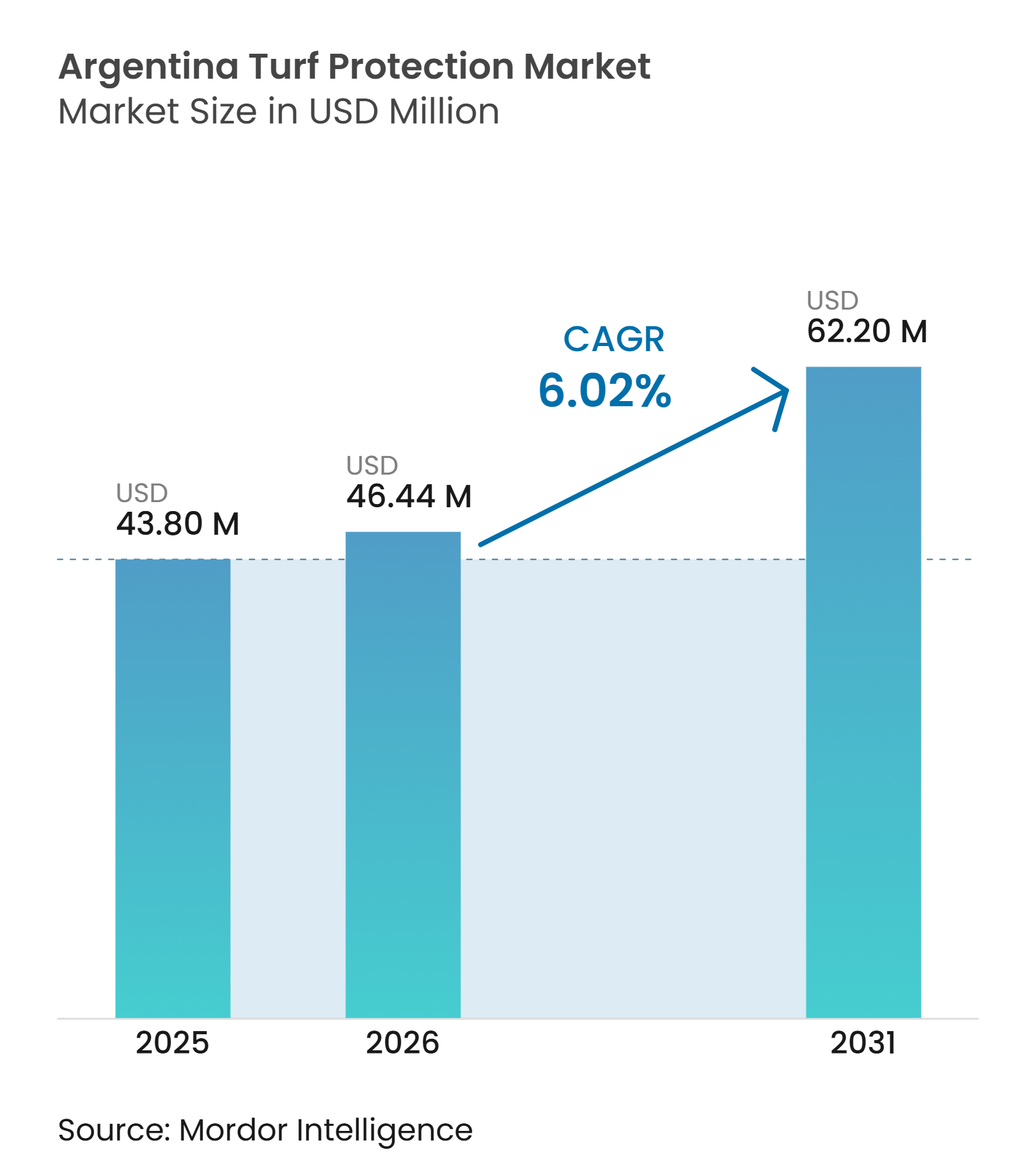
| Base Year Market Size (2025) | USD 43.80 Million |
| Market Size (2026) | USD 46.44 Million |
| Market Size (2031) | USD 62.20 Million |
| Growth Rate (2026 - 2031) | 6.02 % |
| Market Concentration | Medium |
Major Players *Disclaimer: Major Players sorted in no particular order Image © Mordor Intelligence. Reuse requires attribution under CC BY 4.0. | |
Argentina Turf Protection Market Analysis by Mordor Intelligence
The Argentina turf protection market was valued at USD 43.80 million in 2025 and is estimated to grow from USD 46.44 million in 2026 to reach USD 62.20 million by 2031, at a CAGR of 6.02% from 2026 to 2031. The market is supported by recurring maintenance needs at golf facilities, first-division sports clubs, private residential communities, and municipal green spaces that require reliable turf appearance and playability across changing seasons. Buenos Aires City planted 16,530 trees in 2025, exceeding its annual target of 15,914 plantings and achieving 104% of the planned target. The initiative covered urban tree planting across all Comunas of the city [1]. The market also reflects wider use of professional agronomic services, biological inputs, and irrigation systems that improve control over water use, application timing, and surface conditions at high-visibility and heavily used sites. Disease pressure remains a key factor, as local turf managers work with varying weather patterns and different grass types across a wide geographic range, from warmer northern locations to cooler southern areas. Suppliers can build demand by pairing products with local technical support, particularly outside Buenos Aires and Córdoba, where specialist coverage is less developed, premium programs are less established, and buyers may otherwise rely on general agricultural distribution channels with limited specialist turf support.
Key Report Takeaways
- By product type, fungicides accounted for 36.4% of the Argentina turf protection market share in 2025, while biostimulants and bio-fertilizers are forecast to grow at a CAGR of 9.8% from 2026 to 2031.
- By application, landscaping accounted for 34.2% of the Argentina turf protection market size in 2025, while sports fields are forecast to grow at a CAGR of 8.9% from 2026 to 2031.
- By end user, residential customers accounted for 31% of the market share in 2025, while sports facility owners are forecast to grow at a CAGR of 8.6% from 2026 to 2031.
- By mode of action, chemical accounted for 68% of the market share in 2025, while biological solutions are forecast to grow at a CAGR of 10.8% from 2026 to 2031.
- By formulation, liquid concentrates accounted for 54% of the market share in 2025 and are forecast to grow at a CAGR of 7.7% from 2026 to 2031.
Note: Market size and forecast figures in this report are generated using Mordor Intelligence’s proprietary estimation framework, updated with the latest available data and insights as of January 2026.
Market Trends and Insights
Drivers Impact Analysis of Argentina Turf Protection Market*
| Driver | (~) % Impact on CAGR Forecast | Geographic Relevance | Impact Timeline |
|---|---|---|---|
| Expansion of Professional Sports Turf and Golf Facilities | +1.2% | National, with activity in Buenos Aires, Córdoba, Tucumán, and Patagonia | Medium term (2-4 years) |
| Rising Demand for High-Quality Urban and Residential Landscapes | +1.0% | Buenos Aires metro, Rosario, Mendoza, and peri-urban corridors | Short term (≤ 2 years) |
| Increasing Adoption of Biological Turf-Health Solutions | +1.4% | National, with greatest uptake at golf and high-visibility sports facilities | Long term (≥ 4 years) |
| Professionalization of Turf Management Through Agronomic Services | +0.8% | Buenos Aires metro, Córdoba, Rosario, and growing secondary cities | Medium term (2-4 years) |
| Smart Irrigation and Data-Led Turf Maintenance | +0.7% | Buenos Aires metro, Mendoza, and provincial sports complexes | Long term (≥ 4 years) |
| Climate-Stress Management for Warm-Season and Cool-Season Turf | +1.1% | National, especially Patagonia and the humid Pampas | Short term (≤ 2 years) |
| Source: Mordor Intelligence | |||
Expansion of Professional Sports Turf and Golf Facilities
Professional sports sites and golf facilities generate recurring demand for turf protection products, as their playing surfaces require scheduled management of diseases, weeds, insects, and stress throughout the year. The Asociación del Fútbol Argentino announced an infrastructure plan for Estadio Ciudad de La Plata Diego Armando Maradona in August 2025, including work on the playing field, auxiliary pitch, lighting, and locker rooms [2]. Each new or renovated venue usually places a superintendent or agronomic adviser on an annual purchasing cycle tied to surface condition. This creates a more stable source of demand than a one-time expansion of turf area, as preventive programs continue after construction is complete. The Argentina turf protection market benefits when facility managers shift from reactive treatment to planned maintenance contracts and formal agronomic oversight.
Rising Demand for High-Quality Urban and Residential Landscapes
Peri-urban residential development is extending the use of managed turf beyond formal sports facilities and into communities that use landscaped areas as permanent shared amenities. Private communities with golf courses require consistent treatment of greens, fairways, common areas, and landscape borders maintained to a visible standard. Buenos Aires City planted 16,530 trees in 2025, exceeding its annual target of 15,914 plantings and extending tree-planting activities across all Comunas of the city. Public green spaces and residential landscapes create a larger installed base requiring regular weed, disease, and stress management rather than irregular repairs. The Argentina turf protection market can therefore benefit from recurring maintenance budgets covering residential communities, public parks, hotel grounds, and other professionally managed sites.
Increasing Adoption of Biological Turf-Health Solutions
Resistance management is a primary driver of biological input adoption in Argentina, particularly where operators seek to preserve the effectiveness of conventional disease-control tools. Biofungicides and related products can be used in rotation with conventional products and can support broader turf health and stress management programs. CASAFE members have stated that more than 80% of member companies invest in biological-input development. The commercial and regulatory foundations established for agricultural biologicals can lower entry barriers, improve distribution familiarity, and support turf-specific formulations. Biological adoption in the Argentina turf protection market is likely to spread first through golf courses and high-visibility sports facilities, where managers closely monitor turf quality, disease response, and program outcomes.
Professionalization of Turf Management Through Agronomic Services
Certified turf agronomists are important product specifiers at professional sites, as they link input selection with on-the-ground conditions and planned application schedules. The Facultad de Agronomía at the Universidad de Buenos Aires offers a diploma program focused on sports turf cultivation and maintenance [3]. Under Argentine regulations, registered agronomists are authorized to prescribe and apply agrochemical and domestic sanitary products on turf, creating a credentialed decision point at professional facilities. Their involvement can raise product quality and spending per treated area by enabling integrated programs rather than reliance on single low-cost products. The Argentina turf protection market faces a service gap in provinces where investment in sports and community infrastructure is growing faster than the local supply of specialist advisers.
Restraints Impact Analysis of Argentina Turf Protection Market*
| Restraint | (~) % Impact on CAGR Forecast | Geographic Relevance | Impact Timeline |
|---|---|---|---|
| Environmental Compliance and Pesticide-Registration Requirements | -0.5% | National, with higher burden in Buenos Aires Province and municipalities with buffer-zone rules | Medium term (2-4 years) |
| Seasonal Demand and Weather-Driven Application Windows | -0.4% | National, especially Patagonia and Andean provinces with compressed seasons | Short term (≤ 2 years) |
| High Cost of Imported Specialty Inputs and Equipment | -0.6% | National, with a greater effect in secondary and emerging markets | Short term (≤ 2 years) |
| Limited Availability of Trained Turf Agronomists Outside Major Urban Centers | -0.4% | Interior provinces and secondary cities without agronomy programs | Long term (≥ 4 years) |
| Source: Mordor Intelligence | |||
Environmental Compliance and Pesticide-Registration Requirements
SENASA Resolution 458/2025 introduced an updated regulatory framework for phytosanitary products in Argentina, including procedures for product registration and provisions for products registered in countries with regulatory convergence with Argentina. Certain products may qualify for temporary registration while required efficacy and residue assessments are completed. Resolution 843/2025 subsequently amended several provisions of Resolution 458/2025 to further streamline registration and authorization procedures. The framework also incorporates the Globally Harmonized System of Classification and Labelling of Chemicals (GHS), requiring existing registered products to transition to the updated labeling requirements within the prescribed period. These changes may increase documentation and compliance requirements for suppliers and influence the timing and cost of product registration. Provincial and municipal requirements for pesticide use near sensitive areas, including schools and residential zones, add further compliance considerations, with requirements varying across jurisdictions.
Seasonal Demand and Weather-Driven Application Windows
Turf protection purchasing is concentrated in the autumn transition and spring preparation periods, creating seasonal inventory and cash-flow pressure for distributors. The main windows run from March through May and from September through October, when managers prepare surfaces for changing weather and use conditions. Late frosts in Patagonia and Mendoza can shorten these windows by two to three weeks and force difficult application decisions. Weather disruption can shift a season's demand into the following year rather than merely delaying it, particularly when preventive treatment is missed. This makes annual demand in the Argentina turf protection market more variable than the longer-term forecast suggests and complicates inventory planning for local suppliers.
*Our forecasts treat driver/restraint impacts as directional, not additive. The impact forecasts reflect baseline growth, mix effects, and variable interactions.
Argentina Turf Protection Market Segment Analysis
By Product Type:
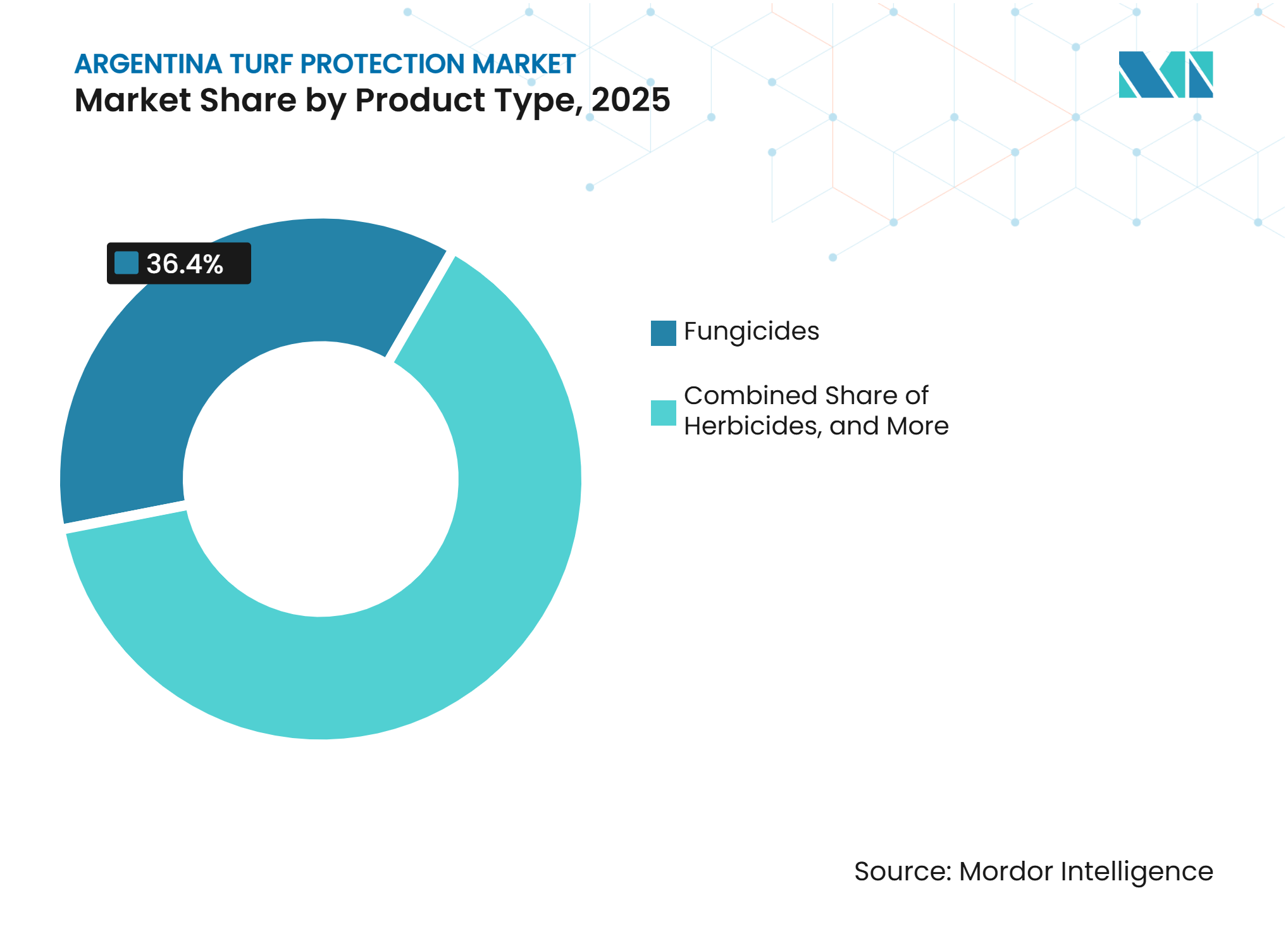
Fungicides Lead the Market, While Biostimulants and Bio-fertilizers Record the Fastest GrowthFungicides accounted for 36.4% of the market share in 2025, making them the largest product group and a central component of many professional treatment programs. They are used against dollar spot, brown patch, large patch, and pythium blight across bermudagrass, kikuyugrass, and bentgrass surfaces, each of which carries different disease risks. Warm summers, afternoon humidity, and cool wet autumn transitions increase the need for repeated disease management and regular condition monitoring. This environment requires a broad product range and treatment schedules that vary by location, turf variety, disease history, and site visibility. Herbicides ranked second because selective broadleaf and sedge control is technically demanding in established bermudagrass systems where turf quality must be preserved. Off-target risk receives close attention near residential and municipal areas, where application practices and product selection face greater scrutiny.
Biostimulants and bio-fertilizers are forecast to grow at 9.8% CAGR from 2026 to 2031, as operators incorporate them into programs that address both disease-related pressure and broader plant stress. They are being integrated into stress-management and resistance-rotation programs across the Argentina turf protection market, rather than being used only as stand-alone inputs. Insecticides remain necessary for grub, caterpillar, and mole cricket management in golf rough and sports surrounds where pest damage can affect both playing quality and surface recovery. Plant growth regulators offer higher gross-margin potential in golf settings where pace-of-play standards support premium maintenance programs and more frequent management decisions. Together, these product groups allow suppliers to address basic disease control, pest management, growth control, and site-specific stress conditions within a single program. The turf protection market is therefore shaped by consistent fungicide demand and a gradual shift toward broader programs that combine multiple input categories.



By Application:
Landscaping Leads the Market, While Sports Fields Record the Fastest GrowthLandscaping accounted for 34.2% of the market share in 2025, reflecting the large number of managed green areas outside formal sports facilities. This application includes private community green spaces, public parks, hotel grounds, and corporate campuses in Greater Buenos Aires and Rosario. Its broad base provides steady demand across large numbers of maintained sites, even when individual accounts have modest purchase volumes. Sports fields are forecast to grow at an 8.9% CAGR from 2026 to 2031, as institutions adopt more formal standards for playing quality, drainage, irrigation, and preventive maintenance. First-division football, rugby, polo, and tennis sites are adopting these standards across several provinces. Atlético Tucumán's training center includes five natural-grass pitches with automated drainage and irrigation systems.
The Asociación del Fútbol Argentino's 2025 plan for Estadio Ciudad de La Plata adds another long-life playing surface that requires specialist treatment through renovation and later maintenance. Golf courses remain a premium niche, even though their total treated area is smaller, because greens, tees, and fairways require close visual and agronomic control. Input spending per hectare is higher on these surfaces because disease-management standards are stricter and playing conditions are central to the customer experience. Sod farms are the smallest application group but can require intensive disease and weed control per treated hectare to meet production standards. The Argentina turf protection market serves applications with different purchasing patterns, ranging from recurring public landscaping work to highly specified sports and golf programs. This mix requires suppliers to balance broad distribution coverage with detailed technical support for accounts that need tailored applications.
By End User:
Residential Customers Lead the Market, While Sports Facility Owners Record the Fastest GrowthResidential customers accounted for 31% of the market share in 2025, supported by the concentration of professionally maintained community landscapes. Their demand comes from gated-community golf courses and managed landscapes in Greater Buenos Aires, Córdoba, Rosario, and Mendoza. Landscape contractors often act as the effective product specifier because they purchase for multiple community accounts and translate site needs into recurring orders. They can encourage a shift from generic products to integrated programs when they demonstrate measurable agronomic results to community committees responsible for budgets and service standards. Sports facility owners are forecast to grow at an 8.6% CAGR from 2026 to 2031 as professional and semi-professional clubs formalize maintenance programs. Clubs are adding agronomist advisers to operations, which increases attention to product performance and preventive treatment.
Commercial landscape contractors can represent the highest transaction-value buyer group because they consolidate volume across residential accounts and standardize purchases across multiple managed locations. Municipalities and schools are the most price-sensitive users, which tends to favor products that are simple to apply and suited to constrained maintenance budgets. The turf protection market must meet different purchasing criteria for each group, including technical performance, price, ease of application, and the availability of local advice. This buyer mix gives the Argentina turf protection market a large residential base while sports operators create demand for more advanced programs. It also means that distributor relationships and field-service capacity can be as important as the product itself when suppliers seek to reach varied accounts.
By Mode of Action:
Chemical Products Lead the Market, While Biological Solutions Record the Fastest GrowthChemical products accounted for 68% of the market share in 2025, reflecting their established distribution, predictable performance, and familiar use within the Argentina turf protection market. Conventional chemistry is widely used because local turf systems face broad disease pressure and managers are familiar with established programs across multiple grass types. Multi-site and single-site fungicides have a clear role in treatment schedules designed around recurring disease risk and visible turf quality requirements. Biological solutions are forecast to grow at a 10.8% CAGR from 2026 to 2031, the highest growth rate across the reported segmentation types. Their adoption is linked to resistance management, lower-risk program options, and the ability to combine biological tools with conventional products.
Agricultural biological-product development provides an existing technology and commercialization base for turf formulations and gives suppliers experience with distribution, stewardship, and product positioning. CASAFE member companies are investing in biological-input development. Integrated solutions combine chemical and biological tools within a single program, allowing managers to apply different modes of action according to surface conditions and treatment priorities. They are particularly relevant to golf facilities and clubs that pursue sustainability certification or international stewardship frameworks and require a documented program approach. The Argentina turf protection market is therefore likely to retain conventional chemistry as its core while biological and integrated approaches gain a larger share of premium programs. The pace of this shift will depend on technical advice, registration access, and operators' confidence that integrated programs can consistently protect turf quality.
By Formulation:
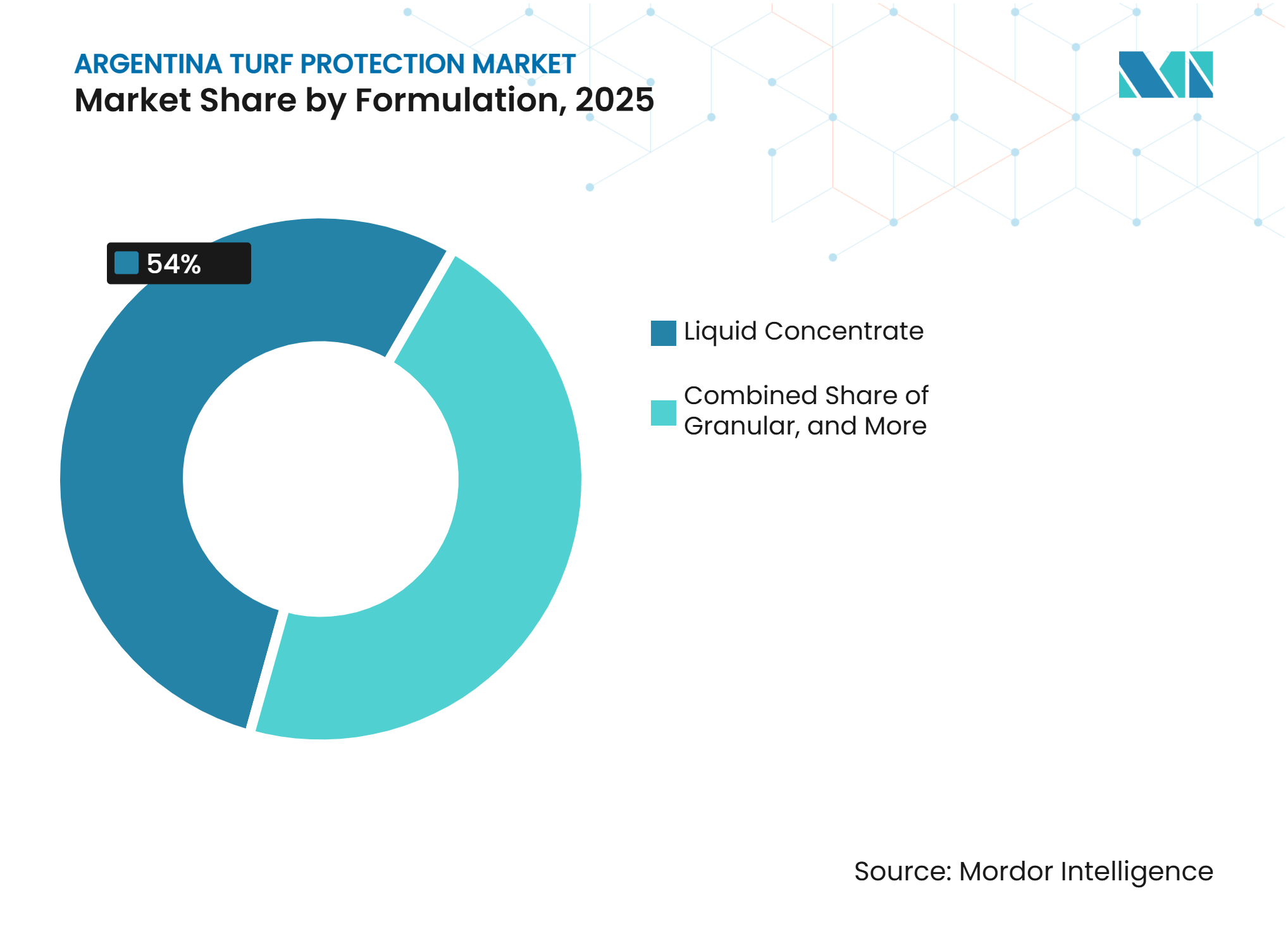
Liquid Concentrates Lead the Market and Record the Fastest GrowthLiquid concentrates accounted for 54% of the market share in 2025 and are forecast to grow at a 7.7% CAGR from 2026 to 2031. They are compatible with fungicides, herbicides, biostimulants, and plant growth regulators, allowing a common application format across product categories. Professional turf managers can dilute and tank-mix compatible products using equipment already present at many sites, including golf courses, clubs, and landscaped communities. A multi-product tank mix can enable a single-pass program and reduce labor cost per treated area while supporting more efficient scheduling. This operational flexibility supports the position of liquid concentrates across professional turf accounts. It also allows site managers to tailor treatments to observed disease, weed, or stress conditions without changing their core application equipment.
Granular products serve a different role in residential communities and sod farms, where the method of application can be as important as the active ingredient. Slow-release products can improve broadcast-spreading efficiency and allow application by non-specialist maintenance staff who do not operate professional spray equipment. Wettable powder is the smallest formulation group and remains relevant where stability or active-ingredient solubility limits liquid development. The use of Globally Harmonized System categorization and lowest-toxicity labeling can influence municipal and school procurement criteria when buyers screen products before use. The turf protection market may therefore see more formulation work directed toward lower-classification finished products and formats suited to non-specialist applications. These factors keep liquid concentrates central to the Argentina turf protection market while preserving roles for granular and specialty powder formats.

Geography Analysis
Greater Buenos Aires represents the largest consumption area for the Argentina turf protection market. The region combines golf courses, first-division football and rugby stadiums, polo grounds, private communities, and municipal green spaces. Buenos Aires Province adds demand through private country clubs, golf resorts, and Atlantic coast residential communities where landscaped and playing surfaces require regular maintenance. The region also serves as the primary entry and distribution point for imported specialty inputs, supporting wider availability of premium products. Multinational distributors in the Zona Norte corridor provide buyers with better access to technical agronomic support than is available in many provincial markets.
Córdoba, Santa Fe including Rosario, Mendoza, and Tucumán form a second demand cluster in the Argentina turf protection market. Córdoba's multi-sport club network and sod farms support regular distributor volumes, while Mendoza needs drought-stress biostimulants, water-efficient applications, and cool-season fungicide schedules. This product mix differs from the disease-pressure focus seen in Buenos Aires and requires suppliers to adapt programs to local weather and turf conditions. Tucumán is gaining importance through the new Atlético Tucumán training complex and a growing private-club base, where natural-grass pitches and automated irrigation systems require specialist protection programs.
Neuquén, Río Negro, Chubut, Corrientes, Misiones, Formosa, Jujuy, and Salta are receiving increased professional and institutional turf investment. Local markets in these regions remain underserved by specialist distribution and technical services, even as demand for tailored turf programs grows. The clearest provincial opportunity in the Argentina turf protection market exists where suppliers provide mobile field support ahead of fully established distribution networks.
Competitive Landscape
Market Concentration
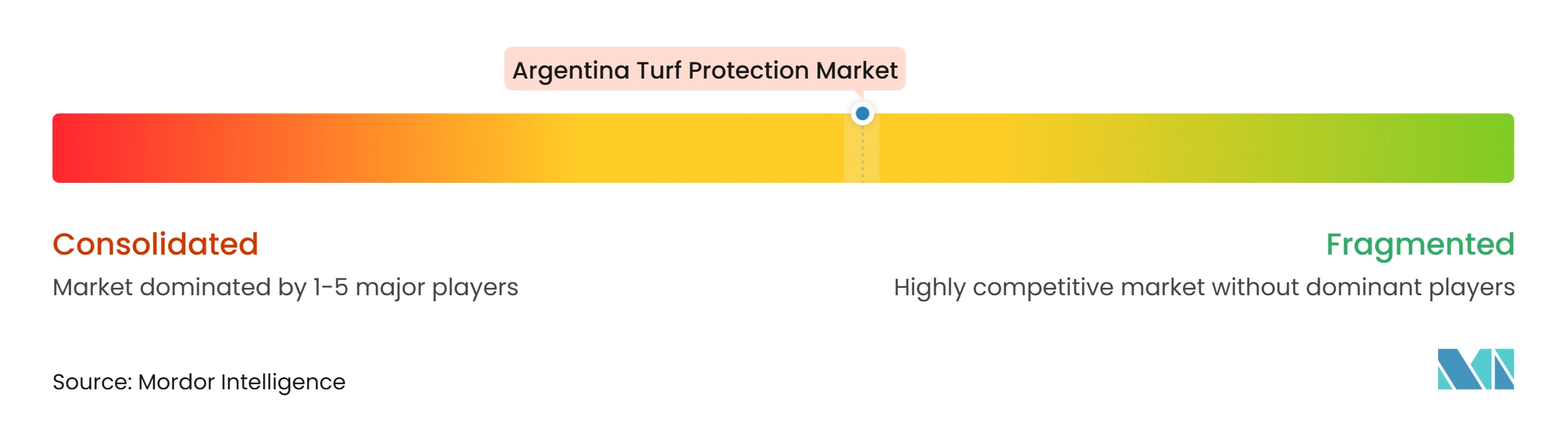
The Argentina turf protection market is moderately consolidated, with BASF SE, Syngenta Group, FMC Corporation, Environmental Science AR S.A., and UPL Limited among the key companies operating in the market. Competition centers on portfolio breadth, local technical knowledge, and service proximity across a broad range of professional turf accounts. Secondary markets outside Buenos Aires and Córdoba present opportunities for local and regional suppliers, as multinational distribution and specialist technical support are less extensive in some areas. Local operators can use their knowledge of climate, soil, and turf varieties to compete effectively and address needs that broader product portfolios may not fully cover.
BASF SE introduced Aramax Intrinsic brand fungicide for golf-course fairways in May 2024, extending its coverage of cool-season and warm-season turf diseases. BASF SE also uses its xarvio precision agronomy platform to connect product programs with digital agronomic support and deepen buyer relationships. These developments show how large suppliers combine registration, product development, and technical services rather than relying on product availability alone. SENASA Resolution 458/2025 may reduce the registration timing advantage historically held by early-entrant multinationals and open the market to companies with strong United States or European Union product pipelines.
Turfmax S.A., Bracar Biotecnologia, Triagro Césped y Riegos, and Mamboretá compete by assembling multi-supplier programs tailored to local soil, climate, turf variety, and maintenance conditions for individual accounts. Biological turf protection for cost-sensitive municipal and sports buyers outside the Buenos Aires and Córdoba corridor remains an open area. The segment remains relatively underserved by suppliers combining product availability with agronomic field service. ICL Group Ltd. is present with Greenmaster Liquid Advance and H2Pro TriSmart specialty plant nutrition products, indicating that specialty nutrition is attracting international participation alongside conventional protection. Regional specialists retain room to compete where service proximity, flexible program design, and detailed knowledge of local growing conditions are more important to buyers than the breadth of a single multinational brand.
Argentina Turf Protection Industry Leaders
-
BASF SE
-
Syngenta Group
-
FMC Corporation
-
Environmental Science AR S.A. (Envu)
-
UPL Limited
- *Disclaimer: Major Players sorted in no particular order
Argentina Turf Protection Market Companies Covered in this Report
- Syngenta Group
- BASF SE
- UPL Limited
- Corteva Agriscience
- FMC Corporation
- ADAMA Agricultural Solutions Ltd.
- Environmental Science AR S.A. (Envu)
- ICL Group Ltd.
- Mamboretá
- ProField (BEST)
- Turfmax S.A.
- Bracar Biotecnologia
- Triagro Césped y Riegos
- The Toro Company
- GreenArg
Recent Industry Developments in Argentina Turf Protection Market
- August 2025: The Asociación del Fútbol Argentino announced a master infrastructure plan for Estadio Ciudad de La Plata Diego Armando Maradona covering the playing field, auxiliary pitch, lighting, and locker rooms as part of an upgrade of Argentina's national team headquarters stadium.
- April 2025: Hipódromo de Palermo in Buenos Aires installed Barkaima's Maxgrow physical water treatment system on its turf irrigation infrastructure, improving soil infiltration and nutrient availability on a high-profile public turf facility and signaling a shift toward technology-integrated turf water management at institutional sites.
- April 2025: Atlético Tucumán’s Centro de Alto Rendimiento in Tucumán Province reached the final stage of construction, with five pitches, including four natural-grass pitches equipped with automated drainage and irrigation systems.
Argentina Turf Protection Market Report Scope
The turf protection market is defined as products and solutions used to prevent, control, and reduce pest, disease, and stress damage in natural turfgrass across residential, commercial, and sports surfaces, with market value measured at the point of sale in USD.
The Argentina Turf Protection Market Report is Segmented by Product Type (Fungicides, Herbicides, Insecticides, Plant Growth Regulators, and Biostimulants and Bio-fertilizers), by Application (Landscaping, Golf Courses, Sports Fields, and Sod Farms), by End User (Residential Customers, Commercial Landscape Contractors, Sports Facility Owners, and Municipalities and Schools), by Mode of Action (Chemical, Biological, and Integrated Solutions), and by Formulation (Granular, Liquid Concentrate, and Wettable Powder). The Market Forecasts are Provided in Terms of Value (USD).
Segmentation Overview
| Fungicides |
| Herbicides |
| Insecticides |
| Plant Growth Regulators |
| Biostimulants and Bio-fertilizers |
| Landscaping |
| Golf Courses |
| Sports Fields |
| Sod Farms |
| Residential Customers |
| Commercial Landscape Contractors |
| Sports Facility Owners |
| Municipalities and Schools |
| Chemical |
| Biological |
| Integrated Solutions |
| Granular |
| Liquid Concentrate |
| Wettable Powder |
| By Product Type | Fungicides |
| Herbicides | |
| Insecticides | |
| Plant Growth Regulators | |
| Biostimulants and Bio-fertilizers | |
| By Application | Landscaping |
| Golf Courses | |
| Sports Fields | |
| Sod Farms | |
| By End User | Residential Customers |
| Commercial Landscape Contractors | |
| Sports Facility Owners | |
| Municipalities and Schools | |
| By Mode of Action | Chemical |
| Biological | |
| Integrated Solutions | |
| By Formulation | Granular |
| Liquid Concentrate | |
| Wettable Powder |
Key Questions Answered in the Report
What is the forecast for the Argentina turf protection market?
The Argentina turf protection market is forecast to reach USD 62.20 million by 2031, growing at a CAGR of 6.02% from 2026 to 2031, from USD 46.44 million in 2026.
Which product category leads turf protection sales in Argentina?
Fungicides accounted for 36.4% of the market in 2025 because dollar spot, brown patch, large patch, and pythium blight affect several grass types and maintained surfaces.
Which application is growing fastest in Argentina?
Sports fields are forecast to grow at an 8.9% CAGR from 2026 to 2031 as football, rugby, polo, and tennis facilities improve playing surfaces and formalize maintenance programs.
Why are biological turf products gaining attention in Argentina?
Biological solutions are forecast to grow at a CAGR of 10.8% from 2026 to 2031 as operators use them for resistance management, stress management, and integrated programs with conventional products.
What formulation is most widely used at professional turf sites?
Liquid concentrates held 54% of 2025 value because they can be diluted, tank-mixed when compatible, and used with spray equipment already deployed at many professional sites.