
Argentina Outdoor Lighting Market Size and Share
Market Overview
| Study Period | 2020 - 2031 |
|---|---|
| Forecast Data Period | 2026 - 2031 |
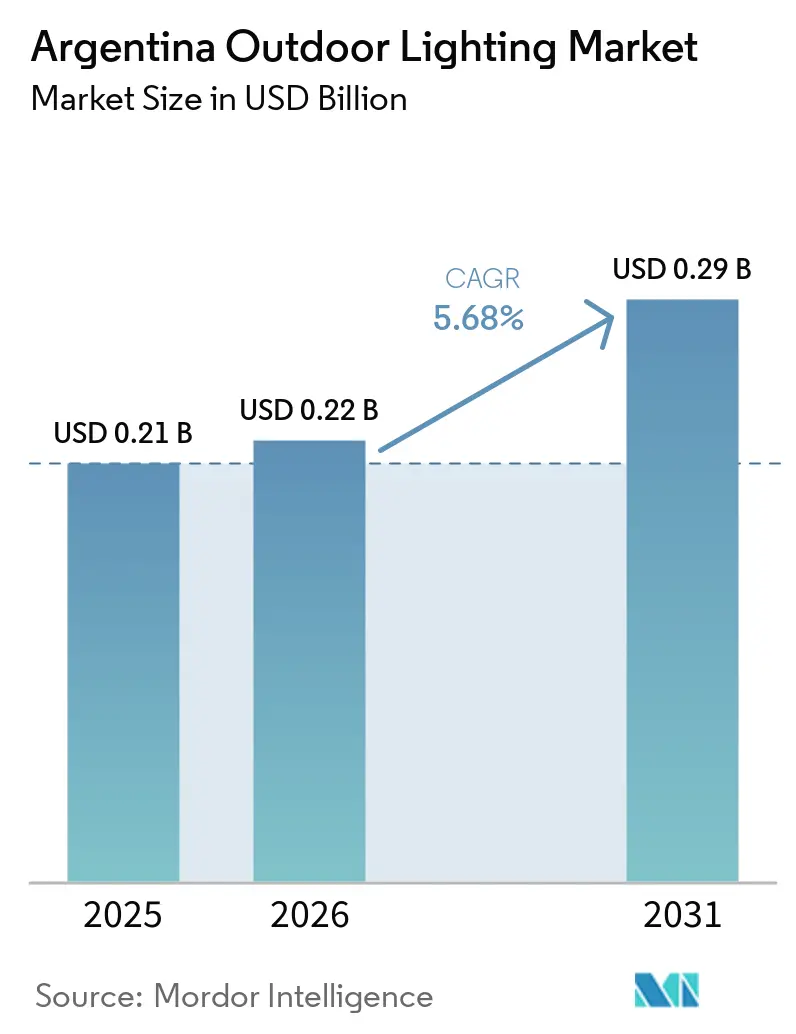
| Base Year Market Size (2025) | USD 0.21 Billion |
| Market Size (2026) | USD 0.22 Billion |
| Market Size (2031) | USD 0.29 Billion |
| Growth Rate (2026 - 2031) | 5.68 % |
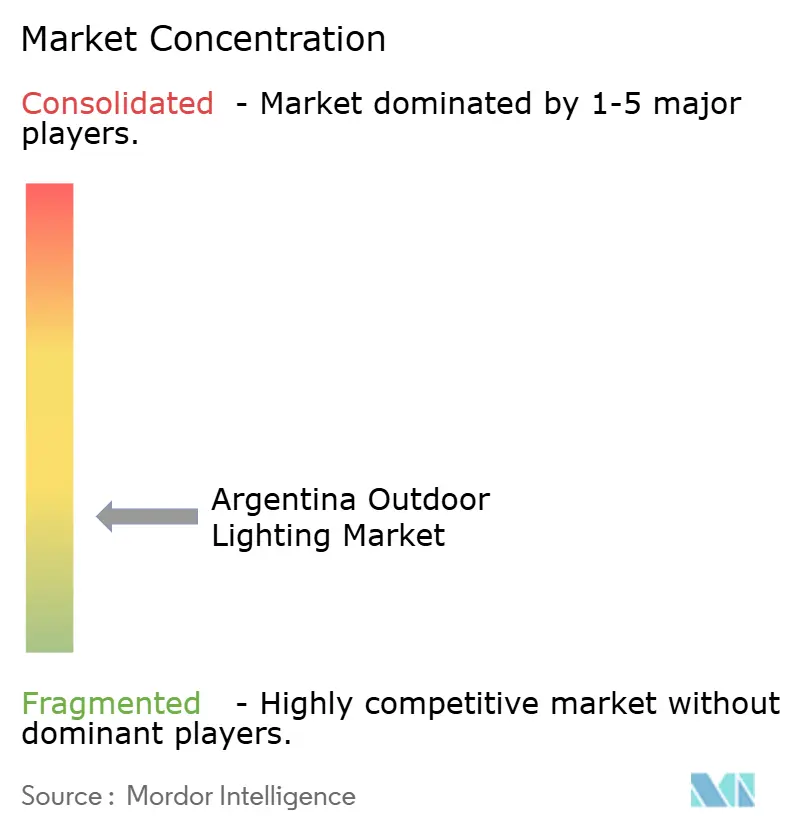
| Market Concentration | Low |
Major Players *Disclaimer: Major Players sorted in no particular order Image © Mordor Intelligence. Reuse requires attribution under CC BY 4.0. | |
Argentina Outdoor Lighting Market Analysis by Mordor Intelligence
The Argentina outdoor lighting market was valued at USD 0.21 billion in 2025, is estimated at USD 0.22 billion in 2026, and is forecast to reach USD 0.29 billion by 2031, growing at a 5.68% CAGR during 2026–2031. Municipal LED replacement programs, public safety projects, and a wider use of connected controls support demand across the country. Economic recovery can improve the ability of municipalities and commercial buyers to fund deferred upgrades, while lower inflation can reduce uncertainty in procurement budgets.. The strongest opportunities are tied to public corridors, off-grid communities, and projects that combine equipment with installation and ongoing service. Suppliers with local support, product certification, and experience in public tenders are better placed to compete for these projects. Import dependence remains a material constraint because China supplied USD 28.1 million of Argentina’s USD 33.7 million electric lamp and lighting-fitting imports in 2024.
Key Report Takeaways
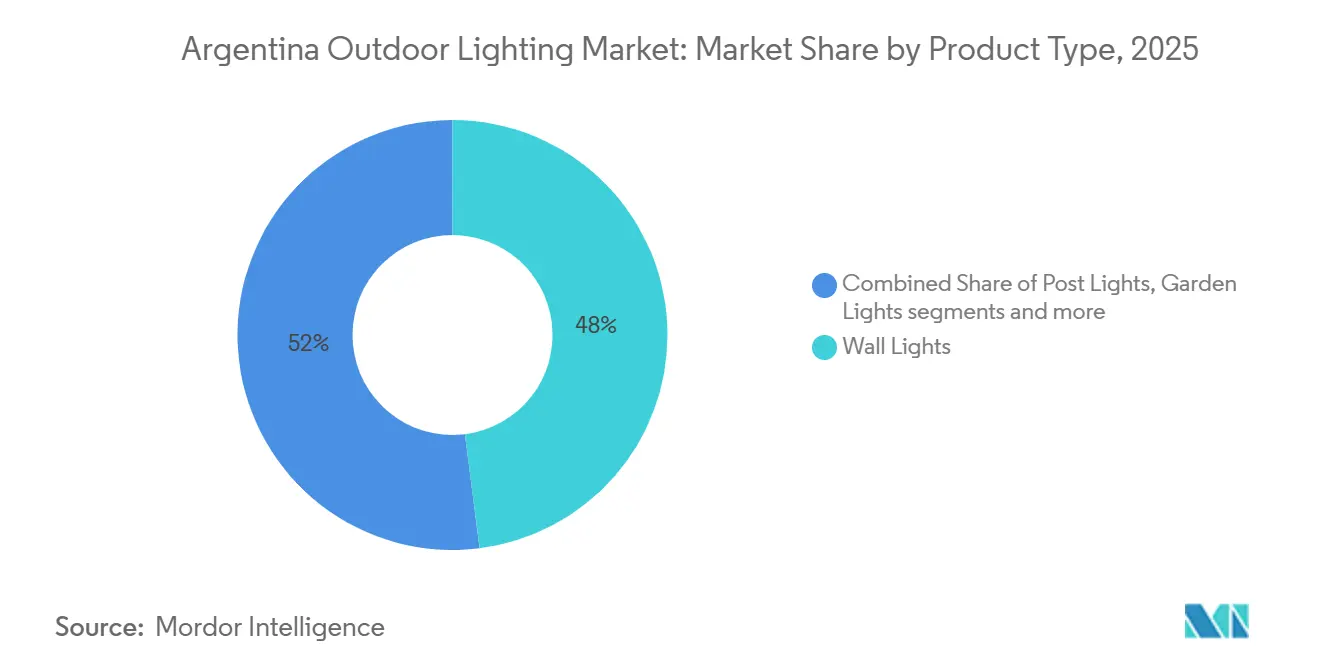
- By product type, wall lights held 48.0% of the Argentine outdoor lighting market share in 2025, while security lighting is forecast to grow at a 6.70% CAGR through 2031.
- By light source, LED held 53.4% of the Argentine outdoor lighting market share in 2025 and is projected to grow at the fastest CAGR of 6.30% during 2026–2031.
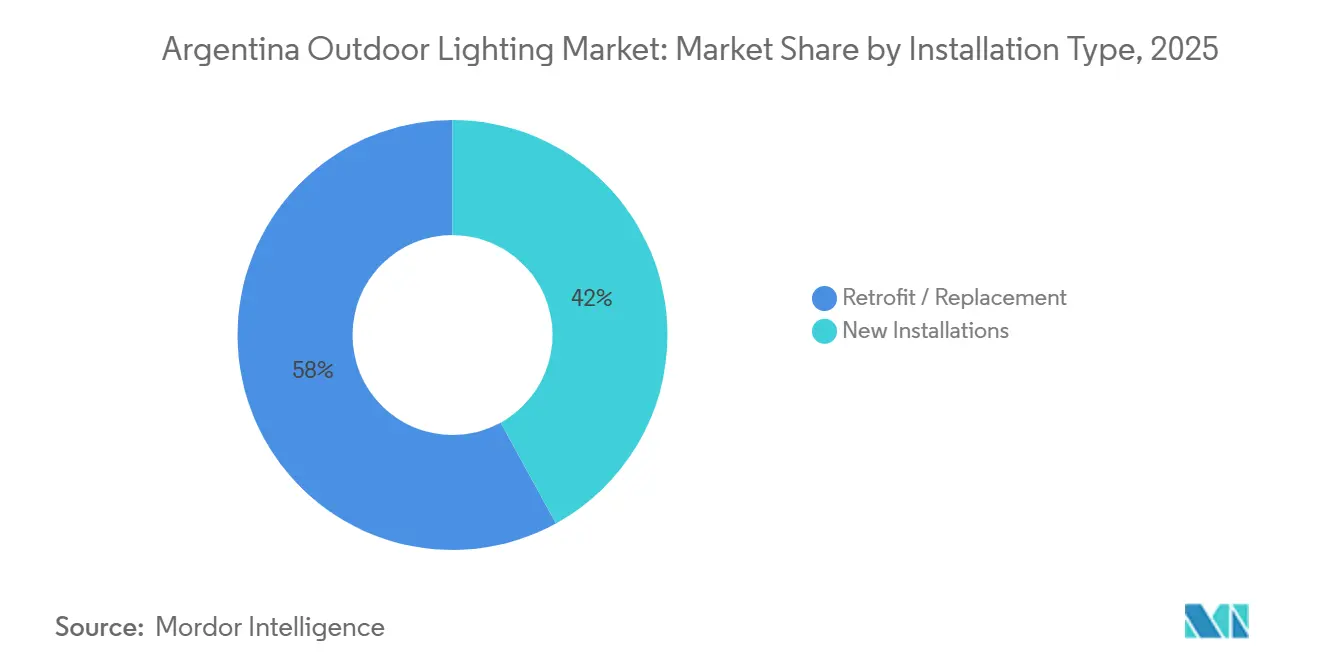
- By installation type, retrofit and replacement installations accounted for 58.0% of the Argentine outdoor lighting market size in 2025 and are projected to expand at a 6.90% CAGR through 2031.
- By application, commercial accounted for 51.30% of the market in 2025 and is projected to grow at the fastest CAGR of 6.80% during 2026–2031
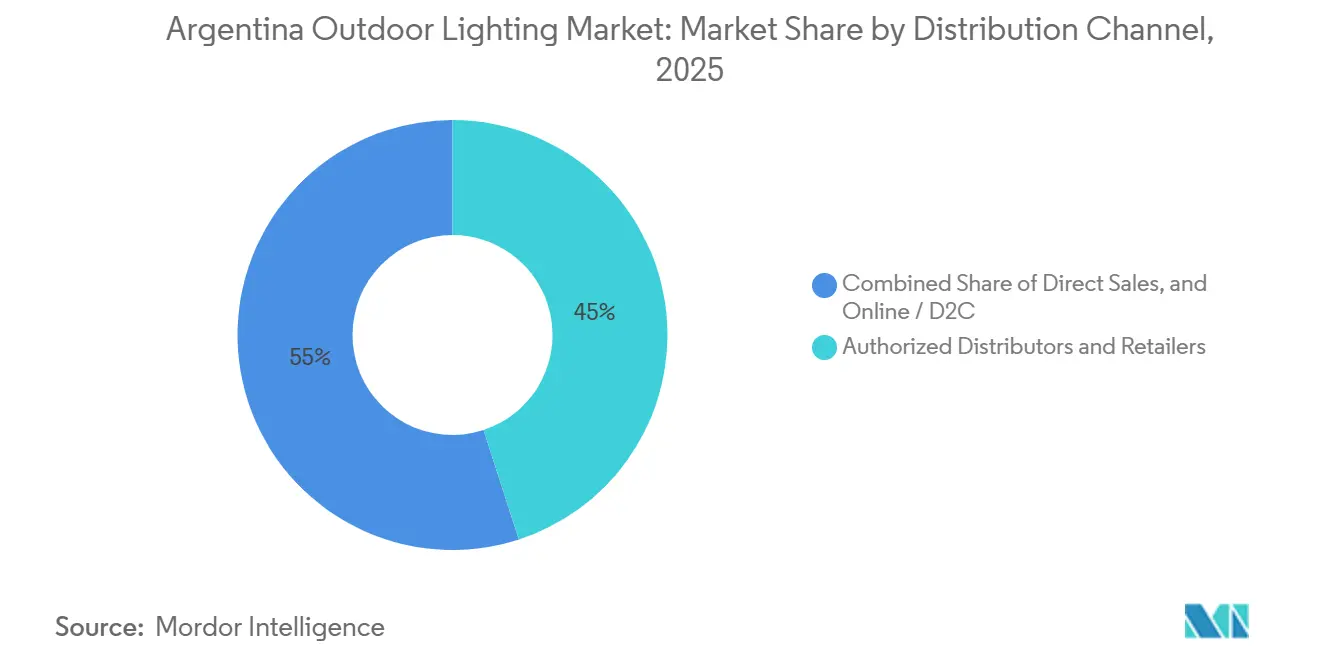
- By distribution channel, authorized distributors and retailers held 45.0% in 2025, while online and direct-to-consumer channels are forecast to grow at a 7.20% CAGR through 2031.
- By geography, the Buenos Aires Metropolitan Area held 42.0% in 2025, while Patagonia is forecast to grow at a 6.90% CAGR through 2031.
Note: Market size and forecast figures in this report are generated using Mordor Intelligence’s proprietary estimation framework, updated with the latest available data and insights as of January 2026.
Argentina Outdoor Lighting Market Trends and Insights
Drivers Impact Analysis*
| Driver | (~) % Impact on CAGR Forecast | Geographic Relevance | Impact Timeline |
|---|---|---|---|
| Accelerating LED Retrofits in Public Lighting | +1.5% | National, with concentration in Buenos Aires, Córdoba, Rosario, La Pampa, and Entre Ríos | Short term (≤ 2 years) |
| Lower Lifecycle Cost for Efficient Luminaires | +1.1% | National, with strong relevance in the Buenos Aires Metropolitan Area and Central Argentina | Medium term (2-4 years) |
| Smart-City and Remote Telegestion Projects | +0.9% | Buenos Aires, Rosario, Córdoba, Esperanza, and Tres de Febrero | Medium term (2-4 years) |
| Solar Lighting in Weak-Grid and Remote Locations | +0.7% | Patagonia, NOA, Cuyo, and NEA | Medium term (2-4 years) |
| Lighting Designs for Argentina’s Climate Range | +0.4% | Patagonia, Cuyo, and NOA | Long term (≥ 4 years) |
| Safety Upgrades on High-Traffic Corridors and Public Spaces | +0.5% | National, with the highest density in Buenos Aires, Córdoba, and Rosario | Short term (≤ 2 years) |
| Source: Mordor Intelligence | |||
Accelerating LED Retrofit Demand in Public Lighting
Argentina’s Plan de Alumbrado Eficiente provides nonreimbursable support for public-sector energy-efficiency projects, including replacement of inefficient lighting[1]. The program gives provinces and municipalities a route to advance LED projects when local capital budgets are limited. Buenos Aires City had 202,500 LED luminaires and 100% LED public-lighting coverage in 2025. The renewal of 2013-2017 luminaires (reusing housings, replacing plates and drivers) is projected at 35,000 units in 2026. This activity shows that mature cities can move from initial conversion work into a further replacement cycle. Technical requirements under the PLAE framework can also encourage equipment that delivers higher efficiency and can support future connectivity.
Expansion of Smart-City and Remote Telegestion Projects
Remote management has become more important in public lighting projects because it can support fault reporting, maintenance scheduling, and controlled dimming. Buenos Aires used Signify’s CityTouch system across more than 91,000 public luminaires in the city[2]. The installed base demonstrates that connected platforms have a role beyond the sale of a luminaire. In 2026, EPEC opened an intelligent public-lighting control center in Córdoba that is intended to progressively supervise 165,000 LED luminaires. Such systems can create multi-year requirements for software, network management, field service, and compatible replacement equipment. This favors vendors that combine lighting hardware with controls or can work with technology partners. Schréder’s 2025 work with EdgeMachines on the SENSE ONE sensor shows the type of data integration being developed for connected lighting networks[3].
Solar Lighting Adoption in Weak-Grid and Remote Locations
Remote areas create a practical use case for solar lighting where extending the grid is difficult or costly. The Puna de Jujuy project installed 147 Philips LED solar projectors across 12 communities with limited grid access in 2025. The project linked lighting with safer public spaces, community activity, and local tourism needs. Chubut also installed solar equipment in protected areas during 2025, including outdoor public-lighting components. These deployments support demand in Patagonia, NOA, Cuyo, and NEA, where grid conditions and distance differ from major cities. Solar installations can be designed to accept later control upgrades, which leaves room for follow-on monitoring services when local infrastructure expands. The Argentina outdoor lighting market therefore includes demand that is less tied to conventional grid-connected construction activity.
Safety-Led Upgrades Along High-Traffic Corridors and Public Spaces
Lighting upgrades along streets, sidewalks, parks, and public facilities are closely connected with urban safety objectives. Buenos Aires City announced 11,000 new pedestrian luminaires across its 15 communes in 2026 to address dark areas created by tree cover. This type of work favors luminaires that can provide reliable coverage in pedestrian areas and withstand public-space conditions. It also creates a need for planning that considers poles, vegetation, maintenance access, and local visibility requirements. Corridor projects can support demand for security fixtures, floodlights, and connected equipment in addition to standard street lighting. Municipal buyers are likely to value suppliers that can document installation quality and maintenance performance. The focus on safety gives public lighting demand a role that extends beyond electricity savings.
Restraints Impact Analysis*
| Restraint | (~) % Impact on CAGR Forecast | Geographic Relevance | Impact Timeline |
|---|---|---|---|
| High Upfront Cost of LED and Smart-Lighting Projects | -0.9% | National, most acute in smaller municipalities outside the Buenos Aires Metropolitan Area | Short term (≤ 2 years) |
| Macroeconomic Volatility and Import-Cost Exposure | -0.8% | National, particularly affecting import-dependent distributors and EPC contractors | Medium term (2-4 years) |
| Municipal Budget and Tender-Cycle Uncertainty | -0.6% | All geographies, particularly NOA and NEA municipalities | Medium term (2-4 years) |
| Limited Specialized Installation and Maintenance Capacity | -0.4% | Rural and peri-urban locations in Patagonia, NOA, NEA, and Cuyo | Long term (≥ 4 years) |
| Source: Mordor Intelligence | |||
High Upfront Cost of LED and Smart-Lighting Projects
Integrated projects require spending on luminaires, poles, control hardware, communications equipment, software, and installation. This creates a higher initial requirement than a simple replacement of a failed fixture. PLAE support can reduce part of that burden for eligible public buyers. Smaller municipalities can still face long administrative and procurement processes before work begins. Cities that have used early grants but have not completed full conversion may defer later phases until funding is available. Energy-service arrangements can help where a utility or concession partner has sufficient credit quality. Their reach is likely to remain narrower outside the larger municipalities in the near term.
Macroeconomic Volatility and Import-Cost Exposure
Argentina’s lighting supply chain remains exposed to imported products and components. China accounted for 83.5% of the value of Argentina’s electric lamp and lighting-fitting imports in 2024. This concentration means that currency changes can raise procurement costs for distributors and domestic assemblers. Domestic sellers can face pressure when their costs track foreign currency, and their sales are priced in pesos. Import duties, taxes, certification requirements, and financing costs can add to the difference between purchase cost and delivered cost. Larger suppliers may have more flexibility to manage currency and inventory risk than smaller firms. The Argentina outdoor lighting market may therefore continue to reward companies that can provide dependable stock, service, and compliant products through volatile conditions.
*Our forecasts treat driver/restraint impacts as directional, not additive. The impact forecasts reflect baseline growth, mix effects, and variable interactions.
Segment Analysis
By Product Type: Wall Lights Hold the Largest Position, While Security Lighting Grows Faster
Wall lights held 48.0% of the Argentina outdoor lighting market size in 2025. Their use spans residential exteriors, commercial facades, and institutional perimeters. Dense housing areas in Buenos Aires and peri-urban developments support this demand because wall-mounted fixtures do not require ground installation. These products also address routine visibility and security needs around entrances and shared outdoor areas. Floodlights and spotlights remain relevant for sports venues and larger commercial sites. Bollards and path lights serve parks, plazas, gardens, and pedestrian routes. Post lights and decorative formats serve hospitality and premium residential settings, including tourism areas and vineyard properties.
Security lighting is forecast to grow at a 6.70% CAGR through 2031. The category benefits from corridor illumination programs and demand for perimeter lighting at retail parks and logistics sites. Buenos Aires City’s 2026 pedestrian-lighting program shows the continuing importance of eliminating poorly lit areas. Security products need durable housings, sufficient output, and equipment suited to public or commercial use. Wall lights and decorative fixtures place greater importance on appearance and flexibility. Suppliers can address both needs with connected wall luminaires, tamper-resistant designs, or solar path lights with motion sensing. Exterior products also need to meet relevant IRAM and IP65-or-higher requirements where specified for outdoor use.

By Light Source: LED Leads Through Efficiency and Connectivity
LED held 53.4% of the Argentina outdoor lighting market share in 2025. It is also the fastest-growing light-source category, with a forecast CAGR of 6.30% through 2031. The position reflects continuing replacement of older lighting technologies and a wider LED offering across outdoor formats. Fluorescent products retain a role in older commercial and institutional installations where full replacement has not occurred. Incandescent and halogen fixtures persist in some decorative applications, especially in hospitality-oriented settings. HID and OLED account for a smaller combined role and face pressure as LED efficacy improves. The Argentina outdoor lighting industry is consequently shifting toward products that pair light output with longer operating life and lower energy use.
Commodity LED modules face strong price competition from imported supply. China’s share of Argentina’s electric-lamp and lighting-fitting imports was 83.5% by value in 2024. Smart LED luminaires with embedded controls and NEMA-socket compatibility serve a different requirement. Municipal specifications increasingly value equipment that can be integrated into managed lighting networks. This supports a difference in positioning between low-cost modules and connected products. Suppliers with control capability can compete for projects that include maintenance and system management. Suppliers focused only on hardware can remain competitive where price and immediate availability are the central selection criteria.
By Installation Type: Retrofit and Replacement Work Moves into a Further Cycle
Retrofit and replacement installations accounted for 58.0% of the Argentina outdoor lighting market share in 2025. The same installation type is forecast to grow at a 6.90% CAGR through 2031. First-stage conversions from sodium lighting to LED remain active in smaller municipalities. Leading cities are also replacing earlier LED systems with higher-efficacy and connected equipment. Buenos Aires renewed 25,000 earlier LED luminaires as part of its 2025 modernization work. This creates a more recurring source of demand than a single replacement event. Public programs that support efficiency upgrades further reinforce the role of retrofit work.
New installations made up the remaining 42% of value in 2025. They are linked to residential development, commercial construction, tourism accommodation, logistics parks, and expanding urban areas. Patagonia and Cuyo provide settings for projects that combine new construction with solar or specialized outdoor lighting. New installations can be more exposed to changes in construction activity and municipal capital budgets. Retrofit work can be less dependent on greenfield building because it responds to maintenance, safety, and energy-efficiency needs. For distributors and system integrators, this can support a more stable pipeline. Updated technical requirements can also move routine maintenance work toward more capable LED equipment.
By Application: Residential Demand Provides Scale, and Commercial Projects Grow Faster
Residential applications held 48.7% of the Argentina outdoor lighting market size in 2025. Wall lights, garden fixtures, path lights, and security fittings support demand from homes and housing developments. The segment benefits from the density of Buenos Aires and the continued expansion of suburban areas around major cities. Residential buyers commonly rely on distributors and retailers for product availability, credit terms, and contractor referrals. Decorative choices also remain relevant for premium homes and hospitality-linked properties. The category includes both practical security fixtures and products selected for exterior design. This breadth makes the residential base important for the Argentina outdoor lighting market.
Commercial applications are projected to grow at a 6.80% CAGR through 2031. The segment covers hospitality, sports, health care, retail, institutional facilities, and galleries or museums. Logistics growth and commercial property development support the need for high-grade and energy-compliant luminaires. Signify Foundation and Fundación River Plate worked on outdoor LED lighting for neighborhood club sports facilities in Argentina during 2025. Health-care campuses and retail parks can require reliable light quality, operational safety, and documented energy performance. Hospitality sites in Patagonia and Mendoza can also specify decorative or tunable systems as part of the guest environment. Commercial projects can therefore deliver higher value per unit than standard residential fixtures.
By Distribution Channel: Established Retail Networks Remain Important as Online Sales Expand
Authorized distributors and retailers held 45.0% of the Argentina outdoor lighting market share in 2025. Electrical wholesalers and specialty lighting stores remain central to residential and smaller commercial purchases. They provide local inventory and relationships with contractors that online channels cannot always replace. Their role is especially important outside Buenos Aires and Córdoba, where local service and stock availability can guide supplier choice. Direct sales also have an important position in larger business and public-sector projects. Tender processes require documentation, product support, and the ability to supply larger order volumes. This keeps formal distribution networks relevant even as digital channels grow.
Online and direct-to-consumer channels are forecast to expand at a 7.20% CAGR through 2031. CACE reported 253 million purchase orders and 645 million units sold through Argentine e-commerce in 2025[4]. Digital channels increase product visibility and price comparison for commodity lighting products. They can also reduce distributor margins where products need little technical support. Authorized distributors can respond by emphasizing installation advice, project packages, local stock, and after-sales service. Buyers may use online platforms to research products even when they complete the purchase through a local retailer. This changes marketing priorities for lighting brands without removing the role of established channel partners.
Geography Analysis
The Buenos Aires Metropolitan Area held 42.0% of the Argentine outdoor lighting market size in 2025. Buenos Aires City had 202,500 LED luminaires and full LED public-lighting coverage in 2025. In 2026, the city is adding 11,000 pedestrian luminaires across all 15 communes. Central Argentina includes Buenos Aires Province outside AMBA, Santa Fe, Córdoba, and Entre Ríos. Córdoba committed ARS 37,500 million to a 25-month lighting modernization program with EPEC in 2026. These areas combine first-stage conversion activity with replacement of earlier LED equipment. This favors systems that deliver better efficacy, controls, and reliable maintenance support.
Cuyo includes Mendoza, San Juan, and San Luis, where tourism, industrial activity, and solar conditions influence outdoor-lighting needs. San Juan achieved full public LED coverage in 2025 after replacing 3,388 luminaires since 2024. The region also provides a suitable setting for solar-integrated lighting projects. NOA and NEA have lower urbanization and tighter municipal budgets, which can slow broad LED conversion. At the same time, remote communities in NOA have received solar lighting under the Ruta de la Luz initiative. Smaller municipalities may favor bundled supply and service contracts because they have limited in-house technical procurement capacity. This creates room for experienced providers who can manage specification, supply, installation, and support.
Patagonia is forecast to grow at a 6.90% CAGR through 2031. Oil and gas service activity, eco-tourism facilities, and off-grid applications support this position. The Los Chihuidos Solar Park project in Neuquén combined a 200 kW photovoltaic installation, a 545 kWh lithium-ion battery bank, and LED public-lighting renewal, with works underway from mid-2025. Chubut installed solar equipment with outdoor-lighting components across protected areas during 2025. Wide temperature ranges and high winds increase the need for robust equipment in this geography. Products with strong ingress protection, thermal resistance, and structural strength can have an advantage over basic imported fixtures. These conditions support higher-value engineered products and suppliers with cold-climate references.
Competitive Landscape
The Argentina outdoor lighting market is fragmented. Global technology companies, regional specialists, and domestic manufacturers compete in different parts of the value chain. Signify has a visible institutional position through its CityTouch system in Buenos Aires, which serves more than 91,000 public luminaires. In 2026, Signify moved its outdoor specification portfolio in South America to the Signify brand, including road, solar, tunnel, flood, and sports luminaires. This action brings products previously offered under the Philips brand within one identity. The move does not change the stated product quality or specifications.
Schréder has strengthened its solar position through full ownership of Photinus in 2025. It also worked with EdgeMachines on SENSE ONE, which supports real-time data integration in lighting infrastructure. LEDVANCE competes through Argentine electrical wholesalers and specialty distributors with public, commercial, and solar lighting products. Domestic suppliers such as Lumenac S.A., Ferrolux S.A., JEG Luminarias, Industrias Centilux S.R.L., Optilux S.A., and HiperLed compete with local service, peso-denominated pricing, and tender relationships. Their local presence can be decisive in smaller municipalities where delivery and field response matter as much as advanced controls. Certification requirements and public-tender specifications can limit participation by suppliers that cannot demonstrate product compliance. This allows established vendors to compete on more than initial equipment cost.
Mid-sized cities with populations from 50,000 to 300,000 represent an area for further supplier engagement where public efficiency programs can support conversion work. The competitive divide is becoming clearer between connected-system suppliers and firms focused on basic lighting hardware. Connected platforms can create recurring service needs around software, controls, data, maintenance, and compatible replacements. Hardware-led domestic manufacturers can still compete in price-sensitive work and through local service coverage. Online channels add pressure on commodity residential products and encourage manufacturers to build direct customer visibility.
Argentina Outdoor Lighting Industry Leaders
-
Signify N.V.
-
Lumenac S.A.
-
JEG Luminarias
-
IEP S.A.
-
Ferrolux S.A.
- *Disclaimer: Major Players sorted in no particular order
Recent Industry Developments
- August 2026: Buenos Aires City announced the deployment of 11,000 new pedestrian LED luminaires across all 15 city communes. The project targets elimination of sidewalk dark zones caused by urban tree canopy, improving nighttime safety and walkability.
- June 2026: Signify commenced the transition of its entire outdoor specification portfolio, including sports, urban, road, solar, tunnel, and flood luminaires, to the Signify brand across South America. The change consolidated branding previously held under the Philips name, while stated product quality and specifications remained unchanged.
- June 2026: EPEC opened an intelligent public-lighting control center in Córdoba designed to progressively supervise 165,000 LED luminaires.
Argentina Outdoor Lighting Market Report Scope
| Decorative lighting | |
| Post lights | |
| Wall lights | Hanging lights |
| Chandeliers | |
| Others (flush mounts, etc.) | |
| Path & step lights | |
| Deck & patio lights | |
| Garden lights | |
| Security lighting | |
| Flood & spotlights | |
| Bollard | |
| Others (rope lights, string lights, etc.) |
| LED |
| Fluorescent |
| Incandescent |
| Halogen |
| Other Light Sources (HID, OLED, laser, etc.) |
| New Installations |
| Retrofit / Replacement |
| Residential |
| Commercial (HoReCa, Sports centers, Healthcare, Retail, Institutional, and Others (galleries/museums, corporates, etc.)) |
| Direct Sales (B2B / Tenders) |
| Online / D2C |
| Authorized Distributors & Retailers |
| Buenos Aires Metropolitan Area |
| Central Argentina |
| Cuyo Region |
| Northwest (NOA) |
| Northeast (NEA) |
| Patagonia |
| By Product Type | Decorative lighting | |
| Post lights | ||
| Wall lights | Hanging lights | |
| Chandeliers | ||
| Others (flush mounts, etc.) | ||
| Path & step lights | ||
| Deck & patio lights | ||
| Garden lights | ||
| Security lighting | ||
| Flood & spotlights | ||
| Bollard | ||
| Others (rope lights, string lights, etc.) | ||
| By Light Source | LED | |
| Fluorescent | ||
| Incandescent | ||
| Halogen | ||
| Other Light Sources (HID, OLED, laser, etc.) | ||
| By Installation Type | New Installations | |
| Retrofit / Replacement | ||
| By Application | Residential | |
| Commercial (HoReCa, Sports centers, Healthcare, Retail, Institutional, and Others (galleries/museums, corporates, etc.)) | ||
| By Distribution Channel | Direct Sales (B2B / Tenders) | |
| Online / D2C | ||
| Authorized Distributors & Retailers | ||
| By Geography | Buenos Aires Metropolitan Area | |
| Central Argentina | ||
| Cuyo Region | ||
| Northwest (NOA) | ||
| Northeast (NEA) | ||
| Patagonia | ||
Key Questions Answered in the Report
What is the projected growth rate for outdoor lighting in Argentina?
The category is forecast to grow at a 5.70% CAGR from 2026 through 2031, reaching USD 0.29 billion by 2031.
Which outdoor lighting product has the largest position in Argentina?
Wall lights held 48.0% of value in 2025, supported by residential, commercial, and institutional exterior uses.
Why is LED adoption growing in Argentina?
Public efficiency programs, replacement activity, and demand for connected systems support LED use. Buenos Aires had full LED public-lighting coverage in 2025 .
Which installation type is growing fastest?
Retrofit and replacement work is projected to grow at a 6.90% CAGR through 2031 and held 58.0% of value in 2025.
Which region is expected to expand most quickly?
Patagonia is forecast to grow at a 6.9% CAGR through 2031 because of remote-community demand, solar lighting, tourism facilities, and service infrastructure.