
AR Remote Assistance For Field Service Market Size and Share
Market Overview
| Study Period | 2020 - 2031 |
|---|---|
| Market Size (2026) | USD 0.81 Billion |
| Market Size (2031) | USD 1.53 Billion |
| Growth Rate (2026 - 2031) | 13.56 % |
| Fastest Growing Market | Asia-Pacific |
| Largest Market | North America |
| Market Concentration | Medium |
Major Players *Disclaimer: Major Players sorted in no particular order Image © Mordor Intelligence. Reuse requires attribution under CC BY 4.0. | |
AR Remote Assistance For Field Service Market Analysis by Mordor Intelligence
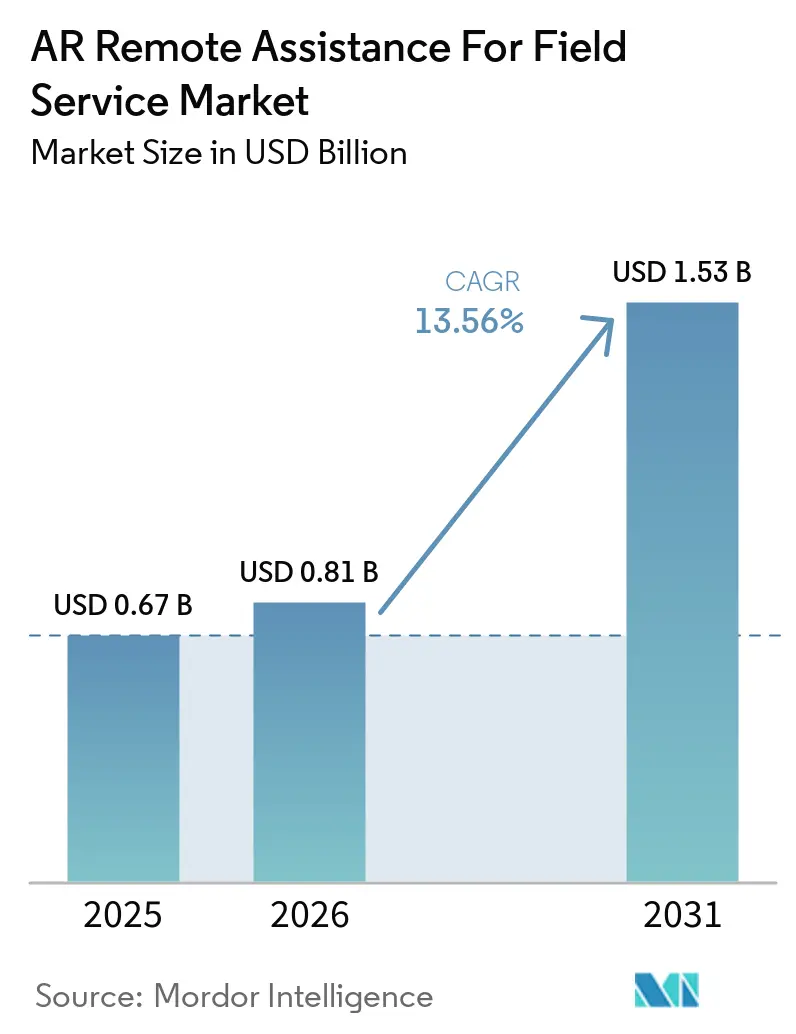
The AR remote assistance for field service market size was valued at USD 0.67 billion in 2025 and is estimated to grow from USD 0.81 billion in 2026 to reach USD 1.53 billion by 2031, at a CAGR of 13.56% during the forecast period (2026-2031). Labor shortages in industrial roles are increasing the value of tools that extend access to experienced technicians across multiple sites. Buyers are also moving from device-centered pilots toward software subscriptions that can support live guidance, work instructions, and session records. AI features are making recorded support sessions more useful for training and recurring maintenance work. Security controls, data handling requirements, and hardware comfort remain important conditions for wider deployment. The augmented reality (AR) remote assistance for field service market is therefore becoming more closely tied to operational workflows rather than stand-alone visualization projects.
Key Report Takeaways
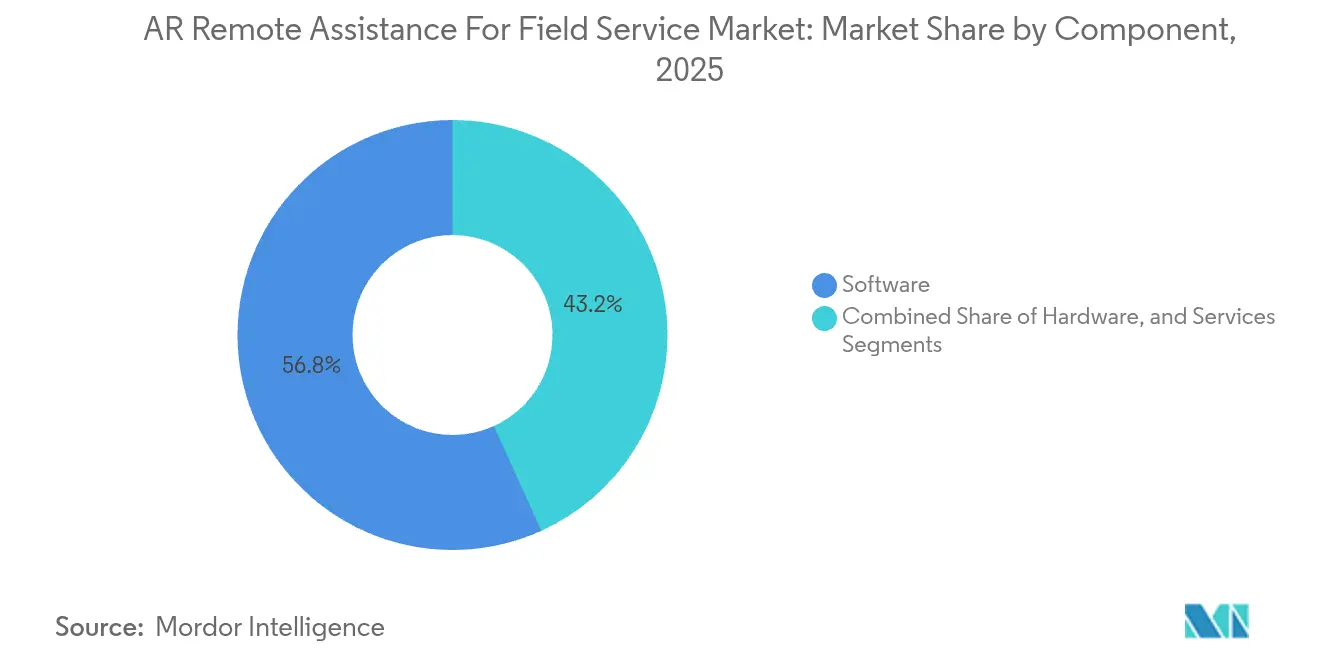
- By component, software accounted for 56.78% of the AR remote assistance for field service market share in 2025 and is projected to expand at a 14.03% CAGR through 2031.
- By deployment mode, cloud-based deployment held 74.59% of revenue in 2025 and is projected to grow at a 13.87% CAGR through 2031.
- By enterprise size, large enterprises accounted for 75.07% of revenue in 2025, while SMEs are projected to grow at a 14.62% CAGR through 2031.
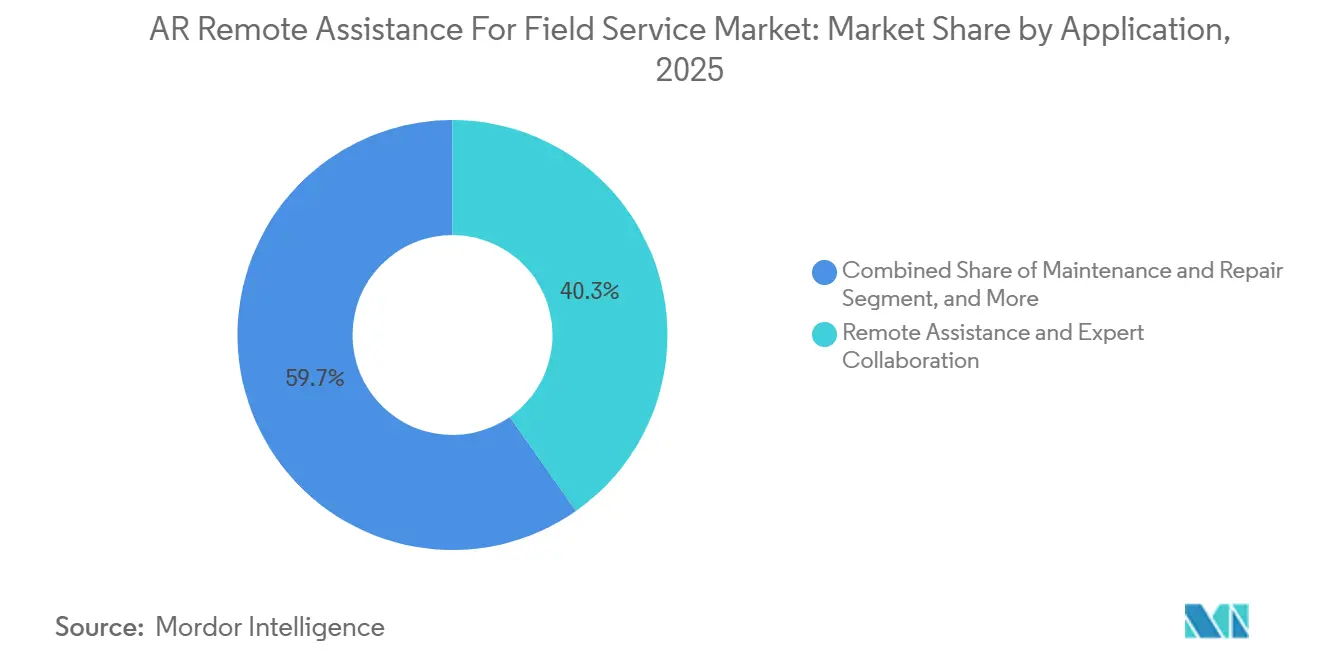
- By application, remote assistance and expert collaboration held 40.27% of revenue in the AR remote assistance for field service market in 2025, while inspection and quality assurance is projected to grow at a 16.38% CAGR through 2031.
- By industry vertical, manufacturing held 33.47% of revenue in 2025, while energy and utilities are projected to expand at a 15.82% CAGR through 2031.
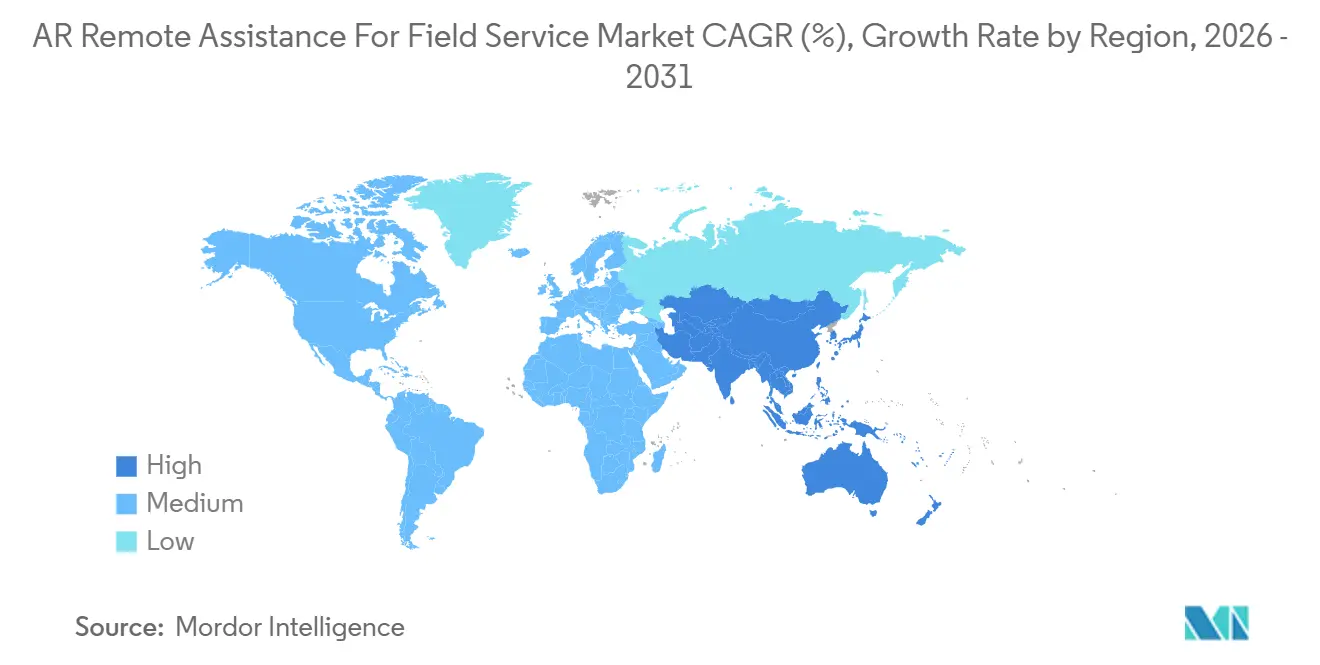
- By geography, North America held 37.52% of revenue in 2025, while Asia-Pacific is projected to grow at a 16.03% CAGR through 2031 in the AR remote assistance for field service market.
Note: Market size and forecast figures in this report are generated using Mordor Intelligence’s proprietary estimation framework, updated with the latest available data and insights as of January 2026.
Market Trends and Insights
Drivers Impact Analysis of AR Remote Assistance For Field Service Market*
| DRIVER | (~) % IMPACT ON CAGR FORECAST | GEOGRAPHIC RELEVANCE | IMPACT TIMELINE |
|---|---|---|---|
| Skilled-Trade Labor Shortages and Expert Retirement Risk | +2.8% | Global, with concentrated demand in North America and Asia-Pacific | Medium term (2-4 years) |
| Lower Truck Rolls and Faster First-Time Fixes | +2.2% | North America and Europe, spillover to Middle East | Short term (≤ 2 years) |
| 5G, Private Wireless, and Edge-Enabled Visual Collaboration | +2.0% | Asia-Pacific core, spillover to North America and Europe | Medium term (2-4 years) |
| AI-Assisted Knowledge Capture From Expert Sessions | +1.8% | Global | Long term (≥ 4 years) |
| Safety-Critical Remote Guidance in Hazardous Worksites | +1.4% | Middle East, Africa, and South America, with energy and oil and gas demand | Short term (≤ 2 years) |
| Low-Bandwidth AR Delivery for Remote Assets | +1.0% | Africa, South America, and rural Asia-Pacific | Long term (≥ 4 years) |
| Source: Mordor Intelligence | |||
Skilled-Trade Labor Shortages and Expert-Retirement Risk
The retirement of industrial tradespeople is supporting demand for remote expert access. The Manufacturing Institute projected 1.9 million unfilled U.S. manufacturing positions by 2033, with 3.8 million new hires needed, and linked the gap to workforce replacement needs.[1]The Manufacturing Institute, “2026 State of the U.S. Manufacturing Workforce Address,” The Manufacturing Institute, themanufacturinginstitute.org. More than one-quarter of U.S. manufacturing workers were near retirement age in the supplied analysis. The AR remote assistance for field service market gives organizations a way to connect experienced specialists with less experienced workers without adding equivalent senior headcount. It also lets teams document practical judgments that might otherwise be left with retiring employees. This makes early deployment valuable where companies want to preserve maintenance and repair knowledge before workforce turnover intensifies.
Lower Truck Rolls and Faster First-Time Fixes
Remote support can remove unnecessary field visits and shorten the time required to diagnose equipment problems. This matters most for utilities and energy operators that maintain dispersed substations, meters, platforms, and other field assets. Shell used AR headsets on offshore operations to connect site personnel with onshore experts and support inspections that previously required helicopter travel.[2]Shell, “Augmented Reality (AR) and Virtual Reality (VR),” Shell, shell.com. CareAR described smart-glass-supported maintenance workflows that connect utility technicians with remote specialists across distributed assets. The AR remote assistance for field service market can gain support from operating budget owners when savings from avoided trips and faster repairs are visible. This buyer group may place more weight on service continuity than on the underlying AR interface.
5G, Private Wireless, and Edge-Enabled Visual Collaboration
Reliable wireless connectivity is expanding the settings in which live visual guidance can be used. The Manufacturing Technology Center demonstrated that moving visual processing from a headset to edge computing can preserve a responsive XR experience and reduce overheating concerns. A 2025 industrial AR study reported that a 5G edge architecture reduced session latency from 78 ms to 45 ms while maintaining defect-recognition accuracy above 99%. TeamViewer also demonstrated on-device video super-resolution with 5G support for unstable mobile conditions in April 2026. The AR remote assistance for field service market benefits when private networks make visual collaboration practical in factories and other operating sites. These deployments can move the technology from occasional support toward a routine operations tool.
AI-Assisted Knowledge Capture From Expert Sessions
AI-assisted session capture is changing the value of live support from a one-time interaction into a reusable internal resource. TeamViewer stated that its Tia agent uses a knowledge graph and prior sessions to make suggestions during live support calls. SightCall introduced Xpert Knowledge in 2025 to turn session content into reusable step-by-step training material. Research in Computers and Industrial Engineering found that AI-enabled AR overlays can improve task accuracy and support early error detection in industrial maintenance. The AR remote assistance for field service market is gaining a stronger software case as session libraries become part of maintenance and training practices. Organizations that build these records early may face higher switching costs because the documented knowledge is linked to a platform workflow.
Restraints Impact Analysis of AR Remote Assistance For Field Service Market*
| RESTRAINT | (~) % IMPACT ON CAGR FORECAST | GEOGRAPHIC RELEVANCE | IMPACT TIMELINE |
|---|---|---|---|
| Cybersecurity and Privileged Remote-Access Exposure | -2.5% | Global, with highest exposure in critical infrastructure sectors | Medium term (2-4 years) |
| Smart-Glass Ergonomics and Frontline Adoption Friction | -1.8% | Global | Short term (≤ 2 years) |
| Connectivity Gaps in Industrial and Rural Sites | -1.4% | Africa, South America, and rural Asia-Pacific | Long term (≥ 4 years) |
| Data Residency, Recording, and Customer-Privacy Constraints | -1.0% | Europe and North America | Medium term (2-4 years) |
| Source: Mordor Intelligence | |||
Cybersecurity and Privileged Remote-Access Exposure
Live video access to operational environments creates additional security requirements for industrial users. The 2025 SANS ICS/OT Security Report found that unauthorized external access accounted for half of reported OT incidents in 2024, while 13% of surveyed organizations had advanced controls such as session recording or OT-aware authentication. ISACA identified unpatched firmware, hardcoded credentials, and flat network structures as recurring weaknesses in IT and OT environments.[3]ISACA, “Bridging the IT OT Security Gap,” ISACA Journal, isaca.org. The AR remote assistance for field service market must address these concerns, where tools connect corporate networks with shop-floor systems. Security reviews can extend procurement cycles for energy, chemicals, utilities, and other critical infrastructure users. Requirements under IEC 62443 and the NIST Cybersecurity Framework also raise the importance of access controls, system design, and audit records.
Smart-Glass Ergonomics and Frontline Adoption Friction
Hardware use remains difficult to standardize across industrial settings. Clean-room facilities, outdoor utility work, and confined-space operations each impose different requirements for weight, heat, hygiene, and safety. Research from Frankfurt University of Applied Sciences found that industrial remote AR deployments require substantial preparation and integration work rather than functioning as plug-and-play tools. The AR remote assistance for field service market may therefore scale first within specific roles and tasks instead of across entire workforces. Device selection, worker training, and workflow design remain essential parts of deployment. This constraint supports demand for browser-based sessions and smartphone-compatible options where specialized hardware is not practical.
*Our forecasts treat driver/restraint impacts as directional, not additive. The impact forecasts reflect baseline growth, mix effects, and variable interactions.
AR Remote Assistance For Field Service Market Segment Analysis
By Component:
Software Supports Recurring Platform RevenueSoftware held 56.78% of the AR remote assistance for field service market share in 2025, reflecting the shift from hardware-led pilots to subscriptions with recurring license fees. Enterprise buyers use these platforms for live guidance, workflow integration, session analytics, and knowledge capture. TeamViewer Frontline, PTC Vuforia, and CareAR are among the platforms that support this software-centered model. Vendors are also introducing AI capability tiers and usage-based features alongside conventional seat licenses. Hardware, including smart glasses and head-mounted displays, remained the second-largest component. Devices from suppliers such as RealWear and Vuzix are increasingly sold as part of software bundles rather than as stand-alone deployments. Services for implementation, training, and customization remain important when companies extend deployments across sites. The augmented reality (AR) remote assistance for filed service industry is therefore earning more of its revenue from long-term platform use than from a single device purchase.
Software is projected to expand at a 14.03% CAGR through 2031, placing it above the overall forecast rate. This growth reflects demand for more than video streaming and basic annotations. Organizations are adding searchable session records, AI suggestions, and analytics that support technicians over repeated work cycles. Augmentir launched AR functions in September 2025 within its connected-worker platform and positioned them alongside its GenAI capabilities. The offering illustrates how suppliers are competing on assistance quality and workflow intelligence. A library of resolved sessions can also become a practical organizational asset. Moving to another provider may be harder when that library is closely integrated with the existing platform. The AR remote assistance for field service market continues to favor suppliers that combine real-time support with reusable operational knowledge.



By Deployment Mode:
Cloud Delivery Leads as Hybrid Designs DevelopCloud-based deployment held 74.59% of revenue in 2025. Managed infrastructure reduces the need for site-specific maintenance and connects experts with field teams across dispersed locations. It also supports multi-expert collaboration without a dedicated local system at every operating site. RealWear’s Collaborate platform uses Microsoft Azure Communication Services for collaboration functions. TeamViewer also uses a cloud-managed approach for knowledge and session-related functions. On-premises delivery remained relevant for oil and gas, defense, and critical utilities. These users may require local video processing due to data sovereignty and cybersecurity regulations. Kognitiv Spark addresses this need with RemoteSpark configurations designed for secure, low-bandwidth environments.
Cloud-based deployment is projected to grow at a 13.87% CAGR through 2031. The distinction between cloud and on-premise models is becoming less rigid as regulated users adopt hybrid designs. These designs can use cloud management tools while retaining sensitive video processing on-site. Bosch presented its any.site platform at Hannover Messe in April 2026 as an example of cloud-accessible knowledge support that processes operational data locally.[4]Bosch, “Hannover Messe 2026, Bosch Setzt auf Zusammenspiel von Mensch und KI,” Bosch Media Service, bosch-presse.de. The design addresses the need for distributed support while preserving control over sensitive information. This can shift buyer attention from a simple deployment label toward security and integration capabilities. The AR remote assistance for the field service market is likely to benefit when vendors make these choices easier for regulated operators. The augmented reality (AR) remote assistance for field service industry will still need to meet customers’ specific rules on recordings and data location.
By Enterprise Size:
SMEs Gain Access While Large Enterprises Retain Revenue LeadershipLarge enterprises held 75.07% of revenue in 2025 because early deployments often required dedicated integration, hardware procurement, and change-management resources. Automotive manufacturers, energy utilities, and aerospace maintenance providers were among the early users. Their geographically distributed operations made it easier to measure the savings from remote expert support. Large companies also had the resources to integrate AR tools with service and asset management systems. Scope AR and FTAI Aviation reported 30-40% lower task times and zero recorded errors in AR-supported engine maintenance workflows in 2025. This use case shows why high-value maintenance work has been a core entry point. Large accounts remain important because they can expand a successful deployment from one facility to many. Their established digital systems also provide suppliers with a broader range of integration opportunities.
SMEs are projected to grow at a 14.62% CAGR through 2031, making them the fastest-growing enterprise-size segment. Per-seat and per-session pricing is lowering the cost of entry for firms with 20-50 technicians. Browser-based sessions can reduce the need for dedicated hardware and application installations. VSight introduced its Nova AI copilot in 2026, offering work instructions, remote assistance, and knowledge capture on a single platform. Kognitiv Spark added a browser-based RemoteSpark client in July 2026 to reduce deployment complexity for smaller organizations. The AR remote assistance for field service market can reach a broader customer base when an initial deployment does not require a large technology project. Smaller firms may prefer focused tools with clear maintenance or service workflows. This opportunity could also bring more specialist providers into the lower-price tier.
By Application:
Inspection Expands Alongside Remote CollaborationRemote assistance and expert collaboration held 40.27% of revenue in 2025, making it the largest application in the AR remote assistance for field service market. The core use case is a skilled technician guiding another worker through diagnosis or repair using live video and AR annotations. Maintenance and repair remained the next major application because users want to reduce unplanned downtime. Training and simulation are also growing as organizations reuse recorded sessions and AI-generated guides for new employees. Logistics and warehousing guidance remained at an earlier stage, with many deployments still in proof-of-concept use. The largest application is closely connected to the immediate operational need for expertise at the point of work. It provides the data and work records that can later support training and standard operating procedures. This makes remote collaboration a foundation for several adjacent use cases.
Inspection and quality assurance are projected to expand at a 16.38% CAGR through 2031. AI computer vision and live AR overlays allow remote quality personnel to review a worker’s camera feed and mark defects during an inspection. Percepto introduced an inspection intelligence platform for energy infrastructure in June 2026, combining contextual AI with autonomous drone capabilities.[5]Percepto, “Percepto Launches Next-Generation Inspection Intelligence for Energy Infrastructure,” Percepto, percepto.co. Published SPE and IADC research also described wearable AR for remote equipment surveys, tubular thread inspection, and rig operations. These applications can reduce travel demands and support safety procedures at remote sites. Inspection workflows are becoming less distinct from remote support as automated sensing and expert review are integrated. Suppliers with computer vision and inspection capabilities may have a stronger position in this faster-growing application. The AR remote assistance for field service market is consequently extending into structured quality workflows, not only live troubleshooting.
By Industry Vertical:
Manufacturing Leads While Energy and Utilities Grow FastestManufacturing held 33.47% of industry-vertical revenue in 2025. Automotive, industrial machinery, electronics, and semiconductor production were the main manufacturing use cases identified in the supplied research. These operations involve complex equipment, require frequent maintenance, and have limited tolerance for prolonged downtime. Siemens offers COMOS Mobile Worker for maintenance workflows that combine AR overlays with process data. Germany’s Industrie 4.0 activity has also supported early use in precision manufacturing and mechanical engineering. Siemens and TeamViewer have worked together on AR applications for assembly, training, service, and logistics. Electronics and semiconductor facilities are using AR-supported quality work in environments where production standards are strict and experienced inspectors are scarce. Manufacturing remains a key base of demand because it combines workforce pressure with well-defined repeatable tasks.
Energy and utilities are projected to grow at a 15.82% CAGR through 2031, the fastest rate among the defined verticals. Remote assets, aging field workforces, high expert travel costs, and the need to avoid downtime support deployment in this sector. VSight reported that its work with European utility EDP reduced expert travel by 15% in an initial phase. Offshore oil and gas facilities have similar requirements because travel-intensive and hazardous environments complicate access to expert support. Telecommunications can use the technology for network equipment commissioning and maintenance. Construction and facilities teams can apply it to inspections and compliance work. Healthcare and life sciences users can use it for medical-device servicing and equipment qualification. The AR remote assistance for field service market has broad vertical potential, but energy and utilities offer a particularly direct link between remote guidance and service continuity.
Geography Analysis
North America AR Remote Assistance for Field Service Market
North America held 37.52% of global revenue in 2025. Manufacturing, energy and utilities, and field service operations supported early adoption in the region. The United States has a large installed base of automotive, aerospace, defense, and industrial equipment that requires skilled intervention. Canada contributed to demand from oil sands and energy infrastructure operations. Mexico’s automotive and electronics assembly facilities are beginning to adopt remote guidance as supplier networks undergo digital transformation. Strong 5G coverage and mature enterprise cloud environments enable the region to deploy connected tools. The concentration of vendors also supports product development and local customer engagement. TeamViewer and Microsoft demonstrated AI video enhancement for industrial frontline use at Microsoft Build 2026.
APAC AR Remote Assistance for Field Service Market
Asia-Pacific is projected to grow at a 16.03% CAGR through 2031, the fastest regional rate in the AR remote assistance for field service market. China faces rising labor costs and growing equipment complexity across its manufacturing base. Sany Heavy Industry used a Baidu Cloud AR system for more than 4,000 monthly maintenance work orders involving excavators, loaders, and piling machines. Japan’s aging manufacturing workforce supports a similar demand for ways to extend expert knowledge. South Korea’s electronics and semiconductor operations also have a strong need for high-quality maintenance and inspection processes. India is gaining adoption in pharmaceutical manufacturing and IT-enabled engineering services. Australia provides another use case through mining and natural resources operations that manage remote sites with centralized expert teams. Domestic technology policies in China may create different opportunities for local and Western providers in sensitive industrial settings.
EMEA and South America AR Remote Assistance for Field Service Market
Europe remained the second-largest regional market, with Germany, the United Kingdom, and France as important adopters. Germany’s industrial base and Industrie 4.0 efforts have encouraged the use of AR in precision manufacturing and mechanical engineering. The General Data Protection Regulation adds requirements for recording, storing, and transferring session data that contains employee images or proprietary process information. This can slow cloud deployment when video is stored outside European Union data centers. The Middle East is seeing growing demand driven by oil and gas digital transformation in Saudi Arabia and the United Arab Emirates. South America is seeing early use in Brazilian energy and mining operations. Africa remained the smallest regional opportunity, with activity centered on oil and gas and telecommunications maintenance in countries including South Africa and Nigeria. The AR remote assistance for field service market will need local data and connectivity approaches to address these varied conditions.

Competitive Landscape
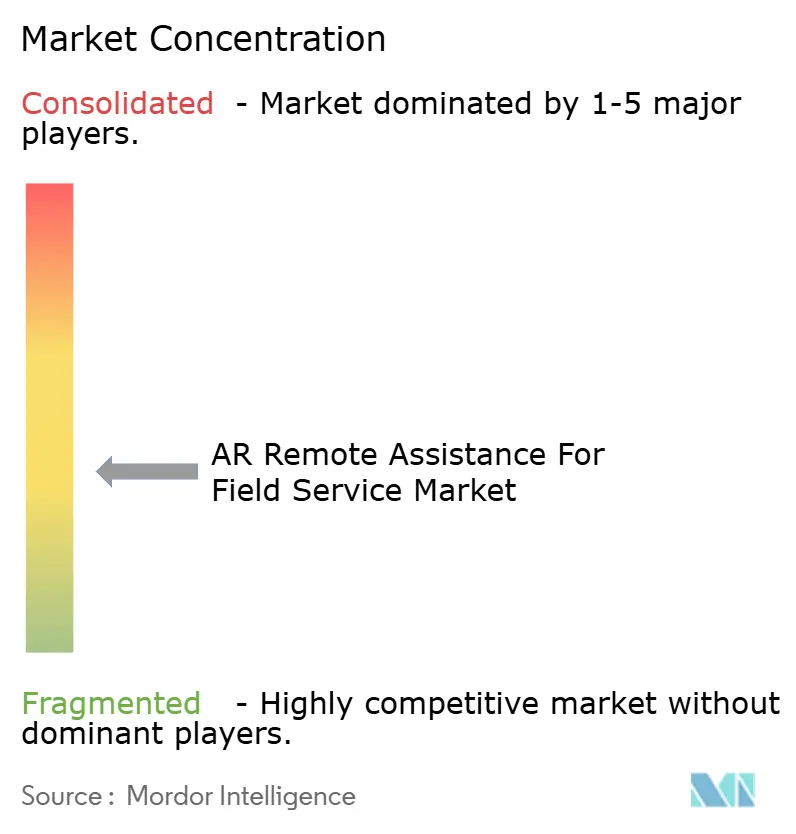
The AR remote assistance for field service market is moderately fragmented, with no single supplier controlling hardware, software, and implementation services simultaneously. Siemens, Microsoft, and Honeywell offer related capabilities through broader industrial IoT and connected-worker portfolios. Their wider product suites create opportunities to sell AR functions alongside existing systems. Dedicated providers such as TeamViewer, PTC, Augmentir, Kognitiv Spark, SightCall, and XMReality focus more directly on remote guidance, knowledge capture, analytics, and enterprise integration. Smaller specialists can gain access to customers through established software ecosystems. XMReality integrated its offering with Microsoft Dynamics 365 and positioned the connection for users seeking a replacement path after Microsoft discontinued its HoloLens Remote Assist app.[6]XMReality, “XMReality Integrates with Microsoft Dynamics 365,” XMReality, xmreality.com. Integration with ServiceNow, Salesforce, and Microsoft Dynamics 365 can embed an AR tool into workflows already used by an enterprise. This can give providers distribution advantages that new entrants may find difficult to replicate.
The competitive focus in the AR remote assistance for field service market is moving away from video quality and hardware compatibility alone. Buyers increasingly compare the ability to capture knowledge, support AI-assisted decisions, and connect with field-service processes. TeamViewer is embedding Tia-powered recommendations and Salesforce-ticket-initiated AR sessions into its Frontline workflow. This approach seeks to integrate remote assistance into a customer’s existing service operations. Flatirons Solutions acquired Scope AR in January 2026 and combined technical-documentation authoring with 3D work instructions and remote expert support. The deal illustrates growing interest in aerospace, maintenance, repair, overhaul, advanced manufacturing, and defense applications. Suppliers that can link content, live support, and completed work records may be better positioned in these settings. The AR remote assistance for field service market is therefore rewarding integrated platforms as well as specialized AR functions.
Opportunities remain for simple, SME-focused products that use smartphones or browser sessions rather than dedicated hardware. There is also room for sector-specific content libraries that place inspection criteria, maintenance steps, and regulatory checks into a worker’s visual workflow. Emerging providers can build AI-native functions without the burden of maintaining older enterprise architectures. Incumbents retain advantages in established customer relationships, security reviews, and enterprise integrations. The AR remote assistance for field service market can support both groups because deployment requirements differ greatly by customer size and site conditions. Vendors will need to prove that tools are suited to specific roles rather than assuming a single device or application works everywhere. The combination of specialist platforms and industrial automation companies supports the description of a moderately fragmented field. It also means strategic partnerships and acquisitions are likely to remain important routes to broader capabilities.
AR Remote Assistance For Field Service Industry Leaders
TeamViewer SE
PTC Inc.
Xerox Corporation
Librestream Technologies Inc.
Scope AR Inc.
- *Disclaimer: Major Players sorted in no particular order
AR Remote Assistance For Field Service Market Companies Covered in this Report
- TeamViewer SE
- PTC Inc.
- Xerox Corporation
- Librestream Technologies Inc.
- Scope AR Inc.
- RealWear, Inc.
- Vuzix Corporation
- Siemens AG
- Microsoft Corporation
- Honeywell International Inc.
- Robert Bosch GmbH
- SAP SE
- Salesforce, Inc.
- ServiceNow, Inc.
- Schneider Electric SE
- ABB Ltd
- Augmentir, Inc.
- Kognitiv Spark Corporation
- AMA XpertEye SAS
- SightCall, Inc.
- TechSee, Inc.
- XMReality AB
- VSight UAB

Recent Industry Developments in AR Remote Assistance For Field Service Market
- July 2026: Kognitiv Spark released a significant update to its RemoteSpark connected field worker platform, introducing a browser-based client, centralized software lifecycle management, and expanded video capture and call recording capabilities for knowledge preservation. The update added Microsoft Teams and OneDrive integration, extending the platform's reach within enterprise Microsoft environments and enabling workers to pull task-critical files and join expert calls without switching applications.
- June 2026: Percepto launched its next-generation inspection intelligence platform for energy infrastructure operators, integrating contextual AI with autonomous drone capabilities to deliver expert-level remote inspections for oil and gas and electric utility assets. The platform addresses the growing demand for scalable inspection coverage at organizations facing limited access to experienced field inspectors.
- June 2026: TeamViewer SE partnered with Microsoft to integrate the Windows AI API for Video Super Resolution into its Assist AR frontline solution, delivering AI-enhanced video quality for remote guidance sessions even over weak or unstable mobile networks. The integration was demonstrated at Microsoft Build 2026 in San Francisco and is targeted at industrial manufacturing, utilities, and healthcare environments.
- January 2026: Flatirons Solutions acquired Scope AR, backed by TELEO Capital, creating an AI-powered end-to-end technical content-to-execution platform for aerospace, aviation MRO, advanced manufacturing, and defense. The acquisition combines Flatirons' S1000D/ATA-compliant technical documentation authoring with Scope AR's 3D work instructions and remote expert support.


Global AR Remote Assistance For Field Service Market Report Scope
The AR remote assistance for field service market comprises augmented reality (AR)-enabled software solutions that enable field technicians and frontline workers to access real-time visual guidance, collaborative support, and expertise from remote specialists. These platforms use smartphones, tablets, smart glasses, or head-mounted displays to superimpose digital instructions, annotations, and contextual information onto physical equipment and work environments. Organizations across field service, manufacturing, utilities, telecommunications, healthcare, and industrial maintenance deploy AR remote assistance solutions to reduce service resolution times, improve first-time fix rates, lower travel costs, and increase technician productivity and knowledge transfer.
The AR Remote Assistance for Field Service Market Report is Segmented by Component (Hardware, Software, and Services), Deployment Mode (Cloud-Based, and On premise), Enterprise Size (Small and Medium Enterprises, and Large Enterprises), Application (Remote Assistance and Expert Collaboration, Maintenance and Repair, Training and Simulation, Inspection and Quality Assurance, and Other Applications), Industry Vertical (Manufacturing [Automotive and Mobility Manufacturing, Industrial Machinery and Equipment, and Electronics and Semiconductor Manufacturing], Energy and Utilities, Oil and Gas, Telecommunications, Construction and Facilities, Healthcare and Life Sciences, Transportation, Logistics, and Warehousing, and Other Industry Verticals), and Geography (North America, South America, Europe, Asia-Pacific, Middle East, and Africa). The Market Forecasts are Provided in Terms of Value (USD).
| Hardware |
| Software |
| Services |
| Cloud-Based |
| On premise |
| Small and Medium Enterprises |
| Large Enterprises |
| Remote Assistance and Expert Collaboration |
| Maintenance and Repair |
| Training and Simulation |
| Inspection and Quality Assurance |
| Other Applications |
| Manufacturing | Automotive and Mobility Manufacturing |
| Industrial Machinery and Equipment | |
| Electronics and Semiconductor Manufacturing | |
| Energy and Utilities | |
| Oil and Gas | |
| Telecommunications | |
| Construction and Facilities | |
| Healthcare and Life Sciences | |
| Transportation, Logistics, and Warehousing | |
| Other Industry Verticals |
| North America | United States |
| Canada | |
| Mexico | |
| South America | Brazil |
| Rest of South America | |
| Europe | Germany |
| United Kingdom | |
| France | |
| Italy | |
| Russia | |
| Rest of Europe | |
| Asia-Pacific | China |
| Japan | |
| India | |
| South Korea | |
| Australia | |
| Rest of Asia-Pacific | |
| Middle East | Saudi Arabia |
| United Arab Emirates | |
| Turkey | |
| Rest of Middle East | |
| Africa | South Africa |
| Nigeria | |
| Rest of Africa |
| By Component | Hardware | |
| Software | ||
| Services | ||
| By Deployment Mode | Cloud-Based | |
| On premise | ||
| By Enterprise Size | Small and Medium Enterprises | |
| Large Enterprises | ||
| By Application | Remote Assistance and Expert Collaboration | |
| Maintenance and Repair | ||
| Training and Simulation | ||
| Inspection and Quality Assurance | ||
| Other Applications | ||
| By Industry Vertical | Manufacturing | Automotive and Mobility Manufacturing |
| Industrial Machinery and Equipment | ||
| Electronics and Semiconductor Manufacturing | ||
| Energy and Utilities | ||
| Oil and Gas | ||
| Telecommunications | ||
| Construction and Facilities | ||
| Healthcare and Life Sciences | ||
| Transportation, Logistics, and Warehousing | ||
| Other Industry Verticals | ||
| By Geography | North America | United States |
| Canada | ||
| Mexico | ||
| South America | Brazil | |
| Rest of South America | ||
| Europe | Germany | |
| United Kingdom | ||
| France | ||
| Italy | ||
| Russia | ||
| Rest of Europe | ||
| Asia-Pacific | China | |
| Japan | ||
| India | ||
| South Korea | ||
| Australia | ||
| Rest of Asia-Pacific | ||
| Middle East | Saudi Arabia | |
| United Arab Emirates | ||
| Turkey | ||
| Rest of Middle East | ||
| Africa | South Africa | |
| Nigeria | ||
| Rest of Africa | ||


Key Questions Answered in the Report
What is the AR remote assistance for field service market size?
The AR remote assistance for field service market size was valued at USD 0.67 billion in 2025 and is estimated to grow from USD 0.81 billion in 2026 to reach USD 1.53 billion by 2031, at a CAGR of 13.56% during the forecast period (2026-2031).
What is driving adoption of AR remote assistance for field service?
Industrial labor shortages, the retirement of experienced workers, lower field-travel needs, and reusable knowledge from recorded expert sessions are supporting adoption.
Which component leads spending?
Software led with 56.78% of revenue in 2025 and is forecast to grow at a 14.03% CAGR through 2031.
Why are cloud-based deployments common?
Cloud-based deployment held 74.59% of revenue in 2025 because it supports distributed collaboration without dedicated infrastructure at each site.
Which application is expanding fastest?
Inspection and quality assurance is forecast to grow at a 16.38% CAGR through 2031 as computer vision and live AR overlays are used together.
Which region is projected to grow fastest?
Asia-Pacific is projected to grow at a 16.03% CAGR through 2031, supported by manufacturing modernization and demand for experienced maintenance and inspection workers.
Page last updated on:





