
Apple Juice Concentrate Market Size and Share
Market Overview
| Study Period | 2022 - 2032 |
|---|---|
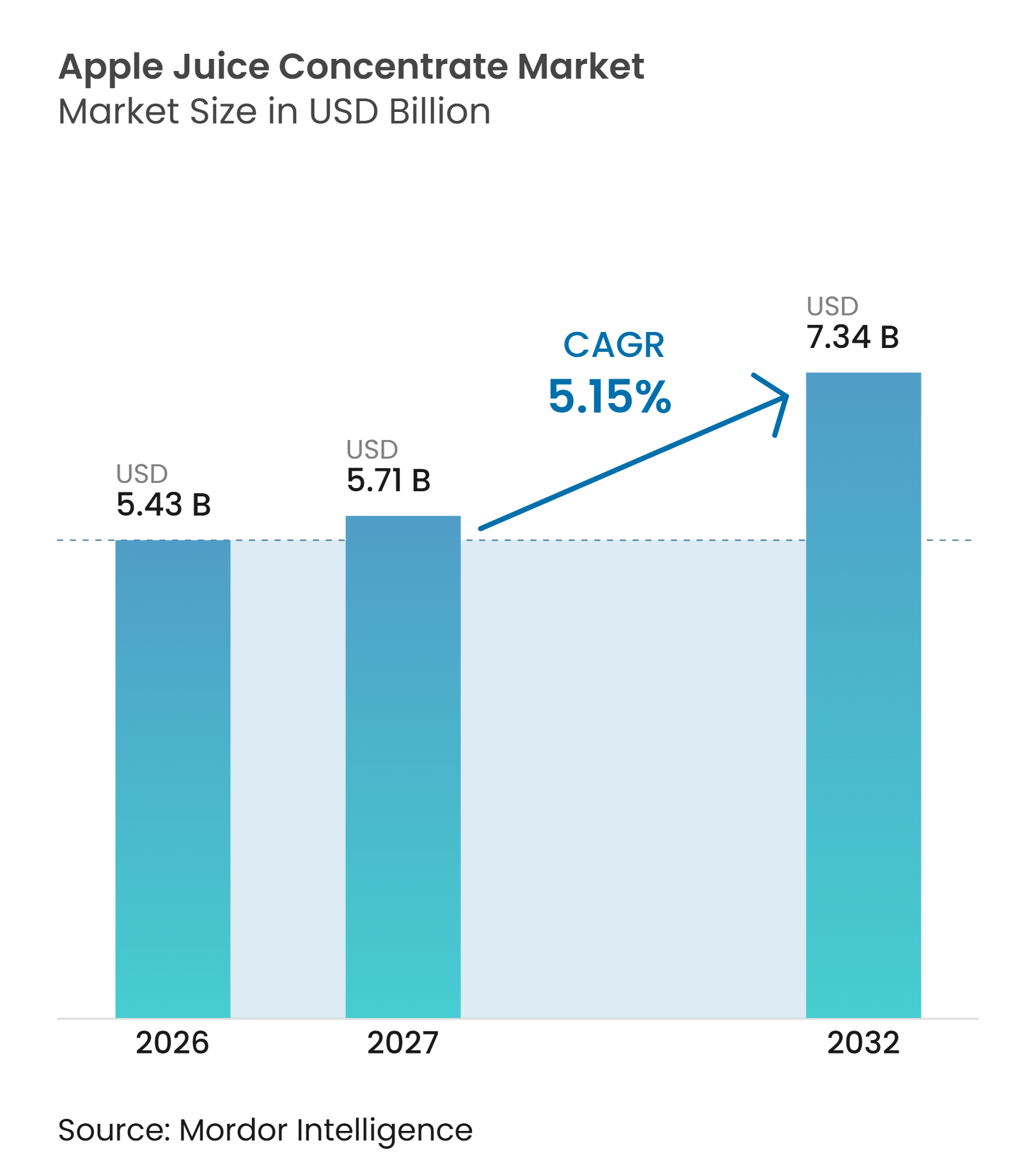
| Market Size (2027) | USD 5.71 Billion |
| Market Size (2032) | USD 7.34 Billion |
| Growth Rate (2027 - 2032) | 5.15 % |
| Fastest Growing Market | Asia-Pacific |
| Largest Market | North America |
| Market Concentration | Medium |
Major Players *Disclaimer: Major Players sorted in no particular order Image © Mordor Intelligence. Reuse requires attribution under CC BY 4.0. | |
Apple Juice Concentrate Market Analysis by Mordor Intelligence
The apple juice concentrate market size is expected to grow from USD 5.43 billion in 2026 to USD 5.71 billion in 2027 and is forecast to reach USD 7.34 billion by 2032 at a 5.15% CAGR over 2027-2032. The apple juice concentrate market benefits from growing demand for fruit-derived ingredients in food and beverage reformulation, as manufacturers seek alternatives to refined sugar. Apple juice concentrate offers sweetness, moisture retention, and support for fermentation, making it a versatile ingredient across various applications. Opportunities are expanding in deionized and organic formats, driven by demand for specialized ingredients in premium food and beverage formulations. Manufacturers are also strengthening sourcing strategies through diversified supply networks and long-term procurement arrangements to improve supply continuity. Suppliers offering consistent quality, traceability, and technical support are well-positioned to benefit from increasing demand across beverage, dairy, bakery, and frozen-food applications
Key Report Takeaways
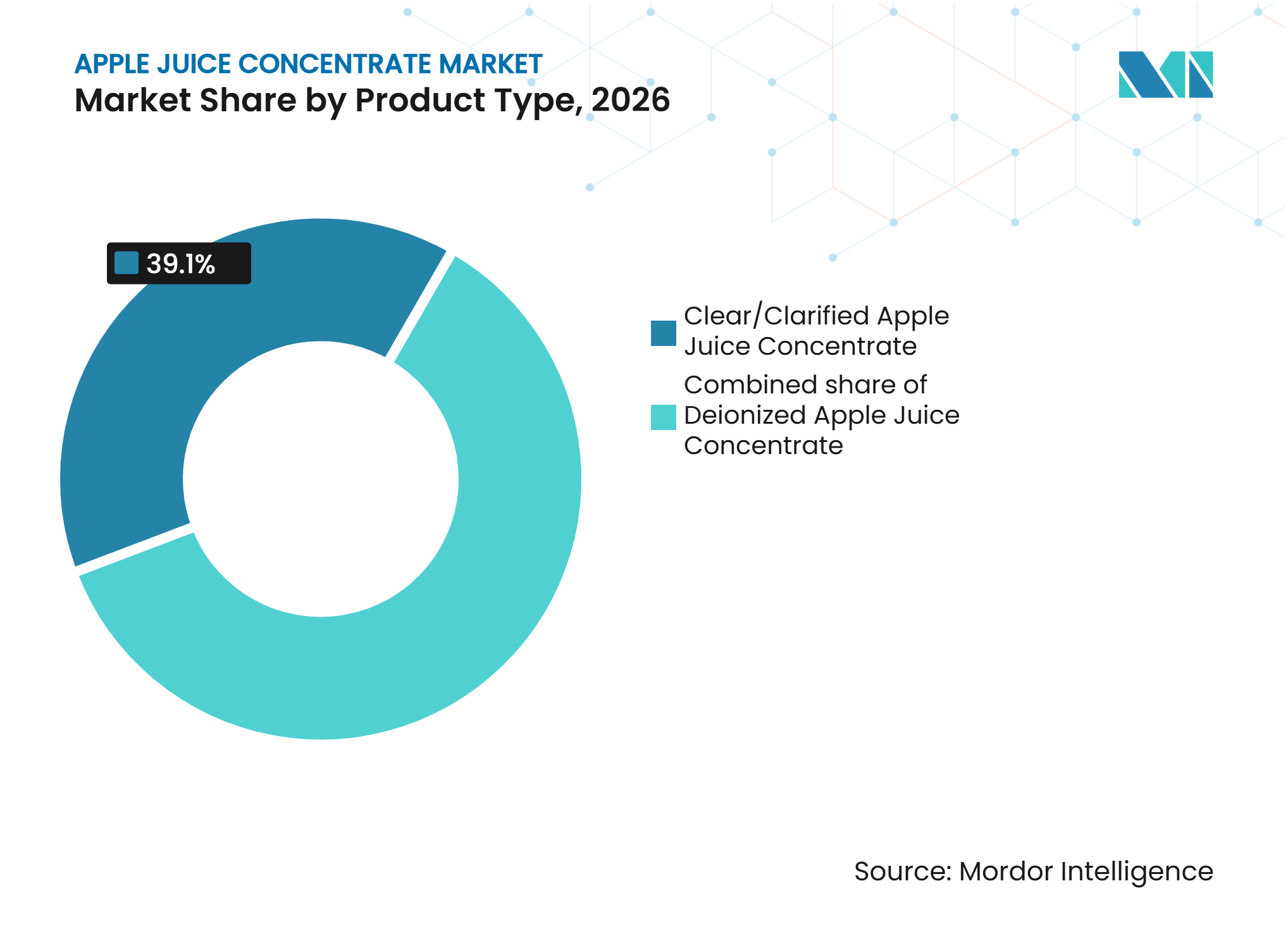
• By product type, clear/clarified juice concentrate held 39.12% of the apple juice concentrate market share in 2026, while deionized apple juice concentrate is forecast to expand at a CAGR of 6.51% through 2032.
• By category, conventional held 67.52% of the apple juice concentrate market share in 2026, while organic is projected to expand at a CAGR of 7.28% through 2032.
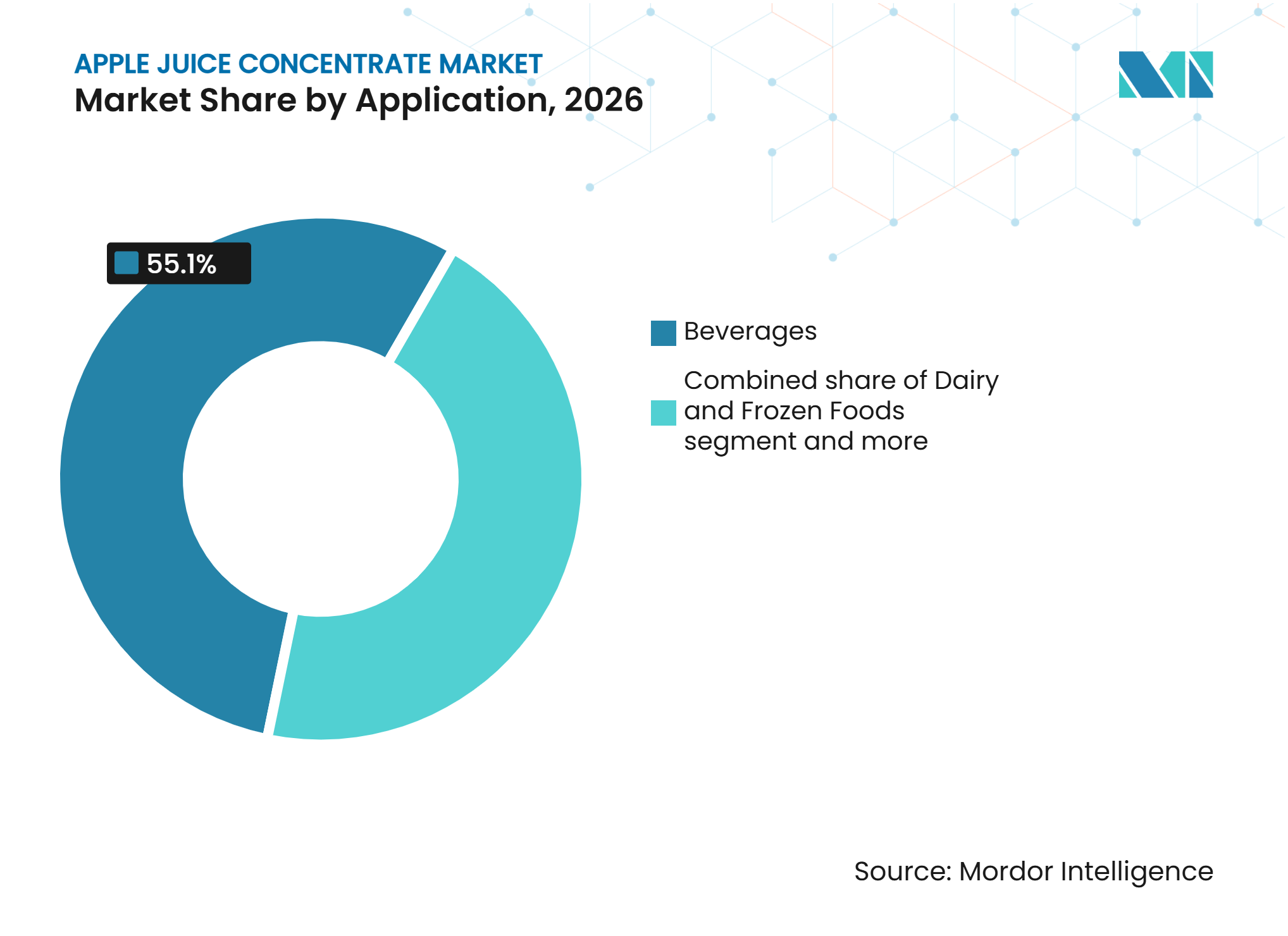
• By application, beverages held 55.12% of the apple juice concentrate market share in 2026, while dairy and frozen foods are projected to expand at a CAGR of 6.20% through 2032.
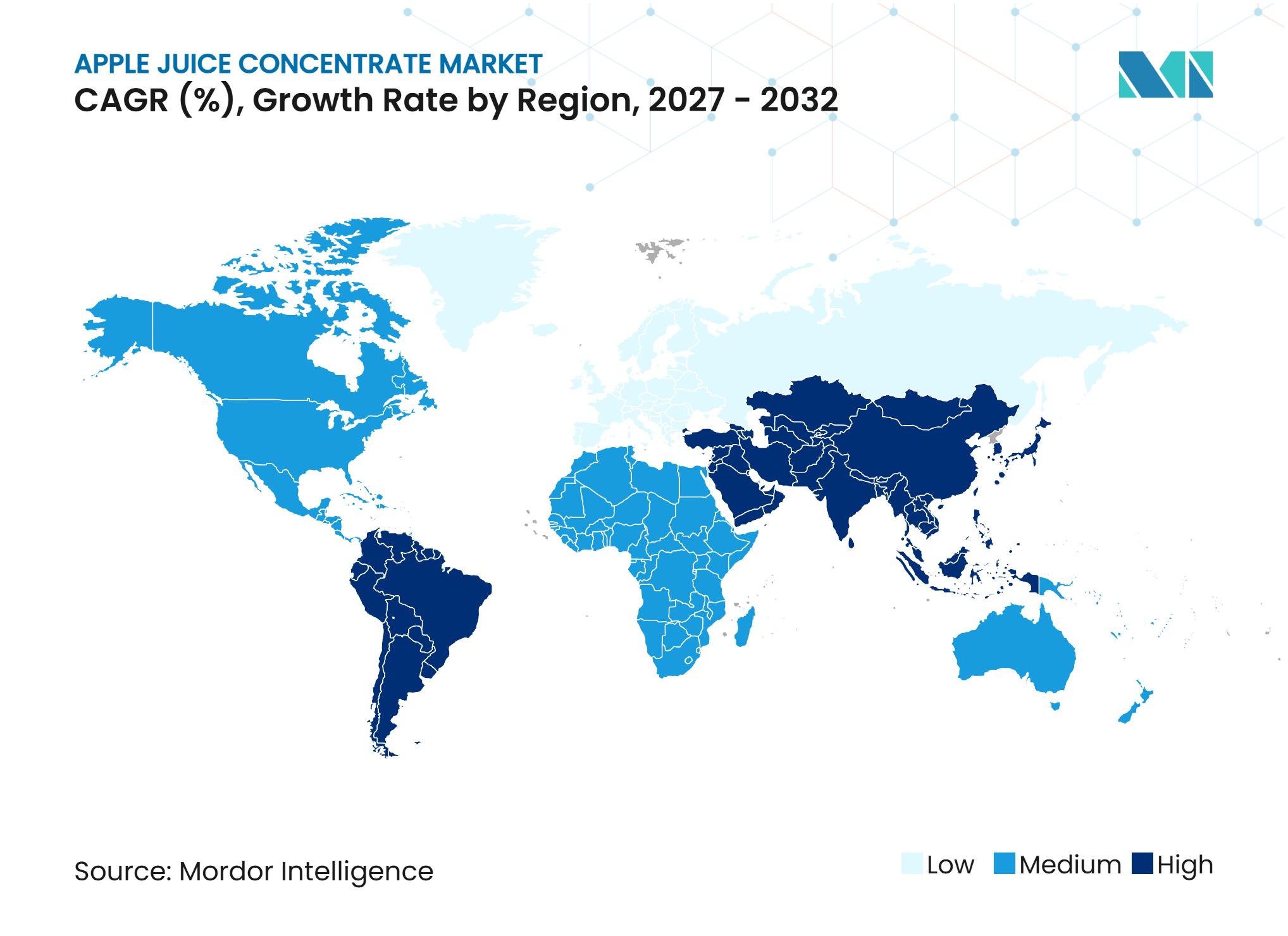
• By geography, North America held 32.51% of the apple juice concentrate market share in 2026, while Asia-Pacific is forecast to expand at a CAGR of 6.12% through 2032.
Note: Market numbers in this report are based on Mordor Intelligence's proprietary estimation framework, which combines nine months of actuals with Q4 projections for base year 2026.
Market Trends and Insights
Drivers Impact Analysis of Apple Juice Concentrate Market of Apple Juice Concentrate Market*
| Driver | (~) % Impact on CAGR Forecast | Geographic Relevance | Impact Timeline |
|---|---|---|---|
| Clean-label reformulation and demand for fruit-derived sweetening ingredients | +1.2% | Global, with early gains in North America and Europe | Short term (≤ 2 years) |
| Expanding applications of apple juice concentrate across food industries | +1.0% | Global, strongest in North America and Asia-Pacific | Medium term (2–4 years) |
| Growing demand for organic apple juice concentrate and premium fruit ingredients | +0.8% | North America and Europe, with increasing opportunities in Asia-Pacific | Medium term (2–4 years) |
| Transportation efficiency and storage advantages of concentrated apple juice | +0.6% | Global, particularly Europe and Asia-Pacific | Short term (≤ 2 years) |
| Increasing industrial utilization of apples through juice processing | +0.7% | Global, particularly China, Europe, and North America | Medium term (2–4 years) |
| Expansion of fruit processing infrastructure and concentrate production capacity | +0.9% | Global, with strong opportunities in Asia-Pacific and emerging markets | Long term (4–6 years) |
| Source: Mordor Intelligence | |||
Clean-Label Reformulation and Demand for Fruit-Derived Sweetening Ingredients
Food and beverage manufacturers are increasingly exploring fruit-derived ingredients to support sugar-reduction initiatives and changing consumer preferences. Apple juice concentrate offers a suitable formulation option, providing fruit-based sweetness while supporting product functionality across applications. For instance, in 2025, according to the International Food Information Council (IFIC) Food & Health, 75% of Americans are actively trying to limit or avoid sugar, while 63% of these consumers specifically target added sugars [1]. Additionally, 30% use Nutrition Facts labels to identify products containing less added sugar. This growing focus on sugar intake encourages manufacturers to evaluate alternative sweetening ingredients and reformulate existing products, creating opportunities for apple juice concentrate across beverage, dairy, and bakery applications
Expanding Applications of Apple Juice Concentrate across Food Industries
The apple juice concentrate market benefits from expanding applications across the food and beverage industries, as manufacturers increasingly incorporate fruit-derived ingredients into diverse product formulations. Growing demand for natural and minimally processed ingredients is encouraging food manufacturers to adopt fruit-based concentrates as functional components in their recipes. For instance, in March 2026, according to the United States Department of Agriculture, India's expanding food processing sector further broadened demand for such food ingredients, supported by rising consumer preference for processed and packaged food products, reflecting in the diverse applications of apple concentrate across multiple product categories [2]. For instance, Pilmifresh is expected to showcase its Apple Concentrate 70 Brix – Low Acidity at SIAL Paris 2026, targeting applications in fruit-based beverages, dairy products, bakery goods, ice cream, jellies, jams, ready meals, and flavored syrups.
Growing Demand for Organic Apple Juice Concentrate and Premium Fruit Ingredients
The apple juice concentrate market is shaped by increasing demand for organic fruit-derived ingredients and premium food and beverage formulations. For instance, in May 2025, according to the European Commission's report, Europe had approximately 47,000 hectares of organic apple orchards, producing around 720,000 tonnes of organic apples, with juice apples representing a distinct category within organic processing [3]. Further, FOGT launched a 70° Brix organic apple juice concentrate in June 2026, produced from certified organic apples and targeted at beverage manufacturers, juice blenders, cider producers, and food processors. The product's organic certifications support its positioning in premium ingredient applications. These developments create opportunities for concentrate manufacturers to expand certified organic product portfolios, strengthen sourcing relationships, and cater to manufacturers seeking traceable, fruit-derived ingredients
Transportation efficiency and storage advantages of concentrated apple juice
Apple juice concentrate offers significant transportation and storage advantages over ready-to-drink apple juice due to its reduced volume and lower water content. Its concentrated form allows manufacturers to transport larger quantities of apple solids using less packaging and storage space, helping reduce logistics and warehousing requirements. Concentrate also offers greater flexibility in inventory management, as manufacturers can store it for later reconstitution according to production requirements. These advantages make apple juice concentrate a cost-effective and convenient ingredient for beverage manufacturers, food processors, and industrial users operating across geographically dispersed markets.
Restraints Impact Analysis of Apple Juice Concentrate Market of Apple Juice Concentrate Market*
| Restraint | (~) % Impact on CAGR Forecast | Geographic Relevance | Impact Timeline |
|---|---|---|---|
| Climate-induced apple production volatility and raw material supply constraints | -1.2% | Global, highest in Europe, Turkey, and China | Short term (≤ 2 years) |
| Competition from alternative sweeteners and not-from-concentrate juice products | -0.9% | North America and Europe | Medium term (2–4 years) |
| Stringent food safety, contaminant control, and quality compliance requirements | -0.6% | Global, particularly Europe and North America | Medium to long term (2–5 years) |
| Concentration of export supply and vulnerability to international trade disruptions | -0.8% | Global, particularly China, Europe, and North America | Short to medium term (1–3 years) |
| Source: Mordor Intelligence | |||
Climate-Induced Apple production Volatility and Raw Material Supply Constraints
Climate-induced volatility in apple production and raw material supply constraints pose significant challenges to the apple juice concentrate market, as apple yields, quality, and harvesting cycles are highly dependent on weather conditions. Frost, drought, excessive rainfall, and irregular seasonal temperatures can affect orchard productivity, fruit maturity, and the availability of processing-grade apples. Such fluctuations can create uncertainty in raw material procurement, increase sourcing and production costs, and disrupt manufacturing schedules. Additionally, variations in apple quality and sugar content can affect concentrate yield, flavor consistency, and processing efficiency, making it challenging for manufacturers to maintain stable production and reliable supply throughout the year.
Competition from Alternative Sweeteners and Not-from-Concentrate Juice Products
Competition from alternative sweeteners and not-from-concentrate juice products creates challenges for the apple juice concentrate market, as beverage manufacturers have access to a wider range of ingredients and juice formats to meet changing formulation requirements. Alternative sweeteners, including stevia, monk fruit, and other plant-based sweeteners, offer options to reduce added sugar while maintaining product sweetness. At the same time, not-from-concentrate (NFC) juices appeal to consumers seeking products perceived as closer to freshly squeezed juice, with minimal processing and natural flavor characteristics. These alternatives can influence manufacturers' sourcing and formulation decisions, limiting the adoption of apple juice concentrate in certain beverage applications and intensifying competition across the fruit juice ingredients market.
*Our forecasts treat driver/restraint impacts as directional, not additive. The impact forecasts reflect baseline growth, mix effects, and variable interactions.
Apple Juice Concentrate Market Segment Analysis
By Product Type:
Clear Formats Lead, Deionized Products Grow FasterClear/clarified apple juice concentrate accounted for 39.12% of the apple juice concentrate market in 2026. Clear apple juice concentrate holds a leading position in the market due to its broad applicability across beverage reconstitution, juice blending, and food ingredient formulations. Its consistent appearance, controlled acidity, and standardized Brix levels make it suitable for large-scale manufacturing, where repeatable product quality is essential. Beverage manufacturers prefer clear concentrates to develop consistent formulations across different production facilities and markets. In comparison, cloudy concentrate serves more specialized applications where natural appearance and suspended fruit solids are preferred, while high-Brix and enzyme-treated concentrates cater to specific industrial requirements. The wider application range and formulation flexibility of clear apple juice concentrate support its dominant market position.
Deionized apple juice concentrate is projected to expand at a CAGR of 6.51% through 2032. Deionized apple juice concentrate is well-suited to specialized formulations that require fruit-derived sweetness while maintaining a neutral color, taste, and flavor profile. It is particularly suitable for functional beverages, sports drinks, and dairy products where conventional apple concentrate may influence the appearance or sensory characteristics of the finished product. Its reduced mineral content, controlled acidity, and formulation flexibility allow manufacturers to incorporate fruit-derived ingredients without significantly altering product characteristics. The format is gaining relevance in premium applications where consistent sensory performance and specific ingredient requirements are important. Its specialized functionality also enables producers to serve niche applications and differentiate their offerings from standard grades of apple juice concentrate.



By Category:
Conventional Supply Holds Scale, Organic Supply Commands a PremiumConventional accounted for 67.52% of the apple juice concentrate market in 2026. Conventional apple juice concentrate holds a dominant position in the market due to its established production networks, widespread availability, and competitive procurement costs. Major producing countries, including China, Poland, Türkiye, Chile, and Argentina, support a broad supply base for beverage manufacturers and food processors. Its established sourcing channels and compatibility with standard processing requirements make conventional concentrate suitable for large-scale industrial applications. Manufacturers can also diversify procurement across different origins to maintain supply continuity and manage sourcing costs. Recognized international quality standards further support consistent product specifications across suppliers and markets. These advantages reinforce the importance of conventional apple juice concentrate in meeting large-volume requirements across the global food and beverage industry.
Organic is forecast to expand at a CAGR of 7.28% through 2032. Organic apple juice concentrate benefits from growing demand among food and beverage manufacturers seeking certified ingredients for premium product formulations. The development of organic apple production and processing networks supports the availability of certified raw materials, while established organic certification frameworks strengthen product credibility and traceability. These requirements encourage producers to invest in dedicated sourcing, storage, and processing capabilities, supporting quality consistency across the supply chain. Long-term sourcing partnerships further help manufacturers secure reliable supplies and strengthen relationships with certified processors. While conventional products continue to cater to large-volume applications, organic apple juice concentrate creates opportunities for manufacturers to expand premium product portfolios and serve value-added market segments.
By Application:
Beverages Provide Volume, Dairy and Frozen Foods Add GrowthBeverages held 55.12% of the apple juice concentrate market in 2026. The beverage segment holds a prominent position in the apple juice concentrate market due to its extensive use across reconstituted juices, juice drinks, nectars, ciders, and functional beverages. Apple juice concentrate serves as both a flavoring and a sweetening ingredient, offering manufacturers flexibility in product formulation and sugar-reduction initiatives. The availability of different concentrate grades also supports diverse beverage requirements, including applications that require controlled color, flavor, and mineral content. Beyond beverages, its use in bakery, confectionery, sauces, and baby food further demonstrates its versatility as a food ingredient. Established manufacturing capabilities and consistent demand across these applications support the segment's strong market position.
Dairy and frozen foods are projected to expand at a CAGR of 6.20% through 2032. The dairy and frozen desserts segment offers diverse applications for apple juice concentrate across yogurt, ice cream, frozen desserts, and plant-based alternatives. The ingredient provides sweetness and fruit flavor while supporting formulation flexibility across different product types. Deionized grades are particularly suitable for applications that require sweetness without significantly affecting the appearance of light-colored products. Growing interest in clean-label formulations also encourages manufacturers to incorporate fruit-derived ingredients into dairy and frozen dessert products. The need to balance cost efficiency, shelf life, and sensory quality further supports the use of concentrate in large-scale food manufacturing. These applications create additional growth opportunities for apple juice concentrate suppliers beyond traditional beverage products.

Geography Analysis
North America
North America held 32.51% of the apple juice concentrate market in 2026. The United States holds a significant position in the apple juice concentrate market, supported by strong demand from beverage manufacturers and food processors. Its reliance on imported concentrate creates opportunities for international suppliers, while changes in trade conditions encourage buyers to diversify sourcing across alternative origins. Investments in processing and packaging infrastructure further strengthen regional supply capabilities and support demand from foodservice, institutional, and industrial customers. The presence of established manufacturers and ongoing capacity development also supports the market's long-term growth. Compliance with food and beverage labeling requirements remains an important part of product development and distribution, encouraging suppliers to maintain consistent quality and regulatory standards.
Asia-Pacific
Asia-Pacific is forecast to expand at a CAGR of 6.12% through 2032. Asia-Pacific is expected to be the fastest-growing regional market for apple juice concentrate, supported by rising packaged beverage consumption, urbanization, and expanding demand for processed foods. China plays a significant role as both a major producer and exporter of apple juice concentrate, while growing demand across India, Japan, South Korea, and Southeast Asia creates additional opportunities for suppliers. The expansion of food processing capabilities, distribution networks, and packaged beverage portfolios is further supporting regional adoption. Increasing use of fruit-derived ingredients in functional beverages and other processed food applications also strengthens market potential. Additionally, the shelf-stable nature of apple juice concentrate makes it suitable for diverse distribution environments, supporting its adoption across markets with varying storage and supply chain infrastructure.
Europe, South America, and the Middle East and Africa
Europe maintains a strong position in the apple juice concentrate market, supported by well-established production, processing, consumption, and distribution networks across Poland, Germany, the Netherlands, Hungary, and Italy. Its developed processing infrastructure and extensive trade relationships strengthen its role as a key global hub for supply and consumption. South America also offers significant opportunities, with Chile and Argentina contributing to regional production and international supply through their established fruit processing industries and expanding export networks. Meanwhile, the Middle East and Africa present growth opportunities as food and beverage manufacturers increasingly use shelf-stable ingredients to serve diverse distribution markets. The storage and transportation advantages of apple juice concentrate, combined with growing urban populations and demand for processed foods, support its wider adoption across these regions.
Competitive Landscape
Market Concentration
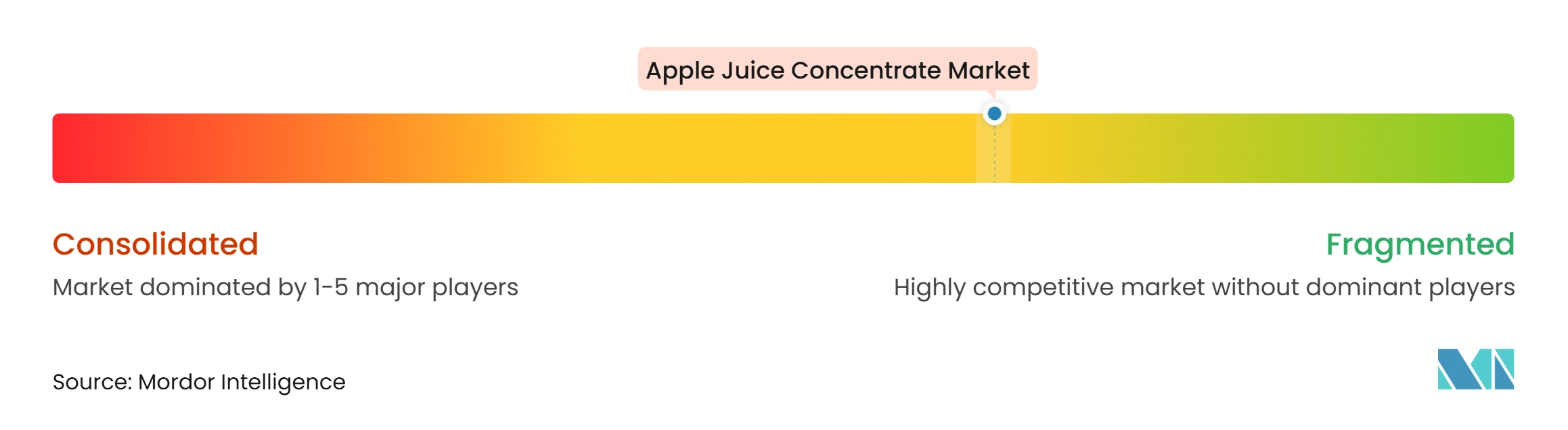
The apple juice concentrate market is moderately fragmented, with competition driven by raw material sourcing, processing capabilities, product quality, and customer-specific requirements. Large processors strengthen their market positions through integrated operations, established supply networks, and the ability to offer complementary ingredients and technical formulation support. Companies with capabilities across concentrate production, aroma recovery, and flavor development can provide more comprehensive solutions to beverage manufacturers and food processors. Vertical integration also helps suppliers improve operational efficiency, maintain consistent product specifications, and build long-term customer relationships. These capabilities allow established participants to compete through both production scale and value-added services rather than relying solely on concentrate pricing.
Competition also comes from specialized processors offering origin-specific products, certified organic ingredients, and customized concentrate grades. These suppliers cater to food and beverage manufacturers seeking traceable raw materials, specific product characteristics, and greater flexibility in formulation and procurement. Technical capabilities in deionized processing, aroma recovery, and product development allow suppliers to differentiate their offerings beyond standard concentrate products. Investments in processing facilities, packaging formats, and adjacent food ingredient categories further strengthen companies' market presence and expand their customer base. Such developments also enable manufacturers to serve specialized applications and respond to evolving customer requirements across different end-use industries.
Regional sourcing capabilities also influence the competitive landscape, as weather conditions, trade policies, and raw material availability can shift purchasing preferences between producing countries. Companies with diversified sourcing networks and established processing infrastructure are better positioned to maintain supply continuity and manage fluctuations in apple availability and procurement costs. Strong relationships with growers, processors, and international buyers further support consistent sourcing and distribution across major markets. Meanwhile, organic certification and specialized processing capabilities provide smaller suppliers with opportunities to compete in premium and niche applications without matching the production scale of larger participants. Overall, the market remains competitive, with integrated operations, sourcing flexibility, processing expertise, and product specialization shaping the positioning of key participants.
Apple Juice Concentrate Industry Leaders
-
AGRANA Beteiligungs-AG (Austria Juice GmbH)
-
Döhler Group (Döhler GmbH; SVZ International B.V.)
-
Yantai North Andre Juice Co., Ltd.
-
State Development & Investment Corporation (SDIC Zhonglu Fruit Juice Co., Ltd.)
-
Lassonde Industries Inc. (Old Orchard Brands, LLC)
- *Disclaimer: Major Players sorted in no particular order
Apple Juice Concentrate Market Companies Covered in this Report
- AGRANA Beteiligungs-AG (Austria Juice GmbH)
- Döhler Group (Döhler GmbH
- SVZ International B.V.)
- Yantai North Andre Juice Co., Ltd.
- State Development & Investment Corporation (SDIC Zhonglu Fruit Juice Co., Ltd.)
- Lassonde Industries Inc. (Old Orchard Brands, LLC)
- TTMFOOD
- Rauch Fruchtsäfte GmbH & Co OG
- Profruit (2006) Limited
- LemonConcentrate S.L.U.
- Ve.Ba. Cooperativa Ortofrutticola S.C.
- FruitSmart, Inc.
- Himachal Pradesh Horticultural Produce Marketing and Processing Corporation Ltd. (HPMC)
- Premier Juices
- Terkon Gıda Sanayi A.Ş.
- Freshco Industry Ltd.
- Invertec Foods S.A.
- Northwest Naturals LLC
- Shenzhen Channel Run Co., Ltd.
- MAK Food Company
- Bata Food
Recent Industry Developments in Apple Juice Concentrate Market
- June 2026: FOGT (Luoran Food) launched a 70° Brix organic apple juice concentrate made from certified organic apples sourced from China's Gansu Province. The product targets beverage manufacturers, juice blenders, cider producers, and food processors.
- October 2025: AGRANA completed the acquisition of the remaining 49.99% stake in AUSTRIA JUICE from Raiffeisen Ware Austria, securing full ownership. The acquisition strengthened its integrated apple juice concentrate, beverage base, and flavor business.
- August 2025: Yantai North Andre Juice Co., Ltd. expanded its product development and sales focus to include decolored and deacidified fruit juice concentrates, NFC apple juice, and cloudy apple juice. The company also highlighted plans for further product diversification to address changing customer requirements and broaden its fruit-ingredient portfolio.
Global Apple Juice Concentrate Market Report Scope
The apple juice concentrate market includes concentrated apple juice products made by removing water from apple juice, primarily used as ingredients in food and beverage applications.The market is segmented by Product Type, Category, Application, and Geography. Based on Product Type, the market is segmented into Clear/Clarified, Cloudy, Deionized, and Other Apple Juice Concentrates. Based on Category, the market is segmented into Organic and Conventional. Based on Application, the market is segmented into Beverages, Bakery and Confectionery, Dairy and Frozen Foods, Soups and Sauces, Baby Food, and Other Applications. By geography, the market is segmented into North America, Europe, Asia-Pacific, South America, and the Middle East and Africa, with further analysis of key countries and the remaining regional markets. Market forecasts for each segment are provided in value (USD).
Segmentation Overview
| Clear/Clarified Apple Juice Concentrate |
| Cloudy Apple Juice Concentrate |
| Deionized Apple Juice Concentrate |
| Other Apple Juice Concentrate |
| Organic |
| Conventional |
| Beverages |
| Bakery and Confectionery |
| Dairy and Frozen Foods |
| Soups and Sauces |
| Baby Food |
| Other Applications |
| North America | United States |
| Canada | |
| Mexico | |
| Rest of North America | |
| Europe | United Kingdom |
| Germany | |
| France | |
| Italy | |
| Spain | |
| Netherlands | |
| Poland | |
| Belgium | |
| Sweden | |
| Rest of Europe | |
| Asia-Pacific | China |
| Japan | |
| India | |
| Australia | |
| Indonesia | |
| South Korea | |
| Thailand | |
| Rest of Asia-Pacific | |
| South America | Brazil |
| Argentina | |
| Colombia | |
| Chile | |
| Peru | |
| Rest of South America | |
| Middle East and Africa | South Africa |
| Saudi Arabia | |
| Nigeria | |
| Egypt | |
| Morocco | |
| Turkey | |
| Rest of Middle East and Africa |
| By Product Type | Clear/Clarified Apple Juice Concentrate | |
| Cloudy Apple Juice Concentrate | ||
| Deionized Apple Juice Concentrate | ||
| Other Apple Juice Concentrate | ||
| By Category | Organic | |
| Conventional | ||
| By Application | Beverages | |
| Bakery and Confectionery | ||
| Dairy and Frozen Foods | ||
| Soups and Sauces | ||
| Baby Food | ||
| Other Applications | ||
| By Geography | North America | United States |
| Canada | ||
| Mexico | ||
| Rest of North America | ||
| Europe | United Kingdom | |
| Germany | ||
| France | ||
| Italy | ||
| Spain | ||
| Netherlands | ||
| Poland | ||
| Belgium | ||
| Sweden | ||
| Rest of Europe | ||
| Asia-Pacific | China | |
| Japan | ||
| India | ||
| Australia | ||
| Indonesia | ||
| South Korea | ||
| Thailand | ||
| Rest of Asia-Pacific | ||
| South America | Brazil | |
| Argentina | ||
| Colombia | ||
| Chile | ||
| Peru | ||
| Rest of South America | ||
| Middle East and Africa | South Africa | |
| Saudi Arabia | ||
| Nigeria | ||
| Egypt | ||
| Morocco | ||
| Turkey | ||
| Rest of Middle East and Africa | ||
Key Questions Answered in the Report
What is the market value of the apple juice concentrate by 2032?
The market is projected to reach USD 7.34 billion by 2032, expanding from USD 5.71 billion in 2027 at a 5.15% CAGR.
Which apple juice concentrate product type is growing fastest?
Deionized apple juice concentrate is projected to expand at a CAGR of 6.51% CAGR through 2032 as it provides neutral color, flavor, and acidity for specialized formulations.
Which application accounts for the largest use of apple juice concentrate?
Beverages held a 55.12% share in 2026, supported by reconstituted juice, juice drinks, nectars, ciders, and functional beverages.
What are the main risks for apple juice concentrate suppliers?
Climate-related crop volatility, alternative sweeteners, and competition from not-from-concentrate juice products are the main constraints identified in the supplied research.