
Anti-Migrating Agent Market Size and Share
Market Overview
| Study Period | 2022 - 2032 |
|---|---|
| Market Size (2027) | USD 194.34 Million |
| Market Size (2032) | USD 274.23 Million |
| Growth Rate (2027 - 2032) | 7.13 % |
| Fastest Growing Market | Asia-Pacific |
| Largest Market | North America |
| Market Concentration | Low |
Major Players *Disclaimer: Major Players sorted in no particular order Image © Mordor Intelligence. Reuse requires attribution under CC BY 4.0. | |
Anti-Migrating Agent Market Analysis by Mordor Intelligence
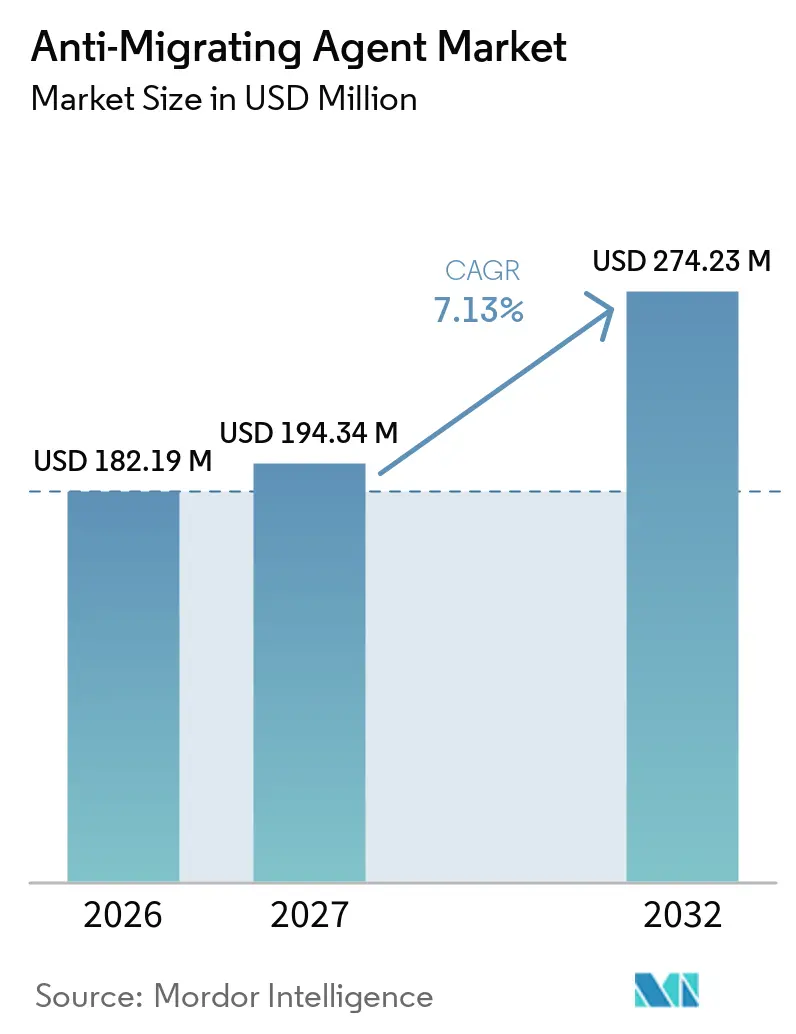
The Anti-Migrating Agent Market size was valued at USD 182.19 million in 2026 and is estimated to grow from USD 194.34 million in 2027 to reach USD 274.23 million by 2032, at a CAGR of 7.13% during the forecast period (2027-2032). The anti-migrating agent market serves textile processors that must keep unfixed dyes, pigments, and colorants stable during drying, heat setting, and curing. The global fiber production reached 132 million metric tons in 2024, while polyester represented 59% of output, reinforcing demand for processing chemistry suited to polyester and blended fabrics. These fabrics face a greater risk of color movement during high-temperature processes, which makes migration control a regular part of dyehouse auxiliary programs. The anti-migrating agent market is also shifting toward multi-function products that combine migration control, leveling, anti-redeposition, and shade stability. Across the anti-migrating agent market, mills increasingly value predictable results, lower rework, consistent quality, and suppliers that document chemical compliance and process performance for export-focused programs.
Key Report Takeaways
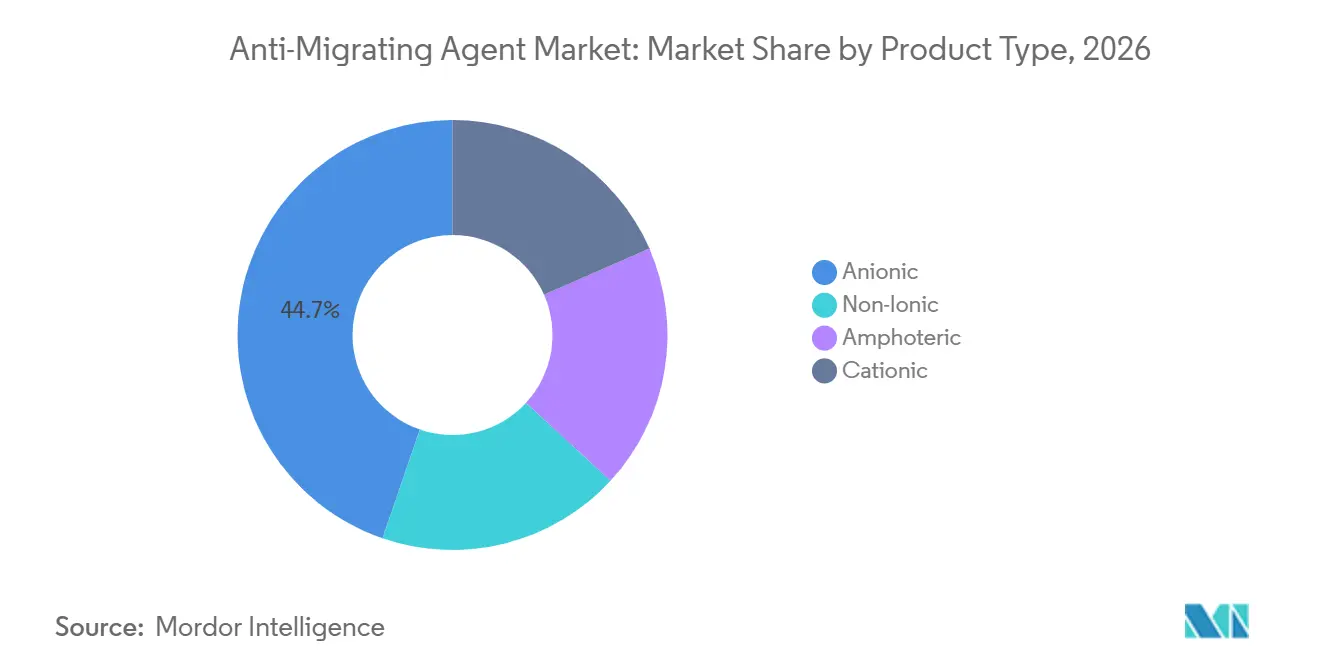
- By product type, anionic held 44.72% of the anti-migrating agent market share in 2026, while non-ionic is forecast to advance at a 7.43% CAGR through 2032.
- By chemistry, organic chemistry held 72.35% of the anti-migrating agent market share in 2026 and is forecast to advance at a 7.66% CAGR through 2032.
- By grade, the technical grade held 58.17% of the anti-migrating agent market share in 2026, while the pharmaceutical grade is forecast to advance at a 7.78% CAGR through 2032.
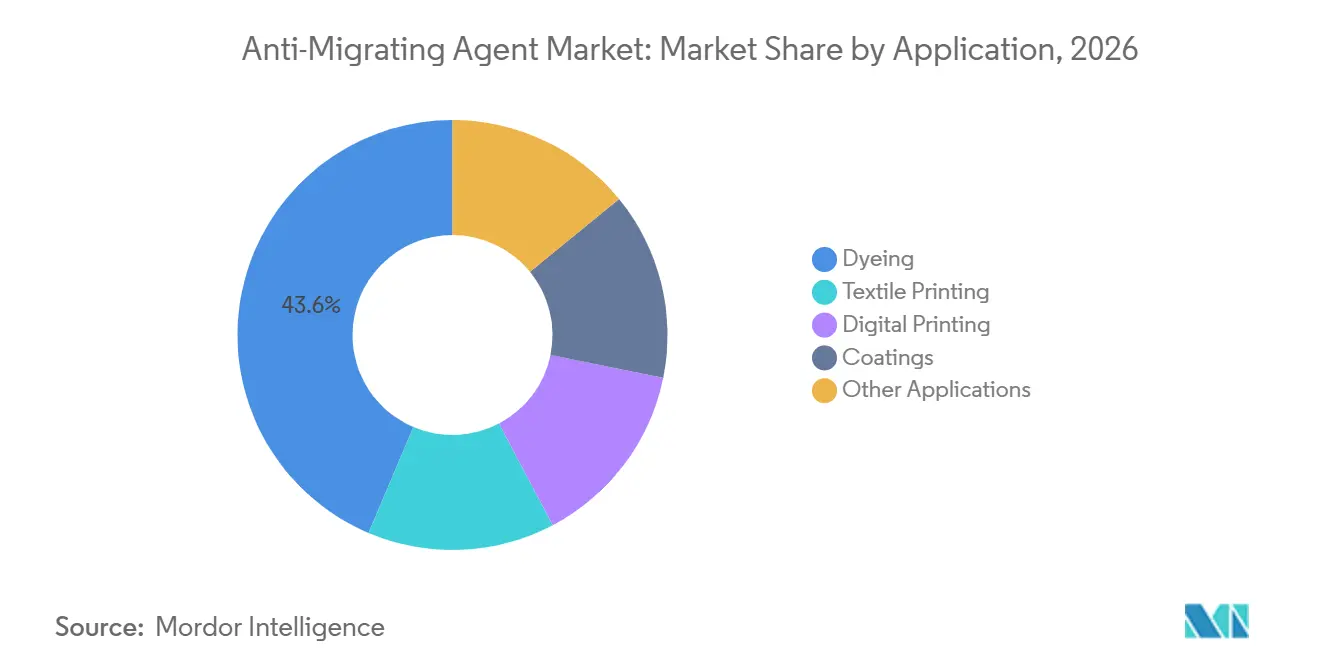
- By application, dyeing held 43.61% of the anti-migrating agent market share in 2026, while digital printing is forecast to advance at an 8.15% CAGR through 2032.
- By geography, Asia-Pacific held 40.52% of the anti-migrating agent market share in 2026, while North America is forecast to advance at an 8.04% CAGR through 2032.
Note: Market numbers in this report are based on Mordor Intelligence's proprietary estimation framework, which combines nine months of actuals with Q4 projections for base year 2026.
Market Trends and Insights
Drivers Impact Analysis of Anti-Migrating Agent Market*
| Driver | (~) % Impact on CAGR Forecast | Geographic Relevance | Impact Timeline |
|---|---|---|---|
| Textile and Apparel Production Expansion | +1.8% | Global, with highest concentration in China, India, and ASEAN processing clusters | Medium term (2-4 years) |
| Growth of Digital Textile Printing | +1.5% | Global; led by North America and Europe with rapid adoption across Asia-Pacific | Medium term (2-4 years) |
| Demand for Premium Colorfastness and Shade Uniformity | +1.2% | Global; compliance-driven demand most pronounced in EU-exported and brand-audited goods | Short term (≤ 2 years) |
| Low-Water Processing and Bio-Based Formulation Adoption | +1.0% | Europe and North America primarily; growing traction in South Asia | Long term (≥ 4 years) |
| Migration Control for Recycled and Complex Fiber Blends | +0.8% | Global; strongest in EU circular economy mandates and APAC recycled PET processing hubs | Long term (≥ 4 years) |
| Source: Mordor Intelligence | |||
Textile and Apparel Production Expansion
The expansion of textile and apparel production raises demand for anti-migrating agents as more fabric moves through wet-finishing lines. The International Cotton Advisory Committee reported that world textile exports rose from USD 560 billion in 2006 to USD 914 billion in 2025[1]. Man-made and synthetic woven garment exports increased from USD 35.4 billion to USD 100.5 billion over the same period. The anti-migrating agent market benefits as polyester and polyethylene terephthalate blends need stronger control during thermosol and continuous pad-dry-cure processing. The International Textile Manufacturers Federation recorded 72% global textile capacity utilization in May 2025, with Asian markets reporting higher utilization levels. This operating base supports steady demand even when individual apparel export corridors weaken.
Growth of Digital Textile Printing
Digital printing is changing the anti-migrating agent market from a volume-led business into a performance-led business. Inkjet-deposited pigments and disperse dyes remain on the textile surface before curing. Temperature differences during intermediate drying can therefore cause color bleed, haloing, and uneven shade. Migration-control pre-treatment becomes important because later printing steps cannot correct those defects. CHT Group introduced MIGRASOL IPP in July 2026 as a cross-linking migration inhibitor within its Pigmentura pigment dyeing system. The launch showed how suppliers are building products around inkjet process needs rather than adapting conventional formulations.
Demand for Premium Colorfastness and Shade Uniformity
Buyer testing requirements are making reliable colorfastness a basic supplier qualification issue. China issued GB/T 24345-2025 for package-dyed yarns in March 2025, addressing shade uniformity within yarn packages and between lots. The standard is set for mandatory adoption in March 2027. KAKEN Standards 2025 set class 3-4 rubbing fastness and class 4 washing fastness requirements for many garment categories. The anti-migrating agent market gains where mills use stronger formulations to limit rejected lots and maintain buyer approval.
Low-Water Processing and Bio-Based Formulation Adoption
Lower-water processing is creating demand for auxiliaries that work well under tighter process conditions. A 2025 study found that biopolymers, plant-derived surfactants, and agro-waste materials can replace conventional textile auxiliaries in several wet-processing steps. Lower-temperature dyeing reduces energy use but shortens the temperature window available for dye fixation. This condition increases the need for purpose-designed migration-control chemistry. Zschimmer & Schwarz Holding GmbH & Co KG presented 100% bio-based LERTISAN spin finishes and the bio-based HYDROSET ECO-DRY wicking agent in October 2025. The European Commission also funded demonstration work on bio-based substitutes for hazardous textile processing chemicals.
Restraints Impact Analysis of Anti-Migrating Agent Market*
| Restraint | (~) % Impact on CAGR Forecast | Geographic Relevance | Impact Timeline |
|---|---|---|---|
| Raw Material and Logistics Cost Volatility | -1.2% | Global; accentuated in North America and Europe; feedstock pressure originating in China | Short term (≤ 2 years) |
| Regulatory Testing and Restricted-Substance Compliance Costs | -0.8% | North America and EU; spill-over to APAC exporters supplying these markets | Medium term (2-4 years) |
| Limited Process Standardization Across Mills and Dye Systems | -0.5% | APAC core, particularly South and Southeast Asian processing clusters | Long term (≥ 4 years) |
| Source: Mordor Intelligence | |||
Raw Material and Logistics Cost Volatility
Raw material price swings can reduce formulation margins for products based on acrylic copolymers and polyacrylamides. BASF announced price increases for glacial acrylic acid, butyl acrylate, methyl acrylate, and 2-ethylhexyl acrylate in North America, effective April 23, 2026. The company cited higher raw material, energy, and logistics costs. These costs are difficult to pass through when textile mills purchase under fixed contracts. Smaller formulators have less ability to absorb sudden feedstock movements or manage procurement risk. This can encourage customers to favor suppliers with broader manufacturing and technical-service resources.
Regulatory Testing and Restricted-Substance Compliance Costs
Compliance costs remain a barrier for suppliers that serve export-oriented textile mills. The Zero Discharge of Hazardous Chemicals (ZDHC) Manufacturing Restricted Substances List 3.1 requires detailed chemical documentation across the supply chain. The ZDHC 2025 impact report linked chemical management with reporting obligations under the European Union Corporate Sustainability Reporting Directive and the Taskforce on Nature-related Financial Disclosures. Level 3 conformance extends disclosure requirements to raw materials used in a formulation. The European Commission-funded REACH4Textiles program also identified gaps in the laboratory capacity needed for market surveillance of textile imports[2]. The cost burden is higher for smaller suppliers that lack dedicated regulatory teams.
*Our forecasts treat driver/restraint impacts as directional, not additive. The impact forecasts reflect baseline growth, mix effects, and variable interactions.
Anti-Migrating Agent Market Segment Analysis
By Product Type:
Anionic Leads While Non-Ionic Grow FastestThe anionic segment held 44.72% of the anti-migrating agent market share in 2026. Its broad compatibility with reactive, disperse, and vat dyeing supports reliable use in continuous pad-dry-cure operations at large textile mills. Polyacrylate and maleic anhydride copolymers can increase liquor viscosity during the most sensitive stages of drying. This slows the movement of unfixed colorants through polyester and polyester-blend fabrics before a stable shade is established. Anionic agents also remain useful where mills need predictable performance without foaming, substrate yellowing, or major changes to established production settings.
The non-ionic segment is projected to advance at a 7.43% CAGR through 2032. It is compatible with neutral and weakly acidic dyebaths used for nylon, wool, and spandex-blend fabrics in premium apparel programs. A 2025 study found that modified polyethylene terephthalate and spandex blends showed better colorfastness at lower dyeing temperatures when advanced auxiliaries limited disperse dye staining. Cationic products remain relevant in fiber-reactive and direct-dyeing systems where charge-based affinity supports cellulosic substrates. Amphoteric products serve processes that need performance over a wide pH range, including union dyeing of blended fabrics through sequential acid and alkali baths.

By Chemistry:
Organic Chemistry Combines Scale with Product DevelopmentOrganic chemistry held 72.35% of the anti-migrating agent market share in 2026. This anti-migrating agent market size reflects long-standing use of acrylic copolymers, polyurethanes, modified cellulosics, and polysaccharide derivatives in textile auxiliaries. These systems are designed for consistent behavior during drying, curing, and color fixation in industrial textile processing. Organic chemistry also offers a route to bio-derived formulations that meet demanding environmental, compliance, and process requirements. Bozzetto Group introduced PERMULSIN BIO 170 in May 2026 with 72% bio-based content, Alkylphenol Ethoxylates (APEO)-free status, and solvent-free certification.
Organic products can be tailored for recycled polyethylene terephthalate dyeing, where surface properties and retained finishes may vary between feedstocks. The 2025 recycled microfiber study reinforced the importance of controlling temperature and dye concentration to maintain color uniformity. Inorganic products remain relevant in printing pastes and cost-sensitive applications that mainly require rheological control rather than strong chemical affinity. However, restrictions on heavy-metal process aids and less favorable ecotoxicity profiles may limit their use in certified auxiliary programs. This supports continued research and development in organic formulations with stronger environmental documentation.
By Grade:
Technical Grade Supports Revenue While Pharmaceutical Grade ExpandsTechnical grade held 58.17% of the anti-migrating agent market share in 2026. Apparel, home textile, and denim dyehouses use this grade where batch consistency, availability, and cost efficiency guide routine purchasing decisions. Conventional polymer products can provide suitable performance for high-volume processing programs with established dye recipes and operating parameters. Food grade products address packaging textiles, Global Organic Textile Standard-certified natural fiber processing, and food-contact technical fabrics. These applications require greater attention to purity, traceability, biodegradability, and supporting chemical documentation.
Pharmaceutical grade is projected to advance at a 7.78% CAGR through 2032. Medical textiles, wound-care fabrics, cleanroom garments, and technical nonwovens require chemical purity and traceability throughout supplier qualification and production use. Quality systems aligned with International Organization for Standardization 13485 and United States Food and Drug Administration Title 21 Code of Federal Regulations requirements can lengthen supplier approval cycles. Suppliers may need to provide biocompatibility information, traceability records, regulatory declarations, and additional technical documentation. Those requirements can favor established specialty chemical producers with stronger technical-service capacity and validated quality systems.
By Application:
Dyeing Holds Revenue While Digital Printing Changes Product NeedsDyeing held 43.61% of the anti-migrating agent market share in 2026. The anti-migrating agent market size in dyeing is supported by reactive, disperse, and direct dyeing across broad apparel and home textile supply chains. Continuous and batch dyeing systems process large textile volumes and need stable shade results between production lots. Migration control reduces color movement while the fabric passes through drying and curing at different line speeds and temperatures. These requirements sustain demand from standard dyehouse operations that serve large apparel and furnishing textile programs.
Digital printing is projected to advance at an 8.15% CAGR through 2032. Inkjet-deposited colorants can move before curing, which can cause haloing, shade variation, and costly quality issues in finished textile designs. CHT Group’s Pigmentura system combined PIGMENTURA 1500 with MIGRASOL IPP during its July 2026 introduction. Textile printing by screen and rotary methods remains relevant for repeated, high-volume patterns where established equipment remains cost-effective. Coatings and other applications add demand from laminates, coated textiles, and nonwovens, where functional additives can move during oven curing.
Geography Analysis
APAC Anti-Migrating Agent Market
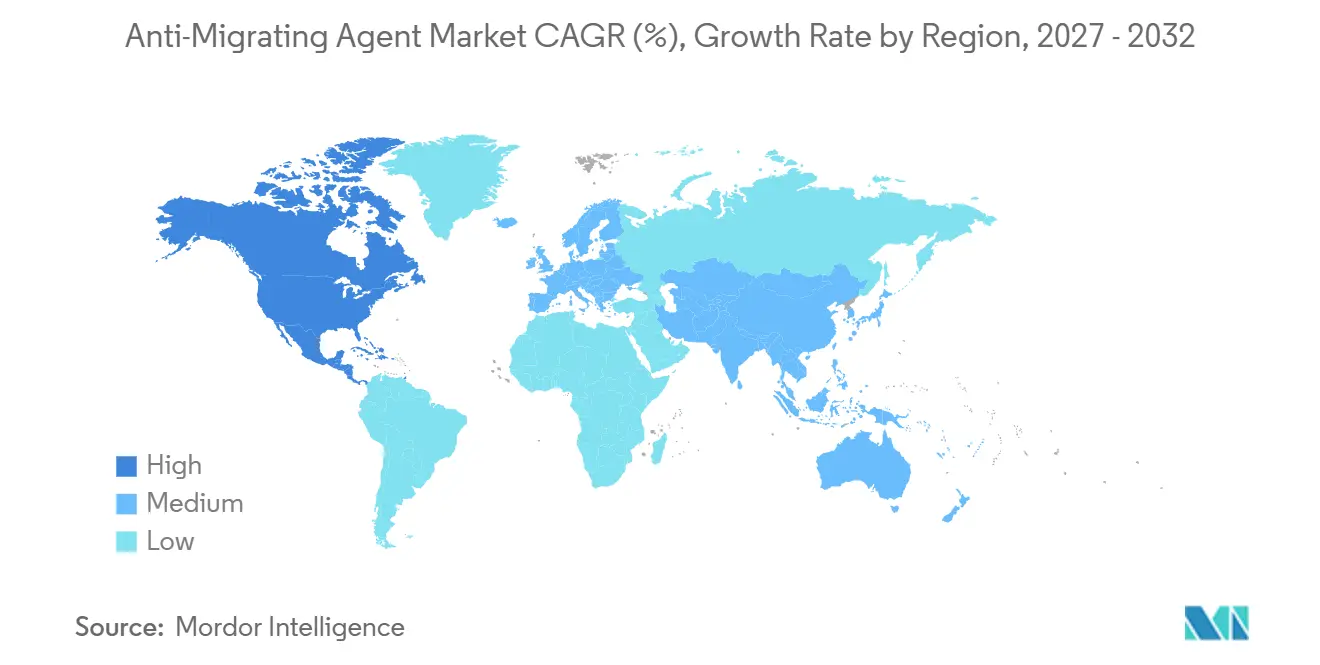
Asia-Pacific held 40.52% of the anti-migrating agent market share in 2026. China, India, Bangladesh, and the Association of Southeast Asian Nations (ASEAN) manufacturing centers support the region’s large dyehouse base across apparel, home textiles, and export-oriented fabric processing. The International Textile Manufacturers Federation reported strong Asian capacity utilization in May 2025. India’s Pradhan Mantri Mega Integrated Textile Regions and Apparel (PM MITRA) textile park program has government backing of INR 4,445 crore, which supports organized processing capacity in textile clusters. Japan and South Korea add demand for higher-performance chemistry through strict customer requirements and quality-focused textile programs.
North America Anti-Migrating Agent Market
North America is projected to advance at an 8.04% CAGR through 2032. The region’s growth is linked to digital printing adoption, apparel manufacturing reshoring, and sustainability-focused chemical upgrades. Smaller and more frequent production runs can favor digital printing where tooling costs matter more than scale. That increases demand for reliable pre-treatment products in fashion, sportswear, and promotional textile facilities. Mexico also contributes demand through its apparel manufacturing and maquiladora operations serving North American brands.
EMEA and South America Anti-Migrating Agent Market
Europe has mature production volumes but maintains demand for premium and documented chemical systems. The European Union’s Chemical Strategy for Sustainability, REACH substance evaluation, and corporate reporting requirements raise the value of upstream chemistry documentation. South America is developing through domestic apparel production and regional fast-fashion demand, with Brazil as the main regional center. Middle East and Africa remain early-stage opportunities, supported by Saudi Arabia’s Vision 2030 textile investment agenda, South Africa’s industrial textile base, and growing attention to dyehouse capacity in Morocco and Ethiopia.
Competitive Landscape
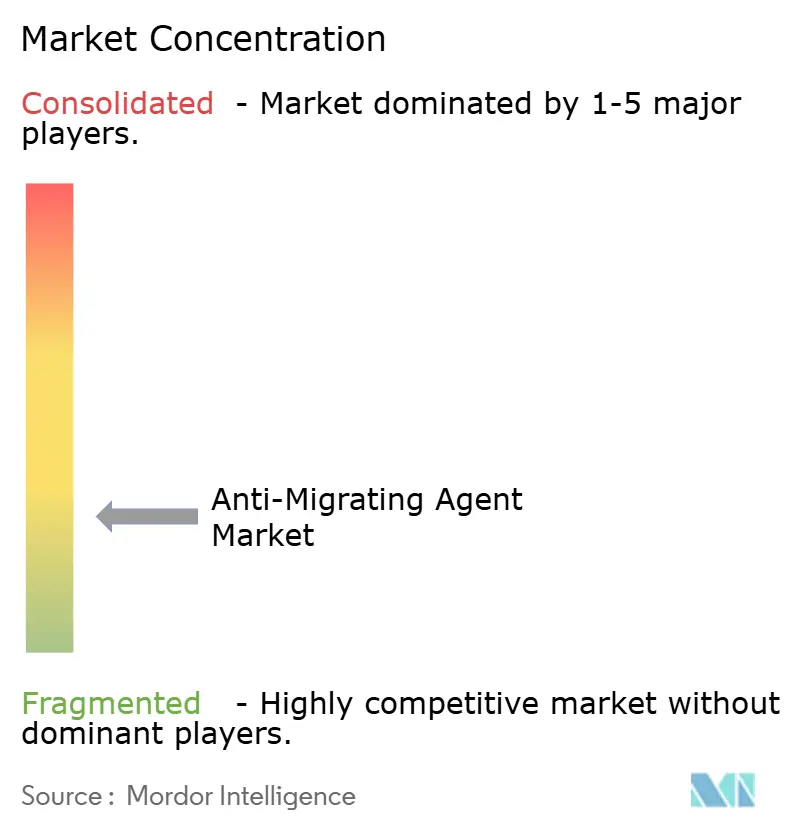
The anti-migrating agent market is highly fragmented, with the top five players including Archroma, SNF Group, RUDOLF Holding SE & Co. KG, Zschimmer & Schwarz Holding GmbH & Co. KG, and Sarex. Archroma, Bozzetto Group, CHT Group, and RUDOLF Holding SE & Co. KG compete in premium applications. Their offerings combine chemical products, application support, and documented compliance with ZDHC, bluesign, and OEKO-TEX requirements, which can increase switching costs for mills that depend on validated process results. Suppliers with Level 3 conformance documentation are better placed in export programs that require detailed chemical disclosure.
Asutex, Cosmo Speciality Chemicals, Dymatic Chemicals, Inc., PROTEX INTERNATIONAL, Sarex, SENKA Corporation, Shree BS Chemicals, Spectra Specialities, and Taiwan Dyestuffs & Pigments Corp. compete across product performance, price, local service, and compliance support. CHT Group’s July 2026 Pigmentura launch integrated migration control within a pigment dyeing process system. RUDOLF Holding SE & Co. KG assumed exclusive global distribution rights for Sanitized textile technologies in February 2026. Archroma expanded its textile effects portfolio through a partnership with HeiQ, announced in April 2026.
Pharmaceutical grade products for medical textiles remain a development area where documentation requirements are high. Bio-based chemistry for recycled polyethylene terephthalate fabrics is another area with room for specialized formulations. Bozzetto Group’s Migrostop CPA and PERMULSIN BIO 170 show a focus on continuous dyeing and bio-based polyester dyeing needs. Zschimmer & Schwarz Holding GmbH & Co KG presented bio-based textile auxiliaries in October 2025. The anti-migrating agent market favors suppliers that qualify new products against brand-restricted substance lists before broader adoption begins.
Anti-Migrating Agent Industry Leaders
-
Archroma
-
SNF Group
-
RUDOLF Holding SE & Co. KG
-
Zschimmer & Schwarz Holding GmbH & Co KG
-
Sarex
- *Disclaimer: Major Players sorted in no particular order
Anti-Migrating Agent Market Companies Covered in this Report
- Archroma
- Asutex
- Bozzetto Group
- CHT Group
- Cosmo Speciality Chemicals
- Dymatic Chemicals, Inc.
- PROTEX INTERNATIONAL
- RUDOLF Holding SE & Co. KG
- Sarex
- SENKA Corporation
- Shree BS Chemicals
- SNF Group
- Spectra Specialities
- Taiwan Dyestuffs & Pigments Corp.
- Zschimmer & Schwarz Holding GmbH & Co KG
Recent Industry Developments in Anti-Migrating Agent Market
- April 2026: Kornit Digital Ltd. unveiled its Atlas MATRIX digital textile production system, featuring Karbon Shield technology designed to prevent dye migration on deep-dyed and sublimated polyester fabrics. The launch supports the anti-migrating agent market by increasing demand for effective dye-blocking technologies that preserve print clarity, color vibrancy, and durability in polyester apparel.
- July 2025: Archroma launched CYCLANON XC-W e, a washing-off auxiliary designed to improve color fastness in cellulosic dyeing, including under high-electrolyte and hard-water conditions. The product supports the anti-migrating agent market by addressing dye fixation and color-control challenges that affect uniformity and fastness in textile processing.
Global Anti-Migrating Agent Market Report Scope
Anti-migrating agents are specialty chemical additives used to limit the unwanted movement of dyes, pigments, or other formulation components during processing and application. They help improve color uniformity, print definition, and finish consistency across treated materials.
The Anti-Migrating Agent Market is segmented by product type, chemistry, grade, application, and geography. By product type, the market is segmented into anionic, non-ionic, cationic, and amphoteric agents. By chemistry, the market is segmented into organic chemistry and inorganic chemistry. By grade, the market is segmented into technical grade, food grade, and pharmaceutical grade. By application, the market is segmented into dyeing, textile printing, digital printing, coatings, and other applications. The report also covers the market size and forecasts for anti-migrating agents across 15 countries. For each segment, the market sizing and forecasts have been done on the basis of value (USD).
Segmentation Overview
| Anionic |
| Non-Ionic |
| Cationic |
| Amphoteric |
| Organic Chemistry |
| Inorganic Chemistry |
| Technical Grade |
| Food Grade |
| Pharmaceutical Grade |
| Dyeing |
| Textile Printing |
| Digital Printing |
| Coatings |
| Other Applications |
| Asia-Pacific | China |
| India | |
| Japan | |
| South Korea | |
| ASEAN Countries | |
| Rest of Asia-Pacific | |
| North America | United States |
| Canada | |
| Mexico | |
| Europe | Germany |
| United Kingdom | |
| France | |
| Italy | |
| NORDIC Countries | |
| Rest of Europe | |
| South America | Brazil |
| Argentina | |
| Rest of South America | |
| Middle East and Africa | Saudi Arabia |
| South Africa | |
| Rest of Middle East and Africa |
| By Product Type | Anionic | |
| Non-Ionic | ||
| Cationic | ||
| Amphoteric | ||
| By Chemistry | Organic Chemistry | |
| Inorganic Chemistry | ||
| By Grade | Technical Grade | |
| Food Grade | ||
| Pharmaceutical Grade | ||
| By Application | Dyeing | |
| Textile Printing | ||
| Digital Printing | ||
| Coatings | ||
| Other Applications | ||
| By Geography | Asia-Pacific | China |
| India | ||
| Japan | ||
| South Korea | ||
| ASEAN Countries | ||
| Rest of Asia-Pacific | ||
| North America | United States | |
| Canada | ||
| Mexico | ||
| Europe | Germany | |
| United Kingdom | ||
| France | ||
| Italy | ||
| NORDIC Countries | ||
| Rest of Europe | ||
| South America | Brazil | |
| Argentina | ||
| Rest of South America | ||
| Middle East and Africa | Saudi Arabia | |
| South Africa | ||
| Rest of Middle East and Africa | ||
Key Questions Answered in the Report
What is the size of the anti-migrating agent market?
The anti-migrating agent market size was valued at USD 182.19 million in 2026 and is estimated to grow from USD 194.34 million in 2027 to reach USD 274.23 million by 2032, at a CAGR of 7.13% during the forecast period (2027-2032).
What is driving demand for anti-migrating agents?
Higher textile processing volumes, polyester-rich fabric programs, digital printing, and stricter colorfastness requirements support demand.
Which product type held the largest share in 2026?
Anionic held a 44.72% share in 2026.
Which application is projected to advance fastest through 2032?
Digital printing is projected to advance at an 8.15% CAGR through 2032 as dyehouses require stronger control of color movement before curing.