
Alumina Trihydrate Market Size and Share
Market Overview
| Study Period | 2021 - 2031 |
|---|---|
| Market Size (2026) | USD 2.14 Billion |
| Market Size (2031) | USD 2.86 Billion |
| Growth Rate (2026 - 2031) | 5.97% CAGR |
| Fastest Growing Market | Asia-Pacific |
| Largest Market | Asia-Pacific |
| Market Concentration | Medium |
Major Players *Disclaimer: Major Players sorted in no particular order Image © Mordor Intelligence. Reuse requires attribution under CC BY 4.0. | |
Alumina Trihydrate Market Analysis by Mordor Intelligence
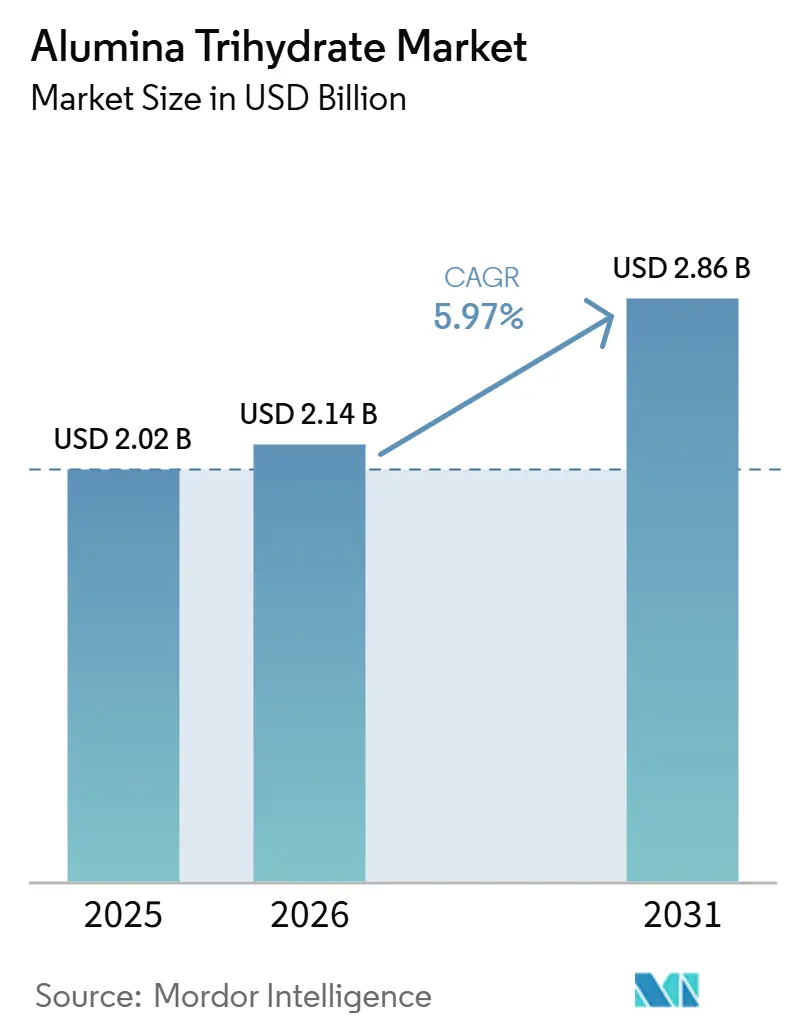
The Alumina Trihydrate Market size is expected to increase from USD 2.02 billion in 2025 to USD 2.14 billion in 2026 and reach USD 2.86 billion by 2031, at a CAGR of 5.97% over 2026-2031. The alumina trihydrate (ATH) market is supported by steady demand from flame-retardant and functional filler applications across plastics, construction materials, and electrical infrastructure, where halogen-free performance remains a core requirement. ATH's dual role as a flame retardant and white filler helps compounders manage costs while maintaining fire and formulation performance in high-volume applications. Regulatory pressure on brominated and chlorinated systems continues to shift buying patterns toward halogen-free materials, particularly in wire, cable, building products, and electrical systems that must meet increasingly stringent smoke and fire standards. The competitive response in the market has become more selective, with producers expanding specialty capacity, particle engineering, and surface treatment capabilities rather than competing solely on commodity output. Feedstock volatility in bauxite and margin pressure from energy-intensive refining continue to limit expansion, but these constraints are creating opportunities for suppliers that can deliver consistent fine-particle grades for electrification and electronics applications.
Key Report Takeaways
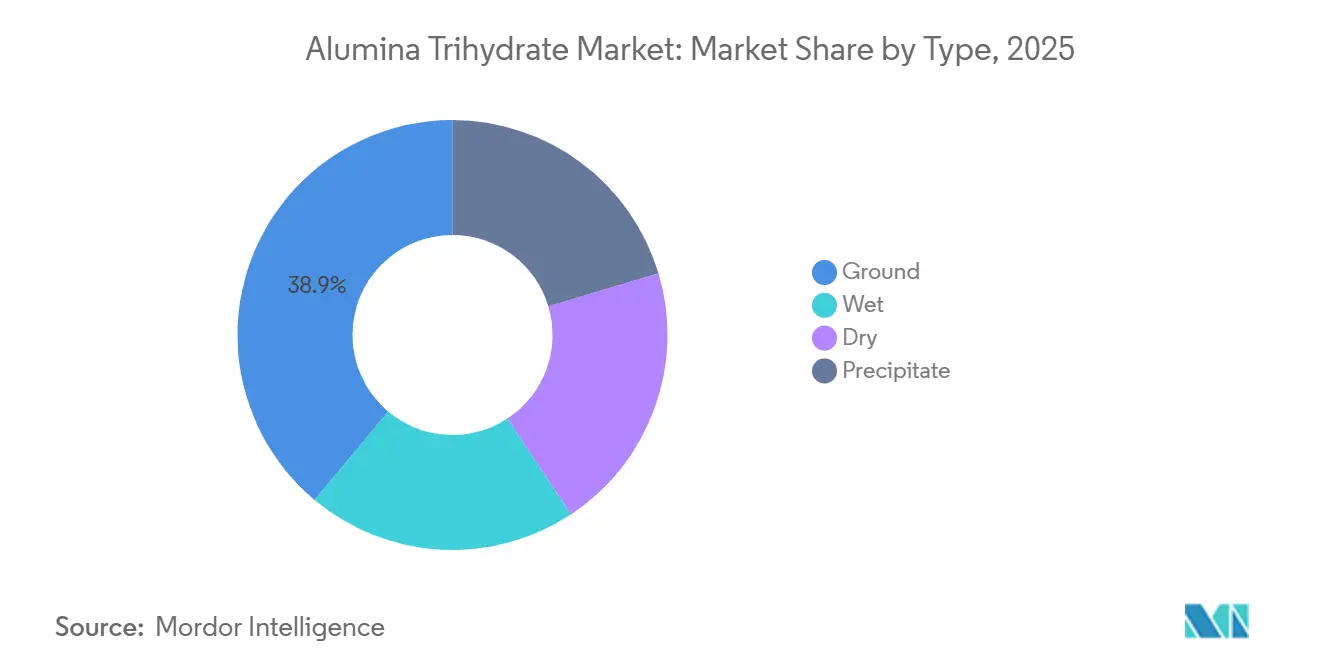
- By type, ground alumina trihydrate held 38.92% of the alumina trihydrate market share in 2025, while precipitate grades are forecast to expand at a 6.84% CAGR through 2031.
- By application, flame retardants accounted for 55.40% of the alumina trihydrate market in 2025 and are forecast to grow at a 6.42% CAGR through 2031.
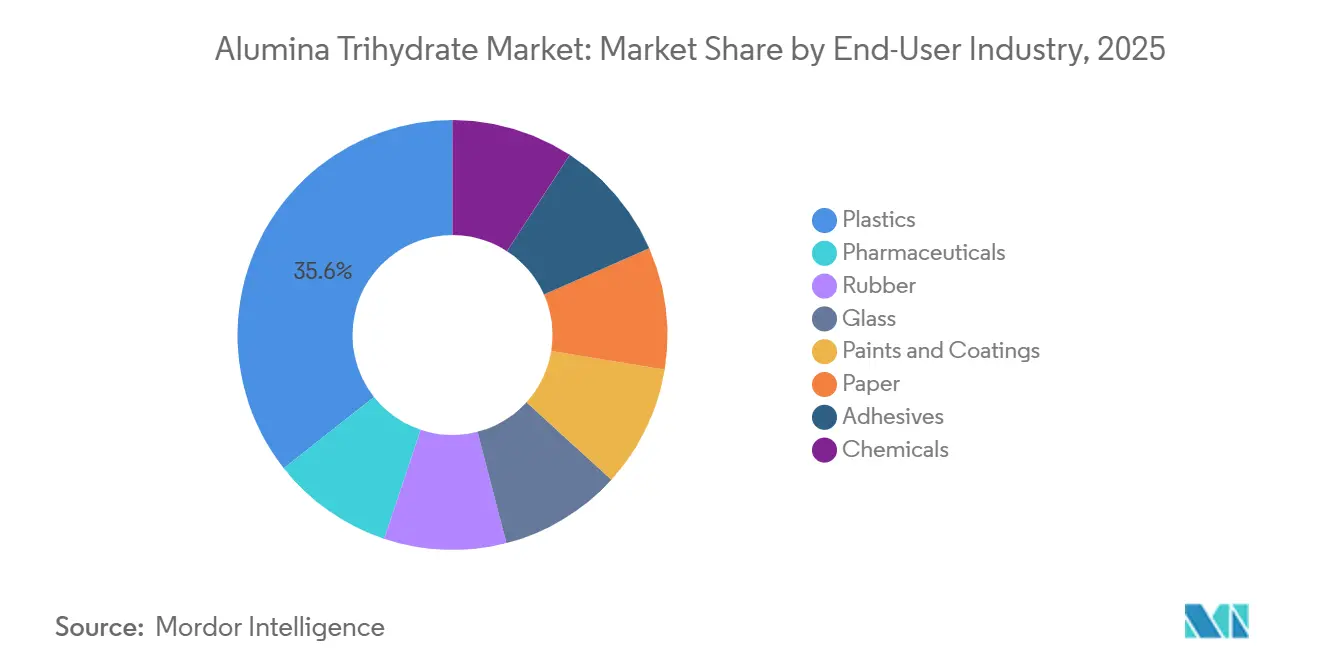
- By end-user industry, plastics held 35.64% share in 2025, while paints and coatings are forecast to grow at a CAGR of 6.51% through 2031.
- By geography, Asia-Pacific accounted for 46.87% of the alumina trihydrate market in 2025 and is forecast to grow at a 6.63% CAGR through 2031.
Note: Market size and forecast figures in this report are generated using Mordor Intelligence’s proprietary estimation framework, updated with the latest available data and insights as of January 2026.
Global Alumina Trihydrate Market Trends and Insights
Drivers Impact Analysis*
| Drivers | (~) % Impact on CAGR Forecast | Geographic Relevance | Impact Timeline |
|---|---|---|---|
| Rising Demand for Halogen-Free Flame Retardants | +2.0% | Global, with core gains in Europe, North America, and China | Short term (≤ 2 years) |
| Expansion of Engineering-Grade Polymer Applications | +1.3% | Asia-Pacific core, with spillover to the Middle East, Africa, and South America | Medium term (2-4 years) |
| Growth in High-Loading Composite Applications | +0.9% | Global, concentrated in Asia-Pacific and North America | Medium term (2-4 years) |
| More Stringent Fire Safety Standards | +0.7% | North America and Europe, with increasing relevance in the Asia-Pacific | Short term (≤ 2 years) |
| Increasing Use of High-Purity ATH in Electronics and EVs | +0.5% | Asia-Pacific, especially Japan, South Korea, and China, plus North America | Long term (≥ 4 years) |
| Source: Mordor Intelligence | |||
Rising Demand for Halogen-Free Flame Retardants
The shift away from organohalogen flame retardants, driven by tighter chemical and product safety regulations, is one of the strongest forces shaping the alumina trihydrate market. European compliance frameworks, including the Construction Products Regulation, the Low Voltage Directive, International Electrotechnical Commission (IEC) 60332 cable standards, and REACH, are reinforcing halogen-free substitution across cable and building supply chains. Wire and cable remains the largest single downstream channel for the alumina trihydrate market, with ATH volume reaching 476,000 tons in 2025 and projected to reach 509,000 tons in 2026. Demand is expanding as low-smoke, zero-halogen cable specifications become standard in public infrastructure, data transmission, and enclosed commercial environments. Hyperscale data center construction is also contributing to market growth, where Low Smoke Zero Halogen (LSZH) cable use is broadening the customer base beyond traditional construction and utility projects. This is increasing demand for fine-particle grades faster than commodity market signals alone would suggest.
Growth in High-Loading Composite Applications
The alumina trihydrate market is moving beyond traditional flame-retardant applications as battery thermal management increases the importance of ATH as a functional filler in thermal interface materials. Consumption of Thermal Interface Material (TIM)-grade ATH for lithium-ion batteries rose from 101,000 tons in 2024 to 129,000 tons in 2025 and is projected to reach 162,000 tons in 2026, indicating growth above the overall alumina trihydrate market rate. Viscosity-optimized hydrate grades are becoming standard in gap fillers and adhesive systems, as processors require high filler loading without losing workable flow behavior. Research published in 2026 showed that fine-particle, surface-modified ATH improved flame retardancy in polyolefin composites at the same loading level by improving interfacial performance. The alumina trihydrate market is therefore shifting toward suppliers that can more precisely manage particle size, morphology, and surface chemistry, which favors specialty producers over sellers of undifferentiated hydrate grades in EV and electronics-linked applications[1]RSC Advances, “Unraveling the Particle Size Characteristics Flame Retardancy Relationship in ATH Polyolefin Composites, A Focus on Interfacial Properties and Thermal Analysis,” RSC Advances, pubs.rsc.org.
More Stringent Fire Safety Standards
Stricter fire safety regulations in buildings, electrical systems, and mobility applications are supporting alumina trihydrate market growth by requiring lower smoke output and improved flame control. Standards tied to the International Building Code, National Fire Protection Association (NFPA) provisions, and EN 13501 fire classification schemes are widening the use of halogen-free materials in structural boards, cable trays, insulation systems, and related assemblies. In 2025, published coating research found that combining ATH with intumescent systems reduced peak heat release by 7.3% and peak smoke release by 31% in oriented-strand board fire-retardant coatings. These results are relevant because performance evidence helps coating formulators and construction suppliers justify broader use of ATH in regulated building products. The alumina trihydrate market is also seeing specification growth in vehicle enclosures and electrical housings, as fire codes become more demanding amid expanding electrification. This broadens demand beyond standard polymer compounding and into higher-value coated and composite systems.
Expansion of Engineering-Grade Polymer Applications
Infrastructure electrification, renewable energy installation, and EV charging build-out are supporting alumina trihydrate market growth, as these applications require flame-managed polymer systems. Global battery demand for e-mobility is projected to reach 2,790 GWh by 2030, up from 1,050 GWh in 2025, indicating higher material demand for thermal and electrical protection systems. Research published in 2026 demonstrated strong flame and mechanical performance in glass fiber-reinforced polyester composites containing ATH, supporting their use in wind turbine nacelles and structural electrical housings. The alumina trihydrate market is also seeing procurement growth in South and Southeast Asia as local content requirements increase across renewable energy and grid projects. This is driving a gradual shift from standard filler grades toward higher-specification hydrate materials capable of meeting IEC-linked fire performance targets, expanding the range of engineering polymer applications where suppliers must balance cost control with precise technical performance.
Restraints Impact Analysis*
| Restraints | (~) % Impact on CAGR Forecast | Geographic Relevance | Impact Timeline |
|---|---|---|---|
| Performance Limitations at High Polymer Loadings and Elevated Temperatures | -1.1% | Global, most acute in high-performance engineering applications | Short term (≤ 2 years) |
| Energy-Intensive Calcination and Refining Process | -0.8% | Asia-Pacific, especially China, and Europe | Medium term (2-4 years) |
| Price Volatility in Bauxite as Primary Feedstock | -1.0% | Global, most acute in import-dependent refiners in North America and Europe | Short term (≤ 2 years) |
| Source: Mordor Intelligence | |||
Performance Limitations at High Polymer Loadings
The alumina trihydrate (ATH) market faces a technical limitation in applications requiring both high flame performance and strong mechanical retention. Research published in 2025 showed that achieving UL-94 V-0 performance in EVA composites required ATH loading of 65 wt% or more, which reduced tensile strength and elongation at break. These constraints are more pronounced in demanding engineering applications, such as under-hood automotive parts and structural aerospace components, where alternatives like magnesium hydroxide or intumescent blends offer better processing balance. ATH also begins to decompose at around 180°C, limiting its use in polymer systems processed above that temperature, including polyamides, polycarbonates, and thermoplastic polyesters. Surface treatment and hybrid filler systems can improve performance outcomes, but they add cost and formulation complexity for compounders. As a result, the ATH market advances more slowly in high-specification niches than in mainstream cable, coatings, and construction applications.
Price Volatility in Bauxite as Primary Feedstock
The ATH market remains exposed to fluctuations in bauxite supply, as bauxite is the primary commercial raw material for alumina production via the Bayer process. Imported bauxite cost, insurance, and freight (CIF) prices reached USD 116.19 per ton in mid-January 2025 and then fell to USD 78.57 per ton in Q2 2025, creating sharp movement in upstream economics for alumina producers. In the United States, average import prices for metallurgical-grade alumina in the first eight months of 2025 were USD 595 per ton, up 9% year on year, even as spot prices declined from earlier peaks. This mismatch reflects contract structures that protect sellers more than buyers, potentially squeezing non-integrated ATH producers in North America and Europe. Feedstock quality variation is also a concern, as specialty hydrate grades depend on consistent chemistry to maintain tight particle control and repeatable performance[2]U.S. Geological Survey, “Mineral Commodity Summaries 2026, Bauxite and Alumina,” USGS, usgs.gov. The ATH market, therefore, remains vulnerable to raw material instability even when downstream demand remains firm.
*Our forecasts treat driver/restraint impacts as directional, not additive. The impact forecasts reflect baseline growth, mix effects, and variable interactions.
Segment Analysis
By Type: Precipitate grades set to outpace standard commodity forms
Ground alumina trihydrate held 38.92% of the market share in 2025, maintaining its lead among product types. The segment remains present in cost-sensitive applications such as cable compounds, PVC flooring, standard coatings, and other high-volume polymer systems. Its production route benefits from direct Bayer-process output with limited downstream processing, preserving a cost advantage over finer, more engineered hydrate grades. Wet-process grades retain a role in paper coating and specialty coatings, where tighter particle-size control is required and finish and consistency are more important. Dry grades continue to serve as filler options where processors require a lower-cost alternative and where moisture sensitivity demands a more practical handling profile.
Precipitated ATH is the fastest-growing type in the alumina trihydrate market, with a projected CAGR of 6.84% from 2026 to 2031. Its appeal stems from its submicron morphology, higher purity, and suitability for thermal interface materials, semiconductor packaging, and pharmaceutical-grade applications. Research published in 2026 showed that finer particle ATH improved flame retardancy per unit loading in polyolefin systems by enhancing the filler-polymer interface. Nabaltec AG invested EUR 7.2 million (USD 7.9 million) in functional filler capital expenditure in Q1 2026, with much of that spending directed at viscosity-optimized hydrate grades. As electric vehicle (EV) output rises and data center construction expands, the alumina trihydrate market is likely to shift more value toward precipitated grades than toward standard ground material.



By Application: Flame retardant use remains dominant while filler demand broadens
Flame-retardant use accounted for 55.40% of the alumina trihydrate market in 2025, making it the leading application. This position reflects alumina trihydrate (ATH)'s widespread use in wire and cable, construction composites, electrical enclosures, and other formulations where halogen-free compliance has become increasingly important. The segment is projected to grow at a CAGR of 6.42% through 2031 as regulations tighten across North America and Europe, and more infrastructure projects in the Asia-Pacific region adopt Low Smoke Zero Halogen (LSZH) specifications. ATH remains competitive because its thermal decomposition releases water vapor that cools the combustion zone and dilutes combustible gases without producing halogenated byproducts. This dual fire-and-smoke control function keeps the alumina trihydrate market anchored in this core application, even as other applications expand.
The filler segment is smaller but gaining depth as formulators use ATH to extend titanium dioxide in roof coatings, paper coatings, inks, and related systems. J.M. Huber has positioned sub-micron Spacerite grades for UV-cure inks and elastomeric coatings where cost reduction must be balanced with opacity and finish performance. Antacid-grade ATH continues to provide a steady pharmaceutical outlet, supporting a stable specialty demand stream in the alumina trihydrate market. Other applications, including acrylic solid surfaces and glass fiber-reinforced polyester systems, are gaining traction in construction and marine settings, where high filler loading can support halogen-free compliance. This keeps the alumina trihydrate market exposed not only to fire-protection demand but also to broader formulation economics in coatings and thermoset composites.
By End-User Industry: Paints and coatings grow fastest while plastics keep the volume base
Plastics accounted for 35.64% of the alumina trihydrate market in 2025, making them the largest end-user category by volume and value. The segment absorbs ATH across cable jacketing compounds, connector housings, packaging formats, automotive trim, and other molded parts with fire or filler requirements. Plastic demand is being sustained by higher output of engineered thermoplastics in Asia-Pacific and stricter certification standards for goods sold into North America and Europe. Requirements linked to UL-94 and EN 45545 raise the technical floor for flame-retardant formulations, supporting steady ATH intake in mainstream polymer compounding. This gives the alumina trihydrate market a reliable volume base even as higher-margin specialty applications grow faster.
Paints and coatings are the fastest-growing end-user segment in the alumina trihydrate market, with a forecast CAGR of 6.51% from 2026 to 2031. The category is supported by the rising use of fire-retardant architectural coatings in high-rise buildings, transport hubs, and industrial facilities. Coating systems that combine smoke suppression and flame retardancy are becoming more relevant as building product requirements tighten and end users seek solutions compatible with existing application methods. Paper, rubber, adhesives, chemicals, glass, and pharmaceuticals remain smaller end markets, but they add balance as ATH contributes whiteness, opacity, filler value, and fire performance across different formulations. The alumina trihydrate market therefore maintains a broad end-user base, with more rapid growth coming from coatings and other specialty applications.
Geography Analysis
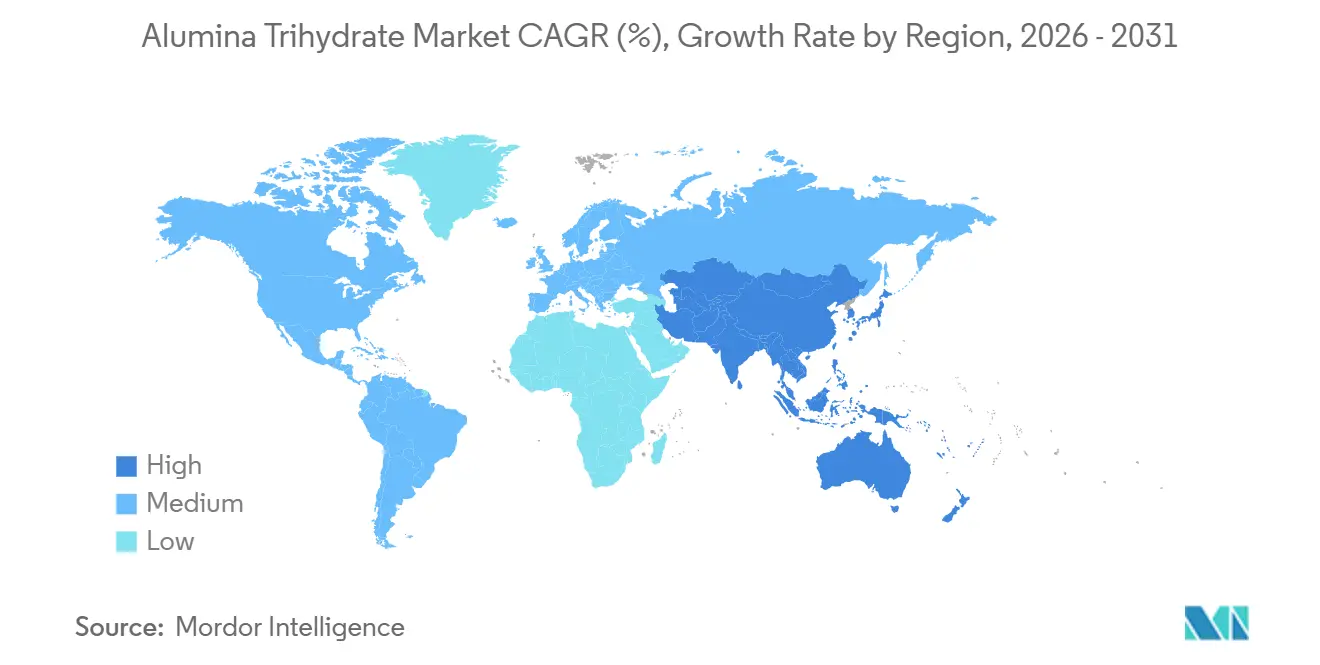
Asia-Pacific accounted for 46.87% of the alumina trihydrate market share in 2025 and is forecast to expand at a 6.63% CAGR through 2031. China remains the largest single-country market, combining large cable manufacturing capacity with domestic Bayer-process alumina output and a cost-competitive processing base. India is gaining momentum through infrastructure expansion and a growing domestic alumina base. Aditya Birla Group proposed an additional INR 12,000 crore (approximately USD 1.26 billion) to expand its Kansariguda alumina refinery in Odisha to 3 MTPA. Japan and South Korea are recording demand growth for high-value electronics and automotive-linked grades, while Southeast Asia is transitioning from infrastructure build-out toward more specification-driven ATH consumption.
North America holds the second-largest position in the alumina trihydrate market, supported by cable and wire production, retrofit construction activity, and specialty formulation work. U.S. alumina imports for consumption increased from 1,340,000 dry tons in 2024 to an estimated 1,900,000 dry tons in 2025, reflecting stronger demand across primary aluminum and specialty alumina uses. The United States also benefits from a regulatory environment that supports ATH demand in building wire, plenum cable, and structural composite systems through electrical and fire code requirements. Huber's May 2025 acquisition of R.J. Marshall's ATH and related smoke suppressant assets strengthened the regional specialty supply base. Canada adds upstream stability through proximity to U.S. demand and integrated aluminum operations in Quebec.
Europe remains a mature but strategically important alumina trihydrate market, with demand supported by sustainability-driven reformulation and stringent fire-safety requirements in cable and building products. Germany is a core specialty production center, the United Kingdom continues to tighten fire-related material specifications, and France, Italy, and Russia contribute steady cable and construction demand. South America, led by Brazil and Argentina, is posting moderate growth linked to infrastructure and construction activity. The Middle East and Africa remain the smallest regional block but are benefiting from large construction projects that are increasing the use of fire-retardant materials in specified applications.

Competitive Landscape
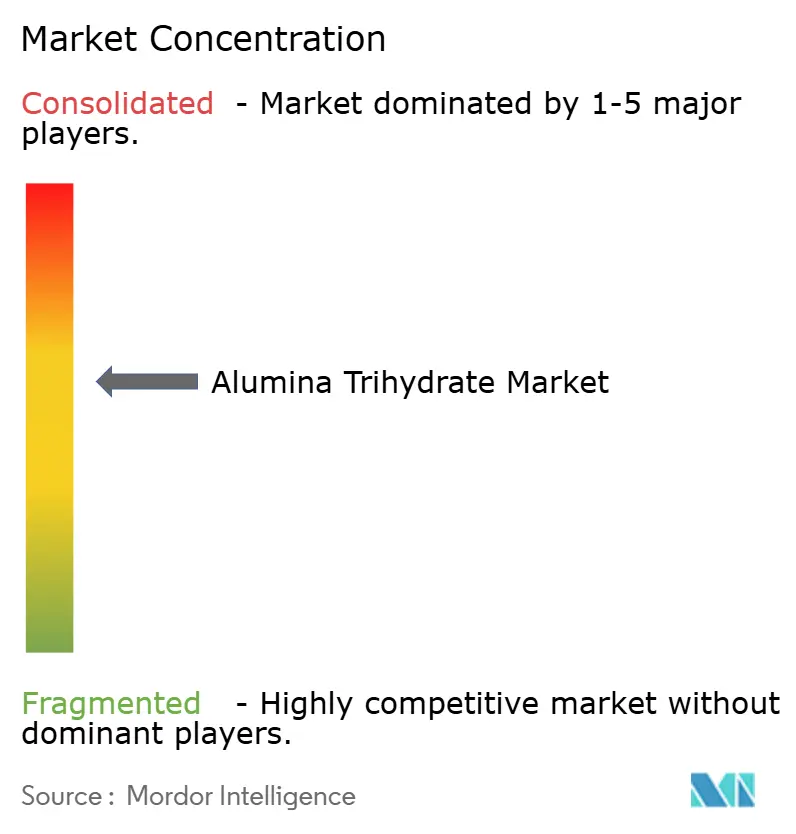
The alumina trihydrate market is moderately consolidated. Key players include Nabaltec AG, J.M. Huber Corporation, Hindalco Industries, Kyowa Chemical Industry, and Nippon Light Metal. These companies compete less on raw commodity price and more on particle size control, purity, surface treatment, technical service, and regulatory documentation. Within China, producers such as Chalco, Shandong Aluminum, and Zibo Pengfeng New Materials focus primarily on standard grades and price-led competition. This creates a two-tier structure in the alumina trihydrate market, where commodity output faces cost pressure while specialty grades protect margins through technical differentiation. The competitive balance therefore depends as much on formulation capability as on access to alumina feedstock.
Strategic moves in 2025 and 2026 reflect how suppliers are responding to the higher-value segment of the alumina trihydrate market. In May 2025, Huber acquired R.J. Marshall's ATH, antimony-free flame retardant, and molybdate-based smoke suppressant assets, strengthening its North American specialty position. Nabaltec increased Q1 2026 capital expenditure to EUR 7.2 million (equivalent to USD 7.9 million), with priority given to viscosity-optimized aluminum hydrates for EV thermal interface materials and Low Smoke Zero Halogen (LSZH) cable applications. Hindalco's June 2025 acquisition of AluChem added a specialty alumina platform to the Aditya Birla Group's portfolio, signaling a broader push into advanced alumina materials globally. These actions indicate that scale alone is no longer sufficient in the alumina trihydrate market, as customers move toward more precise grade requirements.
The most apparent opportunity for suppliers lies in viscosity-optimized, surface-modified, and ultra-high-purity ATH for EV, electronics, and semiconductor applications. Nabaltec's investor materials identify electrification and AI infrastructure as primary demand drivers for fine hydroxide expansion, which aligns with the stronger growth already visible in thermal interface materials (TIM) applications. Emerging suppliers such as Alpha HPA are targeting very high-purity materials that standard Bayer-process grades cannot meet for advanced ceramic and semiconductor applications. The alumina trihydrate market is therefore likely to favor companies that combine upstream supply security with consistent specialty grade development over those that remain exposed to mid-range commoditization.
Alumina Trihydrate Industry Leaders
J.M. Huber Corporation
Nabaltec AG
Sumitomo Chemical Co., Ltd.
Aluminum Corporation of China Limited
Hindalco Industries Ltd.
- *Disclaimer: Major Players sorted in no particular order

Recent Industry Developments
- May 2026: Nabaltec AG invested EUR 7.2 million (USD 8.21 million) in capital expenditure for its Functional Fillers segment in Q1 2026, a 56.5% year-on-year increase. The investment was primarily directed toward expanding capacity for viscosity-optimized aluminum hydrates serving EV thermal interface materials and LSZH cable markets. The company guided for 4-6% revenue growth for full-year 2026.
- June 2025: Hindalco Industries acquired a 100% equity stake in US-based AluChem Companies, Inc., a specialty alumina manufacturer, for an enterprise value of USD 125 million.


Global Alumina Trihydrate Market Report Scope
Alumina trihydrate (ATH) is a non-toxic, halogen-free inorganic powder with the chemical formula Al(OH)₃. It is the most widely used flame retardant and smoke suppressant globally. When exposed to fire, ATH absorbs heat and releases water vapor, cooling the material and inhibiting the spread of flames.
The alumina trihydrate market is segmented by type, application, end-user industry, and geography. By type, the market is segmented into ground, wet, dry, and precipitate. By application, the market is segmented into flame retardants, fillers, antacids, and other applications. By end-user industry, the market is segmented into plastics, paints and coatings, paper, adhesives, chemicals, pharmaceuticals, rubber, and glass. The report also covers market size and forecasts for alumina trihydrate across 16 countries in major regions. The market sizes and forecasts are provided in terms of value (USD).
| Ground |
| Wet |
| Dry |
| Precipitate |
| Flame Retardant |
| Filler |
| Antacid |
| Other Applications |
| Plastics |
| Paints and Coatings |
| Paper |
| Adhesives |
| Chemicals |
| Pharmaceuticals |
| Rubber |
| Glass |
| Asia-Pacific | China |
| India | |
| Japan | |
| South Korea | |
| Rest of Asia-Pacific | |
| North America | United States |
| Canada | |
| Mexico | |
| Europe | Germany |
| United Kingdom | |
| France | |
| Italy | |
| Russia | |
| Rest of Europe | |
| South America | Brazil |
| Argentina | |
| Rest of South America | |
| Middle-East and Africa | Saudi Arabia |
| South Africa | |
| Rest of Middle-East and Africa |
| By Type | Ground | |
| Wet | ||
| Dry | ||
| Precipitate | ||
| By Application | Flame Retardant | |
| Filler | ||
| Antacid | ||
| Other Applications | ||
| By End-User Industry | Plastics | |
| Paints and Coatings | ||
| Paper | ||
| Adhesives | ||
| Chemicals | ||
| Pharmaceuticals | ||
| Rubber | ||
| Glass | ||
| By Geography | Asia-Pacific | China |
| India | ||
| Japan | ||
| South Korea | ||
| Rest of Asia-Pacific | ||
| North America | United States | |
| Canada | ||
| Mexico | ||
| Europe | Germany | |
| United Kingdom | ||
| France | ||
| Italy | ||
| Russia | ||
| Rest of Europe | ||
| South America | Brazil | |
| Argentina | ||
| Rest of South America | ||
| Middle-East and Africa | Saudi Arabia | |
| South Africa | ||
| Rest of Middle-East and Africa | ||


Key Questions Answered in the Report
What is current market size of Alumina Trihydrate Market?
The Alumina Trihydrate Market size is expected to increase from USD 2.02 billion in 2025 to USD 2.14 billion in 2026 and reach USD 2.86 billion by 2031, at a CAGR of 5.97% over 2026-2031.
Which application accounts for the largest use of ATH?
Flame-retardant applications led with 55.40% share in 2025 and are projected to grow at a 6.42% CAGR through 2031.
Why is Asia-Pacific the key regional growth center?
Asia-Pacific held 46.87% share in 2025 and is projected to grow at 6.63% CAGR, supported by China’s cable base, India’s infrastructure push, and rising EV-linked demand.
What limits the wider use of alumina trihydrate in advanced polymers?
High loading requirements and decomposition onset near 180 °C can reduce mechanical performance and restrict use in higher-temperature polymer systems.
Page last updated on:






