
Size and Share of Alternate Fuel and Raw Materials (AFR) Market For Metal Processing Industry
Market Overview
| Study Period | 2021 - 2031 |
|---|---|
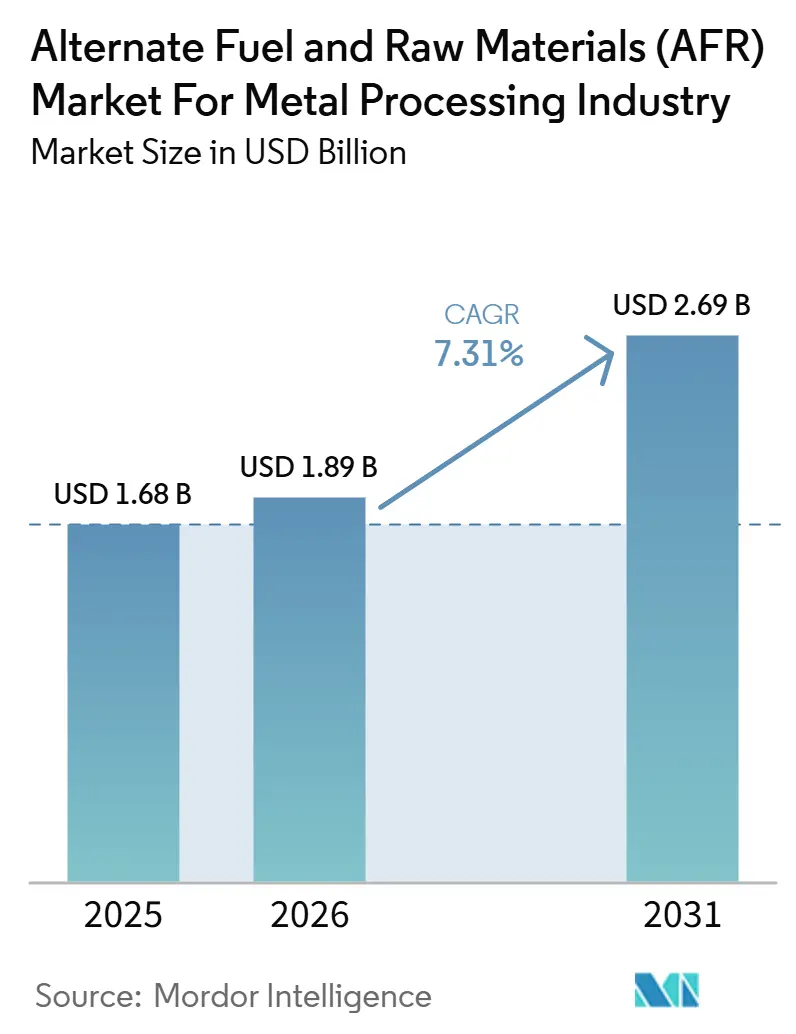
| Market Size (2026) | USD 1.89 Billion |
| Market Size (2031) | USD 2.69 Billion |
| Growth Rate (2026 - 2031) | 7.31 % |
| Fastest Growing Market | Asia-Pacific |
| Largest Market | Europe |
| Market Concentration | Medium |
Major Players *Disclaimer: Major Players sorted in no particular order Image © Mordor Intelligence. Reuse requires attribution under CC BY 4.0. | |
Analysis of Alternate Fuel and Raw Materials (AFR) Market For Metal Processing Industry by Mordor Intelligence
The Alternate Fuel and Raw Materials Market For Metal Processing Industry size is expected to increase from USD 1.68 billion in 2025 to USD 1.89 billion in 2026 and reach USD 2.69 billion by 2031, growing at a CAGR of 7.31% over 2026-2031. The alternate fuel and raw materials market is being shaped by metal producers seeking lower-carbon fuels and secondary inputs without replacing every existing furnace. Regulatory pressure is increasing the value of certified waste-derived fuels, recycled mineral inputs, and traceable carbon content. The shift toward electric arc furnaces changes demand from coal substitutes toward bio-carbon, secondary carbon carriers, and slag-conditioning materials. Established European collection and sorting systems support present demand, while emerging Asian capacity provides the strongest growth opportunity. Competition depends increasingly on feedstock control, quality assurance, transport access, and the ability to meet furnace-specific requirements.
Key Report Takeaways
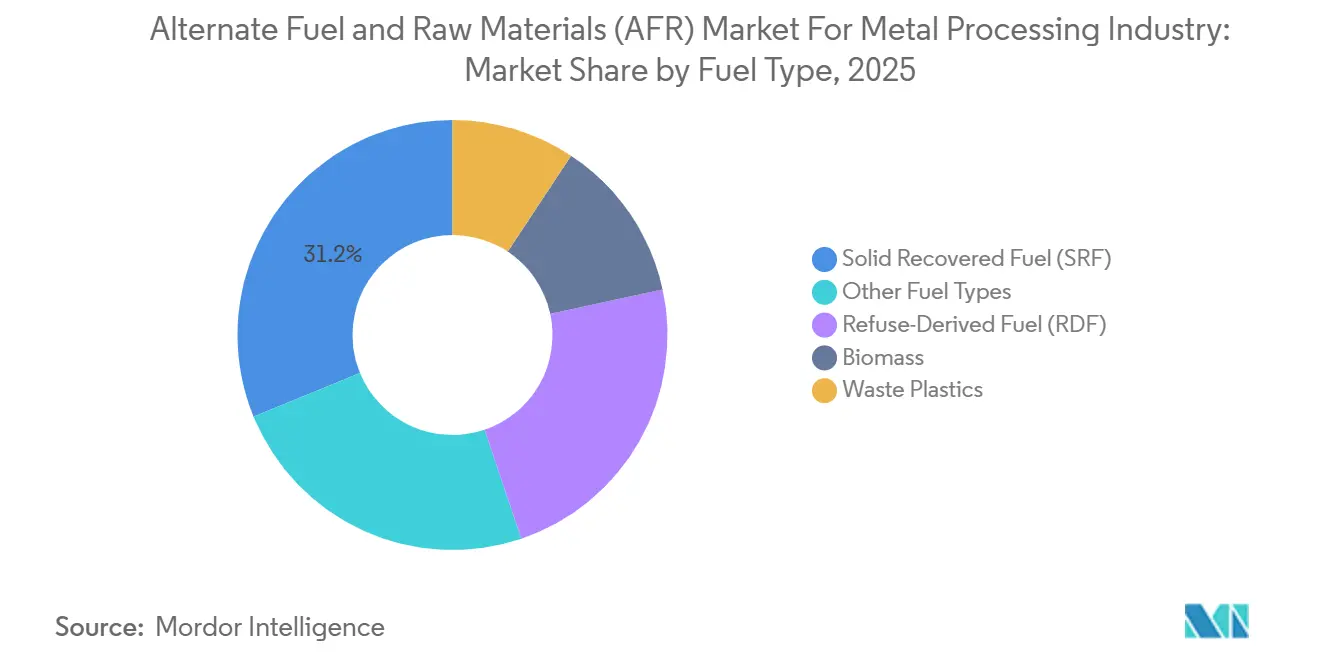
- By fuel type, Solid Recovered Fuel held 31.2% of the alternate fuel and raw materials market share in 2025, while biomass is forecast to grow at a 9.2% CAGR through 2031.
- By raw material type, blast furnace slag accounted for 33.1% of the alternate fuel and raw materials market size in 2025, while steel slag is forecast to expand at an 8.8% CAGR through 2031.
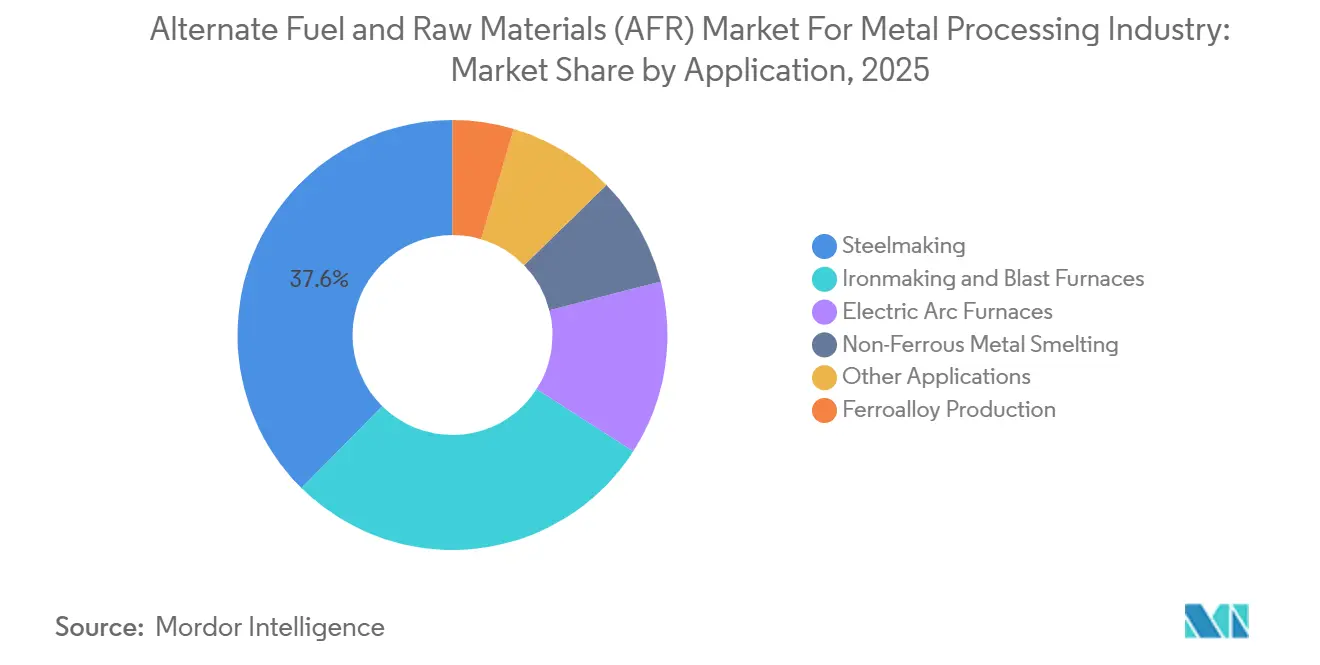
- By application, steelmaking held 37.6% of the alternate fuel and raw materials market share in 2025, while electric arc furnaces are projected to grow at a 10.8% CAGR through 2031.
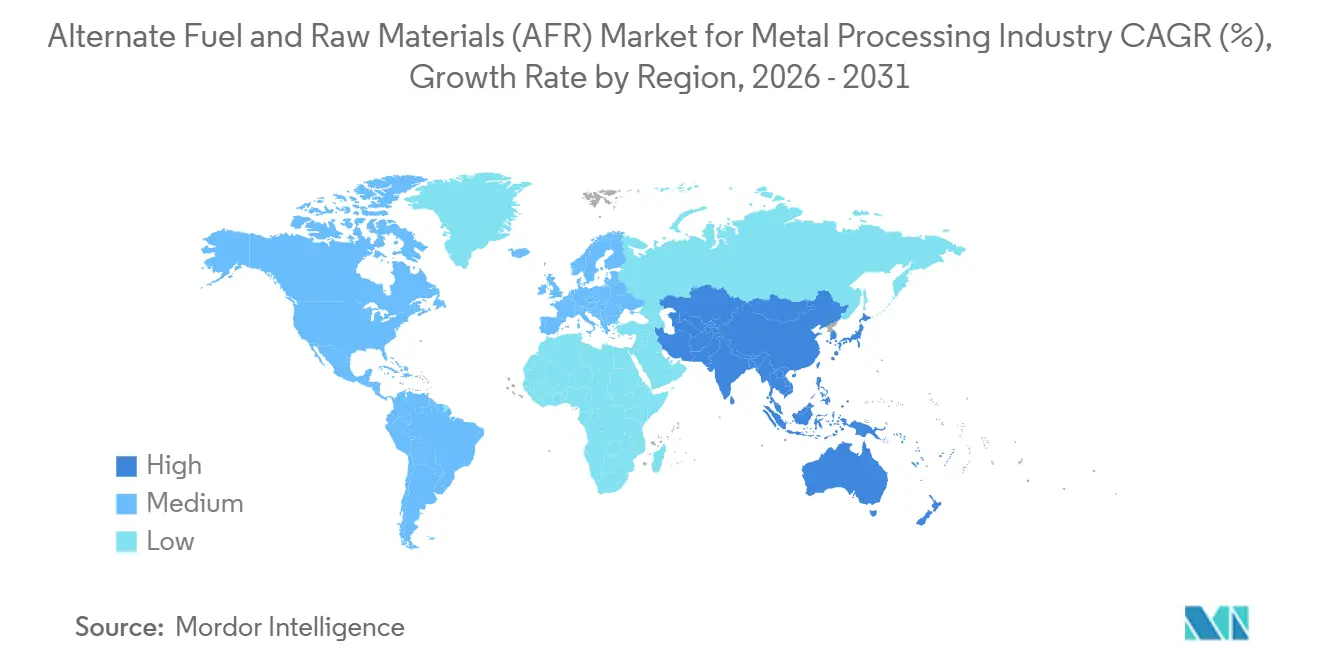
- By geography, Europe held 36.2% of the alternate fuel and raw materials market share in 2025, while Asia-Pacific is projected to grow at a 9.6% CAGR through 2031.
Note: Market size and forecast figures in this report are generated using Mordor Intelligence’s proprietary estimation framework, updated with the latest available data and insights as of January 2026.
Market Trends and Insights
Drivers Impact Analysis of Alternate Fuel and Raw Materials (AFR) Market For Metal Processing Industry*
| Driver | (~) % Impact on CAGR Forecast | Geographic Relevance | Impact Timeline |
|---|---|---|---|
| Industrial Decarbonization and Fossil-Fuel Substitution | +2.8% | Global, concentrated in EU and APAC core | Medium term (2-4 years) |
| Low-Carbon Reducing Agents in Steelmaking | +1.6% | APAC core, EU, North America | Medium term (2-4 years) |
| Landfill Diversion and Circular-Economy Requirements | +1.2% | EU, with spillover to South America and MEA | Medium term (2-4 years) |
| Waste-Derived Feedstocks in Existing Furnace Systems | +0.6% | North America, EU, APAC | Short term (≤ 2 years) |
| Embedded Mineral and Carbon Value in Industrial Residues | +0.5% | EU, APAC, with early gains in Japan and South Korea | Long term (≥ 4 years) |
| Digital Quality Certification for AFR Streams | +0.3% | EU, North America | Short term (≤ 2 years) |
| Source: Mordor Intelligence | |||
Industrial Decarbonization and Fossil-Fuel Substitution
The alternate fuel and raw materials market benefits from pressure on steel and metal processors to reduce fossil fuel use. Scrap electric arc furnace routes can offer lower-cost emissions reductions than conventional routes in some regions [1]Authors, “Technological Pathways for Cost-Effective Steel Decarbonization,” Nature, nature.com. This supports near-term use of recovered fuels and secondary materials where full process replacement is not practical. As electric arc furnace capacity grows, buyers need more bio-carbon carriers and slag-conditioning materials. Voestalpine approved USD 115.95 million of additional investment for its Donawitz Greentec steel expansion in June 2026 [2]voestalpine AG, “voestalpine Presents Further Expansion Plans for Greentec Steel at Donawitz,” voestalpine, voestalpine.com. That investment indicates that suppliers with certified low-carbon inputs can benefit from new furnace capacity.
Rising Demand for Low-Carbon Reducing Agents in Steelmaking
The alternate fuel and raw materials market is supported by demand for reducing agents with lower embedded carbon. A 2026 review found that biochar can work as a foaming slag agent and auxiliary reducing agent in electric arc furnace steelmaking. Biochar and coke blends can widen operating conditions for slag foaming while lowering electricity use. The University of Minnesota Natural Resources Research Institute is preparing a commercial-scale electric arc furnace biocarbon demonstration in 2026. ArcelorMittal España completed a pilot and techno-economic evaluation of SRF gasification for synthesis gas applications in steelmaking [3]ArcelorMittal España, “GASSYNREDU, Completed Evaluation of SRF Gasification as a Pathway for Synthesis Gas in the Steel Industry,” ArcelorMittal España, spain.arcelormittal.com. These projects make biomass, SRF, and related reducing inputs more relevant to operational steelmaking decisions.
Tightening Landfill Diversion and Circular-Economy Requirements
The alternate fuel and raw materials market gains supply when landfill rules favor recovery and co-processing. The European Union updated the Waste Framework Directive in 2025 and set new requirements for waste prevention and recycling. Regulation (EU) 2024/1252 encourages the recovery of critical raw materials from extractive waste and legacy deposits. This increases attention on ferrous slag heaps that were previously treated mainly as closed waste sites. Steelmakers with in-house recovery capacity can capture more of the resulting material value. Third-party processors, therefore, face a more competitive environment for secondary mineral feedstocks.
Integration of Waste-Derived Feedstocks into Existing Furnace Systems
Existing furnace assets give the alternate fuel and raw materials market a practical route to adoption. Metal processors can introduce suitable recovered fuels and materials without waiting for complete plant replacement. ArcelorMittal España's SRF gasification evaluation demonstrated a technical route for using waste-derived feedstock in steel applications. The process requires reliable carbon content, low contaminant loads, and stable physical properties. Furnace operators are likely to favor suppliers that can tailor materials to specific feed and emissions requirements. This favors processors that combine preparation capability with long-term industrial offtake relationships.
Restraints Impact Analysis of Alternate Fuel and Raw Materials (AFR) Market For Metal Processing Industry*
| Restraint | (~) % Impact on CAGR Forecast | Geographic Relevance | Impact Timeline |
|---|---|---|---|
| Inconsistent AFR Quality and Contaminant Loads | -1.20% | Global, most acute in South America and MEA | Short term (≤ 2 years) |
| High Logistics Costs for Low-Density Waste Streams | -0.80% | APAC periphery, South America, MEA | Medium term (2-4 years) |
| Furnace-Specific Feeding and Emissions Compatibility Constraints | -0.50% | North America, EU | Medium term (2-4 years) |
| Competition from Higher-Value Recycling and Secondary-Material Uses | -0.40% | EU, North America | Long term (≥ 4 years) |
| Source: Mordor Intelligence | |||
Inconsistent AFR Quality and Contaminant Loads
The alternate fuel and raw materials market faces a material quality challenge because recovered streams vary in moisture, calorific value, and chlorine content. These changes can affect furnace stability and lead operators to set conservative substitution rates. Metal applications also require strict control of lead, zinc, copper, and other trace metals. This is especially important for electric arc furnaces producing flat products with narrow chemistry limits. Digital sorting and batch certification can improve visibility, but they do not remove the need for physical segregation. Suppliers that consistently meet furnace-grade specifications can command a more defensible position than processors selling mixed material.
High Logistics Costs for Low-Density Waste Streams
The transport economics of the alternate fuel and raw materials market remain challenging for RDF and biomass. These materials have lower bulk density than coal, so transport costs can rise quickly over longer distances. Holcim's Geocycle operates 75 specialized processing facilities across nearly 30 countries, reflecting the role of local infrastructure in viable collection and processing [4]Holcim, “Closing the Loop with Geocycle,” Holcim, holcim.com. Regions with fragmented collection systems must build sorting, preparation, and transport capacity before they can scale supply. This creates a high entry barrier for smaller processors in South America, the Middle East, and Africa. It also gives established operators an advantage where their networks are already near industrial customers.
*Our forecasts treat driver/restraint impacts as directional, not additive. The impact forecasts reflect baseline growth, mix effects, and variable interactions.
Alternate Fuel and Raw Materials (AFR) Market For Metal Processing Industry Segment Analysis
By Fuel Type:
SRF Leads Revenue while Biomass Supports Lower-Carbon SteelmakingSolid Recovered Fuel held 31.2% of the alternate fuel and raw materials market size in 2025, supported by standardized specifications and developed sorting networks. CEN and ISO methods help processors document the relevant characteristics of solid recovered fuels. SRF provides a consistent option for co-processing where material preparation is mature. RDF remains a lower-cost option, although its broader composition can limit furnace use. Waste plastics can provide secondary carbon in selected ironmaking and electric arc furnace applications. The fuel choice depends on carbon content, contamination risk, local availability, and the receiving process. Suppliers must balance a buyer's emissions objectives with its requirements for consistent performance. The alternate fuel and raw materials industry, therefore, needs processing systems that separate fuel grades rather than treating all waste-derived fuels as interchangeable. Mature European markets retain an advantage because the collection and sorting infrastructure is already connected to industrial users.
Biomass is projected to record a 9.2% CAGR through 2031, the fastest rate among fuel types. Biochar can support slag foaming and auxiliary reduction within electric arc furnace operations. The same material can be valuable when buyers need documented biogenic carbon content. The Natural Resources Research Institute's 2026 commercial-scale demonstration will test this route under operating conditions relevant to North American producers. Non-forest feedstocks can also widen the available supply base. Mazda completed trials involving bamboo-waste briquettes for cupola furnace use in April 2026. The alternate fuel and raw materials market can therefore gain from regional biomass streams that meet quality and traceability requirements. Biomass suppliers still need to manage storage, moisture, transport density, and seasonal collection conditions. These operating constraints will determine whether strong growth translates into broad commercial adoption.



By Raw Material Type:
Slag Recovery Builds Value from Industrial ResiduesBlast furnace slag accounted for 33.1% of the alternate fuel and raw materials market size in 2025. Its position reflects established uses in cement, road construction, hydraulic fill, and other construction applications. Germany's slag sector reported that iron and steel slag recycling avoided 11 million metric tons of natural rock extraction and 4 million metric tons of CO2 equivalent in 2025. Those applications support resource efficiency and reduce the volume sent to disposal. However, the move from blast furnaces toward DRI and electric arc furnace routes could gradually reduce the supply of granulated blast furnace slag. This makes recovery quality and material allocation more important for buyers. Research reviewed by the Japan Iron and Steel Institute identified continued demand for technologies that recover useful elements from steelmaking slag. The alternate fuel and raw materials industry must respond to both tighter material supply and stronger demand for recovered minerals. Producers with established slag handling rights can protect access to this valuable secondary resource.
Steel slag is the fastest-growing raw material type, with an 8.8% CAGR projected through 2031. Regulation (EU) 2024/1252 has increased the importance of identifying recoverable materials in legacy ferrous slag deposits. Steel slag can contain iron, vanadium, manganese, and other materials that justify more detailed screening. The material can also support cement and aggregate uses after suitable processing. A 2026 study found that BOF and next-generation electric arc furnace slag can substitute for Portland cement clinker components when iron phases are separated. Fly ash and foundry sand remain established secondary materials in concrete and casting-related uses. The alternate fuel and raw materials market is becoming more dependent on recovery technology that distinguishes valuable mineral fractions. This favors operators that can process residues with controlled quality and identified end uses. It also increases competition between internal steelmaker recovery teams and external recycling specialists.
By Application:
Steelmaking Remains the Largest Outlet while Electric Arc Furnaces Grow FastestSteelmaking accounted for 37.6% of the alternate fuel and raw materials market size in 2025. The application uses recovered fuel and material inputs across conventional and transitional production routes. The shift from basic oxygen furnaces to electric arc furnaces changes the required mix of materials. Demand moves away from coking coal substitutes and toward bio-carbon, waste plastic secondary carbon, and slag conditioners. ArcelorMittal España's GASSYNREDU assessment confirmed technical feasibility for generating synthesis gas from SRF for furnace applications. That work shows that SRF can serve a more specialized role than conventional thermal substitution. Ironmaking and blast furnace operations remain relevant outlets, although their installed base is declining in higher-carbon-cost regions. The alternate fuel and raw materials market will need products matched to changing furnace chemistry and emissions requirements. Suppliers with flexible preparation capability can serve both present steelmaking assets and newer electric arc furnace operations.
Electric arc furnaces are projected to grow at a 10.8% CAGR through 2031. Their growth reflects capacity additions and increased interest in lower-carbon steelmaking routes. Electric arc furnace operators need materials that help control foaming, energy use, and melt chemistry. Biochar, secondary carbon carriers, and recovered mineral inputs can meet some of these needs when their composition is verified. The 2026 biocarbon demonstration planned by the Natural Resources Research Institute will provide an important commercial reference point for this application. Non-ferrous smelting and ferroalloy production have a narrower tolerance for contaminants than many bulk applications. This creates a premium segment for carefully segregated, furnace-specific recovered inputs. The alternate fuel and raw materials industry has room to grow in these applications, but quality control will decide which suppliers qualify. In-house by-product management at large metal producers can also limit the addressable volume available to outside processors.
Geography Analysis
Europe Alternate Fuel and Raw Materials (AFR) Market for Metal Processing Industry
Europe held 36.2% of the alternate fuel and raw materials market size in 2025. Its leading position rests on waste regulation, collection infrastructure, industrial processing capacity, and carbon-cost exposure. The European Commission's 2025 Waste Framework Directive update reinforces prevention, separate collection, and improved recycling obligations. Regulation (EU) 2024/1252 also strengthens interest in recovering materials from extractive and legacy waste. Germany, the Netherlands, and Belgium remain central to regional SRF and secondary-material supply chains. These countries have dense waste sorting networks and established industrial users. European processors are therefore better placed to offer specified material grades. The alternate fuel and raw materials market in Europe will continue to depend on policies that direct materials away from landfill and toward verified recovery routes.
APAC Alternate Fuel and Raw Materials (AFR) Market for Metal Processing Industry
Asia-Pacific is forecast to grow at a 9.6% CAGR through 2031, the highest regional rate. The region combines steel capacity expansion with national efforts to reduce emissions intensity. This increases demand for low-carbon inputs in electric arc furnace and direct reduced iron routes. The alternate fuel and raw materials market has a larger supply-chain development opportunity in Asia-Pacific than in mature European systems. Regional buyers need dependable collection, preprocessing, and certification systems. Agricultural residues may provide a local source of biomass-derived reducing material where collection can be organized. The strongest opportunity lies where steel capacity, residue availability, and industrial logistics overlap. Suppliers that establish local processing networks can avoid the transport penalty associated with low-density materials.
The Americas and MEA Alternate Fuel and Raw Materials (AFR) Market for Metal Processing Industry
North America, South America, and the Middle East and Africa are earlier-stage opportunity areas for the alternate fuel and raw materials market. The US Department of Energy published a 2026 technical report on methane-pyrolysis-driven direct reduced iron as a route toward lower-carbon steel production. Such projects can widen the need for compatible recovered inputs as steel assets are upgraded. Holcim reported that Geocycle managed 12.6 million metric tons of waste globally in 2025 and supported nearly 40% of Holcim thermal energy needs with circular waste-derived sources. The same collection and preparation model can inform industrial co-processing where metal-sector demand develops. South America and the Middle East and Africa face more fragmented waste handling and longer transport routes. Investment in sorting and local preparation will be necessary before these regions can scale supply reliably.

Competitive Landscape
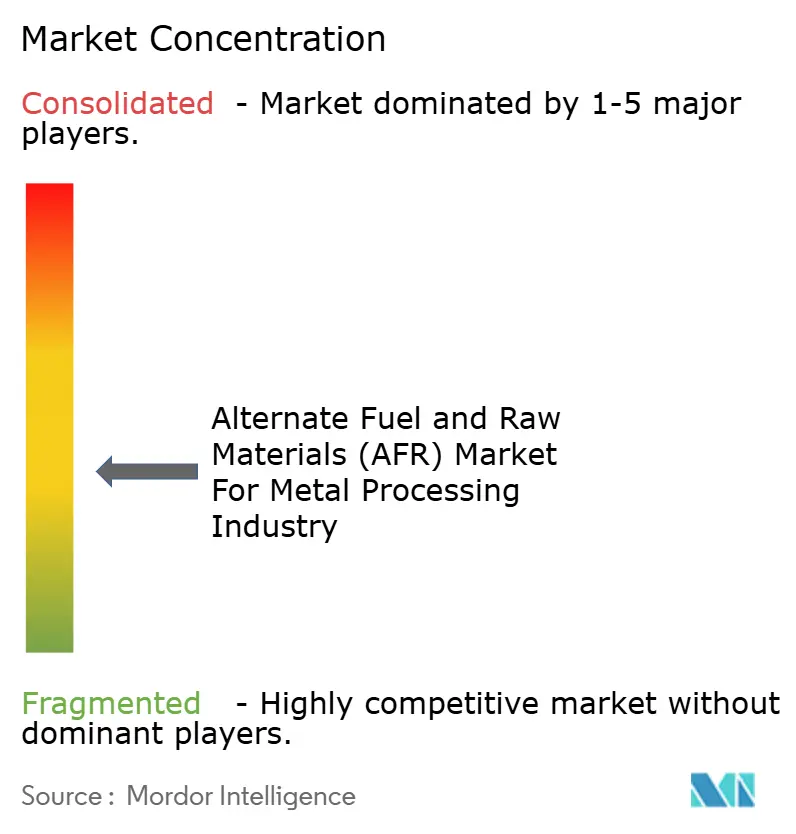
The alternate fuel and raw materials market is moderately fragmented at the feedstock production level. Large European waste managers have an advantage because they control collection, sorting, preparation, and industrial delivery networks. Veolia, SUEZ, REMONDIS, and Renewi are positioned through integrated waste-to-resource operations. Their scale can secure access to material streams that asset-light entrants cannot easily obtain. This advantage is strongest in regions with regulated waste collection and mature industrial demand. Smaller processors can still compete where they offer local supply or specialized fuel grades. Market power is less dependent on a single technology than on reliable access to usable material. The alternate fuel and raw materials market remains open to firms that can provide consistent quality and dependable logistics.
Competition is moving toward process control and carbon documentation. N+P Group raised GBP 30.6 million to invest in biogenic separation technology, sorting upgrades, and greater Teesside throughput. Its work reflects buyer interest in fuels with higher documented biogenic content. ISO 3884:2025 provides updated methods for determining element content in solid recovered fuels. These standards make analytical testing a more important part of commercial qualification. Producers that can link quality data to each batch have a stronger case for serving steel and metal plants. The alternate fuel and raw materials industry is therefore likely to reward firms that combine physical processing with clear quality records. Operators without traceability systems may find it harder to sell into more demanding furnace applications.
Strategic activity also shows how companies are building capability around processing and materials recovery. voestalpine approved additional investment for its Donawitz electric arc furnace expansion, which supports future demand for low-carbon inputs. ArcelorMittal España completed its SRF gasification evaluation, creating a reference point for synthesis-gas use in steelmaking. Holcim's Geocycle network shows the value of distributed facilities for managing waste-derived inputs near receiving plants. These moves reinforce the importance of asset location, engineering capability, and quality control. They also show that large industrial groups can internalize parts of the value chain. Independent suppliers must therefore differentiate through specialized materials, local access, or stronger process performance.
Leaders of Alternate Fuel and Raw Materials (AFR) Market For Metal Processing Industry
Geocycle SA
Veolia Environnement S.A.
SUEZ S.A.
REMONDIS SE & Co. KG
Befesa S.A.
- *Disclaimer: Major Players sorted in no particular order
Alternate Fuel and Raw Materials (AFR) Market For Metal Processing Industry Companies Covered in this Report
- Airex Energy Inc.
- Averda International Limited
- Befesa S.A.
- Biffa Limited
- Blue Phoenix Group B.V.
- EEW Energy from Waste GmbH
- Enva Group Limited
- Fomento de Construcciones y Contratas, S.A.
- Geocycle SA
- Holcim AG
- Indaver NV
- N+P Group B.V.
- PreZero International GmbH
- Ragn-Sells AB
- REMONDIS SE & Co. KG
- Renewi plc
- SARIA SE & Co. KG
- Sembcorp Environment Pte. Ltd.
- SUEZ S.A.
- Veolia Environnement S.A.
- Viridor Limited

Recent Industry Developments in Alternate Fuel and Raw Materials (AFR) Market For Metal Processing Industry
- June 2026: Voestalpine announced USD 115.95 million in additional approved investment for electric arc furnace capacity expansion at its Donawitz, Austria, Greentec steel plant. Targeting 1.5 million metric tons per year of CO2-reduced steel by 2030, the expansion increases demand for waste-derived carbon carriers and low-carbon raw material inputs.
- March 2026: Holcim and Geocycle reported managing 12.6 million metric tons of waste globally in 2025, with Geocycle supporting nearly 40% of Holcim's thermal energy needs from circular waste-derived sources and avoiding 1.1 million metric tons of CO2 in Latin America alone.
- March 2026: The US Department of Energy published a final technical report on carbon-neutral steel production through methane-pyrolysis-driven direct reduced iron, confirming a pathway to eliminate up to 60 million metric tons of CO2 annually in the US steel sector.
- January 2026: SUEZ commenced operations under a 12-year, USD 486.95 million public service delegation contract for the Calce waste treatment facility near Perpignan, France, incorporating construction of a new selective sorting center and a preparation center producing high-calorific fuel for energy-from-waste applications.


Scope of Report on Alternate Fuel and Raw Materials (AFR) Market For Metal Processing Industry
The Alternate Fuel and Raw Materials (AFR) Market for the Metal Processing Industry covers the production, collection, processing, supply, and utilization of alternative fuels and secondary raw materials that replace conventional fossil fuels and virgin mineral resources in metal production and processing operations. AFR solutions help reduce energy costs, improve resource efficiency, divert industrial and municipal waste from landfills, and lower greenhouse gas emissions, while supporting circular economy and decarbonization objectives.
The Alternative Fuel and Raw Material (AFR) market is segmented by fuel type, raw material type, application, and geography. By fuel type, the market is segmented into refuse-derived fuel (RDF), solid recovered fuel (SRF), biomass, waste plastics, and other fuel types. By raw material type, the market is segmented into fly ash, blast furnace (BF) slag, foundry sand, steel slag, and other raw materials. By application, the market is segmented into steelmaking, ironmaking and blast furnaces, electric arc furnaces, non-ferrous metal smelting, ferroalloy production, and other applications. The report also covers the market size and forecasts for the global alternative fuel and raw material (AFR) market for metal processing industry across 26 countries in key regions. For each segment, the market sizing and forecasts have been provided on the basis of value (USD).
| Refuse-Derived Fuel (RDF) |
| Solid Recovered Fuel (SRF) |
| Biomass |
| Waste Plastics |
| Other Fuel Types |
| Fly Ash |
| Blast Furnace Slag |
| Foundry Sand |
| Steel Slag |
| Other Raw Material Types |
| Steelmaking |
| Ironmaking and Blast Furnaces |
| Electric Arc Furnaces |
| Non-Ferrous Metal Smelting |
| Ferroalloy Production |
| Other Applications |
| North America | United States |
| Canada | |
| Mexico | |
| Europe | Germany |
| France | |
| Italy | |
| Spain | |
| United Kingdom | |
| Poland | |
| Russia | |
| Rest of Europe | |
| Asia-Pacific | China |
| India | |
| Japan | |
| South Korea | |
| Australia | |
| Indonesia | |
| Vietnam | |
| Thailand | |
| Rest of Asia-Pacific | |
| South America | Brazil |
| Argentina | |
| Chile | |
| Rest of South America | |
| Middle East and Africa | Saudi Arabia |
| United Arab Emirates | |
| Egypt | |
| South Africa | |
| Morocco | |
| Rest of Middle East and Africa |
| By Fuel Type | Refuse-Derived Fuel (RDF) | |
| Solid Recovered Fuel (SRF) | ||
| Biomass | ||
| Waste Plastics | ||
| Other Fuel Types | ||
| By Raw Material Type | Fly Ash | |
| Blast Furnace Slag | ||
| Foundry Sand | ||
| Steel Slag | ||
| Other Raw Material Types | ||
| By Application | Steelmaking | |
| Ironmaking and Blast Furnaces | ||
| Electric Arc Furnaces | ||
| Non-Ferrous Metal Smelting | ||
| Ferroalloy Production | ||
| Other Applications | ||
| By Geography | North America | United States |
| Canada | ||
| Mexico | ||
| Europe | Germany | |
| France | ||
| Italy | ||
| Spain | ||
| United Kingdom | ||
| Poland | ||
| Russia | ||
| Rest of Europe | ||
| Asia-Pacific | China | |
| India | ||
| Japan | ||
| South Korea | ||
| Australia | ||
| Indonesia | ||
| Vietnam | ||
| Thailand | ||
| Rest of Asia-Pacific | ||
| South America | Brazil | |
| Argentina | ||
| Chile | ||
| Rest of South America | ||
| Middle East and Africa | Saudi Arabia | |
| United Arab Emirates | ||
| Egypt | ||
| South Africa | ||
| Morocco | ||
| Rest of Middle East and Africa | ||


Key Questions Answered in the Report
What is driving demand for alternate fuels and raw materials in metal processing?
Decarbonization requirements, circular-economy rules, and electric arc furnace investment support demand for certified recovered fuels and secondary materials, especially where plants need lower-carbon inputs without full process replacement and can qualify materials for controlled furnace use.
How large is the alternate fuel and raw materials market for metal processing?
It is projected to grow from USD 1.89 billion in 2026 to USD 2.69 billion by 2031 at a 7.31% CAGR, as supplied in the underlying market estimates, with Europe currently leading global revenue. Growth reflects the wider use of certified recovered fuels, secondary mineral inputs, and lower-carbon furnace operating practices across steel and metal processing facilities, where quality documentation and transport access remain essential commercial conditions.
Which fuel type has the largest position in metal processing?
Solid Recovered Fuel led fuel types with 31.2% share in 2025, supported by standardized specifications, established sorting systems, and suitability for prepared industrial co-processing streams where reliable calorific performance is required.
Which raw material is growing fastest for metal processors?
Steel slag is forecast to grow at an 8.8% CAGR through 2031 as recovery rules, material screening, and potential mineral recovery increase its commercial importance, including in legacy ferrous waste deposits.
Why are electric arc furnaces important for recovered-input suppliers?
Electric arc furnaces are forecast to grow at a 10.8% CAGR through 2031 and need verified carbon carriers and slag-conditioning inputs that can support controlled operating conditions, chemistry management, and more consistent furnace performance.
Which region offers the strongest growth potential?
Asia-Pacific is forecast to grow at a 9.6% CAGR through 2031 as steel capacity expansion intersects with decarbonization goals, local biomass availability, developing processing networks, and growing need for dependable industrial material supply.
Page last updated on:





