
Air-Dried Vegetables Market Size and Share
Market Overview
| Study Period | 2022 - 2032 |
|---|---|
| Market Size (2027) | USD 5.14 Billion |
| Market Size (2032) | USD 6.69 Billion |
| Growth Rate (2027 - 2032) | 5.41 % |
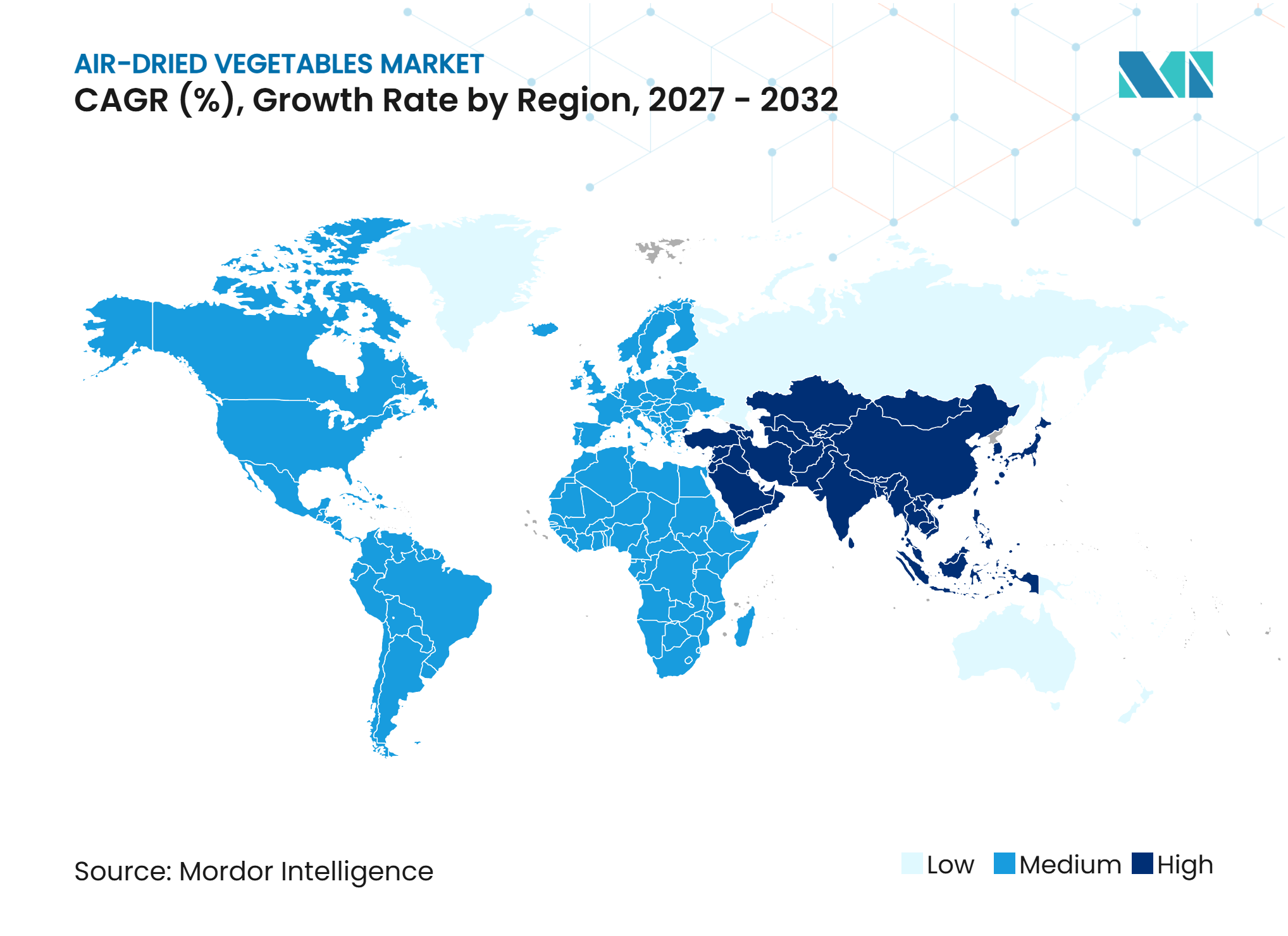
| Fastest Growing Market | Asia-Pacific |
| Largest Market | North America |
| Market Concentration | Low |
Major Players *Disclaimer: Major Players sorted in no particular order Image © Mordor Intelligence. Reuse requires attribution under CC BY 4.0. | |
Air-Dried Vegetables Market Analysis by Mordor Intelligence
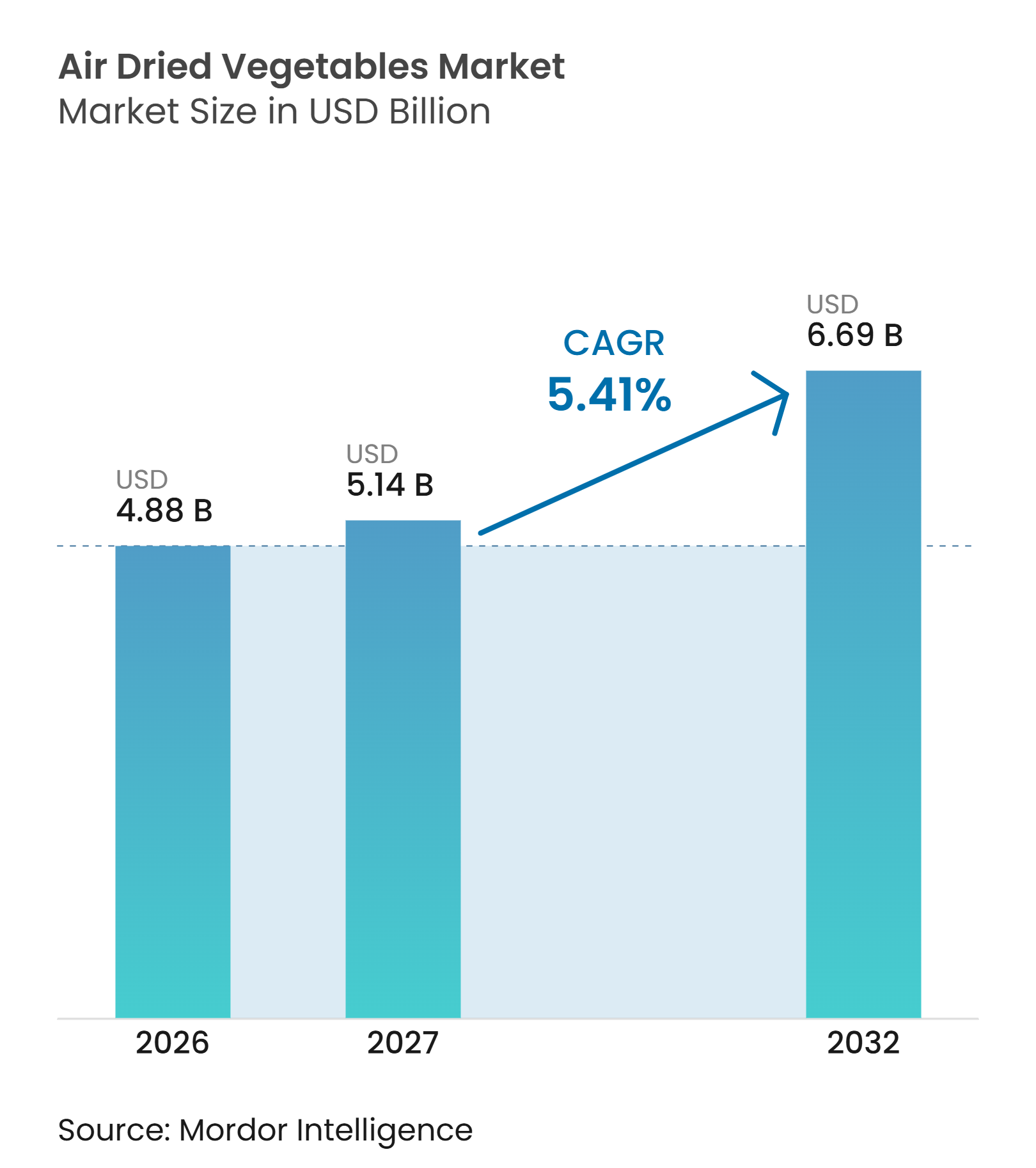
The air-dried vegetables market size is expected to grow from USD 4.88 billion in 2026 to USD 5.14 billion in 2027 and is forecast to reach USD 6.69 billion by 2032 at a 5.41% CAGR over 2027-2032. The air-dried vegetables market is supported by food manufacturers seeking ingredients with extended shelf life, consistent quality, and reduced dependence on refrigerated logistics. Growing procurement requirements emphasize traceability, clean-label ingredients, and reliable food safety standards. This benefits processors with strong agricultural sourcing, drying capabilities, and quality control systems. Advances in low-temperature drying technologies support improvements in product quality and production efficiency. Retail demand creates further opportunities for suppliers offering recognizable, high-quality, and certified ingredients.
Key Report Takeaways
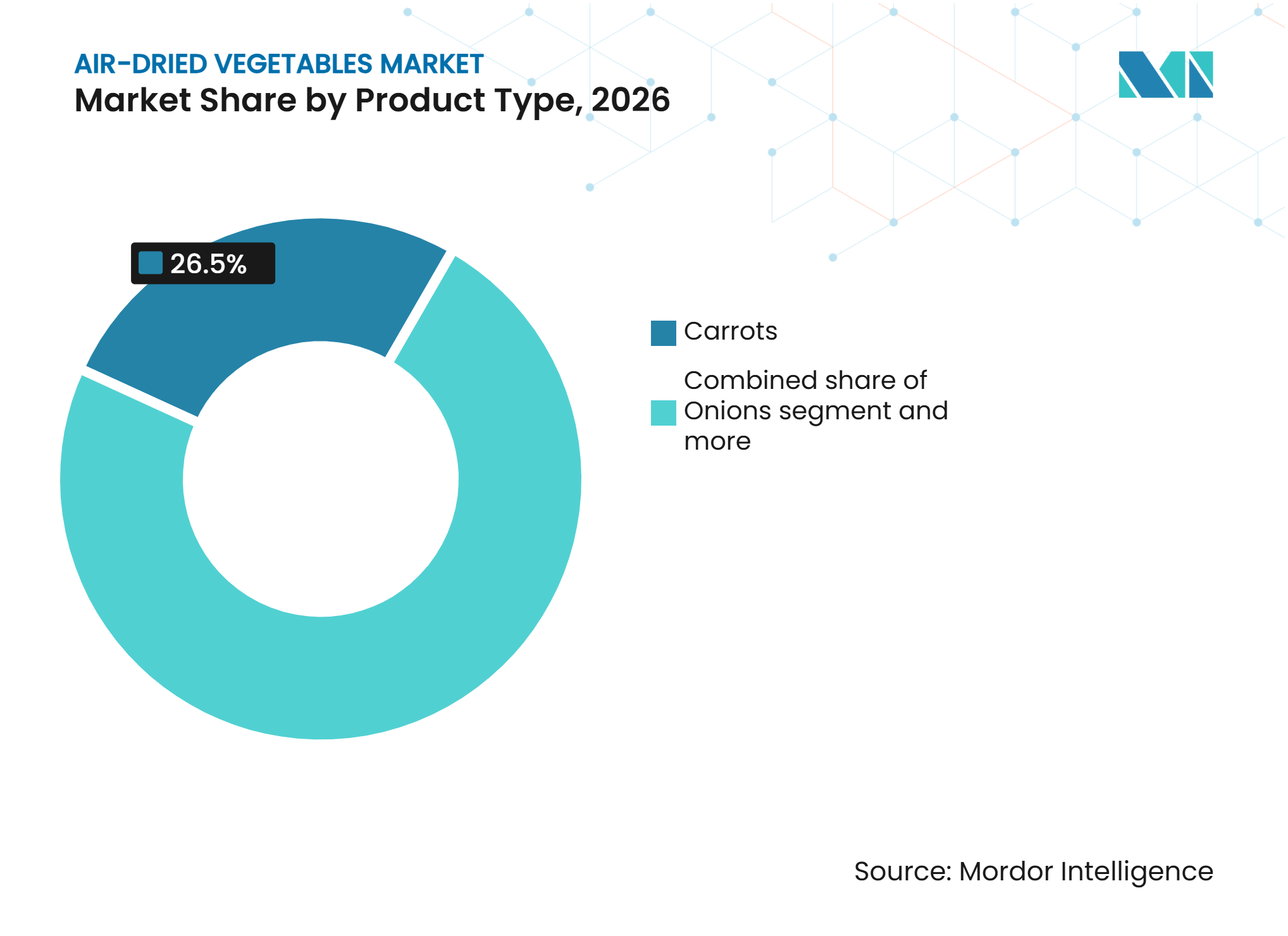
• By product type, carrots held 26.51% of the air-dried vegetables market size in 2026, while onions are forecast to expand at a CAGR of 6.11% through 2032.
• By nature, conventional held 72.21% of the air-dried vegetables market share in 2026, while organic is forecast to expand at a CAGR of 7.12% through 2032.
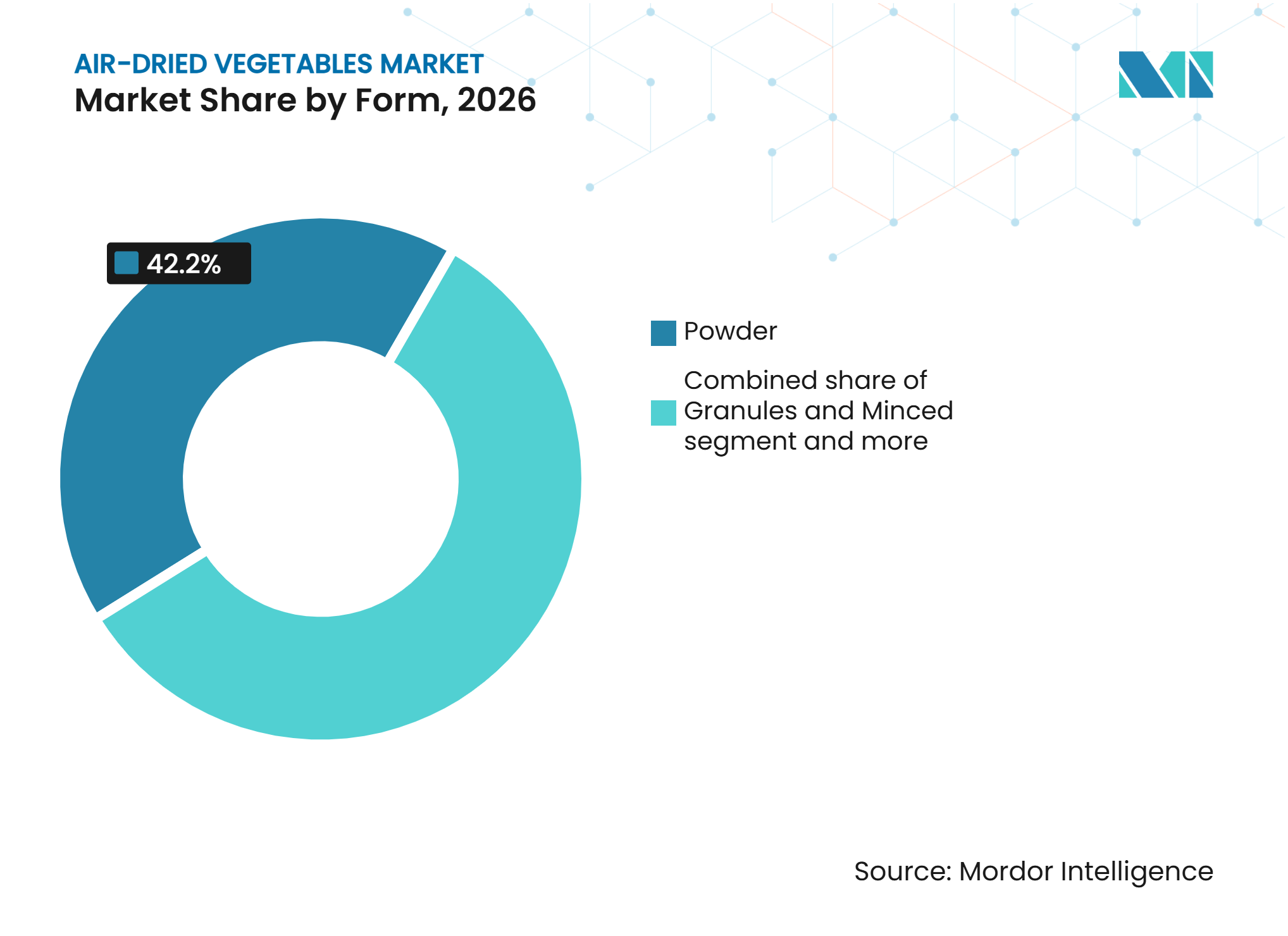
• By form, powder held 42.23% of the air-dried vegetables market share in 2026, while granules and minced products are forecast to expand at a CAGR of 7.21% through 2032.
• By end use application, industrial packaged food held 54.12% of the air-dried vegetables market share in 2026, while retail is forecast to expand at a CAGR of 7.62% through 2032.
• By geography, North America held 41.61% of the air-dried vegetables market share in 2026, while Asia-Pacific is forecast to expand at a CAGR of 7.71% through 2032.
Note: Market numbers in this report are based on Mordor Intelligence's proprietary estimation framework, which combines nine months of actuals with Q4 projections for base year 2026.
Market Trends and Insights
Drivers Impact Analysis of Air-Dried Vegetables Market*
| Driver | (~) % Impact on CAGR Forecast | Geographic Relevance | Impact Timeline |
|---|---|---|---|
| Rising demand for shelf-stable and convenient vegetable ingredients | +1.4% | Global, with intensity in North America, Europe, and Southeast Asia | Short term (≤ 2 years) |
| Expansion of ready meals, soups and instant food products | +1.1% | Asia-Pacific, with spillover to Middle East and Africa and South America | Medium term (2-4 years) |
| Rising utilization of dehydrated vegetables in food processing applications | +0.8% | Global, concentrated in North America and Europe | Medium term (2-4 years) |
| Growing demand for clean-label and plant-based food ingredients | +0.9% | North America and Europe, with early adoption in Asia-Pacific and South America | Medium term (2-4 years) |
| Increasing adoption of dehydrated vegetable ingredients in food formulations | +0.6% | Global | Long term (≥ 4 years) |
| Technological advancements in vegetable drying and processing | +0.4% | Global, with research activity in Europe, India, and China | Long term (≥ 4 years) |
| Source: Mordor Intelligence | |||
Rising Demand for Shelf-Stable and Convenient Vegetable Ingredients
The demand for shelf-stable and convenient vegetable ingredients supports the adoption of air-dried vegetables in food manufacturing and export applications. For instance, in March 2025, according to the Agricultural and Processed Food Products Export Development Authority, a packaging development project reported that flexible consumer packages developed for dehydrated onion flakes and garlic powder achieved a shelf life of 8–12 months. The project also established bulk packaging solutions for these products, achieving a shelf life of approximately 1.5–2 years [1]. These developments highlight the importance of extended storage life, efficient packaging, and reduced freight requirements in vegetable ingredient distribution. These advantages support the use of air-dried vegetables in packaged foods, soups, seasonings, and ready-to-cook products.
Expansion of Ready Meals, Soups and Instant Food Products
The expansion of ready meals, soups, and instant food products supports demand for dehydrated vegetable ingredients across packaged food applications. Manufacturers increasingly incorporate air-dried vegetable flakes, granules, and powders into soup mixes, instant noodles, seasoning blends, and ready-meal formulations to enable convenient preparation, ensure consistent ingredient distribution, and maintain recognizable vegetable content. The use of dehydrated vegetables allows manufacturers to standardize recipes and maintain product consistency across large production volumes, which is particularly important for mass-market packaged food brands. These ingredients also offer extended shelf life, easier storage, and reduced dependence on refrigerated logistics, making them suitable for packaged food products that require longer storage.
Rising Utilization of Dehydrated Vegetables in Food Processing Applications
The increasing use of dehydrated vegetables in packaged food manufacturing supports demand for air-dried vegetable ingredients across industrial applications. For instance, in June 2026, according to the Ministry of Food Processing Industries, secondary processing of onions, which includes dehydration into flakes, powders, and kibbles, increased from an estimated 3% in FY2023 to 4% in FY2025. The report identified onion powder and flakes as important ingredients in snacks, instant mixes, noodles, seasonings, and processed meats. Additionally, the overall processing level of other vegetables increased from an estimated 8% to 10% during the same period, reflecting greater adoption of value-added vegetable products, including flakes and powders [2]. These developments support the broader use of air-dried vegetables as functional ingredients in food-processing formulations.
Growing Demand for Clean-Label and Plant-Based Food Ingredients
Growing consumer preference for natural, organic, and plant-based food products supports the use of air-dried vegetables in food processing applications. For instance, in 2025, according to the International Food Information Council, 41% of consumers looked for natural food-label claims, while 30% sought organic and 14% sought plant-based claims. Additionally, 25% of consumers considered the inclusion of vegetables when defining healthy foods [3]. In February 2026, reflecting this demand, Baidyanath Ayurved launched its certified organic moringa powder, made from cleaned, shade-dried moringa leaves, with no artificial additives or fillers. The product can be incorporated into smoothies, soups, and other food preparations. These preferences and product developments support the use of air-dried vegetable powders and flakes in clean-label and plant-based food formulations.
Restraints Impact Analysis of Air-Dried Vegetables Market*
| Restraint | (~) % Impact on CAGR Forecast | Geographic Relevance | Impact Timeline |
|---|---|---|---|
| Volatility in vegetable raw material and energy costs | -0.5% | Global, with acute effects in India, China, and Egypt-sourced supply chains | Short term (≤ 2 years) |
| Quality deterioration during drying and rehydration | -0.4% | Global, most pronounced for smaller processors in South Asia and Southeast Asia | Medium term (2-4 years) |
| Food safety risks associated with pathogen survival in low-moisture ingredients | -0.4% | Global, with high compliance intensity in North America and Europe | Medium term (2-4 years) |
| High processing costs and quality-control requirements | -0.3% | Emerging market processors in South Asia, Southeast Asia, and Africa | Long term (≥ 4 years) |
| Source: Mordor Intelligence | |||
Volatility in Vegetable Raw Material and Energy Costs
Volatility in raw material and energy costs creates challenges for air-dried vegetable manufacturers by increasing production and procurement expenses. Fluctuations in the availability and prices of fresh vegetables can affect sourcing consistency and processing schedules. Seasonal variations, adverse weather conditions, and supply chain disruptions can further amplify price instability, making it difficult for manufacturers to plan procurement and maintain consistent input quality. Energy-intensive drying operations also expose manufacturers to changes in electricity and fuel costs. Given that drying processes account for a significant portion of total production costs, any sustained increase in energy prices can have a considerable impact on overall operational expenses.
Quality Deterioration During Drying and Rehydration
Quality deterioration during drying and rehydration can affect the appearance, texture, color, and flavor of air-dried vegetables. Improper drying conditions may cause uneven moisture removal, reducing the quality of the finished product. Variations in airflow, temperature, and humidity levels during processing can lead to inconsistent drying, resulting in products with uneven moisture content and reduced shelf life. Excessive heat exposure can also affect the retention of sensitive nutrients and natural characteristics, leading to loss of vitamins, enzymes, and volatile compounds that contribute to the flavor and nutritional value of the final product.
*Our forecasts treat driver/restraint impacts as directional, not additive. The impact forecasts reflect baseline growth, mix effects, and variable interactions.
Air-Dried Vegetables Market Segment Analysis
By Product Type:
Carrots Lead Demand While Onions Expand Through Core Food UsesCarrots accounted for 26.51% of the air-dried vegetables market share in 2026. Carrot powder represents the largest product category due to its versatility as a flavoring ingredient and as a source of beta-carotene in food formulations. Its natural color and familiar vegetable profile make it suitable for bakery, pasta, snack, and other processed food applications. Carrot ingredients are available in different forms, offering manufacturers flexibility in product formulation and processing. Their ability to contribute color, flavor, and nutritional value supports their use in clean-label formulations. This broad base of applications strengthens demand from food processors seeking multifunctional vegetable ingredients.
Onions are forecast to expand at a CAGR of 6.11% through 2032. Onion represents a major product category due to its widespread use in soups, sauces, instant noodles, seasonings, and prepared meals. Its strong savory flavor makes it an important ingredient in food formulations where consistent taste is required. Air-dried onion is available in flakes, powder, chopped, and minced forms, allowing manufacturers to select formats suited to their processing requirements. Its ease of storage, handling, and portioning supports its use in large-scale food production. Demand is further supported by the broad application of onion ingredients across packaged food and foodservice products, making product consistency an important purchasing consideration.



By Nature:
Conventional Products Retain Scale While Organic Supply Gains GroundConventional ingredients accounted for 72.21% of the air-dried vegetable market share in 2026. Conventional ingredients represent the largest segment due to established agricultural sourcing networks, competitive pricing, and steady demand from industrial buyers. Their availability and cost advantages make them suitable for high-volume food production where organic certification is not a requirement. Conventional air-dried vegetables are widely used across soups, sauces, snacks, and seasoning blends. Established supplier relationships also help manufacturers maintain consistent sourcing and production schedules. Their broad availability and suitability for existing formulations support continued demand across mass-market food applications.
Organic is forecast to expand at a CAGR of 7.12% through 2032. Organic products are gaining relevance as food brands increasingly seek certified and traceable ingredients for premium food offerings. Organic sourcing supports transparency and provides buyers with greater visibility into agricultural production practices. These ingredients appeal to manufacturers targeting consumers who value certified products and responsible sourcing. Established certification and quality management systems help suppliers maintain traceability and ensure consistent handling throughout processing and packaging. This creates opportunities for suppliers to build strong relationships with branded food manufacturers and expand their presence in organic food applications.
By Form:
Powder Supports Automated Blending While Textured Formats Gain UsePowder held 42.23% of the air-dried vegetables market share in 2026. Powder is a prominent product form due to its suitability for automated blending and uniform distribution of flavor and color. Food manufacturers use vegetable powders across cereals, bakery products, beverage mixes, seasonings, and instant foods. Their fine texture supports precise dosing, consistent batch quality, and efficient mixing in large-scale production. Powders also rehydrate readily, making them suitable for formulations that require a smooth texture. Their compact format and ease of handling further support adoption among manufacturers seeking reliable performance and efficient processing.
Granules and minced are forecast to expand at a CAGR of 7.21% through 2032. Flakes and larger vegetable pieces are gaining demand due to their ability to provide visible texture and a recognizable vegetable appearance in finished food products. These formats are widely suited to soups, sauces, meal kits, and foodservice preparations where identifiable vegetable ingredients enhance product appeal. They offer manufacturers the convenience of dried ingredients while maintaining the visual characteristics of vegetables. Pre-cut formats also support efficient food preparation and reduce handling requirements for foodservice operators. Their versatility across packaged foods and prepared meals supports demand for products that combine convenience, texture, and visual appeal.

By End Use Application:
Industrial Packaged Food Holds Volume While Retail Broadens AccessIndustrial packaged food accounted for 54.12% of the air-dried vegetable market share in 2026. Industrial packaged food manufacturers represent a major end-user segment due to their extensive use of air-dried vegetables in instant noodles, canned soups, seasoning blends, snack coatings, and other shelf-stable products. These ingredients support standardized production by offering convenient storage, consistent handling, and reduced dependence on fresh produce deliveries. Their suitability for large-scale processing helps manufacturers maintain efficient production schedules and product consistency. Established quality specifications and reliable supply arrangements encourage long-term relationships between food processors and ingredient suppliers. The widespread use of air-dried vegetables across packaged food categories continues to drive demand among industrial manufacturers.
Retail is forecast to expand at a CAGR of 7.62% through 2032. Retail distribution is supported by the availability of air-dried vegetables through supermarkets, specialty stores, and online channels, making these products accessible to household consumers. Their use in snacks, cooking mixes, soups, and everyday meal preparation broadens their appeal across different consumer needs. Online platforms further improve product accessibility, while specialty stores provide opportunities for organic and clean-label offerings. Convenient pack sizes, clear preparation instructions, and protective packaging enhance the consumer experience. The expansion of retail channels also allows manufacturers to introduce differentiated product formats and strengthen their direct reach to consumers.
Geography Analysis
North America
North America held 41.61% of the air-dried vegetables market share in 2026. North America holds a strong position due to its established food-processing industry and demand for packaged, convenience, and foodservice products. Air-dried vegetables support manufacturers by simplifying inventory management and reducing dependence on refrigerated handling. The United States benefits from an established network of ingredient processors and distributors serving food manufacturers. Investments in processing, blending, packaging, and storage infrastructure further strengthen regional supply capabilities. A well-developed food-safety regulatory framework also encourages suppliers to maintain documented preventive controls and sanitation practices, supporting consistent quality across the supply chain.
Asia-Pacific
Asia-Pacific is forecast to expand at a CAGR of 7.71% through 2032. Asia-Pacific is supported by urbanization, expanding consumption of convenience foods, and the growing food-processing industry. Countries such as China and India benefit from established vegetable processing capabilities and strong agricultural supply networks. Manufacturers across Japan, South Korea, and Southeast Asia incorporate air-dried vegetables into noodles, soups, snacks, and other prepared foods. Investments in advanced drying and processing technologies are also helping regional producers improve energy efficiency and maintain product quality. Increasing emphasis on food-safety certification and documented quality controls further supports suppliers serving domestic and international food manufacturers.
Europe, South America, and the Middle East and Africa
Europe benefits from established food-processing industries in countries such as Germany, the Netherlands, and Poland, where dried vegetables are used across soups, sauces, and ready meals. Growing emphasis on clean-label ingredients, traceability, and procurement standards supports demand for well-documented products. South America offers opportunities through its expanding food-processing and foodservice sectors, particularly for commonly used vegetable ingredients. In the Middle East and Africa, demand is supported by food manufacturers and the development of domestic dehydration capabilities in agricultural markets. Turkey also serves as an important production and supply base for regional food applications. These varied regional developments create opportunities for suppliers to expand through local processing, exports, and foodservice distribution.
Competitive Landscape
Market Concentration

The air-dried vegetables market has a fragmented competitive landscape, with established international processors competing alongside numerous regional suppliers. Competition is influenced by product quality, processing capabilities, reliable sourcing, and the ability to meet diverse customer requirements. The presence of suppliers across major agricultural regions supports a broad competitive environment. Manufacturers differentiate themselves through product availability, processing expertise, and customer service. No single supplier holds a dominant position, and market share is distributed across a wide range of players operating at different scales and geographies.
Food safety, traceability, and quality documentation are important factors in supplier selection. Buyers, particularly large food manufacturers, require suppliers to meet stringent quality standards and maintain consistent product specifications across batches. Investments in advanced processing technologies and production capabilities help suppliers improve product consistency and operational efficiency. Strong quality management systems support compliance with customer and regulatory requirements. These capabilities help suppliers build long-term relationships with food manufacturers and reduce the risk of supply disruptions.
Opportunities for differentiation exist through certified sourcing, specialized product formats, and broader ingredient portfolios. Suppliers can strengthen their market positions by addressing specific formulation requirements and offering consistent product performance. The ability to provide customized particle sizes, moisture levels, and blends tailored to specific applications further supports differentiation. Regional manufacturers can also benefit from proximity to agricultural sources and established local supply networks, thereby reducing lead times and logistics costs. Overall, competition is driven by product consistency, application suitability, reliable supply, and technical capabilities rather than dominance by a single supplier.
Air-Dried Vegetables Industry Leaders
-
BCFoods, Inc.
-
Van Drunen Farms - Golden State Herbs, Inc.
-
Hygienic Foods
-
Universal Corporation (Silva International, Inc.)
-
JJT Group (ROHA Dried Ingredients Limited)
- *Disclaimer: Major Players sorted in no particular order
Air-Dried Vegetables Market Companies Covered in this Report
- BCFoods, Inc.
- Van Drunen Farms - Golden State Herbs, Inc.
- Hygienic Foods
- Universal Corporation (Silva International, Inc.)
- JJT Group (ROHA Dried Ingredients Limited)
- Ningxia Lihe Food Co., Ltd.
- Heze Mudan Shengxinyuan Food Co., Ltd.
- Brückner-Werke KG
- Seawind Foods
- Melbourne Food Group Limited (J.L. Priestley & Co. Limited)
- Gopi Dehydrates Private Limited
- Jiangsu Cereals, Oils & Foodstuffs Import and Export Group Co., Ltd. (JSVEG)
- Meghani Group (Natural Dehydrated Vegetables Pvt. Ltd.)
- Green Rootz
- Garlico Industries Limited
- Steinicke GmbH
- Maharaja Dehydration Private Limited
- Xuzhou Lujian Dehydrated Vegetable Co., Ltd.
- VegAlliance
- Mevive International Food Ingredients
Recent Industry Developments in Air-Dried Vegetables Market
- August 2026: Sky Agri Export launched Vaidic-branded dehydrated red onion flakes, produced through an air-drying process, for use in cooked and baked food applications.
- July 2026: Dehydrated Veg Food Ingredients added dehydrated cabbage flakes and powder to its product portfolio for applications in instant noodles, soup mixes, food premixes, and prepared foods.
- May 2025: Bonvie Snacks expanded its air-dried vegetable chips, mixed vegetable chips, masala magic, and broccoli chips, thereby expanding its air-dried snack portfolio. The products use air-drying technology and are positioned as preservative-free snack options.
Global Air-Dried Vegetables Market Report Scope
The air-dried vegetables market includes vegetables preserved through air-drying to reduce moisture content, extend shelf life, and provide convenient food ingredients. The market is segmented by Product Type, Nature, Form, End Use Application, and Geography. Product Type includes Onions, Carrots, Tomatoes, Potatoes, and Other Product Types. Nature includes Conventional and Organic. Form includes Flakes, Powder, Granules and Minced, and Other Forms. End-Use Applications include Industrial Packaged Food, Foodservice, and Retail. Retail is further segmented into Supermarkets and Hypermarkets, Specialty Stores, Convenience Stores, Online Retail Stores, and Other Retail Channels. Geography includes North America, Europe, Asia-Pacific, South America, and the Middle East and Africa.
Segmentation Overview
| Onions |
| Carrots |
| Tomatoes |
| Potatoes |
| Other Product Types |
| Conventional |
| Organic |
| Flakes |
| Powder |
| Granules and Minced |
| Other Forms |
| Industrial Packaged Food | |
| Foodservice | |
| Retail | Supermarkets and Hypermarkets |
| Specialty Stores | |
| Convenience Stores | |
| Online Retail Stores | |
| Other Retail Channels |
| North America | United States |
| Canada | |
| Mexico | |
| Rest of North America | |
| Europe | Germany |
| United Kingdom | |
| Italy | |
| France | |
| Spain | |
| Netherlands | |
| Poland | |
| Belgium | |
| Sweden | |
| Rest of Europe | |
| Asia-Pacific | China |
| India | |
| Japan | |
| Australia | |
| Indonesia | |
| South Korea | |
| Thailand | |
| Singapore | |
| Rest of Asia-Pacific | |
| South America | Brazil |
| Argentina | |
| Colombia | |
| Chile | |
| Peru | |
| Rest of South America | |
| Middle East and Africa | South Africa |
| Saudi Arabia | |
| United Arab Emirates | |
| Nigeria | |
| Egypt | |
| Morocco | |
| Turkey | |
| Rest of Middle East and Africa |
| By Product Type | Onions | |
| Carrots | ||
| Tomatoes | ||
| Potatoes | ||
| Other Product Types | ||
| By Nature | Conventional | |
| Organic | ||
| By Form | Flakes | |
| Powder | ||
| Granules and Minced | ||
| Other Forms | ||
| By End Use Application | Industrial Packaged Food | |
| Foodservice | ||
| Retail | Supermarkets and Hypermarkets | |
| Specialty Stores | ||
| Convenience Stores | ||
| Online Retail Stores | ||
| Other Retail Channels | ||
| By Geography | North America | United States |
| Canada | ||
| Mexico | ||
| Rest of North America | ||
| Europe | Germany | |
| United Kingdom | ||
| Italy | ||
| France | ||
| Spain | ||
| Netherlands | ||
| Poland | ||
| Belgium | ||
| Sweden | ||
| Rest of Europe | ||
| Asia-Pacific | China | |
| India | ||
| Japan | ||
| Australia | ||
| Indonesia | ||
| South Korea | ||
| Thailand | ||
| Singapore | ||
| Rest of Asia-Pacific | ||
| South America | Brazil | |
| Argentina | ||
| Colombia | ||
| Chile | ||
| Peru | ||
| Rest of South America | ||
| Middle East and Africa | South Africa | |
| Saudi Arabia | ||
| United Arab Emirates | ||
| Nigeria | ||
| Egypt | ||
| Morocco | ||
| Turkey | ||
| Rest of Middle East and Africa | ||
Key Questions Answered in the Report
What is the market size of air-dried vegetables?
The air-dried vegetables market is estimated to reach USD 4.88 billion in 2026, increasing to USD 5.14 billion in 2027. By 2032, the market is projected to reach USD 6.69 billion, registering a CAGR of 5.41% during 2027–2032.
Which air-dried vegetable product has the largest share?
Carrots held 26.51% of the air-dried vegetables market share in 2026, supported by their flavor and natural color applications.
Why are food manufacturers using air-dried vegetables?
They provide shelf stability, consistent portions, and lower dependence on refrigerated storage for soups, noodles, snacks, and prepared foods.
Which format is most widely used in food production?
Powder held 42.23% of the air-dried vegetables market share in 2026 as it supports precise dosing and even blending in high-volume processing.