
AI Video Generation For OTT Market Size and Share
Market Overview
| Study Period | 2020 - 2031 |
|---|---|
| Market Size (2026) | USD 1.61 Billion |
| Market Size (2031) | USD 5.24 Billion |
| Growth Rate (2026 - 2031) | 26.62 % |
| Fastest Growing Market | Asia-Pacific |
| Largest Market | North America |
| Market Concentration | Medium |
Major Players *Disclaimer: Major Players sorted in no particular order Image © Mordor Intelligence. Reuse requires attribution under CC BY 4.0. | |
AI Video Generation For OTT Market Analysis by Mordor Intelligence
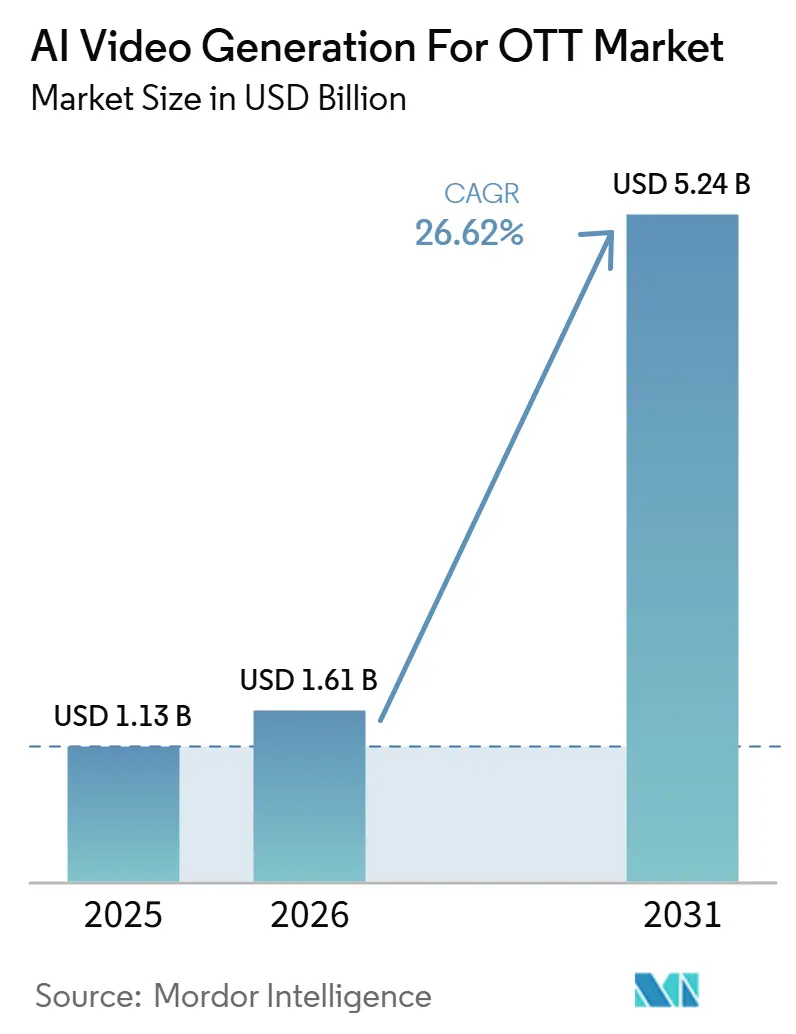
The AI video generation for OTT market size is expected to grow from USD 1.13 billion in 2025 to USD 1.61 billion in 2026 and is forecast to reach USD 5.24 billion by 2031 at 26.62% CAGR over 2026-2031. The AI video generation for OTT market is moving from trials toward production use in studios, broadcasters, and streaming services. Platforms are using generated video for crowd scenes, visual world-building, historical material, and promotional work, thereby reducing the time and cost required for selected production tasks. Netflix used generative AI in its production workflow during 2026, showing that established services are testing the technology across a broad content base. Demand in the AI video generation for OTT market is supported by faster production, localization, content personalization, and distribution across social video channels. Competition increasingly combines specialized video-model providers with large technology platforms that can bundle generation tools with cloud, consumer, and enterprise products.
Key Report Takeaways
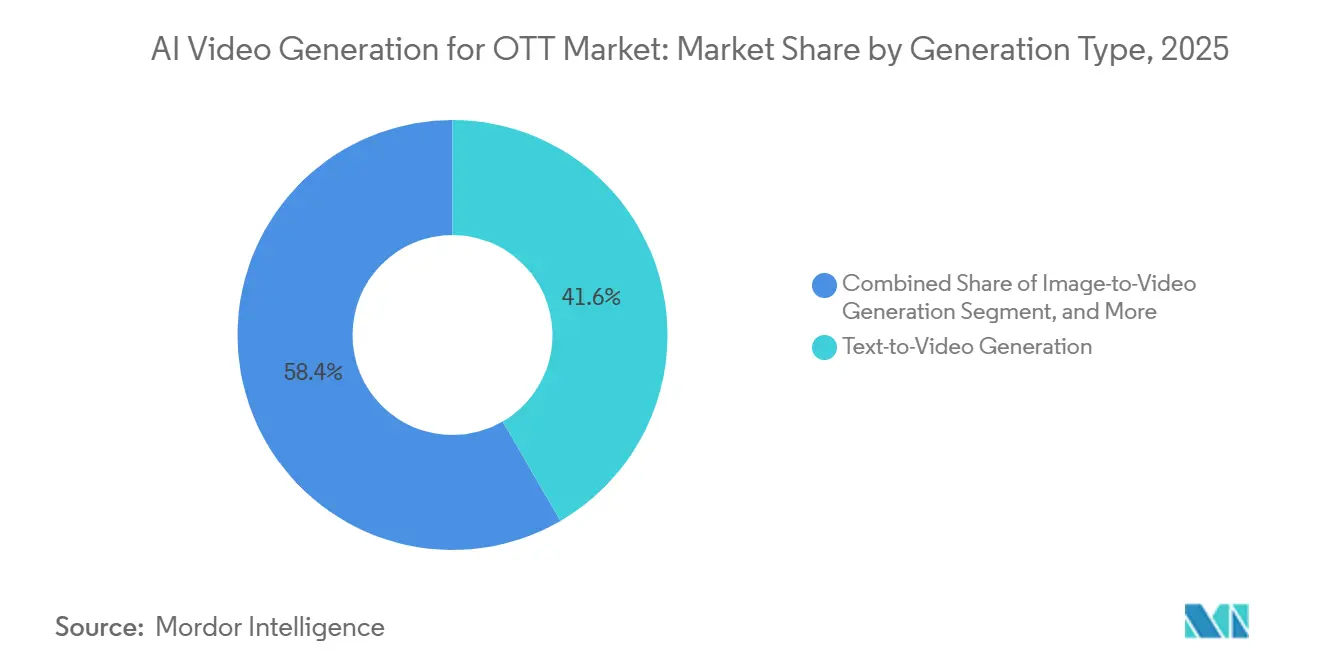
- By generation type, text-to-video accounted for 41.63% share of the AI video generation for OTT market size in 2025 and is projected to grow at a 27.48% CAGR through 2031.
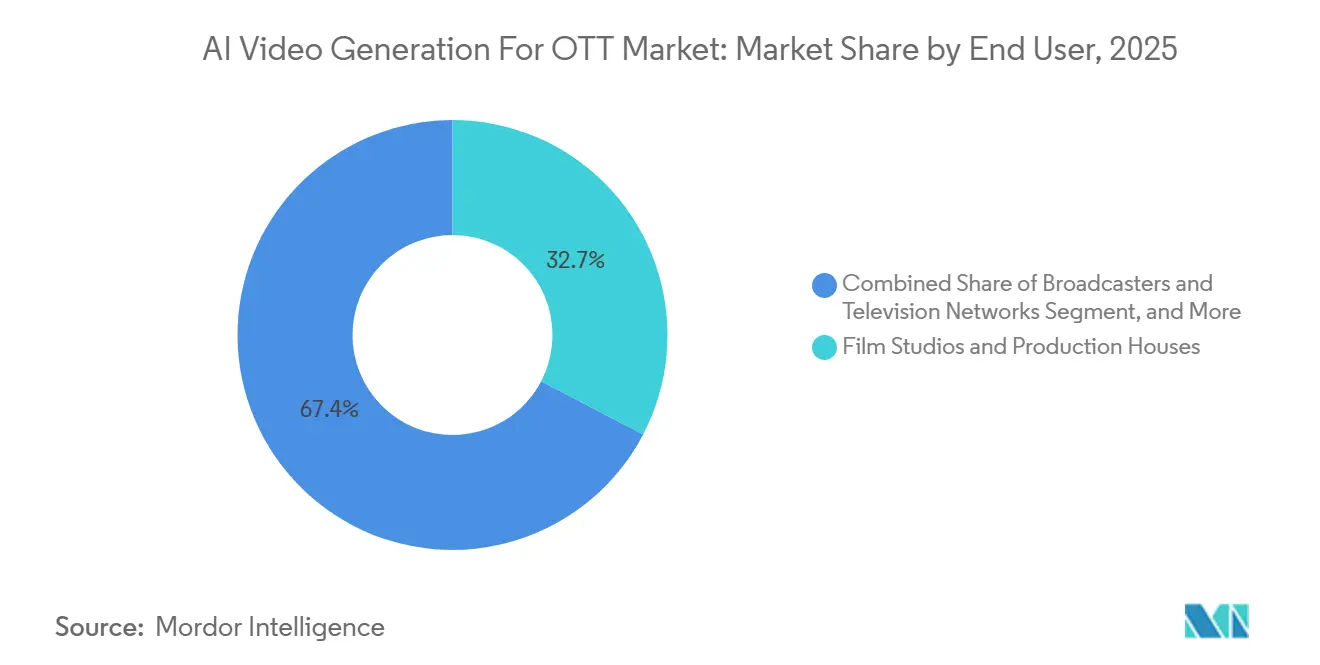
- By end user, film studios and production houses held 32.65% of revenue in 2025, while streaming platforms are projected to grow at a CAGR of 27.71% through 2031.
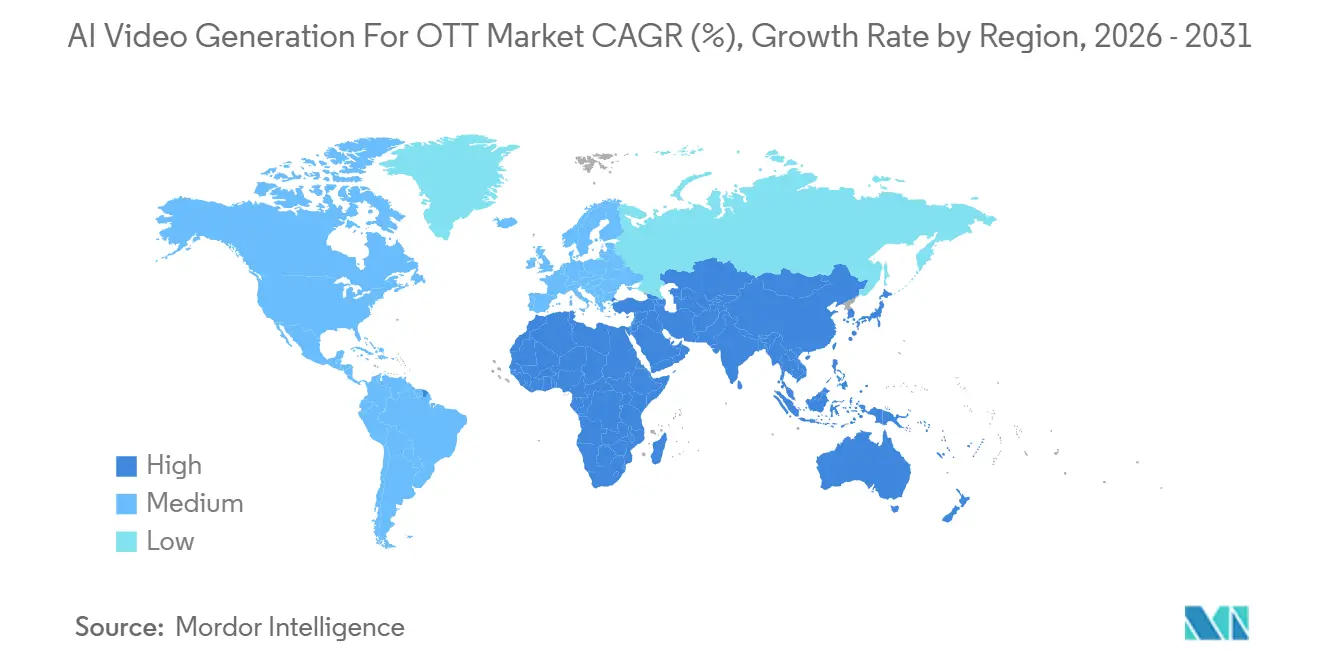
- By geography, North America held 41.56% share of the AI video generation for OTT market size in 2025, while Asia-Pacific is projected to grow at a 26.93% CAGR through 2031.
Note: Market size and forecast figures in this report are generated using Mordor Intelligence’s proprietary estimation framework, updated with the latest available data and insights as of January 2026.
Market Trends and Insights
Drivers Impact Analysis of AI Video Generation For OTT Market*
| Driver | (~) % Impact on CAGR Forecast | Geographic Relevance | Impact Timeline |
|---|---|---|---|
| Faster OTT Content Turnaround and Shorter Production Cycles | +5.2% | Global, strongest in North America and Europe | Short term (≤ 2 years) |
| Scalable Localization, Dubbing, and Versioning of OTT Content | +4.8% | Global, core gains in Asia-Pacific, spill-over to Middle East and Africa | Medium term (2-4 years) |
| Growing Demand for AI-Generated Trailers, Promos, and Advertisements | +4.3% | North America and Europe, expanding to Asia-Pacific | Short term (≤ 2 years) |
| Automated Creation of Short-Form Content Derivatives for Social Platforms | +3.7% | Asia-Pacific and North America core | Short term (≤ 2 years) |
| Increasing Use of Synthetic Pickups and Reshoots to Extend Existing Footage | +2.9% | North America and Western Europe | Medium term (2-4 years) |
| Metadata-Aware Generation of Personalized Video Assets Across OTT Catalogs | +2.2% | North America and Europe, early-stage in Asia-Pacific | Long term (≥ 4 years) |
| Source: Mordor Intelligence | |||
Faster OTT Content Turnaround and Shorter Production Cycles
The AI video generation for OTT market benefits when services need more content without extending production calendars. Netflix reported in 2026 that generative AI helped produce 17 minutes of documentary footage at half the cost and twice the speed of conventional methods.[1]Netflix, “Netflix Shareholder Letter and Earnings Disclosure,” Investor Relations, ir.netflix.net. This result shows how the AI video generation for OTT market can support defined tasks rather than replace a full production process. Faster creation can make catalog refreshes, seasonal content, and extensions of existing intellectual property more practical for broadcasters and studios. It also lets streaming platforms test narrower formats before committing to a larger production budget. In the AI video generation for OTT market, this makes production speed a direct factor in decisions on which projects receive funding.
Scalable Localization, Dubbing, and Versioning of OTT Content
Localization remains a major cost and timing constraint for international streaming distribution. South Korea’s K-FAST initiative localized more than 1,200 titles, totaling 1,400 hours, into English, Spanish, and Portuguese during 2025 and 2026. The program reached 100 million cumulative views in 22 countries through 20 AI-dubbed FAST channels within 5 months. This scale suggests that AI-assisted dubbing can help rights holders monetize libraries in markets where conventional dubbing has been difficult to justify. Deepdub introduced an agentic dubbing co-worker in April 2026 for use within its production workflow. The AI video generation for OTT market can therefore gain from language adaptation, versioning, and lip-sync work that follows platform expansion.
Growing Demand for AI-Generated Trailers, Promos, and Advertisements
Promotional work is an early commercial use case because a single title often requires multiple versions for different audiences, formats, and countries. The research framework showed that automated systems can identify visual sequences and generate audio elements, including voiceovers, for trailers. The study also found that the strongest human-made trailers still had a quality advantage. Lionsgate took an equity stake in a generative AI video platform in June 2026 after working with it since 2024. The studio said it expected savings of tens of millions of USD per year and planned to use its catalog for short-form series. This points to closer links between promotion, catalog management, and editorial production in the AI video generation for OTT market.
Automated Creation of Short-Form Content Derivatives for Social Platforms
Streaming libraries and social video outlets require different editing styles and viewing lengths. Netflix introduced a Clips feature in 2026 and pursued publisher agreements for video content ranging from 3 to 20 minutes. These actions show that short-form programming is becoming part of the competitive response to social video viewing. Generative tools in the AI video generation for OTT market can turn longer scenes into clips, recaps, and trailers without requiring a separate manual workflow for every version. The output can support audience discovery and direct viewers toward a subscription service. This creates an opportunity for the AI video generation for OTT market because social distribution needs a large number of frequent, format-specific assets.
Restraints Impact Analysis of AI Video Generation For OTT Market*
| Restraint | (~) % Impact on CAGR Forecast | Geographic Relevance | Impact Timeline |
|---|---|---|---|
| Intellectual Property, Copyright, and Talent Likeness Risks | -3.4% | Global, most acute in North America and Europe | Short term (≤ 2 years) |
| Inconsistent Output Quality and Enterprise-Grade Brand-Safety Concerns | -2.8% | Global | Medium term (2-4 years) |
| High Compute and Storage Costs for Long-Form, High-Resolution Video Generation | -1.9% | Global | Medium term (2-4 years) |
| Limited Interoperability Between AI Video Tools and Existing OTT Production Workflows | -1.4% | Global, particularly acute in legacy broadcaster environments | Long term (≥ 4 years) |
| Source: Mordor Intelligence | |||
Intellectual Property, Copyright, and Talent Likeness Risks
Legal and consent requirements can slow the use of generated video in commercial workflows. New York enacted the AI Transparency Law in December 2025, and the law took effect on June 9, 2026. It requires disclosure of synthetic performers in commercial advertising and provides civil penalties of up to USD 5,000 for later violations. The state also enacted a posthumous right of publicity law to address unauthorized digital replicas of deceased performers. Netflix requires written approval when AI output involves final deliverables, talent likeness, personal data, or third-party intellectual property. These controls add review steps in the AI video generation for OTT market, particularly where recognizable people or existing assets are involved.
Inconsistent Output Quality and Enterprise-Grade Brand-Safety Concerns
Professional production requires continuity across scenes, accurate motion, and reliable treatment of brand assets. These standards are harder to meet in long-form narrative work than in a single promotional shot. Adobe presents Firefly Video as a commercially safe option, reflecting the importance that buyers place on traceable training data and governance. Quality concerns also affect whether a buyer can use the output without extensive correction or a new production pass. Enterprise customers may favor tools with clear rights controls even if other systems can produce faster experimental work. This restraint limits adoption in the AI video generation for OTT market where consistency and audience trust are more important than novelty.
*Our forecasts treat driver/restraint impacts as directional, not additive. The impact forecasts reflect baseline growth, mix effects, and variable interactions.
AI Video Generation For OTT Market Segment Analysis
By Generation Type:
Text-to-Video Leads Adoption Across Production WorkflowsText-to-video generation accounted for 41.63% of AI video generation for OTT market in 2025 and is projected to grow at a 27.48% CAGR through 2031. Its position reflects the familiarity of text prompts for creative teams that already work from scripts, treatments, and production briefs. Text input also avoids the image preparation step that image-to-video work often requires. ByteDance made Seedance 2.5 available through the BytePlus API in July 2026, supporting 30-second continuous generation in a single API call.[2]ByteDance, “ByteDance Launches Seedance 2.5 API,” Zaikei, zaikei.co.jp. Runway released Gen-4.5 in December 2025, while Google introduced Veo 3 in May 2025, and both developments supported improved video fidelity. These models are increasingly relevant for post-production enhancements, scene visualization, concept reels, and promotional material.
Image-to-video generation serves a different role by animating existing stills, concept art, archival material, and continuity frames. It can support intellectual-property extension and synthetic pickup work in the AI video generation for OTT market when a production has approved visual source material. Lionsgate’s plan to generate short-form series from its catalog illustrates a workflow that can use existing visual assets. Audio-to-video and style-transfer tools also have relevance in campaigns that require a consistent look across advertising placements. The AI video generation for OTT industry faces greater rights review when tools use recognizable images, catalog assets, or talent likenesses. Netflix’s guidance on generative AI requires approval for material involving final deliverables, personal data, talent likeness, and third-party intellectual property. That review process can preserve text-to-video leadership where teams seek less complex paths to approved use.



By End User:
Studios Retain Scale While Streaming Platforms Accelerate UseFilm studios and production houses held 32.65% of the AI video generation for OTT market share in 2025. Their large budgets and established visual effects processes provide a practical foundation for testing tools within existing production systems. Studios can use generated output for previsualization, effects support, marketing versions, and library extensions. Netflix acquired Ben Affleck’s AI filmmaking firm InterPositive in March 2026 for up to USD 600 million. The technology had already been used across approximately 300 active productions before the acquisition was announced. Broadcasters also have relevant use cases in news graphics, sports replay packaging, and promotional content where speed to air is important.
Streaming platforms are projected to grow at a 27.71% CAGR through 2031, the highest rate among end users. They face direct pressure to increase library volume without matching increases in production spending. JioStar launched its GenAI Media Studio in 2026 and used the pipeline for India’s first fully AI-generated micro-drama on Tadka. Tadka attracted more than 100 million users within 2 months of its April 2026 launch. Advertising agencies, independent production companies, and creator platforms make up other end-user groups. Their use is often focused on campaign production and lower-cost content variations for brand clients. The AI video generation for OTT industry is therefore shaped by both large studio workflows and high-volume streaming distribution needs.
Geography Analysis
North America AI Video Generation for OTT Market
North America held 41.56% of global revenue in 2025. The AI video generation for OTT market in the region combines large streaming services, startup investment, and established post-production capacity. Runway raised USD 315 million in February 2026 at a USD 5.3 billion valuation, with General Atlantic leading the round. NVIDIA, Fidelity Management and Research, AllianceBernstein, Adobe Ventures, and AMD Ventures participated in the financing. New York’s 2025 legislation is also influencing deployment policies at regional studios and broadcasters. Canada offers a secondary adoption base through its visual-effects sector, while Mexico supports Spanish-language localization.
APAC AI Video Generation for OTT Market
Asia-Pacific is projected to grow at a 26.93% CAGR through 2031. The region is defined by high-volume, mobile-first content production rather than only quality enhancement for established catalogs. China Mobile Migu introduced an AI short-drama creation platform in July 2026 that integrates several models into an automated production chain.[3]China Mobile Migu, “China Mobile Migu Launches AI Short Drama One-Stop Creation Platform,” Sina Finance, finance.sina.com.cn. The company said the platform reduced total production costs by more than 30%. JioStar’s JAMS program and Tadka micro-drama show the same focus on short serialized video in India. South Korea’s K-FAST program further shows how public support can combine localization and international channel distribution.
EMEA and South America AI Video Generation for OTT Market
Europe, South America, the Middle East, and Africa represented smaller but important parts of the AI video generation for OTT market in 2025. Europe’s use is influenced by rules on synthetic media, transparency, documentation, and human oversight. These requirements can increase implementation work for regulated broadcasters and platforms. South America is supported by Spanish and Portuguese localization needs, with Brazil and Argentina serving as primary commercial markets. Gulf Cooperation Council countries support earlier-stage use in the Middle East through media technology investment and high OTT spending. Africa’s role will depend on mobile streaming growth and the declining cost of multilingual dubbing tools.

Competitive Landscape
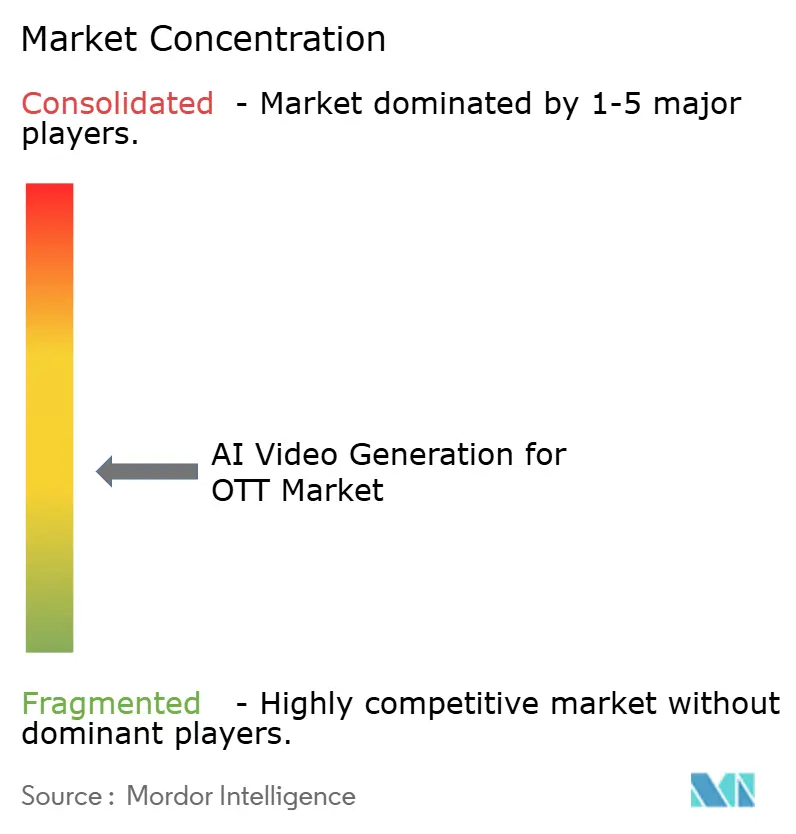
The AI video generation for OTT market has moderate concentration at the foundational-model layer and a more fragmented structure across applications, workflows, and services. Runway holds a strong position among specialized enterprise suppliers and reported more than USD 100 million in annual recurring revenue in 2026. Google’s Veo 3 is available across consumer and enterprise products, enabling OTT operators that already use Google Cloud to adopt it. Adobe differentiates Firefly Video through its emphasis on commercially safe generation and enterprise governance.[4]Google, “Veo on Vertex AI,” Google Cloud, cloud.google.com. Runway’s February 2026 funding included an infrastructure expansion arrangement, indicating that compute access is a long-term competitive factor. The AI video generation for OTT market also includes Chinese suppliers that compete on lower API pricing for standard production use.
Competition is developing around long-form narrative coherence, real-time creation for live events, and fine-tuning models on a studio’s own intellectual property. Reactor raised USD 59 million in a Series A round in July 2026 for real-time AI video generation. The company said it was discussing internal model-training deployments with major Hollywood studios. Kaiber focuses on music video creation, while Flawless AI focuses on screen translation and dubbing. Stability AI provides open-weight models for buyers that need self-hosted options. These specialized positions can remain useful in the AI video generation for OTT market where customers value a specific workflow more than an all-purpose platform.
Strategic partnerships and acquisitions are likely to affect vendor access to large content libraries. Netflix’s acquisition of InterPositive in March 2026 placed AI filmmaking capabilities within its Eyeline studio organization. Lionsgate’s June 2026 equity investment followed an existing partnership and connected its catalog strategy to generative video development. ByteDance expanded Seedance 2.5 access through BytePlus in July 2026, giving international developers an API route to its video model. These moves show that distribution, rights control, compute resources, and model performance are all part of competitive positioning in the AI video generation for OTT market. The AI video generation for OTT market concentration score is 3 out of 10 because the available information does not show a dominant top-player share and competition remains fragmented across providers and workflows.
AI Video Generation For OTT Industry Leaders
Adobe Inc.
Amazon Web Services, Inc.
ByteDance Ltd.
Google LLC
NVIDIA Corporation
- *Disclaimer: Major Players sorted in no particular order
AI Video Generation For OTT Market Companies Covered in this Report
- Adobe Inc.
- Amazon Web Services, Inc.
- ByteDance Ltd.
- Google LLC
- NVIDIA Corporation
- OpenAI, Inc.
- Runway AI, Inc.
- Synthesia Limited
- HeyGen Inc.
- Pika Labs, Inc.
- Stability AI Ltd.
- Kaiber AI, Inc.
- Canva Pty Ltd
- Microsoft Corporation
- WPP plc
- Publicis Groupe S.A.
- Shenzhen Jianying Technology Co., Ltd.
- Flawless AI Ltd.

Recent Industry Developments in AI Video Generation For OTT Market
- July 2026: Netflix disclosed that generative AI workflows were deployed in approximately 300 titles in 2026, with production of 17 minutes of the documentary The American Experiment completed at half the cost and twice the speed of conventional methods, as the company’s annual content spend approached USD 20 billion.
- July 2026: Reactor, a San Francisco-based real-time AI video generation startup, raised USD 59 million in Series A funding led by Lightspeed Venture Partners, with participation from Jeffrey Katzenberg’s WndrCo, Amplify Partners, Sky9 Capital, and FPV Ventures. The company was in active talks with major Hollywood studios for internal model training deployments and planned to expand GPU capacity for real-time generative video workloads.
- July 2026: ByteDance launched public API access for Seedance 2.5 via its international BytePlus platform, enabling 30-second continuous video generation in a single API call, the first commercial AI video model to offer this uninterrupted clip length. Unresolved copyright disputes with major Hollywood studios and data security concerns under China’s National Intelligence Law remained outstanding compliance issues for enterprise buyers.
- July 2026: JioStar launched the JioStar GenAI Media Studio, JAMS, an end-to-end AI-native content production pipeline spanning ideation, writing, image, audio, video, and final production, and debuted India’s first fully AI-generated micro-drama platform.


Global AI Video Generation For OTT Market Report Scope
AI video generation for the OTT market refers to the use of artificial intelligence technologies to create, edit, enhance, personalize, and automate video content for over-the-top streaming platforms. The scope of the study covers AI-driven video generation solutions and services used by OTT providers, media companies, content creators, and streaming platforms to support content production, localization, personalization, advertising, and user engagement across subscription-based, ad-supported, and hybrid OTT models.
The AI Video Generation for OTT Market Report is Segmented by Generation Type (Text-To-Video Generation, Image-To-Video Generation, and Other Generation Types), End User (Streaming Platforms, Film Studios and Production Houses, Broadcasters and Television Networks, and Other End Users), and Geography (North America, South America, Europe, Asia-Pacific, Middle East, and Africa). The Market Forecasts are Provided in Terms of Value (USD).
| Text-to-Video Generation |
| Image-to-Video Generation |
| Other Generation Types |
| Streaming Platforms |
| Film Studios and Production Houses |
| Broadcasters and Television Networks |
| Other End Users |
| North America | United States |
| Canada | |
| Mexico | |
| South America | Brazil |
| Argentina | |
| Chile | |
| Rest of South America | |
| Europe | Germany |
| United Kingdom | |
| France | |
| Italy | |
| Spain | |
| Rest of Europe | |
| Asia-Pacific | China |
| Japan | |
| India | |
| South Korea | |
| Australia | |
| Rest of Asia-Pacific | |
| Middle East | Saudi Arabia |
| United Arab Emirates | |
| Qatar | |
| Rest of Middle East | |
| Africa | South Africa |
| Egypt | |
| Nigeria | |
| Rest of Africa |
| By Generation Type | Text-to-Video Generation | |
| Image-to-Video Generation | ||
| Other Generation Types | ||
| By End User | Streaming Platforms | |
| Film Studios and Production Houses | ||
| Broadcasters and Television Networks | ||
| Other End Users | ||
| By Geography | North America | United States |
| Canada | ||
| Mexico | ||
| South America | Brazil | |
| Argentina | ||
| Chile | ||
| Rest of South America | ||
| Europe | Germany | |
| United Kingdom | ||
| France | ||
| Italy | ||
| Spain | ||
| Rest of Europe | ||
| Asia-Pacific | China | |
| Japan | ||
| India | ||
| South Korea | ||
| Australia | ||
| Rest of Asia-Pacific | ||
| Middle East | Saudi Arabia | |
| United Arab Emirates | ||
| Qatar | ||
| Rest of Middle East | ||
| Africa | South Africa | |
| Egypt | ||
| Nigeria | ||
| Rest of Africa | ||


Key Questions Answered in the Report
What is the size of the AI video generation for OTT market?
The AI video generation for OTT market was valued at USD 1.13 billion in 2025, is valued at USD 1.61 billion in 2026, and is forecast to reach USD 5.24 billion by 2031.
What is driving adoption of AI video tools by OTT providers?
Faster production, scalable localization, promotional asset creation, and short-form content production are central factors.
Which generation type leads OTT video creation?
Text-to-video generation led with a 41.63% share in 2025 and is projected to grow at a 27.48% CAGR through 2031.
Which users are expected to adopt these tools fastest?
Streaming platforms are projected to grow at a 27.71% CAGR through 2031 because they need more content without proportional cost growth.
Which region is expected to grow fastest?
Asia-Pacific is projected to record a 26.93% CAGR through 2031, supported by mobile-first content, short dramas, and localization.
What are the main risks for OTT video generation?
Intellectual property, talent likeness, inconsistent output quality, compute costs, and workflow integration remain the main constraints.
Page last updated on:





