
AI Localization For OTT Market Size and Share
Market Overview
| Study Period | 2020 - 2031 |
|---|---|
| Market Size (2026) | USD 0.91 Billion |
| Market Size (2031) | USD 2.53 Billion |
| Growth Rate (2026 - 2031) | 22.70 % |
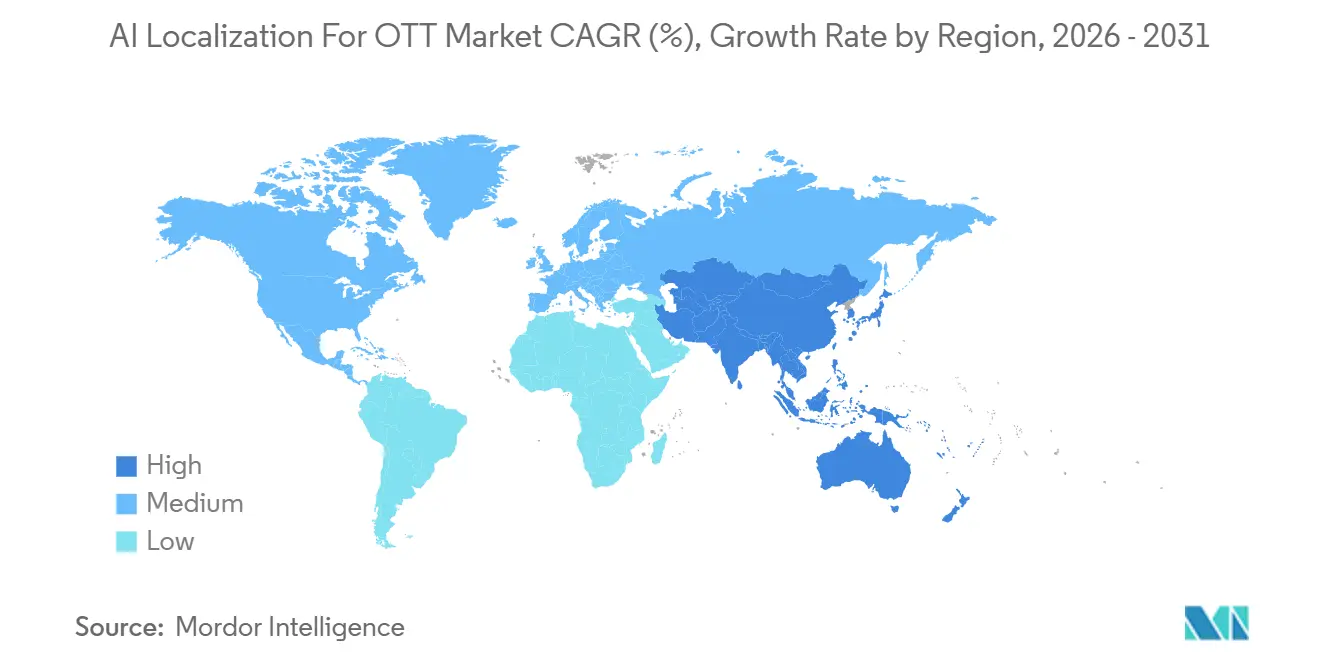
| Fastest Growing Market | Asia-Pacific |
| Largest Market | North America |
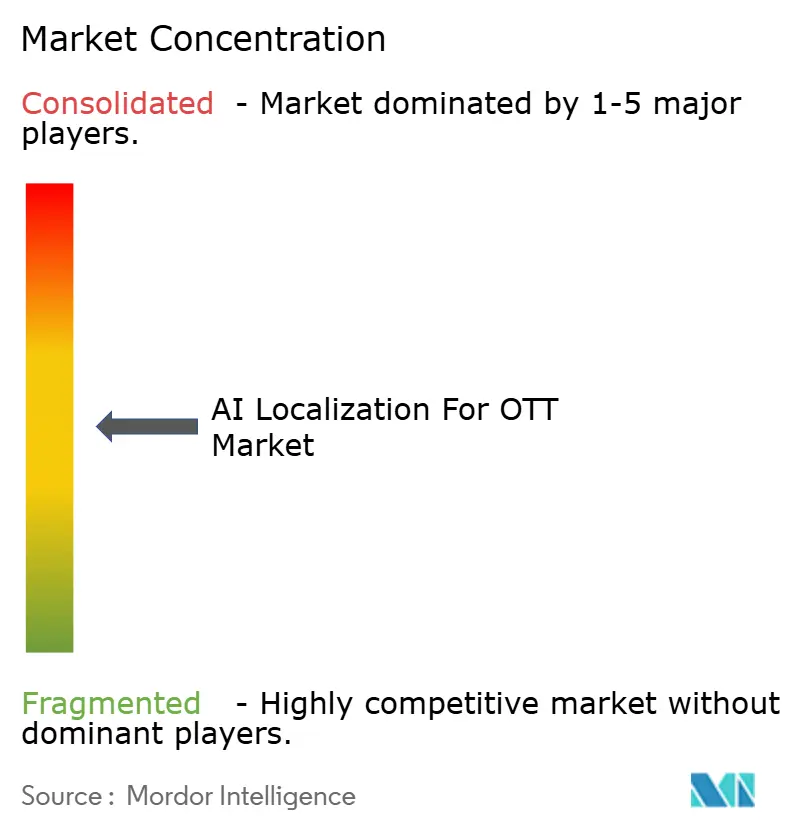
| Market Concentration | Medium |
Major Players *Disclaimer: Major Players sorted in no particular order Image © Mordor Intelligence. Reuse requires attribution under CC BY 4.0. | |
AI Localization For OTT Market Analysis by Mordor Intelligence
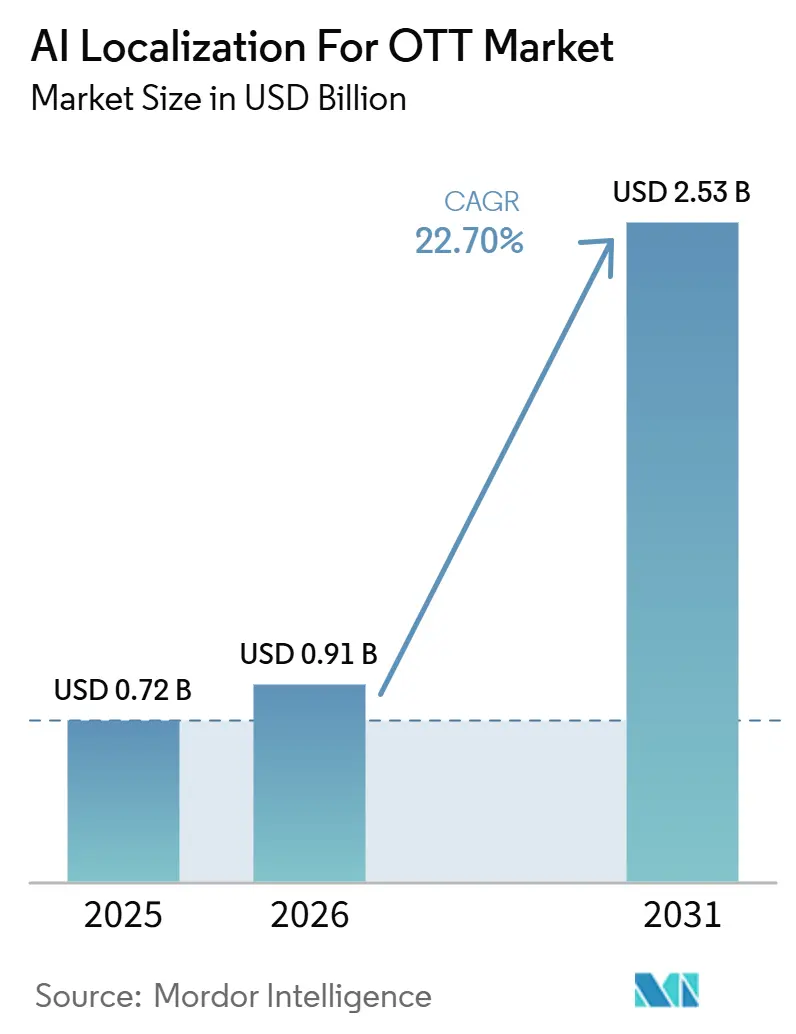
The AI localization for OTT market size is expected to grow from USD 0.72 billion in 2025 to USD 0.91 billion in 2026 and is forecast to reach USD 2.53 billion by 2031 at 22.70% CAGR over 2026-2031. Global streaming services are treating language coverage as part of subscriber acquisition because viewers increasingly choose content across national and language boundaries. Neural voice synthesis, large language model translation, and automated subtitle timing are being incorporated into media workflows, which support faster release cycles. Platforms are also extending support beyond major Western European languages into secondary language markets, creating opportunities for providers that can integrate with established localization workflows. The AI localization for OTT market is shaped by a balance between lower production costs and the need to retain cultural accuracy, performer consent, and viewer trust. Hybrid workflows that combine automation with human review are therefore likely to remain important during the forecast period.
Key Report Takeaways
- By localization function, subtitling and captioning held 35.64% of the AI localization for OTT market share in 2025, while dubbing and voice-over is projected to expand at a 22.86% CAGR through 2031.
- By deployment, cloud accounted for 65.71% of the AI localization for OTT market share in 2025 and is projected to grow at a 22.93% CAGR through 2031.
- By content type, TV shows and episodic content held 45.33% of the market in 2025, while documentaries are projected to advance at a 23.11% CAGR through 2031.
- By geography, North America held 38.42% share in 2025, while Asia-Pacific is projected to expand at a 23.24% CAGR through 2031.
Note: Market size and forecast figures in this report are generated using Mordor Intelligence’s proprietary estimation framework, updated with the latest available data and insights as of January 2026.
Market Trends and Insights
Drivers Impact Analysis of AI Localization For OTT Market*
| Driver | (~) % Impact on CAGR Forecast | Geographic Relevance | Impact Timeline |
|---|---|---|---|
| Expansion of Cross-Border OTT Content Distribution | +4.5% | Global | Short term (≤ 2 years) |
| Demand for Native-Language Streaming Experiences | +4% | Asia-Pacific, Middle East | Short term (≤ 2 years) |
| Requirement for Faster and Lower-Cost Dubbing and Subtitling | +3.8% | Global | Short term (≤ 2 years) |
| Accessibility and Multilingual Content Compliance Requirements | +2.5% | North America and EU | Medium term (2-4 years) |
| Localization of Long-Tail Content Libraries Through AI Cost Curves | +2% | North America, EU, Asia-Pacific | Medium term (2-4 years) |
| Increasing Use of AI Localization for Regional and Secondary Releases | +1.5% | Asia-Pacific, South America | Medium term (2-4 years) |
| Source: Mordor Intelligence | |||
Expansion of Cross-Border OTT Content Distribution
Global streaming platforms are entering markets that need several distinct language versions rather than a single shared dub track. This release pattern makes automated localization more useful because platforms need to prepare content for several audiences at the same time. Disney+ expanded audio support to 58 languages in July 2026, adding 17 languages and a right-to-left interface for Arabic and Hebrew users.[1]The Walt Disney Company, “Disney+ Expands Language Support to 58 Audio Languages and Adds Right-to-Left Interface,” The Walt Disney Company, thewaltdisneycompany.com The AI localization for OTT market is expanding as language coverage reaches markets that previously received content later than core markets. A peer-reviewed study found that Netflix and Amazon Prime Video depend on a limited set of large transnational localization providers, including Iyuno, VSI, and Deluxe, to coordinate high-volume multilingual output. The same structure can create capacity pressure when platforms seek simultaneous releases across many languages. The AI localization for OTT market can therefore favor providers that work with existing vendor and platform relationships rather than attempting to replace them.
Demand for Native-Language Streaming Experiences
Regional language viewing is becoming central to streaming expansion in large emerging markets. In India, a majority of Prime Video customers streamed content in multiple languages, making multilingual originals a standard release requirement. This preference also supports demand for localization that can serve audiences within India and in international markets. South Korea’s K-FAST program localized extensive content across a large catalog into English, Spanish, and Portuguese. The program reached substantial viewership across many countries within a short period of its launch. QVC Japan is expected to introduce multilingual AI subtitle functionality for its video-on-demand catalog, allowing users to choose subtitles in Japanese, English, Chinese, and Korean. These developments indicate that the AI localization for OTT market supports both domestic accessibility and overseas content distribution.
Requirement for Faster and Lower-Cost Dubbing and Subtitling
The AI localization for OTT market benefits from lower costs and shorter delivery times as platforms adopt AI-supported workflows. Deepdub’s European FAST channel works with Love TV Channels, reporting substantial localization cost reductions compared to traditional dubbing benchmarks. Digital completed a dubbing project within a significantly shorter timeframe than the usual multi-week process. Faster processing is particularly valuable for live and near-live programming, where long delivery cycles reduce the value of localized releases. Amazon Prime Video’s pilot covered several licensed movies and series that had not previously been localized for the pilot languages, making more catalog titles economically viable for localization.[2]Amazon, “Prime Video Begins an AI Dubbing Pilot Program on Licensed Movies and Series,” About Amazon, aboutamazon.com As basic output becomes less costly, the AI localization for OTT market may shift pricing power toward quality assurance and cultural adaptation.
Accessibility and Multilingual Content Compliance Requirements
The AI localization for OTT market benefits from accessibility rules that make captions and related workflows a continuing operational requirement for streaming services. The Federal Communications Commission requires IP-delivered programming with a prior captioned television history to carry captions of comparable quality. FCC This requirement applies to content distributed through major streaming services when it meets the applicable conditions. The FCC also required closed-caption display settings to be readily accessible to consumers by August 17, 2026. FCC Article 50 of the EU AI Act applies from August 2, 2026 and requires machine-readable markings for synthetic audio, along with disclosure to users in relevant cases.[3]European Parliament and Council, “Regulation EU 2024/1689,” EUR-Lex, eur-lex.europa.eu The rule affects AI-dubbed output but does not apply in the same way to captioning and subtitling that do not create a new voice track. Vendors that incorporate disclosure, watermarking, and compliance records into their products can address a clear requirement among EU-regulated broadcasters.
Restraints Impact Analysis of AI Localization For OTT Market*
| Restraint | (~) % Impact on CAGR Forecast | Geographic Relevance | Impact Timeline |
|---|---|---|---|
| Quality Variability in Cultural Adaptation and Emotional Performance | -2.5% | Global | Short term (≤ 2 years) |
| Voice-Likeness, Consent, Copyright, and Performer-Rights Exposure | -2.1% | EU, North America | Short term (≤ 2 years) |
| Limited Training Data for Dialects, Minority Languages, and Regional Accents | -1.8% | Asia-Pacific, Africa, Middle East | Long term (≥ 4 years) |
| Integration Complexity Across OTT Media Supply Chains | -1.4% | Global | Medium term (2-4 years) |
| Source: Mordor Intelligence | |||
Quality Variability in Cultural Adaptation and Emotional Performance
The AI localization for OTT market still faces quality variation because AI dubbing is less reliable for idioms, culturally specific emotions, and nonverbal performance. These shortcomings matter most for premium original series and dramas, where viewers have high expectations for authenticity. Prime Video removed AI-generated Spanish dubs of South Korean dramas after viewers raised quality concerns. The outcome showed that even a workflow with human involvement can fail to meet audience expectations for culturally distinctive content. A peer-reviewed analysis found that centralized localization practices can standardize workflows across geographies while reducing cultural specificity. Models are trained more extensively on high-resource language pairs and common delivery styles than on regional performance traditions. The AI localization for OTT industry will continue to need human linguistic and creative review for titles with greater brand and cultural stakes.
Voice-Likeness, Consent, Copyright, and Performer-Rights Exposure
The AI localization for OTT market faces practical obligations as rules governing synthetic voices affect platforms, studios, and localization vendors. Mexico’s amendments to the Federal Labor Law and Federal Copyright Law took effect on May 15, 2026. The amendments require express, specific, and limited consent, as well as remuneration, for the AI use of a performing artist’s voice or likeness. Mexico’s Film Law also required dubbing to be performed exclusively by natural persons. These provisions limit fully automated dubbing in a significant Spanish-language production hub. The EU AI Act adds disclosure and technical marking requirements for synthetic audio distributed in the European Union. The AI localization for OTT industry can differentiate through verifiable consent records, watermarking, and contractual controls that allow users to manage territory, duration, platform, and distribution channel requirements.
*Our forecasts treat driver/restraint impacts as directional, not additive. The impact forecasts reflect baseline growth, mix effects, and variable interactions.
AI Localization For OTT Market Segment Analysis
By Localization Function:
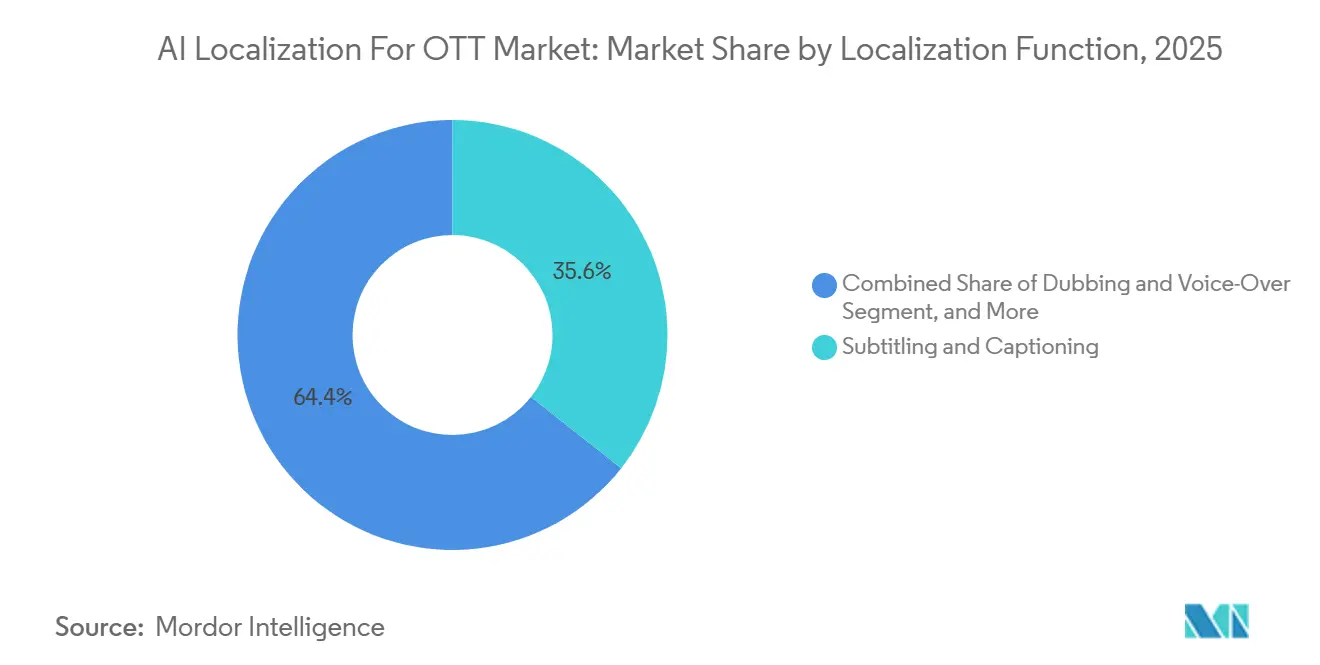
Subtitling Infrastructure Holds the Largest Position While Dubbing and Voice-Over Grows FastestSubtitling and captioning accounted for 35.64% of the market in 2025, making it the largest localization function. Its leading role reflects lower technical complexity and earlier use across broad streaming catalogs. Captioning also benefits from accessibility requirements that apply to relevant IP-delivered programming in the United States. Dubbing and voice-over is projected to grow at a 22.86% CAGR from 2026 to 2031. The growth reflects the lower cost of AI voice synthesis and the opportunity to dub catalog titles that previously could not support the expense. Platforms can use subtitles as an initial entry point for a language market. They can then add dubbed versions when audience demand supports a larger investment. This sequencing means the functions can work together rather than compete directly.
The AI localization for OTT market includes metadata and artwork localization as a recurring but less visible workflow within each language release. Localized thumbnails, title cards, summaries, and search metadata need to be prepared whenever a title is released in another language. AI tools can process these repeat tasks at very low marginal cost, even though they may receive less attention in platform budgets. Audio description is the smallest function by revenue, but accessibility rules support its use for viewers with visual impairments. The U.S. accessibility framework has made captioning a formal requirement for relevant programming and supports broader attention to accessible media services. Audio description can benefit from automated production methods where cost has limited coverage. Human review remains necessary where descriptions must be timed carefully and preserve the meaning of the original program. The AI localization for OTT market is therefore supported by both broad catalog workflows and specific accessibility needs.



By Deployment:
Cloud Leads as Hybrid Systems Address Security RequirementsCloud deployment held 65.71% of the market in 2025 and is projected to grow at a 22.93% CAGR through 2031. Its position reflects the fit between cloud-based media pipelines and the computing needs of voice synthesis, translation, and automated quality checks. Direct integration with a cloud media asset management system can avoid the time needed to export material to a separate localization environment. This is useful for live and near-live programming, where distribution windows are short. The cloud model also allows platforms to scale processing during high-demand periods. These advantages make cloud infrastructure the main deployment approach for many streaming operators. The AI localization for OTT market size for cloud deployment is supported by platforms seeking workflow speed and centralized management.
The AI localization for OTT market also uses a hybrid deployment where platforms need both scalability and strict control over unreleased material. Premium studios and national broadcasters may keep some content in controlled environments because of contractual security conditions. ZOO Digital described its cloud platforms as AI-ready and designed for rapid evaluation and deployment of third-party AI while retaining the workflow controls required by studio partners. On-premises systems also remain relevant in markets where national data policies or content protection requirements limit cloud processing. Germany, South Korea, and India are examples of markets where these concerns can shape deployment decisions. The EU AI Act also increases the importance of documentation and transparency for certain AI model providers. Providers that support secure integration across these environments can serve customers that cannot use a fully cloud-based model.
By Content Type:
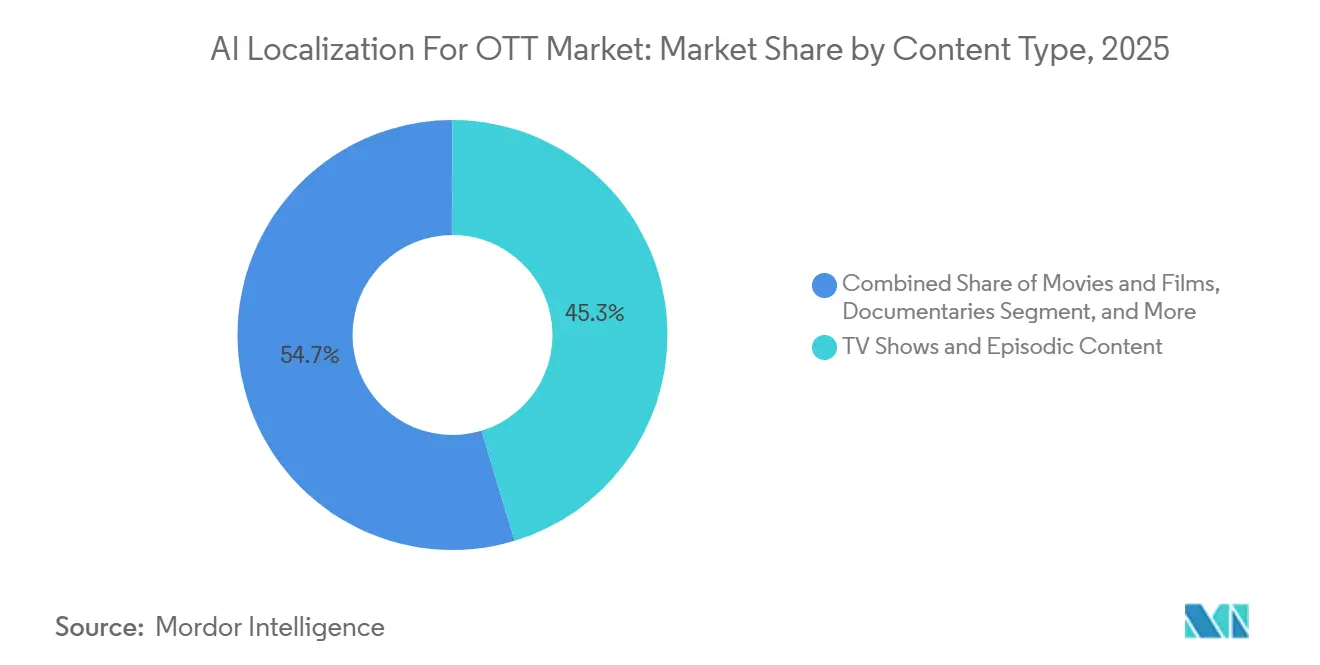
TV Shows and Episodic Content Lead While Documentaries Grow FastestTV shows and episodic content held 45.33% of the market in 2025, giving the format the largest position by content type. A series can require localization across 20 to 36 languages, and each episode creates recurring work. This volume makes episodic releases particularly suitable for standardized workflows. Documentaries are projected to grow at a 23.11% CAGR from 2026 to 2031. They often use narrative voiceover and factual language, which can be more suitable for AI localization than complex dramatic dialogue. Their lower dependence on tightly matched multi-speaker performance can also reduce the amount of human review required for an initial release. This combination supports the faster growth of documentaries.
The AI localization for OTT market continues to serve movies and films, but these titles face stricter studio quality requirements and less tolerance for dubbing artifacts. Per-title investment can be high, particularly for premium releases with established audience expectations. This slows the replacement of traditional workflows compared with some episodic and documentary content. Other content types include short-form video, sports highlights, and format programming. FAST platforms require large catalogs at launch, which can make human-only workflows uneconomic for these formats. South Korea’s K-FAST initiative showed the scale possible when AI dubbing is applied to large content libraries for international distribution. The AI localization for OTT industry is thus serving content types with different quality thresholds and release-speed requirements.
Geography Analysis
North America AI Localization for OTT Market
The AI localization for OTT market in North America accounted for 38.42% of the market in 2025, supported by the concentration of major streaming platforms, studios, and localization technology vendors in the United States. Prime Video began an AI-aided dubbing pilot in March 2025 for 12 licensed movies and series in English and Latin American Spanish. ElevenLabs closed a USD 500 million Series D at an USD 11 billion valuation in February 2026. Canada also supports localization demand through its links to North American studio operations. Mexico’s 2026 legal changes require consent and remuneration frameworks for synthetic voice use. These requirements affect Spanish-language dubbing operations that serve regional and international audiences.
Europe AI Localization for OTT Market
Europe operates under a distinct compliance environment because the EU AI Act applies disclosure obligations to AI-dubbed content from August 2, 2026. The region has major dubbing markets in Spain, Germany, France, and Italy. These markets have strong, established dubbing practices, which can create resistance to automated models that reduce performer involvement. At the same time, providers have a reason to develop auditable technical controls for synthetic audio. The AI localization for OTT market size in Europe is therefore shaped by both demand for localized content and the cost of meeting regulatory and quality expectations. The region can favor hybrid systems that pair automation with human oversight.
APAC, South America and MEA AI Localization for OTT Market
Asia-Pacific is projected to grow at a 23.24% CAGR from 2026 to 2031, the highest regional rate. India has extensive demand for multilingual viewing because more than 60% of Prime Video customers in the country streamed content in 4 or more languages. JioHotstar recruited more than 75 AI roles in 2026 across production automation, multilingual AI capabilities, and engineering. South Korea’s government-supported program showed how localized K-content can be distributed across several overseas markets. Japan added platform-level multilingual subtitle functionality through QVC Japan’s July 2026 launch. South America and Africa remain earlier-stage opportunities, while limited data for Swahili, Hausa, Zulu, and Arabic dialects constrains near-term output quality in parts of Africa. The Middle East is seeing more demand for Arabic-language localization as Saudi Arabia and the UAE increase platform and content investment.

Competitive Landscape
The AI localization for OTT market is moderately fragmented. Established language service providers including RWS Holdings, TransPerfect Global, Iyuno, Deluxe Entertainment Services, and ZOO Digital have long-standing studio and platform relationships. They are adding AI capabilities to existing localization operations. Pure-play providers such as ElevenLabs, Deepdub, HeyGen Technology, and Camb.ai are entering through voice synthesis and dubbing products. These companies often use per-second or per-language-minute pricing that can undercut traditional studio pricing. The AI localization for OTT market therefore includes both workflow incumbents and technology-focused entrants. A peer-reviewed study found that Netflix and Amazon Prime Video source global dubbing through a limited group of transnational providers, which reinforces the value of integration depth.
ZOO Digital stated in September 2025 that further consolidation was leading customers to work with fewer end-to-end providers. This favors firms that can combine subtitles, dubbing, media services, quality management, and secure workflow controls. ElevenLabs raised USD 500 million in February 2026 and identified dubbing and multilingual content creation as investment priorities. The company later reported that it had exceeded USD 500 million in annual recurring revenue in the first 4 months of 2026. Deepdub partnered with Love TV Channels in February 2026 to provide Spanish, Italian, and French dubbing for European FAST channels. Its reported cost reduction of more than 80% shows why FAST and long-tail operators are a practical entry point for AI-native providers.
Technical competition is concentrating on lip synchronization, expressive speech, and automated multilingual quality checks. The sector also has an unresolved need for broadcast-quality localization in minority languages and dialects. Limited training data for Swahili, Tagalog, Hausa, and Bengali restricts current quality in markets with growing streaming audiences. Providers that invest in data acquisition and model fine-tuning can address this gap before demand reaches a larger scale. Platform operators may build proprietary capabilities while continuing to outsource areas that require deep language expertise or specialized workflow capacity. The AI localization for OTT market is likely to reward vendors that can provide measurable quality, consent management, and reliable integration. The competitive structure remains consistent with a moderate level of fragmentation because the supplied material does not provide a combined market-share figure for the leading firms.
AI Localization For OTT Industry Leaders
RWS Holdings plc
TransPerfect Global, Inc.
ZOO Digital Group plc
Iyuno, Inc.
ElevenLabs, Inc.
- *Disclaimer: Major Players sorted in no particular order
AI Localization For OTT Market Companies Covered in this Report
- RWS Holdings plc
- TransPerfect Global, Inc.
- ZOO Digital Group plc
- Keywords Studios plc
- Iyuno, Inc.
- Deluxe Entertainment Services Group Inc.
- VSI Group
- AppTek, Inc.
- ElevenLabs, Inc.
- Deepdub Ltd.
- Respeecher, Inc.
- Veritone, Inc.
- Camb.ai, Inc.
- Dubverse.ai Pvt. Ltd.
- Happy Scribe, S.L.
- Speechify, Inc.
- 3Play Media, Inc.
- CaptionHub Limited
- Phrase, Inc.
- HeyGen Technology Inc.

Recent Industry Developments in AI Localization For OTT Market
- July 2026: Disney+ expanded its audio language support to 58 languages by adding 17 new languages including Arabic, Croatian, Hebrew, Thai, Indonesian, Malay, Hindi, Tamil, and Telugu, alongside a new right-to-left interface for Arabic and Hebrew markets, reflecting a decisive push to serve Tier-2 language audiences directly on the platform rather than through delayed rollout cycles.
- July 2026: QVC Japan launched AI-assisted 4-language subtitle functionality across its VOD catalog on QVC.jp and its official app, enabling viewers to switch between Japanese, English, Chinese, and Korean subtitles, an extension of the platform's AI subtitle system that has been active for Japanese 4K broadcast content since December 2022.
- February 2026: ElevenLabs raised a USD 500 million Series D at an USD 11 billion valuation, led by Sequoia Capital with participation from Andreessen Horowitz, ICONIQ, and Lightspeed, with the company identifying dubbing and the ElevenCreative multilingual content platform as key investment areas alongside enterprise voice agents.
- February 2026: Deepdub partnered with Love TV Channels to deliver AI-powered dubbing in Spanish, Italian, and French for European FAST channels, covering premium factual programming from Cineflix Rights, with Deepdub reporting localization cost reductions of over 80% versus traditional dubbing benchmarks across the 3 target languages.


Global AI Localization For OTT Market Report Scope
The AI Localization for OTT Market refers to the use of artificial intelligence to adapt OTT content for different languages, regions, and cultural preferences at scale. It includes automated subtitling, dubbing, voice cloning, speech recognition, translation, and metadata localization to make streaming content more accessible to global audiences.
The AI Localization for OTT Market Report is Segmented by Localization Function (Subtitling and Captioning, Dubbing and Voice-Over, Metadata and Artwork Localization, and Audio Description), Deployment (Cloud, On-Premises, and Hybrid), Content Type (Movies and Films, TV Shows, and Documentaries), and Geography (North America, South America, Europe, Asia-Pacific, Middle East, and Africa). The Market Forecasts are Provided in Terms of Value (USD).
| Subtitling and Captioning |
| Dubbing and Voice-Over |
| Metadata and Artwork Localization |
| Audio Description |
| Cloud |
| On-Premises |
| Hybrid |
| Movies and Films |
| TV Shows and Episodic Content |
| Documentaries |
| Other Content Type |
| North America | United States |
| Canada | |
| Mexico | |
| South America | Brazil |
| Argentina | |
| Rest of South America | |
| Europe | United Kingdom |
| Germany | |
| France | |
| Spain | |
| Italy | |
| Russia | |
| Rest of Europe | |
| Asia-Pacific | China |
| Japan | |
| India | |
| South Korea | |
| Rest of Asia-Pacific | |
| Middle East | Turkiye |
| Saudi Arabia | |
| United Arab Emirates | |
| Rest of Middle East | |
| Africa | South Africa |
| Nigeria | |
| Egypt | |
| Rest of Africa |
| By Localization Function | Subtitling and Captioning | |
| Dubbing and Voice-Over | ||
| Metadata and Artwork Localization | ||
| Audio Description | ||
| By Deployment | Cloud | |
| On-Premises | ||
| Hybrid | ||
| By Content Type | Movies and Films | |
| TV Shows and Episodic Content | ||
| Documentaries | ||
| Other Content Type | ||
| By Geography | North America | United States |
| Canada | ||
| Mexico | ||
| South America | Brazil | |
| Argentina | ||
| Rest of South America | ||
| Europe | United Kingdom | |
| Germany | ||
| France | ||
| Spain | ||
| Italy | ||
| Russia | ||
| Rest of Europe | ||
| Asia-Pacific | China | |
| Japan | ||
| India | ||
| South Korea | ||
| Rest of Asia-Pacific | ||
| Middle East | Turkiye | |
| Saudi Arabia | ||
| United Arab Emirates | ||
| Rest of Middle East | ||
| Africa | South Africa | |
| Nigeria | ||
| Egypt | ||
| Rest of Africa | ||


Key Questions Answered in the Report
What is the size of the AI localization for OTT market?
The AI localization for OTT market size is USD 0.91 billion in 2026 and is forecast to reach USD 2.53 billion by 2031, at a 22.70% CAGR.
What is driving adoption of AI localization in streaming services?
Platforms use AI tools to expand language coverage, shorten dubbing and subtitle delivery times, and lower the cost of localizing larger catalogs.
Which localization function has the largest revenue position?
Subtitling and captioning led with 35.64% share in 2025, supported by widespread catalog use and accessibility requirements.
Which deployment approach is most widely used for OTT localization?
Cloud deployment held 65.71% share in 2025 and is projected to grow at a 22.93% CAGR through 2031.
Why are hybrid AI and human localization workflows important?
Human review remains important for cultural context, emotional performance, consent management, and titles with high quality expectations.
Which region is expected to grow fastest for AI-supported OTT localization?
Asia-Pacific is projected to grow at a 23.24% CAGR through 2031, supported by regional language viewing and cross-border content distribution.
Page last updated on:





