
AI In Testing, Inspection and Certification Market Size and Share
Market Overview
| Study Period | 2020 - 2031 |
|---|---|
| Market Size (2026) | USD 3.78 Billion |
| Market Size (2031) | USD 8.92 Billion |
| Growth Rate (2026 - 2031) | 18.73 % |
| Fastest Growing Market | Asia-Pacific |
| Largest Market | North America |
| Market Concentration | Low |
Major Players *Disclaimer: Major Players sorted in no particular order Image © Mordor Intelligence. Reuse requires attribution under CC BY 4.0. | |
AI In Testing, Inspection and Certification Market Analysis by Mordor Intelligence
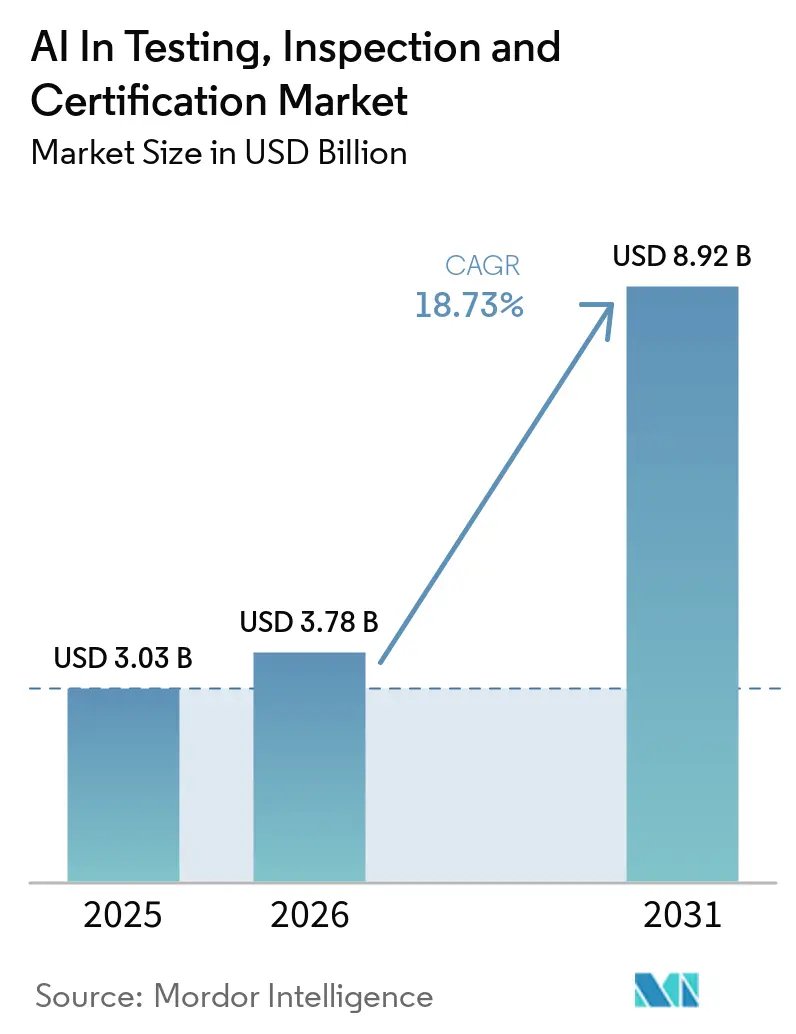
The AI in testing, inspection and certification market size is projected to expand from USD 3.03 billion in 2025 and USD 3.78 billion in 2026 to USD 8.92 billion by 2031, registering a CAGR of 18.73% between 2026 to 2031. Regulatory requirements are making independent validation a more central part of AI deployment, particularly where systems affect safety, employment, education, and critical infrastructure. The AI in the testing, inspection, and certification market is also shaped by the need to test systems after deployment because model updates, data drift, and changing operating conditions can alter performance. Demand is moving beyond single test reports toward ongoing evidence, monitoring, and third-party credentials that can be shown to regulators, customers, and boards. The main constraint is the limited pool of people who combine AI knowledge, regulatory understanding, and sector-specific risk expertise. This shortage may shift more work to external providers while also limiting how quickly assurance programs can be completed.
Key Report Takeaways
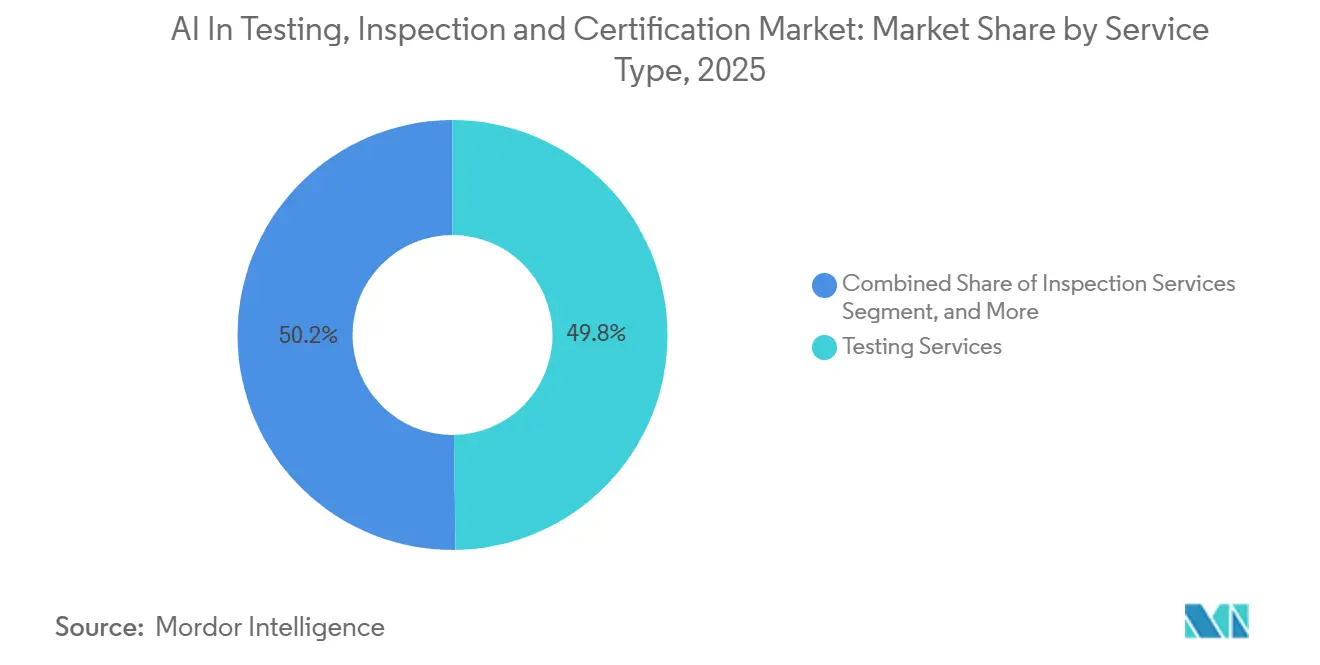
- By service type, Testing Services held 49.78% of the AI in testing, inspection and certification market revenue in 2025, while Certification Services is projected to expand at a 20.31% CAGR through 2031.
- By sourcing type, In-House AI Assurance held 83.59% of revenue in 2025, while outsourced AI TIC services is projected to grow at a 21.02% CAGR through 2031.
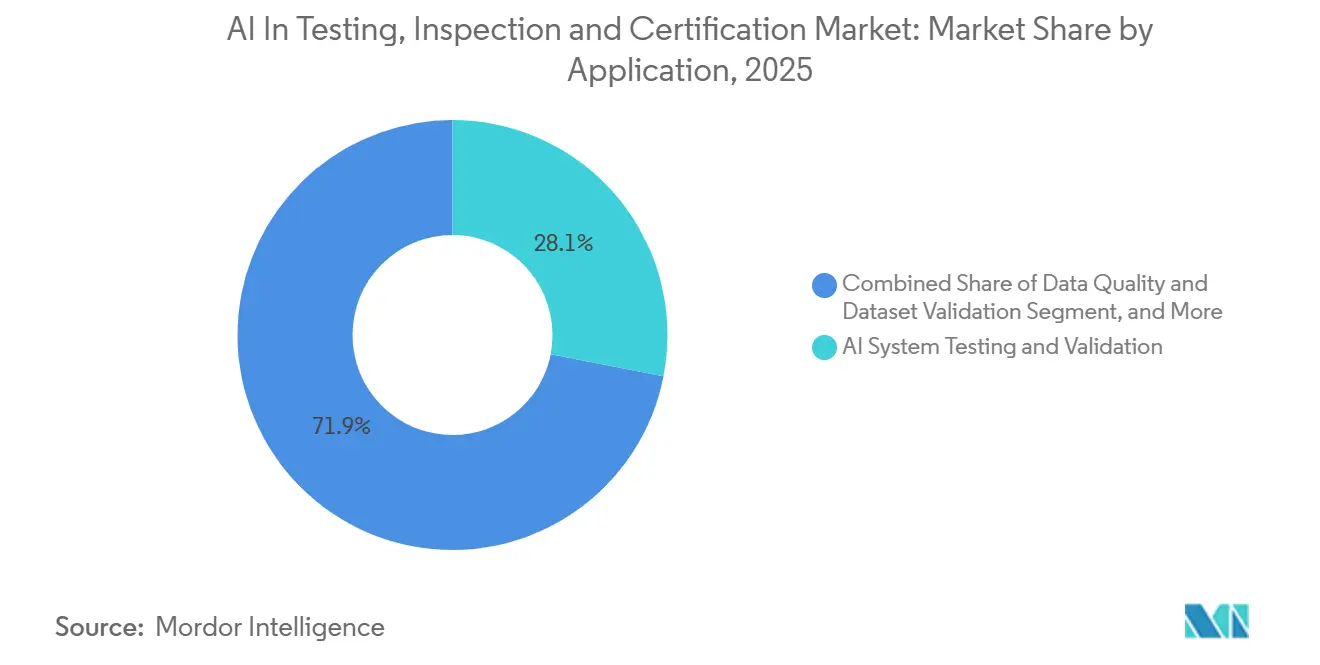
- By application, AI system testing and validation accounted for 28.07% of revenue in 2025, while cybersecurity and adversarial testing is expected to advance at a 22.13% CAGR through 2031.
- By end-user industry, ICT and telecom held 22.13% of revenue in 2025, while automotive and transportation is projected to expand at a 20.67% CAGR through 2031 in the AI in testing, inspection and certification market.
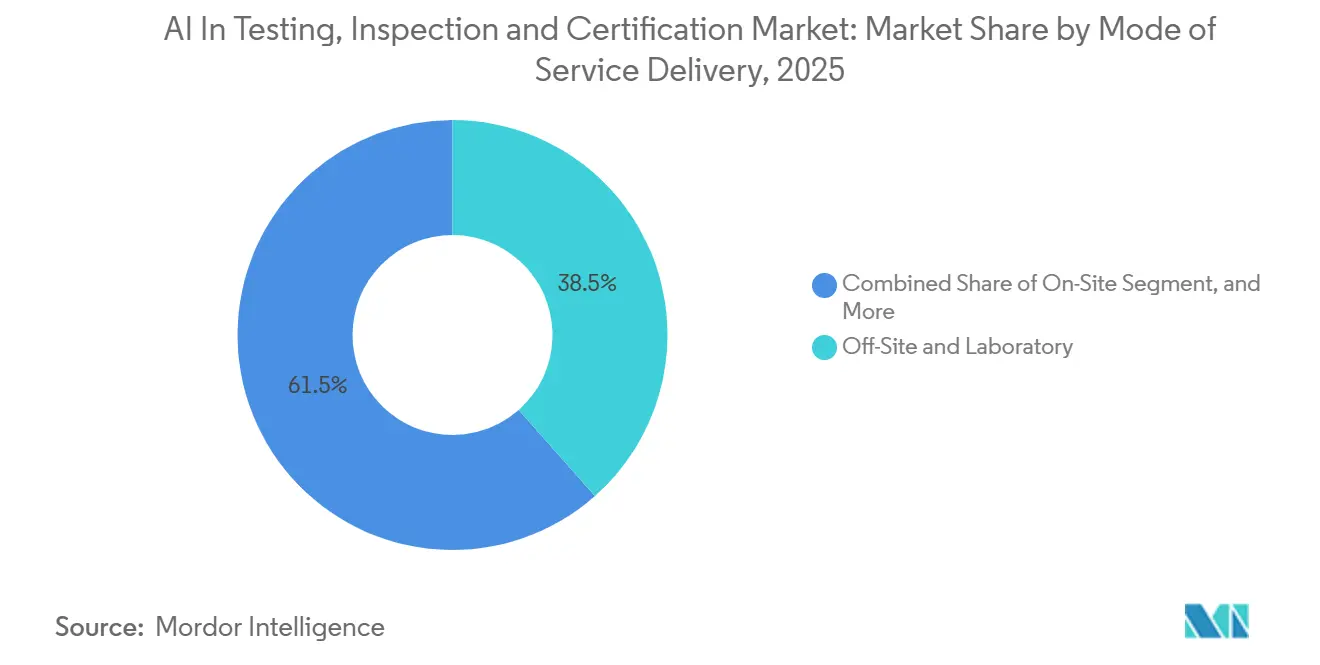
- By mode of service delivery, off-site and laboratory services accounted for 38.47% of revenue in 2025, while remote and digital delivery is expected to grow at a 20.19% CAGR through 2031 in the AI in testing, inspection and certification market.
- By organization size, large enterprises held 78.62% of revenue in 2025, while small and medium-sized enterprises are projected to expand at a 20.06% CAGR through 2031.
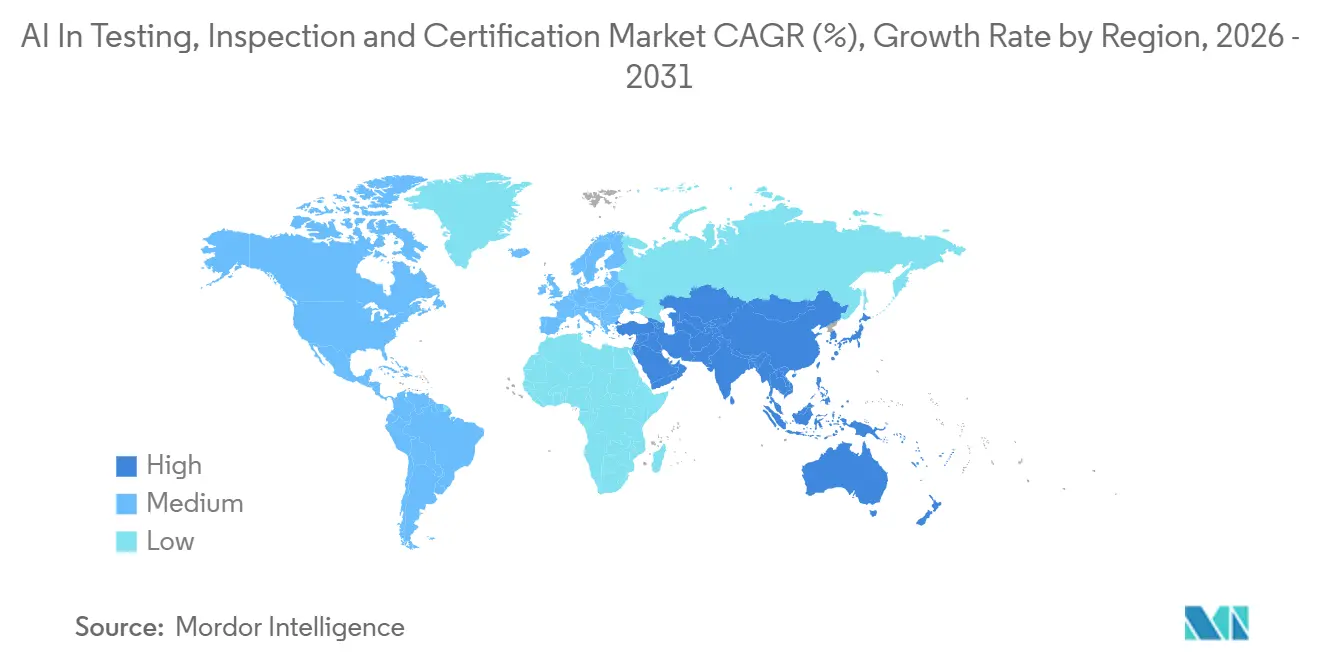
- By geography, North America held 38.12% of revenue in the AI in testing, inspection and certification market in 2025, while Asia-Pacific is projected to grow at a 22.36% CAGR through 2031.
Note: Market size and forecast figures in this report are generated using Mordor Intelligence’s proprietary estimation framework, updated with the latest available data and insights as of January 2026.
Market Trends and Insights
Drivers Impact Analysis of AI In Testing, Inspection and Certification Market*
| DRIVER | (~) % IMPACT ON CAGR FORECAST | GEOGRAPHIC RELEVANCE | IMPACT TIMELINE |
|---|---|---|---|
| Regulatory Expansion for High-Risk AI Systems | +4.8% | Global, with concentrated near-term relevance in Europe and the United Kingdom | Short term (≤ 2 years) |
| Machine-Readable Evidence Requirements for AI Auditability | +3.5% | Global, with core markets in Europe, North America, and Asia-Pacific | Medium term (2-4 years) |
| AI-Enabled Continuous Monitoring and Remote Inspection | +3.2% | Global, with Asia-Pacific leading deployment scale | Medium term (2-4 years) |
| Electrification and Safety Assurance for Batteries and Autonomous Systems | +2.8% | Global, with Europe and China leading electric vehicle and automated vehicle standards | Medium term (2-4 years) |
| Digital Product Passports and Verifiable Supply Chain Claims | +2.1% | Europe, with spillover to North American and Asia-Pacific trading partners | Short term (≤ 2 years) |
| Scarcity of Representative Data for Safety-Critical AI Validation | +1.5% | Global, with greater relevance in high-risk sectors in North America and Europe | Long term (≥ 4 years) |
| Source: Mordor Intelligence | |||
Regulatory Expansion for High-Risk AI Systems
The EU AI Act has been fully applicable since August 2, 2026, and it requires providers of high-risk AI systems to complete conformity assessments before placing them on the market. Providers must maintain technical documentation under Article 11, and selected Annex III categories require involvement of a notified body.[1] Penalties can reach EUR 15 million (USD 16.3 million) or 3% of worldwide annual turnover, underscoring the importance of assurance budgets in executive decision-making. Annex III systems used in employment, education, and critical infrastructure must meet the requirements by December 2, 2027, while Annex I product-embedded AI systems must comply by August 2, 2028. European Commission guidance published in April 2026 states that notified bodies must conduct independent testing when a provider's self-assessment is not adequate. These requirements strengthen the role of third-party work in the AI in testing, inspection, and certification market because internal teams may not satisfy every assessment need.
Machine-Readable Evidence Requirements for AI Auditability
ISO/IEC 42001:2023 requires documented evidence for AI system performance, monitoring, measurement, and nonconformity management.[2] Auditors may review decision logs, performance baselines, and corrective-action histories for individual use cases. ISO/IEC TS 42119-2:2025 provides risk-based methods that connect conventional software testing practices with AI-specific validation. Organizations that cannot provide structured and queryable records may face longer assessments and higher audit costs. Those records can include model-drift logs, bias-monitoring outputs, and AI impact assessments. In January 2026, SGS described the ISO/IEC 42119 series as a framework for verifiable AI trustworthiness. This is increasing demand for providers in the AI in testing, inspection, and certification market that can organize evidence in a form suitable for assessment.
AI-Enabled Continuous Monitoring and Remote Inspection
Point-in-time audits do not fully address systems that change after model updates, retraining, data drift, or altered deployment settings. Continuous monitoring and remote inspection address this gap by reviewing operating evidence over time. A survey conducted by the AIQI Consortium from December 2025 to February 2026 found that just over one-third of conformity assessment bodies used AI in their own inspection workflows. TÜV SÜD introduced AI-specific cybersecurity assessment services in December 2025 using the NIST AI Risk Management Framework, the OWASP Top 10 for large language models, and MITRE ATLAS frameworks. The SUNRISE safety framework presented at SAE World Congress 2026 includes in-service monitoring as a core element for connected and automated mobility systems. This supports recurring contracts in the AI in testing, inspection and certification market because providers must assess operating safety data rather than only pre-deployment results.
Electrification and Safety Assurance for Batteries and Autonomous Systems
ISO/PAS 8800:2024 sets out global requirements for the safety of AI systems used in road vehicles. The standard covers AI system development, deployment, and continuous monitoring, which broadens the work available to independent assurance providers. SGS-TÜV Saar awarded Geely Auto the first certification under this standard in August 2025. TÜV SÜD recommended Mobileye's Safety Management System for SAE Level 4 automated driving systems in March 2026 under Regulation (EU) 2022/1426. In the United States, FMVSS No. 305a requires electric powertrain integrity testing for electric vehicles of 4,536 kg or less beginning in September 2027. ISO/TS 5083:2025 adds further design and validation requirements for automated driving systems. Together, these requirements expand the AI market for testing, inspection, and certification across safety, cybersecurity, battery testing, and AI performance assessment.
Restraints Impact Analysis of AI In Testing, Inspection and Certification Market*
| RESTRAINT | (~) % IMPACT ON CAGR FORECAST | GEOGRAPHIC RELEVANCE | IMPACT TIMELINE |
|---|---|---|---|
| Shortage of AI Assurance Specialists | -2.8% | Global, with the greatest constraint in the United Kingdom, Europe, and North America | Long term (≥ 4 years) |
| Data Confidentiality and Cross-Border Evidence Restrictions | -2.1% | Europe, the United States, and China, where regulatory approaches differ | Medium term (2-4 years) |
| Nonstandardized Performance Thresholds Across AI Use Cases | -1.6% | Global | Medium term (2-4 years) |
| Liability Ambiguity for Model Drift and Post-Certification Changes | -1.2% | Global, with immediate relevance in Europe and emerging relevance in North America | Medium term (2-4 years) |
| Source: Mordor Intelligence | |||
Shortage of AI Assurance Specialists
The AI in testing, inspection and certification market faces a shortage of people who can combine machine-learning knowledge, regulatory fluency, and sector-specific risk expertise. The United Kingdom's Department for Science, Innovation, and Technology identified unclear roles, limited career pathways, and a lack of standardized skills or training frameworks as structural gaps in the AI profession. The AI Assurance Consortium was launched in June 2026 and has made foundational skills and ethics frameworks a first-year priority. That work indicates that a standardized supply of qualified practitioners will take time to develop. Organizations can allocate larger compliance budgets without securing the specialists needed to produce evidence ready for certification. This may support outsourcing in the AI testing, inspection, and certification market, but it can also limit providers' capacity and lengthen project timelines.
Data Confidentiality and Cross-Border Evidence Restrictions
EU AI Act Annex VII allows notified bodies to access training data, trained models, and parameters when needed for conformity assessment. Article 43 still subjects that access to European intellectual-property and trade-secret rules. Providers of proprietary foundation models may, therefore, limit the depth of information they disclose to external assessors. Evidence generated under China's AI governance regime does not automatically meet European conformity assessment procedures, and no mutual recognition arrangement allows a single set of test results to satisfy both European and U.S. requirements. NIST identified evidence access and organizational reluctance to disclose information as recurring challenges in monitoring deployed AI systems.[3] Companies deploying across 3 or more jurisdictions may commission repeated assessments, thereby raising costs and discouraging some organizations from using external services.
*Our forecasts treat driver/restraint impacts as directional, not additive. The impact forecasts reflect baseline growth, mix effects, and variable interactions.
AI In Testing, Inspection and Certification Market Segment Analysis
By Service Type:
Certification Demand Expands Beyond the Testing BaselineTesting Services accounted for 49.78% of the AI market share in testing, inspection, and certification in 2025 and remained the entry point for most validation workflows. The segment covers functional testing, algorithmic robustness assessments, and adversarial probe cycles. Inspection Services provide in-process and post-deployment review of AI behavior against stated safety and performance parameters. These reviews can include monitoring for model drift and adversarial exposure. Certification Services is projected to grow at a 20.31% CAGR from 2026 to 2031 as organizations seek durable third-party credentials. Such credentials can support regulatory filings, procurement reviews, and board oversight.
ISO/IEC 42006:2025 sets additional requirements for bodies that audit and certify AI management systems. The standard raises the accreditation requirements for certification bodies and may favor providers with recognized capabilities. All 3 service types are moving from project-based work to continuing engagements. Substantial AI modifications, including qualifying retraining or fine-tuning, can require renewed conformity assessments under the EU AI Act. This creates recurring testing and inspection work for a single client. SGS and CertX expanded their digital trust services for AI and autonomous systems in 2026, including assurance infrastructure to support audits and certification workflows. Providers with AI-supported audit tools can extend continuous assurance without matching the growth in labor.

By Sourcing Type:
In-House Programs Give Way to More External SupportIn-House AI Assurance accounted for 83.59% of the AI in testing, inspection, and certification market size in 2025, while Outsourced AI TIC Services is projected to grow at a 21.02% CAGR through 2031. Many internal programs use existing IT governance teams. Those teams can encounter capacity constraints when they must produce ISO/IEC 42001 evidence, notified body documentation, and EU AI Act technical records. External providers can offer pre-audit gap reviews, evidence-structuring support, and certification-readiness services. This gives clients access to specialist skills without requiring an immediate full third-party program. The AIQI Consortium found in February 2026 that most conformity assessment bodies were still planning or piloting their own use of AI tools.
Large multinational deployments make the sourcing decision more complex. An enterprise using AI in Asia-Pacific, Europe, and North America may struggle to maintain accredited internal teams in each jurisdiction. External providers with laboratory networks across several jurisdictions can absorb part of that coordination burden. Modular assessment services can also reduce the entry cost for smaller organizations. TIC Council's 2026 recommendations supported risk-proportionate compliance facilitation for smaller organizations through member services.[4] The AI TIC industry can therefore serve clients that need a staged route to compliance rather than a single large engagement. The sourcing shift depends on providers building sufficient technical capacity in the regions where their clients deploy AI.
By Application:
Cybersecurity Testing Changes the Assurance MixAI System Testing and Validation held 28.07% of AI in testing, inspection and certification market revenue in 2025 and anchors most AI deployment cycles. The application includes functional testing, performance validation, and reviews of whether a system behaves as intended. Cybersecurity and Adversarial Testing is projected to expand at a 22.13% CAGR from 2026 to 2031. Article 55 of the EU AI Act requires evaluation and adversarial testing for general-purpose AI models with systemic risk. This makes red-teaming a documented legal requirement for relevant providers rather than only a voluntary practice. NIST's 2025 work on deployed AI monitoring identifies threats such as indirect prompt injection and agent-memory poisoning that require specialized testing approaches.
Algorithmic Risk and Bias Assessment is gaining importance in hiring, credit, and healthcare deployments, where equality concerns are under scrutiny. Data Quality and Dataset Validation are supported by Article 10 of the EU AI Act, which establishes data governance requirements for training, validation, and test data. Functional Safety and Reliability Assurance support regulated settings such as medical AI, critical infrastructure, and aerospace. Other applications address sector-specific needs that cannot be assessed using a single common method. The need to document adversarial testing makes cybersecurity spending less discretionary for providers of high-risk and systemic-risk systems. The AI in testing, inspection and certification market is consequently adding cyber resilience to its established validation work. This broadens the technical skills required from testing organizations.
By End-User Industry:
Automotive Requirements Increase Validation DemandICT and Telecom held 22.13% of AI in testing, inspection and certification market revenue in 2025, reflecting early AI adoption in software development, network monitoring, fraud detection, and customer-service automation. Automotive and Transportation is projected to grow at a 20.67% CAGR from 2026 to 2031. The sector must address functional safety under ISO 26262, AI safety under ISO/PAS 8800:2024, cybersecurity under UNECE WP.29 R155, and in-service monitoring under Regulation (EU) 2022/1426. This combination reduces the scope for standardized low-cost assurance work. It also supports demand for providers with automotive-specific capabilities. The SUNRISE framework brings safety-management audits, scenario-based validation, and in-service monitoring into a common assessment structure.
Life Sciences and Healthcare are important because medical device regulations increasingly interact with AI Act obligations for software used as a medical device. Industrial Manufacturing and Machinery, Energy and Utilities, and Aerospace and Defense have different risk profiles and require different assessment methods. These range from predictive maintenance systems to power-grid optimization models. Consumer Goods and Retail are emerging users of AI-enabled product inspection and supply-chain traceability. Food, Agriculture, and Beverage organizations are applying AI to quality inspection, procurement, and grading. These uses create demand for data-quality validation and bias assessment. The AI TIC industry must therefore retain domain knowledge alongside general AI testing capabilities.
By Mode of Service Delivery:
Remote Review Gains Ground Alongside Laboratory WorkOff-Site and Laboratory services accounted for 38.47% of the AI in testing, inspection, and certification market size in 2025 because controlled and reproducible environments remain necessary for many assessments. Laboratory work is especially relevant to hardware-in-the-loop testing in automotive, industrial, and aerospace uses. Remote and Digital delivery is projected to grow at a 20.19% CAGR from 2026 to 2031. Cloud-native AI systems can often be assessed without physical access to a site. Remote services also allow scarce specialists to serve more clients without comparable growth in staff numbers. Bureau Veritas launched an independent AI assessment offering in 2026 that combines document review, on-site work, and direct testing across 8 assessment pillars.
On-Site delivery remains needed when AI cannot be removed from its operating environment. Examples include embedded systems in manufacturing machinery and components in critical utility infrastructure. Real-time monitoring can continuously send performance and drift data to remote analysts. This has created a recurring revenue category that was less common in traditional inspection work. Hybrid approaches combine remote evidence collection with physical reviews for initial assessments and major modifications. This can improve throughput while retaining controlled audit procedures. The AI in testing, inspection and certification market is likely to use these approaches differently according to the equipment, risk level, and regulatory setting.
By Organization Size:
SME Access Expands the Potential Client BaseLarge Enterprises accounted for 78.62% of AI TIC revenue in 2025 because they have made larger AI investments and face greater reputational and financial exposure to system failures. These organizations often work with several providers across regions and applications. Their programs can require complex coordination among internal teams, laboratories, and certification bodies. Small and Medium-Sized Enterprises are projected to expand at a 20.06% CAGR from 2026 to 2031. The EU AI Act provides access to regulatory sandboxes for SMEs at no charge or at reduced fees. This can allow testing under supervisory conditions before a formal notified-body assessment.
Governments and public bodies are building facilities to reduce the upfront cost of assurance work. The OECD reported in December 2025 that finance, skills, and digital infrastructure were key barriers to AI adoption by smaller firms.[5] Regulatory sandboxes and skills programs can reduce some of these barriers. Proportionate, modular assessment packages can further lower the threshold for a first engagement. Smaller clients may not need the same global coverage as large enterprises, but they still need evidence suitable for customers and regulators. This offers a route for the AI in testing, inspection and certification market to broaden its client base. It also requires providers to offer services that are understandable and affordable for smaller organizations.
Geography Analysis
North America AI in Testing, Inspection and Certification Market
North America held 38.12% of the AI in testing, inspection and certification market share in 2025, with the United States serving as the main regional center for enterprise AI deployment. Financial services, technology, healthcare, and defense have created an early demand base for AI governance and testing. The NIST AI Risk Management Framework has been widely used in corporate AI governance. NIST released an AI RMF Profile for Trustworthy AI in Critical Infrastructure in April 2026, extending structured risk management to utility grids, water systems, and telecommunications. These sectors may need more external assurance as the profile is adopted. Canada adds a second regional compliance opportunity through national support for AI investment and use in financial services and public-sector deployments.
Europe, South America and Africa AI in Testing, Inspection and Certification Market
Europe is the second-largest regional market, supported by the EU AI Act's conformity assessment framework. Germany's TÜV AI.Lab brings together TÜV SÜD, TÜV Rheinland, TÜV NORD, TÜV Hessen, and TÜV Thüringen to develop conformity criteria and test methods. France established INESIA in January 2025, adding a national AI evaluation and safety body. The European Commission's Digital Product Passport Registry went live on July 20, 2026, introducing requirements for supply chain data verification in relevant product categories. This overlaps with AI in testing, inspection and certification market work in manufacturing, consumer goods, and retail. Brazil and Argentina add smaller volumes in South America, while South Africa and Nigeria remain longer-term opportunities as deployment expands.
APAC and Middle East AI in Testing, Inspection and Certification Market
Asia-Pacific is projected to grow at a 22.36% CAGR from 2026 to 2031, the fastest rate among the regions. China's rules for algorithm recommendations and generative AI require safety reviews. South Korea's AI Basic Act, passed in January 2026, introduced obligations for high-impact AI operators that resemble several EU principles. Japan's Ministry of Economy, Trade, and Industry guidance increasingly refers to ISO/IEC 42001. India's AI Mission includes USD 1.25 billion in public investment and is supporting adoption in manufacturing and public services. Saudi Arabia and the United Arab Emirates have issued AI assurance guidance as part of their national AI strategies. These developments support the AI in testing, inspection and certification market as local rules, digital infrastructure, and deployed AI systems mature.
Competitive Landscape
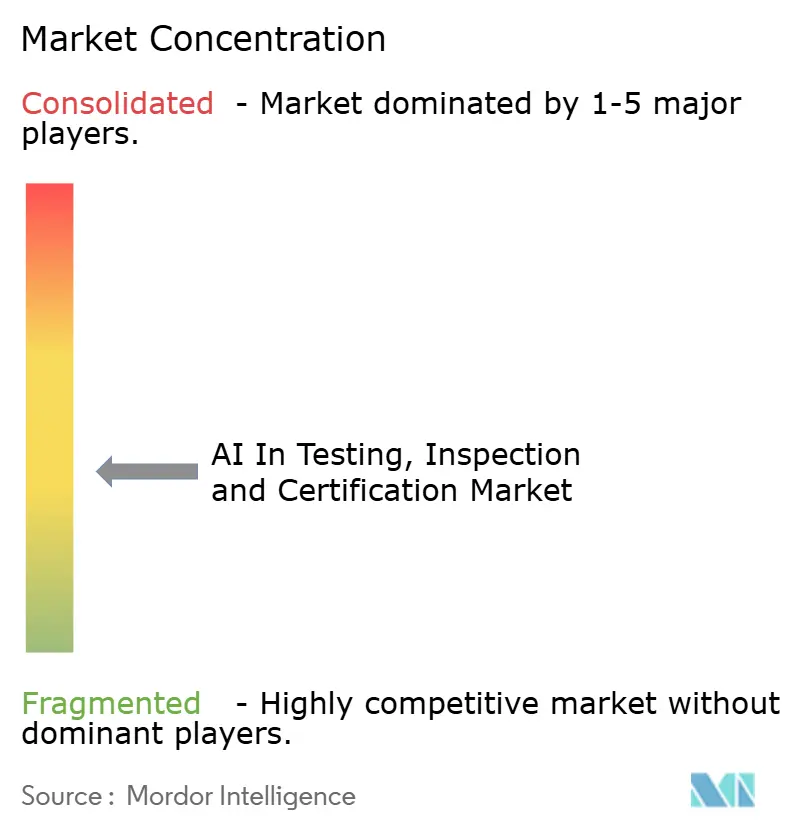
The AI in testing, inspection and certification market is fragmented, with global testing, inspection, and certification groups competing against regional specialists, domain-focused certifiers, and AI governance platforms. Competition centers on digital trust capability, recognized technical expertise, and the ability to provide evidence that clients can use in formal assessments. SGS has pursued an expansion program in Digital Trust through the acquisition of CertX in December 2024, Panacea Infosec in January 2026, and Granite River Labs Services in March 2026.[6] SGS has targeted at least CHF 200 million (USD 220 million) of additional Digital Trust revenue by 2027 compared with 2023. These acquisitions extend its AI, cybersecurity, and connectivity testing capabilities. Bureau Veritas launched an independent AI systems audit for EU AI Act compliance in 2026, while Intertek has developed its AI2 end-to-end assurance program.
A gap remains for scalable recurring audits of agentic and generative AI systems that can produce machine-readable evidence aligned with ISO/IEC 42001 monitoring requirements. Providers that develop this capability could reduce the time spent preparing records for formal review. Regional competitors in South Korea, Japan, and India can compete through national accreditations and entry-level packages suited to SME budgets. AI-native governance platforms can create audit records automatically and connect with evidence-management systems used by assessment bodies. This can shorten preparation time, although it does not replace independent technical judgment. SGS and CertX joined the NVIDIA Halos AI Systems Inspection Lab ecosystem in July 2025. The partnership shows how AI hardware ecosystems can connect third-party assurance providers with developers earlier in the deployment process.
TÜV SÜD has also expanded its AI assurance position through services for EU AI Act implementation and voluntary certificates for low-risk AI products. TÜV NORD acquired EPI Group in October 2025 to add data-center audit, certification, and training capabilities, with a focus on Asia-Pacific expansion. Bureau Veritas has paired AI assessment with a hybrid process that includes site work, document analysis, and direct testing. These moves show that leading providers are combining acquisitions, new service releases, and partnerships. Smaller providers can still compete where they have strong local accreditation or sector expertise. Market position will depend on whether a provider can deliver trusted assessment evidence across safety, cybersecurity, data governance, and operational monitoring. The AI in testing, inspection, and certification market does not yet have a single provider with a dominant position across all assurance categories and geographies.
AI In Testing, Inspection and Certification Industry Leaders
-
SGS SA
-
Bureau Veritas SA
-
DEKRA SE
-
TÜV SÜD AG
-
TÜV Rheinland AG
- *Disclaimer: Major Players sorted in no particular order
AI In Testing, Inspection and Certification Market Companies Covered in this Report
- SGS SA
- Bureau Veritas SA
- DEKRA SE
- TÜV SÜD AG
- TÜV Rheinland AG
- UL Solutions Inc.
- DNV AS
- Intertek Group plc
- Eurofins Scientific SE
- Applus+ Services SA
- ALS Limited
- Kiwa NV
- Lloyd's Register Group Limited
- RINA SpA
- Element Materials Technology Group Limited
- MISTRAS Group, Inc.
- NSF International
- BSI Group
- Cotecna Inspection SA
- SOCOTEC Group
- TÜV AUSTRIA Group
- Perry Johnson Registrars, Inc.
- NVIDIA Corporation
- Tata Consultancy Services Limited
Recent Industry Developments in AI In Testing, Inspection and Certification Market
- July 2026: TÜV SÜD acquired SustainCERT, a Luxembourg-based digital climate verification company, integrating AI-enabled automated verification workflows and Scope 3 value-chain assurance capabilities into its portfolio. The acquisition extended TÜV SÜD's AI-augmented inspection capabilities into voluntary carbon markets and corporate climate compliance.
- July 2026: SGS and CertX introduced an AI-augmented assurance infrastructure covering audits and certification workflows across regulated domains, building on SGS's December 2024 acquisition of CertX and the July 2025 entry into the NVIDIA Halos AI Systems Inspection Lab ecosystem.
- March 2026: TÜV SÜD formally recommended Mobileye's Safety Management System for SAE Level 4 autonomous systems, issuing a System Conformity Audit Report under Regulation (EU) 2022/1426. This was the first public recommendation of its kind for a Level 4 autonomy platform.
- March 2026: SGS acquired Granite River Labs Services, a Santa Clara, California-based connectivity validation specialist with more than 200 experts and 9 specialized laboratories across Asia, Europe, and the United States. The acquisition strengthened digital infrastructure and AI-enabling system testing capabilities.
Global AI In Testing, Inspection and Certification Market Report Scope
The AI in Testing, Inspection, and Certification (TIC) Market comprises artificial intelligence technologies that automate, enhance, and optimize testing, inspection, auditing, verification, and certification processes across industries. These solutions leverage machine learning, computer vision, natural language processing, and predictive analytics to improve accuracy, reduce manual intervention, expedite compliance assessments, and facilitate real-time decision-making. The market supports industries such as manufacturing, automotive, aerospace, healthcare, construction, energy, and consumer goods, where quality assurance and regulatory compliance are essential.
The AI in Testing, Inspection and Certification Market Report is Segmented by Service Type (Testing Services, Inspection Services, and Certification Services), Sourcing Type (In-House AI Assurance, and Outsourced AI TIC Services), Application (AI System Testing and Validation, Algorithmic Risk and Bias Assessment, Data Quality and Dataset Validation, Cybersecurity and Adversarial Testing, Functional Safety and Reliability Assurance, and Other Applications), End-User Industry (Industrial Manufacturing and Machinery, Automotive and Transportation, ICT and Telecom, Life Sciences and Healthcare, Energy and Utilities, Aerospace and Defense, Consumer Goods and Retail, Food, Agriculture and Beverage, and Other End-User Industries), Mode of Service Delivery (On-Site, Off-Site and Laboratory, and Remote and Digital), Organization Size (Large Enterprises, and Small and Medium-Sized Enterprises), and Geography (North America, South America, Europe, Asia-Pacific, Middle East, and Africa). The Market Sizes and Forecasts are Provided in Terms of Value in (USD).
Segmentation Overview
| Testing Services |
| Inspection Services |
| Certification Services |
| In-House AI Assurance |
| Outsourced AI TIC Services |
| AI System Testing and Validation |
| Algorithmic Risk and Bias Assessment |
| Data Quality and Dataset Validation |
| Cybersecurity and Adversarial Testing |
| Functional Safety and Reliability Assurance |
| Other Applications |
| Industrial Manufacturing and Machinery |
| Automotive and Transportation |
| ICT and Telecom |
| Life Sciences and Healthcare |
| Energy and Utilities |
| Aerospace and Defense |
| Consumer Goods and Retail |
| Food, Agriculture and Beverage |
| Other End-User Industries |
| On-Site |
| Off-Site and Laboratory |
| Remote and Digital |
| Large Enterprises |
| Small and Medium-Sized Enterprises |
| North America | United States |
| Canada | |
| Mexico | |
| South America | Brazil |
| Argentina | |
| Rest of South America | |
| Europe | Germany |
| United Kingdom | |
| France | |
| Italy | |
| Spain | |
| Russia | |
| Rest of Europe | |
| Asia-Pacific | China |
| Japan | |
| India | |
| South Korea | |
| Southeast Asia | |
| Australia and New Zealand | |
| Rest of Asia-Pacific | |
| Middle East | Saudi Arabia |
| United Arab Emirates | |
| Turkey | |
| Rest of Middle East | |
| Africa | South Africa |
| Nigeria | |
| Egypt | |
| Rest of Africa |
| By Service Type | Testing Services | |
| Inspection Services | ||
| Certification Services | ||
| By Sourcing Type | In-House AI Assurance | |
| Outsourced AI TIC Services | ||
| By Application | AI System Testing and Validation | |
| Algorithmic Risk and Bias Assessment | ||
| Data Quality and Dataset Validation | ||
| Cybersecurity and Adversarial Testing | ||
| Functional Safety and Reliability Assurance | ||
| Other Applications | ||
| By End-User Industry | Industrial Manufacturing and Machinery | |
| Automotive and Transportation | ||
| ICT and Telecom | ||
| Life Sciences and Healthcare | ||
| Energy and Utilities | ||
| Aerospace and Defense | ||
| Consumer Goods and Retail | ||
| Food, Agriculture and Beverage | ||
| Other End-User Industries | ||
| By Mode of Service Delivery | On-Site | |
| Off-Site and Laboratory | ||
| Remote and Digital | ||
| By Organization Size | Large Enterprises | |
| Small and Medium-Sized Enterprises | ||
| By Geography | North America | United States |
| Canada | ||
| Mexico | ||
| South America | Brazil | |
| Argentina | ||
| Rest of South America | ||
| Europe | Germany | |
| United Kingdom | ||
| France | ||
| Italy | ||
| Spain | ||
| Russia | ||
| Rest of Europe | ||
| Asia-Pacific | China | |
| Japan | ||
| India | ||
| South Korea | ||
| Southeast Asia | ||
| Australia and New Zealand | ||
| Rest of Asia-Pacific | ||
| Middle East | Saudi Arabia | |
| United Arab Emirates | ||
| Turkey | ||
| Rest of Middle East | ||
| Africa | South Africa | |
| Nigeria | ||
| Egypt | ||
| Rest of Africa | ||
Key Questions Answered in the Report
What is the value of the AI in testing, inspection and certification sector?
The AI in testing, inspection and certification market size is projected to expand from USD 3.03 billion in 2025 and USD 3.78 billion in 2026 to USD 8.92 billion by 2031, registering a CAGR of 18.73% between 2026 to 2031.
What is driving demand for AI testing, inspection, and certification services?
High-risk AI rules, structured audit evidence requirements, and continuing monitoring needs are increasing demand for independent assurance.
Which AI TIC service is growing fastest?
Certification Services is projected to grow at a 20.31% CAGR from 2026 to 2031 as organizations seek third-party credentials.
Which end-user sector is expected to grow fastest?
Automotive and Transportation is projected to grow at a 20.67% CAGR through 2031, supported by AI safety, cybersecurity, and automated-driving requirements.
Why are companies outsourcing AI assurance work?
Many organizations lack staff with the AI, regulatory, and sector expertise needed to prepare evidence for conformity assessments.
Which region is growing fastest for AI assurance services?
Asia-Pacific is projected to expand at a 22.36% CAGR through 2031 as AI governance requirements mature across key economies.