
AI In Laboratory Solution Market Size and Share
Market Overview
| Study Period | 2020 - 2031 |
|---|---|
| Market Size (2026) | USD 475.33 Million |
| Market Size (2031) | USD 850.49 Million |
| Growth Rate (2026 - 2031) | 12.34 % |
| Fastest Growing Market | Asia-Pacific |
| Largest Market | North America |
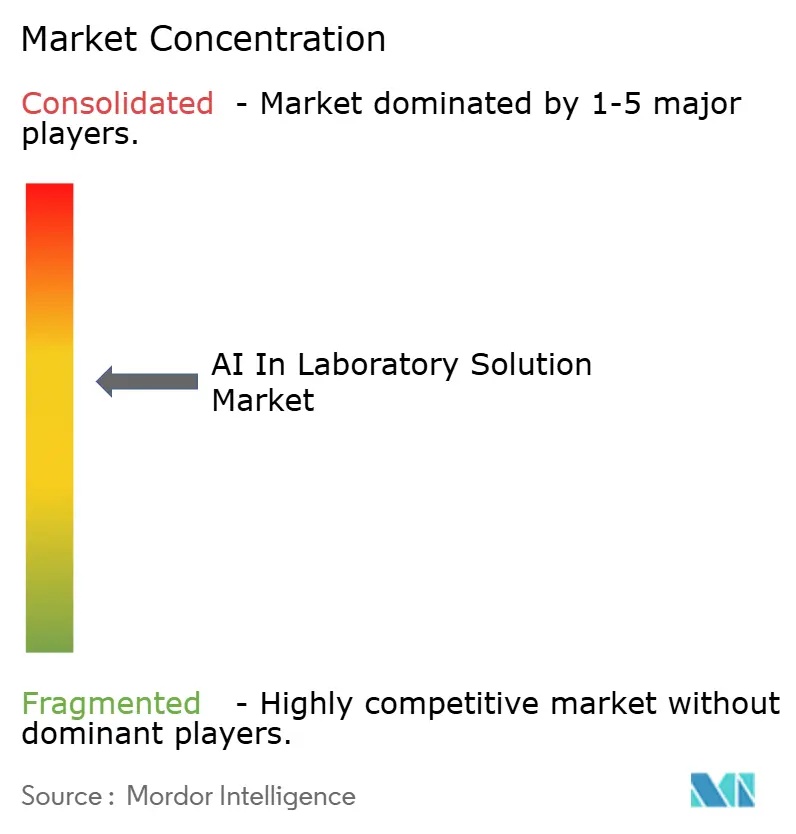
| Market Concentration | Medium |
Major Players
*Disclaimer: Major Players sorted in no particular order Image © Mordor Intelligence. Reuse requires attribution under CC BY 4.0. |
|
AI In Laboratory Solution Market Analysis by Mordor Intelligence
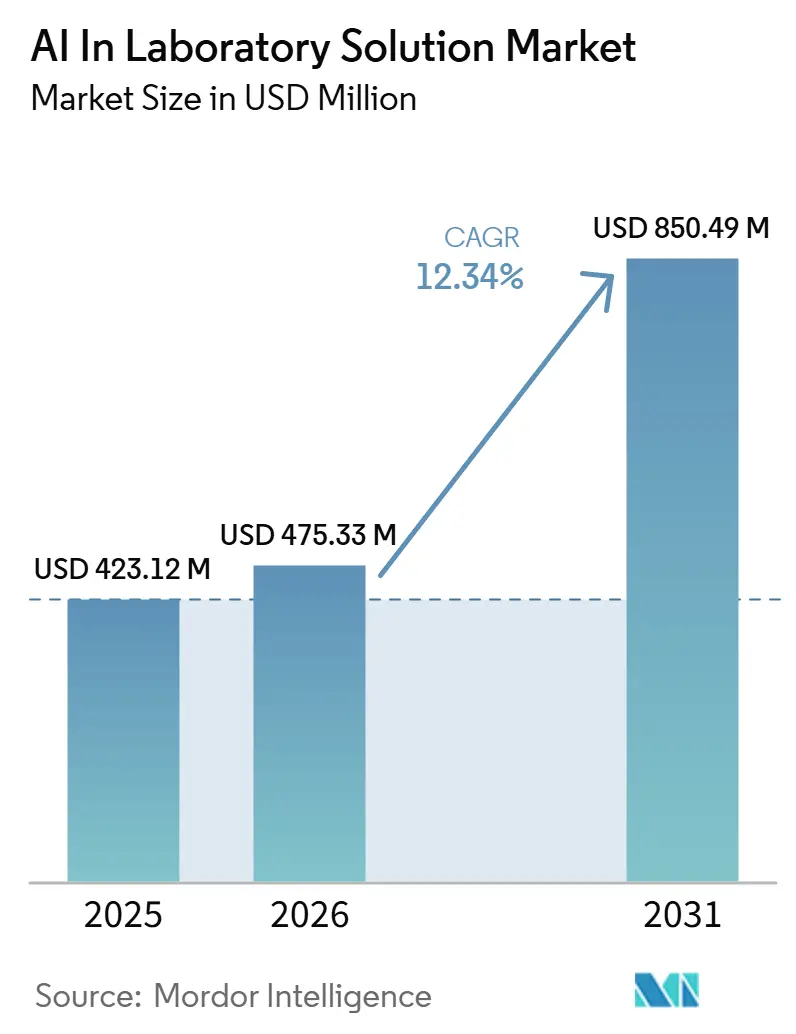
The AI In Laboratory Solution Market size is expected to grow from USD 423.12 million in 2025 to USD 475.33 million in 2026 and is forecast to reach USD 850.49 million by 2031 at 12.34% CAGR over 2026-2031.
Growth reflects the wider use of AI beyond drug discovery programs, including clinical diagnostics, contract research, and biobank operations. Lower inference costs and stronger connectivity between laboratory instruments are supporting this adoption. Multi-omics experimentation is increasing the volume and complexity of laboratory data, which raises demand for AI-based analysis and workflow support. Laboratory staffing shortages are also making automation and review-by-exception tools more valuable for research teams. Vendors are increasingly combining instruments, laboratory information management systems, and electronic laboratory notebooks into connected workflow platforms.
Key Report Takeaways
- By solution type, Software and Systems held 64.41% of the AI in laboratory solution market share in 2025 and is projected to grow at a 13.27% CAGR through 2031.
- By AI capability, predictive analytics and forecasting led with 35.16% revenue share in 2025, while generative AI copilots and natural language assistance are forecast to grow at a 16.57% CAGR through 2031.
- By deployment, on-premise systems accounted for 39.29% of the AI in laboratory solution market share in 2025, while hybrid deployment is projected to expand at an 18.19% CAGR through 2031.
- By end user, pharmaceutical and biotechnology laboratories held 35.56% revenue share in 2025, while biobanks and genomics laboratories are forecast to grow at a 19.73% CAGR through 2031.
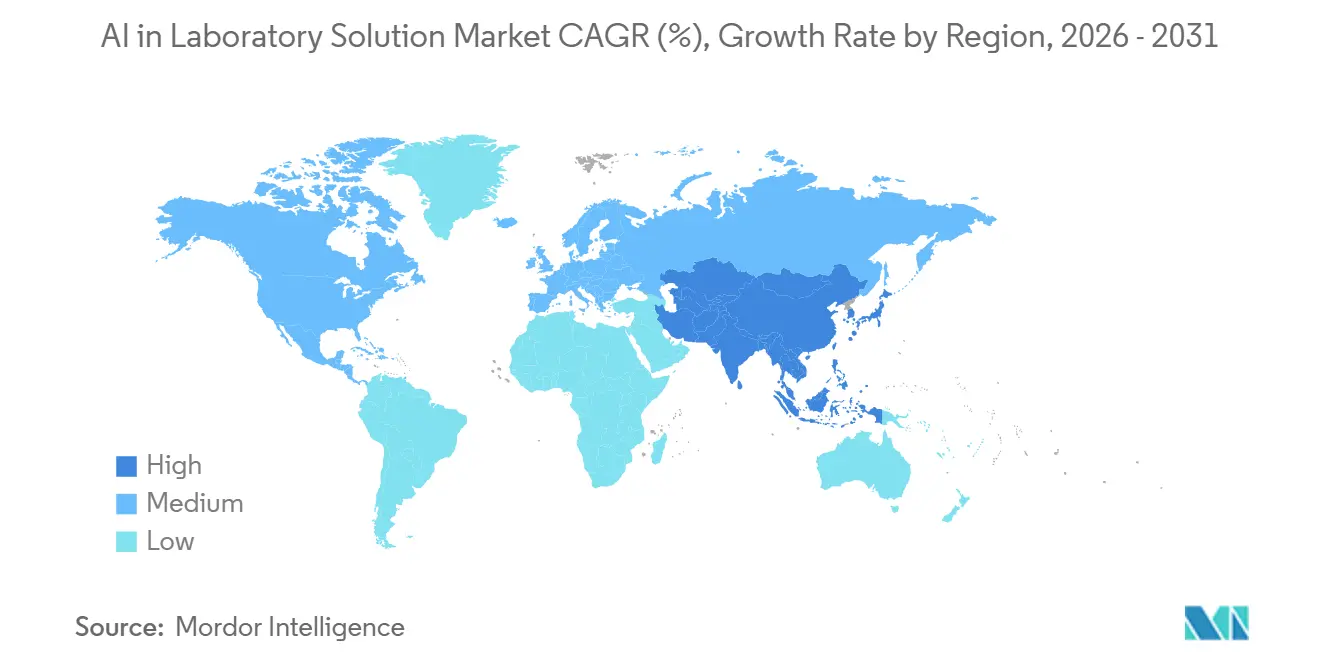
- By geography, North America accounted for 46.38% of global revenue in 2025, while Asia-Pacific is projected to advance at a 15.28% CAGR through 2031.
Note: Market size and forecast figures in this report are generated using Mordor Intelligence’s proprietary estimation framework, updated with the latest available data and insights as of January 2026.
Market Trends and Insights
Drivers Impact Analysis of AI In Laboratory Solution Market*
| Driver | (~) % Impact on CAGR Forecast | Geographic Relevance | Impact Timeline |
|---|---|---|---|
| Rising Need for AI-Guided High-Throughput Experimentation | +3.20% | Global, with high concentration in North America and Western Europe | Short term (≤ 2 years) |
| Laboratory Workforce Shortages and Analyst Productivity Pressure | +2.80% | Global, acutest in Japan, Germany, and United States | Medium term (2-4 years) |
| Multi-Omics and High-Dimensional Data Complexity | +2.40% | North America, Europe, and APAC core markets including China, Japan, and South Korea | Medium term (2-4 years) |
| Closed-Loop Automation Across Instruments, LIMS, and ELN | +2.10% | North America and Europe, with expansion into East Asia | Short term (≤ 2 years) |
| Regulatory-Ready Traceability and Audit Trail Automation | +0.90% | North America and the European Union | Medium term (2-4 years) |
| Decentralized Testing and Point-of-Care Workflow Expansion | +0.70% | Asia-Pacific, Middle East and Africa, and South America | Long term (≥ 4 years) |
| Source: Mordor Intelligence | |||
Rising Need for AI-Guided High-Throughput Experimentation
AI-guided high-throughput experimentation is moving from a specialist capability into broader pharmaceutical, materials, and genomics laboratory workflows. Automated platforms can run AI-designed experiment queues faster than schedules prepared manually by research teams. This allows laboratories to assess more candidate conditions without a matching increase in laboratory staffing. A 2026 Scientific Reports study found that self-correcting multi-agent AI systems reduced numerical errors by more than 85% in complex synthesis tasks and achieved an F1-score above 0.89 in multi-plate synthesis benchmarks[1]Nature/Scientific Reports. "AutoLabs: Cognitive Multi-Agent Systems with Self-Correction for Autonomous Chemical Experimentation." Scientific Reports, 2026. https://www.nature.com/articles/s41598-026-45593-z. These results support the use of AI systems in laboratory settings where researchers need more reliable handling of complex experimental steps. The AI in laboratory solution market is also benefiting as laboratory procurement moves toward connected packages that combine instruments, data platforms, and workflow software.
Laboratory Workforce Shortages and Analyst Productivity Pressure
Laboratory workforce shortages are changing the business case for AI-enabled laboratory systems. Many laboratories now consider productivity support a primary reason to adopt AI tools, rather than treating it only as a quality improvement measure. Aging workforces in Germany, Japan, and the United States are limiting the availability of experienced laboratory scientists. At the same time, omics research and multi-parameter assays are creating greater demand for people who can interpret complex datasets. Smaller contract research organizations and academic core facilities often face the greatest workload pressure because they have fewer specialized analysts. This is increasing their interest in AI systems that can structure data, support analysis, and reduce repetitive review work.
Multi-Omics and High-Dimensional Data Complexity
Multi-omics work is creating data volumes that conventional bioinformatics pipelines cannot manage efficiently. Genomic, transcriptomic, proteomic, metabolomic, and digital biomarker datasets can reveal biological relationships that are difficult to identify with traditional statistical approaches. Research published in npj Digital Medicine in 2026 described the growing regulatory and analytical complexity of AI-enabled omics and multi-omics tools. A separate 2026 study showed that graph neural network models can combine multi-omics datasets to support drug-target and off-target prediction. Biobanks, genomics laboratories, and translational research groups are therefore seeking shared AI layers that can manage data across multiple sources. This demand broadens the AI in laboratory solution market beyond traditional pharmaceutical research environments.
Closed-Loop Automation Across Instruments, LIMS, and ELN
Laboratories are moving from systems that simply record data to systems that help direct the next experimental action. Earlier laboratory integration projects often relied on custom connectors between instruments, LIMS platforms, and electronic laboratory notebooks. Benchling introduced Benchling Automation in May 2026 to connect instruments, automation systems, and scientific records through a hardware-agnostic platform. The system is designed to reduce the need for specialized coding for proprietary instrument-data formats. LabVantage also introduced its CORTEX platform in March 2026, adding agentic AI, predictive maintenance, stability monitoring, and compliance monitoring features to its LIMS offering.
Restraints Impact Analysis of AI In Laboratory Solution Market*
| Restraint | (~) % Impact on CAGR Forecast | Geographic Relevance | Impact Timeline |
|---|---|---|---|
| GxP Validation Burden for AI-Enabled Workflows | -1.80% | North America and Europe | Medium term (2-4 years) |
| Legacy LIMS, LIS, and Instrument Integration Debt | -1.50% | Global, with greater pressure in established pharmaceutical manufacturing hubs | Medium term (2-4 years) |
| Data Provenance Gaps and Model Drift Risk | -0.80% | Global, with early focus in North America | Long term (≥ 4 years) |
| Cybersecurity and IP Leakage Concerns in Cloud-Connected Labs | -0.60% | Global, with greater concern in proprietary drug discovery laboratories | Long term (≥ 4 years) |
| Source: Mordor Intelligence | |||
GxP Validation Burden for AI-Enabled Workflows
Validation requirements remain a major constraint for AI-enabled workflows in regulated pharmaceutical and biotechnology laboratories. Laboratories using AI for GxP-related activities must demonstrate that data, models, decisions, and review records can be traced and reconstructed. The FDA finalized its Computer Software Assurance guidance in September 2025 and updated it in February 2026. The guidance uses a risk-based framework that focuses testing on functions that affect patient safety or product quality. This can simplify validation for lower-risk software functions, but batch release, audit trail, and quality-related workflows still require extensive evidence. The AI in laboratory solution market, therefore, favors vendors that can provide version control, audit trails, human review records, and clear documentation for AI-supported decisions.
Legacy LIMS, LIS, and Instrument Integration Debt
Legacy laboratory systems can slow AI adoption because many older platforms were not designed for continuous data exchange. On-premise systems often rely on older client-server structures that lack modern application programming interfaces and instrument connectivity. This creates data silos that limit the quality and availability of the data required for AI models. Laboratory connections between LIMS, electronic laboratory notebooks, quality management systems, and manufacturing execution systems must also protect chain-of-custody requirements. Each connection can require validation work, which increases implementation time and cost. The problem extends beyond aging software because many instruments still do not produce machine-readable outputs that AI systems can use consistently.
*Our forecasts treat driver/restraint impacts as directional, not additive. The impact forecasts reflect baseline growth, mix effects, and variable interactions.
AI In Laboratory Solution Market Segment Analysis
By Solution Type:
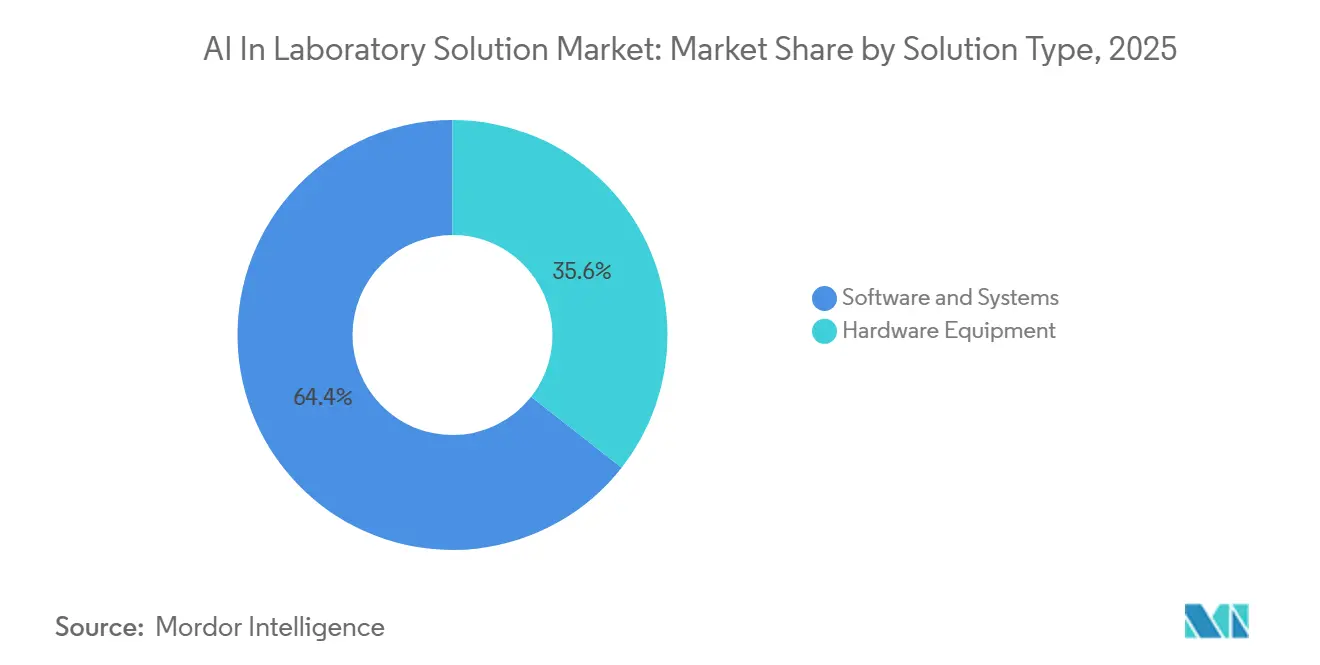
Software Platforms Concentrate AI Value CreationSoftware and Systems held 64.41% of the AI in laboratory solution market share in 2025. This segment includes LIMS platforms, electronic laboratory notebooks, AI analytics tools, and laboratory workflow orchestration systems. Software captures recurring subscription revenue and supports long-term customer relationships. It also gains value as laboratories use more AI capabilities on the same data environment. Hardware Equipment accounted for the remaining share of revenue. This category includes AI-enabled laboratory instruments, connected sensors, environmental monitoring equipment, and automation platforms with embedded AI functions.
Software and Systems is projected to grow at a 13.27% CAGR through 2031. The AI in laboratory solution market size for this segment is supported by laboratories replacing older informatics tools with AI-enabled platforms. Benchling introduced Benchling Inference in May 2026 through a partnership with Baseten to provide scientific AI models and multi-cloud GPU capacity inside its research and development platform[2]Benchling/PR Newswire. "Benchling and Baseten Partner to Bring AI Inference to Biotech R&D." PR Newswire, May 20, 2026. https://www.prnewswire.com/news-releases/benchling-and-baseten-partner-to-bring-ai-inference-to-biotech-rd-302777269.html. Instrument vendors are also facing greater demand for real-time, machine-readable data outputs that can connect to leading software platforms. Hardware vendors without certified integrations may face weaker positions in procurement decisions. Software platforms are becoming the operational system of record for laboratory data, workflows, and AI-assisted decisions


By AI Capability:
Predictive Analytics Leads, Generative AI Rewrites the Growth AgendaPredictive analytics and forecasting held 35.16% share of the AI in laboratory solution market size in 2025. Laboratories use predictive models for stability-study monitoring, instrument maintenance, quality monitoring, and planning activities. These uses align with established laboratory processes and generally require less change in scientist behavior. Anomaly detection and review-by-exception tools also represent an important capability area. They allow systems to identify unusual results while retaining human confirmation for final review.
Generative AI copilots and natural language assistance are forecast to grow at a 16.57% CAGR between 2026 and 2031. Vendors are embedding large language model interfaces into LIMS and electronic laboratory notebook platforms. Benchling launched AI Connectors in April 2026 to allow researchers to access scientific records through external AI tools and natural language queries.
The platform supports more than 1,300 companies, including Merck, Moderna, and Sanofi. Workflow automation, semantic search, and quality-signal detection are also gaining importance as laboratories move away from isolated AI tools. Integrated platforms are increasingly replacing separate single-function products.
By Deployment:
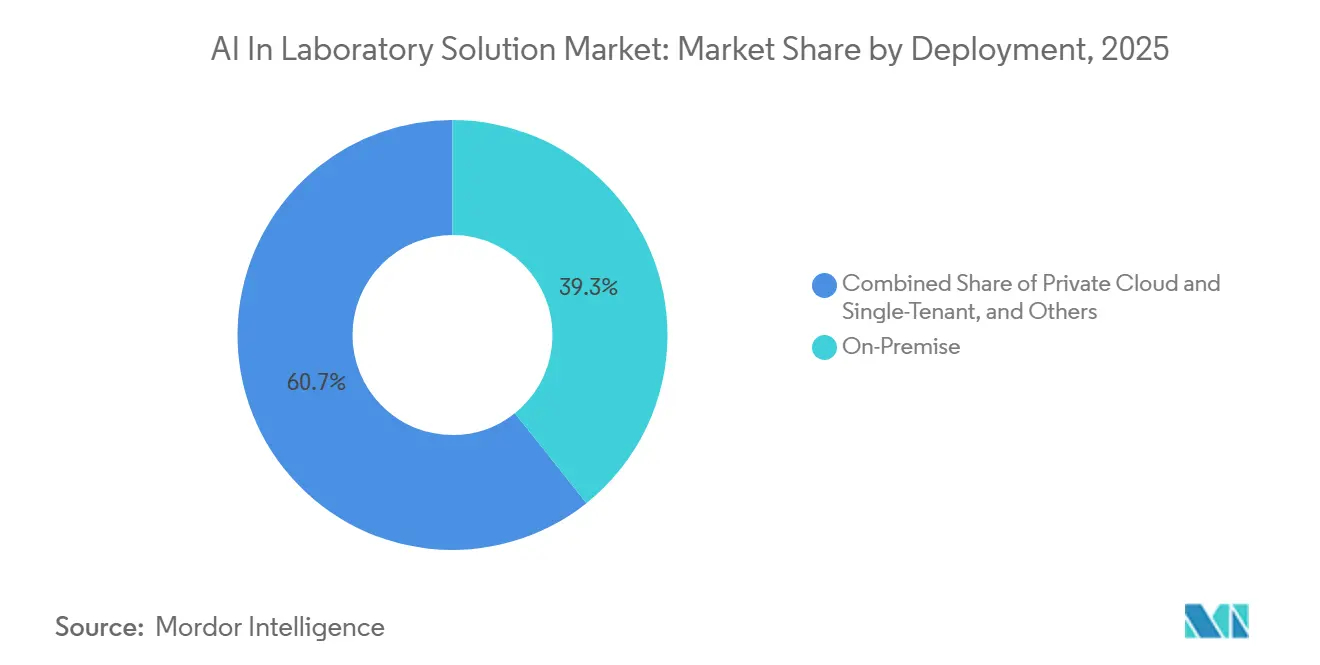
On-Premise Retains Scale, Hybrid Defines the Next Build-OutOn-premise deployment held 39.29% of the AI in laboratory solution market share in 2025. Pharmaceutical manufacturers and clinical laboratories continue to use on-premise systems due to data control requirements, GxP obligations, and prior investments in internal server infrastructure. For many laboratories, cloud migration remains a multi-year process because instruments and automation equipment are physically located on-site. The Human Genome Sequencing Center at Baylor College of Medicine adopted a hybrid LIMS approach with on-premise sequencers and robots while hosting LIMS application functions in the cloud. This approach shows how physical laboratory connectivity remains a central deployment consideration.
Hybrid deployment is projected to record the fastest growth at an 18.19% CAGR from 2026 to 2031. These environments keep regulated source data and instrument interfaces on-site while moving high-computing analytics workloads to cloud infrastructure. Private cloud and dedicated-tenant systems are also growing because they can address data residency requirements. The FDA’s risk-based software assurance approach may reduce validation work for lower-risk cloud software functions. European data protection requirements continue to support private and hybrid deployments, especially in pharmaceutical and clinical laboratory settings. Pure public cloud systems can remain difficult to adopt where laboratories handle sensitive patient, clinical, or proprietary research information. Hybrid architectures provide a practical path for laboratories that want AI computing capacity without fully replacing established infrastructure.

By End User:
Pharma Labs Anchor Revenue, Biobanks Anchor GrowthPharmaceutical and biotechnology laboratories accounted for 35.56% of end-user revenue in 2025. These laboratories have large research budgets, complex workflows, and a strong need to shorten development timelines. Major pharmaceutical sites often already have LIMS and electronic laboratory notebook contracts, which support broader adoption of AI functions within existing platforms. Contract research organizations and contract development and manufacturing organizations formed the second-largest end-user group. Their multi-sponsor and high-volume workflows create diverse datasets that can support AI model development. Clinical diagnostics and molecular laboratories are also adopting AI for anomaly detection, automated result review, and reduced turnaround times.
Biobanks and genomics laboratories are projected to grow at a 19.73% CAGR through 2031. The AI in laboratory solution market size for this end-user group is supported by the expansion of large genomic repositories and automated variant interpretation workflows. Galatea Bio secured USD 25.00 million in March 2025 to expand its biobank program into a global 10 million-participant sequencing initiative focused on non-European ancestry populations. SeqOne raised EUR 20.00 million, equivalent to USD 21.60 million, in May 2025 and reported 3x customer growth to 140 laboratories in 22 countries. The company processed more than 110,000 patient analyses in 2025. Academic and translational research laboratories remain important users, although their spending per laboratory is generally lower than that of commercial pharmaceutical organizations.
Geography Analysis
North America AI in Laboratory Solution Market
North America held 46.38% of the global AI in laboratory solution market share in 2025. The region benefits from a high concentration of pharmaceutical research spending, biotechnology companies, research institutions, and laboratory instrument providers. The United States accounted for most regional revenue because of its large pharmaceutical and biotechnology base. NIH-funded research programs also support the adoption of advanced laboratory data systems. Canada and Mexico are contributing to demand as contract research and manufacturing capacity develop across the North American supply chain.
APAC AI in Laboratory Solution Market
Asia-Pacific is projected to grow at the fastest regional CAGR of 15.28% through 2031. China’s life sciences investment programs and expanding contract research sector are supporting demand for AI-enabled LIMS platforms and multi-omics analytics. Japan combines laboratory automation capabilities with a strong industrial robotics base. MGI Tech and the Shanghai AI Laboratory introduced ProtoPilot and BioLab Bench in July 2026, supporting the use of multi-agent AI systems in life sciences laboratory settings[3]MGI Tech. "MGI Tech and Shanghai AI Laboratory Unveil ProtoPilot and BioLab Bench, Pioneering Physical AI for Life Sciences." MGI Tech, July 3, 2026. https://global-mgitech.com/mgi-tech-and-shanghai-ai-laboratory-unveil-protopilot-and-biolab-bench-pioneering-physical-ai-for-life-sciences. India is becoming an important regional contributor through investment in genomic diagnostics and related laboratory services. Asia-Pacific is therefore expanding from a customer base for laboratory AI systems into a region that also produces laboratory AI technologies.
EMEA and South America AI in Laboratory Solution Market
Europe holds a significant position in the AI in laboratory solution market because of its major pharmaceutical manufacturing centers in Germany, the United Kingdom, France, and Switzerland. Regional procurement increasingly favors platforms that support data integrity, auditability, and AI governance requirements. The Middle East and Africa remain early-stage markets, with adoption focused on government reference laboratories, research centers, and multinational pharmaceutical sites. Gulf Cooperation Council healthcare digitization programs are supporting demand for clinical laboratory software and connected diagnostics. South America is led by Brazil, where pharmaceutical manufacturing, research universities, and laboratory networks support technology adoption. Both regions are expected to develop further as cloud infrastructure expands and laboratory AI regulations become clearer.

Competitive Landscape
The AI in laboratory solution market has a medium-concentration competitive structure. Large life sciences platform providers include Thermo Fisher Scientific, Danaher, Agilent Technologies, and Siemens Healthineers. Laboratory informatics specialists include LabVantage Solutions, LabWare, STARLIMS, and Dotmatics. AI-native companies include Benchling, Sapio Sciences, Scispot, and eLabNext. These groups compete across laboratory data management, automation, AI analysis, workflow integration, and compliance support.
The boundary between LIMS and electronic laboratory notebook products is becoming less distinct. Vendors are combining scientific records, workflow management, AI models, and laboratory automation controls within broader platform offerings. Sapio Sciences offers Elain AI Co-Scientist, which combines natural language prompts, multi-agent orchestration, and scientific model access within LIMS and electronic laboratory notebook workflows. Such offerings can appeal to biotechnology start-ups that prioritize fast deployment and native AI functions. Larger vendors retain advantages in installed customer bases, regulatory support, and broader instrument portfolios.
Benchling’s partnership with Baseten in February 2026 created an AI inference offering with scientific models, multi-cloud computing capacity, and data residency controls. LabVantage expanded its platform through the March 2026 introduction of CORTEX, which added AI analytics and automation features to its LIMS environment. Instrument-linked companies also retain an advantage where their platforms generate proprietary laboratory and genomic datasets. Vendors that can provide validation-ready AI, data traceability, and secure integration are likely to be stronger in regulated procurement cycles. The market remains open to specialists because laboratory users have varied needs across research, manufacturing, diagnostics, and genomics. However, platform integration and compliance capabilities are raising barriers for smaller firms that lack established laboratory data infrastructure.
AI In Laboratory Solution Industry Leaders
-
Thermo Fisher Scientific Inc.
-
Danaher Corporation
-
LabVantage Solutions, Inc.
-
LabWare
-
Siemens Healthineers AG
- *Disclaimer: Major Players sorted in no particular order
AI In Laboratory Solution Market Companies Covered in this Report
- Agilent Technologies
- AIFORIA TECHNOLOGIES OYJ
- Benchling, Inc.
- Bio-Rad Laboratories
- Clinisys
- CloudLIMS
- Danaher
- Dassault Systèmes SE
- Dotmatics, Inc.
- eLabNext
- Illumina
- L7 Informatics, Inc.
- Labguru
- LabVantage Solutions, Inc.
- LabWare
- PathAI, Inc.
- QBench
- QIAGEN
- Revvity, Inc.
- Sapio Sciences LLC
- Scispot
- Siemens Healthineers
- STARLIMS Corporation
- Thermo Fisher Scientific
- Waters Corporation

Recent Industry Developments in AI In Laboratory Solution Market
- July 2026: MGI Tech's subsidiary Genoria AI, in collaboration with the Shanghai Artificial Intelligence Laboratory, launched ProtoPilot, a self-evolving multi-agent system for laboratory scenarios, and BioLab Bench, a comprehensive AI agent evaluation framework from physical laboratory requirements to device operations, marking a significant advance in physical AI for life sciences in China.
- May 2026: Benchling launched Benchling Automation on May 28, a hardware-agnostic closed-loop system connecting laboratory instruments, automation workcells, and scientific records. The launch included partners such as HighRes, Automata, Ginkgo Bioworks, Celltrio, Opentrons, and Hamilton.
- March 2026: LabVantage Solutions launched LabVantage CORTEX on March 5, a cloud-native, multi-tenant SaaS AI analytics and automation platform that adds agentic AI features, stability monitoring, predictive maintenance, and compliance monitoring to its LIMS platform


Global AI In Laboratory Solution Market Report Scope
As per the scope of the report, AI in laboratory solutions refers to the application of artificial intelligence technologies, including machine learning, generative AI, predictive analytics, natural language processing (NLP), computer vision, and intelligent automation, to enhance laboratory operations, scientific research, diagnostics, quality management, and data-driven decision-making. These solutions enable laboratories to automate routine and complex workflows, improve data analysis, accelerate research and development activities, optimize resource utilization, detect anomalies, support regulatory compliance, and enhance the accuracy, efficiency, and reproducibility of laboratory processes. AI-powered laboratory solutions are increasingly being adopted across pharmaceutical, biotechnology, clinical diagnostics, genomics, and research laboratories to streamline workflows, reduce manual intervention, accelerate discovery timelines, and improve operational performance.
The AI in Laboratory Solutions Market is segmented by solution type into hardware equipment and software and systems; by AI capability into predictive analytics and forecasting, anomaly detection and review by exception, generative AI copilots and natural language assistance, intelligent workflow automation and orchestration, knowledge retrieval and semantic search, quality signal detection and risk scoring, and others; by deployment into on-premise, private cloud and single-tenant, public cloud and multi-tenant SaaS, and hybrid; by end user into pharmaceutical and biotechnology labs, CROs and CDMOs, clinical diagnostics and molecular labs, biobanks and genomics labs, academic and translational research labs, and other end users; and by geography into North America, Europe, Asia-Pacific, Middle East and Africa, and South America. The market report also covers the estimated market sizes and trends for 17 countries across major regions globally. For each segment, the market size and forecast are provided in terms of value (USD).
| Hardware Equipment |
| Software and Systems |
| Predictive Analytics and Forecasting |
| Anomaly Detection and Review by Exception |
| Generative AI Copilots and Natural Language Assistance |
| Intelligent Workflow Automation and Orchestration |
| Knowledge Retrieval and Semantic Search |
| Quality Signal Detection and Risk Scoring |
| Others |
| On-Premise |
| Private Cloud and Single-Tenant |
| Public Cloud and Multi-Tenant SaaS |
| Hybrid |
| Pharmaceutical and Biotechnology Labs |
| CROs and CDMOs |
| Clinical Diagnostics and Molecular Labs |
| Biobanks and Genomics Labs |
| Academic and Translational Research Labs |
| Other End Users |
| North America | United States |
| Canada | |
| Mexico | |
| Europe | Germany |
| United Kingdom | |
| France | |
| Italy | |
| Spain | |
| Rest of Europe | |
| Asia-Pacific | China |
| Japan | |
| India | |
| Australia | |
| South Korea | |
| Rest of Asia-Pacific | |
| Middle East and Africa | GCC |
| South Africa | |
| Rest of Middle East and Africa | |
| South America | Brazil |
| Argentina | |
| Rest of South America |
| By Solution Type | Hardware Equipment | |
| Software and Systems | ||
| By AI Capability | Predictive Analytics and Forecasting | |
| Anomaly Detection and Review by Exception | ||
| Generative AI Copilots and Natural Language Assistance | ||
| Intelligent Workflow Automation and Orchestration | ||
| Knowledge Retrieval and Semantic Search | ||
| Quality Signal Detection and Risk Scoring | ||
| Others | ||
| By Deployment | On-Premise | |
| Private Cloud and Single-Tenant | ||
| Public Cloud and Multi-Tenant SaaS | ||
| Hybrid | ||
| By End User | Pharmaceutical and Biotechnology Labs | |
| CROs and CDMOs | ||
| Clinical Diagnostics and Molecular Labs | ||
| Biobanks and Genomics Labs | ||
| Academic and Translational Research Labs | ||
| Other End Users | ||
| By Geography | North America | United States |
| Canada | ||
| Mexico | ||
| Europe | Germany | |
| United Kingdom | ||
| France | ||
| Italy | ||
| Spain | ||
| Rest of Europe | ||
| Asia-Pacific | China | |
| Japan | ||
| India | ||
| Australia | ||
| South Korea | ||
| Rest of Asia-Pacific | ||
| Middle East and Africa | GCC | |
| South Africa | ||
| Rest of Middle East and Africa | ||
| South America | Brazil | |
| Argentina | ||
| Rest of South America | ||


Key Questions Answered in the Report
What is the projected value of the AI in laboratory solution market by 2031?
The AI in laboratory solution market is projected to reach USD 850.49 million by 2031, rising from USD 475.33 million in 2026 at a 12.34% CAGR.
Which solution type has the largest share?
Software and Systems held the largest share at 64.41% in 2025, supported by recurring subscriptions and integration with laboratory workflows.
Which AI capability is growing fastest in laboratory operations?
Generative AI copilots and natural language assistance is expected to grow at a 16.57% CAGR through 2031.
Why are hybrid laboratory AI deployments expanding quickly?
Hybrid deployment is forecast to grow at an 18.19% CAGR because it combines cloud-based AI computing with on-premise control of sensitive data and instruments.
Which end-user group is forecast to grow fastest?
Biobanks and genomics laboratories are forecast to grow at a 19.73% CAGR through 2031, supported by expanding genomic repositories and AI-based data interpretation.
Which region leads laboratory AI adoption?
North America led with 46.38% share in 2025, while Asia-Pacific is forecast to record the fastest growth at a 15.28% CAGR.
Page last updated on:





