
AI Governance Platforms Market Size and Share
Market Overview
| Study Period | 2020 - 2031 |
|---|---|
| Market Size (2026) | USD 0.8 Billion |
| Market Size (2031) | USD 2.38 Billion |
| Growth Rate (2026 - 2031) | 24.21 % |
| Fastest Growing Market | Asia-Pacific |
| Largest Market | North America |
| Market Concentration | Low |
Major Players *Disclaimer: Major Players sorted in no particular order Image © Mordor Intelligence. Reuse requires attribution under CC BY 4.0. | |
AI Governance Platforms Market Analysis by Mordor Intelligence
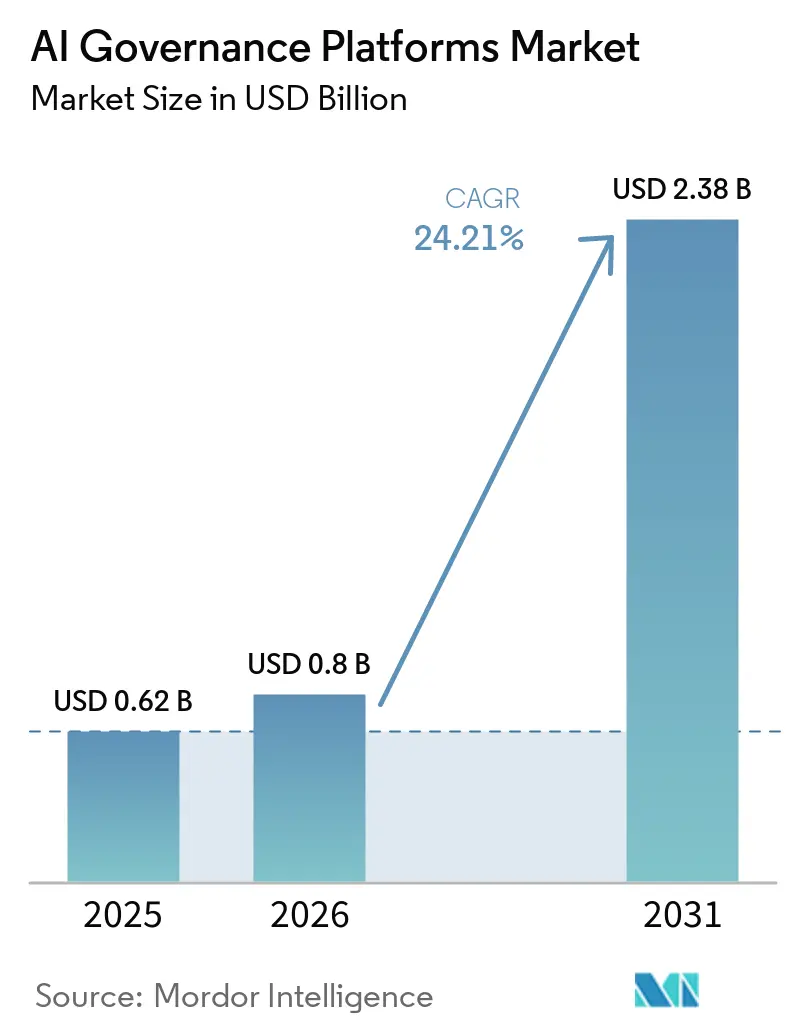
The AI Governance Platforms Market size is expected to grow from USD 0.62 billion in 2025 to USD 0.80 billion in 2026, and is forecast to reach USD 2.38 billion by 2031, at a 24.21% CAGR over 2026-2031. Regulatory obligations are moving governance from periodic review toward continuous controls and evidence collection. This change favors tools that can document decisions while AI systems are operating. The AI Governance Platforms Market is also being shaped by the wider deployment of autonomous agents in regulated settings. Competition increasingly centers on whether suppliers can support native cloud controls while remaining useful across more than 1 environment. The resulting opportunity is strongest where firms must connect risk, legal, data, and engineering teams without slowing deployment.
Key Report Takeaways
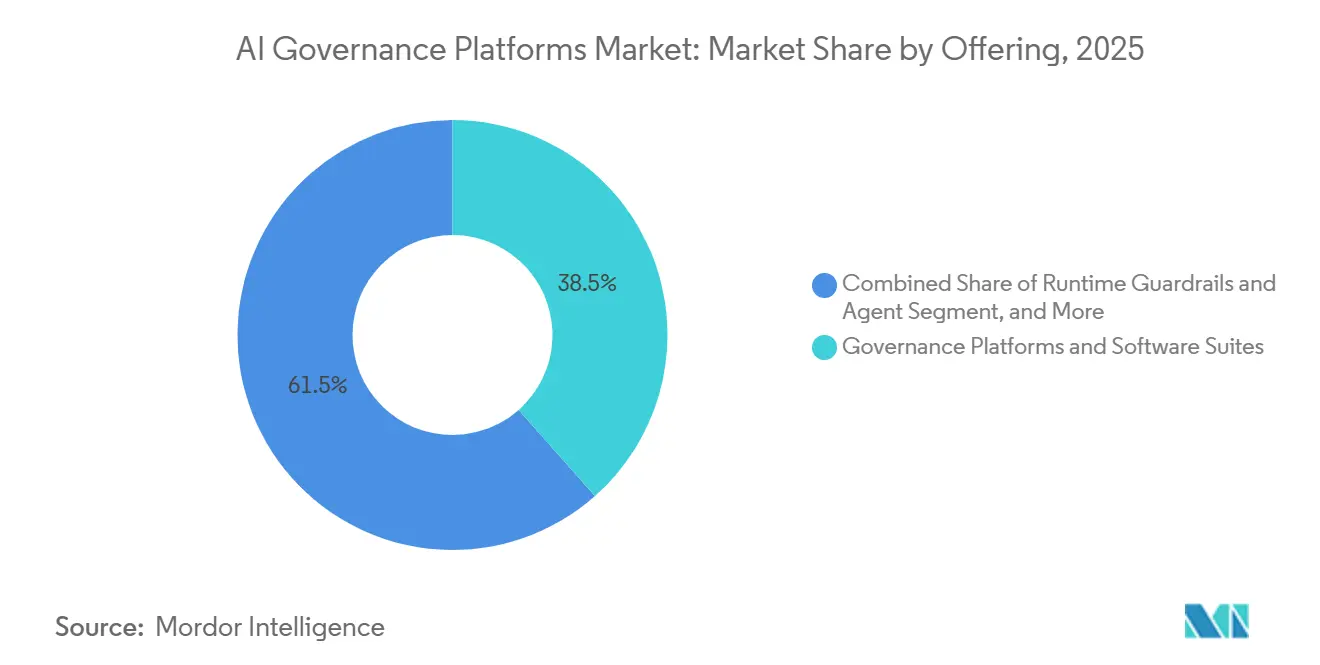
- By offering Governance platforms and software suites, Governance platforms and software suites held 38.48% of the AI governance platforms category share in 2025, while runtime guardrails and agent control planes are forecast to grow at a 24.91% CAGR through 2031.
- By deployment, cloud held 61.28% of the AI governance platforms category share in 2025 and is forecast to grow at 24.75% CAGR through 2031.
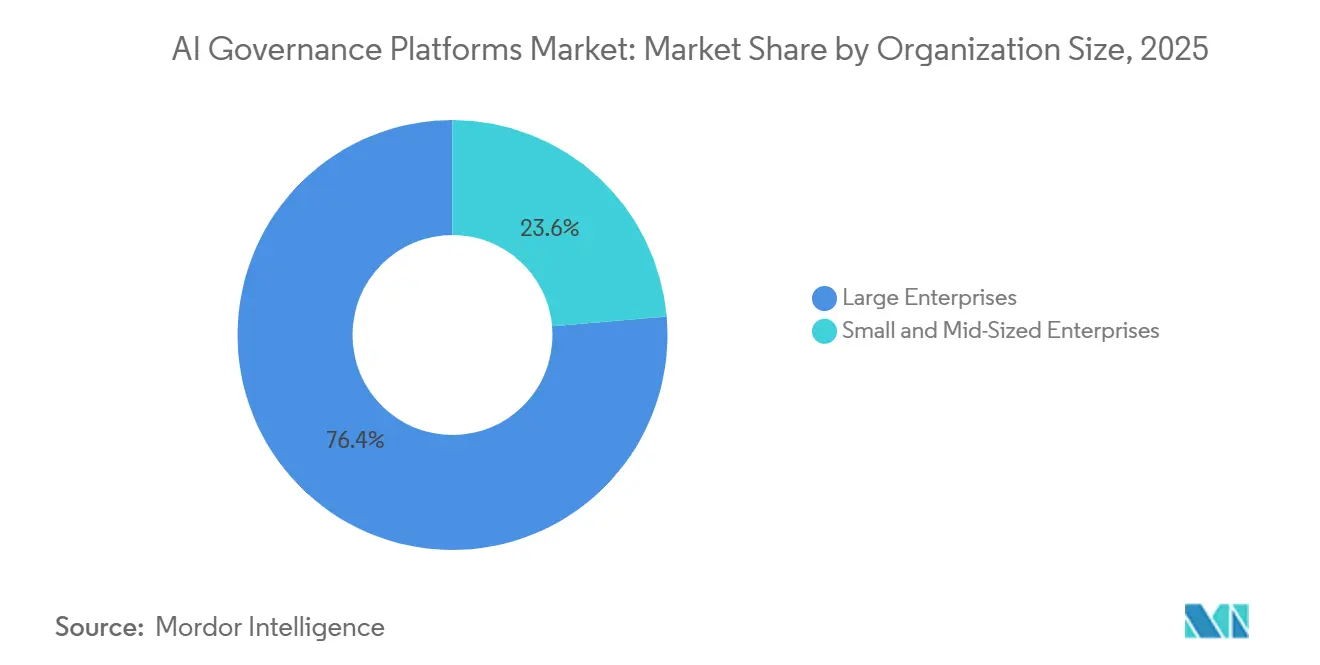
- By organization size, large enterprises held 76.38% of the AI governance platforms category share in 2025, while small and mid-sized enterprises are forecast to grow at 24.98% CAGR through 2031.
- By industry, banking, financial services, and insurance held 40.11% of the AI governance platforms category share in 2025, while healthcare and life sciences are forecast to grow at 25.01% CAGR through 2031.
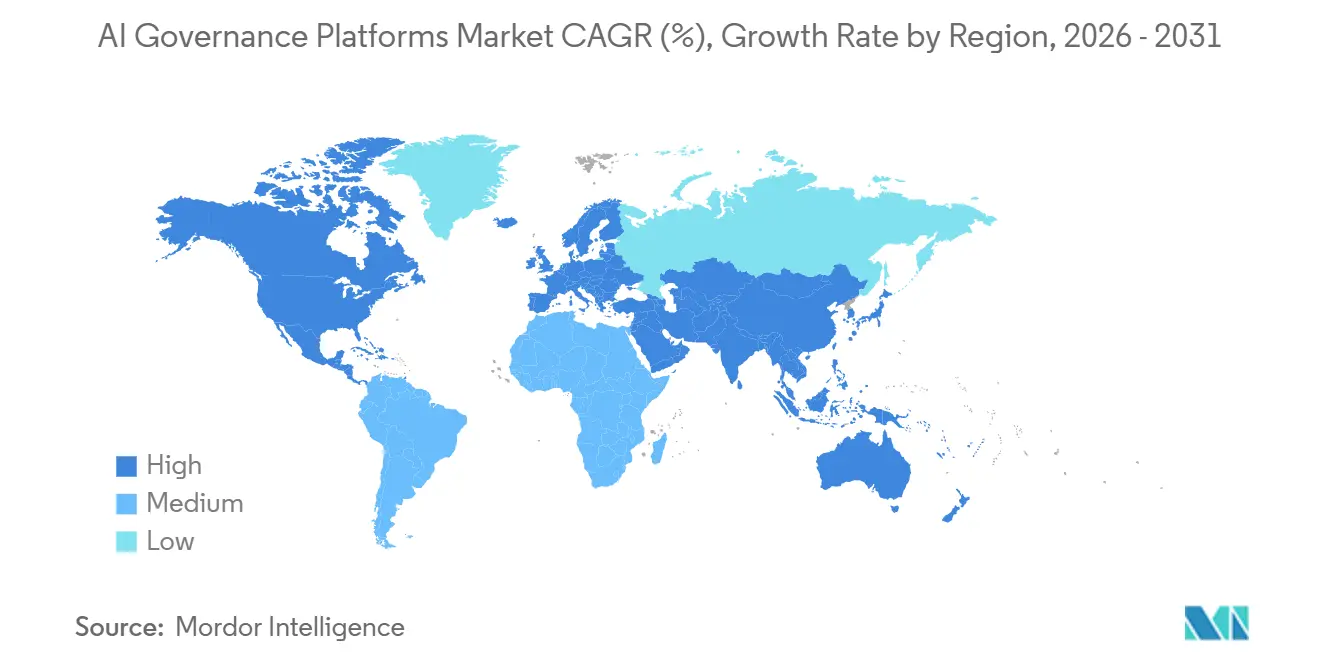
- By geography, North America held 39.18% of the AI governance platforms category share in 2025, while Asia-Pacific is forecast to grow at 24.78% CAGR through 2031.
Note: Market size and forecast figures in this report are generated using Mordor Intelligence’s proprietary estimation framework, updated with the latest available data and insights as of January 2026.
Market Trends and Insights
Drivers Impact Analysis of AI Governance Platforms Market*
| Driver | (~) % Impact on CAGR Forecast | Geographic Relevance | Impact Timeline |
|---|---|---|---|
| Regulatory Enforcement Across High-Impact AI Use Cases | +3.8% | Global, with concentration in Europe and North America | Short term (≤ 2 years) |
| Acceleration of Autonomous AI Deployment | +3.3% | Global | Short term (≤ 2 years) |
| Rising Financial, Clinical, and Public-Service AI Incident Exposure | +2.8% | North America, Europe, and core Asia-Pacific markets | Medium term (2-4 years) |
| Demand for Explainability, Fairness, and Auditability | +2.2% | Global, acute in Europe and regulated Asia-Pacific markets | Medium term (2-4 years) |
| Agent Identity and Model Context Protocol Sprawl | +1.6% | North America and Europe, with spillover to Asia-Pacific | Short term (≤ 2 years) |
| Need for Portable Evidence Across Sovereign and Cross-Border Environments | +1.3% | Europe, North America, and sovereign-AI-focused Asia-Pacific nations | Long term (≥ 4 years) |
| Source: Mordor Intelligence | |||
Regulatory Enforcement Across High-Impact AI Use Cases
Enforcement requirements for high-impact systems in banking, healthcare, and critical infrastructure support the AI Governance Platforms Market. Germany designated the Bundesnetzagentur as the central market-surveillance authority for the EU AI Regulation on July 29, 2026. The EU AI Act transparency obligations under Article 50 became applicable on August 2, 2026, making operational controls more important for affected AI deployments. Manual audits are difficult to maintain when agents make many decisions across changing workflows. ISO/IEC 42001 and the NIST AI Risk Management Framework provide organizations with structured approaches that software providers can translate into workflows, inventories, assessments, and records. South Korea and Japan have also strengthened national AI policy frameworks, which increases the value of regulatory mapping for organizations operating across the Asia-Pacific region.
Acceleration of Autonomous AI Deployment
The AI Governance Platforms Market benefits as enterprises move from isolated models toward agents that can use tools and complete multistep tasks. Agent systems require controls that can assess actions during execution rather than only review results after deployment. Traditional model-governance processes do not always capture tool use, delegated tasks, or dynamically created subagents. The Model Context Protocol specification, published on July 28, 2026, added features for enterprise-scale operations, task management, and enterprise-managed identity.[1] Those features extend the number of actions that an organization may need to authorize and record. The AI Governance Platforms Market, therefore, favors products that combine pre-deployment assessments with runtime policy enforcement and traceable operational records.
Rising Financial, Clinical, and Public-Service AI Incident Exposure
The consequences of AI decisions in financial services, clinical care, and public administration also drive growth in the AI Governance Platforms Market. The Financial Stability Board published a June 2026 consultation on sound practices for the responsible adoption of AI in financial institutions.[2] That work places AI strategy, governance, and risk management within the broader responsibility of financial institutions. Healthcare organizations face requirements for provenance, review, and explainability when they use AI in clinical settings. A 2026 study in npj Digital Medicine mapped more than 100 bodies that issue health-AI governance guidance worldwide. Public-sector users also face elevated requirements where AI affects benefits, law enforcement, or social services under the EU AI Act framework. These needs make repeatable controls more useful than isolated policy documents.
Demand for Explainability, Fairness, and Auditability
The AI Governance Platforms Market is experiencing growing demand as organizations must explain their decisions to customers, regulators, and internal reviewers. Article 86 of the EU AI Act provides affected persons with a right to explanation for decisions made by certain high-risk AI systems. Financial and insurance applications need decision records that link a result to the model, data, controls, and human review in place at the time. In healthcare, governance practices must help clinicians understand when to use or override an AI recommendation. Agent identity management introduces another need: organizations must know which agent requested a tool, which policy applied, and who approved the action. The Coalition for Secure AI set out agentic identity principles in March 2026 that emphasize auditable identity and lifecycle management. Products that create portable evidence can reduce duplication when firms operate across national boundaries.[3]
Restraints Impact Analysis of AI Governance Platforms Market*
| Restraint | (~) % Impact on CAGR Forecast | Geographic Relevance | Impact Timeline |
|---|---|---|---|
| Fragmented Global Regulatory Definitions | -3.1% | Global, particularly for multinational organizations in Europe, Asia-Pacific, and North America | Short term (≤ 2 years) |
| Shortage of AI Governance and Model-Risk Talent | -2.6% | Global, most severe in Europe and emerging Asia-Pacific markets | Medium term (2-4 years) |
| Legacy MLOps, Governance, Risk, Compliance, and Clinical IT Integration Complexity | -1.8% | North America and Europe | Medium term (2-4 years) |
| Non-Portable Evidence and Inconsistent Agent Decision Semantics | -1.4% | Global, acute in cross-border regulated industries | Long term (≥ 4 years) |
| Source: Mordor Intelligence | |||
Fragmented Global Regulatory Definitions
The AI Governance Platforms Market faces slower implementation when firms must reconcile incompatible national requirements. The EU AI Act uses a risk-based framework, while national approaches in South Korea, China, and Japan differ in legal scope and enforcement methods. These differences affect how users classify risk, preserve logs, provide information, and establish human oversight. A platform can simplify mapping, but it cannot remove the need to configure policies for local obligations. Multinational buyers may delay procurement while they decide which baseline controls will apply across their operations. This creates a preference for configurable products, although the configuration work can lengthen deployments.
Shortage of AI Governance and Model-Risk Talent
The AI Governance Platforms Market is constrained when buyers lack staff capable of interpreting regulations and configuring controls. The International Association of Privacy Professionals reported in 2025 that 77% of organizations were building AI governance programs and that a lack of qualified staff was a key barrier. Governance roles commonly require knowledge of regulation, model risk, data management, security, and operational processes. Legacy MLOps, governance, risk, and compliance tools can also require substantial integration before a new platform produces usable evidence. Organizations using on-premises, edge, or air-gapped environments face additional design and deployment work. DataRobot described governance support across on-premises, edge, and air-gapped environments in 2026, showing why requirements extend beyond public cloud deployments. Automation can reduce dependence on scarce specialists, but firms still need qualified teams to set policies and validate results.
*Our forecasts treat driver/restraint impacts as directional, not additive. The impact forecasts reflect baseline growth, mix effects, and variable interactions.
AI Governance Platforms Market Segment Analysis
By Offering:
Runtime Enforcement Reshapes the Governance StackGovernance platforms and software suites held 38.48% of the AI governance platforms category share in 2025. Their position reflects demand for connected workflows that link policies, inventories, assessments, approvals, and evidence. These suites help enterprises avoid managing a separate tool for each governance activity. AI observability and monitoring products remain relevant because users need to measure model and agent behavior after deployment. However, embedded observability functions in large cloud environments can place pressure on standalone monitoring tools. AI risk and compliance services also remain useful where companies need help interpreting obligations or building an operating model. The AI Governance Platforms Market includes both software products and service-led implementations because many buyers need support during early adoption.
Runtime guardrails and agent control planes are forecast to expand at 24.91% CAGR from 2026 to 2031. This growth reflects demand for controls that act before a tool call or other sensitive action is completed. The OWASP Top 10 for Agentic Applications identifies threats such as goal hijacking, tool misuse, and identity abuse that require practical control responses. Runtime systems can apply a policy decision to an individual action and retain a record of that decision. Such controls are more relevant when agents act across multiple applications rather than within a single bounded model environment. The AI Governance Platforms Market is therefore moving toward a balance between central governance software and controls that work in production. Buyers will continue to assess whether a supplier can deliver low-latency enforcement without making operational workflows difficult to use.

By Deployment:
Cloud Infrastructure Anchors the Enforcement LayerCloud accounted for 61.28% of the AI governance platforms category share in 2025 and is forecast to grow at a 24.75% CAGR through 2031. Cloud environments make it easier to connect governance features to managed AI services and shared enterprise controls. Central policy management can reduce duplication across accounts, teams, and applications. Amazon Bedrock Guardrails added cross-account safeguards with centralized control and management in 2026.[4] Such functions can make governance easier to administer when a company has many cloud accounts. Cloud-native integration is becoming a more important procurement consideration because agent activity can expand rapidly across an enterprise. The AI Governance Platforms Market benefits when cloud providers make policy controls easier to deploy across their existing services.
On-premises deployment remains necessary when data sovereignty, security restrictions, or data residency rules prevent the use of public cloud services. Government agencies, defense contractors, and certain healthcare users may need air-gapped or tightly controlled installations. Those requirements can increase the time and expertise needed for configuration. DataRobot’s 2026 announcement of support across on-premises, edge, and air-gapped deployments showed that governance suppliers are responding to this requirement. Hybrid use is also relevant in the Asia-Pacific region, where national frameworks and enterprise infrastructure vary by country. Singapore’s updated Model AI Governance Framework for Agentic AI provides practical guidance that supports a broader discussion of controls across varied deployments. The AI Governance Platforms Market must therefore serve cloud adoption while retaining options for environments that cannot move all workloads to the cloud.
By Organization Size:
Enterprises Anchor Revenue, SMEs AccelerateLarge enterprises accounted for 76.38% of the AI governance platforms category share in 2025. They commonly operate more AI systems, more business units, and more regulated processes than smaller organizations. Their procurement needs include integration with legal, risk, data, security, and engineering functions. Role-based access, workflow automation, and portfolio-level audit trails are particularly relevant to these buyers. OneTrust stated that more than half of the Fortune 500 use its platform, which illustrates the concentration of large-enterprise demand for broad governance coverage. Collibra also expanded its AI control-plane capabilities in 2026, reflecting demand for governance across data and AI workflows. The AI Governance Platforms Market relies on these buyers because they have the resources to adopt integrated controls at scale.
Small and mid-sized enterprises are forecast to grow at 24.98% CAGR from 2026 to 2031. They often need tools that require less configuration and less specialized staffing. Regulatory sandboxes can help these organizations test systems and obtain guidance before full deployment. Germany’s KI-Reallabor provides an innovation environment connected to the national AI Regulation implementation framework. Smaller firms may use modular products because they do not need the same portfolio-wide controls as large enterprises. At the same time, they may lack dedicated governance teams, which makes guided workflows and prebuilt templates valuable. The AI Governance Platforms Market can expand in this segment when suppliers reduce deployment effort without reducing the quality of required records.
By Industry:
Regulated Verticals Set the Adoption PaceBanking, financial services, and insurance accounted for 40.11% of the AI governance platforms category share in 2025. The sector faces model-risk rules, customer-protection duties, and accountability expectations for decisions that affect individuals. Financial institutions need clear records when agents or models influence credit, pricing, claims, fraud review, or customer service. The Financial Stability Board’s 2026 consultation addresses responsible AI practices across strategy, governance, and risk management. Insurance uses also require explanations that supervisors and customers can understand. These requirements make the AI Governance Platforms Market relevant to firms that need traceability across both internal models and client-facing outcomes. The focus is not only on model performance, but also on the data, controls, approvals, and oversight connected with each decision.
Healthcare and life sciences are forecast to grow at 25.01% CAGR from 2026 to 2031. Health organizations need to account for data provenance, clinical review, and protocols for overriding AI-supported recommendations. A 2026 npj Digital Medicine article found a broad and growing global landscape of health-AI governance bodies. The U.S. Food and Drug Administration continues to provide resources for AI and machine learning-enabled medical devices. Government and public-sector organizations have separate needs in benefits administration, law enforcement, and social services. The EU AI Act identifies several public-sector uses as high risk and requires relevant conformity obligations. The AI Governance Platforms Market can support these sectors when its controls fit existing clinical and public-service processes rather than adding parallel manual work.
Geography Analysis
The Americas AI Governance Platforms Market
North America held 39.18% of the AI governance platforms category share in 2025. The region combines large technology suppliers with regulated users in banking, insurance, healthcare, and public services. U.S. organizations often need to manage state-level requirements as well as obligations arising from international operations. The NIST AI Risk Management Framework has become an important voluntary reference point for risk management and procurement. Colorado enacted legislation to protect consumers from high-risk AI systems, and California has adopted rules that affect automated decision-making technology. South America remains an emerging part of the AI Governance Platforms Market. Brazil has developed AI-related guidance through its data-protection authority and its framework under the Lei Geral de Proteção de Dados. Financial institutions in Chile and Argentina are interested in controls that support cross-border operations, especially when working with European counterparties. These buyers may prefer products that support consistent documentation across multiple regulatory settings. Demand is still more limited than in North America, but operational requirements are becoming clearer. The region’s opportunity lies in expanding regulated digital financial services and meeting the need for transparent, automated decision-making.
Europe and APAC AI Governance Platforms Market
Europe is the most regulation-dense geography in the AI Governance Platforms Market. The EU AI Act, the Digital Omnibus Regulation, the Digital Operational Resilience Act, and sector-specific financial rules place governance requirements across many regulated deployments. Germany’s July 2026 designation of the Bundesnetzagentur established a national channel for market surveillance and complaints under the AI Regulation. Asia-Pacific is forecast to grow at 24.78% CAGR from 2026 to 2031. South Korea’s AI Basic Act, Japan’s AI policy measures, China’s rules for generative AI services, and Singapore’s May 2026 framework update create several different governance paths in the region. India’s AI policy activity may further drive procurement interest as requirements develop among financial services and technology companies.
MEA AI Governance Platforms Market
The Middle East is led by Saudi Arabia and the United Arab Emirates, both of which have national AI strategies that position AI as a priority for public and private investment. State-linked financial institutions and sovereign investment organizations are likely users where AI systems affect regulated decisions. Turkey’s alignment efforts on data protection create interest in governance approaches that can work with European requirements. Israel contributes AI security capabilities that can complement broader governance products. Africa is at an earlier stage, although South Africa’s data-protection regime and fintech activity support demand for accountable automated credit decisions. Nigeria and Kenya may become additional demand centers as mobile financial services receive more consumer-protection attention. The AI Governance Platforms Market will develop unevenly across these geographies because policy maturity, cloud availability, and institutional capacity differ substantially.
Competitive Landscape
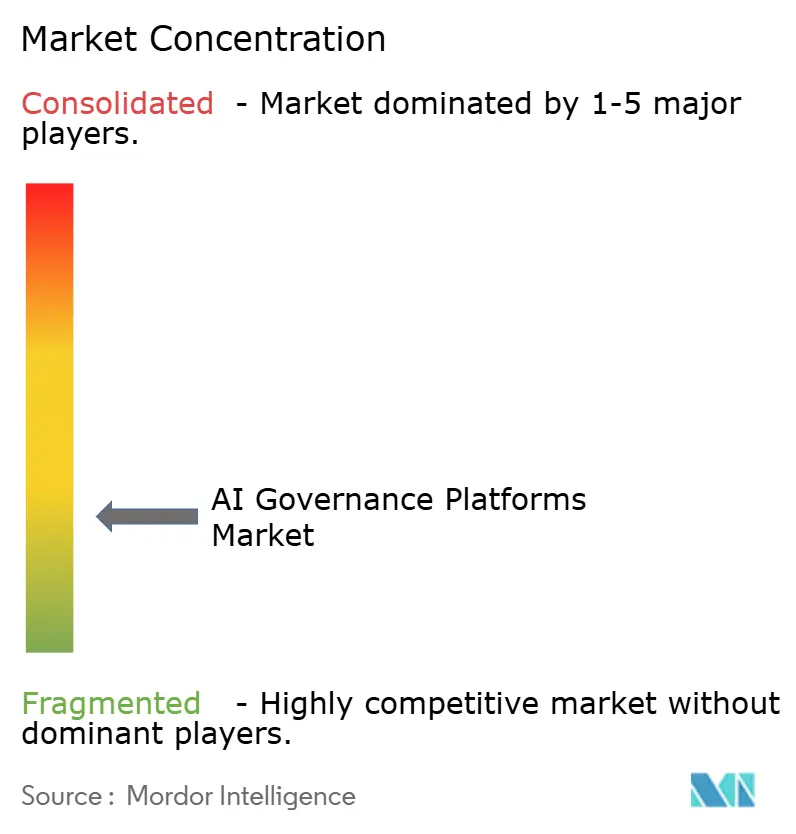
The AI Governance Platforms Market is fragmented among cloud providers, dedicated governance vendors, and enterprise software suppliers. Large cloud providers are embedding controls into agent infrastructure, while dedicated vendors focus on support across multiple cloud environments. This split gives buyers a choice between native integration and cross-vendor portability. Microsoft released its open-source Agent Governance Toolkit on April 2, 2026. Amazon Web Services announced capabilities to control agent behavior and cost in Amazon Bedrock AgentCore during 2026. Google also introduced its Gemini Enterprise Agent Platform in 2026. These releases show that agent governance is becoming a standard part of larger AI platforms.
Dedicated vendors such as OneTrust, Collibra, Credo AI, Holistic AI, and Monitaur compete by emphasizing multi-cloud controls and evidence that can be used across regulatory settings. ServiceNow expanded AI Control Tower in May 2026 with integrations across AWS, Google Cloud, Microsoft Azure, SAP, Oracle, and Workday. This strategy uses its existing enterprise workflow position to aggregate AI asset information and related controls. IBM announced an integration between watsonx. governance and Guardium AI Security in 2025, bringing governance and security functions into a single architecture. Credo AI announced an integration with Microsoft Azure AI Foundry in May 2025 to support policy, risk, and evaluation mappings. The AI Governance Platforms Market rewards suppliers that can fit into existing enterprise systems rather than requiring an entirely separate governance process.
A key area of competition is the production enforcement layer, which evaluates an agent's action before it proceeds. This layer must connect policy requirements with real operational decisions, while preserving records that users can review later. IBM’s 2025 announcement described validation against 12 regulatory frameworks, which illustrates the importance of mapping controls to external requirements. ISO/IEC 42001 alignment is also becoming relevant as buyers seek a recognized management system reference. The AI Governance Platforms Market does not provide sufficient share data for a numeric concentration score based on the combined holdings of the top suppliers. The competitive structure is consistent with moderate fragmentation because several cloud providers, dedicated vendors, and enterprise software firms remain active. Buyers will compare runtime enforcement, compliance mapping, identity controls, integration depth, and evidence portability. Suppliers that can demonstrate these capabilities with low operational burden will have a stronger position in regulated deployments.
AI Governance Platforms Industry Leaders
-
Salesforce, Inc.
-
Amazon Web Services, Inc.
-
Google LLC
-
Microsoft Corporation
-
IBM Corporation
- *Disclaimer: Major Players sorted in no particular order
AI Governance Platforms Market Companies Covered in this Report
- IBM Corporation
- Microsoft Corporation
- Google LLC
- Amazon Web Services, Inc.
- Salesforce, Inc.
- ServiceNow, Inc.
- Oracle Corporation
- SAP SE
- SAS Institute Inc.
- Fair Isaac Corporation
- Credo AI, Inc.
- OneTrust, LLC
- Collibra NV
- ModelOp, Inc.
- Holistic AI Limited
- Monitaur, LLC
- ArthurAI, Inc.
- Fiddler Labs, Inc.
- DataRobot, Inc.
- H2O.ai, Inc.
- Accenture plc
- Deloitte Touche Tohmatsu Limited
- PricewaterhouseCoopers International Limited
- Capgemini SE
Recent Industry Developments in AI Governance Platforms Market
- August 2026: EU AI Act transparency obligations under Article 50 entered operational effect on August 2, 2026
- July 2026: Germany’s KI-MIG took effect on July 29, 2026, designating the Bundesnetzagentur as the central AI market-surveillance and complaint authority, including an innovation sandbox that supports small and mid-sized enterprise AI development.
- July 2026: The Model Context Protocol specification updated to version 2026-07-28, adding enterprise-scale stateless operations, task management for long-running agent workflows, and enterprise-managed identity.
- June 2026: The Financial Stability Board published a consultation report proposing 12 sound practices for responsible AI adoption in financial institutions.
Global AI Governance Platforms Market Report Scope
The AI governance platforms market refers to software suites, runtime guardrails, and monitoring tools designed to manage the risks, compliance, and performance of AI systems. Deployed via cloud, on-premises, or hybrid models, these solutions help organizations ensure their AI models operate securely, transparently, and in accordance with evolving regulatory standards across various industries.
The AI Governance Platforms Market Report is Segmented by Offering (Governance Platforms and Software Suites, Runtime Guardrails and Agent Control Planes, AI Observability, Evaluation, and Monitoring Tools, and AI Risk, Compliance, and Evidence Services), Deployment (Cloud, On-Premises, and Hybrid), Organization Size (Large Enterprises and Small and Mid-Sized Enterprises), Industry (Banking, Financial Services, and Insurance, Healthcare and Life Sciences, Information Technology and Telecommunications, Retail and E-Commerce, Government and Public Sector, Automotive, Energy and Utilities, Logistics and Transportation, Media and Entertainment, and Other Industries), and Geography (North America, South America, Europe, Asia-Pacific, Middle East, and Africa). The Market Forecasts are Provided in Terms of Value (USD).
Segmentation Overview
| Governance Platforms and Software Suites |
| Runtime Guardrails and Agent Control Planes |
| AI Observability, Evaluation, and Monitoring Tools |
| AI Risk, Compliance, and Evidence Services |
| Cloud |
| On premise |
| Hybrid |
| Large Enterprises |
| Small and Mid-Sized Enterprises |
| Banking, Financial Services, and Insurance |
| Healthcare and Life Sciences |
| Information Technology and Telecommunications |
| Retail and E-Commerce |
| Government and Public Sector |
| Automotive |
| Energy and Utilities |
| Logistics and Transportation |
| Media and Entertainment |
| Other Industries |
| North America | United States |
| Canada | |
| Mexico | |
| South America | Brazil |
| Argentina | |
| Chile | |
| Rest of South America | |
| Europe | Germany |
| United Kingdom | |
| France | |
| Italy | |
| Spain | |
| Rest of Europe | |
| Asia-Pacific | China |
| Japan | |
| India | |
| South Korea | |
| Australia | |
| Rest of Asia-Pacific | |
| Middle East | United Arab Emirates |
| Saudi Arabia | |
| Qatar | |
| Rest of Middle East | |
| Africa | South Africa |
| Egypt | |
| Nigeria | |
| Rest of Africa |
| By Offering | Governance Platforms and Software Suites | |
| Runtime Guardrails and Agent Control Planes | ||
| AI Observability, Evaluation, and Monitoring Tools | ||
| AI Risk, Compliance, and Evidence Services | ||
| By Deployment | Cloud | |
| On premise | ||
| Hybrid | ||
| By Organization Size | Large Enterprises | |
| Small and Mid-Sized Enterprises | ||
| By Industry | Banking, Financial Services, and Insurance | |
| Healthcare and Life Sciences | ||
| Information Technology and Telecommunications | ||
| Retail and E-Commerce | ||
| Government and Public Sector | ||
| Automotive | ||
| Energy and Utilities | ||
| Logistics and Transportation | ||
| Media and Entertainment | ||
| Other Industries | ||
| By Geography | North America | United States |
| Canada | ||
| Mexico | ||
| South America | Brazil | |
| Argentina | ||
| Chile | ||
| Rest of South America | ||
| Europe | Germany | |
| United Kingdom | ||
| France | ||
| Italy | ||
| Spain | ||
| Rest of Europe | ||
| Asia-Pacific | China | |
| Japan | ||
| India | ||
| South Korea | ||
| Australia | ||
| Rest of Asia-Pacific | ||
| Middle East | United Arab Emirates | |
| Saudi Arabia | ||
| Qatar | ||
| Rest of Middle East | ||
| Africa | South Africa | |
| Egypt | ||
| Nigeria | ||
| Rest of Africa | ||
Key Questions Answered in the Report
What is the projected value of AI governance platforms by 2031?
The AI governance platform Market is forecast to reach USD 2.38 billion by 2031, up from USD 0.80 billion in 2026. This expansion reflects demand for systems that connect policies with operational evidence.
What is driving growth in AI governance platforms?
Regulatory enforcement, agent deployment, and the need for continuous decision records are supporting adoption. The category is forecast to grow at 24.21% CAGR from 2026 to 2031, as users seek practical controls for high-impact decisions.
Which AI governance offering is growing fastest?
Runtime guardrails and agent control planes are forecast to grow at 24.91% CAGR through 2031. They address the need to apply policies before agents make tool calls or complete sensitive actions.
Why is cloud deployment important for AI governance?
Cloud deployment held 61.28% share in 2025 because it supports centralized policy controls across managed AI services and enterprise accounts. It can also reduce repeated configuration across teams and cloud accounts.
Which organizations are the largest buyers of AI governance tools?
Large enterprises held 76.38% share in 2025 because they operate more AI systems and face broader integration and compliance requirements. Their needs span legal, risk, data, security, and engineering functions.
Which sectors are adopting AI governance platforms fastest?
Healthcare and life sciences are forecast to grow at 25.01% CAGR through 2031, while banking, financial services, and insurance held the largest 2025 share at 40.11%. Both sectors require consistent records for regulated AI decisions.