
AI Content Personalization Market Size and Share
Market Overview
| Study Period | 2020 - 2031 |
|---|---|
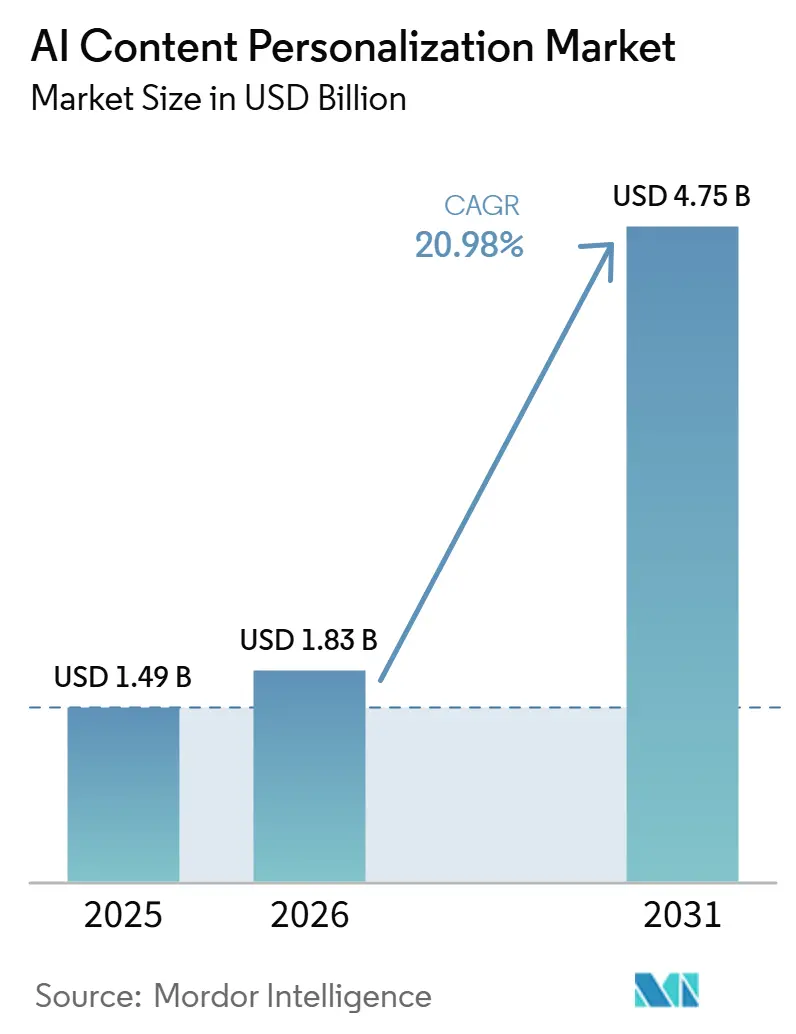
| Market Size (2026) | USD 1.83 Billion |
| Market Size (2031) | USD 4.75 Billion |
| Growth Rate (2026 - 2031) | 20.98 % |
| Fastest Growing Market | Asia-Pacific |
| Largest Market | North America |
| Market Concentration | Medium |
Major Players *Disclaimer: Major Players sorted in no particular order Image © Mordor Intelligence. Reuse requires attribution under CC BY 4.0. | |
AI Content Personalization Market Analysis by Mordor Intelligence
The AI content personalization market size is projected to expand from USD 1.49 billion in 2025 and USD 1.83 billion in 2026 to USD 4.75 billion by 2031, registering a CAGR of 20.98% between 2026 and 2031. The AI content personalization market is being shaped by streaming services that now place more weight on retention and profitable engagement than subscriber additions. Personalized matching tools can help platforms connect viewers with relevant programming and reduce the risk of user churn. The same capabilities are moving beyond streaming as retailers, financial services providers, and telecom companies assemble more tailored digital experiences. Competition is separating large technology platforms with broad data resources from specialist suppliers that offer ready-to-deploy recommendation systems. This creates opportunities for providers to support complex customer journeys without imposing heavy implementation demands.
Key Report Takeaways
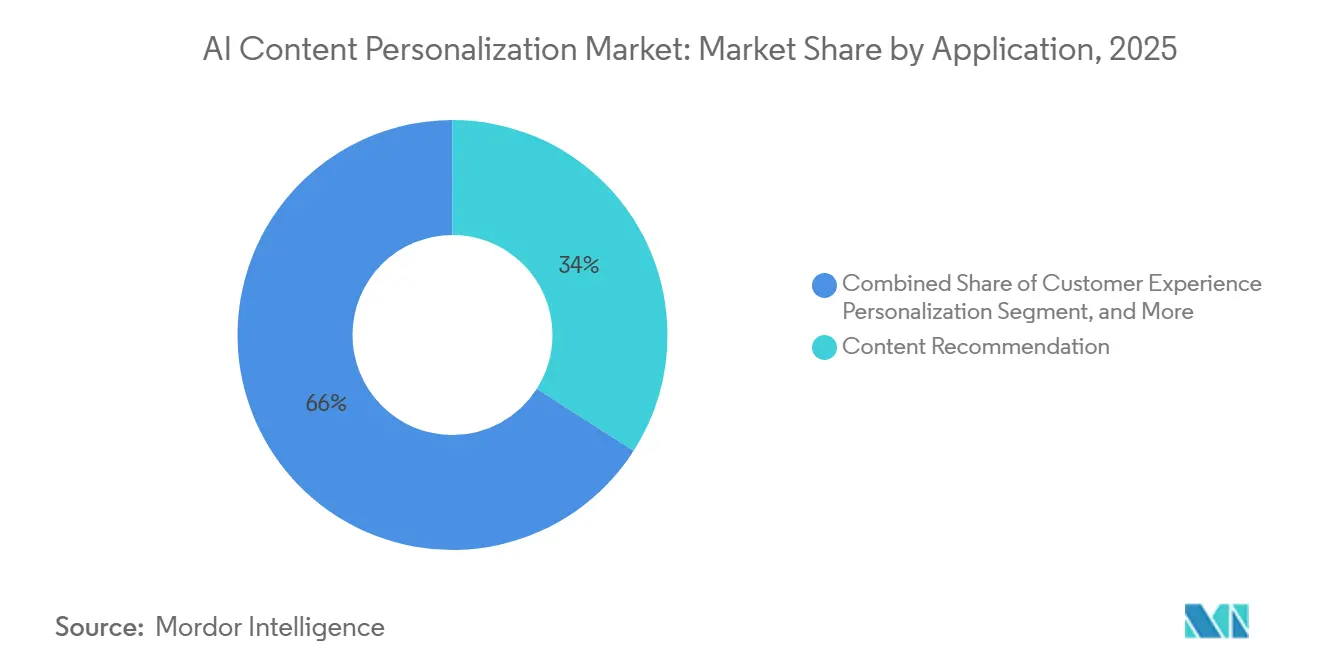
- By application, content recommendation held 34.04% of the AI content personalization market share in 2025, while customer experience personalization is projected to expand at a CAGR of 21.08% through 2031.
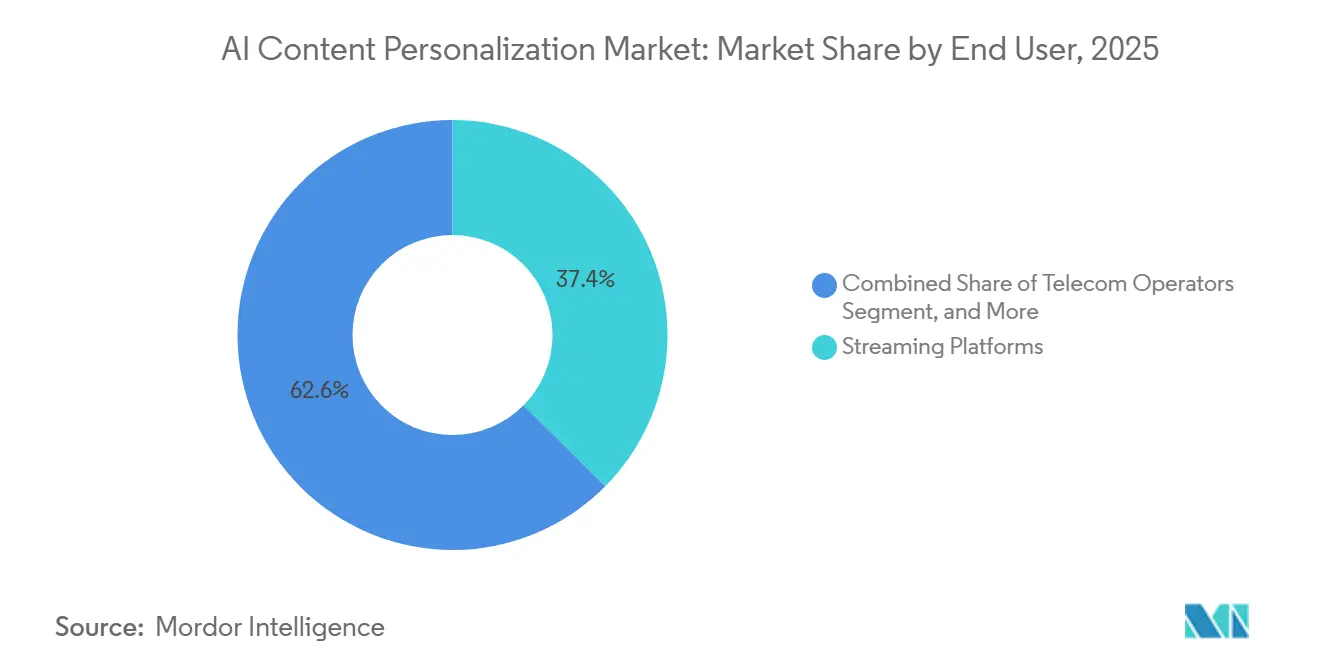
- By end user, streaming platforms held 37.42% of the AI content personalization market share in 2025, while digital platforms are projected to expand at a CAGR of 21.89% through 2031.
- By geography, North America accounted for 42.76% of revenue in 2025 for the artificial intelligence (AI) content personalization market, while Asia-Pacific is projected to expand at a CAGR of 21.73% through 2031.
Note: Market size and forecast figures in this report are generated using Mordor Intelligence’s proprietary estimation framework, updated with the latest available data and insights as of January 2026.
Market Trends and Insights
Drivers Impact Analysis of AI Content Personalization Market*
| Driver | (~) % Impact on CAGR Forecast | Geographic Relevance | Impact Timeline |
|---|---|---|---|
| Rising Demand for Hyper-Personalized Viewer Journeys | +4.5% | Global | Short term (≤ 2 years) |
| GenAI-Assisted Creative and Row Generation | +4.0% | North America, Asia-Pacific | Short term (≤ 2 years) |
| Expansion of Real-Time Behavioral Decisioning | +3.5% | North America and Europe | Medium term (2-4 years) |
| Rapid Adoption of Hybrid Recommendation Architectures | +3.0% | North America, Asia-Pacific | Short term (≤ 2 years) |
| Growing Need to Monetize Long-Tail Content Catalogs | +2.5% | Global | Medium term (2-4 years) |
| Demand for Privacy-First Personalization Architectures | +1.8% | North America and Europe | Medium term (2-4 years) |
| Source: Mordor Intelligence | |||
Rising Demand for Hyper-Personalized Viewer Journeys
Catalog growth is making generic content carousels less useful for many viewers, especially when several services compete for the same attention. Deloitte's 2026 survey found that 22% of fans would use streaming video services more if they offered generative AI-based recommendations. Nearly 30% of respondents also wanted a personalized digest that combined streaming, social, and intellectual-property news. The underlying business case is strongest when recommendations help viewers complete more of the content they begin. Localized models can also give regional services a stronger basis for competing when language, viewing habits, and catalog preferences differ from those in Western training data. This makes the AI content personalization market important to services seeking to protect engagement as their libraries become broader and more varied.
GenAI-Assisted Creative and Row Generation
Generative AI is moving from an experimental feature toward a practical way to build streaming homepages. Netflix's GenPage uses viewing history and request context to generate rows, entities, and page layouts into a single, structured output.[1]Netflix Technology Blog, “GenPage: Towards End-to-End Generative Homepage Construction at Netflix,” Netflix Technology Blog, netflixtechblog.com Netflix reported a 20% reduction in end-to-end serving latency and a statistically significant improvement in its core engagement metric during online A/B testing. Its offline work also found that prompt enrichment reduced the weighted binary classification loss by 6.9%, outperforming simply scaling model capacity. These approaches allow services to tailor row names, artwork, and page structure without depending on a separate human editorial process for every variation. The artificial intelligence (AI) content personalization market therefore benefits as operators seek more detailed personalization without slower page load times.
Expansion of Real-Time Behavioral Decisioning
Real-time behavioral decisioning transforms personalization from a fixed recommendation list into an interface that responds in real time during a live session. Platforms can use signals such as scroll depth, hover time, pause behavior, and device switches to adjust layout, messages, and offer timing. A unified first-party data layer is needed to connect customer data platforms, customer relationship systems, and content management tools. Adobe introduced CX Enterprise at Adobe Summit 2026 with Brand Intelligence and Engagement Intelligence capabilities that support this approach. Salesforce's proposed acquisition of Contentful is intended to connect customer data with content assembly across channels. The AI content personalization market benefits from this convergence as customer data systems and media-focused personalization systems become more closely connected.
Rapid Adoption of Hybrid Recommendation Architectures
Hybrid systems combine collaborative filtering, content-based models, and large language model embeddings in one serving environment. They address a long-standing weakness of single-method systems, which often have less useful outputs for new users or newly released content. Research on cold-start recommendation identified large language model integration as a useful route for sparse-data settings, where semantic content information can supplement limited behavioral signals. The AI content personalization market is relevant to smaller streaming operators and telecom IPTV providers that have less proprietary behavioral data than the largest platforms. Research on LLMTreeRec also reported performance competitive with that of conventional deep recommendation models on the Huawei system. As these systems become easier to deploy, the AI content personalization market can extend beyond the largest streaming providers.
Restraints Impact Analysis of AI Content Personalization Market*
| Restraint | (~) % Impact on CAGR Forecast | Geographic Relevance | Impact Timeline |
|---|---|---|---|
| Data Residency and Consent Complexity | -2.2% | North America and Europe | Medium term (2-4 years) |
| High Integration Effort Across CMS, CRM, CDP, and Ad Tech Stacks | -1.8% | Global | Medium term (2-4 years) |
| Cold-Start Accuracy Gaps for New Users and New Titles | -1.4% | Global | Short term (≤ 2 years) |
| Personalization Fatigue and Perceived Manipulation Risk | -0.8% | North America and Europe | Long term (≥ 4 years) |
| Source: Mordor Intelligence | |||
Data Residency and Consent Complexity
Data residency and consent requirements can limit the behavioral information available to personalization systems. The European Data Protection Board's 2025 guidance on the Digital Services Act and GDPR states that tracking-based profiling requires explicit consent and that recommender systems must provide non-profiling options.[2]European Data Protection Board, “Guidelines 3/2025 on the Interplay Between the Digital Services Act and the GDPR,” European Data Protection Board, edpb.europa.eu Operators that rely only on consented first-party signals can have less data for training than systems built on broader behavioral graphs. A study of GDPR-compliant recommender systems found that, on average, more than 30 user interactions were needed before compelling predictions could be generated. The AI content personalization market can face a longer cold-start period for new users and create a greater burden for operators entering additional jurisdictions. The AI content personalization market must therefore support useful experiences while allowing customers to make meaningful privacy choices.
High Integration Effort Across CMS, CRM, CDP, and Ad Tech Stacks
Large deployments often require personalization software to exchange data with content management systems, customer relationship platforms, customer data platforms, and advertising tools. These systems are frequently built separately and may not have been designed for real-time data interchange. Adobe launched the Adobe Experience Platform Agent Orchestrator in March 2025, with 10 purpose-built AI agents and integration partnerships, to reduce this friction. IBM and Salesforce have also described zero-copy data activation for IBM Z environments, which is intended to enrich customer profiles without moving data. Mid-sized media operators can face a larger challenge because they often lack specialist engineering teams. Inconsistent consent signals across advertising technology systems can further weaken personalization quality and slow deployments in the AI content personalization market.
*Our forecasts treat driver/restraint impacts as directional, not additive. The impact forecasts reflect baseline growth, mix effects, and variable interactions.
AI Content Personalization Market Segment Analysis
By Application:
Recommendation Infrastructure Supports Current RevenueContent recommendation accounted for 34.04% of the AI content personalization market size in 2025. Its position reflects the value of accumulated interaction data, because each additional session can strengthen collaborative filtering signals. That data advantage can make it more difficult for later entrants to match established recommendation quality. Customer experience personalization is projected to grow at a CAGR of 21.08% from 2026 to 2031. This shift reflects a move from standalone content rows to session-wide adjustments across homepages, navigation, and search. Netflix's GenPage illustrates page-level generation, while Adobe's CX Enterprise represents a broader approach to customer experience orchestration. The AI content personalization market is moving toward a broader definition of personalization that encompasses the surrounding experience rather than just the title selected for a viewer.
Marketing and advertising personalization also benefits from the growing use of consent-based first-party signals as third-party cookie pools become less central. Taboola's Realize+ uses a decision engine for cross-campaign budget decisions and an element generator for creative and targeting optimization. Audience analytics supports these applications by gathering signals and feeding them back into the optimization process. It is consequently an enabling layer rather than a separate experience for many buyers. Other applications include voice assistant personalization and interactive content adaptation, which remain less developed at a commercial scale. Connected television settings may provide rich behavioral signals beyond traditional screen sessions. The AI content personalization industry can also serve enterprise learning, healthcare content portals, and financial services, where streaming-derived methods may support higher-value engagements. These adjacent uses broaden the commercial role of core personalization capabilities.



By End User:
Streaming Platforms Lead While Digital Platforms ExpandStreaming platforms accounted for 37.42% of the AI content personalization market in 2025. Their position is supported by direct access to first-party viewing data, subscription relationships, and control over the content catalog. These three elements make the return from personalization more visible to operators. Digital platforms are projected to grow at a CAGR of 21.89% from 2026 to 2031. Their expansion reflects use across social commerce, short-form video, and interactive media, where frequent sessions produce dense behavioral signals. Deloitte found that 70% of Gen Z and millennial respondents were willing to share their browsing, purchase, and app usage data for more useful, personalized experiences. This provides digital platforms with a consent-based basis for training personalization models even without a subscription relationship.
AnyMind Group introduced AnyAI Video in June 2026 to combine AI-generated social commerce video with live-streaming recommendation signals across brand channels in Asia. Broadcaster and cable networks are also moving from broad audience segmentation toward streaming-style personalization to protect viewing time and advertising yield. ThinkAnalytics launched ThinkMediaAI in February 2025 as a unified platform for content monetization, contextual advertising, and recommendations. Telecom operators have household-level IPTV and bundled OTT data that can improve discovery across multiple screens. Other users include enterprise learning services and patient engagement portals that adapt media-centered techniques to their own content. This demand gives the AI content personalization market a broader group of buyers than streaming alone. The artificial intelligence (AI) content personalization market has a common requirement for matching useful content across an increasing number of digital touchpoints.
Geography Analysis
North America AI Content Personalization Market
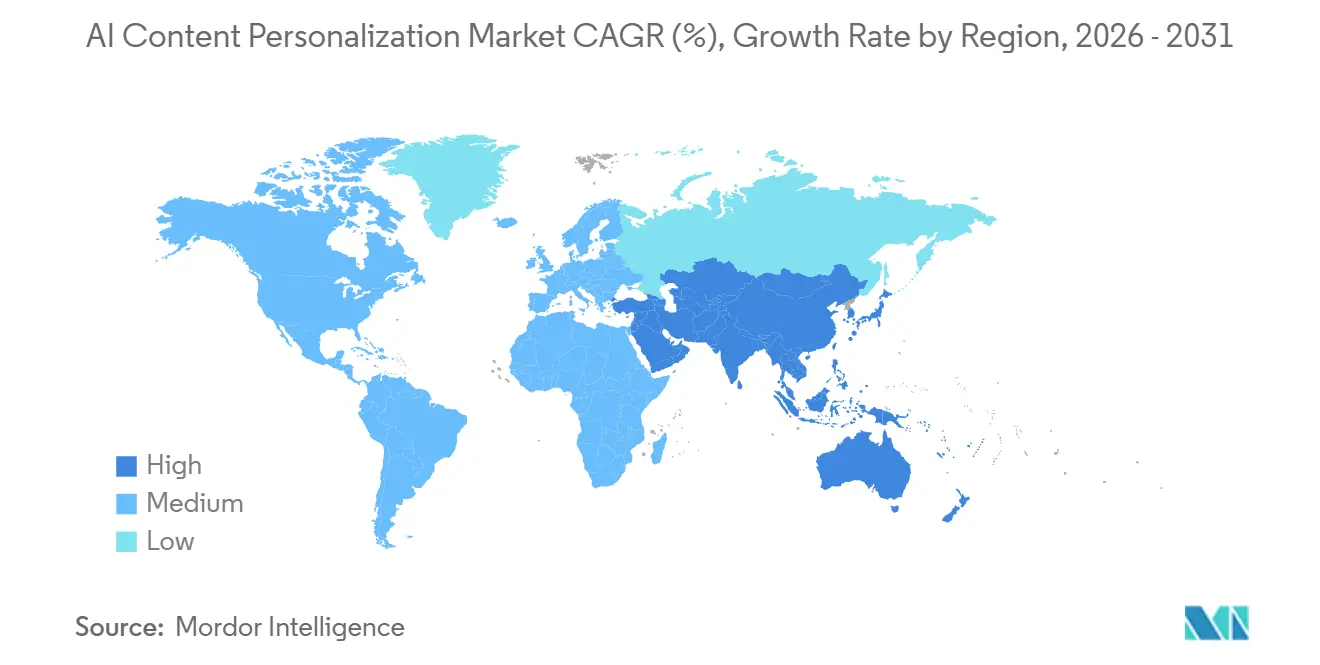
North America held 42.76% share of the regional total in 2025. The region benefits from concentrated technology research and development spending and large subscription video revenue pools. Deloitte reported that nearly 90% of US households subscribed to an average of 4 subscription video services. In this mature AI content personalization market, engagement quality and retention are central competitive issues. Programmatic advertising systems also support closer links between personalized discovery and advertising yield.
APAC AI Content Personalization Market
Asia-Pacific is projected to be the fastest-growing region, with a CAGR of 21.73% from 2026 to 2031. Growth is supported by expanding OTT services in India, South Korea, Japan, and Australia, as well as by stronger AI engineering capabilities across the region. Media Partners Asia projected that India will surpass China as the largest subscription video market by 2030, with 358 million individual subscriptions. India presents a demanding localization setting because regional-language viewing accounts for a major share of OTT consumption. AI systems are being used for subtitles, electronic program guide descriptions, and caption translation across Indian languages. China's domestic video platforms are also developing generative recommendation and live-streaming personalization systems that could compete in South and Southeast Asia.
EMEA and South America AI Content Personalization Market
Europe and South America were the third- and fourth-largest regional markets, respectively. European adoption is moderated by privacy and transparency requirements, although Germany and the United Kingdom remain important centers for privacy-compliant personalization. A 2025 BVDW study found that 41% of German internet users were willing to share their usage data to improve content recommendations.[3]Bundesverband Digitale Wirtschaft, “Let's Get Personal, Personalization Study,” BVDW, bvdw.org South America, led by Brazil, is building personalization capacity alongside OTT expansion and local-language programming. The Middle East and Africa remain early-stage markets, though media digitalization in Saudi Arabia and broader OTT adoption in South Africa support longer-term demand. These regional differences require the artificial intelligence (AI) content personalization market to combine localization, data governance, and operational simplicity.

Competitive Landscape
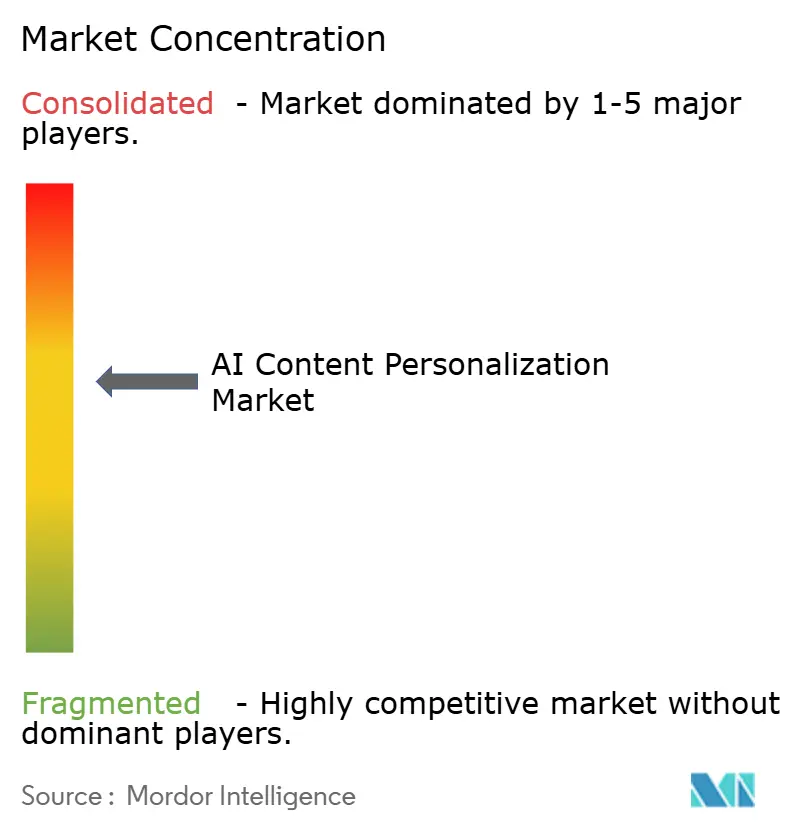
The AI content personalization market has a moderately concentrated vendor supply structure. Large technology platforms operate alongside specialist suppliers focused on media and digital experiences. Adobe, Salesforce, and Oracle are building wider platforms that combine data management, content assembly, and campaign execution. This can reduce the number of separate systems an enterprise must connect. Adobe introduced CX Enterprise Coworker in April 2026 with open standards, including Model Context Protocol and Agent2Agent.[4]Adobe, “Adobe Launches Adobe Experience Platform Agent Orchestrator for Businesses to Activate AI Agents in Customer Experiences and Marketing Workflows,” Adobe Newsroom, adobe.com Its NVIDIA partnership also addresses governed deployment in regulated settings.
Proprietary interaction data remains an important competitive asset as access to foundation models becomes less distinctive. Bloomreach launched Loomi Marketing Agent for general availability in June 2026, using commerce-oriented interaction data to turn one prompt into a campaign workflow. Specialist vendors such as ThinkAnalytics, ContentWise, Viaccess-Orca, and Kaltura compete through media-specific functions and lower implementation requirements. ThinkMediaAI expanded ThinkAnalytics' focus from recommendations to content monetization and contextual advertising. Kaltura added integrations with Adobe Experience Manager and WordPress in April 2026, along with conversational avatars and video intelligence capabilities. These moves show that vendors are seeking a larger role in daily content operations.
Taboola launched Realize+ in April 2026 for publisher-side advertising decisioning and creative optimization. Its database of 9,000 publisher integrations gives it behavioral signal depth that individual operators may not have. Emerging suppliers are also exploring on-device inference to limit data residency concerns. The AI content personalization market is still early in this space, but it could become more relevant in environments with strict privacy requirements. The artificial intelligence (AI) content personalization market will continue to reward suppliers that combine strong domain data with clear integration paths. Buyers in the AI content personalization market will assess whether a broad enterprise platform or a media-focused provider better fits their data resources and operating model.
AI Content Personalization Industry Leaders
Netflix, Inc.
Amazon.com, Inc.
Alphabet Inc.
Adobe Inc.
Salesforce, Inc.
- *Disclaimer: Major Players sorted in no particular order
AI Content Personalization Market Companies Covered in this Report
- Netflix, Inc.
- Amazon.com, Inc.
- Alphabet Inc.
- Adobe Inc.
- International Business Machines Corporation
- Salesforce, Inc.
- Oracle Corporation
- Sitecore A/S
- Bloomreach, Inc.
- Taboola.com Ltd.
- Outbrain Inc.
- Revcontent, Inc.
- ThinkAnalytics Ltd.
- Kaltura, Inc.
- Brightcove Inc.
- Viaccess-Orca
- Dynamic Yield (Mastercard)
- Wurl, LLC
- ContentWise S.r.l.
- Personyze Ltd.

Recent Industry Developments in AI Content Personalization Market
- July 2026: Netflix published GenPage on its technology blog, disclosing an end-to-end generative AI homepage construction system that autoregressively generates rows, entities, and page layout in a single model inference pass. GenPage delivered a statistically significant lift on Netflix's core user engagement metric and a 20% reduction in end-to-end serving latency relative to its prior multi-stage production recommender in online A/B testing.
- July 2026: Oracle introduced an AI-native builder experience for Oracle AI Agent Studio for Fusion Applications, enabling customers and partners to create and run agentic applications that reason, coordinate, and decide within Oracle Fusion Cloud, directly expanding the enterprise AI personalization stack for CRM-connected experience deployment.
- June 2026: Bloomreach announced the general availability of its Loomi Marketing Agent, enabling marketers to convert a single prompt into a fully built campaign workflow spanning content creation, audience segmentation, journey orchestration, and AI-optimized message timing. The agent is trained on more than 12 years of interaction data from global e-commerce brands.
- June 2026: Salesforce signed a definitive agreement to acquire Fin, formerly Intercom, an AI-native customer agent platform, for USD 3.6 billion, to expand Agentforce's autonomous agent capabilities across customer service operations and add fast-to-value deployment options for small and medium-sized business customers.


Global AI Content Personalization Market Report Scope
The AI Content Personalization Market is the global industry focused on developing and deploying artificial intelligence (AI)-driven technologies that analyze user behavior, preferences, contextual signals, and engagement patterns to deliver highly personalized digital content and experiences. The market encompasses AI-powered solutions that leverage machine learning, deep learning, natural language processing (NLP), predictive analytics, and generative AI to optimize content discovery, recommendations, customer interactions, and audience engagement across digital platforms.
The AI Content Personalization Market Report is Segmented by Application (Content Recommendation, Marketing and Advertising Personalization, Customer Experience Personalization, Audience Analytics, and Other Applications), End User (Streaming Platforms, Broadcaster and Cable Networks, Telecom Operators, Digital Platforms, and Other End Users), and Geography (North America, South America, Europe, Asia-Pacific, Middle East, and Africa). The Market Forecasts Provided in Terms of Value (USD).
| Content Recommendation |
| Marketing and Advertising Personalization |
| Customer Experience Personalization |
| Audience Analytics |
| Other Applications |
| Streaming Platforms |
| Broadcaster and Cable Networks |
| Telecom Operators |
| Digital Platforms |
| Other End Users |
| North America | United States |
| Canada | |
| Mexico | |
| South America | Brazil |
| Argentina | |
| Chile | |
| Rest of South America | |
| Europe | Germany |
| United Kingdom | |
| France | |
| Italy | |
| Spain | |
| Rest of Europe | |
| Asia-Pacific | China |
| Japan | |
| India | |
| South Korea | |
| Australia | |
| Rest of Asia-Pacific | |
| Middle East | Saudi Arabia |
| United Arab Emirates | |
| Qatar | |
| Rest of Middle East | |
| Africa | South Africa |
| Egypt | |
| Nigeria | |
| Rest of Africa |
| By Application | Content Recommendation | |
| Marketing and Advertising Personalization | ||
| Customer Experience Personalization | ||
| Audience Analytics | ||
| Other Applications | ||
| By End User | Streaming Platforms | |
| Broadcaster and Cable Networks | ||
| Telecom Operators | ||
| Digital Platforms | ||
| Other End Users | ||
| By Geography | North America | United States |
| Canada | ||
| Mexico | ||
| South America | Brazil | |
| Argentina | ||
| Chile | ||
| Rest of South America | ||
| Europe | Germany | |
| United Kingdom | ||
| France | ||
| Italy | ||
| Spain | ||
| Rest of Europe | ||
| Asia-Pacific | China | |
| Japan | ||
| India | ||
| South Korea | ||
| Australia | ||
| Rest of Asia-Pacific | ||
| Middle East | Saudi Arabia | |
| United Arab Emirates | ||
| Qatar | ||
| Rest of Middle East | ||
| Africa | South Africa | |
| Egypt | ||
| Nigeria | ||
| Rest of Africa | ||


Key Questions Answered in the Report
What is the AI content personalization market size?
The market size is USD 1.83 billion in 2026 and is projected to reach USD 4.75 billion by 2031 at a CAGR of 20.98%.
What application leads AI content personalization adoption?
Content recommendation led with 34.04% share in 2025, supported by its direct role in content discovery and viewer engagement.
Which end user is expected to grow fastest?
Digital platforms are projected to grow at a CAGR of 21.89% through 2031 as personalization extends across social commerce, short-form video, and interactive media.
Which region is growing fastest for AI content personalization?
Asia-Pacific is projected to record a CAGR of 21.73% from 2026 to 2031, supported by OTT expansion and regional AI capabilities.
What limits deployment of AI content personalization?
Privacy rules, consent requirements, data residency, and difficult integration across content, customer, data, and advertising systems can delay deployments.
How are vendors differentiating their offerings?
Vendors are combining proprietary interaction data, generative AI, real-time decisioning, and integrations that reduce the effort needed to deploy tailored experiences.
Page last updated on:





