
AI Budget Allocation Software Market Size and Share
Market Overview
| Study Period | 2020 - 2031 |
|---|---|
| Market Size (2026) | USD 2.07 Billion |
| Market Size (2031) | USD 7.44 Billion |
| Growth Rate (2026 - 2031) | 29.07 % |
| Fastest Growing Market | Asia-Pacific |
| Largest Market | North America |
| Market Concentration | Low |
Major Players *Disclaimer: Major Players sorted in no particular order Image © Mordor Intelligence. Reuse requires attribution under CC BY 4.0. | |
AI Budget Allocation Software Market Analysis by Mordor Intelligence
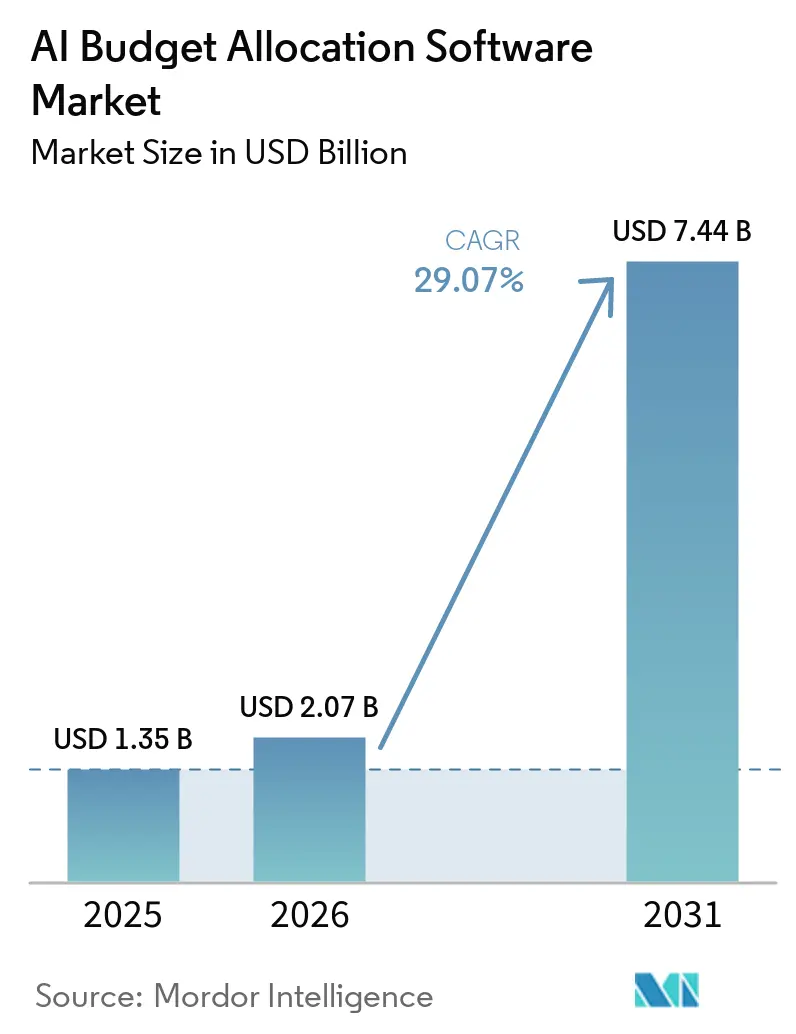
The AI budget allocation software market size is projected to expand from USD 1.35 billion in 2025 and USD 2.07 billion in 2026 to USD 7.44 billion by 2031, registering a CAGR of 29.07% between 2026 and 2031. Demand is moving toward systems that integrate forecasts, spending decisions, and operational data into a single planning process. Finance teams are paying closer attention to tools that can adjust allocations as cost, demand, and performance information change. This shift favors platforms that support continuous planning rather than an annual budget prepared in separate spreadsheets. Product competition is also becoming more focused on governance, traceability, and integration with finance systems. The AI budget allocation software market, therefore, has room for both planning specialists and larger software vendors that can combine planning with established enterprise workflows, including the controls, data connections, and planning routines needed by finance teams across each business unit.
Key Report Takeaways
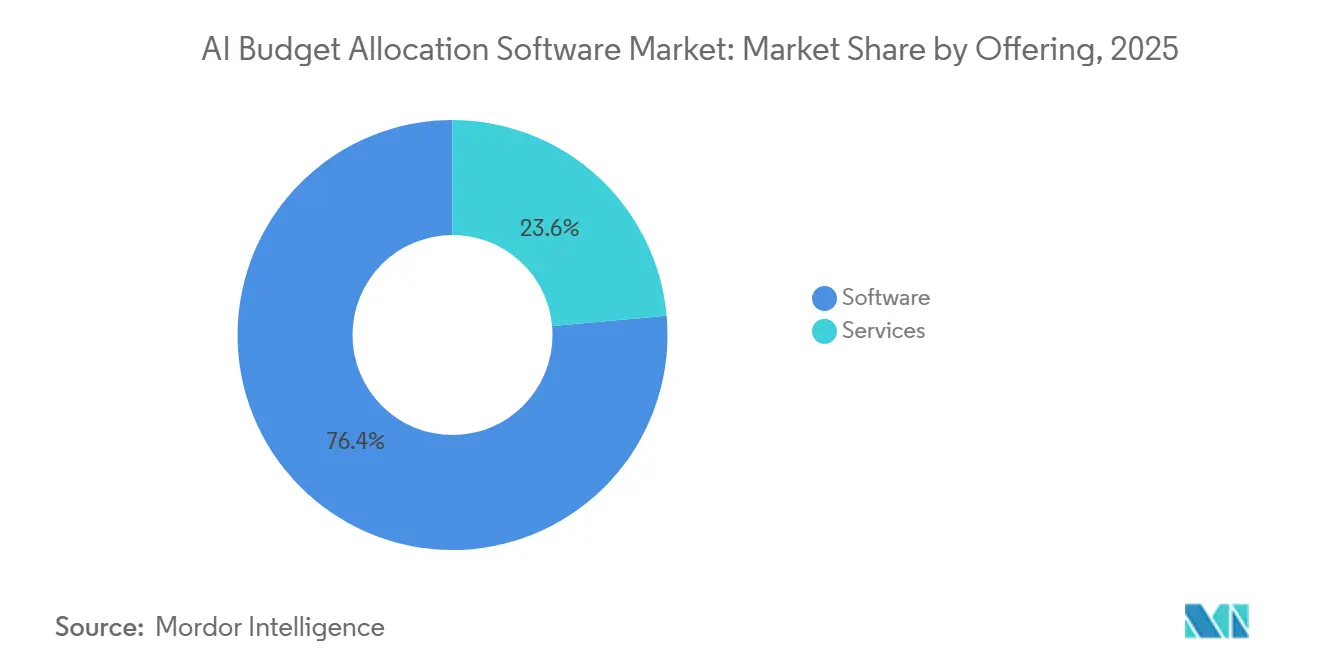
- By offering, software held 76.43% of revenue in 2025, while services are projected to expand at a 29.47% CAGR through 2031 in the AI budget allocation software market.
- By deployment, cloud-based systems held 71.87% of revenue in 2025, while hybrid deployment is projected to expand at a 29.66% CAGR through 2031 in the AI budget allocation software market.
- By organization size, large enterprises held 64.36% of revenue in 2025, while small and medium-sized enterprises are projected to expand at a 29.41% CAGR through 2031 in the AI budget allocation software market.
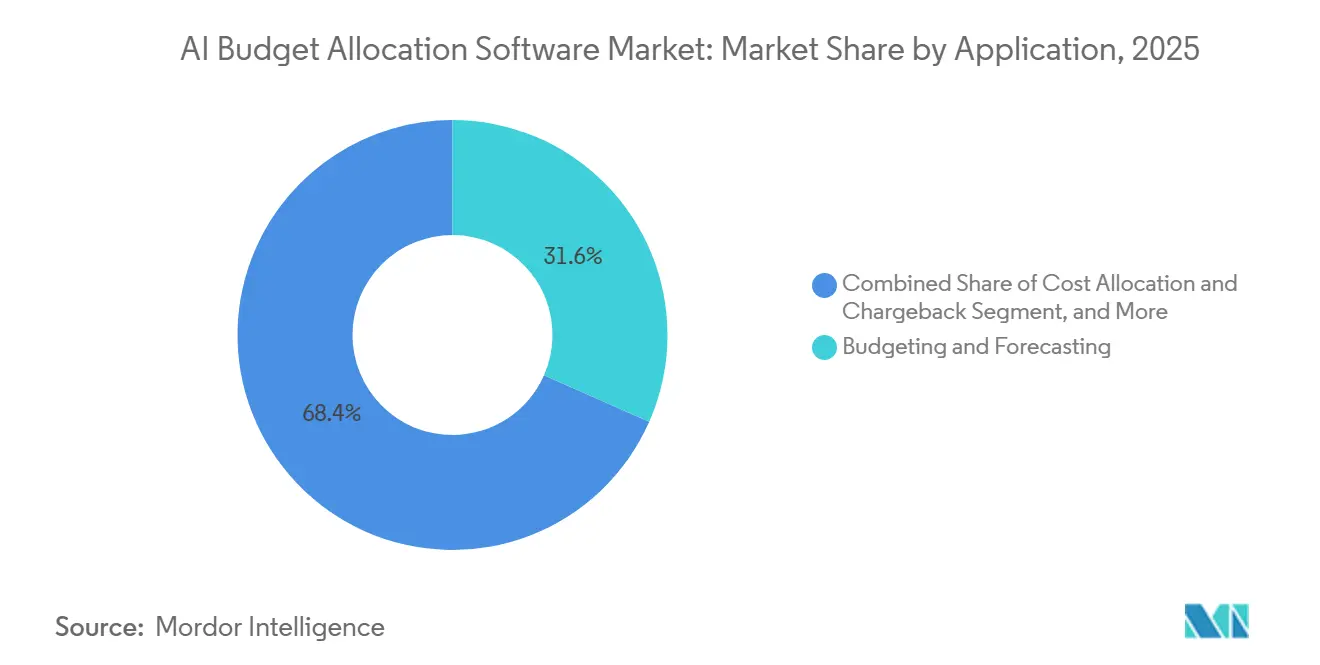
- By application, budgeting and forecasting accounted for 31.61% of revenue in 2025, while marketing-mix and media budget optimization are projected to expand at a 30.18% CAGR through 2031.
- By end-user industry, BFSI accounted for 27.84% of revenue in 2025, while healthcare and life sciences are projected to expand at a 30.38% CAGR through 2031.
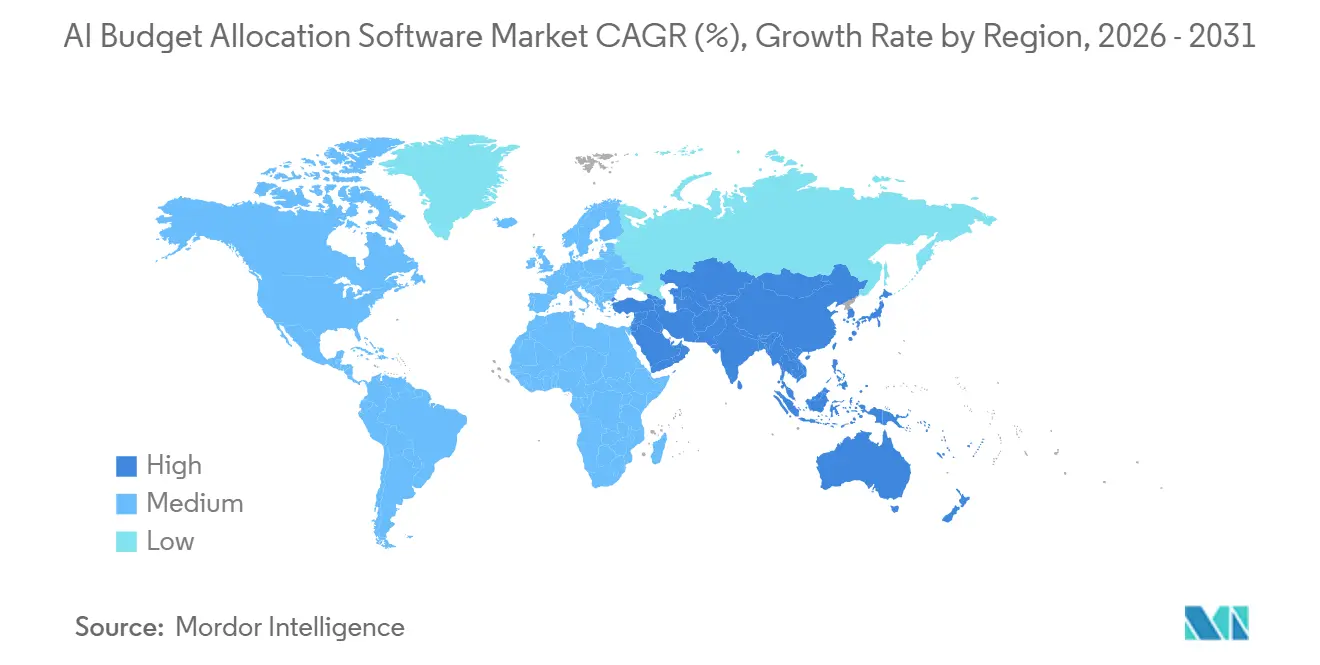
- By geography, North America held 42.74% of the AI budget allocation software market in 2025, while Asia-Pacific is projected to expand at a 30.12% CAGR through 2031.
Note: Market size and forecast figures in this report are generated using Mordor Intelligence’s proprietary estimation framework, updated with the latest available data and insights as of January 2026.
Market Trends and Insights
Drivers Impact Analysis of AI Budget Allocation Software Market*
| Driver | (~) % Impact on CAGR Forecast | Geographic Relevance | Impact Timeline |
|---|---|---|---|
| Predictive and Autonomous Budget Reallocation | +5.2% | Global | Medium term (2-4 years) |
| Cloud-Based Connected Planning Replacing Spreadsheet Workflows | +4.8% | Global, with highest intensity in North America and Europe | Short term (≤ 2 years) |
| Real-Time Visibility Into Multi-Cloud and AI Consumption Spend | +3.6% | North America and Asia-Pacific | Short term (≤ 2 years) |
| CFO Demand for Continuous Forecasting and Scenario Planning | +3.2% | Global | Medium term (2-4 years) |
| Open Banking and API Connectivity Expanding Data Availability | +2.5% | Europe, Asia-Pacific, and South America | Medium term (2-4 years) |
| Embedded Budget Optimization in Banking, ERP, and Marketing Platforms | +2.1% | North America and Europe, with spillover to Asia-Pacific | Long term (≥ 4 years) |
| Source: Mordor Intelligence | |||
Adoption of Predictive and Autonomous Budget Reallocation
Continuous budget reallocation is changing the role of finance teams from reporting past results to managing decisions as conditions change. A 2026 PYMNTS Intelligence study reported that 43% of CFOs expected a high impact from AI agents that continuously reallocate budgets using current cost data, while 47% expected a moderate impact. This expectation reflects a practical need to work with current cost signals instead of waiting for a monthly or quarterly review to identify a material variance. The AI budget allocation software market benefits when recurring allocation tasks move from periodic manual reviews into governed system workflows. Finance staff can then focus more of their time on exceptions, capital choices, and controls that require business judgment. It also changes the relationship between finance and operating teams because the assumptions behind a reallocation must be understood by the managers whose plans are affected. This change increases the need for implementation support because an autonomous recommendation process must align with approval limits, financial policies, and clear escalation rules. The resulting demand includes software subscriptions as well as services for model design, workflow configuration, data validation, user training, and ongoing oversight. For buyers, the value is not limited to speeding up a routine task. It lies in establishing a repeatable way to test options, record approval decisions, and maintain consistent allocation practices as costs or operating conditions change.
Cloud-Based Connected Planning Replacing Spreadsheet Workflows
Cloud planning platforms are increasingly used to reduce the version-control and coordination problems that arise in spreadsheet-led budgeting. A 2025 Deloitte survey found that 50% of surveyed North American CFOs ranked finance technology transformation as their leading 2026 priority, and 54% identified AI agent integration as a focus of transformation. The AI budget allocation software market benefits from this shift because a connected system can integrate operating plans, financial forecasts, and performance data into a single process. A shared model can also reduce the time spent collecting files, reconciling formula changes, and asking business units to explain which version of a plan is current. Adoption often starts when a finance leader needs faster plan changes or greater confidence in the source data behind a forecast. Providers that retain familiar spreadsheet workflows while adding controls and shared models can reduce resistance among finance users. That approach can shorten the time between identifying a planning problem and deploying a platform, especially when finance teams want to preserve established review routines while improving accountability for data and assumptions.
Real-Time Visibility Into Multi-Cloud and AI Consumption Spend
AI infrastructure spending creates cost categories that conventional budget cycles do not capture at the required level of detail. Token use, inference charges, model hosting, and agent runtimes can change frequently across cloud providers and business units. The AI budget allocation software market is driven by enterprises needing to assign those costs to a model, team, program, or business outcome. This is important because technical consumption records and finance records often use different naming structures, time periods, and ownership definitions. Reliable allocation requires a clear connection between usage records and finance data, rather than a separate cost dashboard. Vendors that combine allocation controls with planning can serve finance and technology teams that share accountability for AI spending. They can also support decisions about whether a growing AI workload should be funded centrally, assigned to a business unit, subject to a policy, or reconsidered when the expected business value is not evident.
CFO Demand for Continuous Forecasting and Scenario Planning
Rolling forecasts and scenario models are replacing static annual plans in many finance functions. BCG reported in 2026 that 88% of surveyed finance leaders regarded AI as essential or important to their organizations. Deloitte also found that 87% of surveyed CFOs expected AI to be extremely or very important to finance operations, with variance analysis and what-if modeling among the most relevant uses. OneStream stated that its customers using SensibleAI experienced a 27% average improvement in forecasting accuracy and an 86% average reduction in planning-cycle time.[1] The AI budget allocation software market is shaped by buyers who need planning models that explain why a recommendation changed, not just provide a forecast. A usable scenario process should enable finance teams to assess changes in capital, pricing, demand, costs, and liquidity without having to reconstruct the underlying plan for each question. Systems with controls, model documentation, and traceable data inputs are better aligned with board and audit requirements. This requirement can favor vendors that make the rationale behind a recommendation available to finance users, rather than treating the output as something that cannot be reviewed or challenged.
Restraints Impact Analysis of AI Budget Allocation Software Market*
| Restraint | (~) % Impact on CAGR Forecast | Geographic Relevance | Impact Timeline |
|---|---|---|---|
| Legacy-System Integration and Data-Mapping Complexity | -3.8% | Global, concentrated in Asia-Pacific, Middle East, and Africa | Long term (≥ 4 years) |
| Sensitive Financial Data Privacy and Explainability Requirements | -3.2% | Europe and North America | Medium term (2-4 years) |
| Bundling by ERP and Cloud-Platform Incumbents | -2.6% | North America and Europe | Medium term (2-4 years) |
| Unreliable Allocation From Incomplete Cost and Usage Telemetry | -1.9% | Global | Short term (≤ 2 years) |
| Source: Mordor Intelligence | |||
Legacy-System Integration and Data-Mapping Complexity
Integration with legacy ERP, HR, and operating systems can remain the most time-consuming part of an implementation. Fragmented data structures can extend an expected deployment from weeks into projects lasting 6 months or longer. Different charts of accounts, field definitions, and currency conventions can lead to inconsistent planning inputs when companies operate multiple ERP instances. The issue is especially relevant after acquisitions, when regional businesses often retain separate finance systems and local reporting processes. Finance teams must also decide which source to treat as authoritative when records differ across systems, because a planning recommendation is only as reliable as the data used to create it. The AI budget allocation software market faces longer sales and implementation cycles when buyers must first standardize data before using advanced allocation tools. Vendors can reduce this obstacle with prebuilt connectors, phased deployment methods, and tools that help users reconcile data structures before building planning models. A phased approach can let a buyer begin with a defined planning workflow and then add entities, data sources, and more advanced allocation capabilities after finance users have tested the initial model.
Sensitive Financial Data Privacy and Explainability Requirements
Financial planning tools handle data that is subject to governance and privacy obligations across multiple jurisdictions. The EU AI Act includes transparency requirements that apply from August 2, 2026, and its framework requires organizations to manage AI-related risks in applicable settings. The European Banking Authority’s internal governance guidelines set expectations for accountable management and sound governance within financial institutions.[2] These requirements favor systems that retain a documented basis for recommendations and allow a responsible employee to approve material changes. Buyers may also need evidence showing which data was used, how access was controlled, and whether an automated recommendation was reviewed before it affected a budget decision. The AI budget allocation software market may see slower adoption where buyers cannot demonstrate how automated suggestions were produced. Platforms that offer audit trails, access controls, clear model documentation, and human review can address this concern without removing the value of automation. These capabilities can be particularly relevant in capital planning, treasury, and other financial processes where an unsupported recommendation may pose operational, regulatory, or reputational risks.
*Our forecasts treat driver/restraint impacts as directional, not additive. The impact forecasts reflect baseline growth, mix effects, and variable interactions.
AI Budget Allocation Software Market Segment Analysis
By Offering:
Software Holds the Largest Revenue Base While Services Support DeploymentSoftware accounted for 76.43% of revenue in 2025, giving it the largest share of the AI budget allocation market. Enterprises generally prefer persistent planning platforms because they support recurring budgeting, forecasting, and reporting. Subscription pricing also enables extending a shared planning model to users across finance and operating teams. The large difference between software and services reflects the maturity of cloud delivery and the need for repeatable planning processes. Software products can retain common business rules, approval paths, and reporting structures after an initial implementation is complete. This helps companies move away from one-time consulting work and toward an operating model that can be maintained internally.
Services are projected to expand at a 29.47% CAGR from 2026 to 2031. Their role remains important because AI planning tools often require connections to multiple ERP systems, data warehouses, and usage data sources. Implementation work can include data mapping, model tuning, user training, and the design of approval controls. Pigment reported in March 2026 that 56% of its new customers in 2025 had migrated from a legacy vendor rather than starting with a new planning system. This pattern indicates that migration and change management remain part of contract value even when buyers select a cloud platform. The AI budget allocation software industry is therefore likely to retain a meaningful services requirement as customers replace older planning environments and introduce governed AI functions.
By Deployment:
Cloud Leads Current Adoption While Hybrid Supports Regulated BuyersCloud-based deployment captured 71.87% of revenue in 2025, making it the leading delivery model in the AI budget allocation software market. Cloud systems support faster access for dispersed users and allow planning teams to work from a common data environment. They also reduce the need for each customer to maintain its own application infrastructure. This model is well-suited to organizations that need frequent forecast updates and shared scenario models. On-premises systems remain relevant where an organization has strict internal hosting requirements or a large installed base of local infrastructure. However, their role in new planning deployments is more limited as finance teams seek connected and regularly updated capabilities.
Hybrid deployment is projected to expand at a 29.66% CAGR from 2026 to 2031. Large financial institutions and energy companies can require cloud planning functions while retaining sensitive source data within controlled environments. This combination is valuable where data residency rules or internal policy limit full external hosting. The deployment approach can allow data processing to remain local while selected planning workflows use a cloud layer. The AI budget allocation software market has an opportunity in buyers that need both shared planning and evidence of data control. Providers with mature hybrid architecture can compete for projects where pure cloud and fully on-premises systems do not meet the same governance requirements.
By Organization Size:
Large Enterprises Generate the Most Revenue While SMEs Gain AccessLarge enterprises held 64.36% of revenue in 2025, reflecting their substantial contribution to the AI budget allocation software market size. These organizations often manage multiple legal entities, cost centers, currencies, and operating plans. Their projects can support higher contract values because they require extensive models and wider user access. They also have more resources to complete complex system integrations and formalize data governance. OneStream reported USD 601.934 million in revenue in FY2025 and more than 1,800 customers, including 18% of the Fortune 500. This profile illustrates the revenue density available when a platform serves broad enterprise planning needs across many business units.
Small and medium-sized enterprises are projected to expand at a 29.41% CAGR from 2026 to 2031. Smaller finance teams are adopting tools that require less data preparation and shorter implementation periods. Products designed around familiar spreadsheet use can help these teams introduce forecasting and variance analysis without rebuilding their full finance architecture. Datarails reported 70% year-over-year revenue expansion in 2025 and raised USD 70 million in January 2026 to support its AI-focused finance platform. The company’s approach reflects demand for planning systems that work with established finance habits rather than requiring a complete process replacement. As these products add more governance and modeling features, the AI budget allocation software market can extend beyond large, complex enterprises.
By Application:
Budgeting and Forecasting Provide the Core Use Case While Marketing Optimization AdvancesBudgeting and forecasting accounted for 31.61% of revenue in 2025 and held the largest share of the AI budget allocation software market among applications. It is often the first use case because most finance teams already have a formal budgeting process that can be improved with connected data and more frequent updates. A planning platform can replace disconnected annual files with models that account for current assumptions and business results. Scenario planning and what-if analysis extend that work by testing changes in cost, pricing, demand, liquidity, or capital needs. Financial reporting and variance analysis help finance teams explain differences between plan and performance. Cash-flow planning, cost allocation, and capital planning add further use cases when the same model is adopted across the organization.
Marketing mix and media budget optimization is projected to grow at a 30.18% CAGR from 2026 to 2031. The use case addresses the need to revise campaign spending as channels and performance data change. Hershey used a Mutinex-supported AI system for marketing expenditure of USD 2 billion, replacing a process in which analysis of 2024 information was delivered in the middle of 2025. A 2025 study in Future Business Journal also reported improved impressions and reach across several sectors when optimized allocation replaced empirical weighting. The AI budget allocation software market can benefit when marketing choices connect to corporate planning, finance approval limits, and cash-flow priorities. That integration places the decision within a broader finance workflow rather than treating it only as a marketing analytics exercise.

By End-User Industry:
BFSI Creates Product Requirements While Healthcare and Life Sciences Advance FastestBFSI held 27.84% of revenue in 2025, giving it the largest AI budget allocation software market share by end-user industry. Banks, insurers, and financial services firms require detailed planning for capital, liquidity, treasury, and consolidated reporting. Their needs place a high value on governance, explainability, and a complete audit trail. These requirements can also influence product design for other enterprise customers. IT and telecommunications organizations also use planning systems to assign cloud and AI infrastructure costs across distributed teams. Retail and e-commerce companies focus on promotion and demand-driven spending, while manufacturers use planning tools to manage capital expenditure and supply-chain costs.
Healthcare and life sciences are projected to expand at a 30.38% CAGR from 2026 to 2031. Health systems face pressure to identify savings while managing capital programs, supply contracts, and complex finance systems. Mount Sinai Health System announced in 2026 that it was working with Midstream Health to use AI-based financial intelligence for savings opportunities in supply chain and contract management across its 7-hospital network. TRIMEDX also introduced agentic AI capabilities for capital planning and inventory optimization in January 2026. The AI budget allocation software market has a clear opening for vendors that can combine finance workflows with healthcare-specific data structures and implementation support.
Geography Analysis
North America AI Budget Allocation Software Market
North America held 42.74% of revenue in 2025, the largest regional AI budget allocation software market share. The region has a high concentration of large enterprises and established buyers of financial planning software. It also has a broad ecosystem of cloud providers, enterprise software companies, and specialist planning vendors. A 2025 Deloitte survey of North American CFOs at companies with at least USD 1 billion in annual revenue found that 87% considered AI extremely or very important to finance operations. The United States accounts for most regional demand, while Canada has active financial services modernization and domestic planning software providers. Mexico offers an additional opportunity as manufacturers centralize cost planning across multi-plant operations.
EMEA AI Budget Allocation Software Market
Europe represents a region with strong institutional demand and close attention to financial controls. Germany, the United Kingdom, and France are central demand centers due to their large enterprise bases and mature financial functions. The EU AI Act has increased attention to transparency and risk management in the design of AI-supported finance systems. The United Kingdom’s open banking ecosystem recorded 24 billion API calls in 2025 and 16.5 million user connections in December 2025.[3] Better data connectivity can support current information flows for financial planning in regulated settings. The Middle East is attracting demand from sovereign wealth funds, banks, and infrastructure entities, while adoption in Africa is concentrated in South Africa and Nigeria.
APAC AI Budget Allocation Software Market
Asia-Pacific is projected to expand at a 30.12% CAGR from 2026 to 2031, the fastest regional rate in the AI budget allocation software market. India has an expanding mid-market enterprise base, developing digital finance infrastructure, and increasing cloud adoption. China requires vendors to adapt to local compliance and integration requirements, which supports demand for platforms with regional capabilities. The Wolters Kluwer 2026 Future Ready CFO Survey found that 83% of surveyed Asia-Pacific CFOs identified AI adoption as a key force reshaping finance, while 69% selected financial planning and analysis as a leading use case. Salesforce reported in 2025 that 75% of surveyed Asia-Pacific CFOs believed AI agents would drive revenue and support cost efficiency. Japan also remains a relevant market as organizations shift from established planning environments toward software-as-a-service.
Competitive Landscape
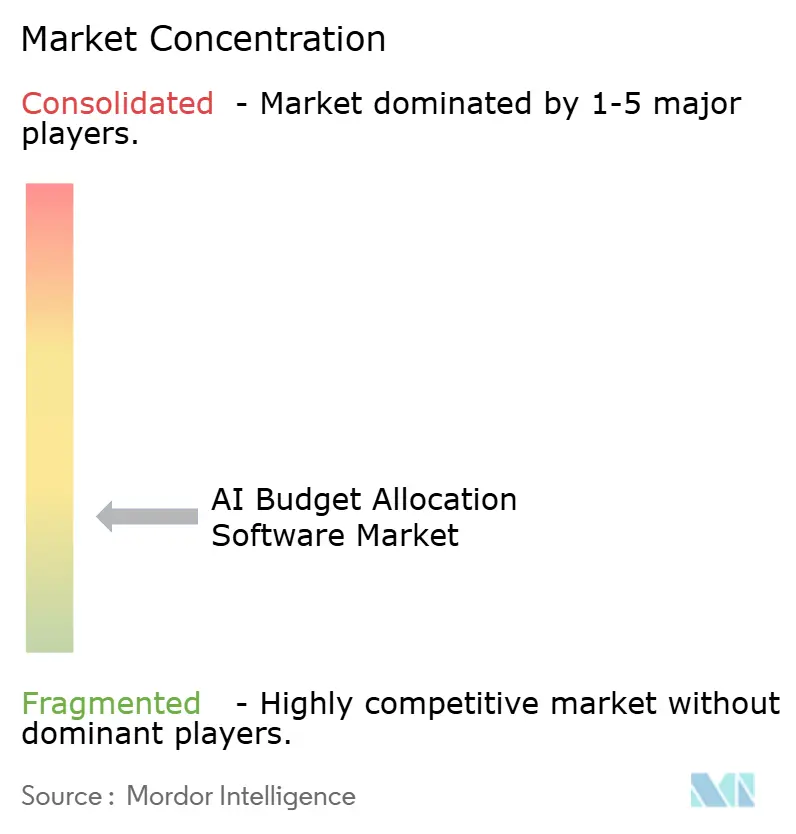
The AI budget allocation software market is fragmented across cloud planning specialists and larger enterprise software vendors. OneStream, Anaplan, Pigment, Planful, Prophix, and Vena Solutions compete alongside planning functions offered by SAP, Oracle, and Workday. No supplier holds a majority position across all customer types, deployment preferences, and applications. OneStream reported USD 601.934 million in revenue in FY2025 and more than doubled its AI bookings during the year. Pigment reported in March 2026 that it was approaching USD 100 million in annual recurring revenue, having doubled the metric for a third consecutive year. Smaller companies, including Datarails, Mosaic, Jirav, Abacum, and Drivetrain AI, serve more specific company sizes and finance team requirements.
Agent-based planning features are a major area of product investment in the AI budget allocation software market. Anaplan has set out its Agentic Enterprise direction, while OneStream offers SensibleAI agents and a Model Context Protocol layer for governed interactions with financial data. Planful introduced Planner Assistant in April 2026 to create forward-looking forecasts from natural-language prompts. Prophix released a second group of AI agents in April 2026 for activities including consolidation, audit trail analysis, and multi-entity reporting.[4] These developments place more weight on systems that can document data sources and retain appropriate controls. A provider that offers automated recommendations without clear reasoning may face resistance from finance leaders with governance responsibilities.
The competitive position of specialist vendors is also influenced by enterprise-suite providers that embed AI planning capabilities in broader cloud products. SAP, Oracle, and Workday can use their existing ERP and HR relationships to offer planning tools alongside systems already used by finance teams across each business unit. Specialists need to show that their planning depth, modeling flexibility, and user experience justify an additional platform decision. Vena agreed in July 2026 to acquire Morpheo AI after acquiring Acterys earlier in the year, underscoring its value in additional capabilities and distribution. OneStream’s planned acquisition by Hg, with General Atlantic and Tidemark as co-investors, also reflects interest in scale and product breadth. The AI budget allocation software market remains open to companies that can address enterprise complexity while making advanced planning practical for mid-sized finance teams across each business unit.
AI Budget Allocation Software Industry Leaders
-
Anaplan, Inc.
-
OneStream, Inc.
-
Planful, Inc.
-
Prophix Software Inc.
-
Board International S.A.
- *Disclaimer: Major Players sorted in no particular order
AI Budget Allocation Software Market Companies Covered in this Report
- Anaplan, Inc.
- OneStream, Inc.
- Planful, Inc.
- Prophix Software Inc.
- Board International S.A.
- Jedox GmbH
- Vena Solutions Inc.
- Pigment SAS
- Cube Software Inc.
- Datarails Ltd.
- Mosaic Group, Inc.
- Jirav, Inc.
- Abacum, Inc.
- Drivetrain AI, Inc.
- Centage Corporation
- Solver, Inc.
- LucaNet AG
- Acterys GmbH
- Aleph Group, Inc.
- Runway Financial, Inc.
- OptiMine Software, Inc.
- Aryma AI, Inc.
- HighRadius Corporation
Recent Industry Developments in AI Budget Allocation Software Market
- July 2026: Vena Solutions entered into an agreement to acquire Morpheo AI to deepen agentic AI capabilities within its FP&A platform. The deal was Vena's second acquisition of 2026, following its earlier acquisition of Acterys, as the company approached USD 200 million in ARR and expanded its platform beyond financial planning into operational and agentic workflow territory.
- May 2026: OneStream announced a significant expansion of its strategic partnership with Microsoft, committing to joint investment over 3 years to scale AI infrastructure for the Office of the CFO. The partnership combines SensibleAI with Microsoft Foundry and Azure, enabling finance teams to access AI-driven forecasting and scenario planning directly within Microsoft 365 Copilot and Teams.
- April 2026: Prophix released the second wave of AI agents on its Prophix One platform, including Copilot for Microsoft Teams and an Architect Agent, extending automation to financial consolidation, audit trail analysis, and multi-entity reporting. Prophix described the release as defining a Delegation Era for finance functions.
- April 2026: Planful launched Planner Assistant, enabling finance teams to generate forward-looking financial forecasts through natural language prompts, powered by the Planful Predict engine. The product pairs with Analyst Assistant, released in October 2025, creating a continuous planning loop across historical analysis and forward projection.
Global AI Budget Allocation Software Market Report Scope
The AI Budget Allocation Software Market represents the annual revenue generated from software platforms and associated services that use artificial intelligence, machine learning, predictive analytics, optimization algorithms, and related AI capabilities to support the planning, allocation, optimization, monitoring, and reallocation of organizational financial budgets and expenditures.
The AI Budget Allocation Software Market Report is Segmented by Offering (Software, Services), Deployment (Cloud-Based, On-Premises, and Hybrid), Organization Size (Large Enterprises, Small and Medium Enterprises), Application (Budgeting and Forecasting, Scenario Planning and What-If Analysis, Financial Reporting and Variance Analysis, Cash Flow and Working-Capital Planning, Cost Allocation and Chargeback, Marketing-Mix and Media Budget Optimization, Capital Allocation and Portfolio Planning, and End-User Industry (BFSI, IT and Telecommunications, Retail and E-Commerce, Healthcare and Life Sciences, Manufacturing, Energy and Utilities, Other End-User Industries), and Geography (North America, South America, Europe, Asia-Pacific, Middle East and Africa). The Market Forecasts are Provided in Terms of Value (USD).
Segmentation Overview
| Software |
| Services |
| Cloud-Based |
| On-Premises |
| Hybrid |
| Large Enterprises |
| Small and Medium-Sized Enterprises |
| Budgeting and Forecasting |
| Scenario Planning and What-If Analysis |
| Financial Reporting and Variance Analysis |
| Cash Flow and Working-Capital Planning |
| Cost Allocation and Chargeback |
| Marketing-Mix and Media Budget Optimization |
| Capital Allocation and Portfolio Planning |
| BFSI |
| IT and Telecommunications |
| Retail and E-Commerce |
| Healthcare and Life Sciences |
| Manufacturing |
| Energy and Utilities |
| Other End-User Industries |
| North America | United States |
| Canada | |
| Mexico | |
| South America | Brazil |
| Argentina | |
| Rest of South America | |
| Europe | Germany |
| United Kingdom | |
| France | |
| Italy | |
| Spain | |
| Russia | |
| Rest of Europe | |
| Asia-Pacific | China |
| India | |
| Japan | |
| South Korea | |
| Australia | |
| Singapore | |
| Rest of Asia-Pacific | |
| Middle East | United Arab Emirates |
| Saudi Arabia | |
| Israel | |
| Turkey | |
| Rest of Middle East | |
| Africa | South Africa |
| Nigeria | |
| Egypt | |
| Kenya | |
| Rest of Africa |
| By Offering | Software | |
| Services | ||
| By Deployment | Cloud-Based | |
| On-Premises | ||
| Hybrid | ||
| By Organization Size | Large Enterprises | |
| Small and Medium-Sized Enterprises | ||
| By Application | Budgeting and Forecasting | |
| Scenario Planning and What-If Analysis | ||
| Financial Reporting and Variance Analysis | ||
| Cash Flow and Working-Capital Planning | ||
| Cost Allocation and Chargeback | ||
| Marketing-Mix and Media Budget Optimization | ||
| Capital Allocation and Portfolio Planning | ||
| By End-User Industry | BFSI | |
| IT and Telecommunications | ||
| Retail and E-Commerce | ||
| Healthcare and Life Sciences | ||
| Manufacturing | ||
| Energy and Utilities | ||
| Other End-User Industries | ||
| By Geography | North America | United States |
| Canada | ||
| Mexico | ||
| South America | Brazil | |
| Argentina | ||
| Rest of South America | ||
| Europe | Germany | |
| United Kingdom | ||
| France | ||
| Italy | ||
| Spain | ||
| Russia | ||
| Rest of Europe | ||
| Asia-Pacific | China | |
| India | ||
| Japan | ||
| South Korea | ||
| Australia | ||
| Singapore | ||
| Rest of Asia-Pacific | ||
| Middle East | United Arab Emirates | |
| Saudi Arabia | ||
| Israel | ||
| Turkey | ||
| Rest of Middle East | ||
| Africa | South Africa | |
| Nigeria | ||
| Egypt | ||
| Kenya | ||
| Rest of Africa | ||
Key Questions Answered in the Report
What is the size of the AI budget allocation software market?
The AI budget allocation software market size is USD 2.07 billion in 2026 and is projected to reach USD 7.44 billion by 2031 at a 29.07% CAGR. The forecast reflects greater use of connected planning, continuous forecasting, and tools that assign spending as business conditions and operating data change. It also reflects the need to bring recurring forecast revisions, spending approvals, and data from several finance systems into one controlled planning process.
What is driving demand for AI budget allocation software?
Demand is supported by continuous forecasting, real-time allocation of AI and cloud costs, and the replacement of disconnected spreadsheet planning processes. Finance teams also need stronger controls over assumptions, approvals, and the data used for decisions that affect operating budgets and capital priorities.
Which deployment model is most widely used for AI budget allocation software?
Cloud-based deployment held 71.87% of revenue in 2025 because it supports shared access, connected planning data, and regular product updates. Hybrid deployment is also becoming more relevant for organizations that want cloud planning capabilities while retaining control of sensitive source data in a managed environment. This option can suit regulated financial institutions, energy companies, and multinational organizations that need shared planning models but cannot move all underlying financial information to a fully external setting.
Which end-user sector leads adoption of AI budget allocation software?
BFSI held 27.84% of revenue in 2025, supported by capital planning, treasury, reporting, governance, and audit requirements. These requirements make the sector an important source of demand for platforms that can document recommendations and support detailed, multi-entity planning workflows. Product requirements developed for banks and insurers can also influence broader enterprise demand for strong access controls, traceable data, scenario modeling, and reviewable decision records.
Which application is expanding fastest in AI budget allocation software?
Marketing-mix and media budget optimization is projected to expand at a 30.18% CAGR through 2031 as companies move toward continuous campaign allocation. The use case becomes more valuable when marketing decisions are connected to finance approval processes, cash-flow constraints, and company-wide planning assumptions. It can also help companies compare planned activity with results more often, rather than relying on a fixed allocation that is reviewed only after a campaign cycle has ended. This allows marketing teams to respond to performance changes while finance retains visibility over the basis for budget changes and the expected use of available funds.
Which region is projected to expand fastest through 2031?
Asia-Pacific is projected to expand at a 30.12% CAGR, supported by finance digitalization, cloud adoption, and growing use of AI in planning functions. Demand varies across the region because organizations must address different local data requirements, finance systems, and levels of planning process maturity. India, China, Japan, and Southeast Asian markets each offer different conditions for vendors that can adapt deployment, integration, and governance practices to local enterprise requirements.